B2B tech content marketing is publishing accurate, useful content that helps engineers and IT buyers understand a problem and choose a product to solve it. A strong program ties each piece to a pipeline goal and has a subject expert check every technical claim before it goes live.
In 2026, more of that research starts in AI assistants, so your pages need clear answers that ChatGPT and Google can quote. In G2's 2025 survey of 1,169 B2B decision makers, 29% said they now start research in AI tools like ChatGPT more often than on Google.
By the end of this guide you will be able to plan the whole program, from the formats engineers trust and a 9-step strategy to distribution, measurement and AI search. Along the way we explain how tech content differs from B2C content and look at real examples, along with the mistakes that cost teams a quarter.
- Tech buyers check claims, so every piece needs proof an engineer can test, such as working code, original data or a fair comparison.
- Tie every piece to one pipeline goal and a metric your sales team already trusts.
- Take topics from sales calls, support tickets and practitioner communities, in the exact words buyers use.
- Interview experts for 30 minutes and let a writer draft, so each expert reviews the piece only once.
- Write answers AI assistants can quote, and count a mention in ChatGPT or Perplexity the way you count a ranking.
- Judge the program on pipeline and treat rankings and AI answer mentions as early signals.
What is B2B tech content marketing?
B2B tech content marketing teaches technical buyers something useful and then shows where your product fits into their work. The reader is usually an engineer, an IT lead or a security reviewer, and the product is software, cloud infrastructure or a developer tool.
It covers anything a buyer reads or watches before talking to sales, which includes tutorials, research reports, case studies, comparison pages, webinars, newsletters and expert posts on LinkedIn. What these pieces share is that a technical reader can check them, and when an engineer cannot test a claim, they read it as an ad.
Who reads tech content
Most tech deals have more than one reader, and each of them comes to your content with a different question. The practitioner wants to know if the tool works, while the technical lead asks whether it fits the stack. The budget owner wants payback, and the security reviewer wants to know where data is stored.
"Does the tool work?"
"Does it fit our stack?"
"When does it pay back?"
"Where is our data stored?"
Buying groups in software are getting smaller, and in G2's 2025 data, groups of 3 to 4 people are becoming more common while committees of 5 to 8 shrink. With fewer people in the room, each piece has to answer one role's question well, which is why step 2 below shows how to map each role to content.
How it relates to docs, developer relations and product marketing
Product docs explain how to use what you sell, while developer relations (DevRel) builds trust through talks, sample apps and community work. Product marketing sets the positioning and writes the launch message when something new ships.
Content marketing draws on all of them, because it takes accuracy from the docs, voice from DevRel and the core message from product marketing, then publishes where buyers search and read. In practice the teams share one backlog, so a support question becomes a tutorial, the tutorial links to a doc page and the next launch post points to both.
Why B2B tech content marketing matters
Tech buyers do much of their research before they speak with anyone on your team. In G2's 2025 data, nearly two in three buyers preferred to meet salespeople only in later stages, so content does the early selling.
These buyers also judge content the way they judge a product, by testing whether it holds up. In Stack Overflow's 2025 Developer Survey, 67.8% of developers used technical documentation to learn in the past year, more than any other resource.
Tech purchases pull in several roles, and IT took part in nearly 50% of software purchase decisions in G2's 2025 data. Each role needs its own proof, from a trial guide for the engineer to a security page for the reviewer.
Trust comes from content that helps buyers with their work. In CMI's research on 2027 plans, published in November 2026, the 861 B2B marketers surveyed put useful practical information (64%) and demonstrated industry expertise (59%) at the top of the ways content builds trust. A tech company already has both in its engineers' heads, so most of the work is getting that knowledge onto the page.
67.8% of developers learned from technical documentation in the past year, more than from any other resource.
B2B marketers rank useful practical information (64%) first among the ways content builds trust.
Source: Content Marketing Institute, November 2026 (861 B2B marketers)
PostHog is a product analytics software company that sells tools engineering teams use to understand and improve their products. Its newsletter, build mode, has more than 80,000 subscribers from companies like Vercel, Hugging Face and GitLab.
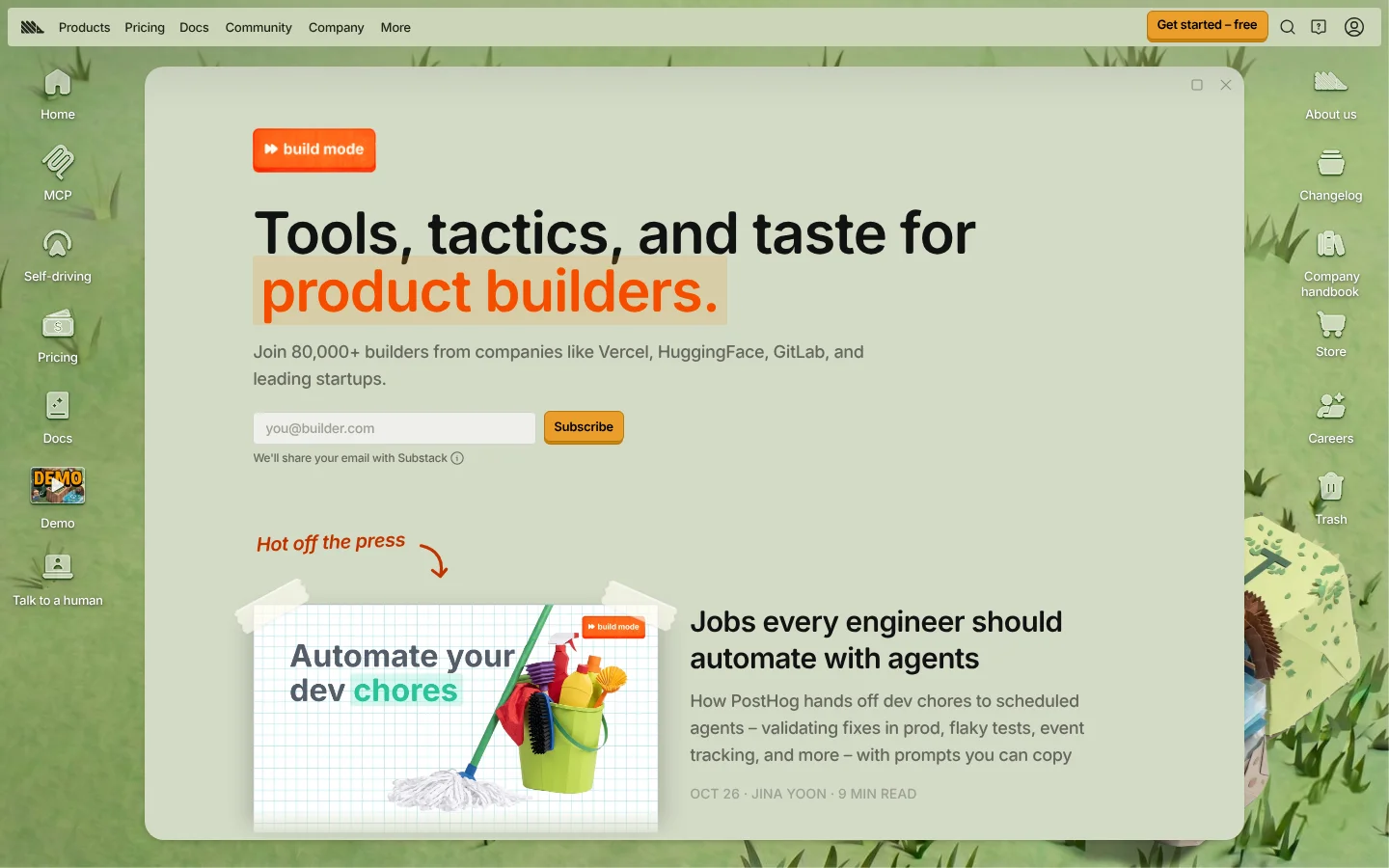
The newsletter was called Product for Engineers until PostHog renamed it in July 2026 to cover everyone who builds products, from engineers to founders. Because each issue helps readers with their jobs, PostHog can reach that audience again with each issue without paying for ads. Content of this kind also compounds, since a tutorial that ranks in March still brings readers in December, while an ad stops the day the budget does.
How B2B tech content differs from B2C and general B2B content
B2C content usually sells to one person making a fast, personal choice, while general B2B content sells to a team building a business case around return on investment and risk. Tech content goes a step further, because its readers will test the product, connect it to their systems and live with it for years.
| B2C content | B2B tech content | |
|---|---|---|
| Main reader | One consumer | Engineers, IT and security, plus a budget owner |
| How they decide | Feeling, price and convenience | Fit with the stack, proof and risk |
| Proof they trust | Reviews and creators | Working code, benchmarks, docs and peer threads |
| Typical length | Short | As long as the task needs, with code and screenshots |
| What breaks trust | A dull message | One wrong step, hidden pricing or no security page |
Accuracy comes first, since a tutorial with a broken command loses the reader at that line, however good the rest of the writing is. The tone is peer to peer, and engineers respond best to a writer who sounds like a colleague who has done the work and states the trade-offs plainly.
Decisions also pass more checks than they used to. In G2's 2025 survey, about 8 in 10 buyers faced stricter review rules for AI software from IT security, legal and compliance teams. Your content has to give each of those reviewers what they need without a call, and our guide to B2B vs B2C content marketing covers the wider differences between the two markets.
Types of B2B tech content
Tech buyers use many formats, and each one has a clear job. In the CMI and MarketingProfs 2025 benchmark of 980 B2B marketers, 53% named case studies and 45% named research reports among their best-performing formats.
Technical guides and tutorials
A tutorial solves one how-to task with working steps, code samples and screenshots. It brings in practitioners early in the buying process and shows the product at the moment it saves them time, which is why an engineer should run every step before you publish.
Documentation and API references
Docs count as content too, since developers named documentation as their top learning resource in the Stack Overflow survey above. Give each docs page a clear title and a short answer at the top, then link to the tutorials that use it.
Original research and benchmark reports
Research gives analysts and AI assistants a fact to cite with your name on it. Use product data you can share in anonymized form or survey practitioners, then publish the method in plain words, the way Datadog does in the State of DevSecOps report covered in step 5.
Engineering case studies
A case study for tech buyers shows the customer's setup before and after the change, the numbers that moved and the engineer who did the work. Pick customers whose stack your prospects will recognize, because a reader trusts a result from a team that looks like their own.
Comparison and alternatives pages
These pages answer the question every evaluator asks, which is how your product compares with the tool they already know. Use one fair template for every competitor, and add a page on building the tool in-house if that option comes up in your deals.
Integration and use-case pages
An integration page shows how your product works with a tool the buyer already runs, such as Okta or GitHub, while a use-case page walks through one job from start to finish. Both match searches from buyers who are close to a decision.
White papers and architecture guides
Longer pieces on how a system is designed suit technical leads who must defend a choice inside their company. Publish a web version next to the PDF, since a form in front of a document stops many engineers before page one.
Webinars, live demos and video
Video topped the CMI 2025 list, with 58% of marketers naming it among their best formats, and live sessions also let buyers ask an engineer questions in real time. Afterward, cut each recording into short clips, a written recap and new answers for your FAQ pages.
Newsletters
A newsletter keeps you in front of buyers between visits to your site. PostHog's build mode shows how far a newsletter can go when it is written for one clear reader and sent on a steady schedule.
Podcasts
A podcast suits a team with an expert who enjoys talking more than writing. Each episode can become a blog post, a few LinkedIn clips and quotes your sales team can share.
Interactive tools, templates and sample code
Calculators, config generators, templates and sample apps let the reader get value before signing up. Engineers bookmark and share the tools they use, which brings you links and repeat visits.
Expert posts on LinkedIn
Posts from your engineers and founders reach buyers who may never visit your blog. Judge them by who reads them, meaning your ICP, more than by the count of likes. Our guide to LinkedIn ghostwriting for SaaS founders shows how to run posts on a schedule without taking hours from the expert.
The table below sums up where each format does its best work and which metric shows whether it is doing that job. Step 4 explains how to turn it into a plan for your own buying stages.
| Format | Best stage | Main metric |
|---|---|---|
| Tutorials and guides | Learn | Rankings, engaged visits and trial starts |
| Docs and API references | Learn and adopt | Activation and feature use |
| Original research | Learn | Links, press mentions and AI answer mentions |
| Integration and use-case pages | Evaluate | Demo requests from the page |
| White papers and architecture guides | Evaluate | Reads from target accounts |
| Webinars and video | Evaluate | Registrations from target accounts |
| Comparison pages | Decide | Demo requests and trials |
| Engineering case studies | Decide | How often reps send them in open deals |
| Newsletter | Between visits | Subscribers from target accounts and replies |
| Expert LinkedIn posts | Every stage | Reach among your ICP and replies |
How to build a B2B tech content marketing strategy in 9 steps
Work through the steps in order the first time, then repeat steps 3 to 9 each quarter as your question bank grows. The first two steps set the goals and the readers, which gives every later step something to aim at.
- Set pipeline goals
One or two goals a quarter, each with a sales metric
- Map the buying group
Practitioner, technical lead, budget owner and security reviewer
- Research with sales and support
Calls, tickets and communities in one question bank
- Match formats to stages
Guides to learn, webinars to evaluate, comparisons to decide
- Publish proof
Original research, case studies and fair comparisons
- Interview experts
A 30-minute call and one technical review
- Run a fixed workflow
An owner and a time limit for every stage
- Distribute
Search, LinkedIn, email, communities and sales
- Measure pipeline
Signals, conversions and revenue, then refresh
1. Set content goals tied to pipeline
A B2B tech content strategy starts with the business goal the content must support, then works back to readers, topics and formats. We recommend one or two goals per quarter, each with a metric your sales team already trusts.
- Win more evaluations: Publish comparison and alternatives pages, then track the demo requests and trials they start. Begin with the competitors that appear most often in your CRM.
- Create demand in a new category: Publish original research and expert essays, then track links, AI answer mentions and branded searches.
- Shorten sales cycles: Write case studies and objection guides, then track how often reps send them in open deals.
- Grow product adoption: Publish technical guides and tutorials, then track activation and feature use in new accounts.
- Write the plan on one page: List goals, roles, formats, channels and owners in one shared document, and send it to sales and product so they know what is coming and can feed ideas into it.
If you are choosing where to begin, pick the goal where one piece can show a result inside a quarter, such as a comparison page for a rival that sales meets every week. An early win like that makes it easier to get time from engineers for the harder pieces later.
2. Map the roles in your buying group
Most tech deals involve four roles: a practitioner who tests the product, a technical lead who picks the architecture, a budget owner and a security reviewer. Each one reads different content at a different point in the deal, so list what each role needs before you plan a single piece.
- List each role's questions: Write down what each role must know before saying yes. A platform engineer asks how the product fits the current stack, while a security reviewer asks where data is stored.
- Show correct technical detail: Use working code, real configuration steps and current version numbers, and ask an engineer to run every step before you publish.
- State the trade-offs: Say when another approach or tool fits a case better, since a short "when to choose something else" section answers a question every evaluator asks anyway.
- Answer security and pricing early: Developers rank security or privacy concerns and prohibitive pricing as their top two reasons to reject a technology, so link to both pages from every product piece.
- Match proof to the reader: Show customers with a similar stack, team size or use case, because a team that runs Kubernetes looks for a customer story from another Kubernetes team.
Content is one part of a tech company's wider marketing plan, alongside positioning, paid channels and sales alignment. Our guide to B2B marketing for tech companies covers how those parts fit together.
3. Research topics with sales and support
Your best topic ideas come from the people who talk to buyers and customers every day. Sales hears the objections and competitor names, while support sees the setup problems and edge cases that tutorials should cover.
- Audit what you already have: List every page and sales deck you own, with its traffic and the deals it touched. Refresh the pieces that still answer a buyer question, merge overlaps and retire the rest before you write anything new.
- Interview sales: Ask which objections come up in most deals and which competitors appear late in the cycle, then ask which pieces reps send after calls and what they wish they had instead.
- Review call recordings: Listen to recent first demos and trial kickoffs and note every question a technical evaluator asks, since the questions that repeat across deals become your first briefs.
- Read support tickets: Sort the last quarter's tickets by topic and find the questions that come back every week, because each one is a tutorial or FAQ answer your buyers already need. Ask support which workarounds customers share with each other too, since a workaround that spreads through your community points to a case a tutorial or doc page should cover.
- Read practitioner communities: Follow the subreddits, Slack and Discord groups, GitHub issues and Stack Overflow threads where your buyers help each other. Note their exact words, since those words make strong headlines and search keywords.
- Keep one question bank: Collect every question in one place, tagged by role, buying stage and source. A shared spreadsheet is enough to start, and it becomes the backlog for your calendar.

4. Match formats to each buying stage
Tech buyers reach for different formats at different stages, so plan a mix and give each format one clear job. Use the format table above as a starting point, then adjust it to what your sales team sees in deals.
Solve a how-to question with working steps, code samples and screenshots, then show where your product saves time once the reader has solved the task.
Buyers ask an engineer questions in real time, and each recording becomes clips, a written recap and new answers for your FAQ pages.
A reviewer can check each one without booking a call.
Zapier is an automation software company that connects business apps so teams can move data between them without code. Its guide on pulling data from another sheet in Excel solves the task with formulas first, and a closing section then shows how to automate the same work with Zapier.

Use the same order in your own tutorials, with the answer first and the product second, so the reader trusts the guide before they see the pitch. Our guide to the B2B content marketing funnel goes deeper on planning pieces for each stage.
5. Publish proof engineers can check
Engineers look for proof they can test, such as benchmarks or real customer setups. Original research, case studies and comparison pages supply that proof, and they give analysts and AI answers a reason to cite you.
Datadog is a monitoring and security software company that helps engineers watch their cloud apps. Its 2026 State of DevSecOps report studied tens of thousands of apps and found that 87% of organizations run at least one service with a known, exploitable vulnerability.
- Run original research: Survey practitioners or publish anonymized patterns from your product data, and explain the sample and method in plain words so others can trust and cite the findings.
- Package each finding: Give every finding a headline, a chart and a short explanation, which makes it easy to quote in an article, a sales deck or an AI answer.
- Write engineering case studies: Show the customer's stack before and after the change, with the problem and the result both stated in numbers. Quote the engineer who did the work and the executive who signed off.
- Build fair comparison pages: Use one template for every competitor buyers name in deals, and back each claim with a link or a test. Update the page whenever either product changes.
- Cover the build option: Add a page on building the tool in-house when engineers in your deals talk about that route.
Tailscale is a networking software company that builds a secure mesh network on the WireGuard protocol. Its compare hub links to 17 comparison pages, including OpenVPN, Zscaler, AWS Client VPN and a page on building your own network.
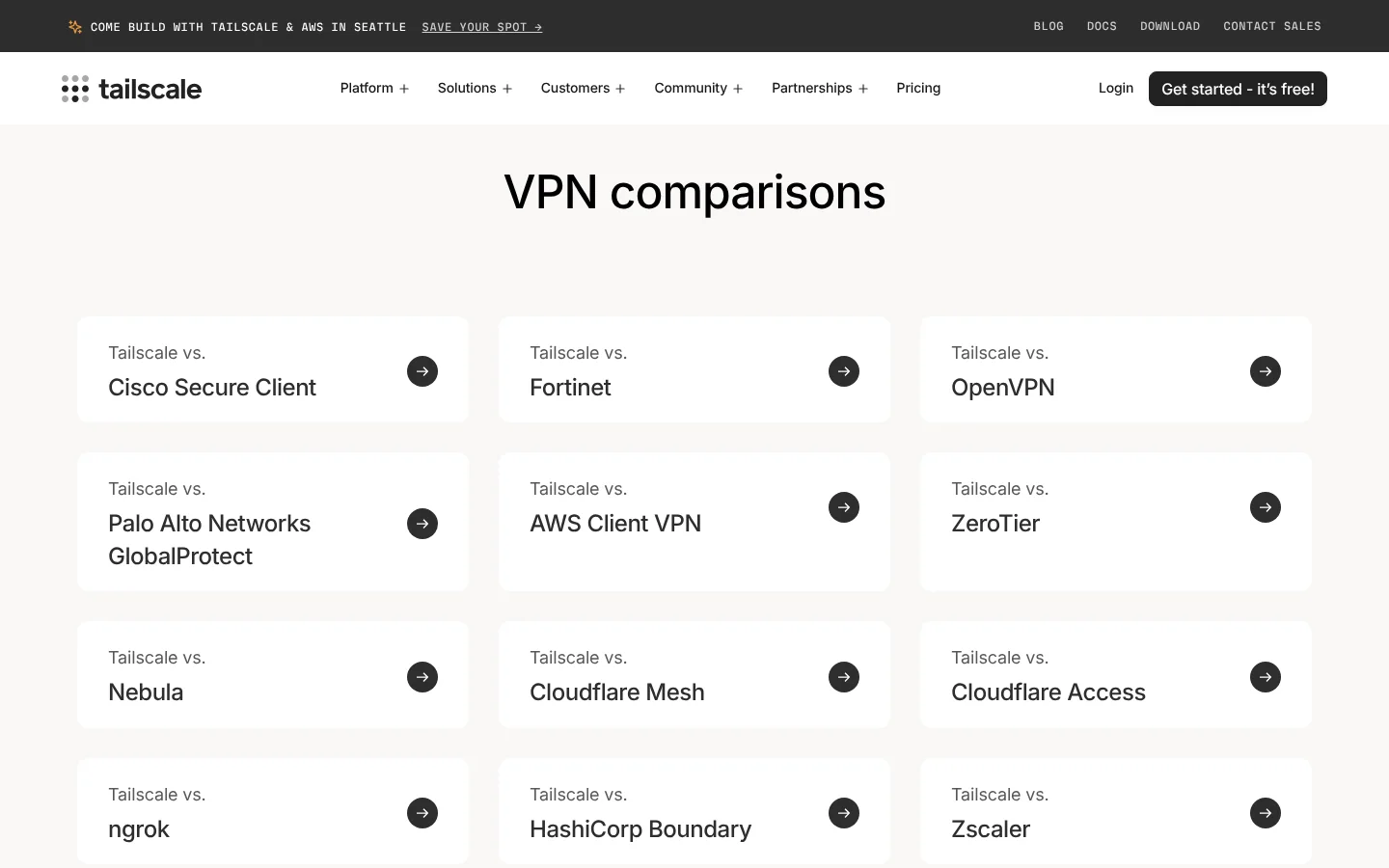
The pages share one structure, and the OpenVPN comparison opens with a feature matrix, then covers architecture, security, authentication, setup and pricing. Our guide to BOFU content shows how to plan pages like these alongside pricing and integration pages.
6. Interview engineers and subject experts
Subject experts make tech content accurate, but engineers and product leads rarely have hours to spare for writing. Interviews solve that, because a writer can turn a 30-minute call into a draft the expert only needs to check.
"What would you tell a new hire about this?"
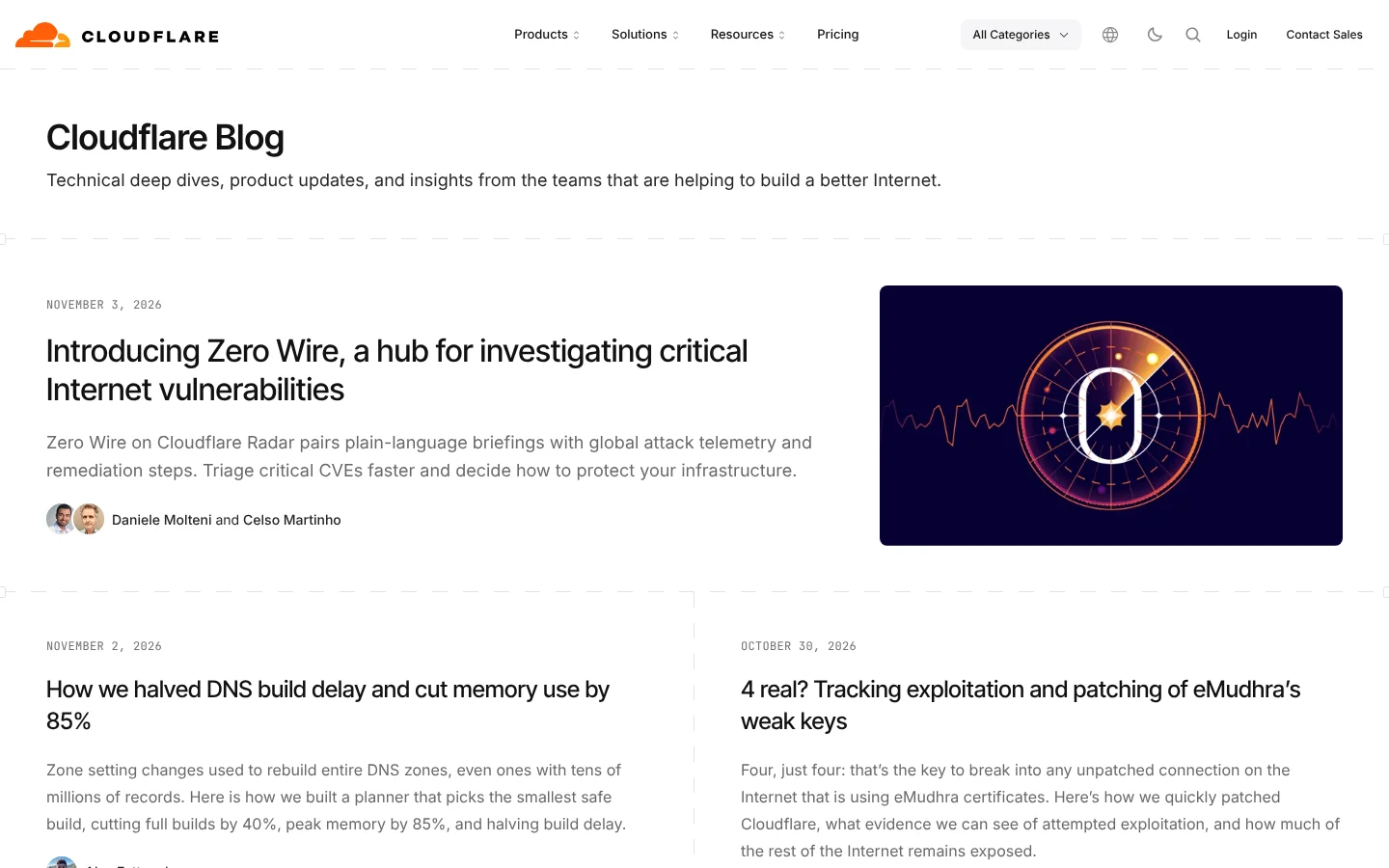
Cloudflare is a connectivity cloud company that runs a global network for security, performance and developer services. Its blog publishes detailed technical posts from the teams that build each product. In a November 2026 post, for example, its engineers show how they halved DNS build delay and cut peak memory use by 85%.
- Send a one-page brief: Include the topic, the reader, your questions and the angle you want to test, and send it a few days before the call so the expert can gather examples.
- Record a 30-minute interview: Ask for real examples, numbers, common mistakes and strong opinions, and use questions like the one above to bring out plain explanations.
- Draft from the transcript: Keep the expert's own phrases wherever they explain an idea well, and mark any claim you need them to confirm.
- Ask for one technical review: Set a firm deadline, such as two working days, and collect comments in the document itself.
- Credit the expert: Publish under their name or as a co-author, and ask them to share it with their network. Show them the leads, replies and speaking invites their earlier pieces brought in.
Regulated fields add a compliance review to this flow, so plan extra time for it in the calendar. We cover that review in our guide to B2B healthcare content marketing.
7. Build a production process and calendar
A fixed production process keeps quality steady as your team publishes more each month. Give each stage an owner and a time limit, so drafts never sit in someone's inbox for weeks.
- 1 dayBriefStrategist
- 30 minutesExpert interviewWriter and expert
- 3 daysDraftWriter
- 2 daysTechnical reviewExpert
- 1 dayEdit and SEOEditor
- 1 dayDesign and publishDesigner and web team
- First 2 weeksDistributeMarketing, experts and sales
- Every 6 to 12 monthsRefreshEditor
Plan the calendar by quarter and give each month a fixed rhythm, so experts know when you will need them. The starting mix below suits a small team with one writer and one editor.
Each month, publish 2 to 4 search and comparison pieces picked from the question bank to match your goal for the quarter. Add one case study a month, drafted from an interview with the customer's engineer who ran the project. Run one webinar or live demo each quarter and cut short clips from it for LinkedIn, then publish one original research report every 6 months, timed with an industry event your buyers attend.
Send a newsletter every 2 weeks, and refresh older pages that are losing traffic each month. Log each piece in the calendar with its goal, role, stage, expert, owner, due date and distribution plan. Keeping all of that in one record makes monthly reporting much simpler, since the goal and the stage sit right next to the results.
8. Distribute where tech buyers spend time
Distribution decides whether a strong piece reaches buyers, so plan it before you write. In CMI's 2026 trends report, B2B marketers said LinkedIn (76%), email newsletters (54%) and speaking events or webinars (52%) gave their thought leadership the best results.
Start with search and AI answers by covering the questions in your bank, so the pages rank in Google and show up when buyers ask an assistant. Our B2B tech SEO guide covers the technical setup. On LinkedIn, post from your experts' personal profiles as well as the company page, with one chart or code sample per post.
In communities, reply with a full answer first and link only when the link adds detail, following each group's rules on promotion. Give sales reps a short library of pieces mapped to objections and buying stages, with a note on when each one helps. Review that library each quarter and retire pieces that no longer match the product.
Each channel needs its own version of the piece and its own measure of success, as the rows below show. Send each new piece to your newsletter list with a two-line summary of what the reader will learn.
- Google and AI answersShareGuides, comparison pages and integration pagesTrackRankings, AI answer mentions and demo requests
- LinkedInShareExpert posts with one chart or code sampleTrackReach among your ICP and replies
- NewsletterShareEach new piece with a two-line summaryTrackSubscribers, clicks and replies
- Communities such as Reddit, Slack and GitHubShareFull answers, with a link only when it helpsTrackReferral visits and sign-ups
- Events and webinarsShareTalks built on your researchTrackRegistrations and meetings booked
- Sales libraryShareCase studies, comparison pages and security pagesTrackHow often reps send each piece
- Paid promotionShareYour best-performing pieces onlyTrackCost per engaged visit from target accounts
Plan the cutdowns before you publish a major piece, because one research report can become a LinkedIn chart, a newsletter summary, a webinar topic and a one-page sales handout with small edits. For more options, see our list of distribution channels for B2B content.
9. Measure pipeline and refresh what works
Judge content on the pipeline it creates and treat traffic as an early signal along the way. Measuring content effectiveness was a top challenge for 33% of B2B marketers in the same CMI report, so agree on definitions with sales before you report.
Is the right audience finding it?
- Rankings for target topics
- Mentions in AI answers
- Engaged visits from target accounts
- Newsletter growth
Does it start conversations?
- Demo requests that start on a content page
- Trial signups
- Webinar registrations
Does it help close deals?
- Pipeline touched by content
- Closed deals touched by content
- "How did you hear about us?" answers
- How often reps send each piece
Ask buyers directly as well, by adding a "How did you hear about us?" field to your demo form. It catches sources that analytics tools miss, such as a forwarded newsletter. Review the numbers monthly with sales, then refresh, expand or retire pieces each quarter.
GA4 only records the visit that comes after the buyer has already made up their mind, so it misses most of what your content did earlier in the deal. The demo form field, CRM touch data and a monthly check of AI answers fill in the rest, and our guide to AI search attribution shows how to connect them.
Our SEO and GEO program case study shows this reporting in practice for a B2B SaaS company, with Salesforce as the source of truth. The program generated about $500K in pipeline in 6 months, and ranked keywords grew from about 300 to 2,000.
How AI search changes B2B tech content
AI answers now sit between many buyers and your website. In Pew Research Center's July 2025 study of 900 U.S. adults, Google users clicked a standard result in 8% of visits when an AI summary appeared, against 15% when it did not. Links inside the summary itself got a click in 1% of visits.
1% of visits with a summary ended in a click on a link inside it.
B2B teams see the same drop in their own numbers. In CMI's research on 2027 plans, 31% of B2B marketers said website traffic fell over the past 12 months, and 79% of that group blamed AI-powered search. Being named in the answer now counts as a ranking, since a buyer who never clicks still sees which vendors the assistant names.
Tech buyers ask assistants the same questions they used to type into Google, only longer and with more detail about their setup. A typical prompt asks which tool fits a team of 40 engineers on Postgres, or how two vendors compare on SSO. The content that gets quoted answers those questions directly and says the same thing on every site that mentions you.
- Answer first: Put a one or two sentence answer under each heading and the detail after it, because assistants lift short, direct answers.
- Name things exactly: Use exact product names and version numbers, since "Supports SAML SSO with Okta and Microsoft Entra ID" is easier to quote than "enterprise-grade security".
- Publish facts only you have: Original data and benchmarks give an assistant a reason to cite you by name.
- Keep facts the same everywhere: Pricing and plan limits should match across your site, your docs, review sites and partner pages.
- Earn mentions off your site: Reddit threads, review sites and industry guides shape AI answers too, so answer questions in communities as a named expert.
- Track prompts: Run a fixed set of buyer prompts in ChatGPT, Perplexity, Gemini and Google AI Overviews each month, and log which brands get named.
Katalon, a test automation platform and a Perceptric client, grew ARR 4x, with more than 80% of that ARR growth coming from SEO, and it is now cited by ChatGPT, Claude and Perplexity. Arrowsterr and Omniscient are Perceptric clients too. Our guides to GEO for B2B SaaS and missing from Google AI Overviews cover the setup in more detail.
Using AI to produce tech content
Most teams already use AI to write, and in the same CMI research, 88% of B2B marketers said their organization uses AI content creation tools. Ensuring accuracy tied for the top AI challenge in that study, at 54%.
Your readers are wary of AI output as well. In Stack Overflow's 2025 survey, 84% of respondents used or planned to use AI tools, and 46% distrusted the accuracy of AI output.
Use AI for transcripts, research summaries, outlines and first drafts, but keep a named expert on every technical claim and run every code sample before you publish. Our AI use policy is one example of how to explain that process to readers.
B2B tech content marketing examples
The companies below publish content their buyers use at work, and five of them already appear in the steps above. The other four, GitLab, Linear, Atlassian and Supabase, each get a short note after the table.
| Company | What it publishes | What to copy |
|---|---|---|
| PostHog | The build mode newsletter | One clear reader and a steady schedule |
| Datadog | State of DevSecOps research | Product data turned into findings others cite |
| Tailscale | A compare hub with 17 pages | One fair template for every competitor |
| Cloudflare | Posts by the engineers who build each product | Real systems with real numbers |
| Zapier | How-to guides that solve the task first | A product section after the problem is solved |
| GitLab | A public company handbook | Showing how you work in the open |
| Linear | The Linear Method | A clear point of view on building software |
| Atlassian | The free Team Playbook | Exercises a team can run in its next meeting |
| Supabase | Launch Week | Product news packaged as an event |
GitLab: a handbook buyers can read
GitLab is a DevSecOps platform company, and because it is all-remote, it takes a handbook-first approach. Anyone can read the handbook, which has sections on engineering, security, marketing and sales, so buyers can see how the company works long before they speak to anyone there. To copy it, publish the internal guides buyers already ask your team for, such as your security process or your release steps.
Linear: a method with a point of view
Linear makes issue tracking and project planning software for product teams. The Linear Method sets out the ideas the product is built on, in 10 principles and practices split between direction and building. An engineer who agrees with those ideas already has a reason to try the tool, because the product is built to work the way the method describes.
Atlassian: plays a team can run
Atlassian makes team software such as Jira and Confluence. Its Team Playbook is a free set of research-backed exercises, called plays, that teams run together to solve a shared problem. Each play is useful on its own, and it leaves room for the product without requiring it.
Supabase: launches as an event
Supabase is a Postgres development platform, and its Launch Week ships one main launch each day for 5 days, with a hackathon and community meetups around it. The new launch post each morning gives developers a reason to come back all week. For more companies to learn from, see our list of B2B content marketing examples.
Common B2B tech content marketing mistakes
Most programs that stall make one of the mistakes below, and each one has a simple fix. The summary gives the short version for five of them, and the sections after it explain all nine.
- Instead ofA page built around a keyword with no new answerDo thisStart from a question in your bank and use the keyword where it fits
- Instead ofWords like "fast" or "secure" with nothing behind themDo thisThe number, test or customer setup that proves the claim
- Instead ofA form in front of every tutorialDo thisOpen learning content, with forms saved for a custom benchmark or a live demo
- Instead ofA monthly report on traffic aloneDo thisConversions and revenue reported next to traffic
- Instead ofStopping the program at month 2Do thisA plan measured in quarters, with paid campaigns alongside if you need leads this month
Writing for keywords alone
A page built around a keyword with no new answer may rank for a while, but it then loses to a page that solves the problem. Start from a question in your bank and use the keyword where it fits.
Making claims with no proof
Words like "fast" or "secure" mean little to an engineer without a number, a test or a customer setup behind them. Go through each draft and swap every adjective of that kind for the fact behind it.
Hiding pricing and security details
Security concerns and pricing are the top two reasons developers reject a technology, as step 2 shows. A reviewer who cannot find either page will move on to a vendor who shows both.
Skipping the expert review
Every technical piece needs one review from a named expert before it goes live, because one wrong command or outdated version number costs more trust than a month of good posts earns. Set a deadline for that review so it never holds up the calendar.
Gating every piece
A form in front of a tutorial stops the reader at the moment they wanted to learn. Keep learning content open and save forms for assets worth an exchange, such as a custom benchmark or a live demo.
Publishing with no distribution plan
A strong piece with no plan reaches only the readers who find it by chance. Plan the LinkedIn posts, the newsletter slot and the note to sales before you write, as step 8 describes.
Reporting traffic alone
Traffic from students and job seekers looks good in GA4 and never turns into pipeline. Report conversions and revenue next to traffic, and cut topics that keep bringing in readers outside your ICP.
Letting content go stale
Tech content ages fast, because APIs change, versions move on and screenshots drift away from the product. Review your top pages each quarter and show a last-checked date on tutorials so readers know the steps still work.
Stopping after 2 months
Search and AI visibility build over quarters, so a team that quits at month 2 pays for the slow part and misses the part that compounds. If you need leads this month, run paid campaigns alongside content while it builds.
Who should run your tech content program
A tech content program needs four skills, and they rarely sit in one person. You need a strategist who ties topics to pipeline and a writer who can follow technical detail, plus an editor who owns quality and SEO and the subject experts who supply the facts.
An in-house team is a good fit when you publish a lot on one product and want writers close to engineering. Hiring takes time, and one writer rarely covers strategy and SEO as well.
Freelance writers are a good fit for adding volume to a team that already has a strategy and an editor, although you still manage the briefs and reviews yourself. Our guide to hiring and vetting freelancers covers the process.
An agency is a good fit when you want strategy, writing, SEO and reporting from one team. Pick one that has worked with technical buyers and can show the pipeline its content brought in, and use our list of B2B tech content marketing agencies to compare 15 options.
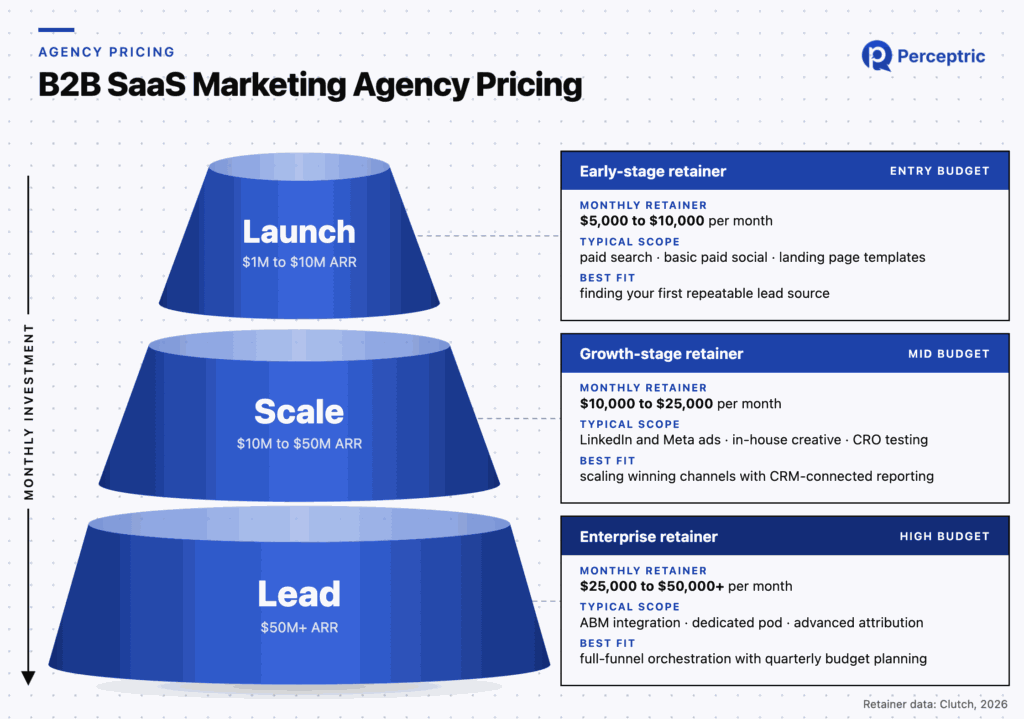
Perceptric is a B2B SaaS SEO/GEO and LinkedIn thought leadership agency. We build an Organic Content Engine for post-PMF B2B SaaS teams, and our monthly programs start at $10,000 a month on a 6-month term, and a 30-day AI visibility sprint costs $6,999. For ScoutQA, an AI testing platform for developers, the work brought 320% traffic growth and 5K+ new users. Early-stage startups fit other options better, and teams that need leads this week should start with paid.
Your B2B tech content marketing checklist
Start with steps 1 to 3 this month, then add the rest as your first pieces go live and the question bank fills up. Each item below links back to the step that explains it.
- Set one or two content goals per quarter, each tied to a pipeline metric. Step 1
- Map the practitioner, technical lead, budget owner and security reviewer in your deals. Step 2
- Audit your current content, then build a question bank from sales calls, support tickets and communities. Step 3
- Match guides, webinars, decision pages and newsletters to buying stages. Step 4
- Publish original research, engineering case studies and fair comparison pages. Step 5
- Interview experts for 30 minutes and ask for one technical review. Step 6
- Run each piece through a fixed workflow and a quarterly calendar. Step 7
- Plan distribution across search, LinkedIn, email, communities and sales. Step 8
- Report leading signals, conversions and revenue, then refresh each quarter. Step 9
A good first step is to pull the last 20 questions technical buyers asked your sales team and check whether your site answers each one. To see where AI assistants already name you, request our free AI visibility audit.
FAQ
What is B2B tech content marketing?
B2B tech content marketing is publishing accurate, useful content that helps engineers, IT leaders and other buyers choose a product. It includes technical guides, original research, case studies, comparison pages, webinars and newsletters.
How is B2B tech content marketing different from B2C content marketing?
B2C content sells to one person making a quick, personal choice. B2B tech content sells to a group of engineers, IT and security reviewers and budget owners who test every claim, so it needs working steps, real numbers and clear pricing and security details.
What content works best for engineers and IT buyers?
Technical guides with working steps, case studies with real numbers, fair comparison pages and original research work well for most tech buyers. Pick the mix by buying stage, with guides early in the process and comparisons near the decision.
How do you get engineers to help with content?
Interview engineers for 30 minutes and have a writer draft the piece, so the expert only reviews it once. Credit them with a byline and share the leads and replies their pieces bring in.
Should you gate technical content?
Keep tutorials and comparison pages open, since a form stops engineers at the moment they want to learn. Save forms for assets worth an exchange, such as a custom benchmark, an assessment or a live demo.
How much content should a B2B tech company publish?
A small team with one writer and one editor can start with 2 to 4 search or comparison pieces and one case study a month. Add a webinar each quarter and a newsletter every 2 weeks. Raise the volume only when expert review can keep up.
How long does B2B tech content marketing take to work?
Plan for 3 to 6 months of steady publishing before early signals like rankings and subscribers show up. Pipeline impact usually takes 6 to 12 months to become clear, since pieces need time to rank and reach deals.
How do you measure B2B tech content marketing?
Measure leading signals like rankings and AI answer mentions, conversions from content pages and the pipeline that content touched. Add a "How did you hear about us?" field to your demo form to catch sources that analytics tools miss.