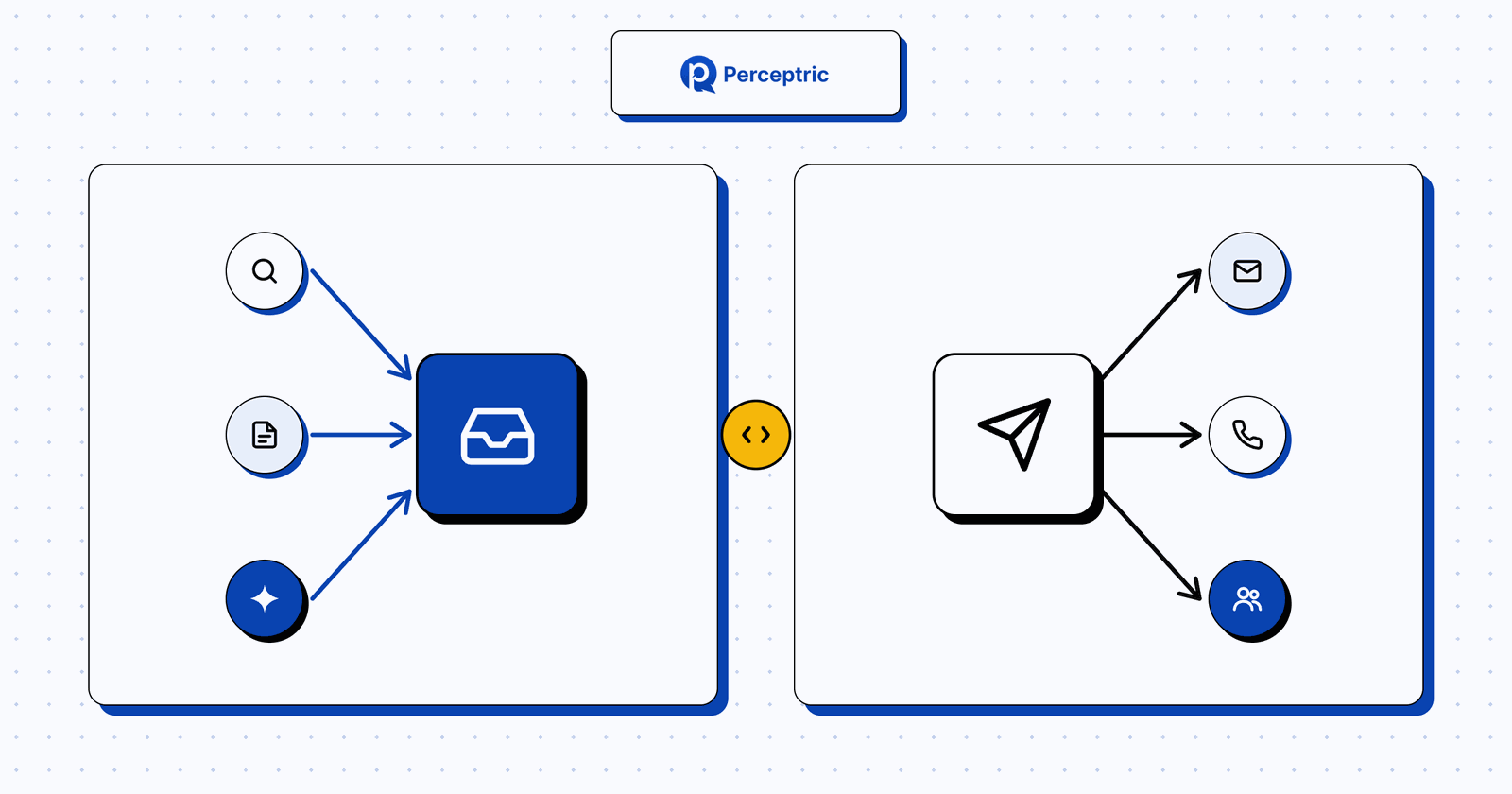
B2B companies generally generate leads through two approaches: inbound and outbound.
- Inbound attracts prospects who are already looking for a solution
- Outbound proactively reaches potential customers who fit your ideal customer profile.
Which is the better approach? It depends a lot on your industry, your customers, and the resources you have at the team.
Key Takeaways
- Inbound attracts buyers who are already looking. Outbound reaches buyers who fit your ICP but don’t know you yet.
- Inbound leads convert better because buyers arrive pre-sold. 75% of B2B buyers prefer a rep-free experience and do most of their research before they ever contact you.
- Organic search drives 52.7% of B2B revenue, and 58.8% for tech companies. It is the biggest inbound channel.
- AI search is now the starting point. 51% of software buyers begin research with an AI chatbot more often than Google, so SEO and GEO have to run together.
- Outbound is getting harder. Cold email replies average 3.4%, down from 8.5% in 2019, and only 0.8–1.5% of emails sent turn into a meeting.
- Outbound still works when you need speed, control over which accounts you target, or access to buyers who never search.
- Inbound takes months but compounds. Our client went from $20K to $326K in organic pipeline in six months.
- Most B2B companies need both. Outbound for speed, inbound for efficiency.
What is B2B Lead Generation?
B2B lead generation is the process of identifying, attracting, and engaging potential business customers who may have a need for your product or service.
Unlike B2C lead generation, which often targets individual consumers, B2B lead generation typically involves reaching decision-makers such as founders, executives, VPs, department heads, or managers.
A typical B2B lead generation process looks like this:
- Define your ideal customer profile (ICP): Identify the companies, industries, sizes, and characteristics that are most likely to need your solution.
- Find potential buyers: Identify the people within those companies who influence or make purchasing decisions.
- Attract or reach them: Use channels such as SEO, content marketing, LinkedIn, paid advertising, email outreach, events, or referrals.
- Capture their interest: Encourage prospects to take an action, such as requesting a demo, booking a call, downloading a resource, or responding to an outreach message.
- Qualify the lead: Determine whether the prospect has a genuine need, sufficient budget, decision-making authority, and a suitable timeline.
- Move the lead toward a sale: Sales and marketing work together to nurture qualified prospects and eventually convert them into customers.
In simple terms, B2B lead generation is about creating a predictable path from “this company could be a good fit” to “this company is interested in talking to us.”
You don’t want to generate as many leads as possible. The more meaningful objective is to generate qualified leads that have a realistic potential to become revenue.
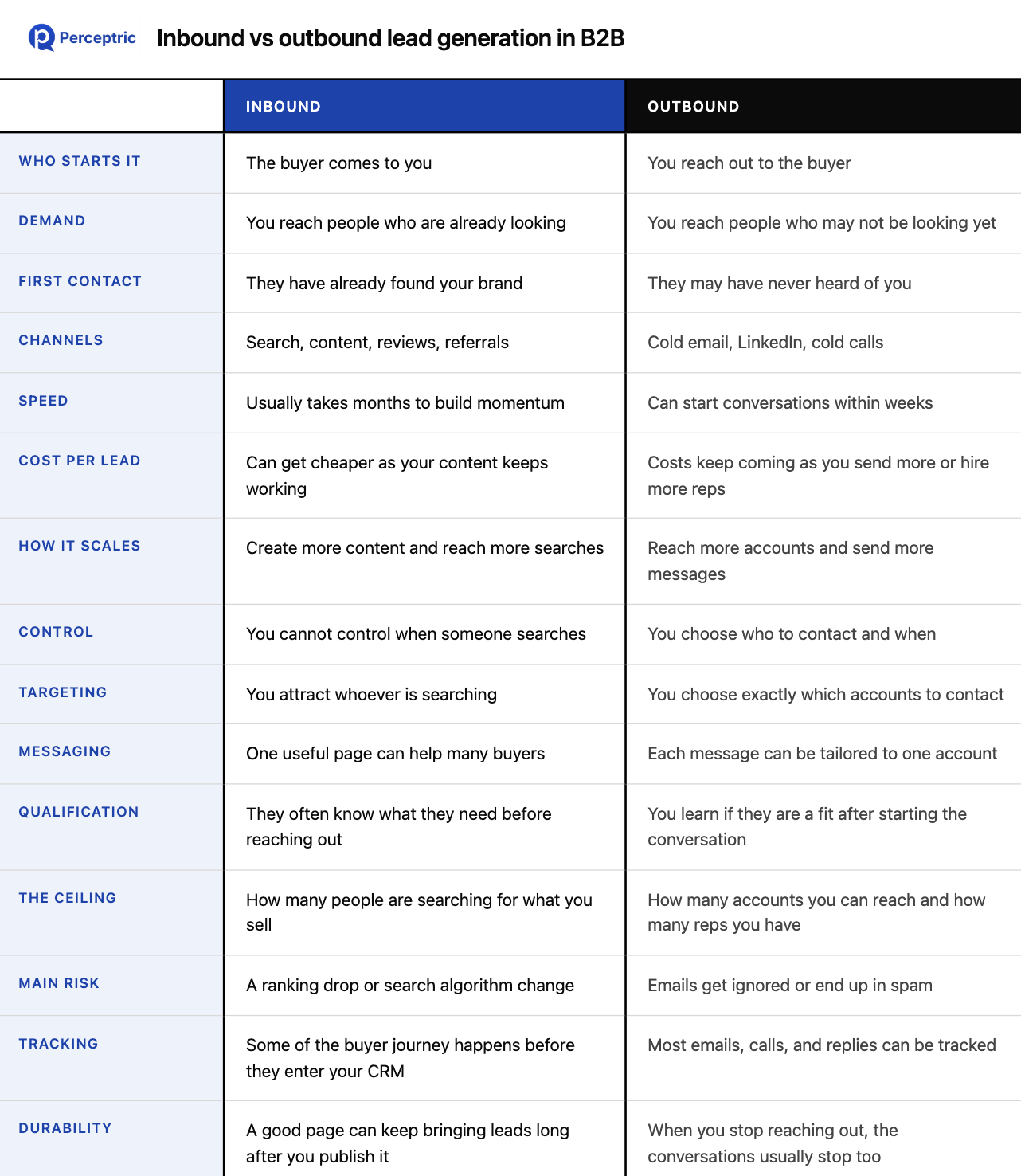
Inbound Lead Generation vs Outbound Lead Generation in B2B
- Inbound lead generation attracts potential customers to you. They discover your company through channels like SEO, content, social media, referrals, or search.
- Outbound lead generation involves proactively reaching potential customers. You identify target accounts and contact them through email, LinkedIn, cold calls, or other direct outreach.
B2B Inbound Lead Generation Strategies
Why inbound lead generation?
Inbound is incredibly powerful because people come to you pre-sold. They contact you because they already develop a certain liking to your product/services after some self-research. Intent is generally high, and therefore win rate is also higher compared to outbound.
In fact:
- 6sense’s 2024 Buyer Experience Report found that the first 70% of the B2B buying journey is spent in a “Selection Phase,” where buying groups gather information and evaluate vendors.
- Gartner’s research on digital content strategy found that 75% of B2B buyers prefer a rep-free sales experience and 40% of B2B purchases are completed without a sales representative.
- BrightEdge’s organic search research found that organic search accounted for 52.7% of B2B revenue in its dataset, compared with 22.9% from paid search. For technology companies, organic search represented 58.8% of revenue.
- HubSpot’s 2024 ROI report analyzed 67,842 customers with at least 12 months of Marketing Hub data and found that inbound leads increased 107% after six months and 133% after 12 months.
With AI, B2B buyers are doing more research on their own before talking to sales. They search, read reviews, compare vendors, use AI, and visit websites long before they ever book a call.
This makes it important for your brand to show up early, while buyers are still researching and deciding what to buy. And the best way to do that is to build your inbound marketing engine.
How inbound helps buyers throughout their buying journey?
The B2B buying journey is usually messy and non-linear. As you can see here, buying intent gradually increases over every touchpoint. On average, a B2B buyer needs around 27 touchpoints before they make the final decision.
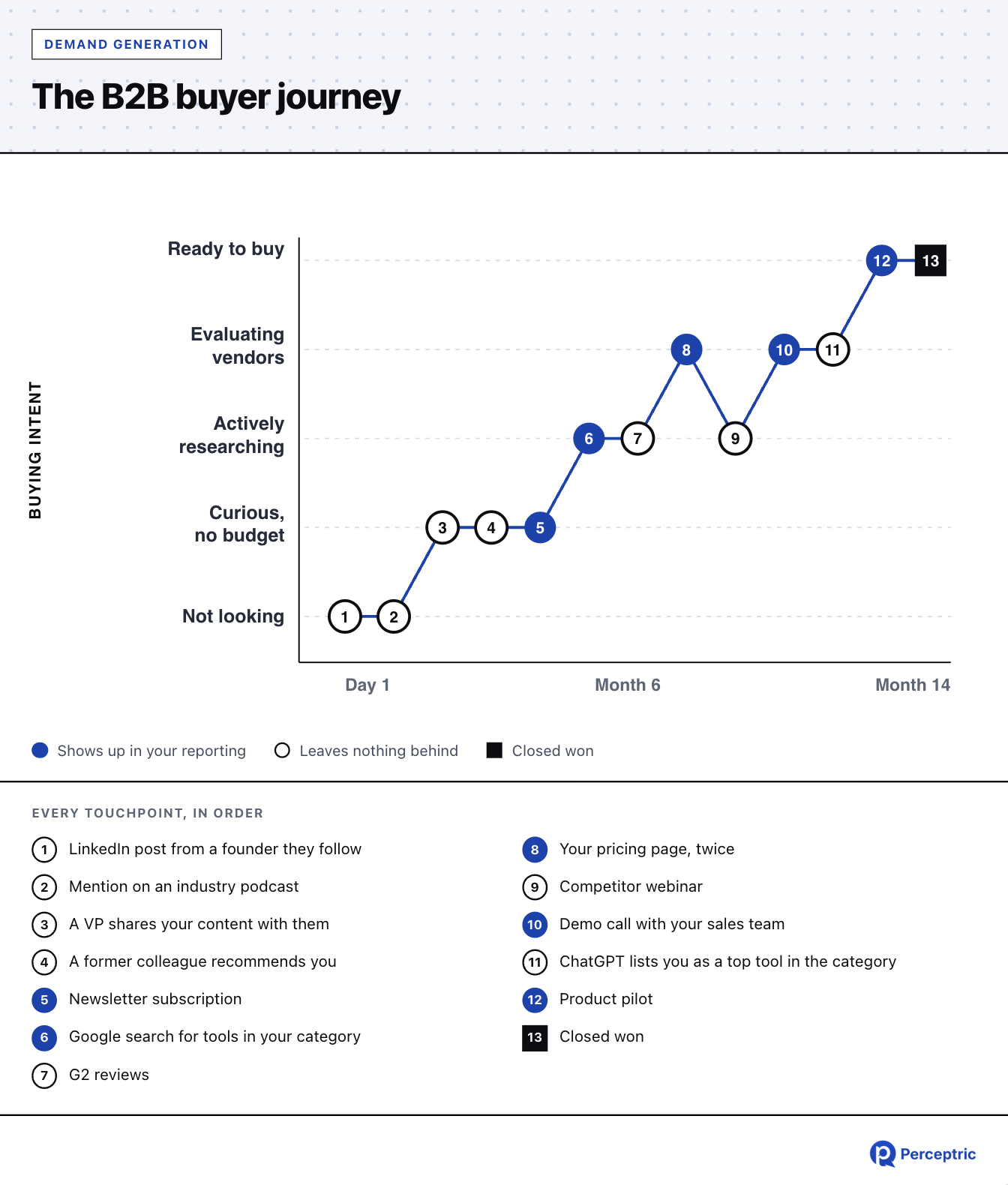
Your goal is to support that journey with the right content and experiences at each stage, based on the questions and concerns your buyers have. That might mean thought leadership and SEO content at the top of the funnel, product comparisons and ROI calculators in the middle, and detailed case studies or integration guides at the bottom.
Inbound programs to start today
If you want to start building inbound demand today, focus on three programs:
1. SEO + GEO/AEO
G2’s 2026 research found that 51% of B2B software buyers now start their research with an AI chatbot more often than Google, while 71% use AI chatbots at some point in their research. AI chatbots are also the #1 source influencing which vendors make buyer shortlists.
To be recommended by AI, you need to do both SEO and GEO/AEO. They’re two sides of the same coin. Thanks to the SEO/GEO program Perceptric ran for a B2B SaaS client, we generated 30K visits per month from Google within the first 6 months since program kickoff, and brought in $500K+ pipeline
That’s why you should start your SEO/GEO programs, today.
2. Founder-led LinkedIn content
Many people still think of LinkedIn as the place to announce new jobs or career milestones. However, when used strategically, it can be an incredibly powerful lead generation channel.
In fact, founder-led LinkedIn content has been used by so many successful B2B SaaS brands:
- Devin Reed was the content mastermind behind Gong’s explosive growth, helping take the company from $20M to $200M ARR. He then built a LinkedIn strategy for Clari’s CEO that pulled in 6.1 million views in 12 months. This is the kind of reach that would have cost a fortune to buy with LinkedIn ads.
- Tommy Clark started his B2B social media agency as a side hustle while working full-time at Triple Whale. His LinkedIn expertise brought in so much client demand that he had to pick between the salary and the roster (take a wild guess which one won).
- And Kait Stephens, CEO of Brij, grew her company’s revenue 7x in a single year while inbound went from 0 to 40%+ of pipeline, all thanks to LinkedIn.
The playbook is:
- Pick your topic. Start with one word you want to be known for. Do not write about everything. Be very specific about what you share. You don’t need a massive following to see results; you want to attract people who genuinely care about what you have to say.
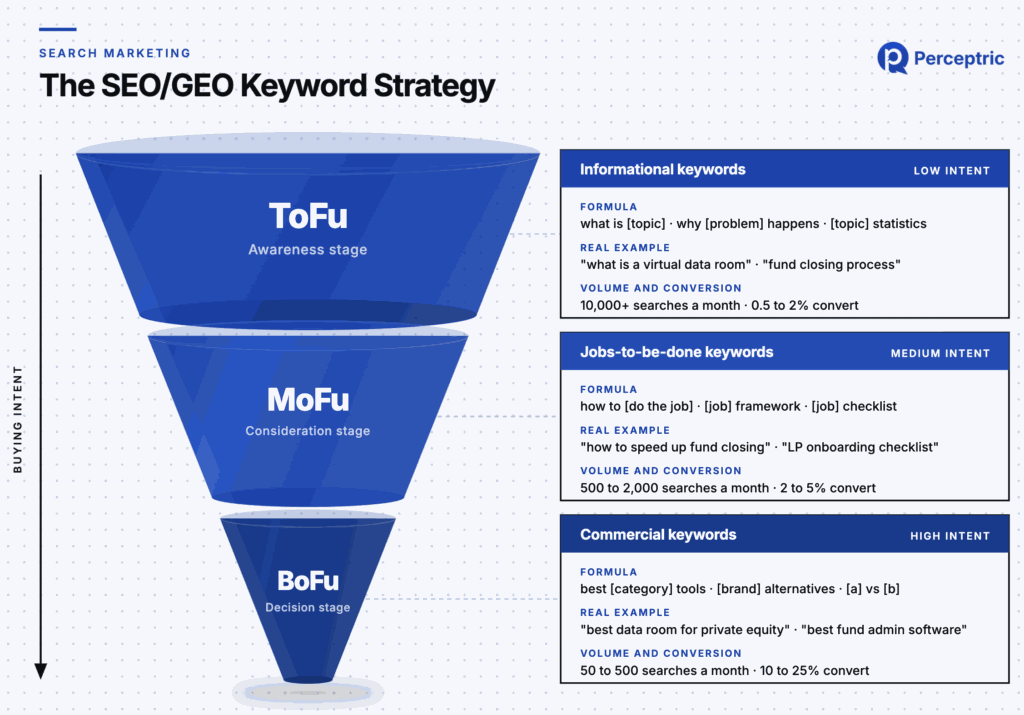
- Plan your content. You should ideate and build your editorial calendar based on the three levels of intent:
- Top of funnel: Business, entrepreneurship, personal content (once a week is fine)
- Middle of funnel: Industry-specific content (bulk of your content should be this, whatever you want to be known for)
- Bottom of funnel: New product features, book a demo, sign up, etc. (no more than once a week)
- Timely content (like current events): this should definitely be incorporated into your strategy, but only supplemental. Treat those as bonus posts when you can.
- Create your content. If you’re starting from scratch, just write text-based content first. Literally any type of content works on LinkedIn, you just need to make sure what you write resonates with your target audience. Once you’ve comfortable with text-based content, lean into other formats like infographics or video clips. These can accelerate trust-building massively since they help viewers put a face and personality (not just a photo of you) to your name and get to know you better.
3. Newsletter
Your newsletter subscribers are your fans. It takes time to build up an audience, but once you have a decent following, the benefits really compound.
To build your newsletter, just go with an email platform that makes it easy to send, automate, and track your emails. You don’t need anything overly complicated to get started. Some of the best newsletter platforms you can use are:
- HubSpot: If you already use it, the built-in newsletter tool ties directly into your CRM and analytics stack.
- beehiiv: sleek UI, strong analytics, great for growth-focused creators.
- MailerLite: affordable, intuitive, solid automation.
- Kit: designed for commerce-focused newsletters.
- Flodesk: beautiful design templates, simple UX.
- Substack: great for thought leadership and community-building, and it’s gaining a lot of traction recently
The most important part is the content. Give people something worth opening your emails for. Don’t be overly salesy, and focus on giving value instead. A good newsletter should be able to:
- Cut through the noise: Do the research for your readers and bring the most useful information together in one place. Make it easier for them to stay informed without having to dig through multiple sources.
- Build trust through useful insights: Help readers understand what’s happening in your industry and why it matters to them. Over time, consistently useful content builds credibility.
- Stay present without being intrusive: Send valuable content on a regular schedule so your brand stays familiar, without making every email feel like a sales message.
- Introduce your product when it makes sense: If your product is relevant to the topic, explain how it can help. Keep the focus on the reader’s problem rather than forcing a pitch into every email.
- Give readers something they can use: Share practical ideas, relevant trends, and useful lessons that help subscribers do their work a little better.
B2B Outbound Lead Generation Strategies
1. Why outbound lead generation?
Outbound campaigns target prospects who have had no prior contact with your company. You initiate the conversation by email, based on fit rather than on any signal of interest from them.
In 2026, outbound is getting increasingly competitive. The statistics don’t lie:
- Cold email reply rates now average about 3.4%, down from 8.5% in 2019, with 5% being the solid baseline and 8–12% strong
- Positive reply rates of 0.5–2% are normal and 5% is exceptional
- A good meeting-booked rate is 0.8–1.5% of emails sent, and teams hitting 2% in 2023 now see 0.5–1% on the same lists and playbooks
- Measured all the way to a closed deal, cold email converts at 0.215%, or one deal per 464 emails
- Cold calls convert to meetings at 2–3% of dials, roughly one meeting per 40 dials, with connect rates of 3–10% in the US
- Gong’s data shows the spread: at 800 dials a month, an average rep books 2 meetings and a top-quartile rep books 18
- LinkedIn publishes a 10–25% InMail response range, but Belkins found 6.38% across 20 million outreach attempts, and InMail credits went from $3 to $21 in October 2025
But people are still using outbound. In fact, HubSpot, the company that defined inbound marketing itself, used to do outbound back in its early days. There are many upsides to outbound:
- It works from day one. Inbound needs months of published content before the first lead arrives; a list and a sequence can produce meetings in the first week.
- It is the only way to reach accounts that never search. In a small or new category, nobody is typing your keyword yet, so you have to go to the buyer directly. This works the same way for incredibly high-value accounts too. To close enterprise deals, you need to connect and personally interact with the buying committee.
- You choose the accounts. With inbound, you’re on the passive side. You sit there and wait for people to come to. Outbound lets you target the exact companies and titles that fit your ICP and your pricing.
- Volume is under your control. If you need more pipeline this quarter, just scale your email sending capacity. Inbound cannot be dialed up on demand.
- It funds the patience inbound requires. Early-stage companies use outbound revenue to buy the runway that content and SEO need to compound.
2. B2B outbound lead generation playbook
- Get specific about your ICP. Start with the companies where your product has already worked. Pick a clear industry, company size, and job title. A focused list of 500 good-fit accounts is worth far more than 5,000 random ones.
- Build the list, then verify it. Use tools like Apollo, Clay, or Sales Navigator to find the right people. Then verify every email before you send. Letting your bounce rate creep above 2–3% can hurt your deliverability across future campaigns.
- Get your sending setup right. Use secondary domains and properly warmed mailboxes, with SPF, DKIM, and DMARC configured. Keep the volume reasonable for each inbox. It’s not the exciting part of outbound, but skipping it can kill a campaign before it even gets going.
- Lead with the offer, not your product. Keep each email focused: one problem, one piece of proof, and one clear ask. And if you personalize, make it actually personal. Mention something relevant about the company rather than just dropping their first name into a template.
- Give people more than one chance to respond. Build a sequence of 4–7 touches over 3–4 weeks, using a mix of email, phone, and LinkedIn. People are busy, and a first email is easy to miss.
- Treat replies like conversations, not leads. When someone responds, have a real person take over. Respond quickly, understand what they actually need, and use judgment about whether a meeting makes sense. This is where a lot of potential meetings are won or lost.
- Measure what gets you closer to revenue. Track positive replies, meetings held, and cost per held meeting. Opens and total reply rates can be useful signals, but they don’t tell you whether outbound is actually creating pipeline.
Work With Perceptric To Generate Demand For Your B2B SaaS
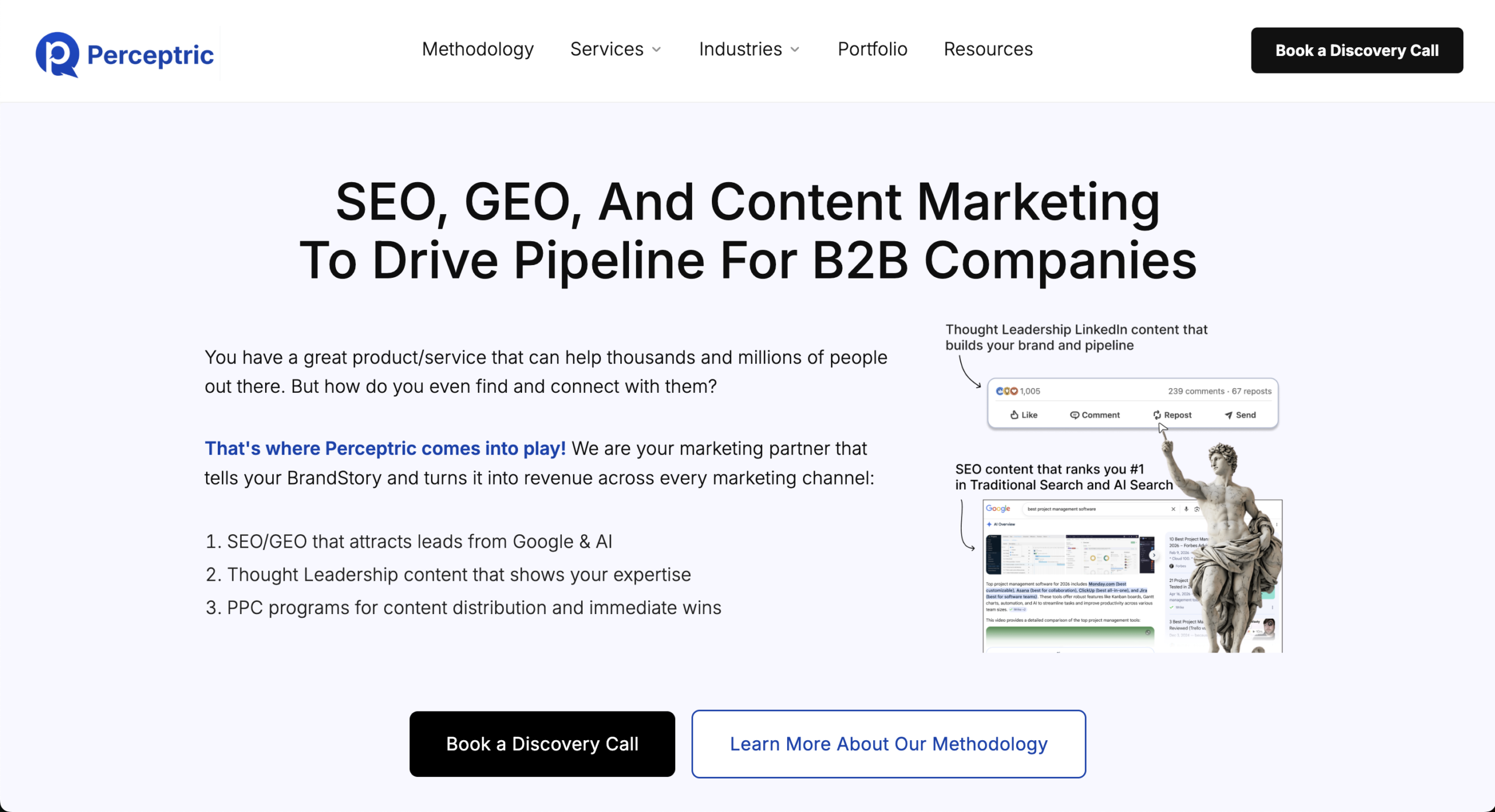
Perceptric is a B2B SaaS marketing agency focused on building demand, earning buyer trust, and turning that demand into pipeline. We combine SEO/GEO, expert-led content, LinkedIn thought leadership, and paid search to help SaaS companies become known and considered before buyers enter an active buying cycle.
Our approach is built around a simple idea: buyers often have a shortlist before they ever speak to sales. We help your company get onto that shortlist by showing up consistently across the channels buyers use to learn, research, and evaluate solutions.
Perceptric’s key capabilities:
- Conversion-led SEO. Build visibility around the problems, solutions, and commercial questions your buyers care about. We prioritize keywords that can influence consideration and create demand rather than simply generate traffic.
- AI SEO (GEO/AEO). Increase your visibility across ChatGPT, Claude, Perplexity, and Google AI Overviews so your brand appears when buyers use AI to research problems, solutions, and vendors.
- Content production. Expert-led content based on SME interviews, customer insights, and original research. The goal isn’t to publish more content; it’s to give buyers useful reasons to understand your market, trust your expertise, and remember your brand.
- Interactive content experiences. Turn educational content into interactive experiences that help buyers explore problems, compare options, and understand your solution while creating stronger brand recall.
- LinkedIn thought leadership. Turn founder and executive expertise into consistent, story-led content that builds familiarity and trust with the people you want to reach — before they’re actively looking for a vendor.
- Paid search. Capture existing demand around high-intent searches while reinforcing the same positioning and messaging used across your SEO and content. This connects demand creation with demand capture rather than treating paid search as a standalone lead-generation channel.