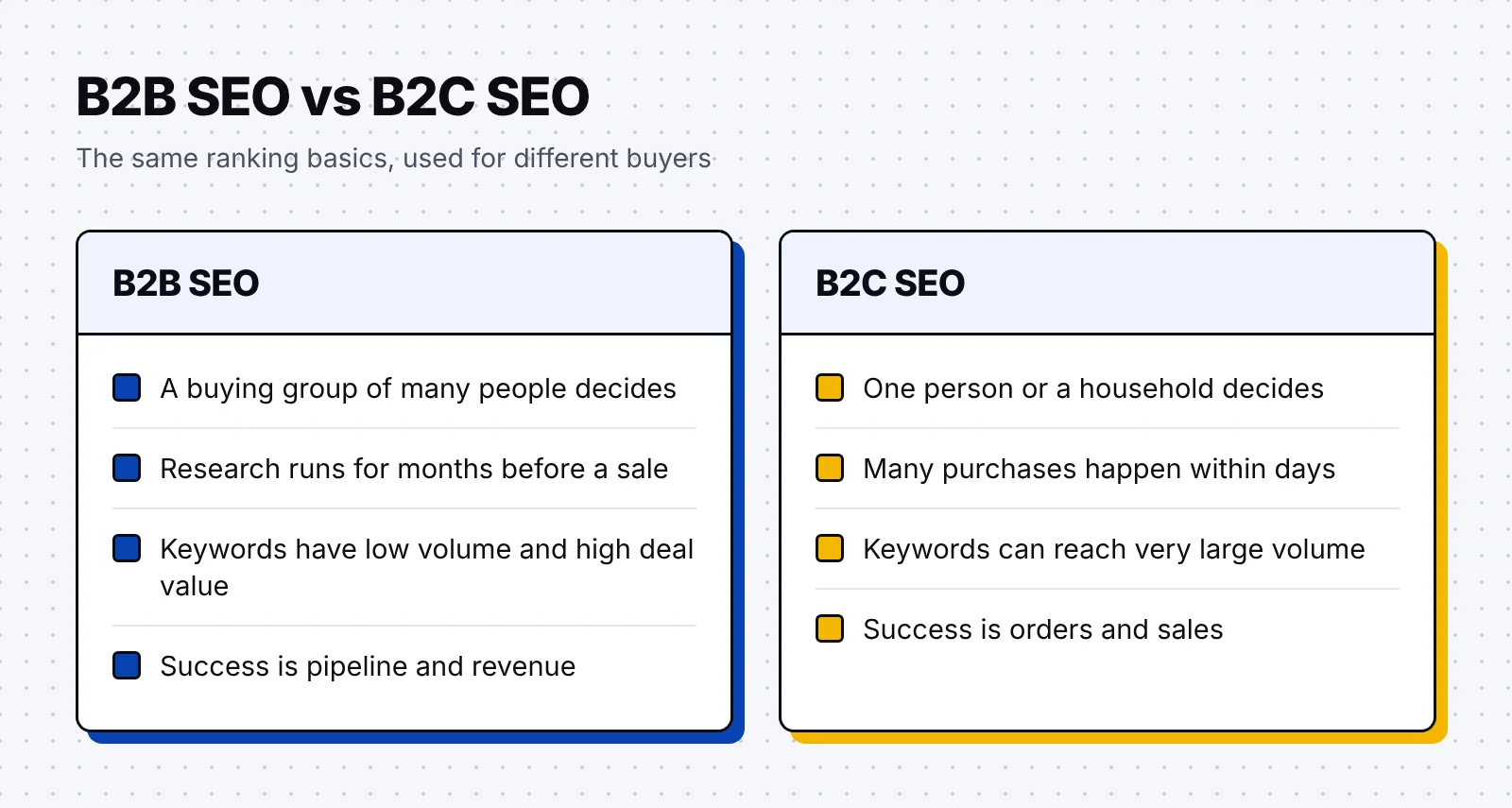
B2B SEO is the work of getting your company found in Google and AI answers when business buyers research a problem you solve. It turns those searches into pipeline, with pages for each stage of a purchase that a group of people makes over several months.
Buyer research is moving into AI tools in 2026, and the pages you publish shape what those tools say about you. In G2's March 2026 survey, 51% of B2B software buyers started research in an AI chatbot more often than in Google.
- B2B SEO brings in pipeline by reaching buying groups during months of research, well before they contact sales.
- Keyword research starts with your buyers' own words, and every keyword maps to a stage of their purchase.
- Bottom of funnel pages come first, since comparison and pricing searches sit closest to a sales conversation.
- Direct answers and mentions on trusted sites help your pages rank in Google and get cited in AI answers.
- Success is measured in pipeline and revenue from organic and AI search, over six to twelve months.
Why B2B SEO matters for B2B marketing teams
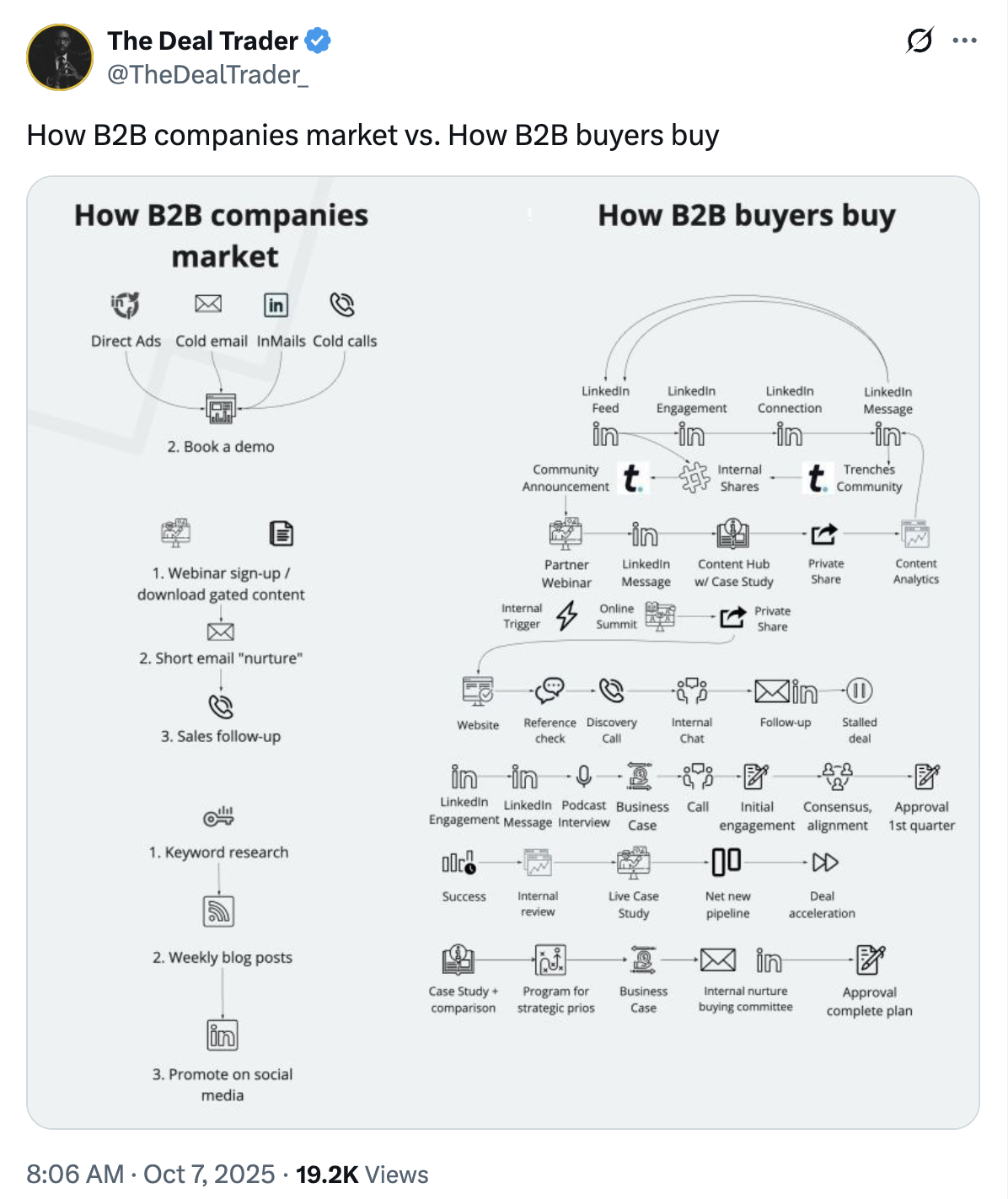
Business buyers do most of their research before they talk to a seller, which makes search one of the main places a shortlist forms. In 6sense's 2025 study, buyers first reached out 61% of the way through a purchase, and 94% of buying groups had already ranked their vendors.
Each purchase also involves many people, and each one searches for different answers. In Forrester's 2024 research, an average of 13 people took part in each buying decision, and 89% of purchases involved two or more departments.
Atlassian is a software company that makes Jira, Confluence and Trello for teams. When it went public in 2015, over 98% of its transactions happened on its own website. Word of mouth and targeted web content helped it grow without a traditional sales team.
Its Agile Coach guides still teach methods like Scrum for free, and the Scrum guide offers a free Jira template as the next step. Pages like these let buyers learn a method and try the product before they talk to sales.
How to build a B2B SEO strategy: 9 steps
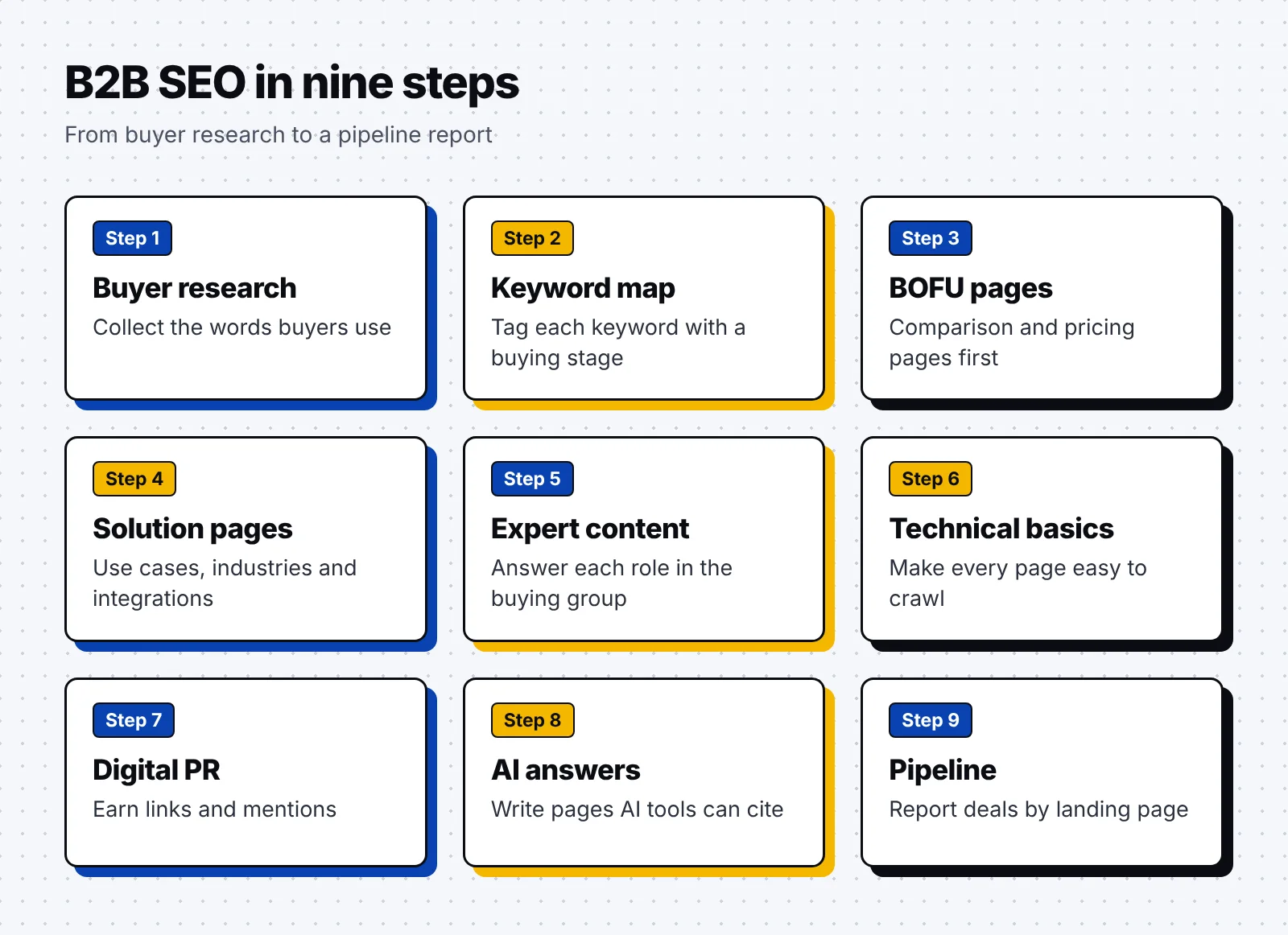
These nine steps take you from buyer research to a quarterly pipeline report, and each one builds on the step before.
1. Research your buyers and the words they use
Your buyers' problems decide which keywords are worth your time, so research starts with people before you open a keyword tool. The best ideas come from the exact words buyers use when they describe a problem to your sales or support team.
Buyers also research on LinkedIn, in communities and on peer calls before a demo, so their questions show up far beyond your website.
- Interview your sales team: Ask which questions come up on first calls and which competitors buyers mention most. Notes on lost deals show the doubts your pages need to answer.
- Read tickets, reviews and threads: Go through support tickets, G2 reviews and Reddit threads about your category. Copy phrases word for word, such as "invoices stuck in email", since buyers search with the same words.
- List every role in the buying group: Write down who uses, approves, secures and pays for your product. For each role, note the event that starts their search and the first question they ask.
- Group your notes into topics: Sort the phrases by problem and by role, then give each group a working title. That topic list becomes the seed for keyword research in step 2.
2. Map keywords to buying stages and deal value
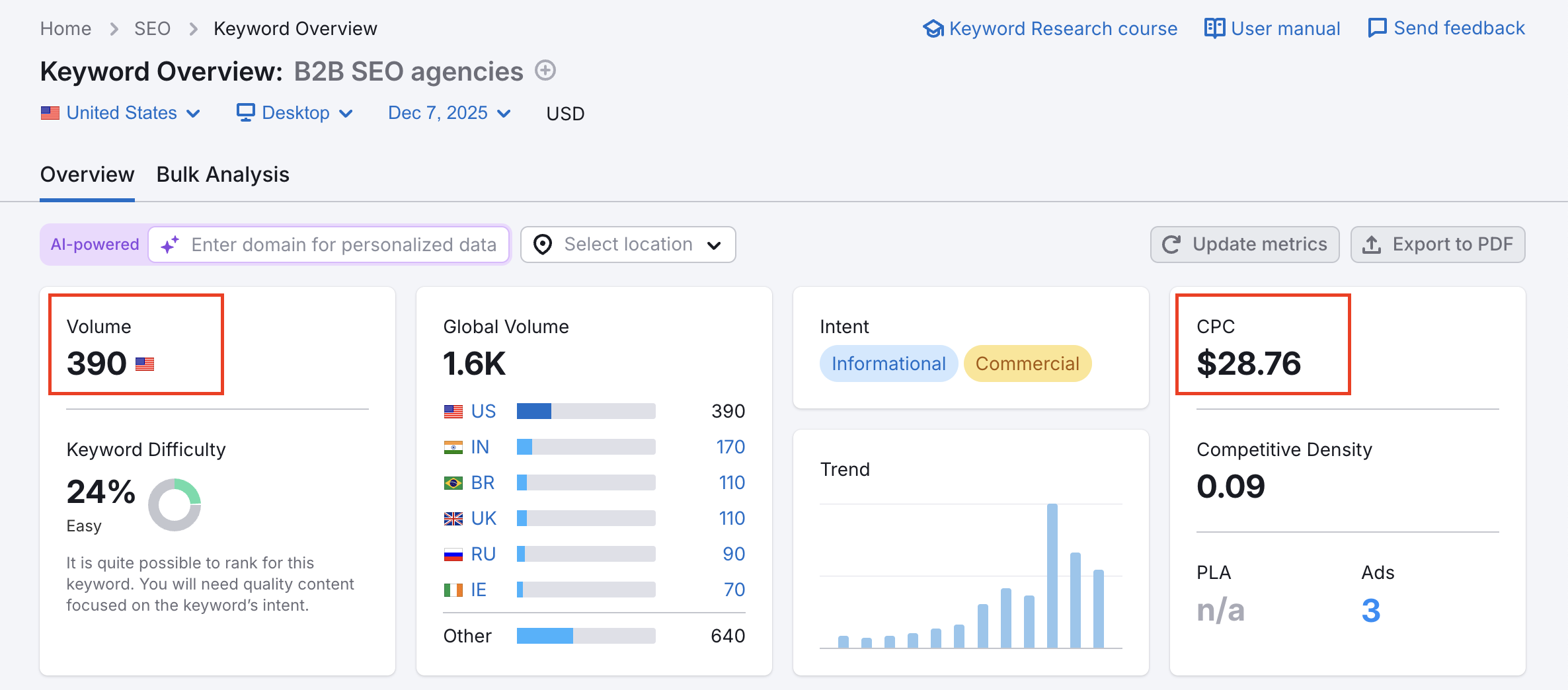
Keyword tools show search volume, but in B2B the value of a search depends on how close the searcher is to buying. Almost 93% of keywords in Ahrefs' US database get fewer than 10 searches a month, and many B2B queries sit in that long tail.
Thankfully, a keyword with few searches can still bring in a buyer worth a large contract, so volume alone says little about value.
- Expand your seed list: Enter each phrase from step 1 into a tool like Semrush or Ahrefs, then collect related searches and questions. Keep very low volume terms when they match a real problem your buyers describe.
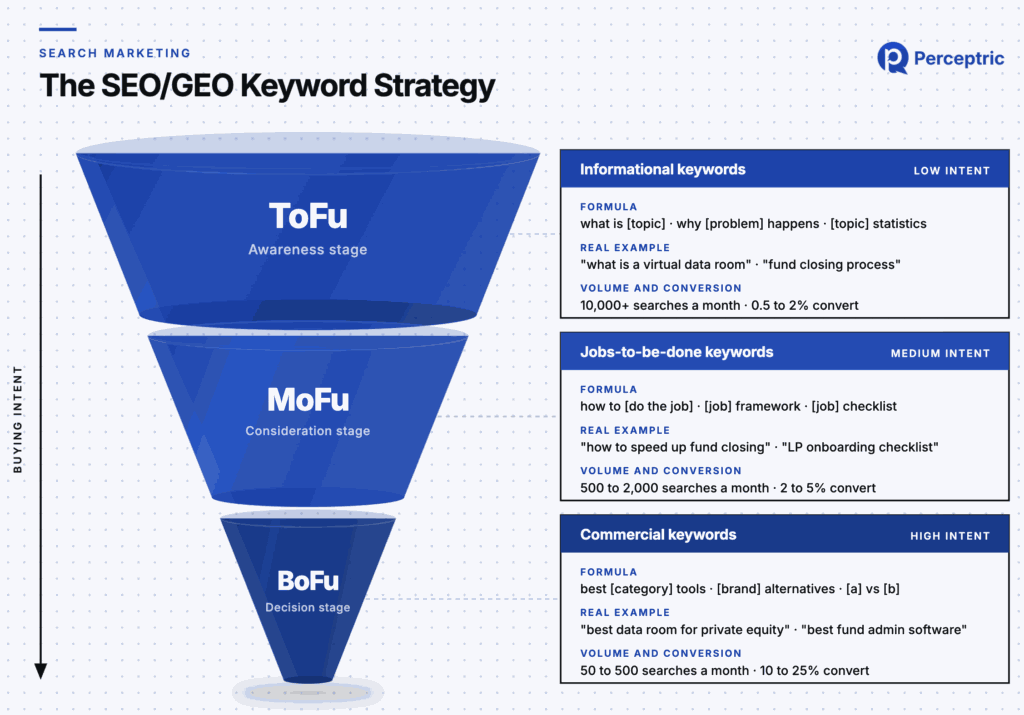
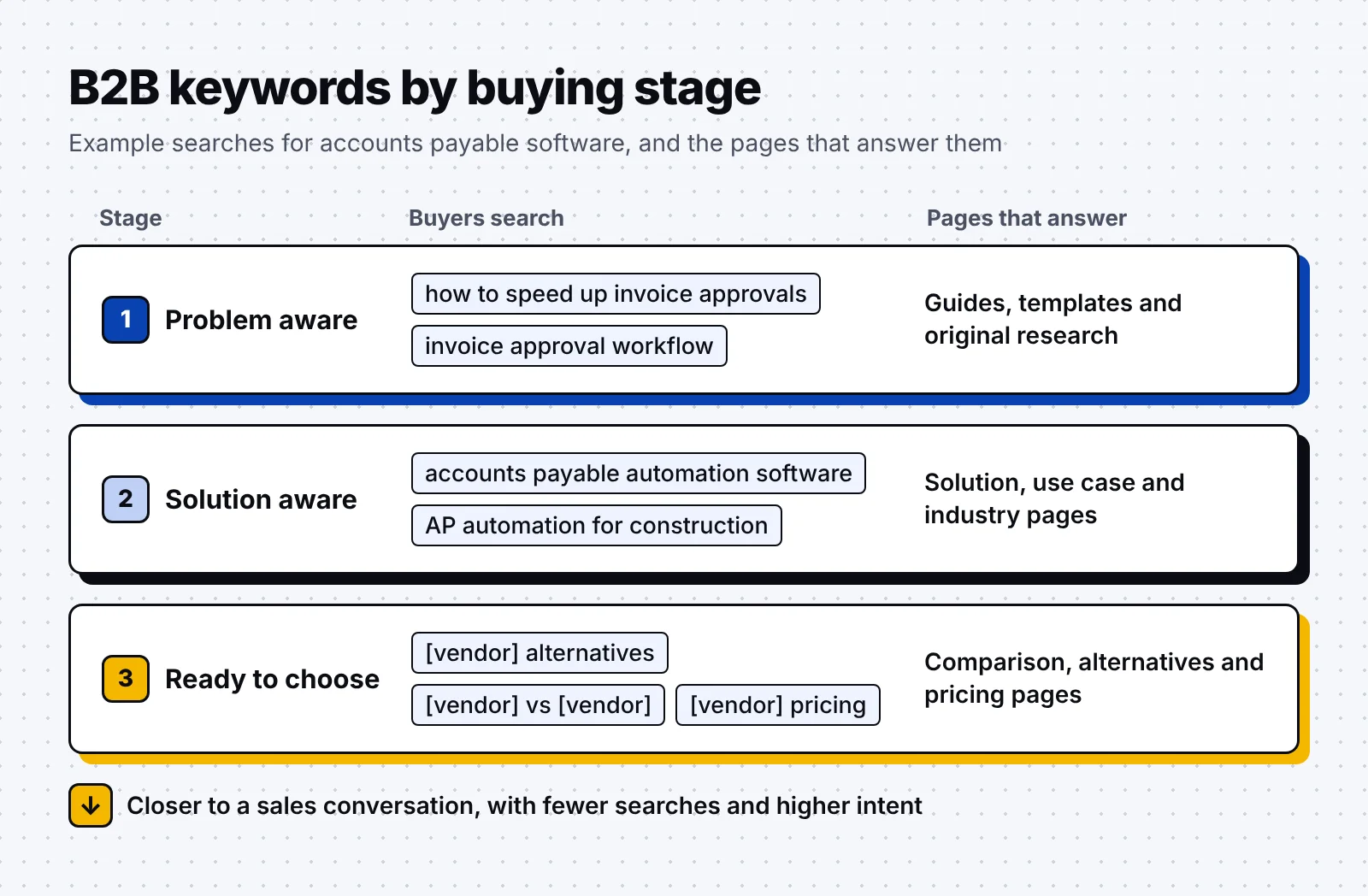
- Tag each keyword with a stage: Problem searches, such as "how to speed up invoice approvals", come from early research. Searches for "[vendor] alternatives" or "[vendor] pricing" come from buyers with a shortlist.
- Score by fit and deal value: Rank each keyword by how well the searcher matches your ideal customer and the size of a typical deal. Use search volume only to break ties between two keywords with a similar fit.
- Check what ranks today: Search each keyword and look at the top results. If they are vendor comparisons, plan a comparison page, and if they are guides, plan a guide.
Our guide to B2B keyword research walks through a full example for a B2B SaaS company, including how to find buyer questions on Reddit.
3. Publish bottom of funnel pages first
Bottom of funnel (BOFU) pages answer searches from buyers who already have a shortlist, so they sit closest to a sales conversation. We recommend building them before broad guides, since they can bring in pipeline while the rest of your content gains authority.
- Build comparison pages: Create a page for each competitor buyers weigh against you, with the main differences in a table. Then say which kind of company each product suits best, including when a competitor fits better.
- Build alternatives pages: Target "[competitor] alternatives" with a page that lists real options, including yours, and the common reasons buyers switch.
- Publish a pricing page: Show plans or a price range and what drives the cost, such as seats or usage. A clear range helps buyers build a business case before they talk to sales.
- Add case studies: Write case studies by industry and use case with measured results, and link each one from the matching comparison page.
- Keep these pages open: Leave them free of forms so buyers and AI crawlers can read them in full. Put the demo request at the end, after buyers have the facts they came for.
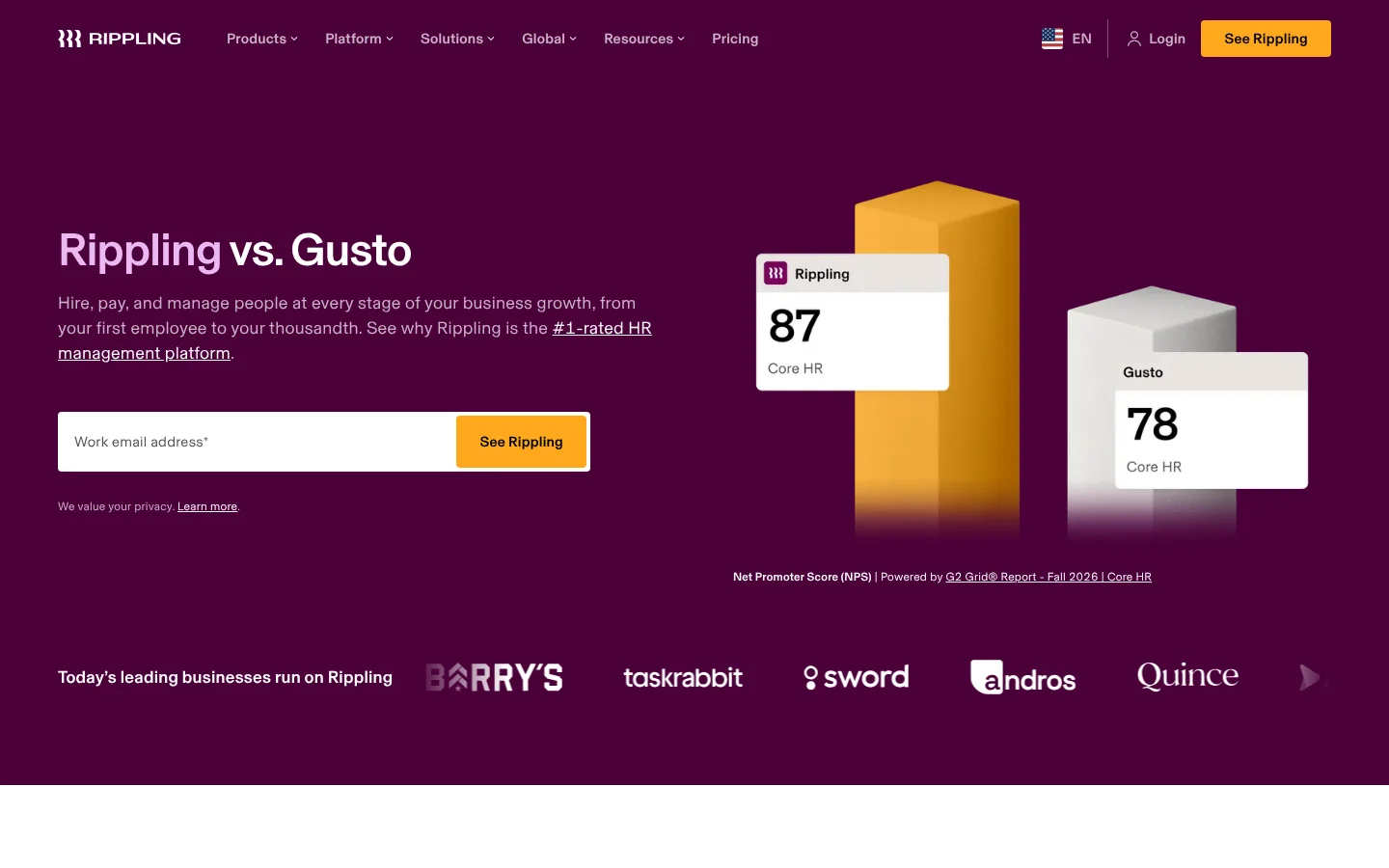
Rippling is a workforce management software company that runs HR, IT, payroll and finance in one system. Its compare hub links to head-to-head pages against ADP, BambooHR, Deel, Gusto and other vendors.
Our guide to BOFU content covers how to write and measure each of these page types, from pricing pages to ROI calculators.
4. Create solution, industry and integration pages
Buyers who know what kind of product they need search for a use case, an industry or a tool they already use. Each of those searches deserves its own page, written for the job or market it names.
- Write a page for each use case: Give every job your product does its own page, such as "invoice approval software". Open with the problem, then show how the product solves it with screenshots and proof.
- Add industry pages: Build a page for each vertical you sell to, using its own terms and rules. A page for construction firms could cover lien waivers and subcontractor invoices.
- Publish integration pages: Create one page per integration that explains what syncs and how to set it up. Buyers who already use a tool search "[tool] integration" to check fit before a demo.
- Match the next step to the buyer: Offer a free trial on product-led pages and a demo request on sales-led pages. Keep one clear call to action on each page so buyers know what to do next.
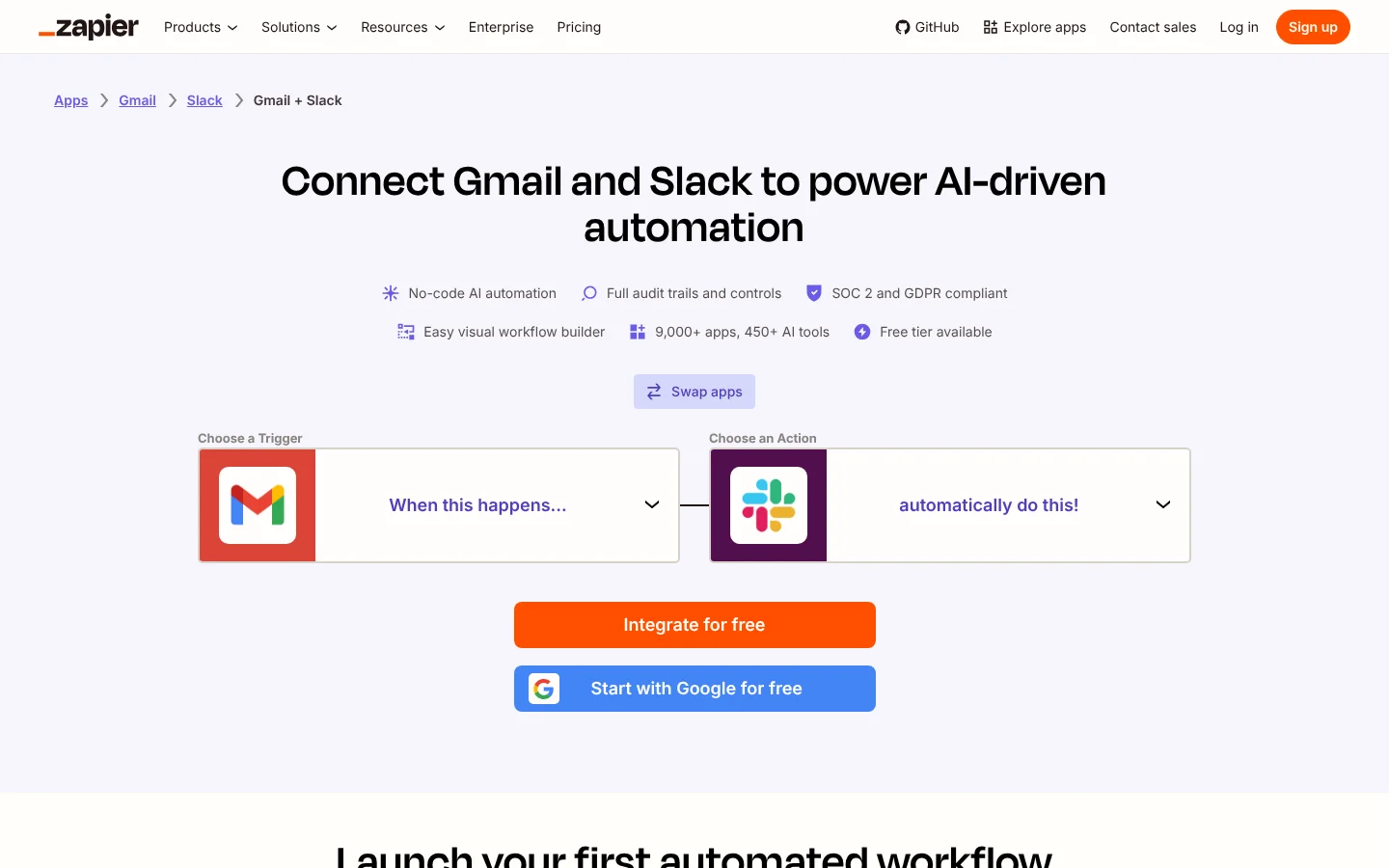
Zapier is an automation software company that connects business apps so teams can run workflows without code. Its app directory lists more than 9,000 apps, and popular pairs, such as Gmail and Slack, get their own pages with ready-made workflows.
If you sell software, our B2B SaaS SEO guide shows how product-led and sales-led teams turn these pages into trials and demos. IT services firms can use service, industry and location pages instead, covered in our guide to SEO for tech companies.
5. Publish expert content for every role in the buying group
Earlier in the journey, each member of the buying group searches for answers about their own part of the decision. Expert guides that answer those questions build trust before you're on the shortlist, and they give AI tools specific facts to cite.
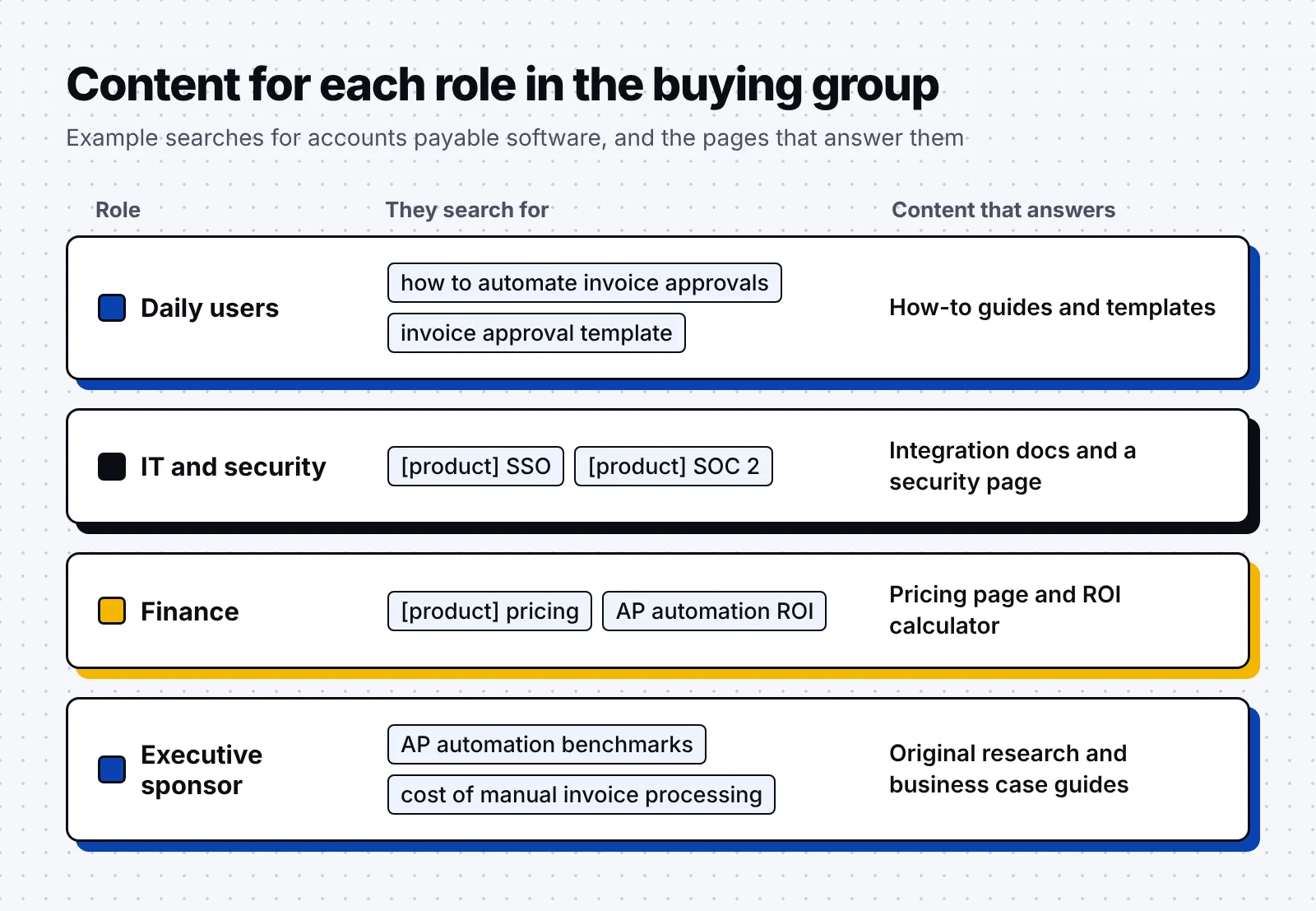
- Answer each role's questions: Write how-to guides for daily users and security pages for IT. Give finance a clear cost breakdown, and give executives research tied to business goals.
- Interview your subject experts: Talk with a product lead or engineer before you draft each guide. Their examples make a guide more useful than a summary of pages that already rank.
- Build topic clusters: Group guides around one core topic, with a main page for the basics and a linked page for each subtopic. A cluster on invoice approvals could cover approval workflows and audit trails.
- Show who wrote it: Add the author's name and role to each guide, and link every number to its source so readers can check it.
- Refresh key guides: Review your top guides every six months, update their numbers and screenshots, and change the updated date only when the content changes.
If you sell to engineers or IT teams, our B2B tech SEO guide goes deeper on docs and glossary pages for technical buyers.
6. Build a technical foundation buyers and crawlers can use
Technical SEO makes sure search engines and AI crawlers can load and understand every page you publish. Fortunately, the basics fit on a short list, and fixing them before you scale content keeps every new page easy to find.
- Make key pages indexable: List every page you want found in your XML sitemap and link to it from related pages. Check that no solution or pricing page carries a stray noindex tag.
- Hit Core Web Vitals: Aim for main content within 2.5 seconds, responses within 200 milliseconds and layout shift of 0.1 or below. These are Google's Core Web Vitals targets, and Search Console reports them for your pages.
- Serve text in the HTML: Put important text in the page's HTML on first load, so crawlers can read it without running scripts. Test a key page with JavaScript turned off to see what a crawler reads first.
- Let in the AI crawlers you want: Check that robots.txt allows search crawlers such as OAI-SearchBot for ChatGPT search and PerplexityBot for Perplexity.
7. Earn links and mentions with digital PR
Links from trusted sites still help pages rank, and mentions on those sites now shape AI answers as well. In Muck Rack's October 2026 analysis, more than 84% of AI citations came from earned and third-party sources, and paid content made up 0.3%.
- Publish original research: Turn your product data or a customer survey into a yearly report with clear charts. Journalists and bloggers link to fresh numbers they can quote in their own stories.
- Build a free tool: Make a calculator that solves one small job for your buyers, such as an ROI estimate. Industry blogs often link to tools like this from their own guides.
- Offer expert comments: Answer journalist requests and pitch short comments to industry newsletters on topics your team knows well. One quote in a trade publication can bring both a link and a brand mention.
Gong is a revenue intelligence software company that records and analyzes sales calls and deals. Gong Labs turns billions of sales conversations into public research, including a study of more than 120 million sales calls.
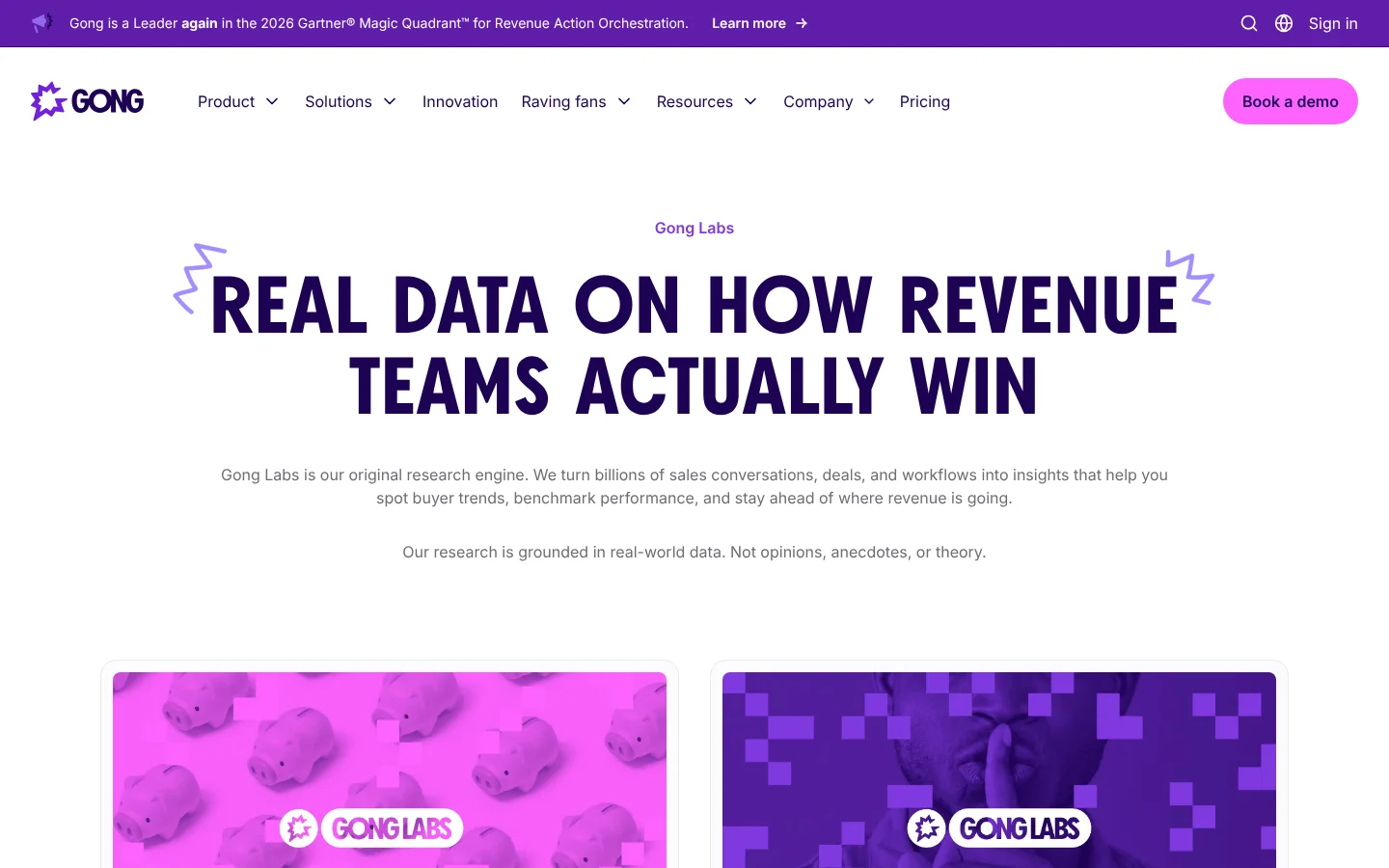
Interestingly, data like this gives journalists and bloggers a number to quote, and each citation points back to Gong.
8. Structure your pages for AI answers
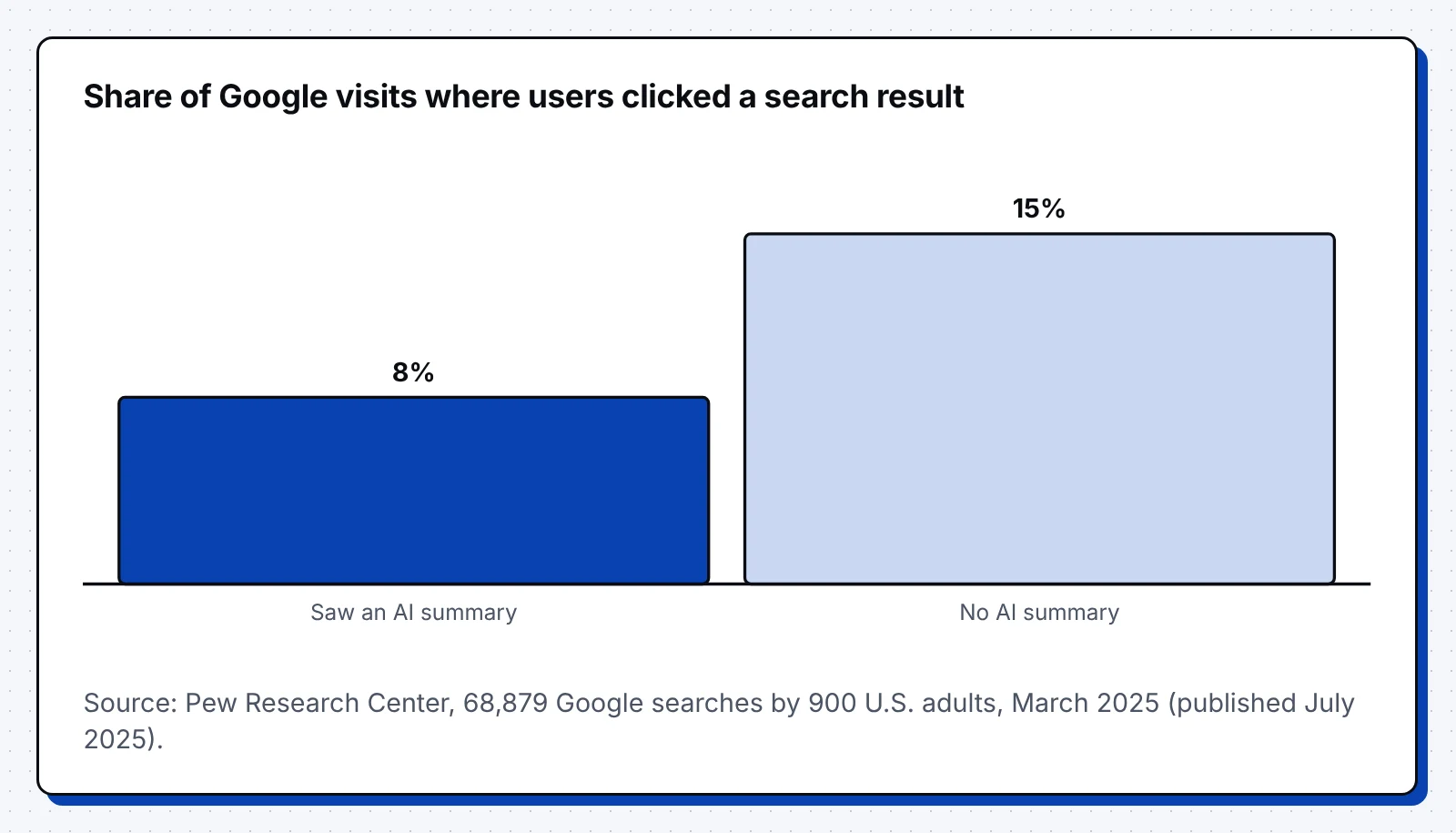
Generative engine optimization (GEO) is the work of getting your brand cited in answers from ChatGPT, Gemini, Perplexity and Google's AI Overviews. When Google showed an AI summary, users clicked a search result in 8% of visits, compared with 15% of visits without one.
Ranking in Google helps with GEO, though it no longer guarantees a citation. In March 2026, 38% of pages cited in AI Overviews also ranked in Google's top 10, down from about 76% in July 2025.
- Answer first: Open each section with a direct answer in the first one or two sentences, then add the detail. A clear opening sentence is easy for an AI tool to quote.
- Cover the follow-up questions: Google's AI Mode breaks one question into subtopics and runs many searches at once. Answer the next questions on the same page, such as cost and setup time.
- Use tables for facts: Put pricing and feature comparisons in HTML tables, so the facts are easy to pull out. Keep the numbers in each table the same as the numbers in the text around it.
- Keep your details consistent: Use the same product names and prices on your site and on review and partner sites. Matching details make it easier for AI tools to describe your product correctly.
- Track buyer prompts: Write prompts a buyer might ask, such as "best AP automation software for construction". Check each month which brands ChatGPT, Perplexity and Google's AI Mode mention.
Luckily, most of this work also makes your pages clearer for Google and for the people who read them.
9. Measure B2B SEO by pipeline and revenue
Traffic shows how many people you reach, while pipeline shows whether SEO pays for itself. Expect a long gap between a first visit and revenue, since buying cycles in 6sense's 2025 study averaged about 10 months.
- Set up key events: Mark demo requests and trial sign-ups as key events in GA4. Add a channel group so visits from AI tools show up as their own channel.
- Pass the source into your CRM: Send the first landing page and traffic source into your CRM with every form fill. That lets you tie every deal in your pipeline back to the page that started it.
- Ask how buyers found you: Add a "How did you hear about us?" field to your demo form. Answers that name ChatGPT or a colleague explain pipeline that analytics records as direct traffic.
- Report on two rhythms: Share impressions, rankings and AI mentions every month, then pipeline and revenue by landing page every quarter. Use attribution windows of at least a year for the pipeline numbers.
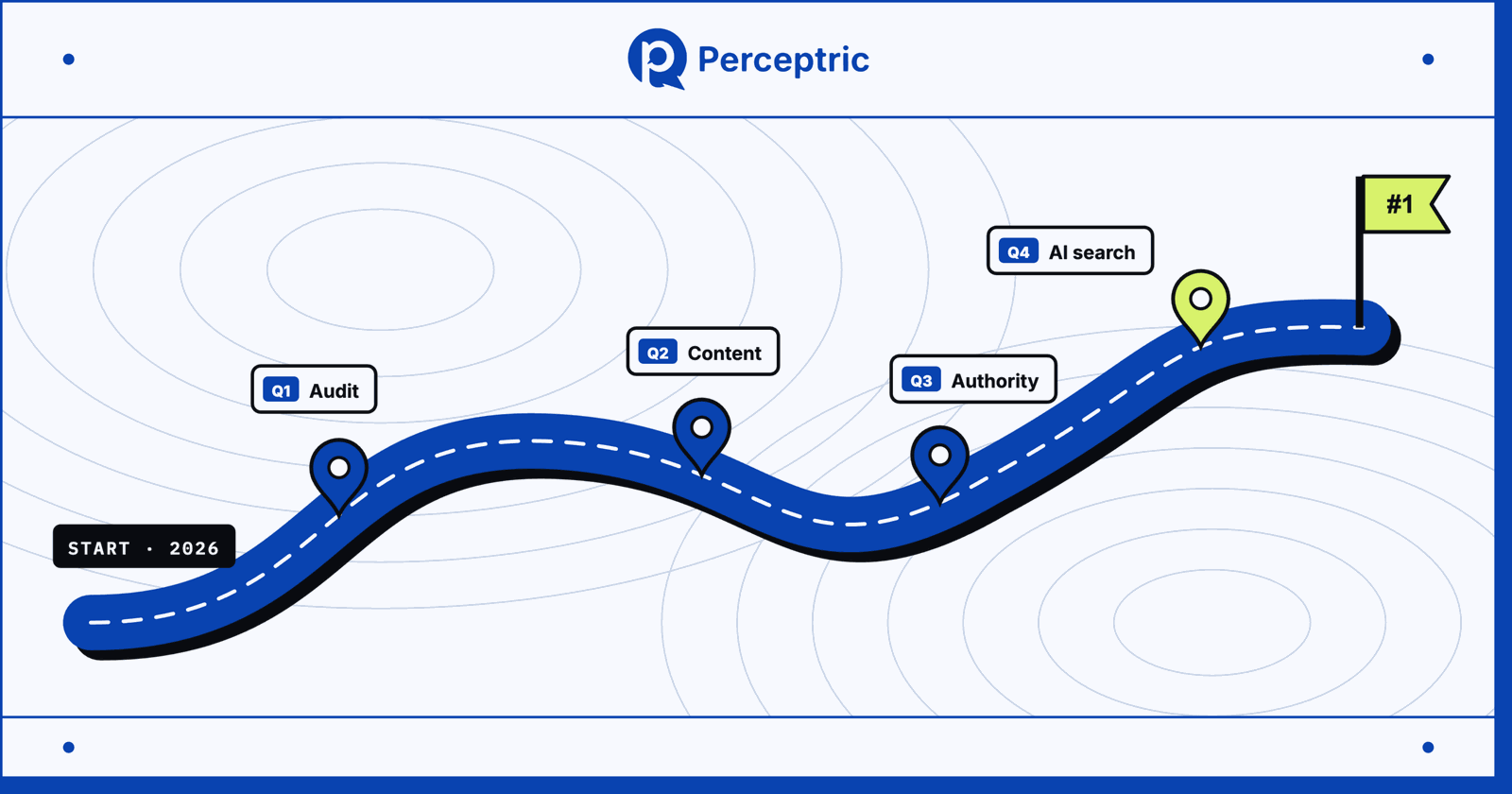
We plan for six to twelve months before a new program brings in steady pipeline, and competitive terms take longer. Only 1.74% of newly published pages reach Google's top 10 within a year, and 72.9% of top 10 pages are more than three years old.
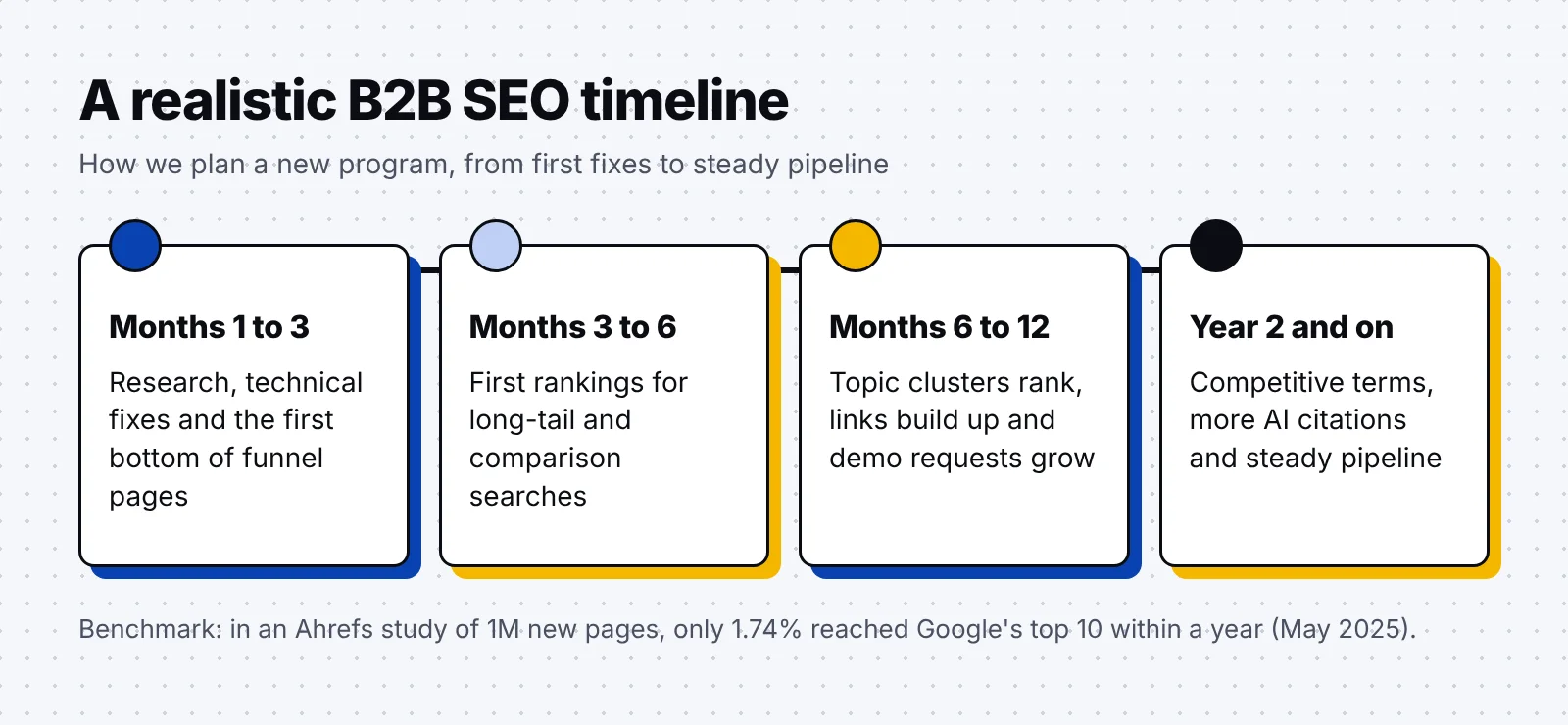
Happily, pages for low volume keywords tend to rank sooner, which is one more reason to publish BOFU pages first. For a real example, see how an SEO and GEO program generated about $500K in pipeline in six months for a B2B SaaS company.
Put the 9 steps to work
Use this list as a checklist when you plan your next quarter of B2B SEO work:
- Collect the words buyers use when they describe problems to your sales and support teams.
- Map each keyword to a buying stage and score it by fit and deal value.
- Publish comparison, alternatives and pricing pages before you write broad top of funnel guides.
- Create solution, industry and integration pages for each use case and market you serve.
- Answer each role in the buying group with expert guides written with your own specialists.
- Fix the technical basics so search engines and AI crawlers can read every page.
- Earn links and mentions with original research and expert comments in trade publications.
- Write direct answers and clear tables that AI tools can quote in their replies.
- Report impressions monthly and pipeline and revenue by landing page every quarter.
FAQ
What is B2B SEO?
B2B SEO is the work of ranking your company in Google and AI answers for the searches business buyers make while they research a purchase. Its goal is qualified pipeline, such as demo requests and sales conversations.
How long does B2B SEO take to work?
Plan for six to twelve months before B2B SEO brings in steady pipeline, and longer for competitive terms. Bottom of funnel pages that target low volume keywords often rank first.
Which B2B SEO pages should come first?
Start with comparison, alternatives and pricing pages, since those searches come from buyers who already have a shortlist. Add solution, industry and integration pages next for buyers who are still comparing options.
Should B2B companies target low volume keywords?
Yes, because a keyword with few searches can still bring in a buyer who is ready to talk to sales. Many B2B searches sit in the long tail, where keyword tools show small numbers.
Does B2B SEO still work with AI search?
Yes, because AI tools draw on pages they can crawl and on mentions from trusted sites. Direct answers, comparison tables and links from respected publications raise your chances of being cited.
A good first step is to list the ten questions your sales team hears most often and check which ones your site answers today. If you want an outside view of your search and AI visibility, start with a free AI visibility audit.