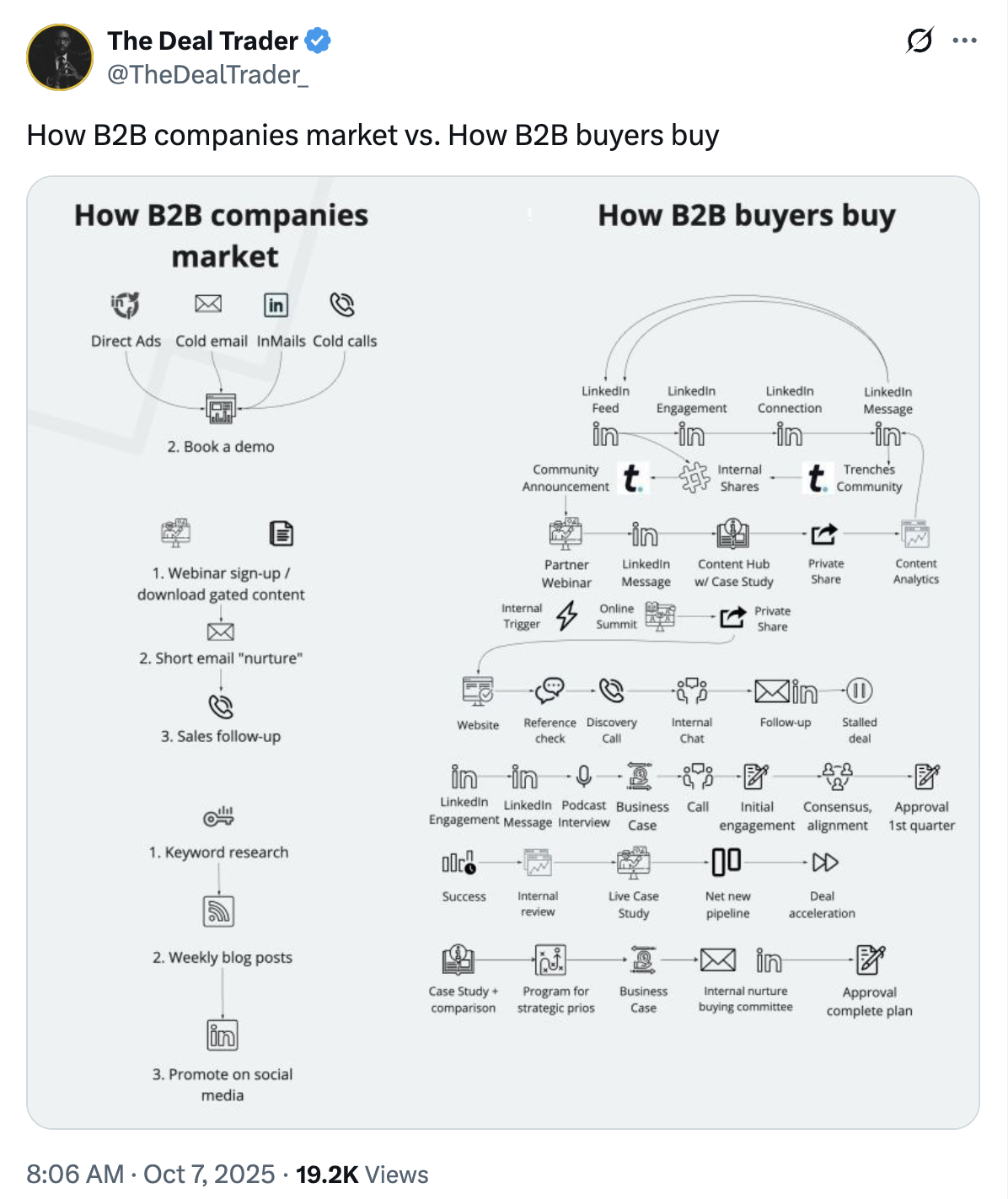
Forrester's 2026 State of Business Buying found that 13 internal stakeholders and nine outside influencers shape a typical B2B buying decision.
That means a fintech deal rarely comes down to one person. A CFO, a compliance officer, someone from procurement and a product or tech lead all read about you before they sign, and the path they take looks nothing like a neat funnel:
That's why fintech SEO needs its own playbook, built on trust more than tactics. I'm sharing how I approach it, based on 10+ years growing B2B SaaS brands: why fintech is different, whether SEO is worth it and the six steps I follow.
What is fintech SEO?
Fintech SEO is the work of getting a financial technology company's pages to rank in Google and get cited in AI answers when its buyers search. Think of a payments platform ranking for "how to automate multi-bank reconciliation" or a lending tool showing up for "best loan origination software".
The basics are the same as any SEO program. What changes is the reader, the level of proof they expect and how long they take to decide.
Why SEO for fintech companies is different
Finance people are some of the most analytical readers you'll ever write for. They work in jobs where one wrong number matters, so they spot marketing fluff a mile away.
Here's what that means for your content:
- Shallow content doesn't work: To keep a CFO reading, your writing has to be clear, useful and grounded in how your product actually works.
- Credibility comes first: Whether you sell embedded payments, fraud prevention or banking APIs, your content has to explain hard concepts correctly. It needs to come from someone who knows the industry.
- The journey doesn't end at sign-up: Activation often depends on connecting live systems or moving data off an old vendor. Good content helps with onboarding and retention too.
- The sales cycle is long: With that many stakeholders, a B2B payments deal can take many months. Your content has to support every stage of it.
Is it worth investing in SEO for fintech companies?
I think fintech is one of the best markets for SEO. Buyers research a lot before they talk to sales, and many fintech niches are narrow enough that a focused company can win the searches that matter.
Anduin, which builds software for private equity, is a good example. Together we mapped 10.8K in monthly search volume and built 19 BOFU assets around it. You can read how Anduin built a BOFU content engine.
Here's why I'd invest:
- SEO and content work together: SEO gets you onto Google, and content does the rest once someone clicks. If your posts help buyers make smarter decisions, they come back when they're ready to buy. Our guide to content marketing for financial services covers that side.
- It compounds: SEO won't bring a thousand sign-ups overnight. But each page you publish keeps working, and month by month the results stack up.
How fast it works depends on two things: how established your domain is and how crowded your niche is. Here's how I'd set expectations:
| Your situation | What to expect |
|---|---|
| New domain, niche market | Early wins come fairly fast because few sites compete, but you build authority from scratch and need real technical depth. |
| Established domain, niche market | The best spot to be in. Specialized content ranks well, and long-tail keywords are easy to scale. |
| New domain, crowded market | A slow start. You need strong links, clear differentiation and the patience to keep going. |
| Established domain, crowded market | You can compete on core terms, and refreshing old pages works well, but it needs constant work. |
To be honest, the hardest spot is a new fintech in a crowded niche. Progress is slow at first, and many teams give up right before the momentum kicks in.
How to rank SEO content for fintech
There's no secret here. Your goal is to publish the best page on the internet for your topic, better than everything on the first page of Google.
Google's own guidance on helpful content says its systems aim to show reliable information made to benefit people, and that's the bar. If your post reads like it could have come from a language model, it won't get there. It needs a real point of view.
That's why I always tell fintech teams: if you invest in SEO, invest in good writers too. Good content keeps readers on the page longer, gets shared with coworkers and makes people curious enough to check out your product.
If you'd rather hire help, here are the best fintech SEO agencies.
How to do SEO for fintech and finance companies (6 steps)
Here's my process, in the order I'd do it:
- Step 1: Get your technical SEO right.
- Step 2: Structure your solution pages.
- Step 3: Do your keyword research.
- Step 4: Create content that's hard to copy.
- Step 5: Build links.
- Step 6: Monitor analytics.
Step 1. Get your technical SEO right
A decent web designer with a modern tech stack can get most technical SEO right, so you don't need to obsess over it. You just need Google to be able to crawl your pages (find them by following links) and index them (store them so they can show up in results).
Here's what I check:
- Site structure: Keep every page a few clicks from the homepage, in a clear order like homepage, category pages, then subpages. Make sure every page has at least one internal link pointing to it.
- Sitemap: Most sites have one at yoursite.com/sitemap.xml. Submit it in Google Search Console under Indexing, then Sitemaps.
- Indexing: Search site:yourdomain.com to see which pages Google has indexed. If key pages are missing, fix that before any other SEO work, and use canonical tags to point duplicate pages to the main version.
- Speed and mobile: Test load time with Google's PageSpeed Insights or GTmetrix, and check that every page works on a phone, especially product pages.
Here's what a sitemap submitted in Search Console looks like for our own site:

And here's a site: search that shows the pages Google has indexed:

Step 2. Structure your solution pages
Solution pages are landing pages that present your product as the answer to one specific need. You can group them in four ways:
- By industry: "Solutions for digital banks".
- By role: "Solutions for compliance officers".
- By problem: "Automate multi-bank reconciliation".
- By use case: "Instant payouts for lending platforms".
Why does this matter for SEO? In my experience, Google works out your market positioning from your product and solution pages. They tell it which problems you solve, and that decides whether you rank for broad terms or niche ones.
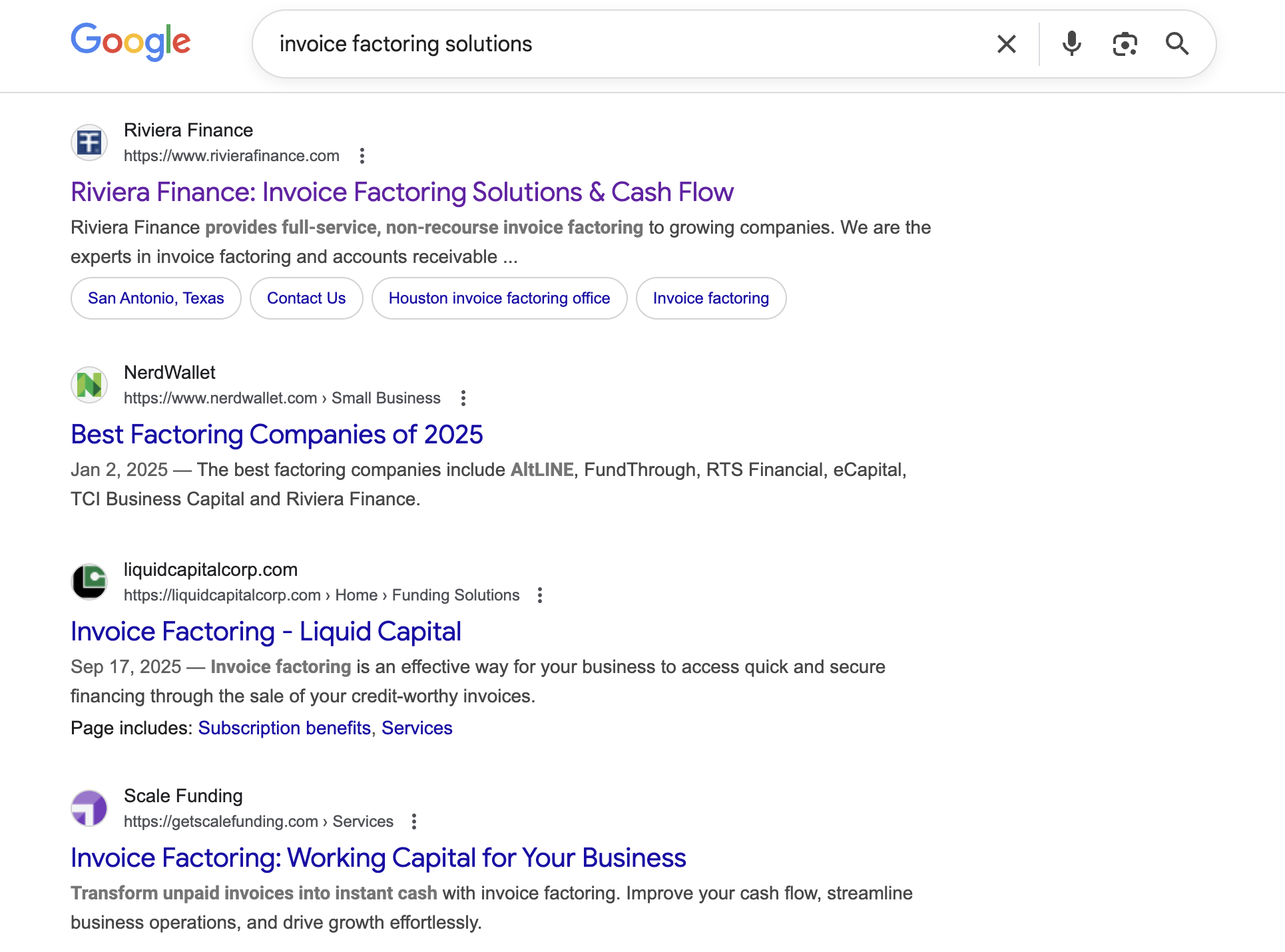
Riviera Finance and DAT show the difference well. Riviera Finance is an invoice factoring company that works with businesses in almost any industry, so Google treats it as a broad factoring provider. Search "invoice factoring" and Riviera Finance shows up next to lists of the best factoring companies:
DAT Freight & Analytics, on the other hand, builds everything around trucking: load boards, freight analytics and freight factoring through Outgo. Because its pages speak to one industry, it ranks high for a narrow search like "invoice factoring companies for logistics companies":
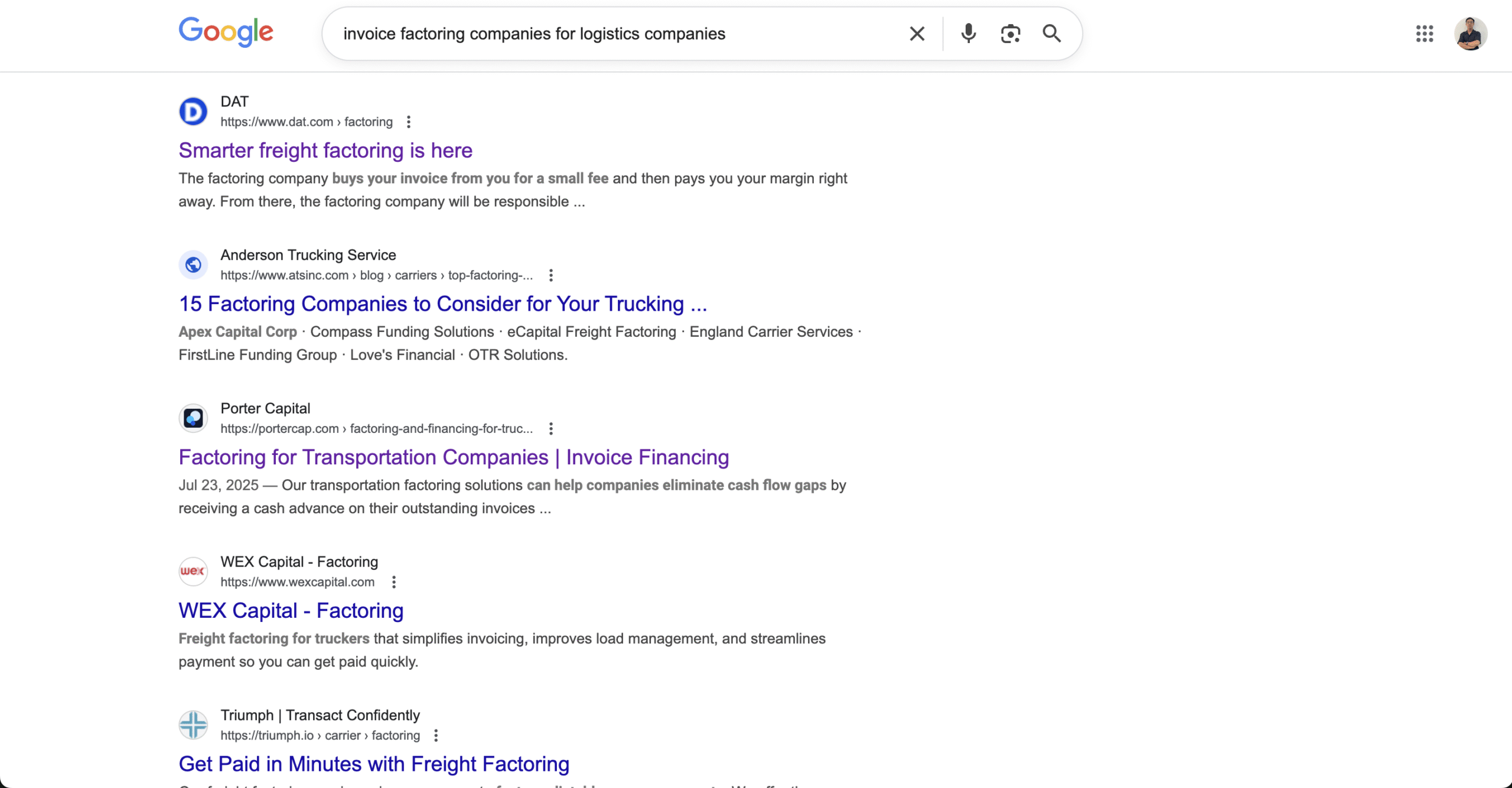
So if your positioning is clear and narrow, you can outrank bigger competitors in your niche. If it's broad, you may rank for general terms but struggle with the specific searches that bring buyers.
Step 3. Do your keyword research
Before I touch a keyword tool, I start with audience research. If you don't know how your buyers think and talk, you can't write content they care about.
Here are my go-to sources:
- Sales calls: Your sales team hears buyer pain points every day, so ask them which ones come up most. If you record calls in a tool like Gong, read the transcripts and pull out the problems your product solves.
- Google's People Also Ask: Search terms related to your business and note the follow-up questions Google suggests.
- Reddit: Communities like r/fintech and r/Accounting are full of questions about choosing vendors, compliance headaches and workflow fixes. Reddit is one of my favorite keyword research tools, next to SEMRush and Google.
- Slack groups and forums: Watch how founders, CFOs and compliance leads describe their problems, and use their words in your pages.
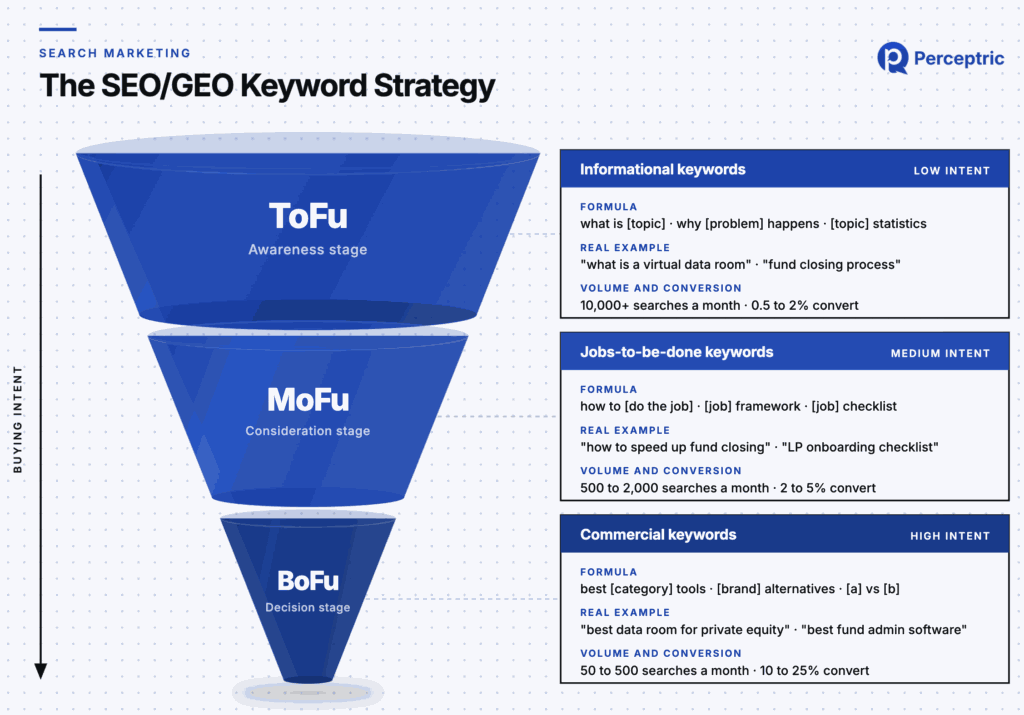
Then I sort keywords into four groups, in this order of priority:
| Keyword type | Example | Why it works |
|---|---|---|
| Competitor keywords | "stripe alternatives", "[competitor] vs [your brand]" | People comparing vendors already know what they need and are close to buying. |
| Listicle keywords | "best accounts payable software for startups" | They reach buyers building a shortlist, so you can get onto it. |
| Pain point keywords | "how to reduce failed payments" | The searcher has a specific problem your product can solve. |
| Lead magnet keywords | "cash flow forecast template" | Templates and calculators bring useful traffic and email sign-ups. |
For each group, here's how I use Ahrefs or SEMRush:
- Start with competitors: Enter a competitor's domain to see the keywords it ranks for, or enter a seed keyword to get related searches.
- Pick the easy wins: Look for keywords with decent volume and low competition.
- Repeat: Run the same process across several competitors and seed terms until your list stops growing.
Our B2B keyword research guide goes deeper on this step.
Step 4. Create content that's hard to copy
Anyone can publish content now that AI writes a draft in seconds, as I wrote in B2B content before and after 2025. So the edge that lasts is something others can't easily copy: your own data, firsthand experience or a clear point of view.
Here's how I build an SEO piece for a term like "B2B SaaS marketing":
- Check the right market: Set Google to show results for your target market, such as the US or UK.
- Study the top results: Note which formats Google prefers (guides, lists or case studies), how deep they go and where they leave gaps.
- Read the forums: Look at Reddit threads on the topic to see what real users care about.
- Write for people first: Answer exactly what the searcher expects, around one core keyword, with a clear H2 and H3 structure, short paragraphs and real screenshots.
- Link it in: Link to your related pages, and add links from older pages to the new one.
Then I add the part only you have, like an opinion from the founder or a lesson from a customer project. You don't need a 5,000-word thesis to show thought leadership. One sharp paragraph in the right place often does it.
Here's what makes a fintech post feel like it came from a leader:
- Built by operators: It comes from people who've actually done the work, tested it and learned from it.
- A clear stance: Even a basic explainer gets stronger when it takes a position.
- Mostly human-written: AI can help, but it can't add the perspective of someone who's been in the room.
- Grounded in data: Real numbers earn links and make a long article easier to trust.
Thought leadership is the Narrative part of my Knowledge-Narrative content strategy, and our thought leadership guide covers it in more detail.
Step 5. Build links
Link building is the most boring and time-consuming part of SEO. Most of it comes down to asking other sites for a guest post or a link exchange, or paying for links.
Here are the tactics I find more rewarding:
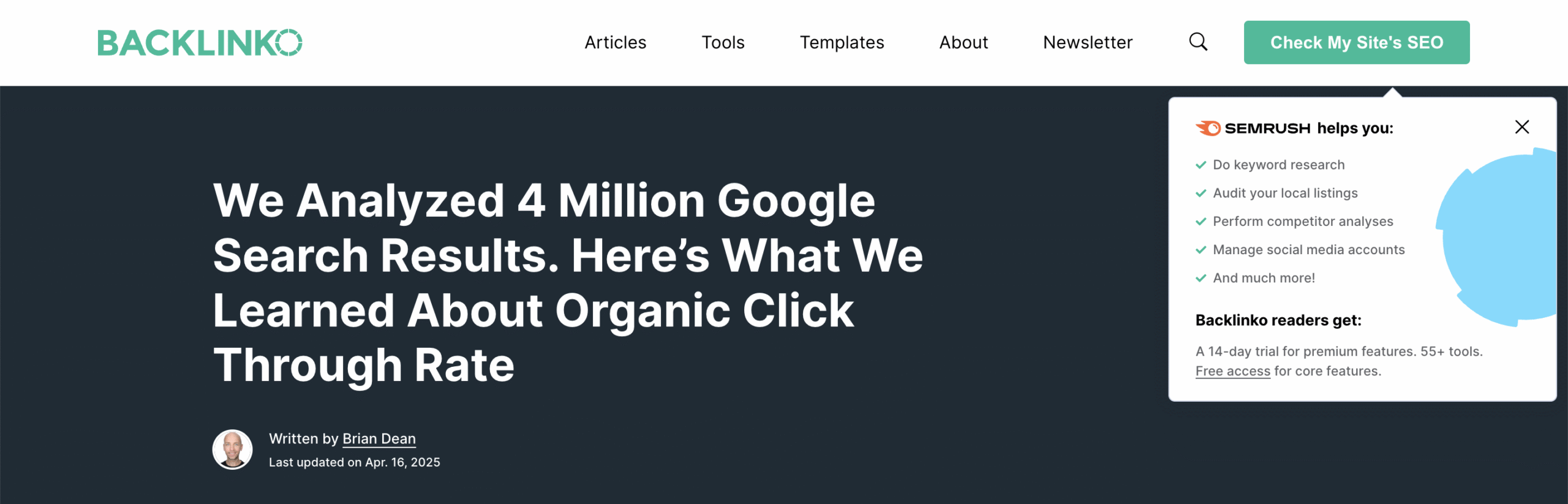
- Publish data people want to cite: Journalists and bloggers love citing well-presented data. Brian Dean built Backlinko this way, with studies like his analysis of 4 million Google search results.
- Build a simple tool: A free ROI calculator or cost estimator earns links from blogs that recommend resources.
- Pitch founders directly: Busy guest post sites get dozens of requests a day. Founders in your niche are often happy to take a free, useful article, especially if it brings them business.
Step 6. Monitor analytics
Pageviews and time on page say little about whether content brings pipeline. That's why I'd connect HubSpot with GA4 and Google Search Console.
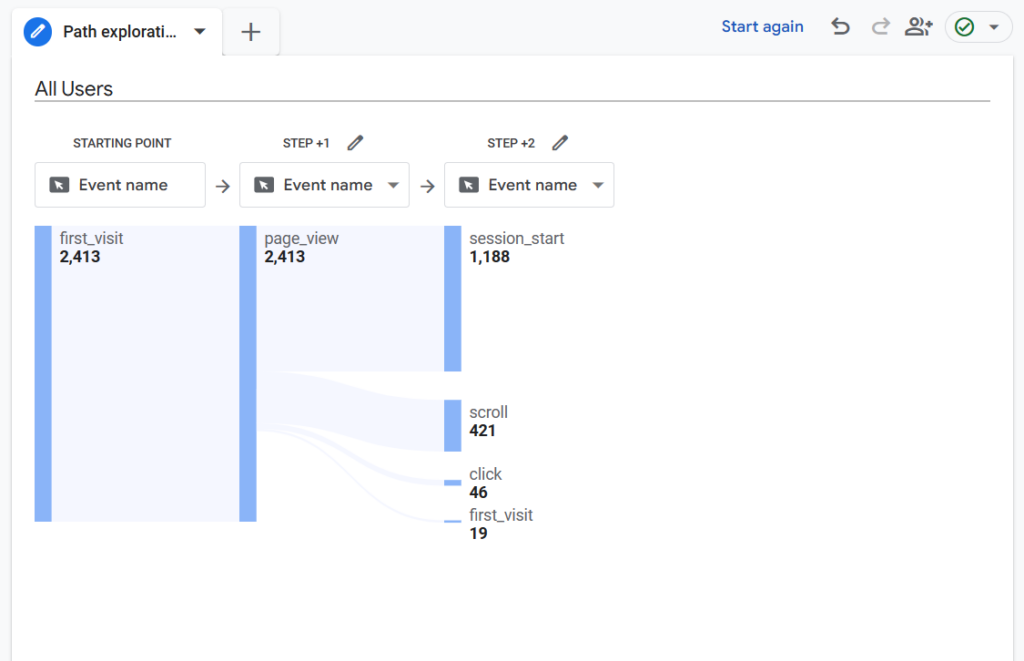
With GA4's event tracking, you can follow a buyer from a blog post to your pricing page to a demo request. Exploration reports also show assisted conversions, such as someone who reads a post, leaves and comes back through a branded search a week later. Just make sure every key button has an event tag.
Keep your top pages fresh as well. Search intent shifts, competitors publish newer pages and old advice loses trust, so refreshing a page Google already trusts is often the fastest traffic win you have.
Conclusion
Fintech buyers are tough readers, but my principles for SEO stay the same as in any B2B niche:
- Make your positioning clear and narrow
- Start with the searches closest to a purchase
- Write from real expertise, with real numbers
- Measure content by the pipeline it brings
Building trust through content takes longer than buying clicks. But if you were the CFO signing off on a payments vendor, wouldn't you want to read their thinking first?
For more, read why you need to go beyond SEO in B2B content marketing.
FAQ
What makes fintech SEO harder than regular SEO?
Finance buyers are analytical and spot marketing fluff fast, so content needs real expertise. Deals also involve a committee, often a CFO, compliance, procurement and a tech lead, and the sales cycle runs for months.
How long does fintech SEO take to work?
It depends on your domain and your market. Established domains and niche players can see results fairly fast, while new companies in crowded niches face a slow start.
What keywords should fintech companies target?
Start with competitor keywords like "[competitor] alternatives", since those searchers are close to buying. Then target listicle keywords, pain point keywords and lead magnet keywords such as templates.
How can a fintech company build backlinks?
Publish original data that others want to cite, build a simple free tool like an ROI calculator and offer useful articles directly to founders in your niche.
Want to keep learning? Read our guides on SEO for engineering companies, SaaS keyword research, how to find the best B2B SEO agency and B2B SEO statistics.