
In our experience, organic search is the number one channel for lead generation. There are several reasons why:
-
1
Organic search has the highest intent
Unlike social media or display ads, organic search captures people who are actively looking for a solution at that exact moment. They have already identified a need (which is why they are searching), you're just showing up at the right time. That's a fundamentally different (and more valuable) conversation than interrupting someone scrolling their feed.
-
2
Search value compounds over time
Paid search gives you immediate, controllable traffic, but the traffic stops if you pause the campaign. And CPC (cost-per-click) is rising higher and higher with every new competitor joining the game. SEO builds a long-term asset that generates leads around the clock without paying per click.
Therefore, we structure our core services around SEO. We believe it's the single most effective channel that, when done right, can bring tremendous value to your business, beyond all other channels.
But, of course, the catch here is "done right".
Why we focus on BOFU instead of TOFU
If you're doing marketing, you're probably aware of the marketing funnel. It describes where a potential buyer is in their decision journey.
We are particularly interested in the TOFU (Top of Funnel) and BOFU (Bottom of Funnel), which are the two ends of the funnel's spectrum.
We have seen way too many agencies design their organic search strategy around keywords at the TOFU stage. Such keywords drive a lot of organic traffic, but more often than not they don't bring a lot of business value.
Why is that? Because TOFU search is purely educational. The searcher of TOFU topics is just trying to understand a concept, not buy something. Think of keywords like:
"What is CRM software?" (14.8K searches/mo)
"Lead generation" (22.2K searches/mo)
"Automation testing" (28.9K searches/mo)
If someone searches for "What is a CRM software?", it's quite likely that they are a beginner in the field. Someone with actual buying power will never Google such keywords. Why does a VP of Marketing in need of a CRM have to search for something so basic?
If you keep publishing "What-is" articles, you are only driving thousands and thousands of beginner-level people to your website. I'm sure you don't want that.
You want to bring decision makers, managers, VPs, directors, and C-levels (people with budget) to your website, who will eventually convert into paying customers.
The problem with TOFU content is that it casts an enormous net, only to catch a very small fraction of real prospects. The good prospects already know why they need to invest in a product like yours. They don't need to read top of the funnel content.
Moreover, AI Overview is already doing a good job at answering the TOFU slice of the cake. It's just not resource-efficient to focus on TOFU, especially when you really need to generate sales-qualified leads.
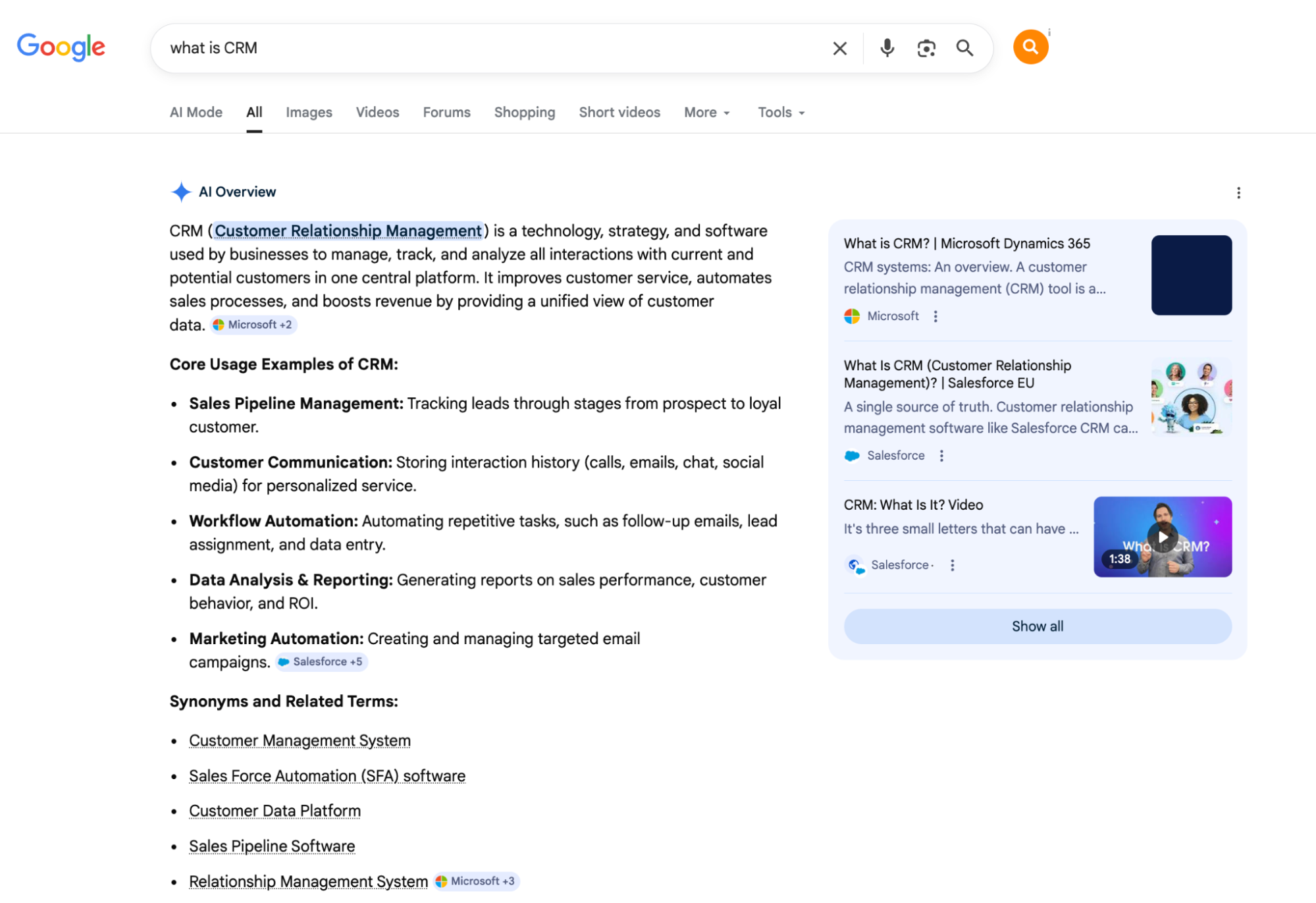
And yet, so many SaaS companies and SEO agencies are still chasing TOFU keywords. Because high traffic looks good on paper.
Instead, what you want to do is focus on BOFU searches, which usually look like this:
"Best CRM software for small business"
"HubSpot vs Salesforce"
"Top email marketing platforms"
"[Your competitor] pricing"
The searchers of BOFU keywords know what solution they need. They are just evaluating options and getting ready to make a decision.
Let's say I am a VP of Marketing looking to onboard a CRM solution. Naturally I would Google "Best CRM software for small business" and click on the #1 result. This is what I see:
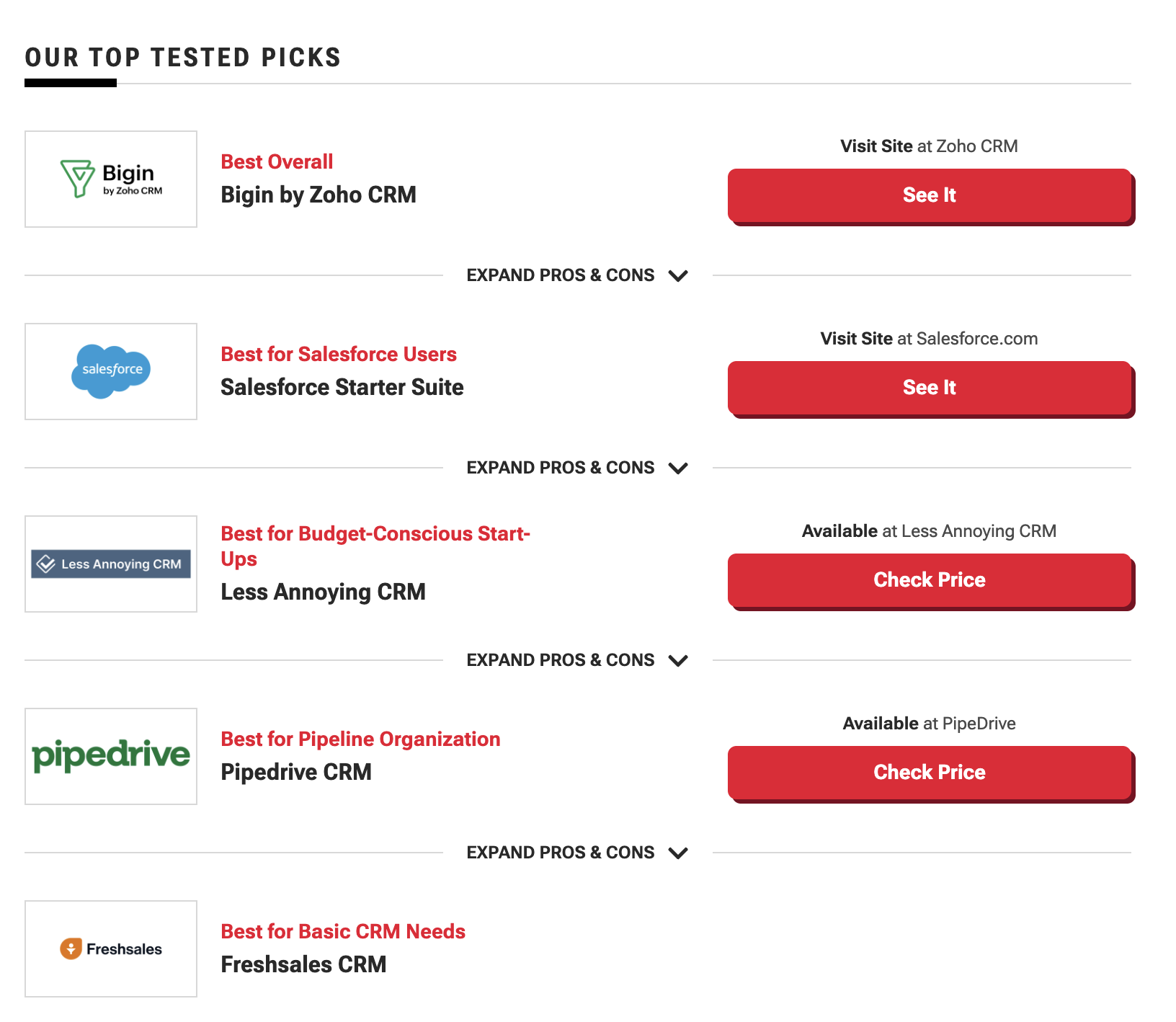
That's exactly the kind of content I want to read when I'm in buying mode. I get to compare solutions, check out their pricing, and see the pros and cons.
That's exactly where you want your product to show up.
Remember: someone typing "best CRM software" have already decided they have a problem and a CRM software is the solution. The only question left is which CRM to go with. They have demand, your job is to convince and convert.
The conversion power of BOFU content
The posts with the highest volume of traffic often have the lowest volume of conversions. And vice versa, the posts with the lowest volume of traffic often have the highest volume of conversions.
We arrived at that conclusion after looking at the conversion rate on the blog of one of our clients in the span of three quarters. The contrast is unbelievably clear :
In fact, this pattern shows up across all clients we work with. The traffic vs. trial ratio also seems to follow the 80:20 rule: roughly 80% of traffic drives 20% of product trials, and 20% of the remaining traffic drives 80% of product trials.
But what if these BOFU keywords have low volume?
Our clients asked us that question a lot, and they have valid reasons.
If you've done any keyword research before, you should recognize a pattern where B2B SaaS commercial keywords tend to have relatively low search volume compared to their B2C or TOFU counterparts.
Here's how we counter that concern:
-
1
Volume without intent is just noise
A BOFU keyword like "best API testing tools" might get 1,000 searches a month, but every single one of those searchers has a problem and is actively evaluating their options. That's 1,000 high-intent prospects handed to you. Compare that to "what is API testing": 50,000 searches a month, mostly students, curious developers, and people who will never buy anything.
-
2
B2B search volume is naturally smaller, and that's fine
The high-volume keyword obsession comes from B2C SEO, where the TAM is in the millions. Of course "best running shoes" gets 200,000 searches a month. But we're not B2C, we're B2B, and things are different here. You're selling to companies, which shrinks the TAM, but your ACV is orders of magnitude higher. A SaaS product closing $20,000 ACV deals doesn't need 100,000 visitors. It needs 500 of the right ones. Judging B2B SEO by B2C volume benchmarks is comparing apples to oranges.
-
3
One article ranks for dozens of keywords at once
No page ranks for just one keyword. A single well-optimized BOFU article naturally captures dozens of variations and long-tail versions of the target keyword. "Best automation testing tools" also ranks for "top Selenium alternatives," "automation testing software comparison," "QA tools for enterprise," and so on. When you add up the collective search volume across all those keywords, you're often looking at several thousand searches per month from a single article.
Another advantage of BOFU content for SaaS
BOFU content is perfect for SaaS companies because it fits in seamlessly with product-led growth.
It's simple:
- The CTA writes itself. BOFU content naturally leads to a "start your free trial" or "get started for free" call to action. There's no awkward leap from content to conversion because the reader's intent and your offer are perfectly aligned. Both are designed for a buyer who wants to move at their own pace, do their own research, and make their own decision.
- It feeds the self-serve funnel. PLG companies live and die by self-serve signups. BOFU content drives exactly the people who want to try the product now, without talking to sales. The entire journey from problem to solution happens digitally and independently.
So when you put them together, the flywheel is seamless: someone searches for a solution, lands on your BOFU article, reads your honest comparison, clicks "start for free," and is inside the product within minutes. No human touched that conversion. That's the point.
How to do BOFU SEO for SaaS?
Keyword research
Keyword research at its core is product and customer research. You need to map your product features and customer persona to the right keywords. It is a cherry-picking process, not about chasing volume, but about finding the terms your best-fit buyers are actually searching for.
Read the full guide on B2B keyword researchAnalyze content gap and write
Look at the top performing articles for the keywords you picked. It gives you a sense of what kind of content people engage with in that space. This is an abstract process to get right. It is about reverse-engineering the UI/UX that wins for that specific term, and delivering the same or better experience.
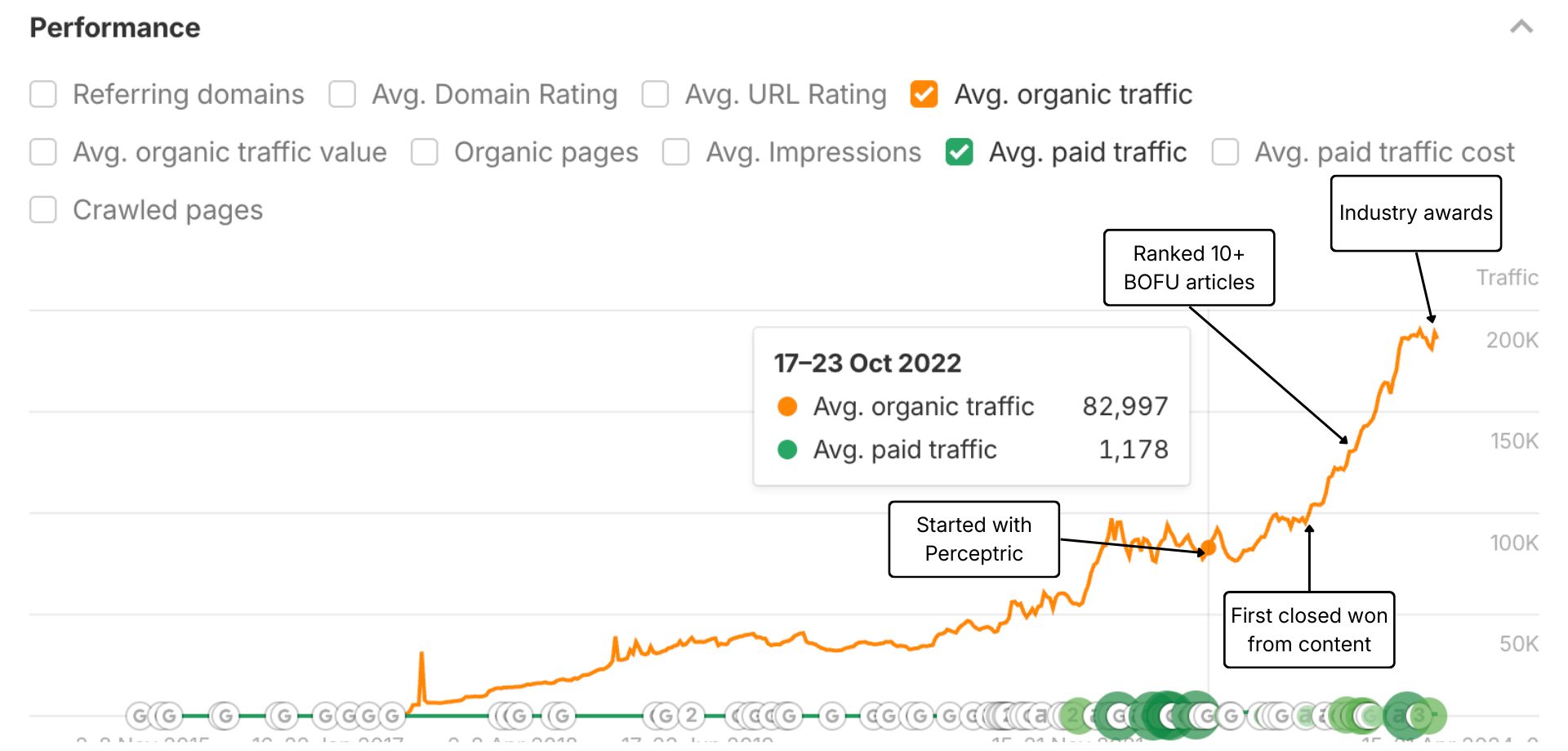
How We Scaled Katalon ARR By $12M+
For a long time, we also believed top-of-funnel content was the path to growth. And by the numbers, it looked like we were right. Katalon was ranking for a lot of TOFU keywords, and the dashboard looked healthy.
However, when we pulled the data on every post and looked for patterns, we realized that the topic of a blog post was the single biggest driver of conversion rate, much more than writing quality or any on-page optimization. And bottom-of-funnel posts were literally outconverting TOFU content by 10 to 20 times.
That's when the TOFU topics that had delivered hundreds of thousands of sessions got deprioritized almost entirely. We redirected that energy toward comparison pages, alternative roundups, use-case tools lists, and how-to content tied directly to Katalon's product.
Within nine months, organic traffic grew 300%. Revenue attributed to organic search crossed $12M. The traffic that had looked great on paper but gone nowhere was replaced by traffic that was arriving with a problem to solve, and finding Katalon as the answer.
Perceptric helps B2B SaaS companies grow SEO and also get recommended by AI Overview with exceptional content.
Let's talk strategy