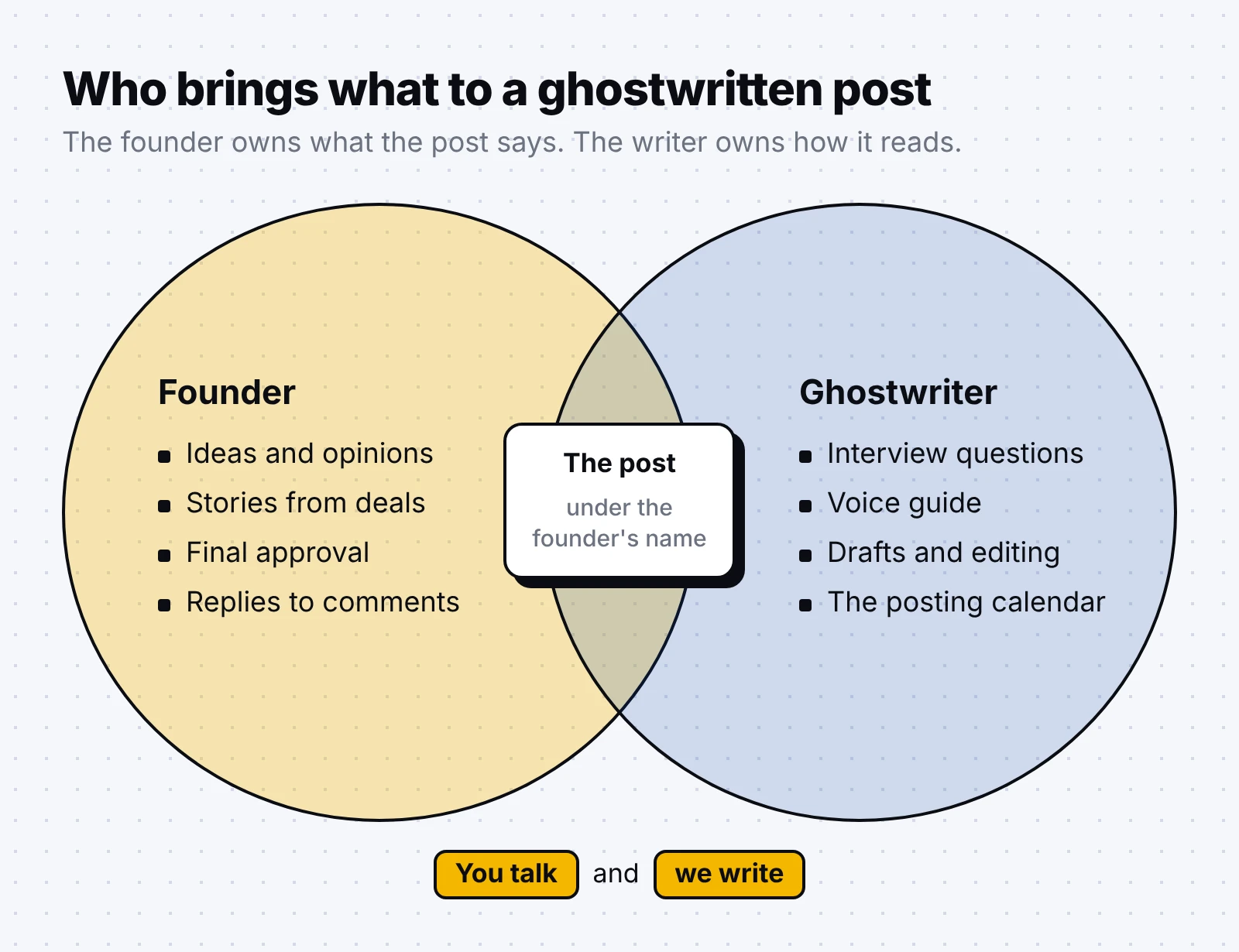
A LinkedIn ghostwriter turns a founder's ideas and stories into posts that go out under the founder's name on a steady schedule. The founder brings the ideas and approves every post. The ghostwriter brings the craft and the calendar.
We've published 1,000+ posts through our LinkedIn service, and this is the process we run. You'll see how a week of LinkedIn ghostwriting works, what a finished post looks like next to the raw notes, what it costs and how to tell whether it brings in pipeline.
What is LinkedIn ghostwriting?
LinkedIn ghostwriting is a service where a writer drafts LinkedIn posts, comments and newsletters for a founder or executive, in that person's voice and from that person's ideas. The executive reviews and approves each post, and it goes out from their own profile.
It's a narrow kind of SaaS copywriting. The difference is whose name sits on top, so the writing has to sound like one real person with real opinions.
Our rule for the work fits in four words: you talk, we write. A writer who makes up opinions for you is writing fiction. A writer who waits for you to send drafts is an editor. The job sits between the two.
Why SaaS founders hire a LinkedIn ghostwriter
Founders hire a ghostwriter for three separate reasons: buyers read founders before the first call, writing takes hours they don't have and AI answers now quote LinkedIn posts.
Buyers read the founder before the demo
Most of the buying decision happens before your team hears about the deal. In 6sense's November 2025 research, 94% of buyers ranked their vendor shortlist before speaking with sales, and nearly 80% bought from their first choice.
During that time, a founder's posts are one of the few things you control that a buyer can read. The 2024 Edelman and LinkedIn B2B Thought Leadership Impact Report shows how much that reading counts:
- 52% of decision makers and 54% of C-suite executives spend an hour or more each week reading thought leadership content.
- 75% of decision makers and C-suite executives say a piece of thought leadership led them to research a product or service they were not considering.
- 9 in 10 say they are more receptive to sales or marketing outreach from a company that keeps producing high quality thought leadership.
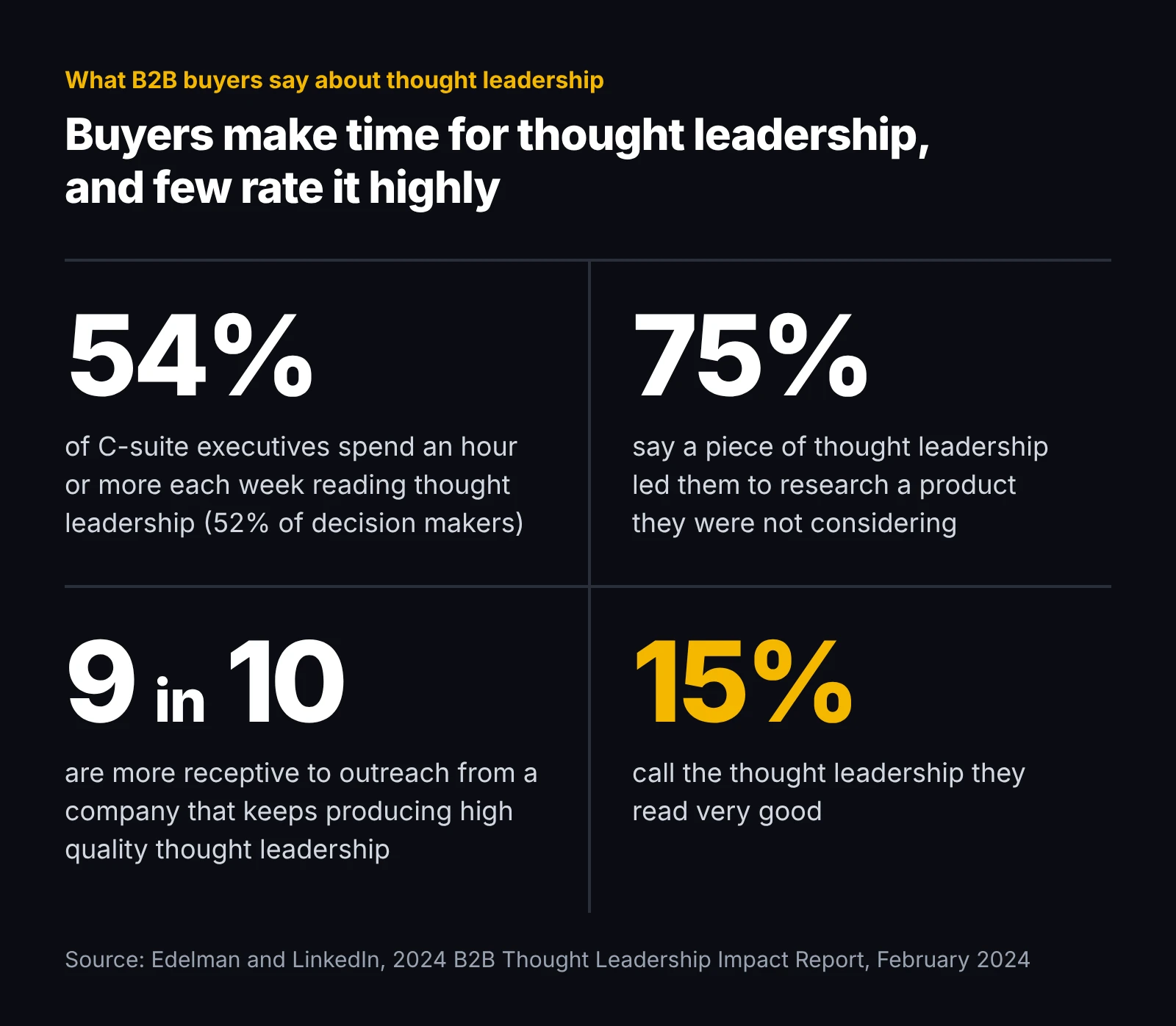
The same report has a warning in it. Fewer than half of decision makers said the thought leadership they read is good, and only 15% called it very good.
Founders don't have the hours
The posts that work come from things only the founder knows: the deal that stalled, the feature that got cut, the question every prospect asks in week two. Saying those things out loud takes minutes. Turning them into a post that holds a buyer's attention takes hours, every week.
So the pattern we see most often is a burst of posts in a quiet month and silence in a busy one.
The schedule matters more than founders expect. In Semrush's March 2026 study of 89,000 LinkedIn URLs cited in AI answers, around three quarters of the cited post authors had published more than 5 posts in the previous four weeks.
Founder posts show up in AI answers
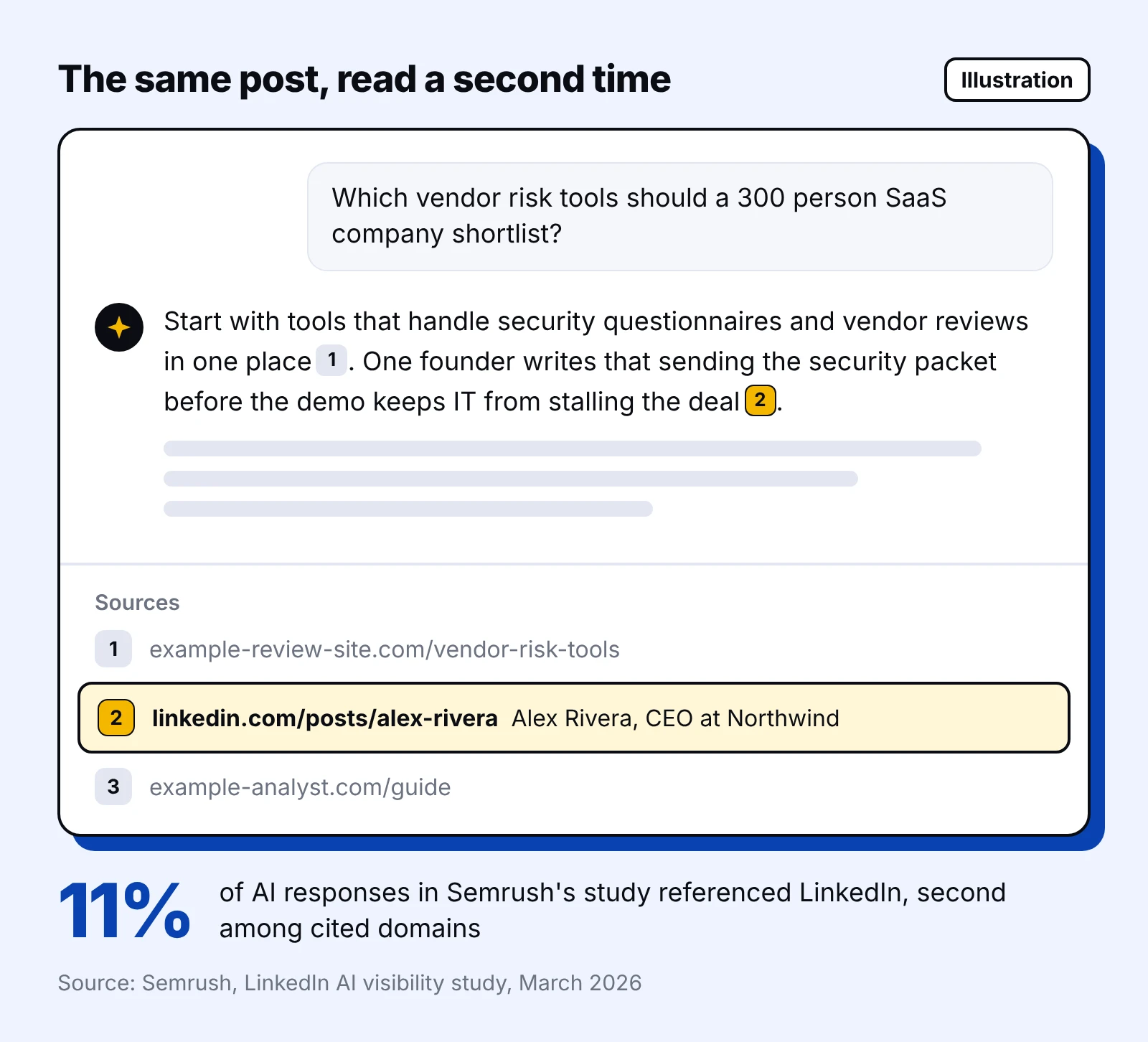
The same Semrush study found that 11% of AI responses reference LinkedIn, which put it second among cited domains in its dataset. On ChatGPT Search and Google AI Mode, individual members made up 59% of LinkedIn citations.
So a founder's post can reach a buyer twice: once in the feed and again when that buyer asks ChatGPT which tools to shortlist. Our guide to AI brand mentions from LinkedIn thought leadership covers how that works and how to track it.
Is LinkedIn ghostwriting ethical?
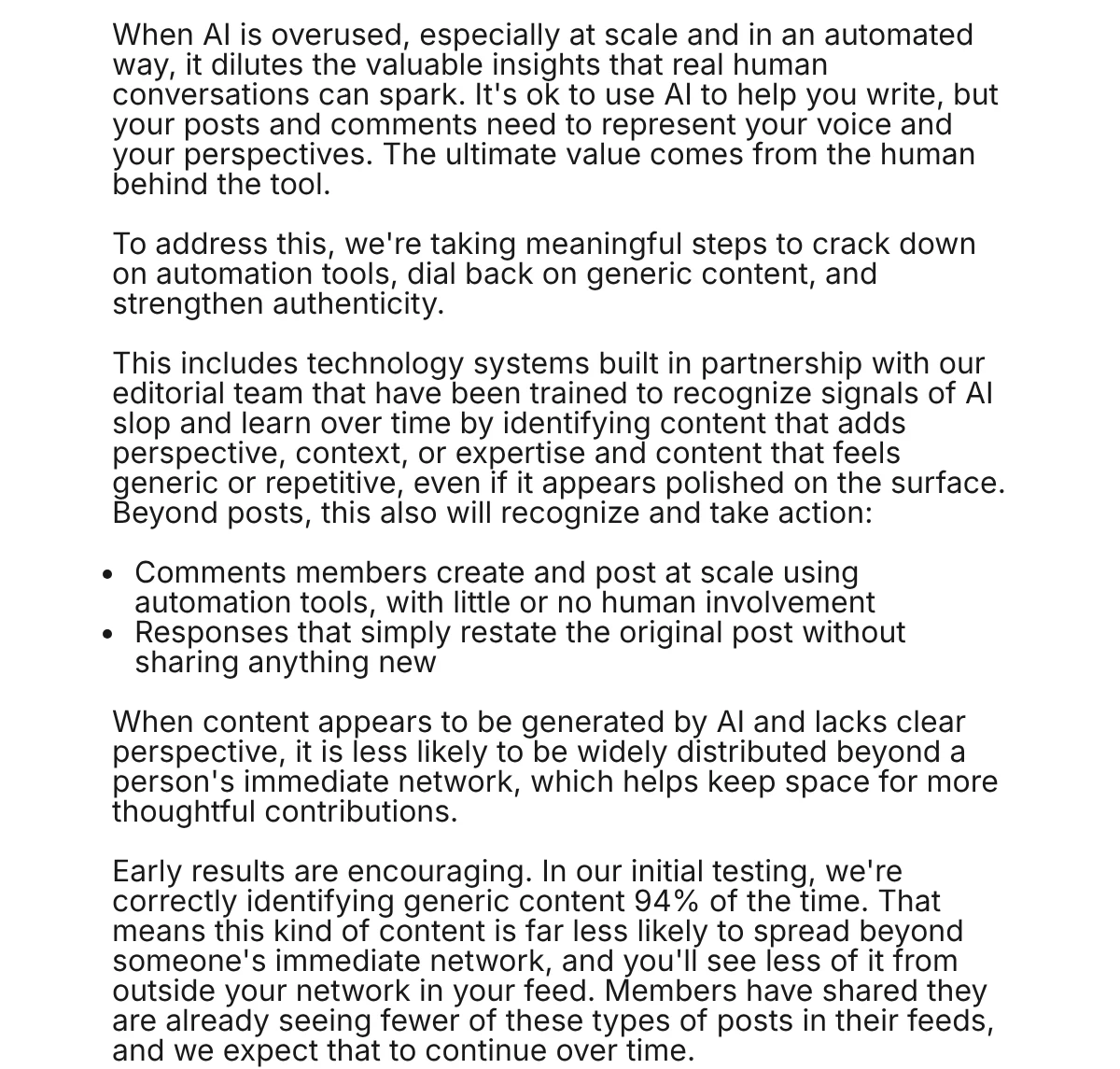
Yes, when the ideas and opinions are the founder's and the founder approves every post before it goes out. LinkedIn draws the same line for AI. In its June 2026 update on authentic content, LinkedIn said using AI to help you write is fine, as long as your posts and comments "represent your voice and your perspectives."
Apply that test to a human writer and the rules follow. The ghostwriter shapes the words, and the founder owns what they say.
Ghostwriting crosses the line in four places:
- The writer invents a story, a result or a customer the founder never mentioned.
- A post goes live without the founder reading it.
- The writer logs in as the founder. LinkedIn's User Agreement (effective November 3, 2025) bans using another member's account, including by sharing login details.
- Comments and replies are posted by automation. The same agreement bans bots that comment on, like or share posts to "drive inauthentic engagement".
If a prospect asks whether you write your own posts, say a writer helps you. The ideas in the post are still yours.
How LinkedIn ghostwriting works in 6 steps
Good ghostwriting runs on interviews. The founder talks, the writer records and the drafts come from the transcript.
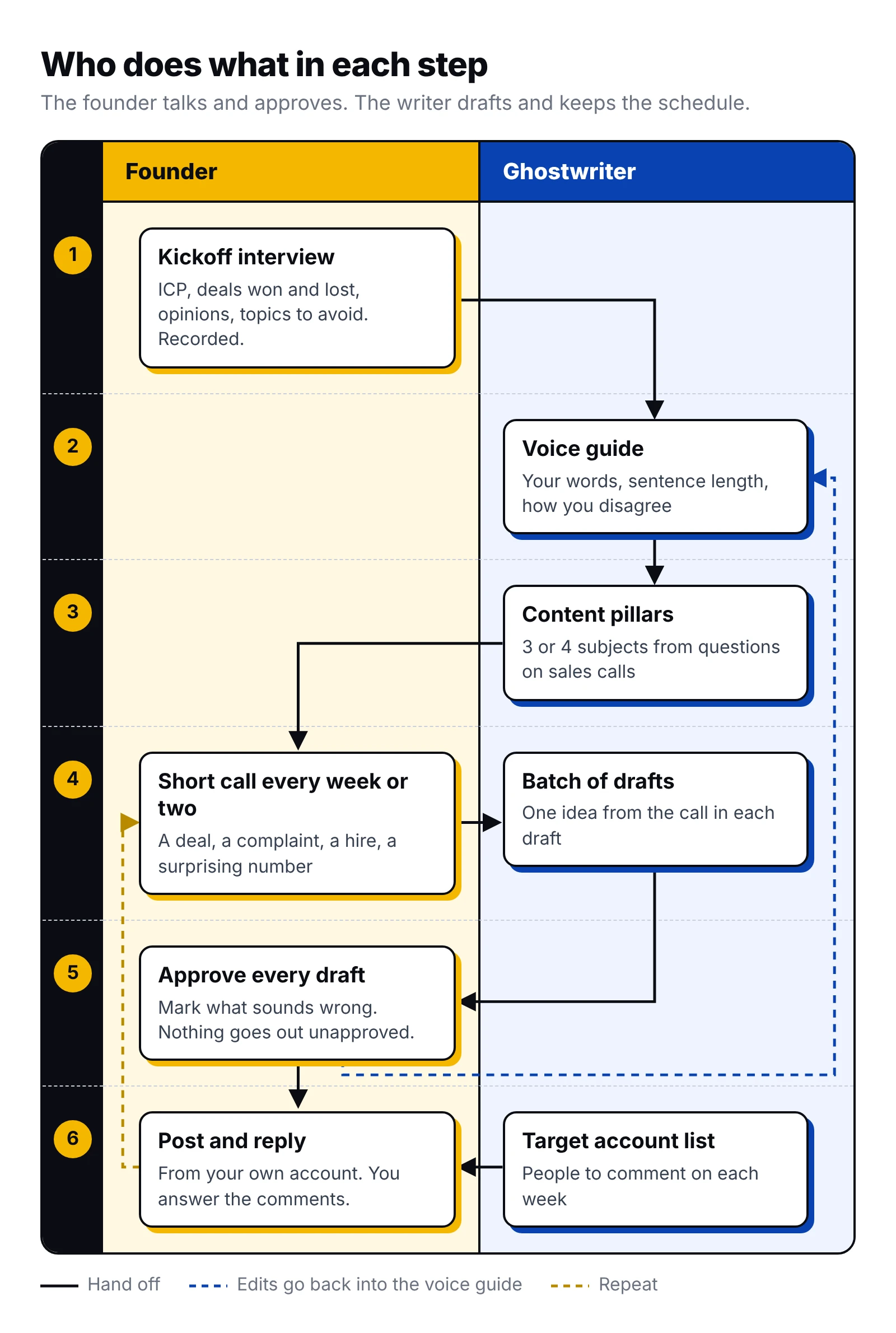
1. Kickoff interview
The first call is the longest. The writer asks about your ICP, the deals you won and lost this year, the opinions you argue with your team and the topics you won't touch in public. Record it, because the transcript feeds every step that follows.
2. Voice guide
The writer turns the kickoff transcript and any posts you wrote yourself into a voice guide. It lists the words you use and the ones you never would, how long your sentences run, how you open a point and how you disagree with someone.
A voice guide is what stops your posts from drifting toward the same tone as everyone else's. Ask to see it before the first draft.
3. Content pillars tied to sales questions
Content pillars are the three or four subjects your posts keep coming back to. Pick them from your sales calls. If prospects keep asking how you handle security reviews, how long setup takes or why you cost more than a rival, each of those is a pillar.
Our post on how your sales team can inform content strategy shows how to pull those questions out of call notes and your CRM.
4. An interview and drafts every week or two
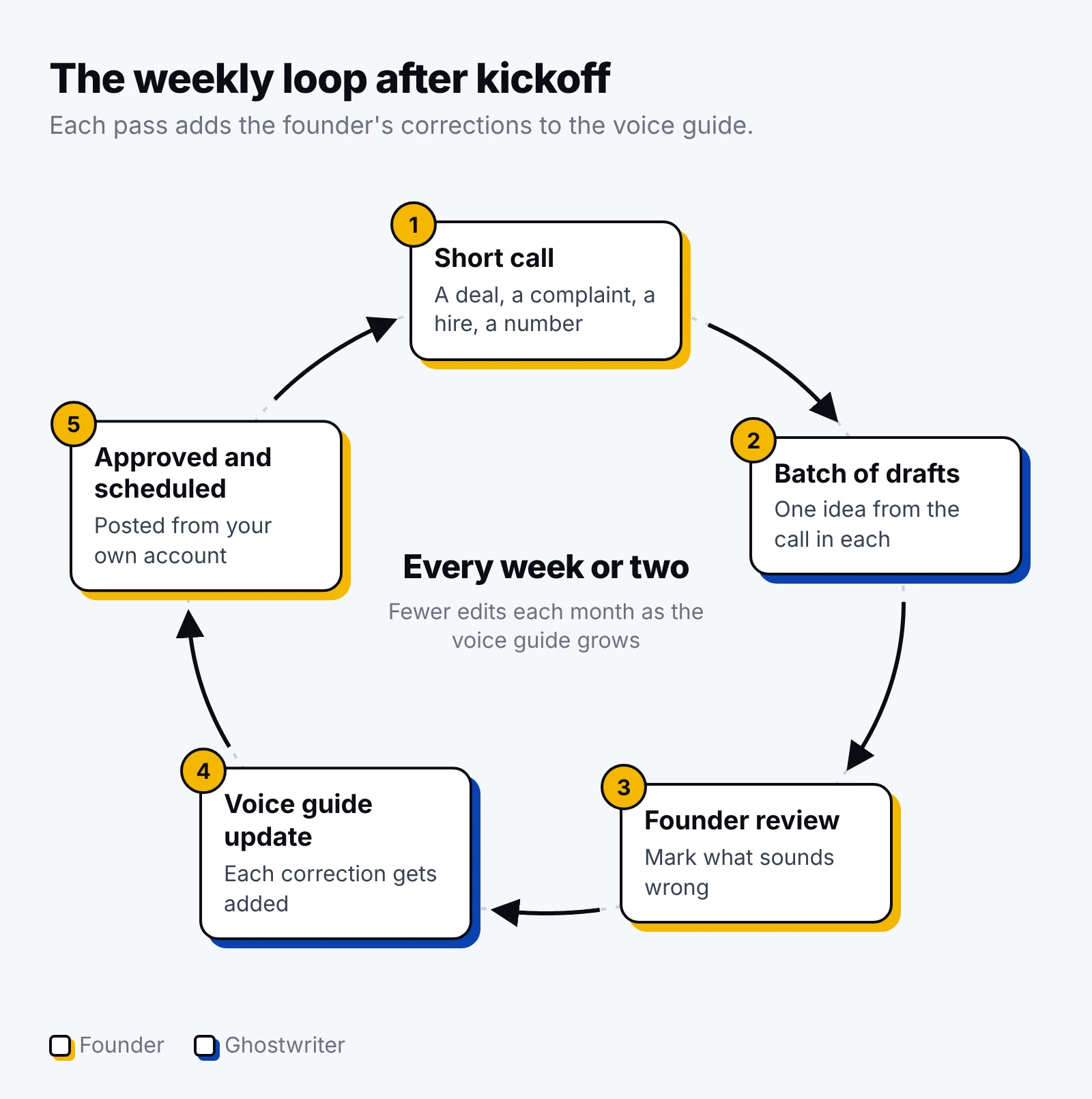
After kickoff, the writer books a short call every week or two. Bring what happened since the last one: a deal, a customer complaint, a hire, a number that surprised you. The writer turns the recording into a batch of drafts, each built on one idea from the call.
5. Founder approval
You read every draft and mark what sounds wrong. A good writer adds each correction to the voice guide, so the drafts need fewer edits each month. Nothing goes out until you approve it.
6. Posting and replies
The post goes out from your own account. LinkedIn lets you schedule a post from the share box with the clock icon, so approved drafts can be queued in one sitting.
Answer the comments yourself. The writer can hand you a list of target accounts and their people to comment on each week, which is where our guide to LinkedIn ABM for B2B SaaS picks up.
What a ghostwritten SaaS post looks like
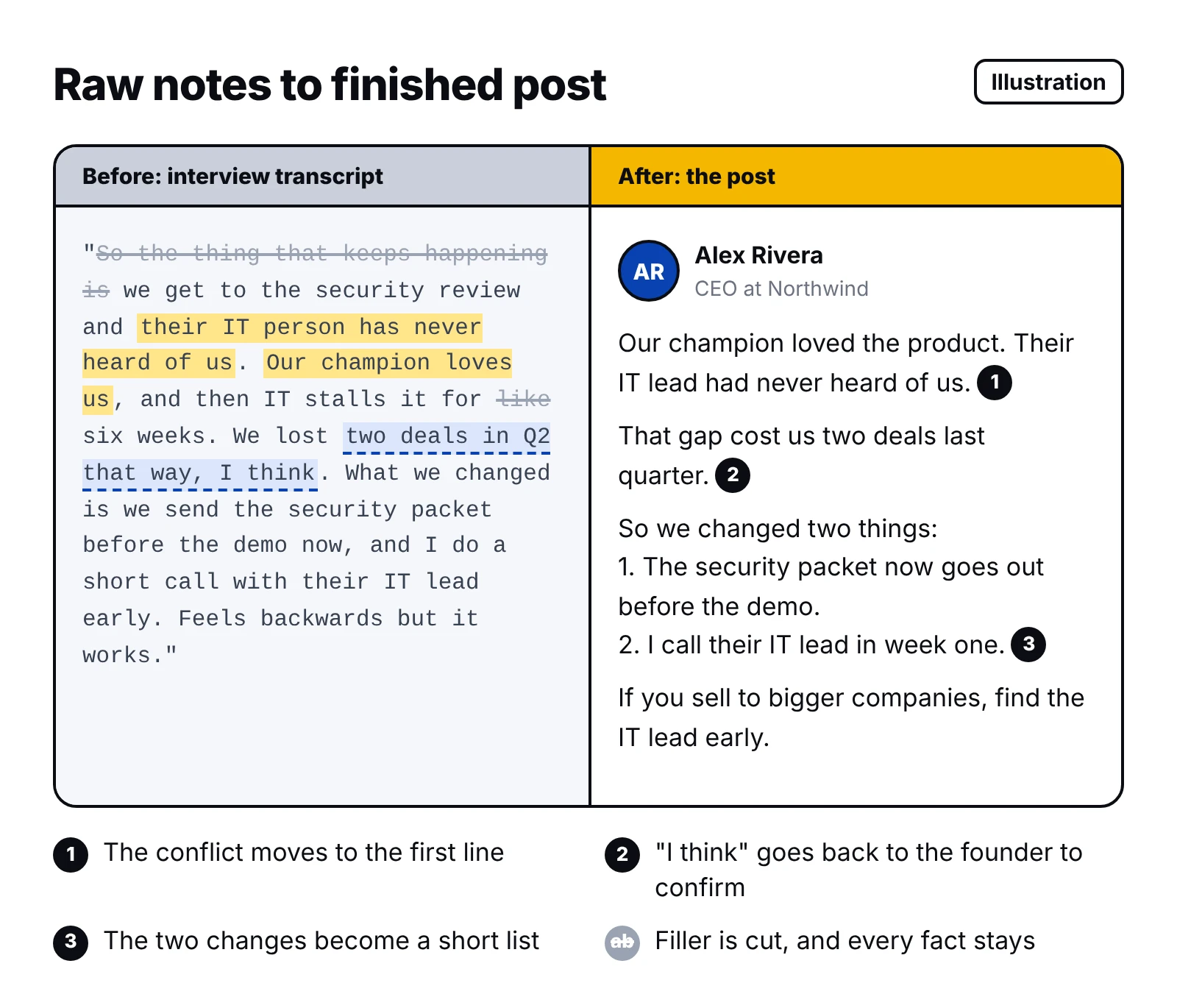
The quickest way to judge a ghostwriter is to put the raw notes next to the finished post. The writer should keep every fact and opinion and change the order, the cuts and the opening.
Illustration only: the founder, company and numbers below are made up to show the process.
Raw notes from a founder interview
"So the thing that keeps happening is we get to the security review and their IT person has never heard of us. Our champion loves us, and then IT stalls it for like six weeks. We lost two deals in Q2 that way, I think. What we changed is we send the security packet before the demo now, and I do a short call with their IT lead early. Feels backwards but it works. I'd tell any founder selling to bigger companies to find the IT person in week one."
The finished post
Every claim in the post comes from the notes. The writer moved the conflict to the first line, cut the filler and turned the two changes into a list. Before posting, the writer would ask the founder to confirm "two deals", because the notes say "I think".
Hook types and when to use each
The first line decides whether a buyer reads the rest. Each of these openings needs a real fact from the interview behind it.
| Hook type | Example (made up) | When to use it |
|---|---|---|
| The number | "We lost 2 deals in Q2 to one security review." | You have a figure from your own data and can explain it. |
| The correction | "Our best leads never filled in the demo form." | You disagree with common advice and can show why. |
| What broke | "Our biggest deal of the year sat with legal for 9 weeks." | Something went wrong recently and you know the fix. |
| The sales question | "A CFO asked me last week how we price seats for contractors." | The same question comes up on sales calls every month. |
| The decision | "We cut our free plan in March. Here's what happened next." | You changed something and can share the before and after. |
Post formats to mix in
A text post on LinkedIn can run up to 3,000 characters, which is enough for most founder ideas. Mix in other formats when the idea needs them:
- Document posts (a PDF carousel) for a checklist or a step by step teardown.
- A single image for one chart from your own data.
- Short video when the founder explains better out loud than in writing.
- A LinkedIn newsletter or article for the long version of an idea.
Long pieces earn their place for AI search too. In the Semrush study, LinkedIn articles made up 50% to 66% of the cited LinkedIn content, against 15% to 28% for feed posts.
LinkedIn ghostwriter vs agency vs AI tool vs in-house
You have four ways to get founder posts written. The table shows what each one costs and where the gaps are.
| Option | Published price | Voice match | Founder time each week | Strategy included | Main risk |
|---|---|---|---|---|---|
| Freelance ghostwriter | $795 to $1,295 a month for 12 to 20 posts (one Contra listing) | Good if the writer interviews you | A short call and draft review | Rarely | One person: if they leave, the schedule stops |
| LinkedIn ghostwriting agency | $2,500 to $5,450 a month (Perceptric, StoryD) | Good with a voice guide and an editor | A short call and draft review | Yes: pillars, reporting and often design | Generic posts if the agency skips interviews |
| AI writing tool | $39 to $199 a month (Taplio) | Weak unless you feed it your own notes | The most: you write the prompts and edit every post | No | Generic posts that LinkedIn shows to fewer people |
| In-house writer | $76,910 median yearly pay for writers, before benefits (BLS) | Strong once the writer knows you | A short call and draft review | Depends on the hire | Hiring time, and one more person to manage |
Source: Contra, Clutch, Taplio and Perceptric price pages, read November 2026; US Bureau of Labor Statistics, May 2025 wage data
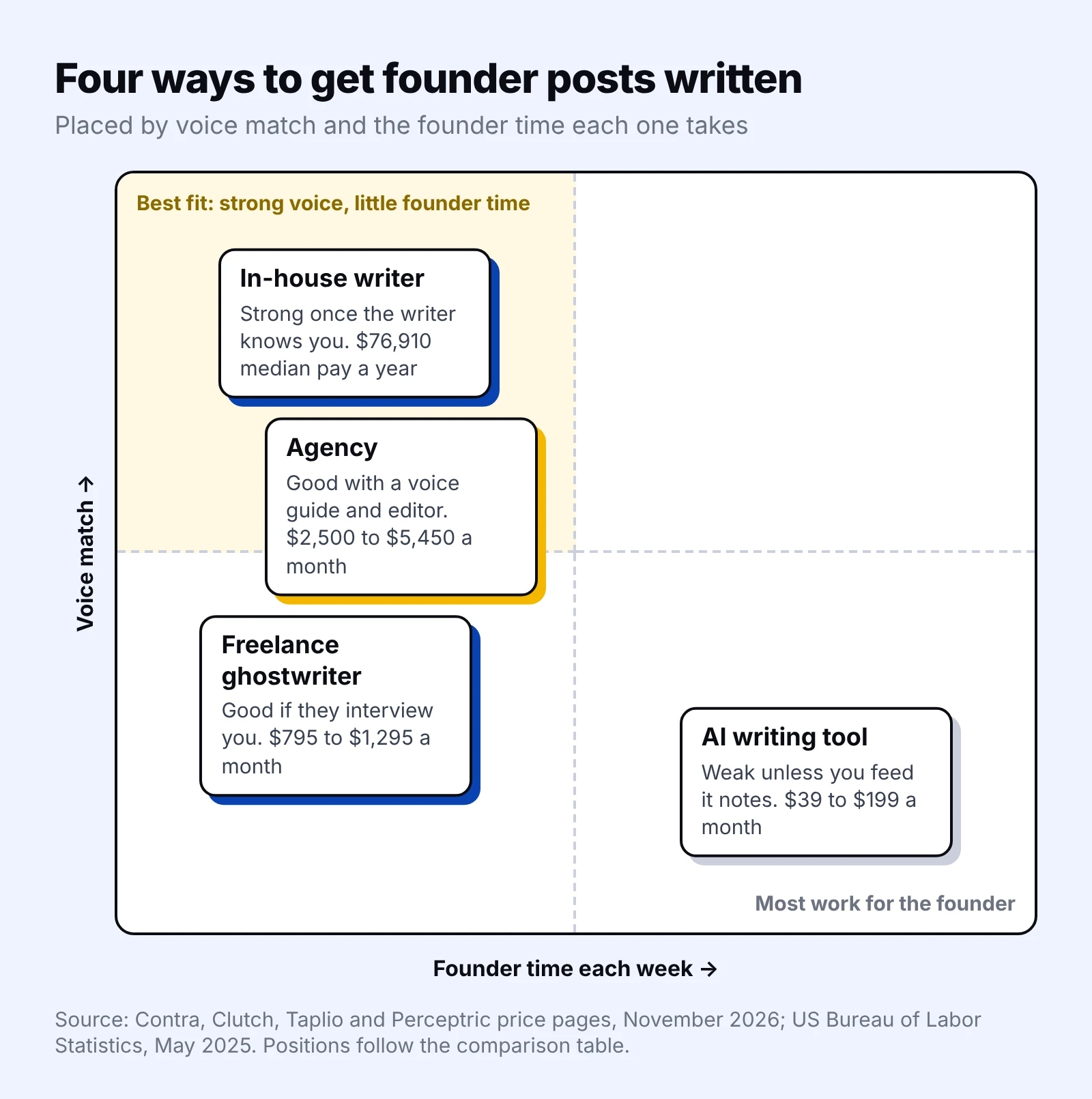
AI tools look cheap until you count the founder's hours, and that's the cost a ghostwriter exists to remove. LinkedIn has also said that when content "appears to be generated by AI and lacks clear perspective, it is less likely to be widely distributed beyond a person's immediate network". It reported catching generic content 94% of the time in early tests.
The feed is full of that kind of post. In Originality.ai's July 2026 sample of 5,000 LinkedIn posts of 100 words or more, its detector classed 81.2% as likely written by AI. Originality.ai sells that detector, so read the number as a sign of the trend.
Even LinkedIn's own AI writing tool for posts is listed as no longer available (read November 2026). AI still helps a ghostwriter with transcripts and outlines. The opinions have to come from the founder.
Who owns the work inside your team matters as much as which option you pick. Our post on B2B SaaS marketing team structure covers who should own LinkedIn.
How much does a LinkedIn ghostwriter cost?
Published prices run from $39 a month for an AI tool to more than $5,000 a month for an agency. The figures below come from providers that publish their prices, so treat them as examples from a small set.
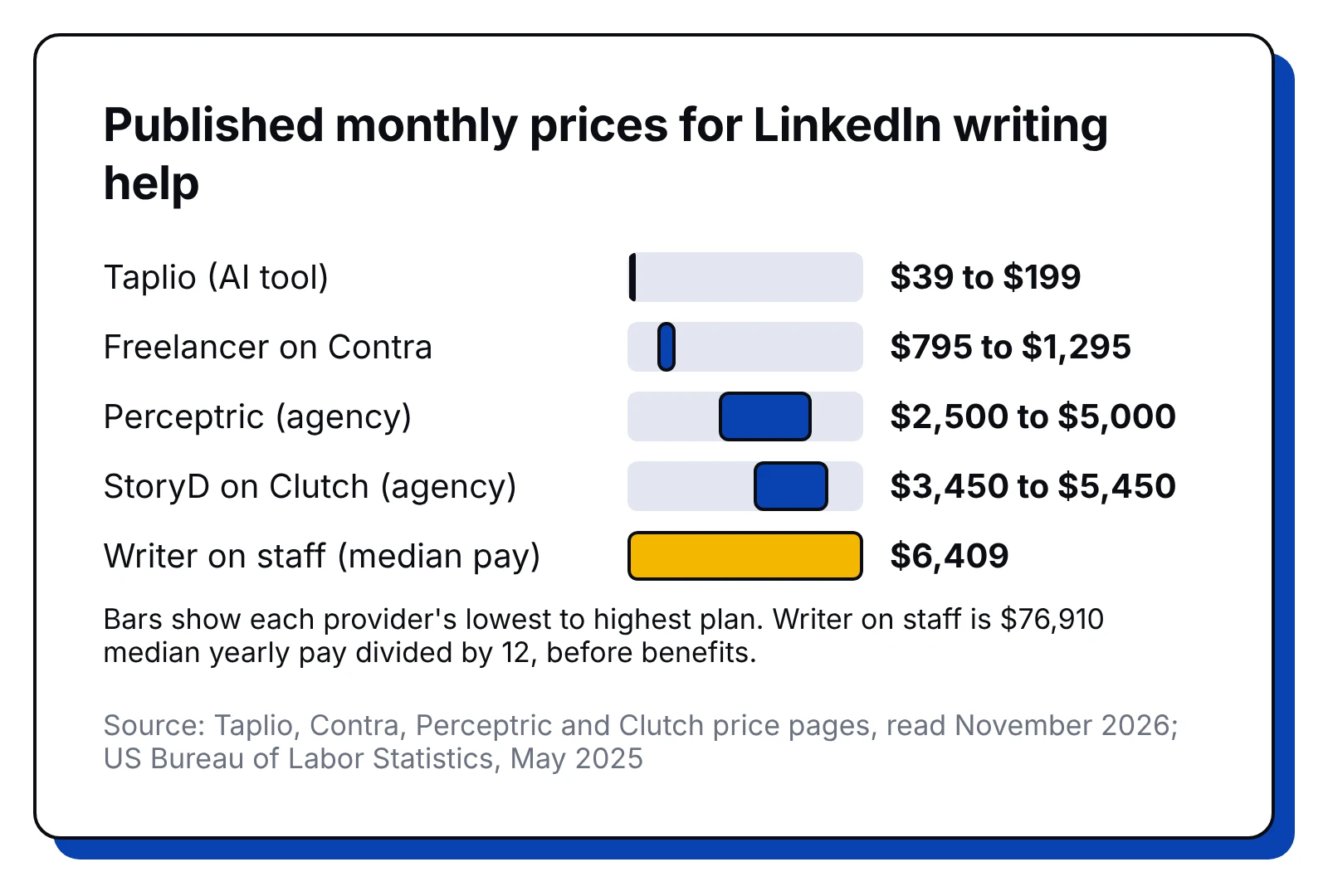
Here is what those providers list:
- Taplio, an AI tool for LinkedIn, charges $39, $69 or $199 a month on monthly billing.
- A freelance ghostwriter on Contra lists $795 a month for 12 posts, $995 for 16 and $1,295 for 20 with custom graphics.
- StoryD's Clutch profile lists LinkedIn packages at $3,450, $4,450 and $5,450 a month, with 2 or 3 posts a week.
- The US Bureau of Labor Statistics puts the median annual wage for writers and authors at $76,910 (May 2025).
Our own LinkedIn thought leadership plans are priced per profile per month on a contract of 12 months:
| Plan | Price a month | What it includes |
|---|---|---|
| Presence | $2,500 | 15 posts a month, 4 branded visuals, content plan and voice guide, monthly report |
| Momentum | $3,000 | Presence plus 20 posts a month, a LinkedIn newsletter 3 times a month, target account comment prompts and a monthly strategy session |
| Authority | $5,000 | Momentum plus a new lead magnet every quarter, a landing page and strategy sessions every two weeks |
A contract of 6 months costs 5% more, and 3 months costs 10% more.
Price per post is the wrong way to compare these. The Contra plan at $995 for 16 posts works out to about $62 a post, and our Presence plan to about $167. What you pay for is the interview, the voice guide, the editing and the strategy behind each post.
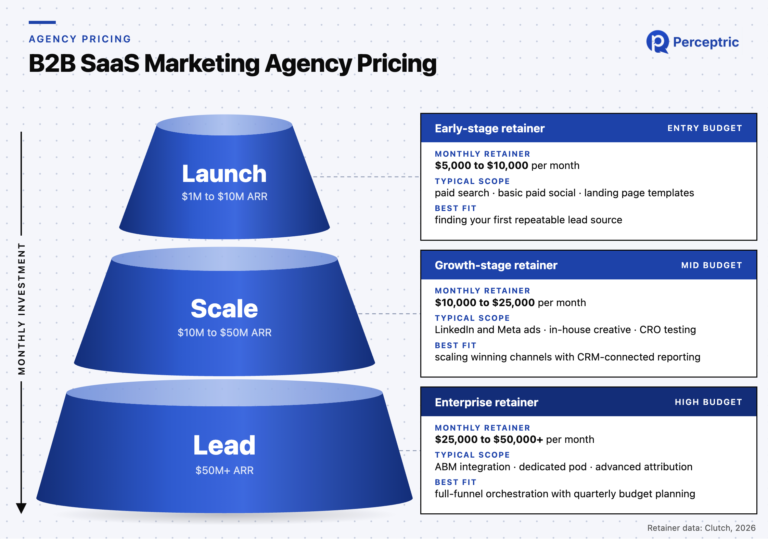
Four things move the price: posts per month, a newsletter, the number of executives and whether design and lead magnets are included. Our breakdown of B2B SaaS marketing agency pricing shows how LinkedIn fees compare with SEO and paid retainers.
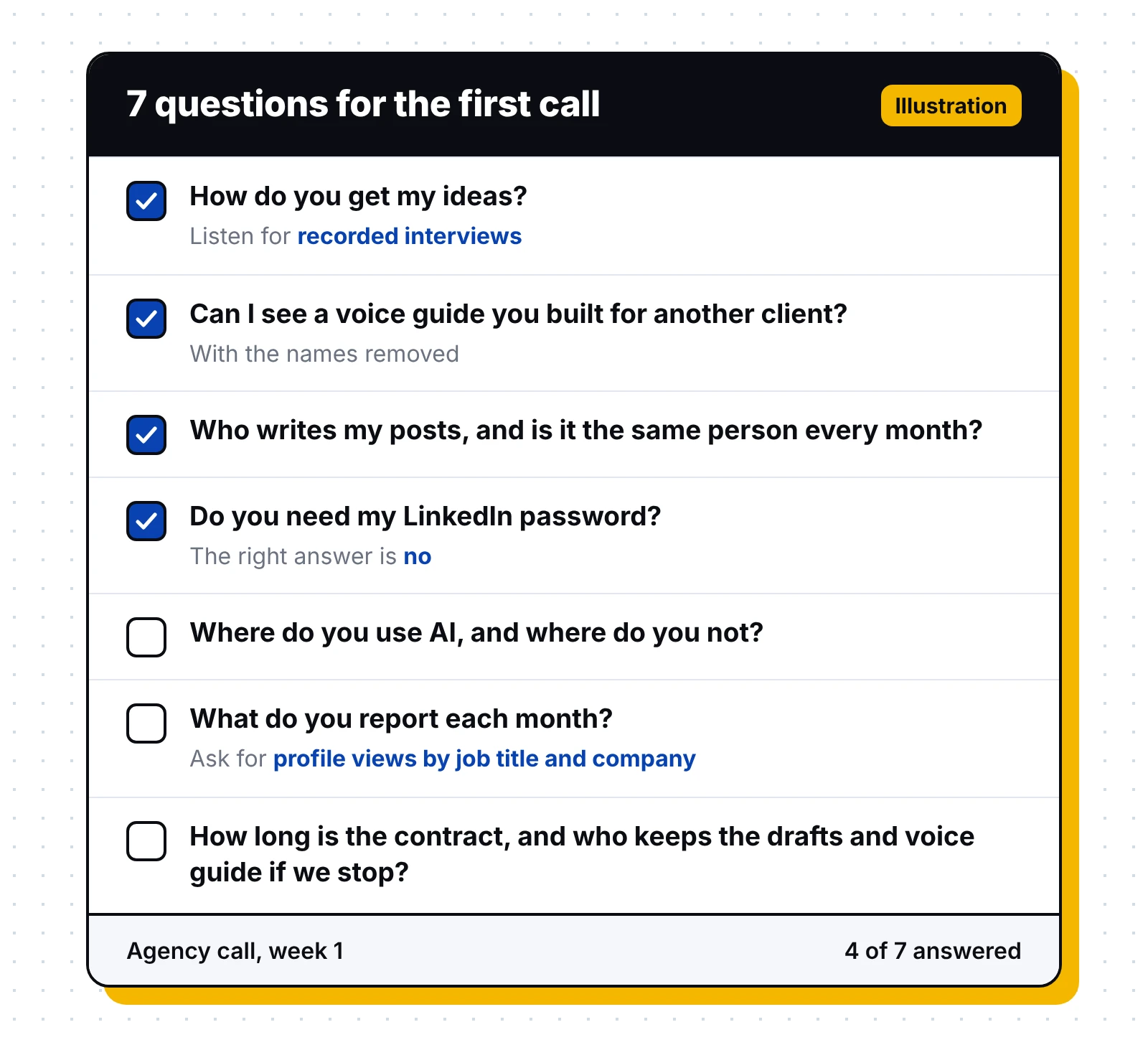
How to choose a LinkedIn ghostwriter: 7 questions to ask
Ask these on the first call with any ghostwriter or LinkedIn ghostwriting agency. The answers tell you more than a portfolio does.
- How do you get my ideas? Look for recorded interviews. "Send us a few topics" means you'll be doing the thinking and they'll be doing the typing.
- Can I see a voice guide you built for another client, with the names removed?
- Who writes my posts, and will it be the same person every month?
- Do you need my LinkedIn password? The right answer is no.
- Where do you use AI in your process, and where do you not?
- What do you report each month? Ask for profile views by job title and company next to the reaction counts.
- How long is the contract, and who keeps the drafts and the voice guide if we stop?
If you want a shortlist to start from, our list of the best B2B SaaS thought leadership agencies compares the main LinkedIn ghostwriter services.
How to measure ghostwriting results
Judge a post by its reader list: the job titles and companies of the people who saw it. Reactions tell you less than founders think. In the Semrush study, the median LinkedIn post cited by AI answers had 15 to 25 reactions and no more than 1 comment.
Track these five signals every month:
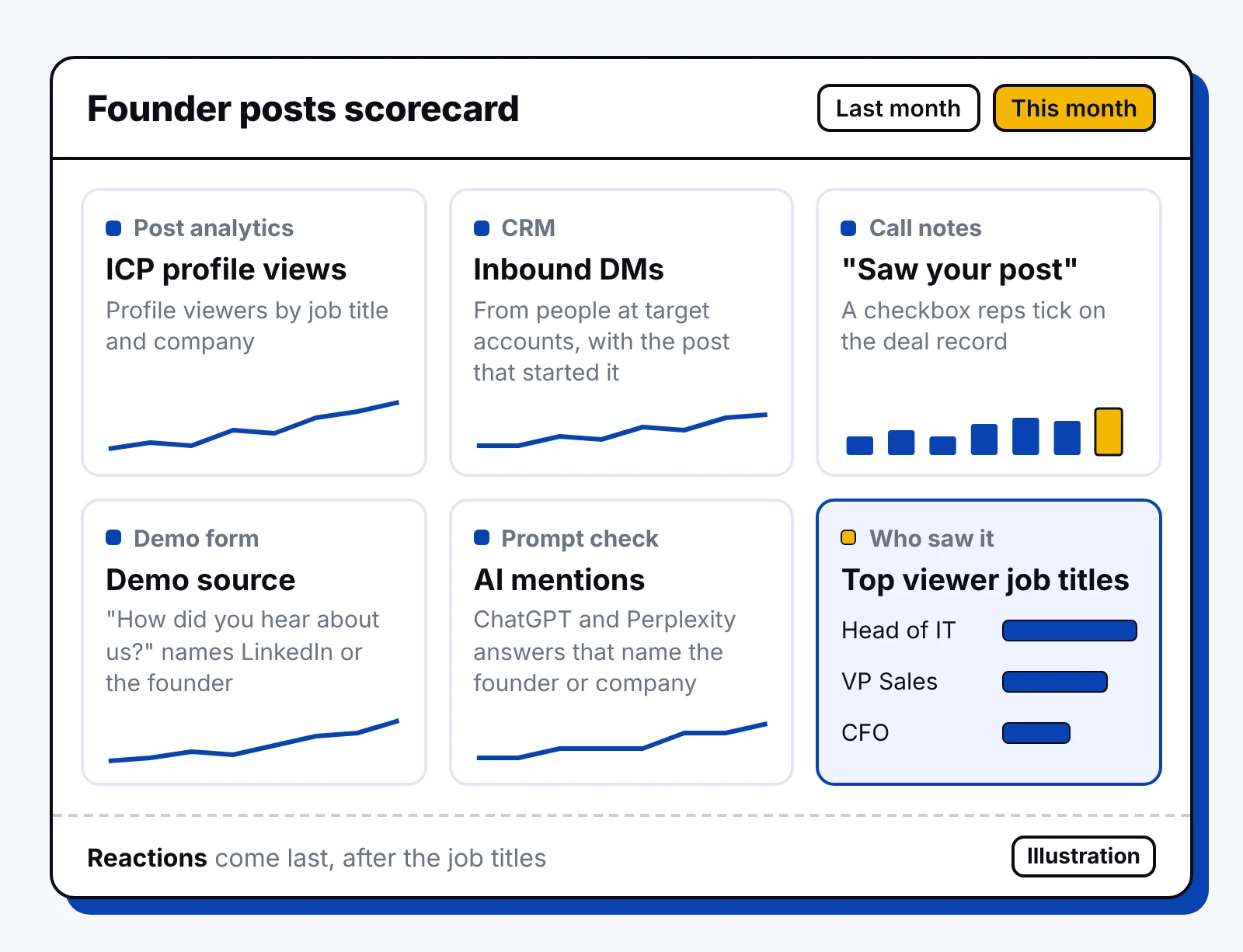
- ICP profile views. LinkedIn post analytics show profile viewers from each post and the top job titles, companies, industries and seniority of the people who saw it.
- Inbound DMs from people at target accounts, logged in the CRM with the post that started the conversation.
- "Saw your post" on sales calls. Add a checkbox to the call notes or the deal record so reps log it every time.
- Demo source. Add a "How did you hear about us?" field with LinkedIn and the founder's name as options. Our guide to AI search attribution covers how to set the field up.
- AI mentions. Run the prompts your buyers use in ChatGPT and Perplexity each month and note when the founder or the company is named.
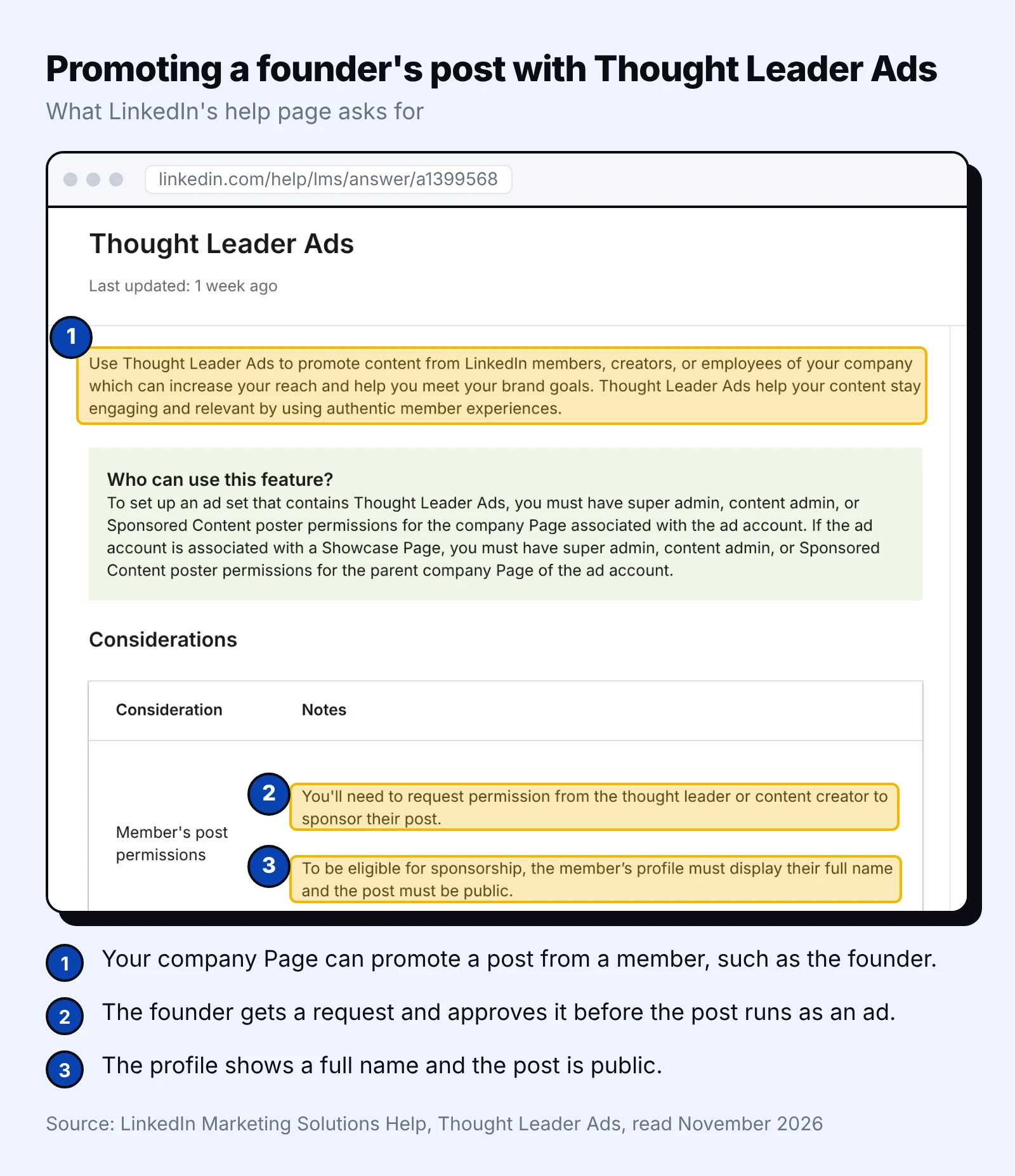
Posts that reach the right readers can be put in front of more of them. LinkedIn's Thought Leader Ads let your company page promote a member's post once the member approves. Our roundup of B2B SaaS LinkedIn campaigns shows how teams use them.
Common LinkedIn ghostwriting mistakes
Each of these is easy to spot in the first month.
Handing over the password
Don't. LinkedIn's User Agreement bans sharing login details. Approve drafts in a shared doc or a scheduling tool and post from your own account.
Letting the writer fill the gaps
When the interview runs short, a weak writer fills the post with generic advice or a story that never happened. Every claim should trace back to something you said. If it doesn't, cut it.
Counting reactions
A post with hundreds of reactions from other founders can bring in nothing. A quiet post that three of your target accounts read is the better post. Check the job titles in post analytics before you look at the reactions.
Posting in bursts
Ten posts in March and none in April means starting over in May. Agree on a number of posts each week and hold it through the busy months.
Automating the comments
LinkedIn's June 2026 update named comments "members create and post at scale using automation tools" as a target. Comments are where buyers talk to you directly, so write them yourself.
Writing for other founders
Posts about fundraising and hustle get likes from peers. Your buyers want answers to the questions in your sales calls, so keep the pillars tied to those.
For the wider plan around founder posts, ads and company pages, start with our hub on LinkedIn marketing for B2B SaaS.
FAQ
What does a LinkedIn ghostwriter do?
A LinkedIn ghostwriter interviews a founder or executive, turns their ideas and stories into posts in their voice and manages the posting schedule. The executive approves every post, and it goes out from their own profile.
How much does a LinkedIn ghostwriter cost?
Published prices range from $795 to $1,295 a month for one freelancer we found to $2,500 to $5,450 a month for agencies. Perceptric's plans run from $2,500 to $5,000 per profile per month on a contract of 12 months.
Can AI replace a LinkedIn ghostwriter?
AI tools can draft and tidy text, but they can't interview you or know what happened in last week's deals. LinkedIn says posts need to represent your voice and perspectives, and it limits the reach of generic posts that look written by AI.
Will people know my posts are ghostwritten?
The posts read as yours when the ideas are yours and the writer matches your voice. If someone asks, say a writer helps you.
How many LinkedIn posts should a founder publish each week?
Pick a number you can keep every week; our plans publish 15 or 20 posts a month. In Semrush's 2026 study, about three quarters of the post authors cited in AI answers had published more than 5 posts in the previous four weeks.
A good first step is to pull the notes from your last ten sales calls and list every question a buyer asked twice. Those are your first posts. When you want a team to run the interviews, the writing and the schedule, see our LinkedIn thought leadership service.