LinkedIn ABM is account-based marketing run on LinkedIn. You pick the companies you want as customers, find the people at each one who make the buying decision and reach them on LinkedIn until they agree to a meeting.
The LinkedIn ABM strategy that works puts your executives' posts in front of that buying committee and uses ads to make sure the right people see them. Running ads at a company list with no person behind them is the weak version. Below are the three types of LinkedIn ABM, a campaign plan in 9 steps, LinkedIn's targeting limits and the metrics that tie the work to pipeline.
What is LinkedIn ABM?
LinkedIn ABM is a B2B marketing approach where sales and marketing agree on a list of target accounts. They reach the buying committee at each account with organic posts, paid ads and direct conversations, and judge the work by meetings and pipeline there.
Regular LinkedIn advertising starts with an audience and asks how many leads it can produce. LinkedIn ABM starts with a fixed list of companies and asks which people at those companies know you yet. A form fill from a company outside the list counts for little. A comment from the CFO of a target account counts for a lot.
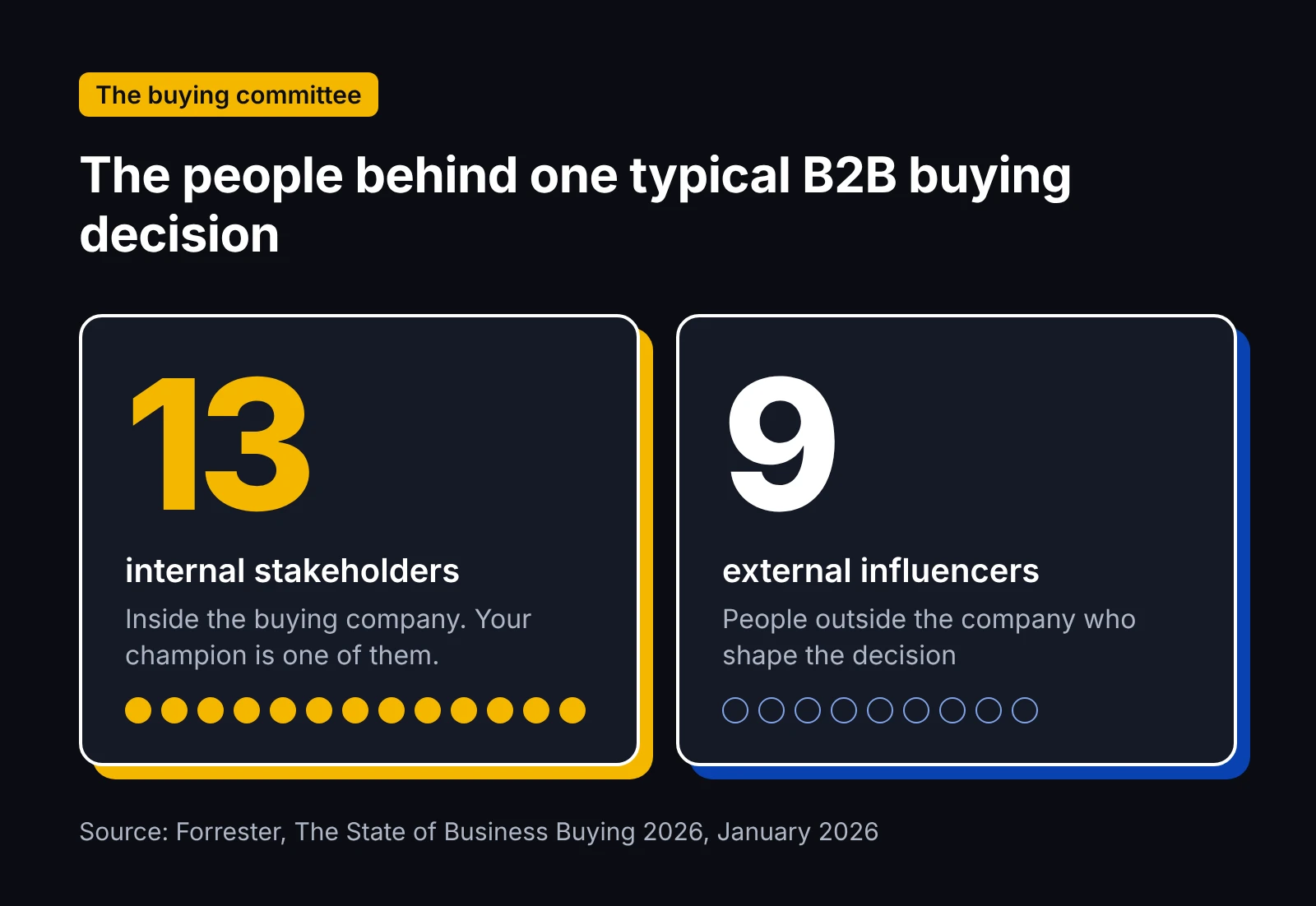
The buying committee is the group of people at one company who shape a purchase. Forrester's 2026 buying research puts the typical decision at 13 internal stakeholders and nine external influencers. Your champion is one of them. The others decide whether your champion wins the internal argument.
Why LinkedIn is the strongest ABM channel for SaaS
Most ABM channels can find the company. LinkedIn can find the people inside it and show them a post under a real person's name.
You can target the company and the job at once
Campaign Manager lets you target by company name, industry, size and growth rate, and by job title, function, seniority, skills and years of experience. Put a company list together with a job function and you reach the finance team at your target accounts without paying for the rest of the building.
The buying committee is already there
LinkedIn says its ads reach 1 billion+ professionals. Sales Navigator adds more than 50 search filters and a Relationship Map that LinkedIn says gives "visibility into buying committee gaps."
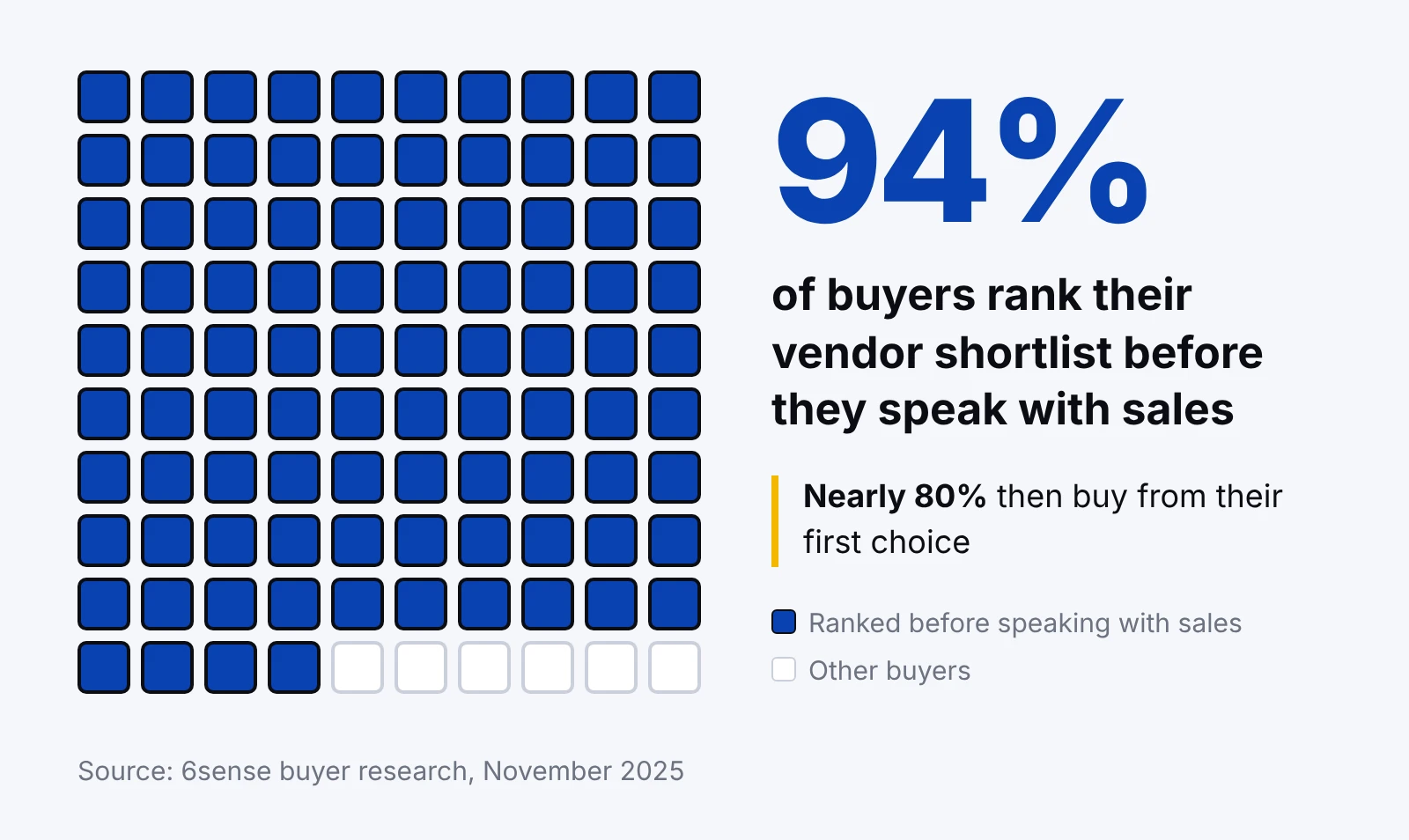
Timing matters too. In 6sense's 2025 buyer research, 94% of buyers ranked their vendor shortlist before speaking with sales, and nearly 80% bought from their first choice. The committee has to know your name before your rep calls.
Paid and organic share one feed
A CFO can read your CEO's post on Monday, see it again as an ad on Wednesday and accept a connection request from your account executive on Friday. Thought Leader Ads make that possible. They let a company sponsor posts from "company employees, industry experts, customers, or content creators," so your best organic post becomes your ad.
The 3 types of LinkedIn ABM
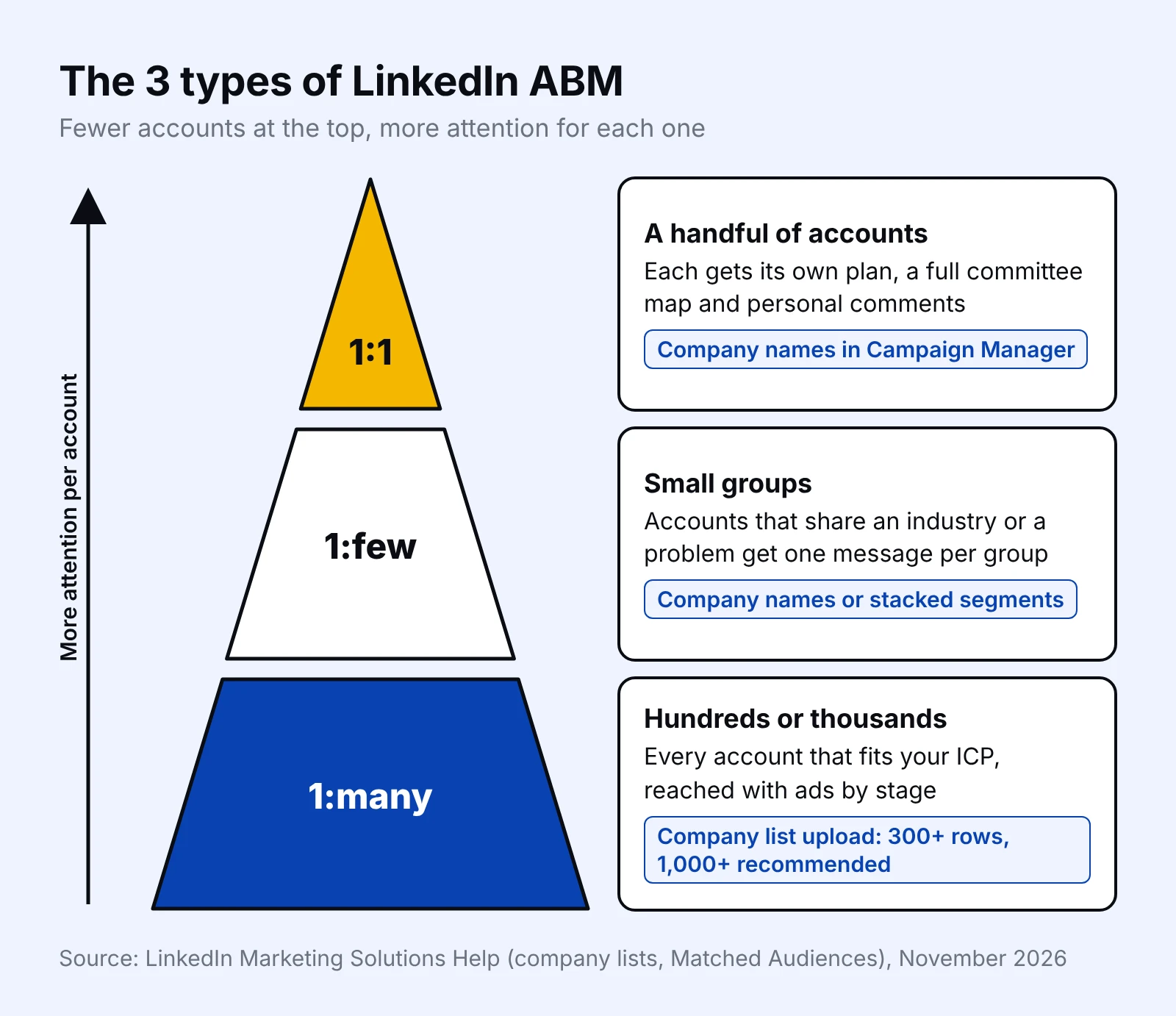
ABM teams sort accounts into tiers by how much attention each one gets. On LinkedIn the tier also decides which targeting you can use, because the platform sets minimum sizes.
| Type | Number of accounts | LinkedIn tactics | Best for |
|---|---|---|---|
| 1:1 | A handful, each with its own plan | Posts on that account's problem, a full committee map, personal comments, ads targeted by company name | Enterprise deals where one contract can change your year |
| 1:few | Small groups that share an industry or a problem | Posts and Document Ads for each group, Thought Leader Ads to the group's job functions | Midmarket segments where one message fits the whole group |
| 1:many | Hundreds or thousands that fit your ICP | An uploaded company list, ads by stage, retargeting and predictive audiences | Getting known across your ICP before sales reaches out |
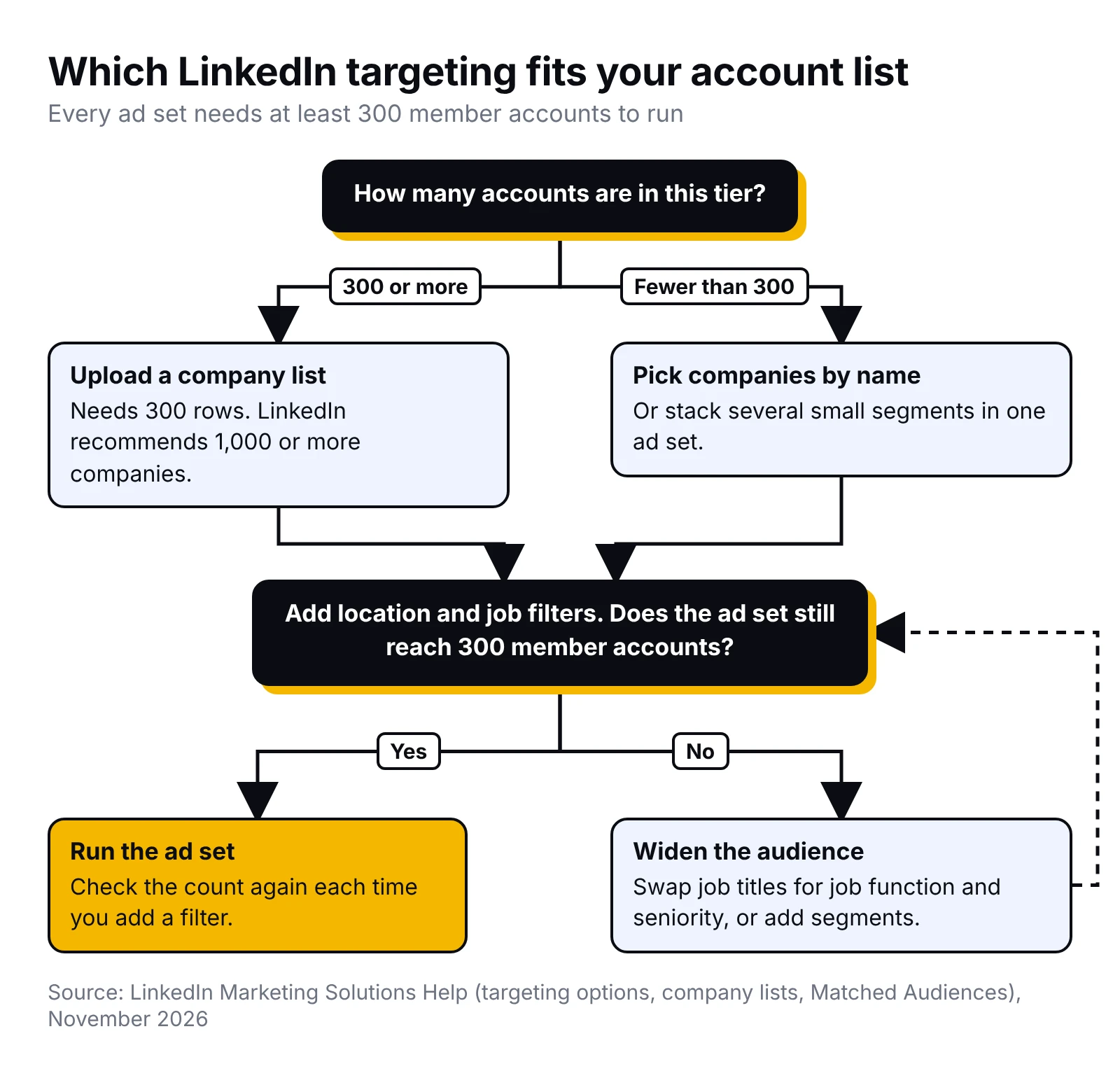
LinkedIn needs at least 300 rows to upload a company list and recommends 1,000 or more companies, so a list upload fits 1:many. For 1:1 and 1:few, pick the companies by name in Campaign Manager or stack several small segments in one ad set.
Budget is left out on purpose. LinkedIn's floor is $10 a day for any ad format, and the rest depends on how many people your targeting reaches.
How to run a LinkedIn ABM campaign in 9 steps
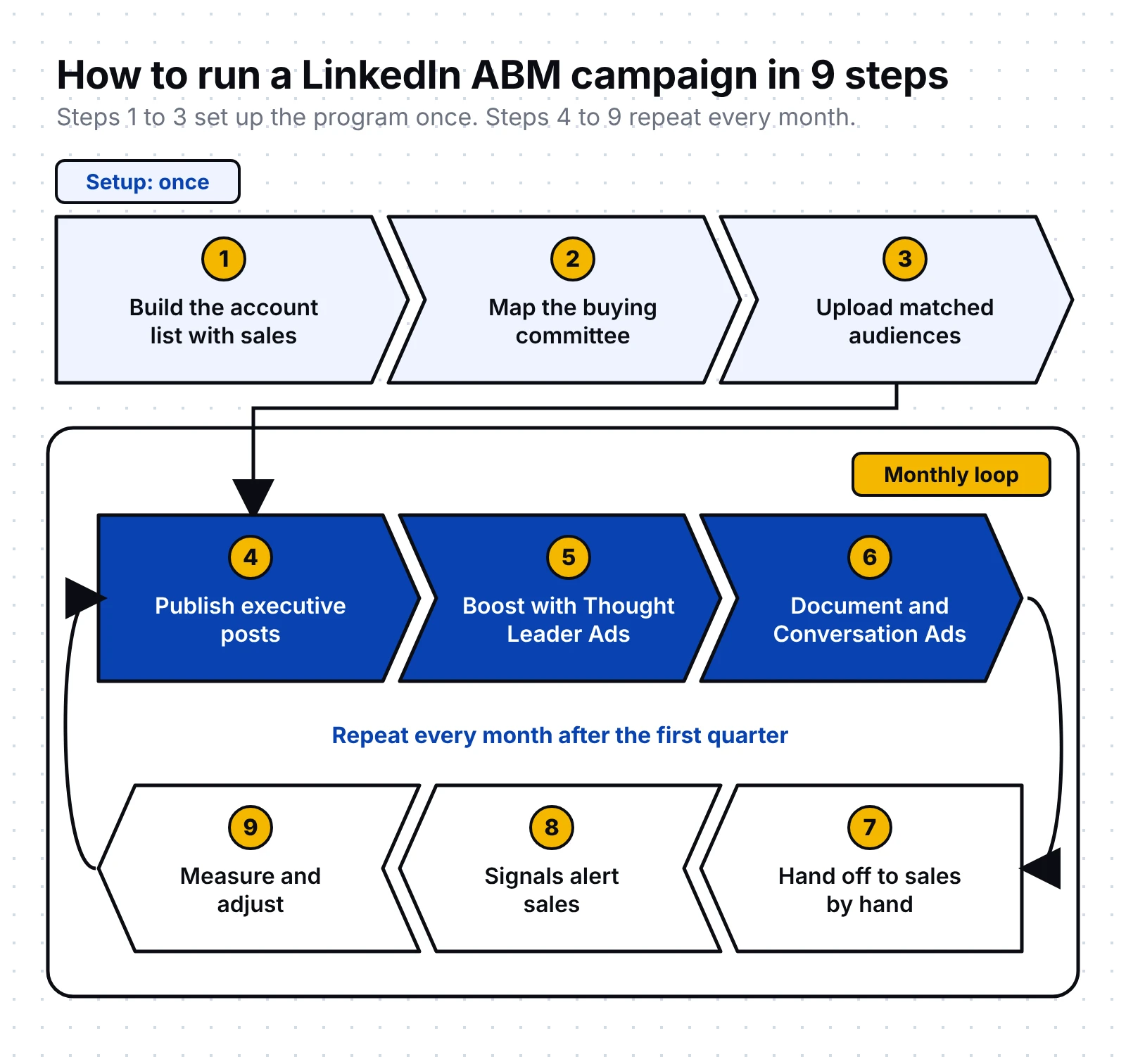
The steps run in order the first time. After the first quarter, steps 4 to 9 repeat every month.
1. Build the target account list with sales
Sales and marketing pick the list together, or sales ignores it. Start from the deals you won and write down what they share: industry, headcount, the tools they ran and what happened before they bought. Then sort accounts into the three tiers.
Keep the company name and the LinkedIn Company Page URL for every account, since LinkedIn's Matched Audiences guide says those two fields improve the match rate. Our post on how your sales team can inform content strategy covers the meeting that gets this list built.
2. Map the buying committee with Sales Navigator
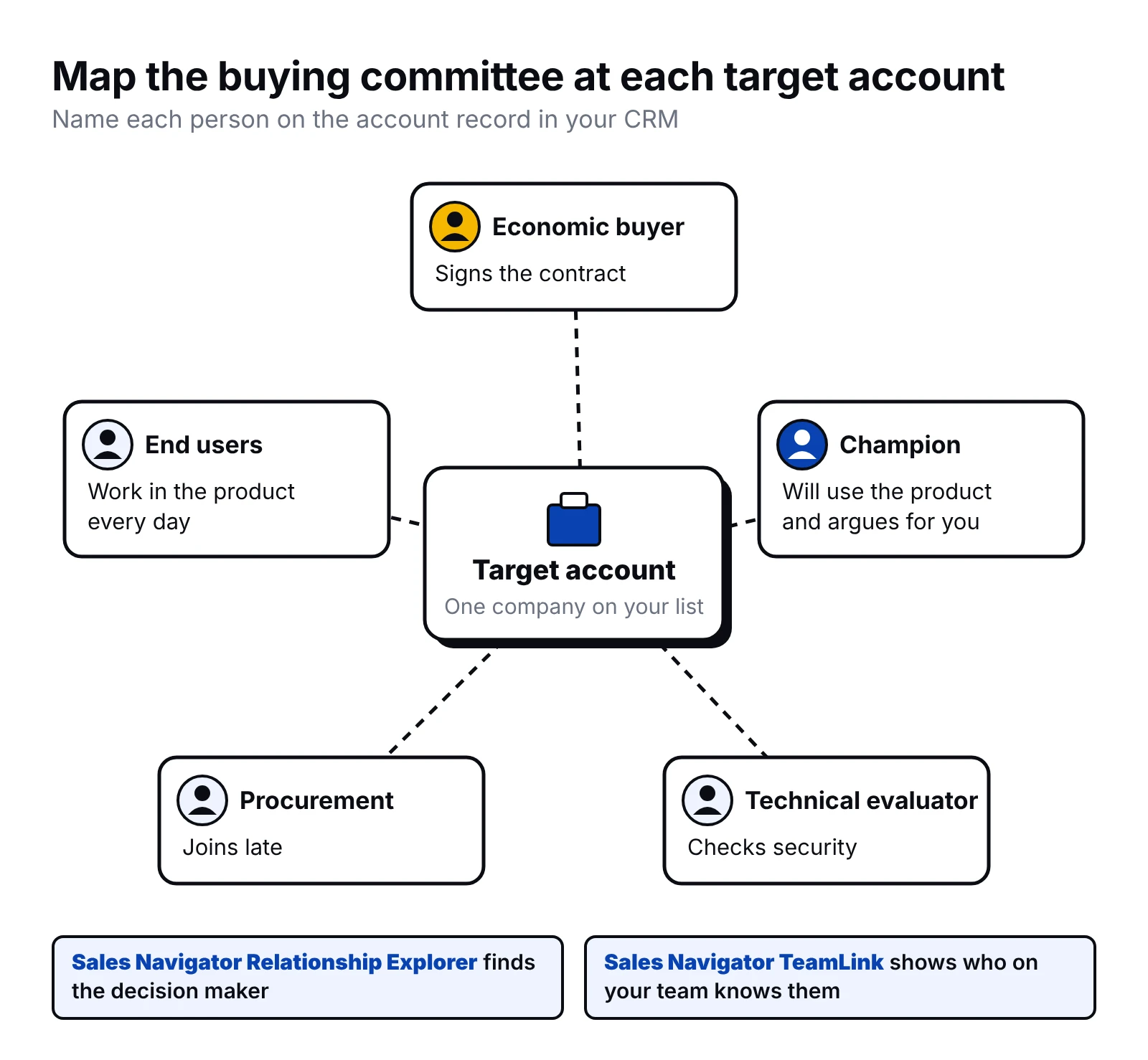
Save each account to a list in Sales Navigator. Relationship Explorer "helps you quickly find the right decision-maker," and TeamLink shows which of your colleagues already know someone there.
For each account, name the economic buyer who signs and the champion who will use the product. Add the technical evaluator who checks security, the procurement contact who joins late and the end users. Put the names on the account record in your CRM.
3. Upload company and contact lists as matched audiences
Upload your 1:many accounts as a company list in Campaign Manager. The file needs at least 300 rows and must match at least 300 member accounts to run. LinkedIn says the audience can take up to 48 hours to build.
Then upload the named committee members from step 2 as a contact list, or sync it from your CRM. LinkedIn accepts up to 300,000 contacts in one upload.
Check the audience count every time you add a filter. Every ad set needs 300 member accounts to run, and 40 companies picked by name with a job title filter on top can fall below that fast.
4. Publish executive posts aimed at those accounts
Step 4 decides whether the program works. Pick two or three people a buyer would recognize, such as the CEO, a product lead and a sales leader. Each posts on a steady schedule about the problems your target accounts argue over internally.
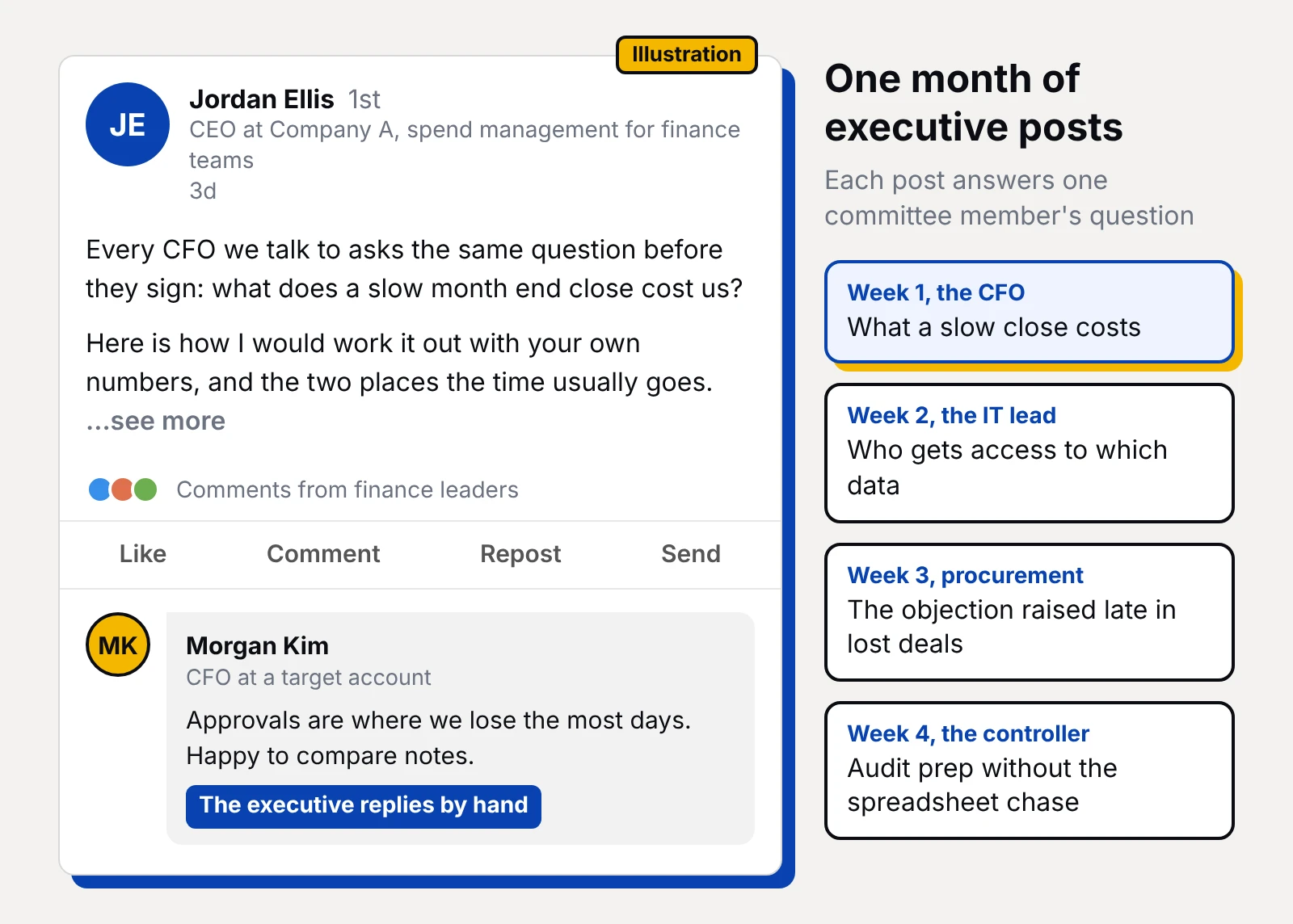
Write for the whole committee across a month. One post answers the CFO's question about cost. Another answers the IT lead's question about data access. A third takes on the objection procurement raises late in the deals you've lost.
If your executives don't have time to write this, that's the gap our guide to LinkedIn ghostwriting for SaaS founders covers. Our model is simple: you talk, we write. For topic selection, see our thought leadership content marketing guide.
Organic posts reach your executive's network and whoever the feed picks. That may not include the CFO at your top account.
5. Boost the best posts with Thought Leader Ads
After a post has run organically for a few days, look at who commented. If people from your ICP engaged, sponsor it as a Thought Leader Ad aimed at your company list plus the committee's job functions.
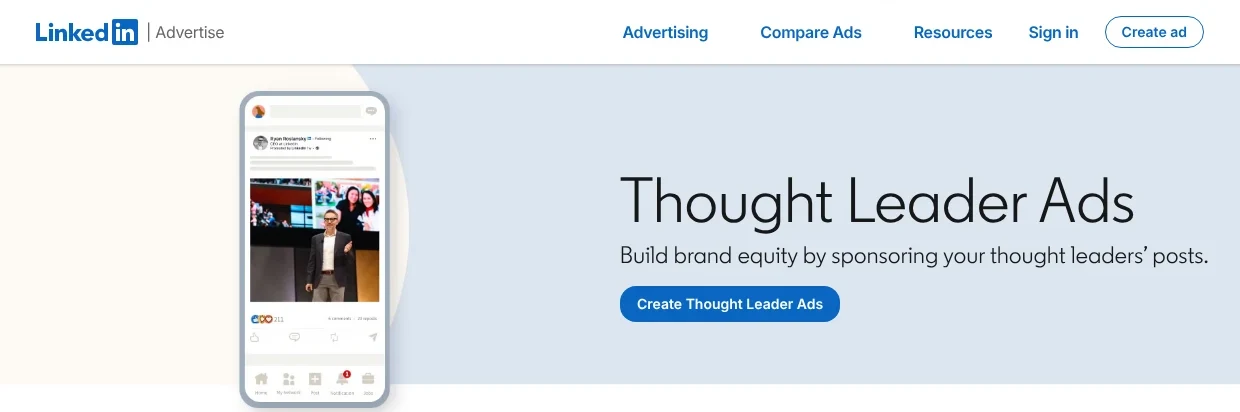
The specs shape how you write any post you might boost:
- You can't add a headline or intro text, and only the author can edit the post.
- There's no call to action button, so the link or the ask has to sit in the post itself.
- Posts with several images, a poll or a document can't be promoted.
Boost the posts. The case against it is that a founder with no posting history reads like a company ad with a face on it. Give each executive a few weeks of organic posts before you put money behind one.
6. Use Document Ads and Conversation Ads by stage
Document Ads let members read and download a file in the feed, with an optional Lead Gen Form gate. Use them in the middle of a deal for a buyer's guide, a security overview or an ROI model. Leave them ungated for 1:1 and 1:few accounts, since you already know who they are.
Conversation Ads open a thread in LinkedIn Messaging with several buttons, and at least one has to send people to your website. Send them late, to members who already engaged, with one concrete offer. In the EEA and Switzerland they only reach members who opted in.
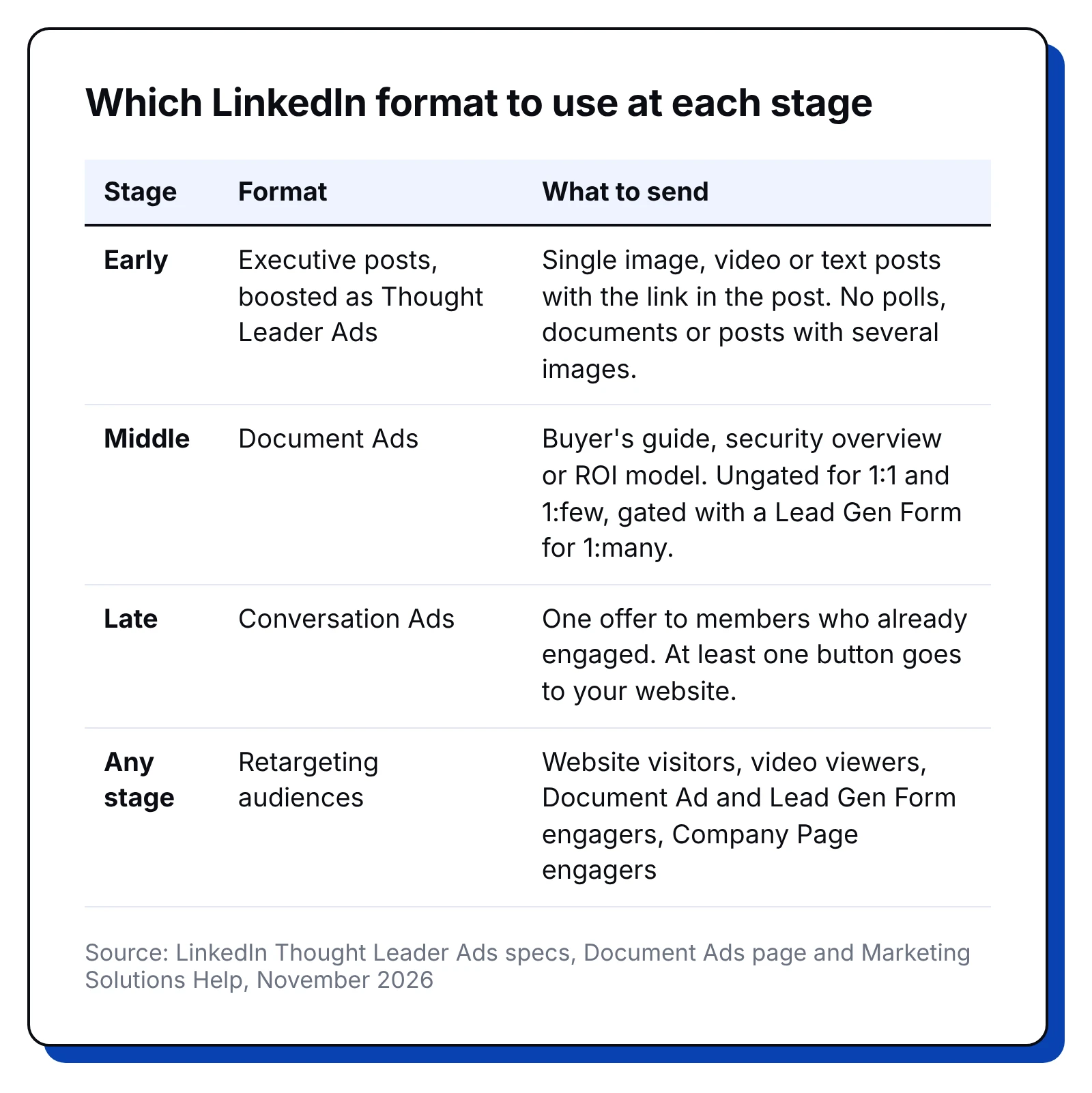
LinkedIn also lets you retarget people who opened a Document Ad, watched a video ad, visited your website or engaged with your Company Page. Build those audiences early so each stage feeds the next.
7. Hand off to sales for manual social selling
When a committee member comments on an executive's post, someone replies by hand. The executive answers the comment. The account executive sends a connection request with a note that refers to the post, then shares something useful a week later.
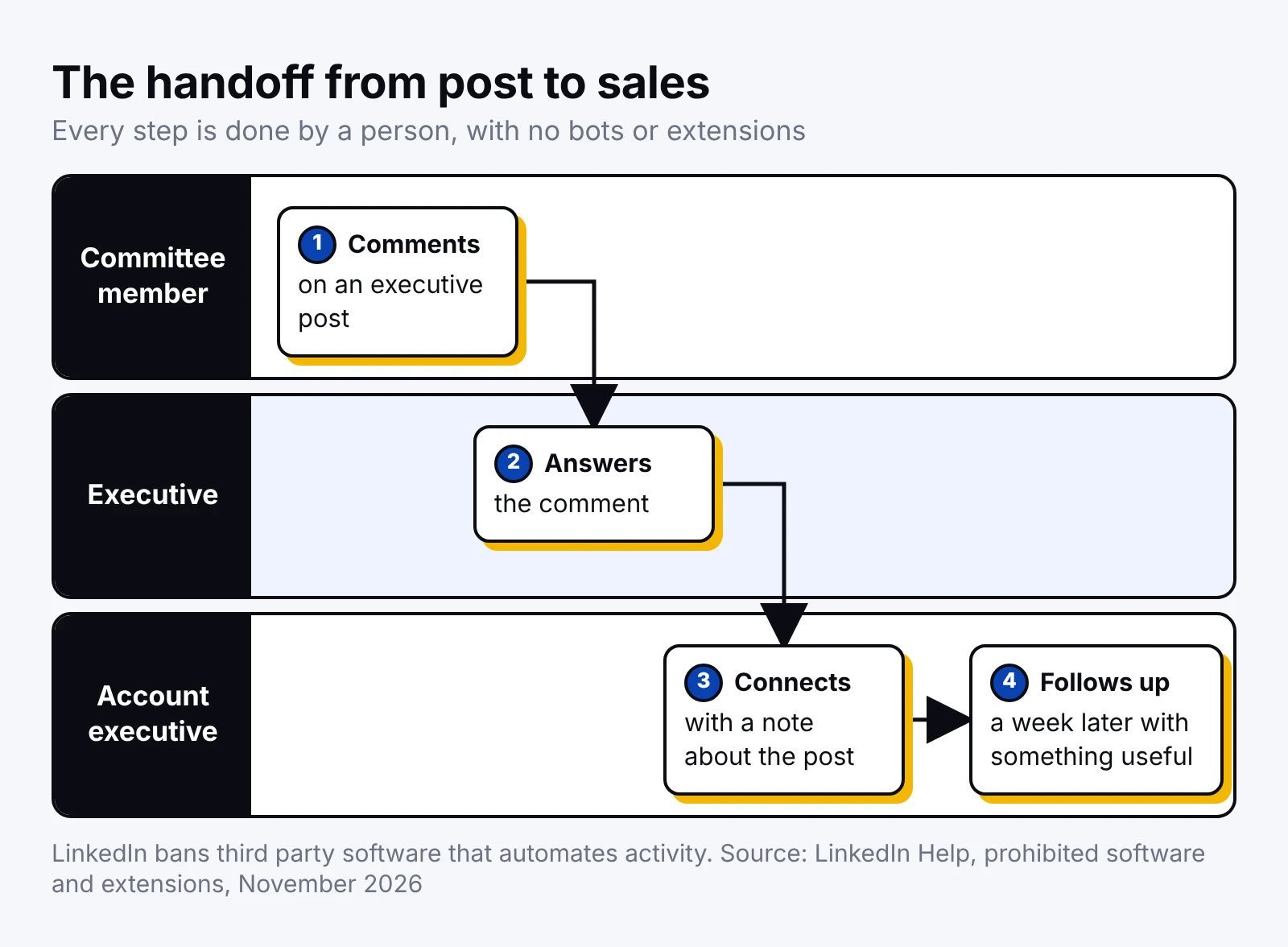
Keep every step manual. LinkedIn's policy on prohibited software bans third party bots and extensions that automate activity. Members who use them "risk having their accounts restricted or shut down," and an executive's profile is the asset this whole program runs on. We never put one at that risk.
Decide who owns each reply before launch. Our guide to B2B SaaS marketing team structure covers who should own LinkedIn.
8. Set signals that alert sales
Sales can't watch every post. Agree on the signals that send an account to a rep:
- An account's engagement level rises in Companies Hub in Campaign Manager.
- Two or more people from one account comment on your posts in the same month.
- Sales Navigator shows the account under Buyer Intent or sends an alert about a new executive.
- Someone from a target account visits your pricing page, which an ABM platform such as 6sense can show.
Write the rule down, for example "two engaged people at one account within 30 days goes to the account owner." Then build it into your CRM.
9. Measure and adjust every month
Once a month, check which posts reached committee members and move ad budget toward them. Swap out accounts that showed no engagement after a full quarter.
LinkedIn ABM targeting options
These are the options that matter for ABM, with the limits from LinkedIn's help pages. Location is a required targeting field on every ad set, so it counts against your audience size too.
| Option | What it reaches | LinkedIn's limits |
|---|---|---|
| Company list upload | Members at the companies in your file | 300 rows to upload, 300 matched members to run, 1,000+ companies recommended |
| Company name | Members at companies you pick in Campaign Manager | 300 member accounts per ad set |
| Contact list | Named people from your CRM | Up to 300,000 contacts |
| Job title | Members with a given title | 300 member accounts per ad set |
| Job function and seniority | Members by department and rank | 300 member accounts per ad set |
| Retargeting | Website visitors, video viewers, ad and Company Page engagers | 300 member accounts per ad set |
| Predictive audiences | New members LinkedIn's AI finds from a source audience | Source of 300+ member accounts, up to 200 per ad account |
Source: LinkedIn Marketing Solutions Help (targeting options, company lists, Matched Audiences, predictive audiences), November 2026
Job function and seniority usually beat job title for ABM. Titles differ from company to company, and a narrow title list on a small account list drops under 300 members quickly.
Organic vs paid LinkedIn ABM
You need both. The posts give the ads something worth paying for, and the ads carry the posts to the people the feed missed.
| Factor | Organic posts | Paid ads |
|---|---|---|
| Who sees it | The executive's followers and whoever the feed picks | Anyone in your targeting, down to one job function at a named company |
| Cost | Executive time or a ghostwriter's fee | Media spend, from $10 a day |
| Whose name is on it | A person's | The company's, unless you use Thought Leader Ads |
| Formats | Any post type | Thought Leader Ads exclude polls, documents and posts with several images |
Source: LinkedIn Thought Leader Ads specs and budget guide, November 2026
Organic alone can carry a 1:1 program when your executives already know people at the account. LinkedIn ABM ads alone buy reach at a company list with nothing worth reading behind them, which is how a program ends up with clicks and no meetings.
LinkedIn ABM metrics that matter
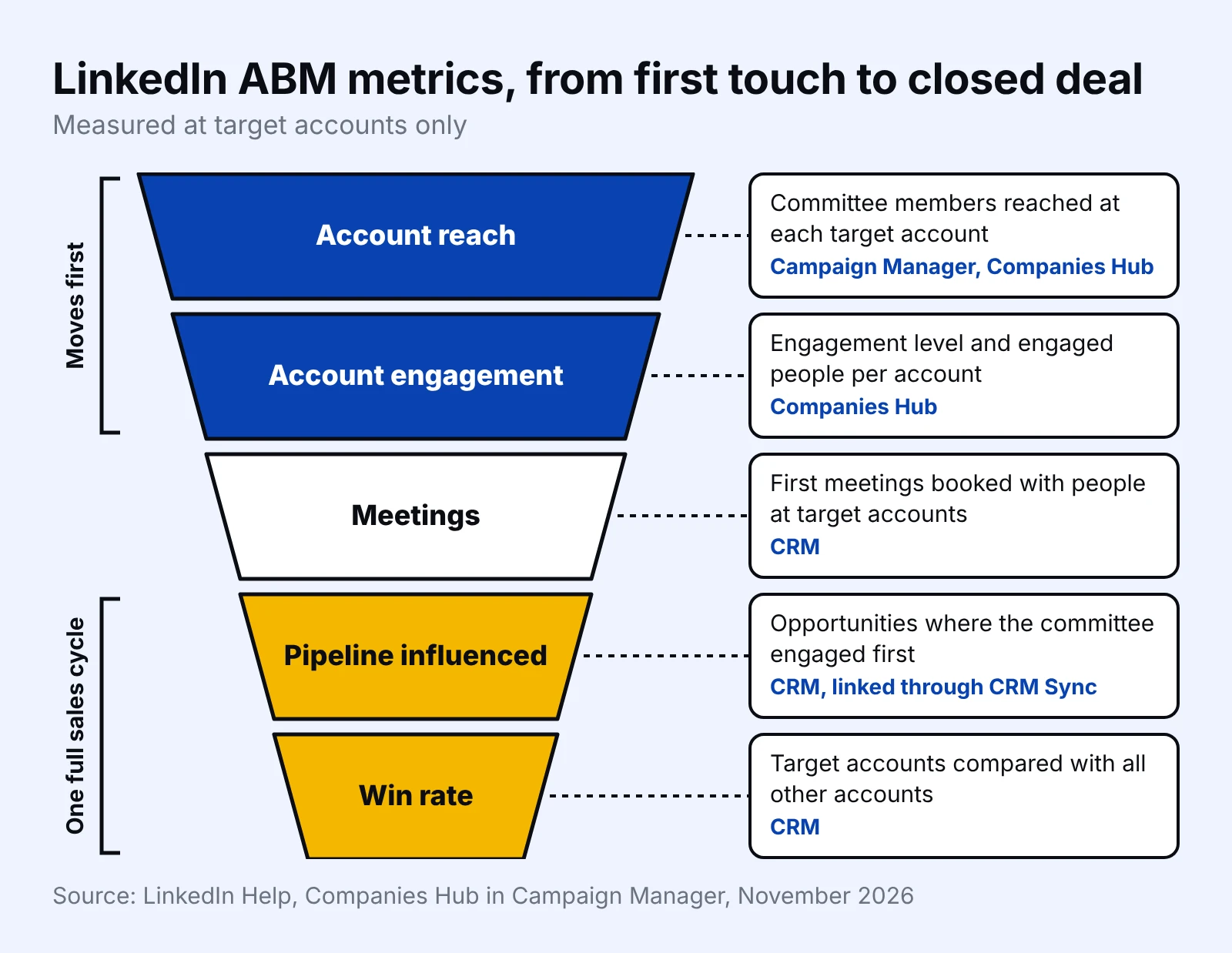
CTR and cost per lead are missing from this list on purpose. A post that reaches the CFO at one target account is worth more than a thousand clicks from companies you'll never sell to.
| Metric | How to calculate it | Where the data lives |
|---|---|---|
| Account reach | Target accounts with a committee member reached this month, divided by all target accounts | Campaign Manager, Companies Hub |
| Account engagement | Target accounts whose engagement level rose, and engaged people per account | Companies Hub |
| Meetings | First meetings booked with people at target accounts | CRM |
| Pipeline influenced | Opportunity value at target accounts where a committee member engaged before the opportunity opened | CRM, linked through CRM Sync |
| Win rate | Won deals divided by closed deals, for target accounts and for all other accounts | CRM |
Companies Hub tracks engagement level, organic engagements, leads, paid clicks and, with CRM Sync, revenue won by company. The win rate comparison is the hardest test. If target accounts close at the same rate as the rest, the program is reaching people without changing how they decide. Our conversion rate by channel benchmarks give you a starting point for the other side.
Reach and engagement move first. Pipeline and win rate follow your sales cycle, so judge them over at least one full cycle.
A LinkedIn ABM campaign example
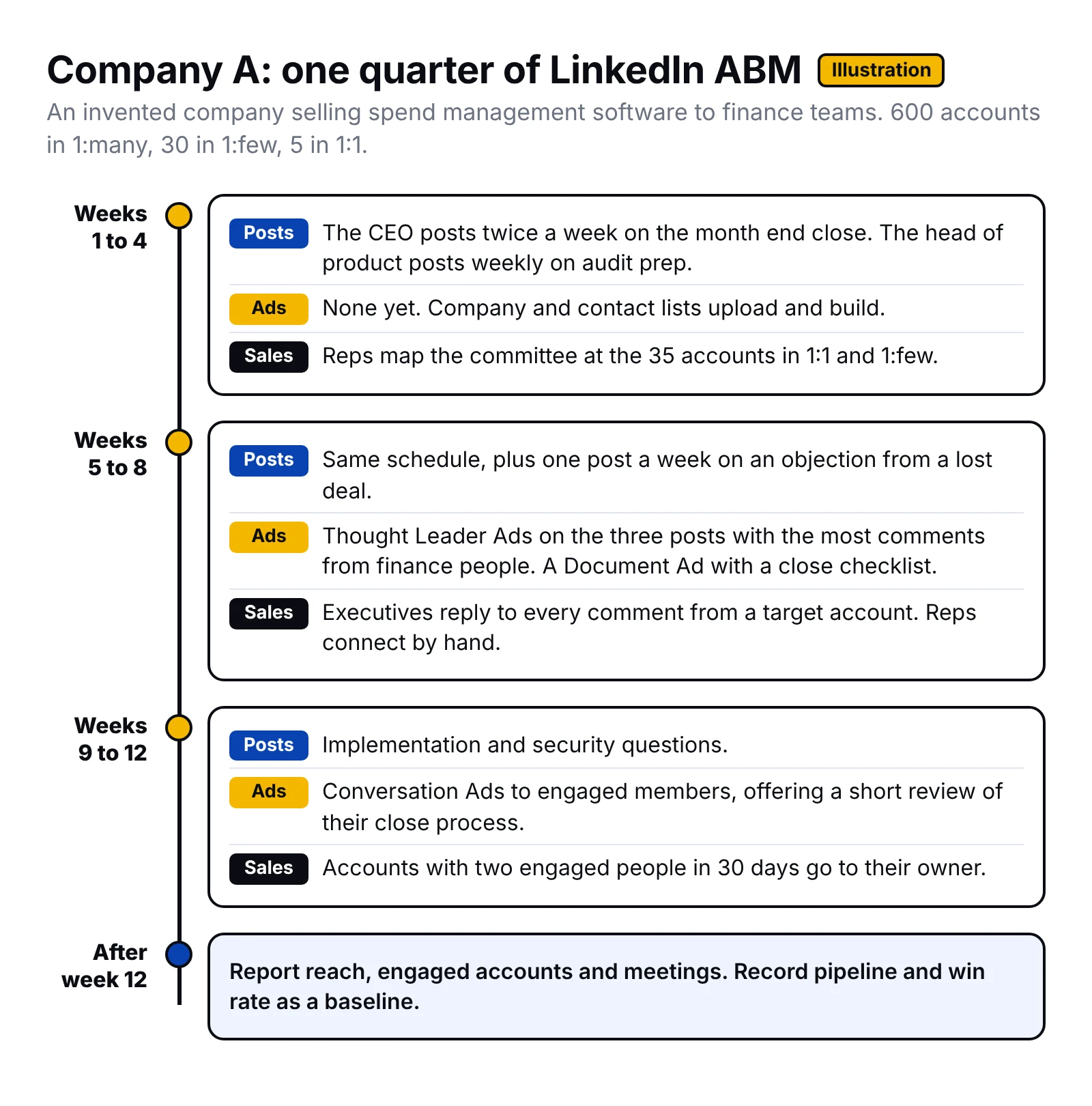
Illustration only. The plan below is a sample for an invented company, to show how the steps fit together over one quarter. It is not a client, and it reports no results.
Company A sells spend management software to finance teams. Its list has 600 accounts in the 1:many tier, 30 accounts in three industry groups for 1:few and five strategic accounts for 1:1. At each account it maps the CFO, the controller, the accounts payable manager, an IT security lead and procurement.
| Weeks | Posts | Ads | Sales |
|---|---|---|---|
| 1 to 4 | The CEO posts twice a week on problems with the month end close. The head of product posts weekly on audit prep. | None yet. The company and contact lists upload and build. | Reps map the committee at the 35 accounts in the 1:1 and 1:few tiers. |
| 5 to 8 | Same schedule, with one post a week on an objection from a lost deal. | Thought Leader Ads on the three posts with the most comments from finance people. A Document Ad with a close checklist. | Executives reply to every comment from a target account. Reps connect by hand. |
| 9 to 12 | Posts shift to implementation and security questions. | Conversation Ads to engaged members, offering a short review of their close process. | Accounts with two engaged people in 30 days go to their owner. |
After week 12, Company A reports reach, engaged accounts and meetings, and records pipeline and win rate as a baseline.
LinkedIn ABM tools
You can run LinkedIn ABM with two LinkedIn products and your CRM. An ABM platform helps once you have more accounts than people to watch them.
| Tool | What it does in LinkedIn ABM |
|---|---|
| LinkedIn Sales Navigator | Account lists, Relationship Explorer and Relationship Map for the committee, TeamLink for warm paths, Buyer Intent and alerts for timing |
| LinkedIn Campaign Manager | Matched audiences, Thought Leader Ads, Document Ads, Conversation Ads, predictive audiences and Companies Hub |
| ABM platforms such as 6sense and Demandbase | Account prioritization and intent data. 6sense says its intent data "resolves at the account level." |
| A CRM such as HubSpot or Salesforce | The account list with its tiers, committee contacts and the opportunities you report pipeline from |
In-house team or ABM agency?
A LinkedIn ABM program run by your own team needs four skills. Someone owns the account list with sales. Someone runs LinkedIn ads well. Someone writes in your executives' voices every week. And your reps do the social selling by hand.
The writer is the hardest of the four to replace. The posts need your executives' own opinions and stories, and those take interviews to get.
An ABM agency makes sense when you lack paid LinkedIn experience or need an ABM platform set up. Ask any agency these questions before you sign:
- Do you write executive posts, or only run ads to a list?
- Do you report meetings and pipeline at target accounts?
- Do you use any tool that automates LinkedIn activity? If yes, walk away.
- Who at our company approves each post before it goes live?
Some teams split the work: an ads agency or your own specialist for Campaign Manager and a ghostwriting partner for the posts. Our LinkedIn thought leadership service covers the posts at $2,500, $3,000 or $5,000 per profile per month on a contract of 12 months. The Momentum plan adds a target account list and comment prompts, so your executives' comments reach the right people. See B2B SaaS marketing agency pricing to compare, or our list of B2B SaaS thought leadership agencies for other options.
For the wider plan, see our guides to LinkedIn marketing for B2B SaaS, B2B SaaS campaigns on LinkedIn and AI brand mentions from LinkedIn thought leadership.
FAQ
What is LinkedIn ABM?
LinkedIn ABM is account-based marketing run on LinkedIn. Sales and marketing agree on a list of target companies, map the buying committee at each one and reach those people through executive posts, ads and manual outreach by sales. It is measured in meetings and pipeline at the target accounts.
How much budget does LinkedIn ABM need?
LinkedIn's minimum is $10 a day, or $100 for a new campaign on a lifetime budget. Above that, budget depends on how many people your targeting reaches. Plan for executive time or a ghostwriter as well, since the posts drive the program.
Can you do ABM on LinkedIn without ads?
Yes. Executive posts, Sales Navigator and manual outreach from your reps make a working 1:1 program. You can't control who sees the posts, so ads help when the committee at a target account doesn't follow your executives yet.
How many accounts should a LinkedIn ABM list have?
A 1:1 tier holds a handful of accounts. A company list upload needs at least 300 rows and LinkedIn recommends 1,000 or more companies, so list uploads suit the 1:many tier. Every ad set needs at least 300 member accounts to run.
How do you measure LinkedIn ABM?
Track account reach, account engagement, meetings, pipeline influenced and win rate at target accounts against all other accounts. Companies Hub in Campaign Manager shows engagement by company, and your CRM holds pipeline and win rate.
A good first step is to pull your last 10 won deals, list who sat on each buying committee and check how many of them follow your CEO on LinkedIn. If the answer is few, start with the posts. Our LinkedIn thought leadership service writes them in your executives' voices, from a short interview call every two weeks.