LinkedIn marketing for B2B SaaS is the practice of using your founders, executives and employees, plus your company page and LinkedIn ads, to reach buyers and turn them into pipeline. When you use LinkedIn for B2B marketing this way, the people on your team carry the reach, the company page holds the proof and ads amplify the posts that already work.
We write LinkedIn posts for B2B founders and executives (1,000+ posts published so far), and this guide comes out of that work. You'll get 12 strategies grouped as organic, paid and pipeline, a lead generation plan in 5 steps, a sample week of posts and the benchmarks to measure your program against.
Why LinkedIn is the top channel for B2B SaaS
LinkedIn has more than 1 billion members in more than 200 countries and territories, according to LinkedIn. LinkedIn also says 4 out of 5 members use it to inform business decisions, though it doesn't publish a method for that figure.
Timing matters more than reach. In 6sense's 2025 Global B2B Buyer Experience Report, 94% of buyers ranked their vendor shortlist before they ever spoke with sales. The names on that list are names buyers already know. LinkedIn is one of the few places where your team's thinking can reach them before the list is set.
The paid side holds up too. Dreamdata's 2026 LinkedIn Ads Benchmarks Report measured a 121% return on ad spend for LinkedIn in 2025, against 67% for Google Search and 51% for Meta. LinkedIn also took 41% of B2B ad budgets in its data. Those are Dreamdata's own customers, measured with its own attribution model, so use them as a direction for your own tests.
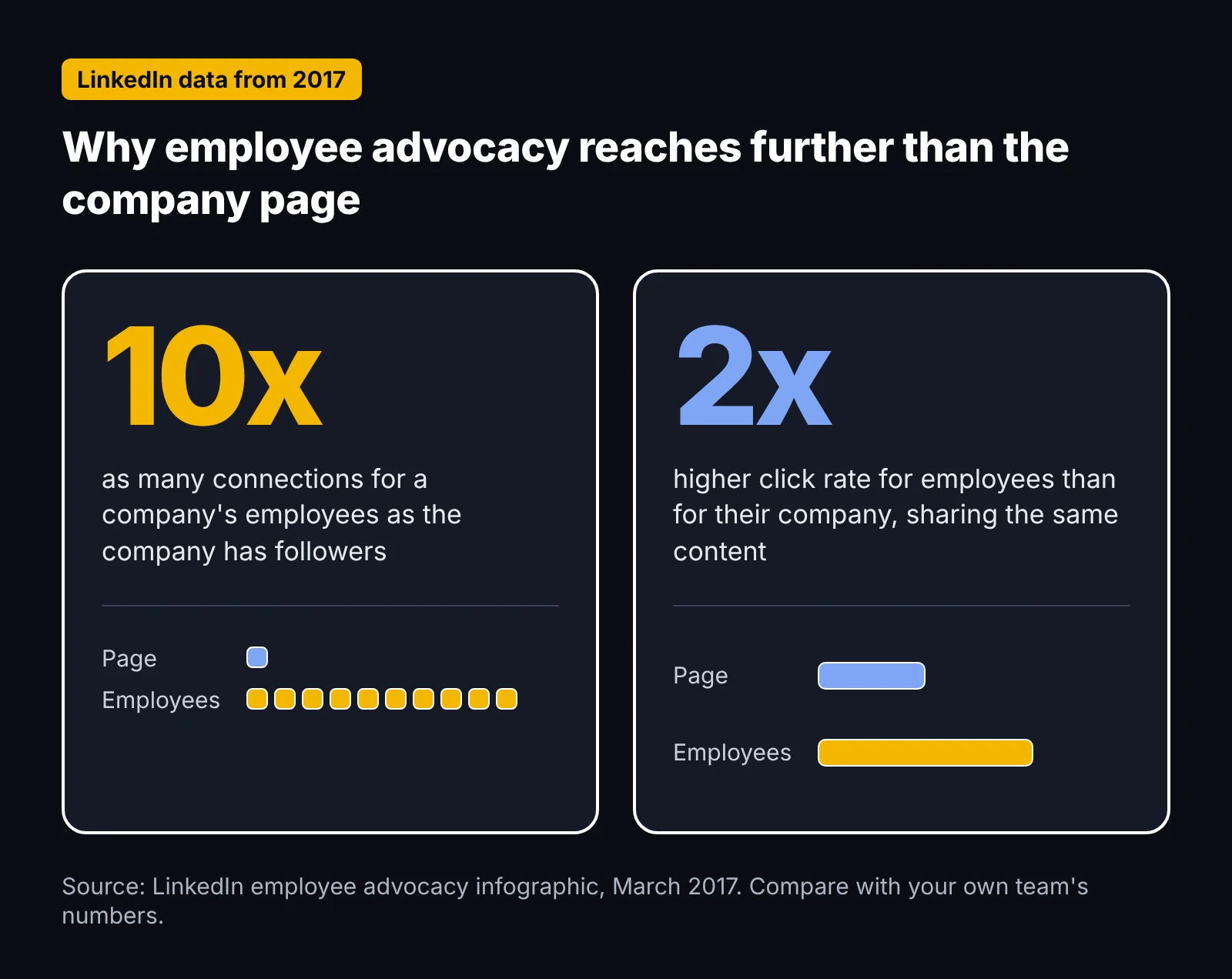
Inside LinkedIn, posts from people get more attention than posts from logos. LinkedIn's employee advocacy data from 2017 found that a company's employees have 10x as many connections as the company has followers. Employees also saw a 2x higher click rate than their company when they shared the same content.
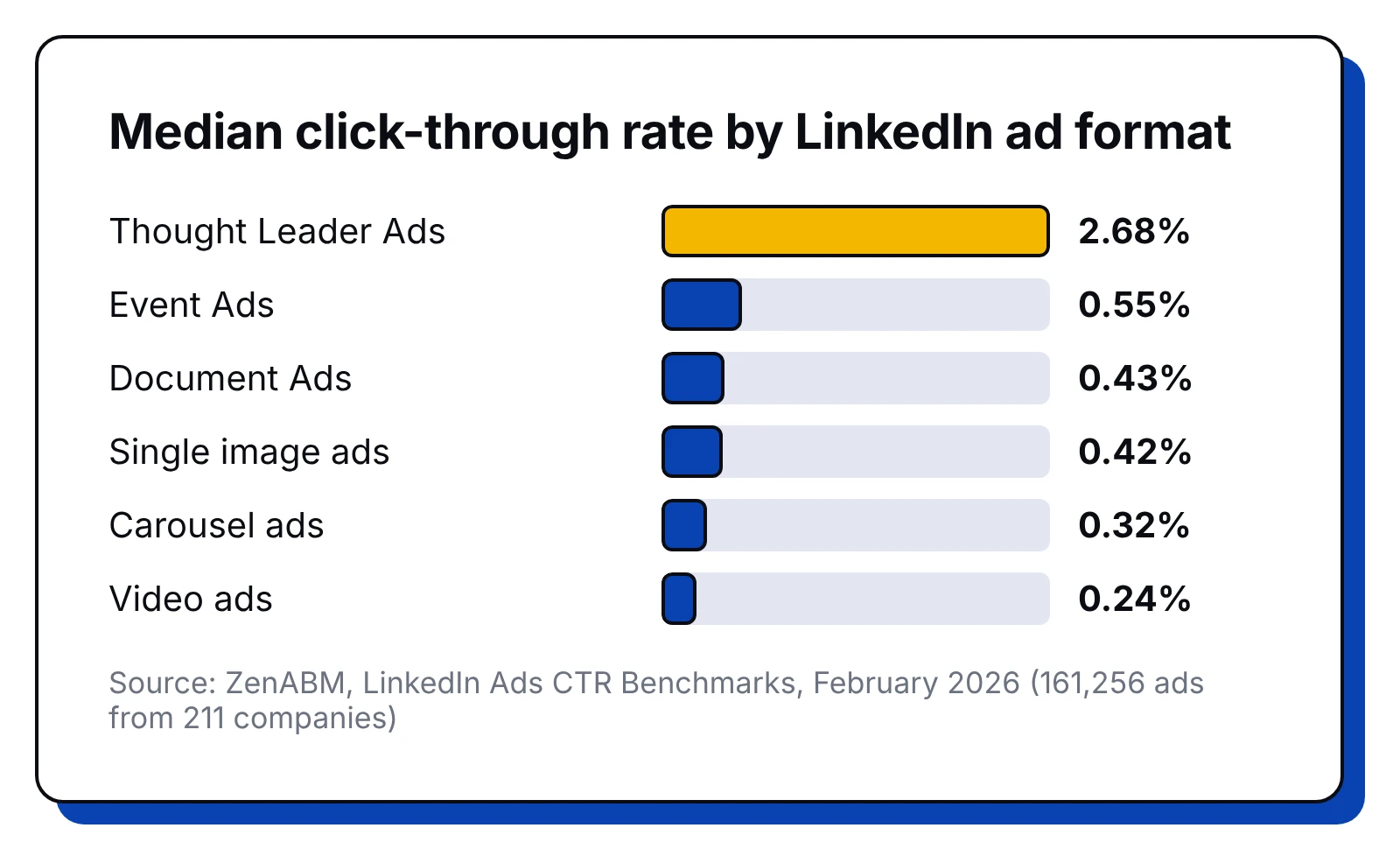
Paid data points the same way. In ZenABM's benchmark of 161,256 LinkedIn ads, Thought Leader Ads, which promote a person's post, had a median CTR (the share of people who saw the ad and clicked it) of 2.68%. Single image ads had 0.42%.
12 LinkedIn marketing strategies for B2B SaaS
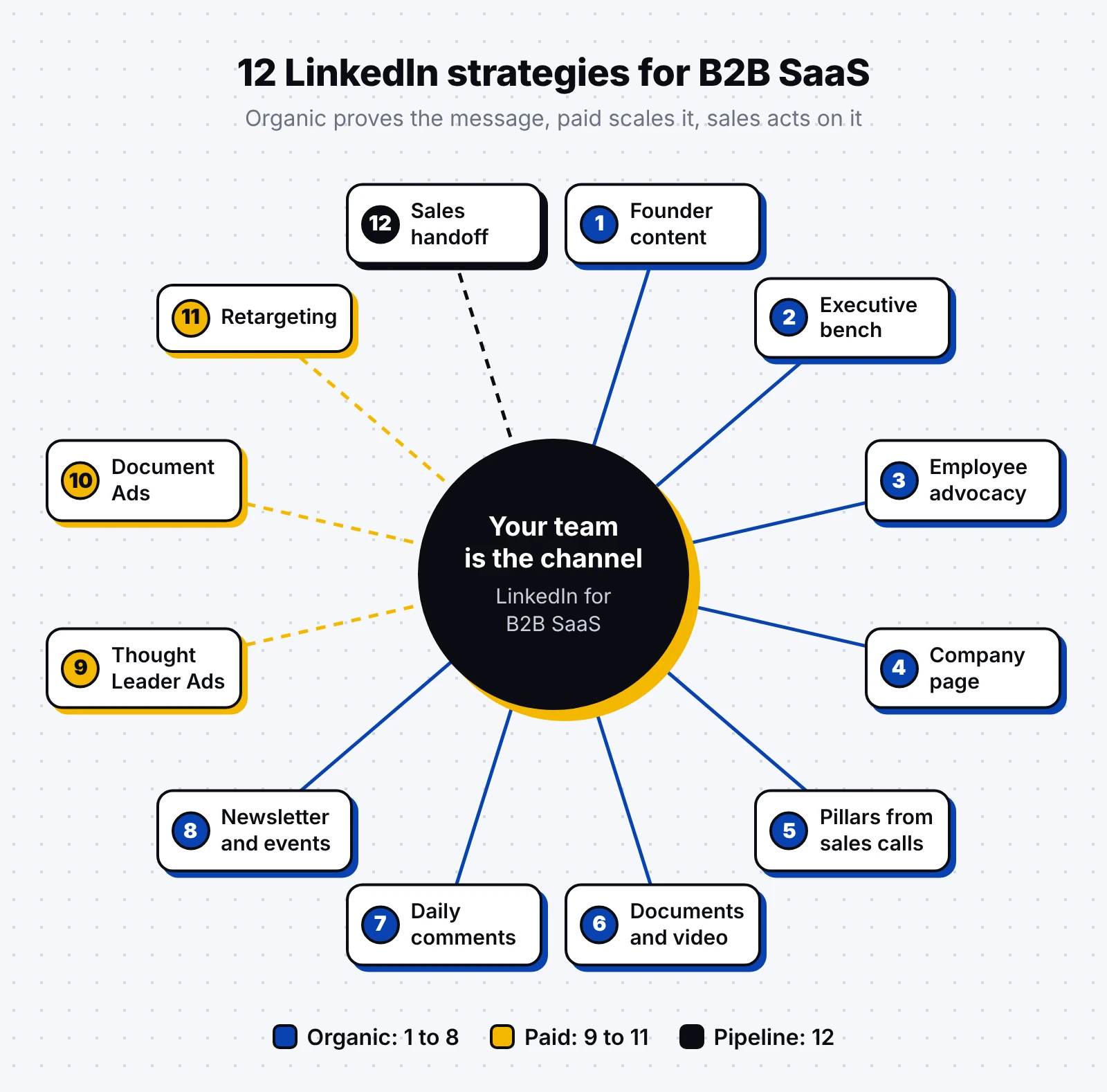
For a B2B SaaS company, the people on your team are the channel, so the 12 strategies start with them. Strategies 1 to 8 are organic and cost time more than money. Strategies 9 to 11 are paid, and they work best once your organic posts have shown you what buyers respond to. Strategy 12 connects LinkedIn to your sales team.
Organic strategies
1. Run founder content on a steady schedule
Founder content means the founder posts their view of the market from their personal profile, every week. It gives buyers a person to trust before they meet a rep.
The schedule is the hard part. If you post only when an idea strikes, the busy months will empty your feed. Buffer's analysis of more than 2 million posts from 94,000+ accounts found that going from 1 post a week to 2 to 5 added 1,182 impressions per post on average. Aim for a steady 2 to 5.
The fix is a system. The founder brings the ideas in a short interview every two weeks, a writer turns them into drafts in the founder's voice and the founder approves each post. We call it "You talk, we write." Our guide to LinkedIn ghostwriting for SaaS founders covers the process and what to look for in a writer.
2. Build an executive bench of 2 to 4 voices
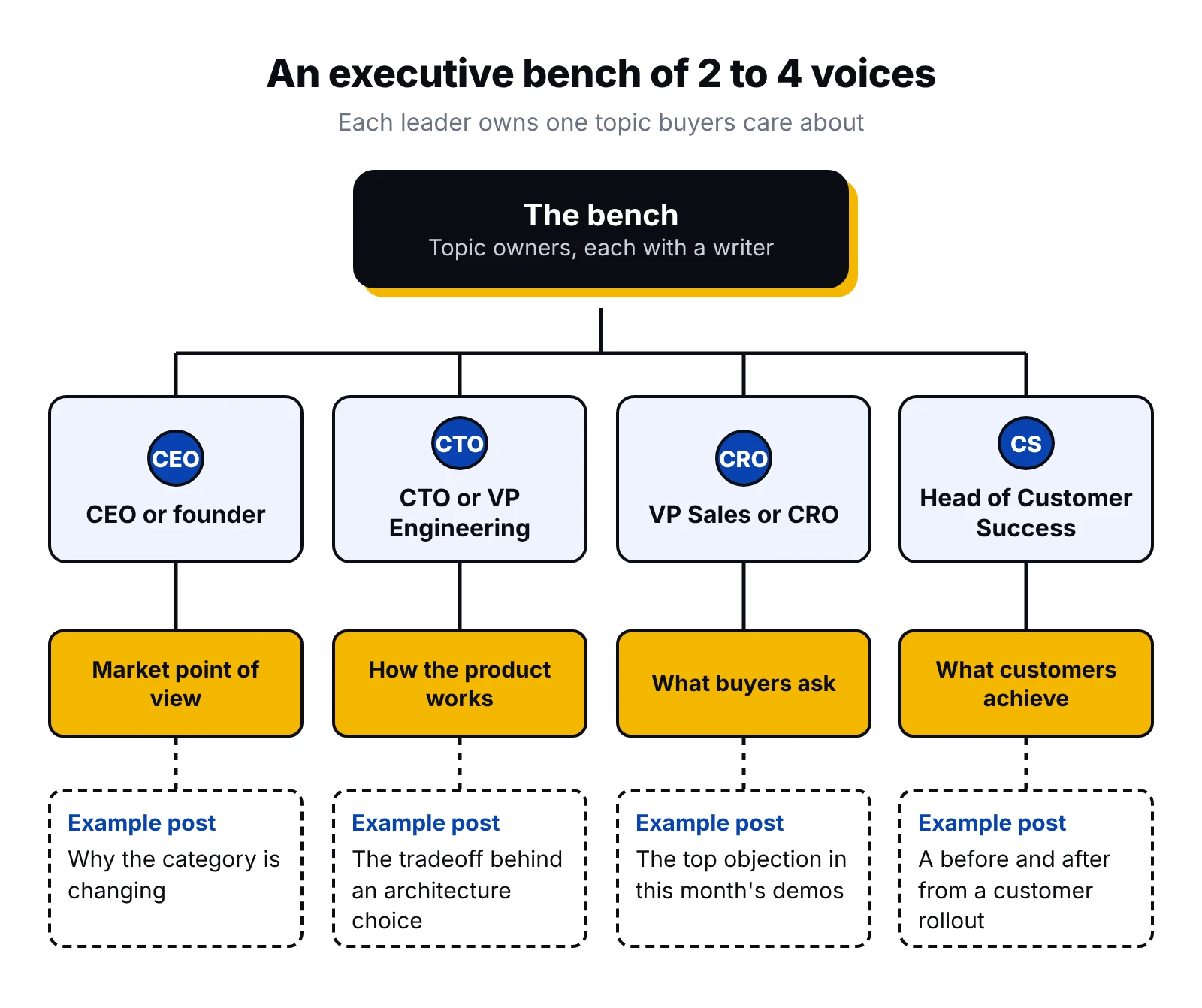
One founder is a single point of failure. When they travel or raise a round, the channel stops. An executive bench spreads the work across 2 to 4 leaders, and each one owns a topic buyers care about.
| Voice | Owns | Example post |
|---|---|---|
| CEO or founder | Market point of view | Why the category is changing and where the company stands |
| CTO or VP Engineering | How the product works | The tradeoff behind an architecture choice |
| VP Sales or CRO | What buyers ask | The objection that came up most in this month's demos |
| Head of Customer Success | What customers achieve | A before and after from a customer rollout, shared with permission |
Pick leaders who have opinions and will sit for an interview. That matters more than title. Who runs the program day to day is its own question, and our post on B2B SaaS marketing team structure covers where LinkedIn ownership sits.
3. Turn employee advocacy into a weekly habit
Employee advocacy is your wider team sharing and commenting on company content from their own profiles. The reach math is the 10x connection gap from LinkedIn's employee advocacy data. That data is from 2017, so compare your own team's connections with your page's followers before you plan around it.
Keep the ask small. Pick one post a week worth sharing and use your page's option to notify employees, which LinkedIn allows up to once a week (LinkedIn Pages best practices, read November 2026). Ask people to add one line of their own view when they share. Forty identical reposts look like a campaign, and readers can tell.
4. Use the company page as a proof hub
The company page is where a buyer goes after a founder's post makes them curious. It should answer one question: can this team deliver? Fill it with customer stories that have numbers, product updates, review site badges, case study documents and the best posts from your bench, reshared.
LinkedIn says pages with complete information get 30% more weekly views, and companies that post weekly see a 2x lift in engagement. Weekly is enough for the page, since your people carry the reach.
5. Build content pillars from sales call questions
Content pillars are the 3 or 4 topics your posts keep coming back to. Your sales calls are the best source for them, since the questions buyers ask a rep are the ones they ask themselves before they book a call.
Pull 20 to 30 recent call recordings or notes from Gong or your CRM. List every question and objection, group them and keep the groups that come up most. Each group becomes a pillar, and each question becomes a post. Our post on how your sales team can inform content strategy shows how to run this with your reps.
6. Pick formats that earn attention: documents, video and newsletters
Format changes how far a post travels. Socialinsider's 2026 LinkedIn benchmarks, built on about 26,000 company pages in 2025, show the gap:
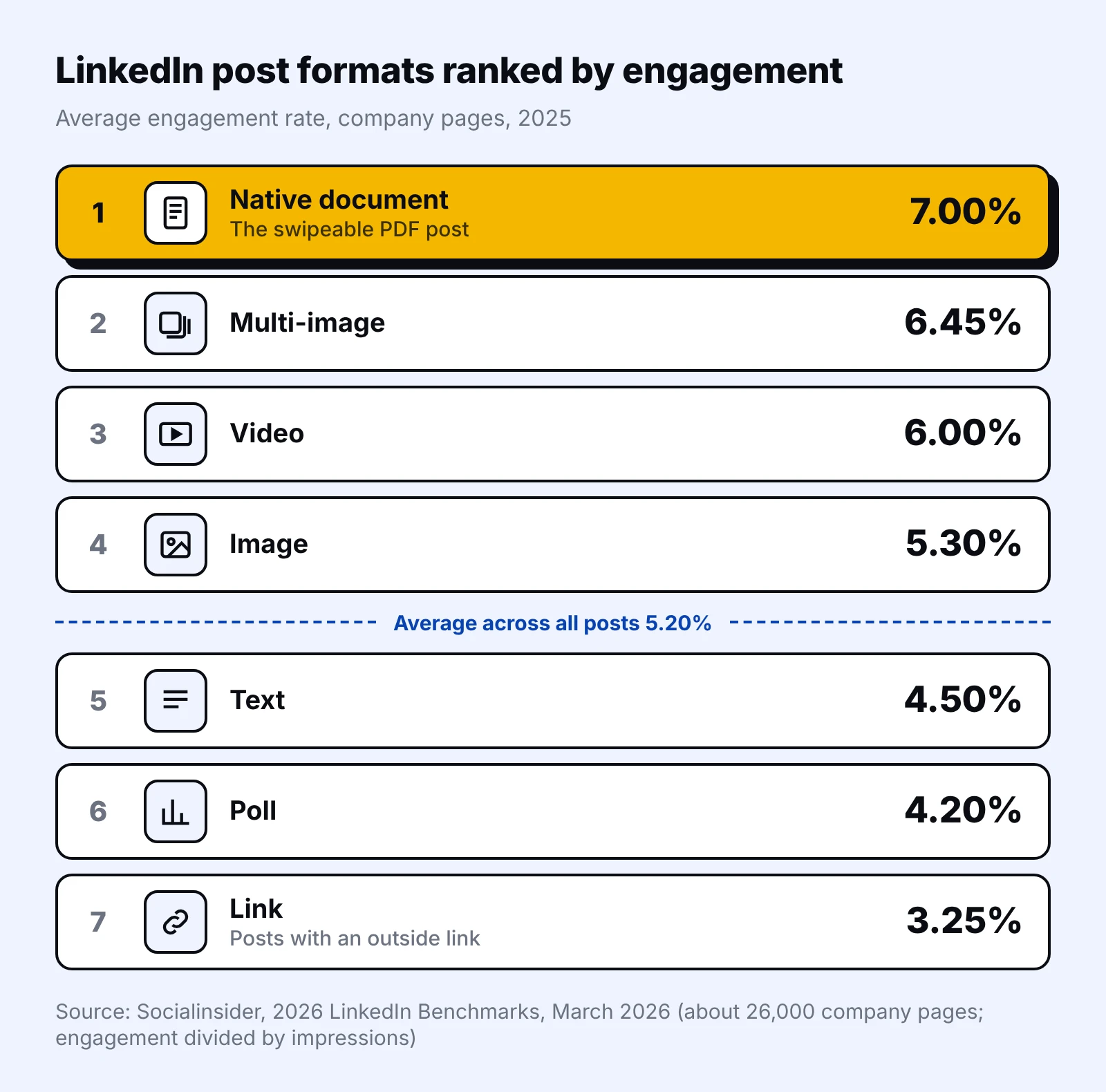
Native documents (the swipeable PDF posts many people call carousels) led at 7.00%. Video reached 6.00% and plain text 4.50%. Posts with an outside link came last at 3.25%. These are company page numbers, so test them on your executives' profiles before you rebuild your plan around them.
Give each format a job. Documents suit checklists and short guides. Short video of an executive talking to camera suits opinions, and customer clips suit proof. Text suits a sharp point of view, and newsletters get their own strategy below.
7. Keep a daily commenting routine
Comments put your bench in front of people who don't follow them yet. Spend 20 minutes a day on posts from your target accounts and the creators your ICP reads.
A useful comment adds something: a number, a counterexample or a question the author can answer. "Great post" adds nothing. Keep a list of 30 to 50 profiles for each executive and work through it during the week.
8. Launch a LinkedIn newsletter and run events
A LinkedIn newsletter reaches people outside the feed. After each edition, LinkedIn notifies every subscriber by push notification, inside the app and by email. People who follow you also get an automatic invitation to subscribe, according to LinkedIn's Help Center (read November 2026). It's the closest thing to an email list you can build on the platform.
Run it from the founder's profile every two weeks or every month, and go deeper than a post can. Events work for live formats, and people who respond to a LinkedIn Event become an audience you can retarget later (strategy 11). Whether this work also helps AI tools name your brand is a separate question, covered in our post on AI brand mentions from LinkedIn thought leadership.
Paid strategies
9. Amplify proven posts with Thought Leader Ads
Thought Leader Ads let a company sponsor a post from a person's profile. LinkedIn allows posts from employees, industry experts, customers and creators, and the author approves or denies each request in Campaign Manager. The campaign objectives are Brand Awareness, Engagement and Video Views, per LinkedIn's Thought Leader Ads page (read November 2026).
Promote the posts that already did well organically. Real readers have already tested their hook, and LinkedIn advises saving a post's organic numbers before launch so you can measure the lift. Then target your ICP job titles or your account list. In ZenABM's data, the median CTR for Thought Leader Ads was more than 6 times the rate for single image ads.
The catch is that these objectives warm people up and stop there. You still need a lead step after them, which is strategy 10. If you run ABM campaigns, our guide to LinkedIn ABM for B2B SaaS covers how to point these ads at named accounts.
10. Use Document Ads for lead generation
Document Ads put a PDF in the feed that people can read and download. LinkedIn's Document Ads and Lead Gen Forms pages (read November 2026) say you can share it freely or gate it behind a Lead Gen Form, which fills in the member's profile details for them. LinkedIn reports how much of the document people read and how many downloaded it.
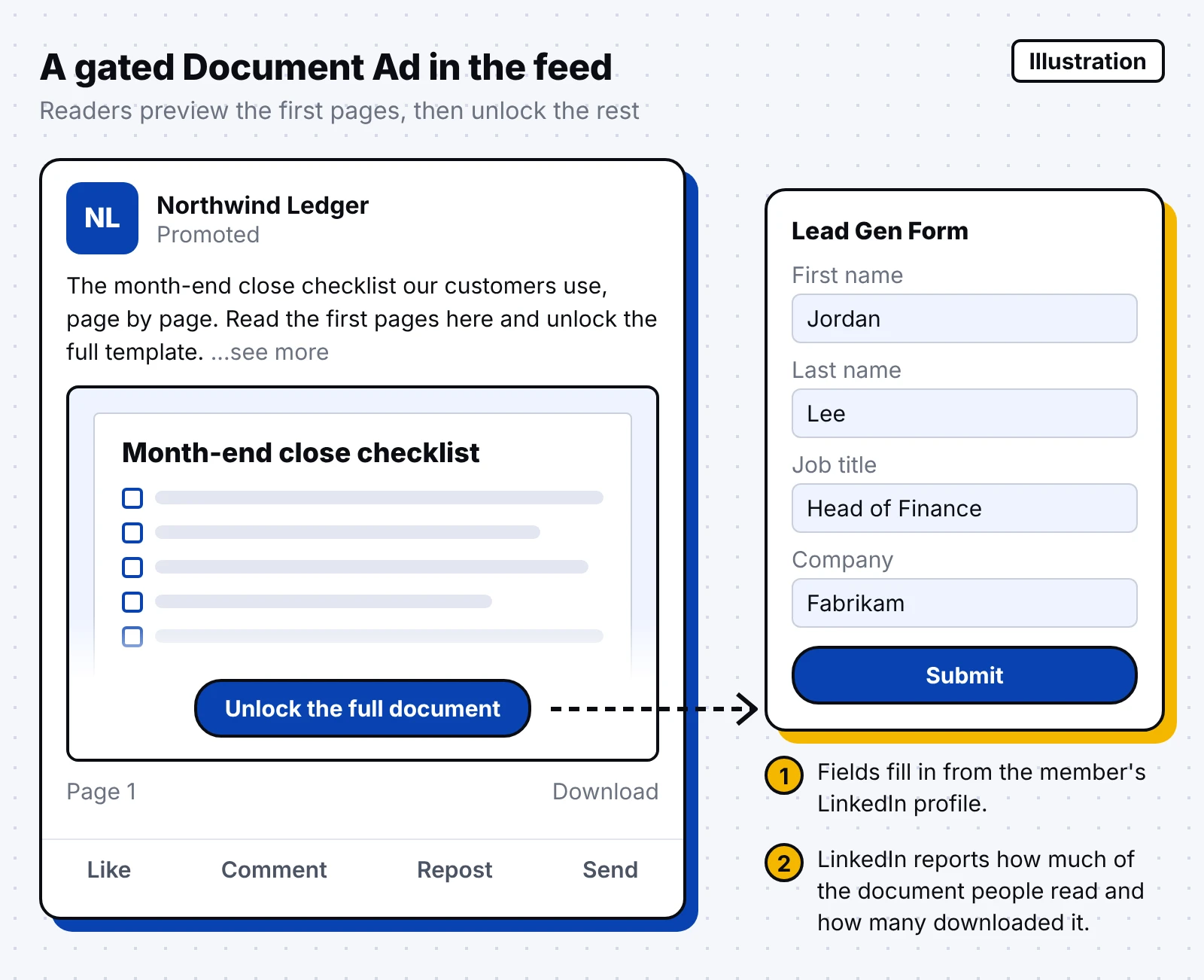
Gate the assets that are worth a work email, such as a benchmark report or a template. Leave short guides ungated for reach. Webflow found that ads promoting content downloads did better with enterprise audiences than ads about product releases, and it reported a 425% year over year increase in MQLs in its LinkedIn customer story.
11. Retarget video viewers and engagers
Retargeting shows a second ad to people who engaged with the first. LinkedIn lets you build audiences from people who viewed a video ad, opened a Lead Gen Form, engaged with a document ad or your company page, or responded to an event. The full list is in its Help Center (read November 2026).
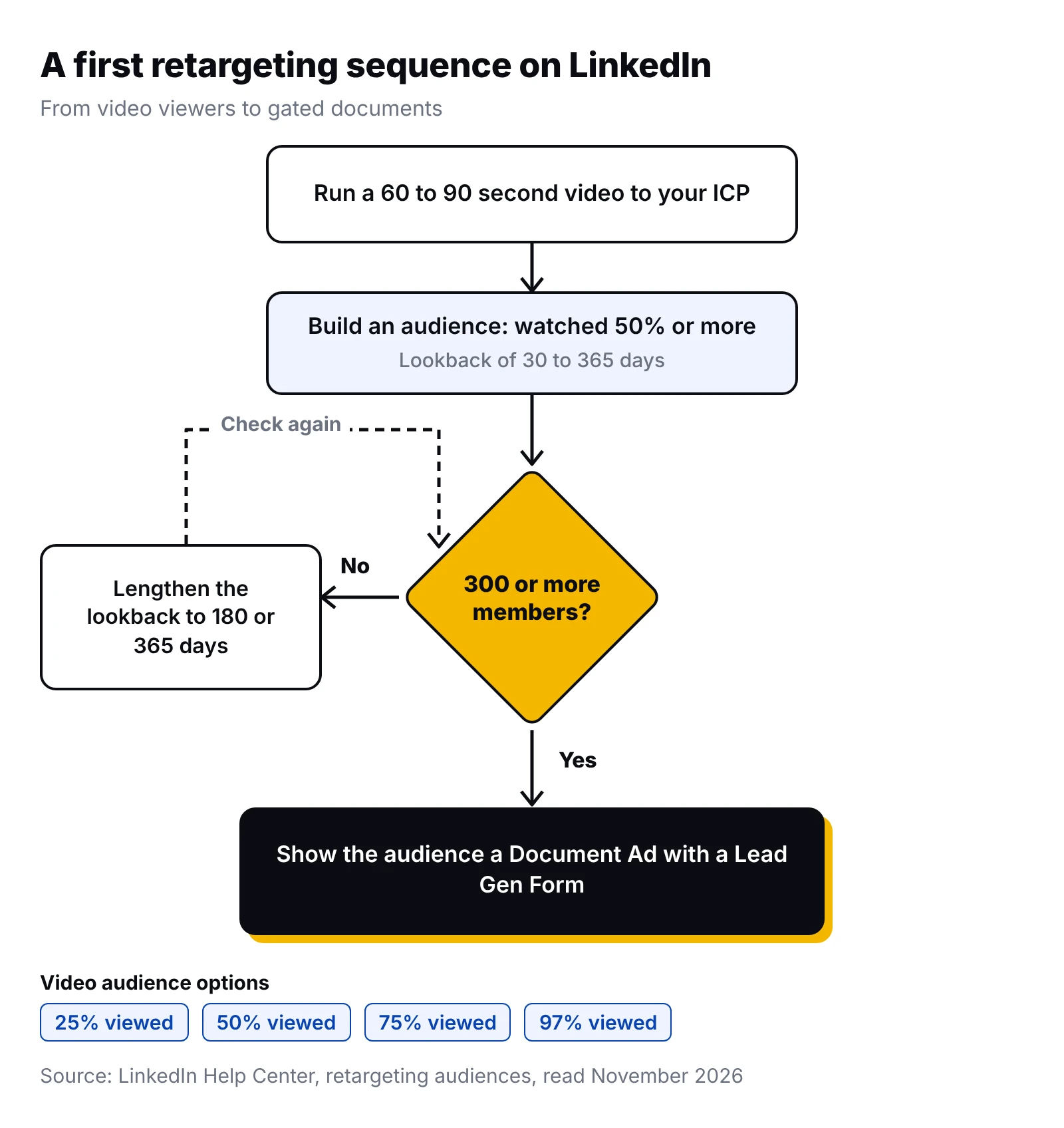
Video audiences can be set at 25%, 50%, 75% or 97% viewed, with a lookback of 30 to 365 days. Every audience needs at least 300 members before you can target it, so small accounts may need the 180 or 365 day window.
A simple sequence to start with: a 60 to 90 second video for your ICP, then a Document Ad with a Lead Gen Form for everyone who watched at least 50%. Our roundup of the best B2B SaaS marketing campaigns on LinkedIn shows how other teams sequence their ads.
Pipeline strategy
12. Hand engaged buyers to sales, by hand
Engagement is a signal, and someone has to act on it. Each week, list the people from ICP accounts who commented on or reshared your bench's posts and pass the list to the account owner. The rep reads the person's profile and recent posts, then sends a connection request with a note about the topic they engaged with.
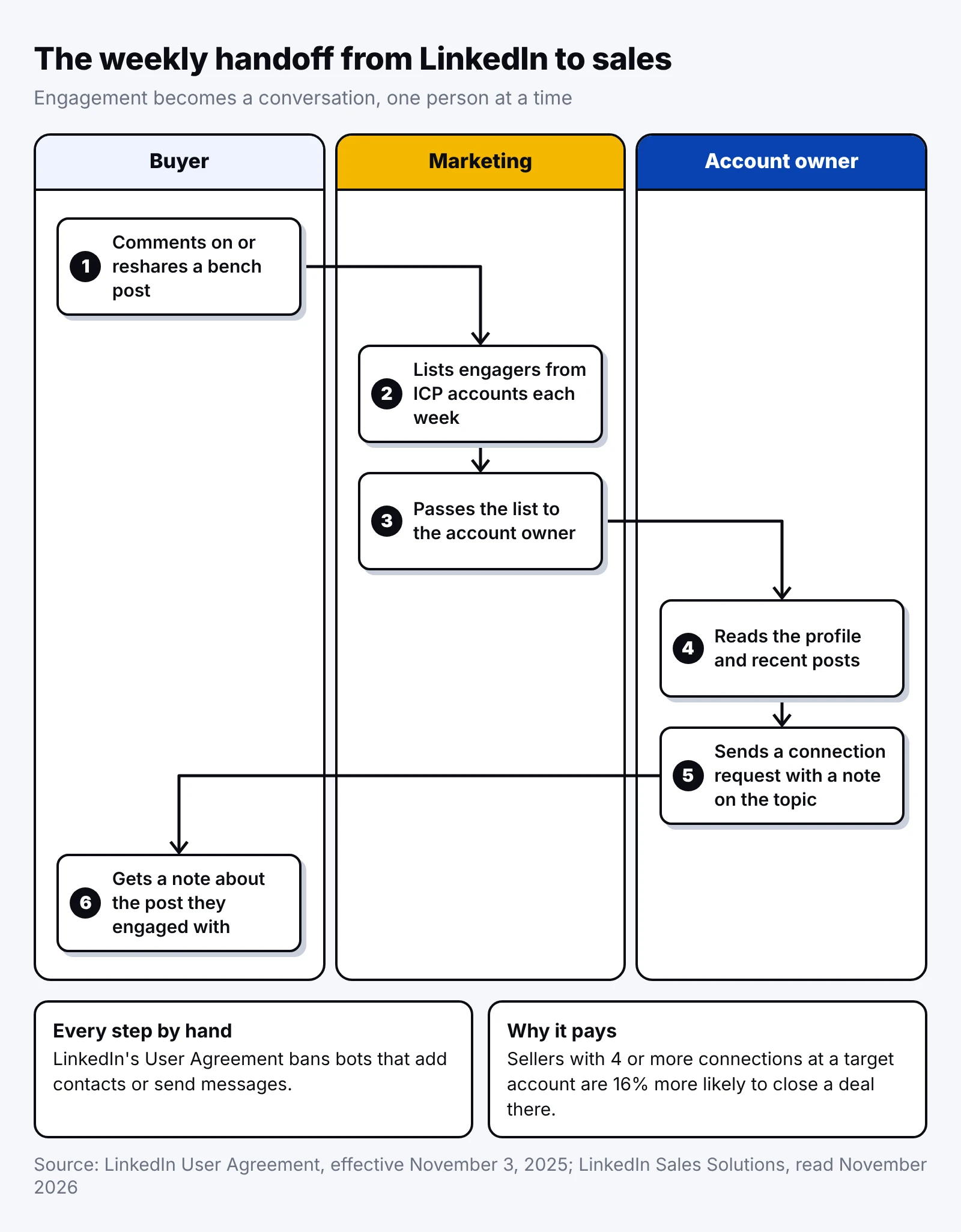
Keep it manual. LinkedIn's User Agreement (effective November 3, 2025) bans bots and other unauthorized automated methods to add contacts, send messages or drive inauthentic engagement. And the work pays off one connection at a time. LinkedIn's sales research says sellers with at least four LinkedIn connections at a target account are 16% more likely to close a deal with that company. The same page says the average sales cycle means engaging up to 11 people at that account.
How to use LinkedIn for B2B lead generation in 5 steps
The 12 strategies fit into one lead generation plan. Here is the order to run them in if your company page is quiet today.
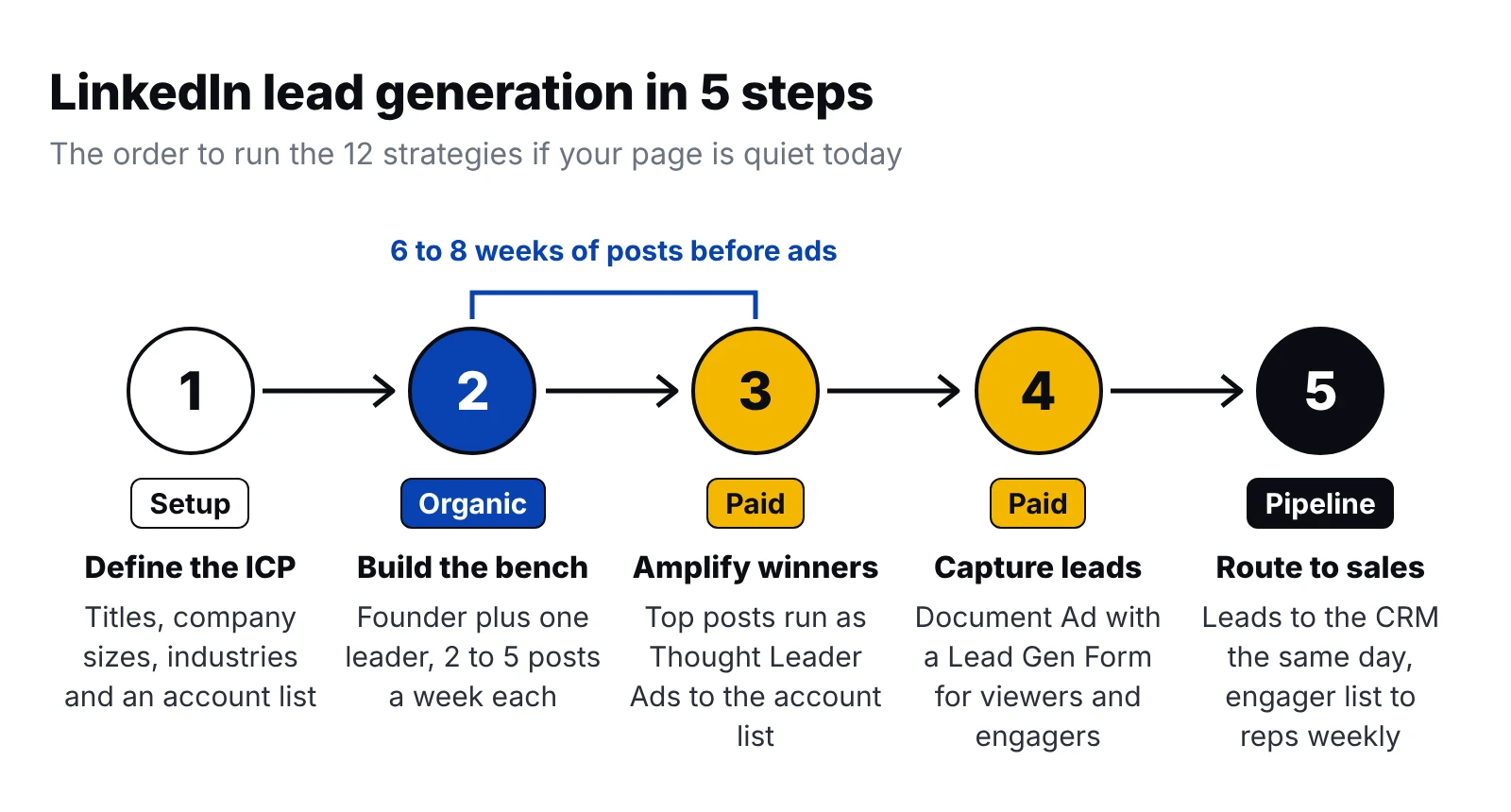
1. Define the ICP and the account list
Write down the job titles, company sizes and industries you sell to, then build a list of target accounts. Webflow targeted decision makers at companies with more than 200 employees when it moved to enterprise sales. Ads and sales should work from the same list.
2. Build the bench and post 2 to 5 times a week
Start with the founder and one more leader. Give each a pillar, a writer and a target of 2 to 5 posts a week. Run this for 6 to 8 weeks before you spend on ads, so you know which posts work.
3. Amplify the winners
Take the posts with the most engagement from your ICP and run them as Thought Leader Ads to your account list. Add a short video if you have one, since its viewers become your first retargeting audience.
4. Capture leads with gated documents
Retarget video viewers and post engagers with a Document Ad gated by a Lead Gen Form. Offer something only your team could make, such as benchmark data from your product or a template your customers use.
5. Route every lead and signal to sales
Send form leads to your CRM the same day and give reps the weekly engager list from strategy 12. Review lead quality every week. Census ran a weekly lead quality review and moved budget to the content, formats and audiences with the most pipeline impact. It reported a 10x quarter over quarter increase in pipeline in its LinkedIn customer story.
A sample LinkedIn content calendar for SaaS
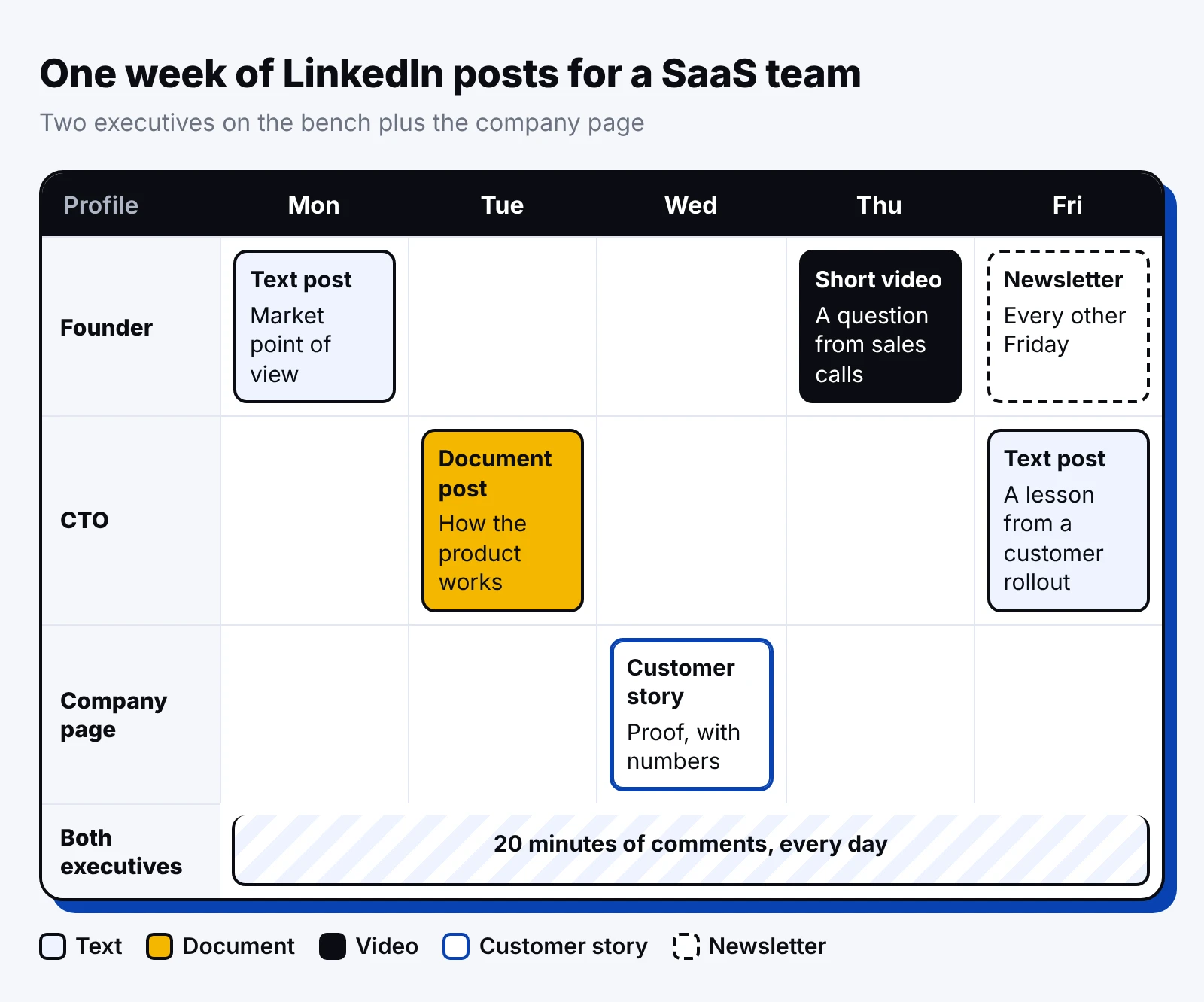
Here is one week for a team with two executives on the bench and an active company page. Swap in your own pillars.
| Day | Profile | Format | Pillar | Goal |
|---|---|---|---|---|
| Monday | Founder | Text post | Market point of view | Comments from ICP buyers |
| Tuesday | CTO | Document post | How the product works | Saves and profile visits |
| Wednesday | Company page | Customer story with numbers | Proof | Clicks to the case study |
| Thursday | Founder | Short video | A question from sales calls | Video views to retarget |
| Friday | CTO | Text post | A lesson from a customer rollout | Replies from target accounts |
| Every day | Both executives | 20 minutes of comments | Any | New ICP followers |
Each executive posts twice and the page posts once. The founder's newsletter goes out every other Friday on top of that.
Organic vs paid LinkedIn for SaaS
Organic and paid do different jobs, and SaaS teams need both. The table shows how they compare.
| Factor | Organic | Paid |
|---|---|---|
| Cost | Time from your bench, plus a writer | Ad spend, from a $10 daily minimum |
| Speed | Weeks to months to build reach | Reach from the first day |
| Who sees it | Followers, their networks and readers of your comments | Any audience you target by title, company, list or past engagement |
| Best for | Trust, point of view and testing which ideas land | Scaling proven posts, retargeting and capturing leads |
| Formats | Text, documents, video and newsletters | Thought Leader Ads, Document Ads, video and Lead Gen Forms |
| What to measure | ICP reach, comments from target accounts and profile visits | Cost per lead, pipeline and return on ad spend |
Source: LinkedIn, Making the most of your budget, read November 2026 (daily minimum)
Run them in that order. Organic tells you what to say, and paid decides how many of the right people hear it. Skip the organic step and you pay to test hooks that a free post would have tested for you.
LinkedIn B2B benchmarks
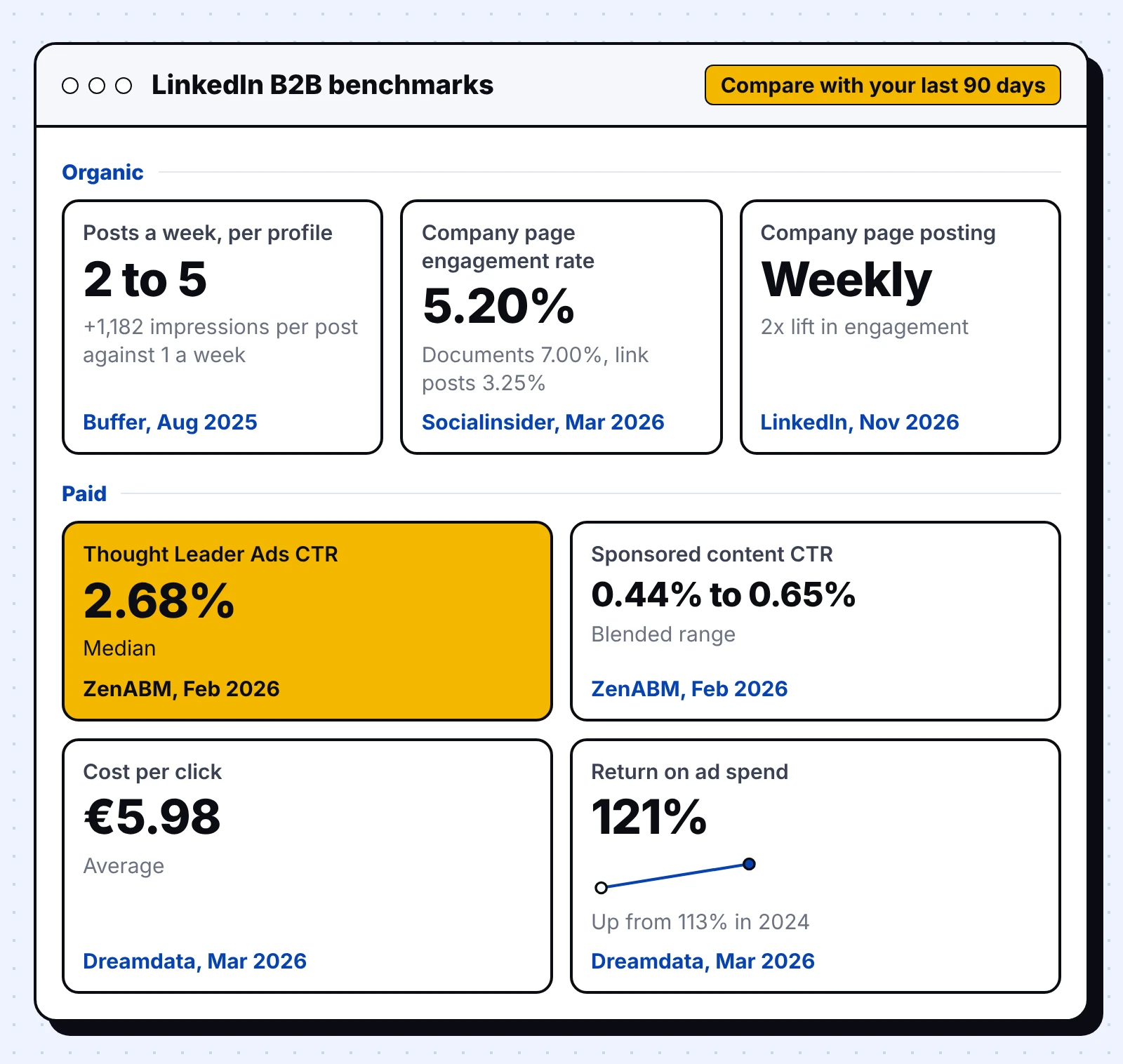
Use these as a starting point and compare them with your own last 90 days. Each comes from a different data set, so read the notes under the table.
| Metric | Benchmark | Source |
|---|---|---|
| Posting frequency | 2 to 5 posts a week; 11+ a week added 16,946 impressions per post against 1 a week | Buffer, August 2025 |
| Company page posting | Weekly posting brings a 2x lift in engagement | LinkedIn, read November 2026 |
| Engagement rate, company pages | 5.20% average; documents 7.00%; link posts 3.25% | Socialinsider, March 2026 |
| Ad CTR, sponsored content | 0.44% to 0.65% | ZenABM, February 2026 |
| Ad CTR, Thought Leader Ads | 2.68% median | ZenABM, February 2026 |
| Cost per click | €5.98 average | Dreamdata, March 2026 |
| Return on ad spend | 121% in 2025 | Dreamdata, March 2026 |
Source: Buffer, August 2025; LinkedIn, November 2026; Socialinsider, March 2026; ZenABM, February 2026; Dreamdata, March 2026
A few notes on the data. Buffer compared each of 94,000+ accounts with its own quieter weeks. Socialinsider measured company pages with 1,000 to 1 million followers and divided reactions, comments and shares by impressions. ZenABM's figures come from 211 companies, and Dreamdata's from its own customers.
Engagement rate tells you little on its own. A post with 40 reactions from your account list beats one with 400 from other marketers.
Common LinkedIn marketing mistakes
Watch for these 7 mistakes:
- Posting only from the company page, the smallest network you own.
- Running ads before organic posts have shown which messages work.
- Letting one founder carry everything, so the channel goes quiet when they get busy.
- Reporting likes and followers instead of reach inside your ICP and pipeline.
- Gating every asset, which caps reach before buyers know who you are.
- Buying automation tools for connection requests and messages.
- Leaving engaged buyers in the notifications tab with no handoff to sales.
FAQ
Is LinkedIn good for B2B marketing?
Yes. LinkedIn has more than 1 billion members and says 4 out of 5 use it to inform business decisions. In Dreamdata's 2026 report, LinkedIn ads returned 121% on ad spend in 2025, ahead of Google Search and Meta. For SaaS, it works best through your team's personal profiles, with the company page as proof.
How often should a B2B SaaS company post on LinkedIn?
Have each executive post 2 to 5 times a week, the range Buffer recommends after studying more than 2 million posts. Post on the company page at least weekly, since LinkedIn says companies that post weekly see a 2x lift in engagement.
Should you post from the company page or personal profiles?
Use both for different jobs. Personal profiles carry the reach, since LinkedIn's 2017 data found employees have 10x as many connections as their company has followers. The company page holds the proof buyers check before they reply.
How much should you spend on LinkedIn ads?
LinkedIn's minimum is $10 a day, and it suggests $25 as a starting budget for new advertisers. Set a fixed monthly test budget you can hold for a full quarter, put it behind posts that already worked organically, then move spend to whatever produces pipeline.
A good first step is to pick two leaders for your bench this week and list the 10 questions your sales team heard most last month. That gives you your first pillars and your first 10 posts. If you'd rather talk and have someone else write, see how our LinkedIn thought leadership service works.