According to 6sense's 2025 Buyer Experience Report, B2B buyers end up buying from the vendor they ranked first before talking to sales 77% of the time.
That means the deal is mostly decided while buyers read on their own. If they never see you while they build their shortlist, you rarely get a fair chance to compete.
That's why I'm sharing how I'd build a B2B SaaS content marketing program, based on what I've learned over the past 10+ years growing B2B SaaS brands. You'll get the formats to start with, a five-step strategy with templates you can copy, and how to distribute and measure what you publish.
What is B2B SaaS content marketing?
B2B SaaS content marketing is creating useful content about the problems your buyers want to solve and the products they're comparing, so they find and trust your software before they talk to sales.
It has a harder job than most consumer content. A software purchase involves a group of people, a budget approval and a long evaluation. Forrester's 2026 State of Business Buying found that 13 people inside the company and nine outside it influence a typical B2B purchase. Your content has to reach all of them, from the team lead who finds your article to the CFO who only reads your pricing page.
How content brings leads and pipeline to your B2B SaaS
A content-driven lead rarely comes from one article. Here's what that buyer journey usually looks like:
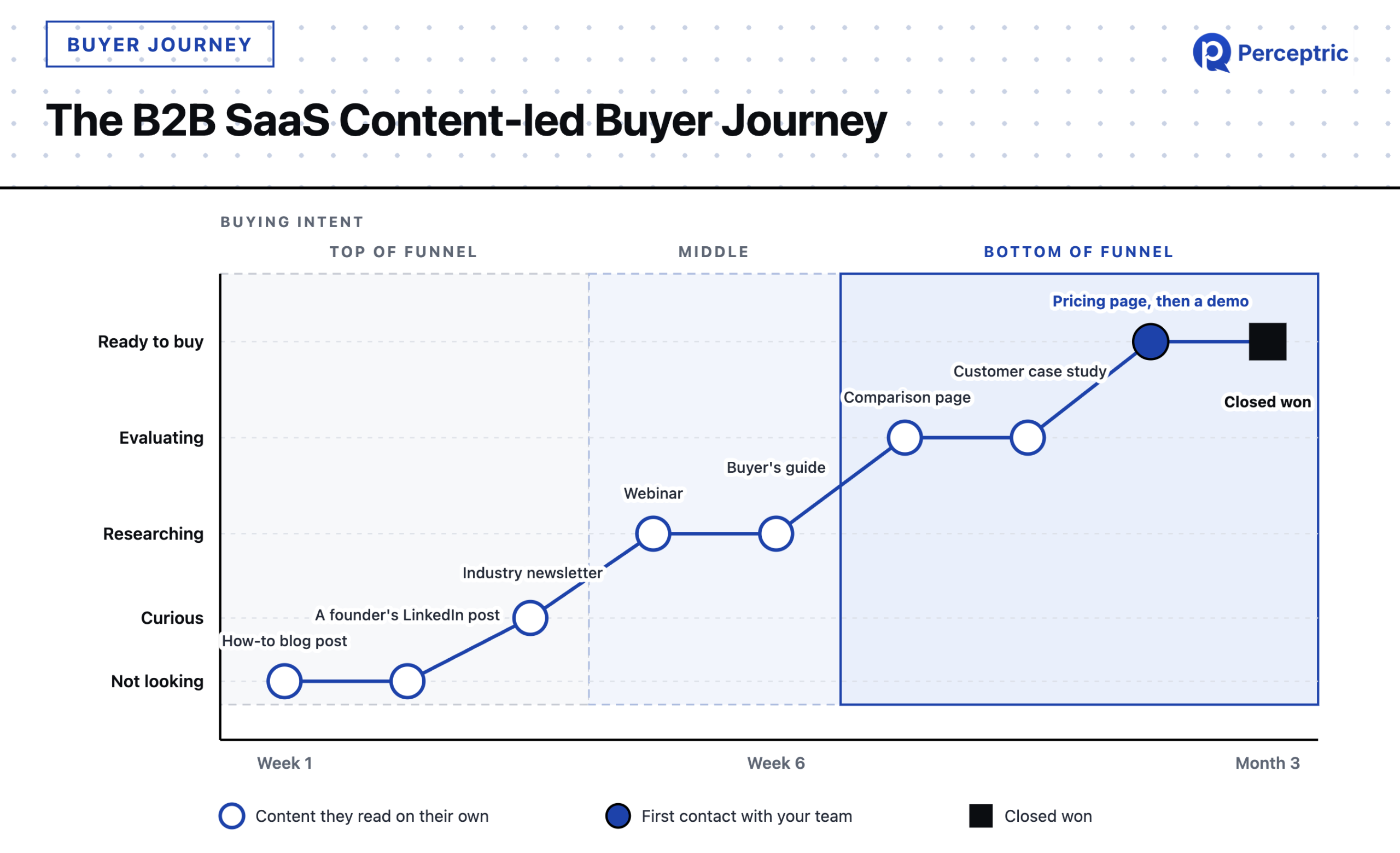
Along the way, a buyer might read your founder's LinkedIn posts, hear your name on a podcast, get a recommendation from a peer and find your article at the top of Google. By the time they book a demo, they already trust you a little, and the sales process moves faster.
Timing matters too. LinkedIn's B2B Institute, drawing on research by John Dawes of the Ehrenberg-Bass Institute, describes the 95:5 rule: only about 5% of B2B buyers are in the market at any given time. Bottom-funnel pages catch the 5% searching today, and educational content keeps you memorable for the 95% who will buy later.
Does content marketing work for B2B SaaS?
Yes, for most B2B SaaS companies it's one of the most dependable ways to bring in leads. But your CFO won't approve a budget based on industry averages. Your own math is what gets it approved.
Here's a simple way to estimate what one bottom-funnel page could be worth. These are example numbers, so swap in your own from your CRM:
- Monthly visits: 400 visits to the page.
- Visit to demo request: 2%, which gives 8 demo requests a month.
- Demo to opportunity: 50%, which gives 4 opportunities a month.
- Average deal size: $20,000 ARR, which gives $80,000 in new pipeline a month.
- Win rate: 25%, which gives about $20,000 in new ARR a month from one page.
The math also shows where to look when something is off. Lots of visits with few demo requests point to a weak page or call to action. Lots of demos with few opportunities mean the page attracts the wrong audience.
Before you publish anything, agree with sales on what counts as a qualified lead and an opportunity. That one conversation saves months of debate about whether content is working.
The best content formats for B2B SaaS
Every format has a job and a cost. Here's how the main ones compare:
| Format | Why it works | Trade-off |
|---|---|---|
| Blog posts | A good post keeps bringing search traffic and gives your other channels something to share | Needs the right keywords, or it depends on paid and social promotion |
| White papers | Room to make a detailed case that buyers can take to leadership | Slow to produce and hard to find without promotion |
| LinkedIn posts | Founders and experts build trust directly with buyers | Short shelf life, and the audience belongs to the person posting |
| Case studies | Proof from a real customer when buyers compare vendors | Needs a customer who agrees to take part |
| Infographics | Make data and processes easy to grasp and share | Design time, and search engines read text more easily than images |
| Podcasts | Reach buyers while they commute, with long conversations that build connection | Slow audience growth and hard to tie to revenue |
| Video | Shows the product and the people behind it | Costs more to make and dates when the product changes |
| Newsletters | A direct line to people who already want to hear from you | Rarely reaches new buyers on its own |
Pick the formats that fit how you sell, then add more once they work. Here's where I'd start, by situation:
| Your situation | Start with | Add next |
|---|---|---|
| Enterprise deals with a sales team | Bottom-funnel SEO pages and case studies reps can send after a first call | Founder LinkedIn and original research your champion can share |
| Self-serve or product-led | Use case and integration pages, templates and how-to guides that lead into a free trial | Comparison pages and short product walkthrough videos |
| New category with little search demand | Founder-led LinkedIn and articles that describe the problem in your buyers' words | Original research and podcast guest spots, then SEO once demand forms |
| Crowded category with big competitors | Alternatives and "X vs Y" pages, plus pages for niche industries and use cases | ROI calculators and opinionated thought leadership |
| Small team with one marketer | 4 to 6 bottom-funnel pages and one founder posting on LinkedIn three times a week | A monthly newsletter built from the same interviews |
How to build your B2B SaaS content strategy
Here's my process, in the order I'd run it.
1. Choose content by buying intent
Buyers search with different levels of intent, and each level calls for different content:
| Intent | The buyer is thinking | What to publish |
|---|---|---|
| High (bottom of funnel) | "Which vendor should we pick?" | Alternatives and "X vs Y" pages, clear pricing, ROI calculators, security and onboarding docs |
| Medium (middle of funnel) | "How do we solve this problem?" | How-to guides, templates, case studies with real numbers, benchmarks |
| Low (top of funnel) | "We want to learn about this topic." | Thought leadership, trend reports, explainers and newsletters |
I recommend starting with high-intent content, because it captures demand that already exists and brings pipeline first. Then expand into medium and low intent to build trust and grow your audience.
Let's say you sell a contract management tool for in-house legal teams. Here's how your keywords might sort:
- High intent: "contract management software for legal teams", "[Competitor] alternatives", "[Your product] vs [Competitor]" and "contract management software pricing".
- Medium intent: "how to set up a contract approval workflow", "contract review checklist template" and "how to track contract renewal dates".
- Low intent: "what is contract lifecycle management", "legal operations trends" and "contract management best practices".
High-intent searches name a product category or a competitor, which tells you the person is shopping. Use that test when you sort your own keyword list.
2. Interview founders and subject experts
Some of your best content ideas are already inside your company. The people who build, sell and support the product hear questions and objections every week. Here's who I'd interview:
- Founders: They know the product vision and what they believe makes it different.
- Product: They know how the product works and which use cases are strongest.
- Sales: They hear what prospects compare you against and what decides a deal.
- Support: They know where customers struggle and which questions keep coming back.
Send a few questions ahead of time, such as "Why do customers choose us over the alternatives?", "What do customers complain about most?" and "What do you wish prospects understood before the first call?". Record each interview with an AI meeting assistant, so you can pull opinions and stories from the transcript later.
Then use the product yourself for 30 to 60 minutes, the way a new user would. Within a day of each interview, fill in this short brief while the details are fresh:
- Source: Who you interviewed and their role.
- Strongest opinion: One thing the expert said that most competitors would never say.
- Customer story: A real situation they described, with the problem and what changed after the customer started using the product.
- Objections: The doubts prospects raise most often, in their own words.
- Content ideas: 3 to 5 article or post ideas, each tagged high, medium or low intent.
3. Set your website up to capture leads
Before you launch any content, make sure your site can capture and track the leads it brings. Here's what I recommend:
- Conversion tracking: Send leads from your content straight into your CRM, such as HubSpot or Salesforce.
- Lead alerts: Notify sales reps the moment a new inbound lead comes in, so they can follow up the same day.
- Attribution data: Capture source, campaign, landing page and first-touch page for every lead.
- Short forms: Only ask for what you need at this stage.
- Social proof: Add customer logos, reviews and case studies across the site.
When a lead fills out a demo form after reading your content, the CRM record should show something like this:
- Original source: Organic search
- First page seen: /blog/contract-management-software-for-legal-teams/
- Conversion page: /demo/
- Self-reported source: "Saw your CEO's posts on LinkedIn, then found your comparison page"
That last field comes from an open question on your demo form, like "How did you hear about us?". Buyers often name a podcast or a colleague that no tracking tool can see.
4. Launch your bottom-funnel SEO program
I recommend SEO for almost every B2B SaaS team, because bottom-funnel pages reach buyers who are already searching for a vendor. A strong page keeps bringing traffic and leads for months or years after you publish it, and buyers can research your product before they ever talk to sales.
The most valuable keywords are usually bottom-funnel searches built around a use case or an industry. They often look like this:
- [Industry] + [use case] software: "construction scheduling software"
- [Use case] software for [industry]: "expense management software for nonprofits"
- [Competitor] alternatives: "Asana alternatives"
Many of these topics suit list and comparison pages. Buyers use those formats to compare vendors, and they match how AI search engines put together product recommendations. Our guide to AI SEO explains why, and our B2B SaaS SEO guide covers the rest of the process.
Here's the outline I use for a "[Competitor] alternatives" page:
- Short answer at the top: Two or three sentences naming the best alternatives and who each one suits.
- Why people switch: The real reasons from sales calls and review sites, such as a pricing change.
- Comparison table: Each product with its pricing model, best fit and main strengths. Be fair, because buyers notice a one-sided page.
- One section per alternative: Who it's for, what it does well and what customers say about it.
- How to choose: Clear advice by situation, like "If your team has fewer than 20 people, start with X."
- Proof and next step: A short story from a customer who switched to you, then a demo or trial call to action.
Once your pages are live, check how AI search sees you. Type prompts like "What is the best [use case] software for [industry]?" or "Compare [your product] and [competitor] for [use case]" into ChatGPT, Perplexity, Gemini and Claude, and note which brands and pages each answer cites. Run the same prompts every month. If competitors show up and you don't, study the pages the answers cite and cover what they cover.
Our SEO and GEO case study walks through a full program like this for a B2B SaaS company.
5. Launch your LinkedIn thought leadership program
Many people still see LinkedIn as a place to announce new jobs. Used with a plan, it's one of the strongest lead channels a B2B SaaS founder has. Here's one of my own posts:
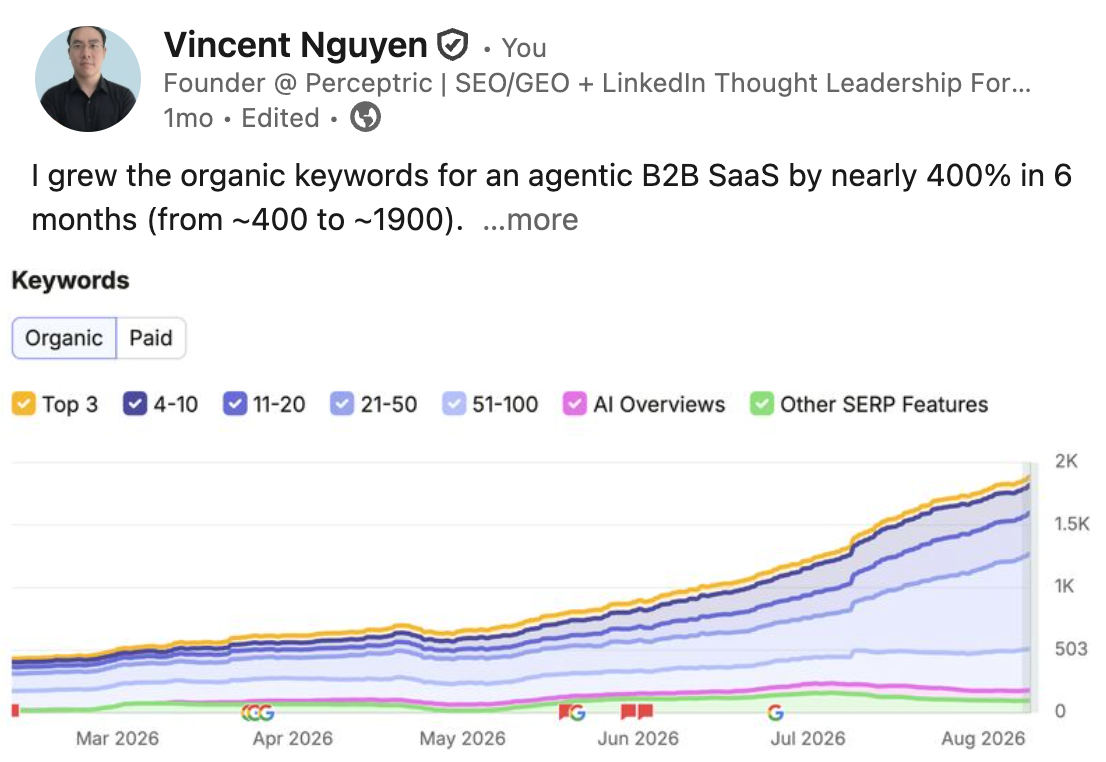
Plenty of B2B SaaS brands have grown this way. In a LinkedIn playbook from Exit Five, Devin Reed, who led content at Gong, describes building a LinkedIn strategy for Clari's CEO that reached 6.1 million views in 12 months. Kait Stephens, CEO of Brij, credits LinkedIn for revenue that grew 7x in a year, as inbound went from nothing to more than 40% of leads.
Here's the playbook I follow:
- Pick one topic: Choose the one thing you want to be known for. You don't need a big following, just the right people reading.
- Plan by intent: Post most often about your topic for your industry. Add business lessons or personal stories about once a week, product updates or demo invites no more than once a week, and news reactions now and then.
- Start with text: Text posts are the easiest place to begin. Add infographics or short video once you're comfortable, since video lets buyers see your face and hear how you think.
- Post consistently: Anyone can write one post. Posting several times a week for months is the hard part, so batch your writing and schedule ahead.
- Engage every day: Spend 5 to 10 minutes a few times a day commenting on posts from buyers and peers. A short reaction to the main point is enough.
- Track the right signals: Give it several months. Look for people who say they follow your posts, prospects who mention them on sales calls and demos that come straight from LinkedIn.
- Bring the team in: Once it works for one person, the results make it easy to get other leaders posting too.
If you're stuck on structure, start each post with a specific claim in one or two lines, like "Most security reviews stall on the same five questions." Then give the context, the lesson in a few short points, one piece of proof and a question that invites comments. Our guide to thought leadership content covers the rest.
How to distribute your content
Without distribution, even great content sits unread. Some pieces find readers on their own, like an SEO article or a LinkedIn post the feed pushes out. Others need you to push them.
I use a simple matrix to decide what role each piece plays. It looks at how easy a piece is to find (discoverability) and how original and memorable it is (creativity):
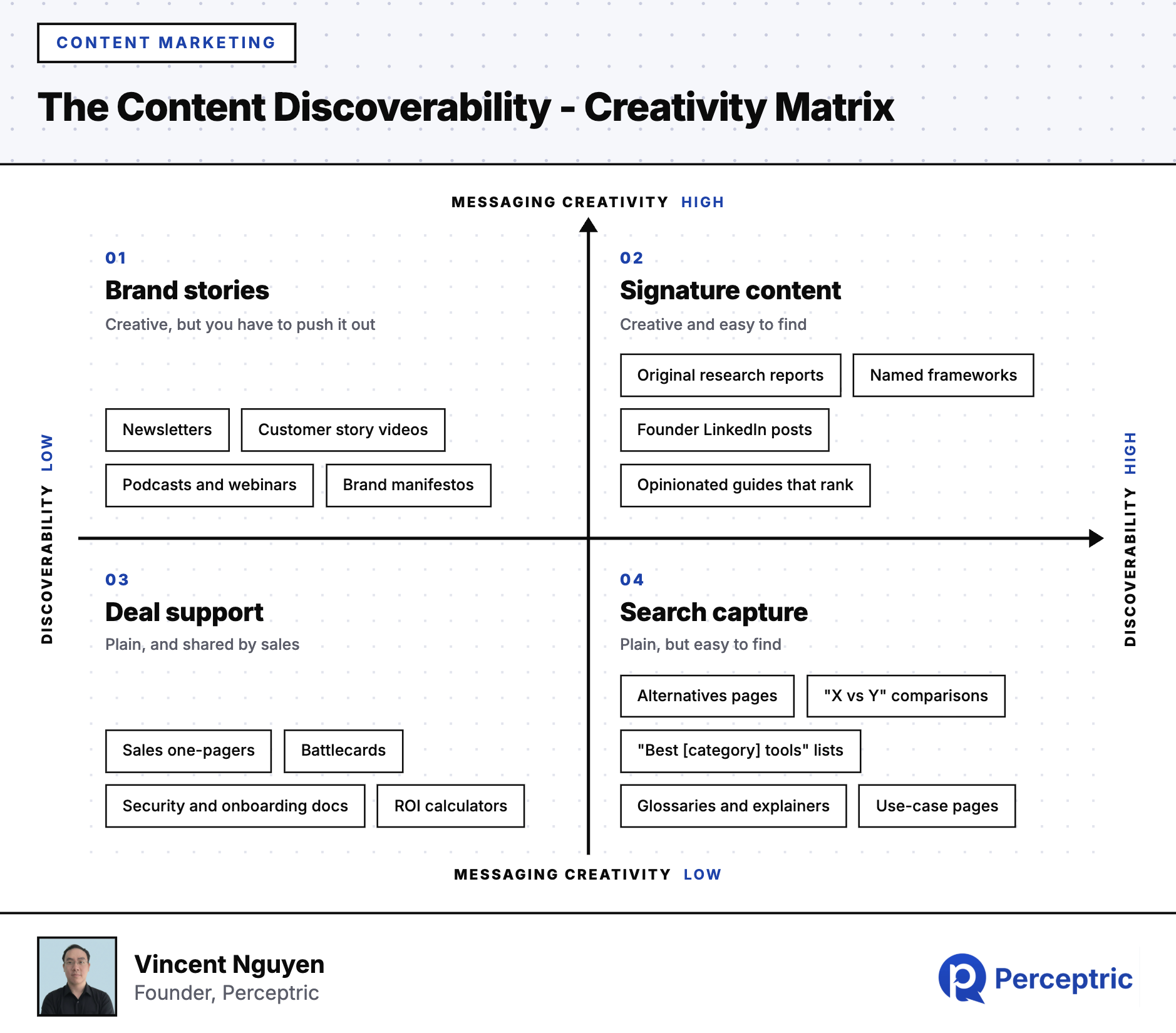
Here's what goes in each quadrant:
- Signature content (easy to find, creative): Founder posts on LinkedIn and opinionated guides that rank on Google. The algorithms bring these new readers, so they're worth your best ideas.
- Search capture (easy to find, plain): Alternatives pages, "X vs Y" comparisons and use case pages. They bring steady traffic, though SEO conventions leave less room for creativity.
- Brand stories (hard to find, creative): Newsletters, customer story videos and podcasts. Promote these yourself on social media and in communities.
- Deal support (hard to find, plain): Sales one-pagers, battlecards and security docs. Your sales team shares these during deals.
How to measure content marketing results
Rankings and traffic are easy to report, but leadership cares about pipeline. Track both, and be clear about which number answers which question:
| Stage | What to track | What it tells you |
|---|---|---|
| Discovery | Impressions, rankings, organic sessions and mentions in AI answers | Whether buyers can find your content |
| Engagement | Time on page, return visits and newsletter sign-ups | Whether the content holds attention |
| Conversion | Demo requests, trial sign-ups and contact form fills | Whether content moves readers to act |
| Pipeline | Qualified opportunities where content was the first or a key touch | Whether content starts real sales conversations |
| Revenue | Closed-won revenue and deal speed for deals content touched | Whether content pays for itself |
Send leadership a one-page report every month, with pipeline at the top and traffic at the bottom. When the first number your CEO sees is pipeline, budget talks get much easier. Here's what I put in it:
- Pipeline from content: New opportunities and pipeline value where content was the first touch or showed up in the self-reported source field.
- Top 5 pages by conversions: The pages that brought demo requests or sign-ups this month.
- Leading signals: Rankings and AI answer mentions for your bottom-funnel keywords, plus the organic traffic trend.
- What shipped and what's next: New and refreshed pieces with links, then the 3 to 5 pieces planned for next month and why.
Conclusion
B2B SaaS content marketing takes a few months to build momentum, and the teams that win keep publishing long enough for it to compound. My principles:
- Start where buying intent already exists
- Get your ideas from the people inside the company
- Build the tracking before the content
- Judge content by pipeline
Your buyers will read about your category with or without you. Wouldn't you rather they read it from you?
Work with Perceptric on your B2B SaaS content
Perceptric is a B2B SaaS SEO/GEO and LinkedIn thought leadership agency. We build an Organic Content Engine that brings pipeline every quarter, from bottom-funnel pages that rank in Google and AI answers to founder posts written in your voice.
We've worked with B2B software brands like Katalon, Arrowsterr and Omniscient. For Katalon, ARR grew 4x, with more than 80% of that growth coming from SEO, and the brand is now cited by ChatGPT, Claude and Perplexity.
Here's what we do:
- Conversion-led SEO: Keyword strategy built around the terms buyers search while they compare vendors.
- AI SEO (GEO): Pages built to get you cited in ChatGPT, Claude, Perplexity and AI Overviews for commercial terms.
- Content production: Expert-led articles based on SME interviews, written by people who learn the product well enough to sound in-house.
- LinkedIn thought leadership: Posts written in your founder's voice that build demand and send warm readers to your site.
A 30-day AI visibility sprint costs $6,999. On a 6-month term, monthly programs start at $10,000 a month for AEO or for LinkedIn thought leadership (Social), and both together cost $15,000 a month. See our pricing for the full plans. We're built for post-PMF B2B SaaS, so if you need leads this week, start with paid ads and add us when you're ready to build for the next quarters.
FAQ
What content should a B2B SaaS company create first?
Start with high-intent content, such as alternatives pages, comparison pages, clear pricing and ROI calculators. It captures existing demand and brings pipeline first, and then you can expand into guides and thought leadership.
Do B2B SaaS buyers decide before talking to sales?
Mostly, yes. In 6sense's 2025 Buyer Experience Report, buyers bought from the vendor they ranked first before talking to sales 77% of the time, so your content shapes the shortlist.
How do you find content ideas for a B2B SaaS company?
Interview your founders, product team, sales reps and support team, since each of them hears different questions and objections. Then use the product yourself, so you write from firsthand experience.
How do you measure whether content marketing is working?
Traffic and rankings show whether people find your content, and qualified leads, pipeline and revenue show whether it helps the business. Send content leads into your CRM with source, landing page and first-touch data to track both.
How long does B2B SaaS content marketing take to show results?
In our experience, bottom-funnel pages take 3 to 6 months to rank well enough to bring steady demo requests. Content often becomes a reliable pipeline source between months 7 and 12.
How often should a B2B SaaS company publish content?
A realistic start for most teams is 2 to 4 well-researched SEO pages a month plus three LinkedIn posts a week from one founder or expert. Publish more only when you can keep the quality behind each piece.
Can you use AI to write B2B SaaS content?
Yes, with care. Google says its ranking systems reward helpful content however it was made, so use AI for research and first drafts, then add expert interviews, product experience, customer stories and a clear point of view.
Want to keep learning? Read our guides on B2B SaaS inbound marketing, why content marketing matters for B2B and B2B blog strategy. To plan your program with us, book a discovery call.