ChatGPT reached 100 million users faster than any app in history. Google’s AI Overviews now reach billions of users each month. More buyers are turning to AI to research software, compare vendors, and find solutions to their business problems.
For B2B SaaS, this changes how buyers discover products. AI can recommend software, compare competitors, explain use cases, and help buyers decide which tools are worth considering.
If AI-generated answers mention your SaaS, you become part of the buyer’s consideration set. If your competitors are mentioned instead, buyers may never discover your product.
That’s why it’s time to start doing GEO. In this article, we’re going to share with you:
- Why GEO is particularly effective for B2B SaaS?
- GEO and the B2B SaaS buyer journy
- The fundamentals of GEO in the B2B SaaS context
- The B2B SaaS GEO playbook
Let’s dive right in!
Key Takeaways
- Most B2B SaaS GEO and SEO agencies charge between $3,000 and $30,000 per month, often with a six-month minimum. Ad management is usually separate and costs around 10% to 25% of ad spend.
- Your own website accounts for only about 25% of AI citations. The other 75% comes from third-party sources, which makes reviews, directories, and industry publications important.
- Reviews can be a relatively quick win. Brands with 1–13 Trustpilot reviews were cited 53.5% of the time, compared with just 1% for brands with no reviews.
- Google rankings don’t necessarily translate into AI visibility. In one study, 80% of LLM citations came from pages that didn’t rank in Google’s top 100.
- Don’t expect results overnight. Getting measurable AI visibility from zero can take 6–8 months, while becoming a recognized leader in a category can take 12–18 months.
- When choosing an agency, look beyond traffic and rankings. Agencies should be able to connect their work to metrics like qualified pipeline, demos, and revenue.
- The 12 agencies on our list are Perceptric, Skale, Grow and Convert, Animalz, Omniscient Digital, Powered by Search, Foundation Marketing, Siege Media, MADX Digital, Virayo, SaaStorm, and YesOptimist.
Why GEO Matters For B2B SaaS
B2B software buyers are increasingly turning to AI to start their product research. GEO helps make sure your brand shows up when they’re first exploring their options.
Here are some numbers to prove that:

| The number | Source |
|---|---|
| Your buyers are already using AI | |
| 51% of B2B software buyers now start their research in an AI chatbot more often than Google. That’s up from 29% in April 2025. | G2, March 2026 |
| 61% of B2B software buyers use AI search alongside Google when researching products. | G2, April 2026 |
| 94% of B2B buyers used generative AI somewhere during their purchase process. | 6sense, 2025 Buyer Experience Report |
| And that changes the traffic equation | |
| When an AI Overview shows up, 34.5% fewer clicks make it through to websites. | Ahrefs, 300K keywords |
| 59% of B2B SaaS brands say their Google organic traffic is either flat or declining. | CommonMind, 2026 |
| Gartner expects traditional search volume to fall 25% by 2026, with organic traffic potentially down 50% by 2028. | Gartner |
| SEO alone isn’t enough anymore | |
| 80% of LLM citations come from pages that don’t rank in Google’s top 100. | Ahrefs, 15,000 queries |
| ChatGPT and Google results overlap only 12% of the time. | Profound, 41M results |
| Your own content accounts for only about 25% of AI citations. The other 75% comes from sites you don’t control. | Contently / Radarly, 2026 |
| So where do those citations come from? | |
| Reviews are one of the easier places to start. Brands with 1–13 Trustpilot reviews were cited 53.5% of the time, versus just 1% for brands with none. | Seer Interactive |
| G2 makes up roughly 33% to 75% of review-site citations for software-related queries. | MADX, 2026 AI Search Benchmark |
| G2, Capterra, Trustpilot, and TrustRadius together account for 88% of review-platform citations. | SE Ranking |
| Listicles are particularly important in B2B tech. They made up 61% of citations for B2B technology services, compared with 19.6% across industries. | DeltaV Digital |
| LinkedIn was the most-cited domain for the B2B technology services brand studied, with 736 citations. | DeltaV Digital, 25,337 citations |
| GEO takes time, so don’t wait until it’s urgent | |
| Starting from zero, it typically takes 6–8 months to build measurable AI visibility. | CompetLab |
| Building a leading position in a category can take 12–18 months of consistent work. | Derivatex |
| And there’s still a measurement problem: almost 60% of B2B SaaS marketers can’t identify AI-referred traffic in their analytics. | CommonMind, 2026 |
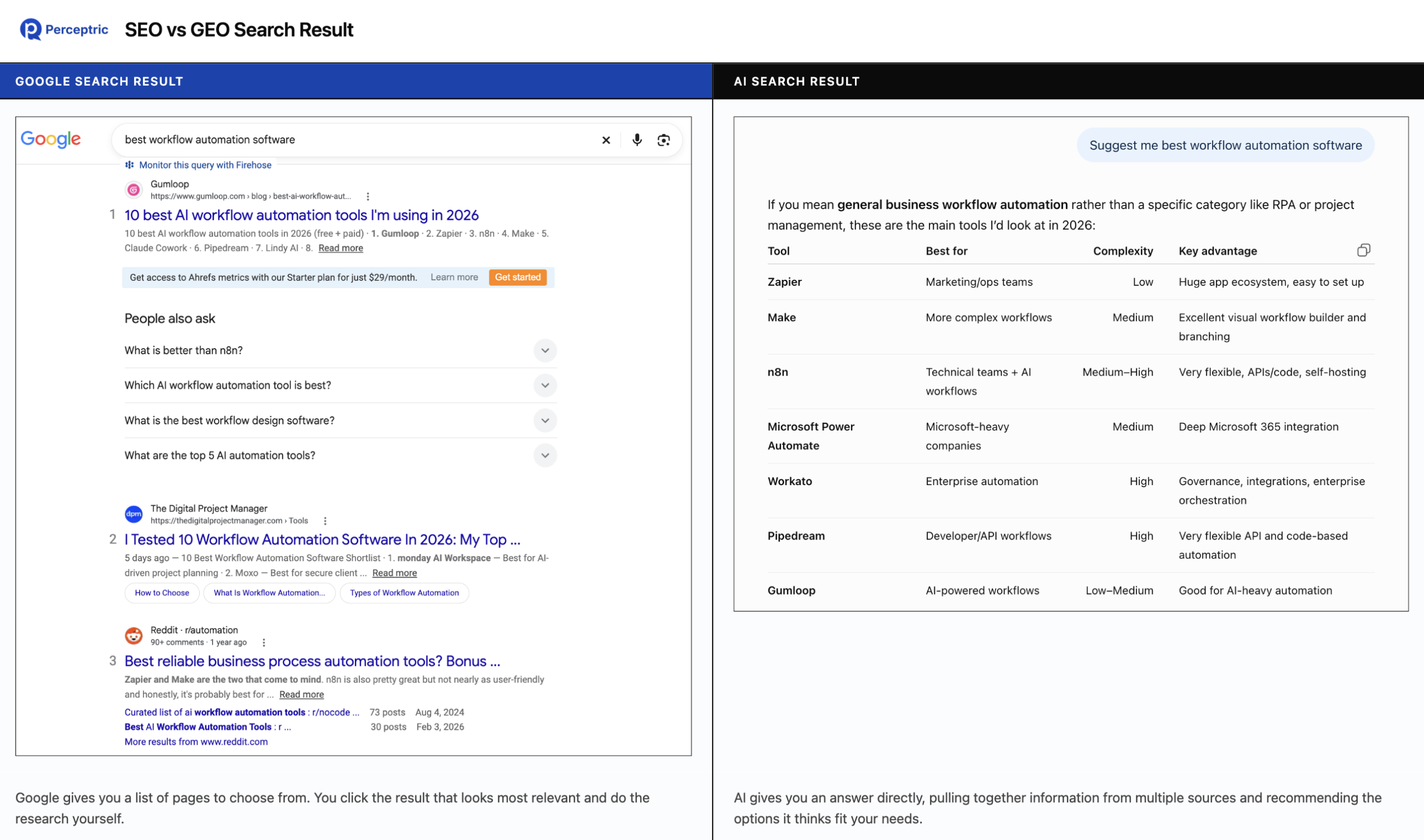
SEO vs GEO: Key Differences
In SEO, people often search with short, generic keywords, and Google tends to return broadly similar results for everyone. There is some personalization, but the basic search experience is still built around the same set of results.
GEO is different. AI search is much more personalized, since LLMs bring chat history into consideration. Each response is tailored to the user’s preferences, previous conversations, location, company, role, and specific problem to the search. Two people can ask essentially the same question and get completely different answers and recommendations.
How Does AI Make SaaS Recommendations?
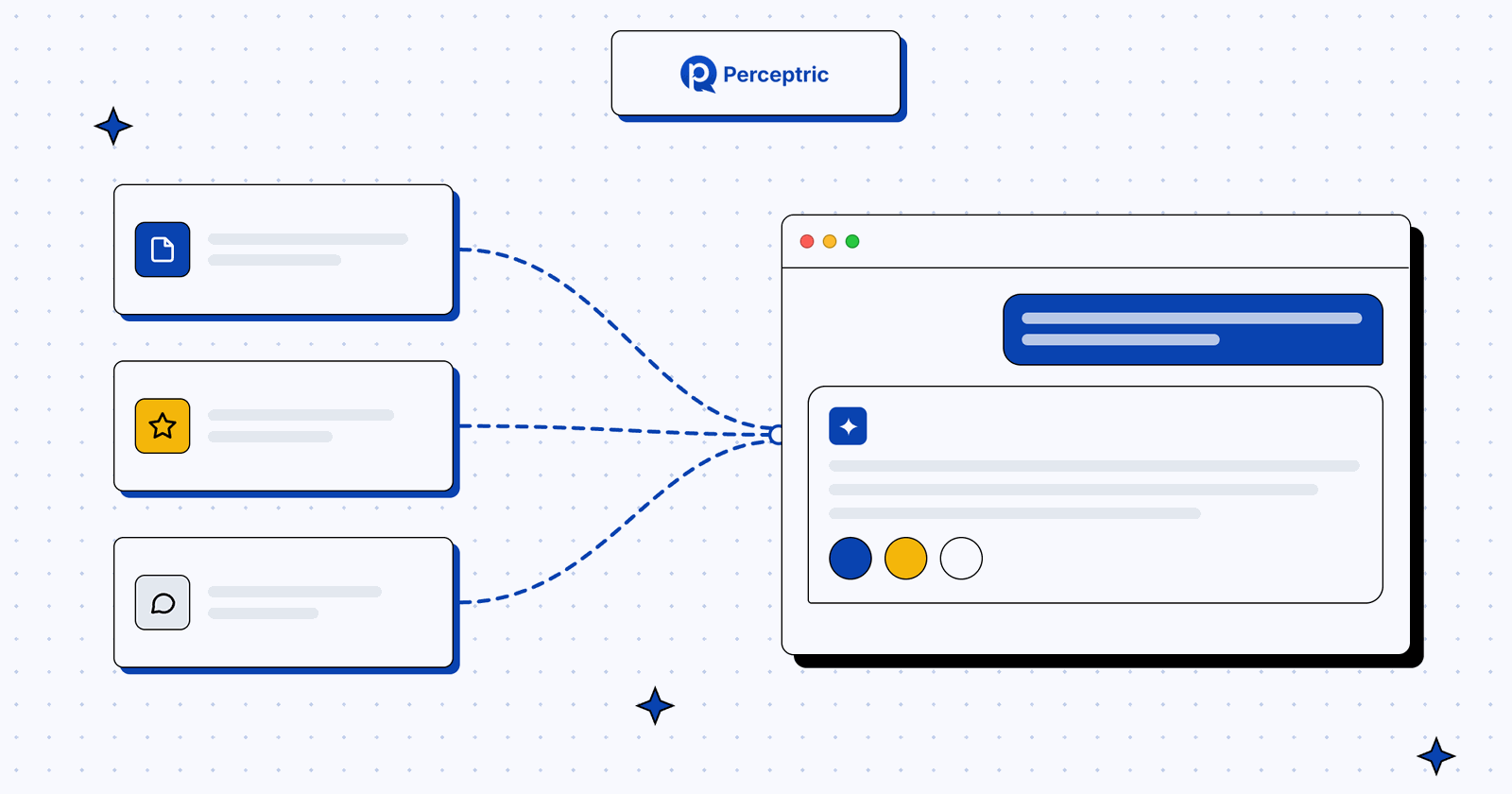
When you ask an LLM a question, it pulls from two primary sources to form its answer:
- Training data: The model relies on patterns and knowledge absorbed during training. This works well for established topics that rarely change, like scientific principles or historical events.
- Live web search: The model searches the internet in real time, reads the results, and synthesizes a response. This is essential for fast-moving topics like news, market trends, or product updates.
In practice, most LLMs blend both sources to give you the best possible answer.
But here’s the important part: when does an LLM decide to search the web instead of relying on its own training?
The answer: when the question demands dynamic information.
- An LLM doesn’t need to Google “how photosynthesis works” or “when was the French Revolution.” That’s static knowledge. LLMs already know the answer, so there’s no point venturing into the web to fetch one.
- But “best CRM for startups in 2026”? “Is Notion still worth it?” “Alternatives to HubSpot”? That’s dynamic information. The answers change every quarter, and so the LLM has no choice but to search the web.
Almost every buying decision lives in the dynamic zone. LLMs don’t have a built-in sense of objectivity to make product recommendations on their own. They will always need third-party sources from humans, such as reviews, comparisons, listicles, to form an answer.
Here’s an example. To answer a simple prompt about top AI testing tools, ChatGPT also had to crawl through several listicles, pull data from each, and synthesize a recommendation. It’s browsing the web on the user’s behalf.
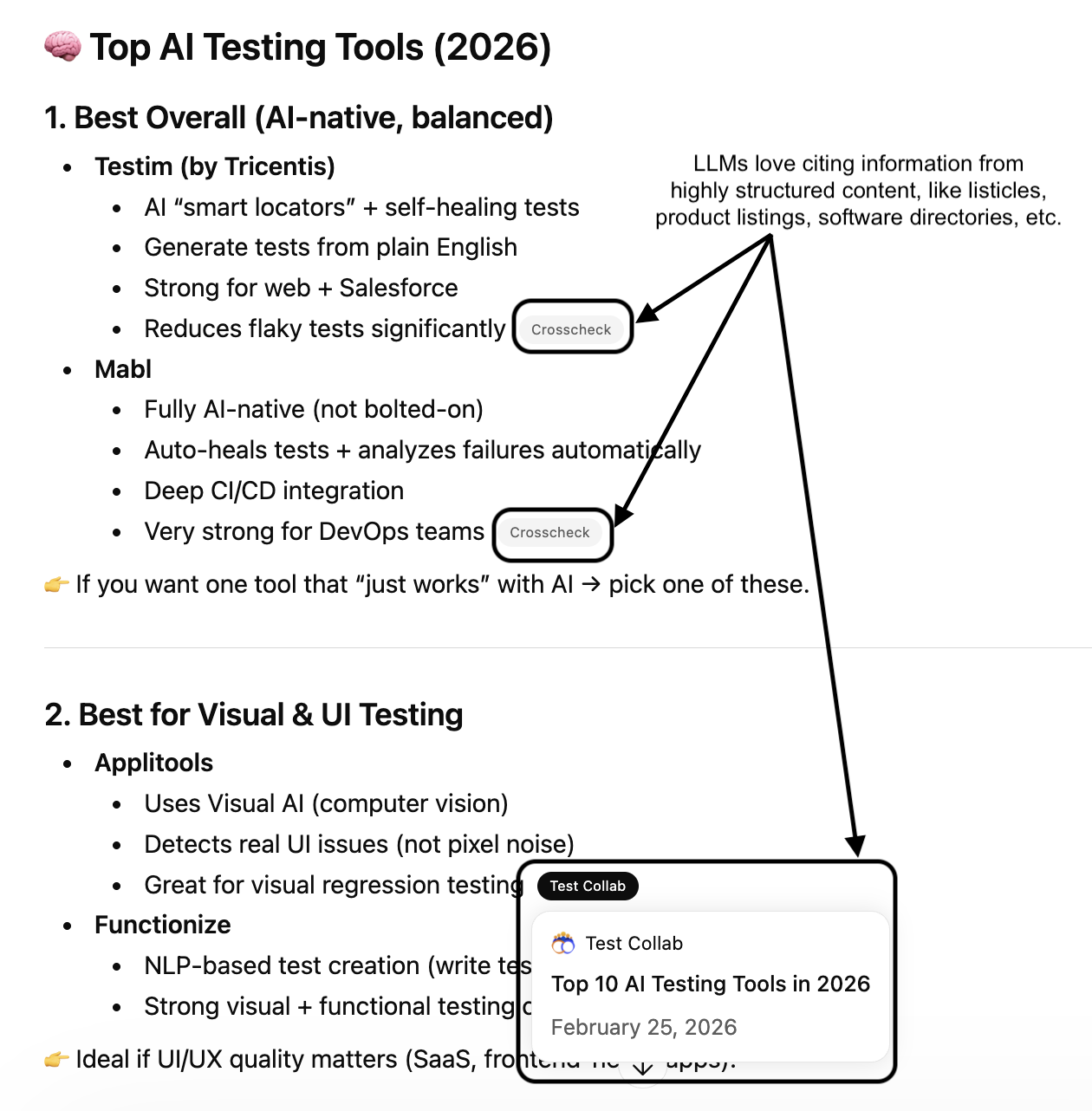
Which means the content that gets cited isn’t top-of-funnel thought leadership or brand awareness fluff. It’s bottom-of-funnel content. LLMs need you to feed it that kind of content because it can’t make product recommendations on its own, by nature.
The GEO Strategy For B2B SaaS Companies
From the researches above, it’s evident that you need to do two things to improve your AI visibility:
- Own your brand narrative
- Collect third-party validation
1. Own the brand narrative
At the end of the day, AI can’t recommend you if it doesn’t know who you are. That’s why you must very clearly define your identity on your website, since it’s the only place you have full control over.
You should publish content that explains:
- What you do
- Who you do it for
- What problem you solve
- How your product works
- What makes you different from the alternatives
You don’t want your buyers (and AI) to be confused about what you do. If you’re a CRM for B2B sales teams, say that. If you’re built specifically for mid-market SaaS companies with complex sales cycles, say that too. The more clearly you define your place in the market, the easier it is for AI systems to understand when your product is relevant.
Once that foundation is built, you can start to work on getting the right third-party sources, reviews, comparisons, and customer evidence to reinforce that narrative.
2. Collect third-party validations
AI doesn’t just look at what you say about yourself. It also looks at what other people say about you, such as:
- Reviews
- Industry publications
- Comparison sites
- Directories
- Reddit discussions
- LinkedIn posts
- Customer stories
Think of these mentions as votes of confidence. Anyone can say that they’re the best solution for a particular use case. That’s why having an independent review site or a real customer personally recommend you carries much more weight.
Case Study: GEO Playbook For a B2B SaaS Company
We wrote this playbook based on a B2B SaaS client in the Hospitality Technology niche we worked with. Thanks to our SEO/GEO efforts, we’ve brought them $1M+ pipeline within 6 months.
Step 1. Product Research
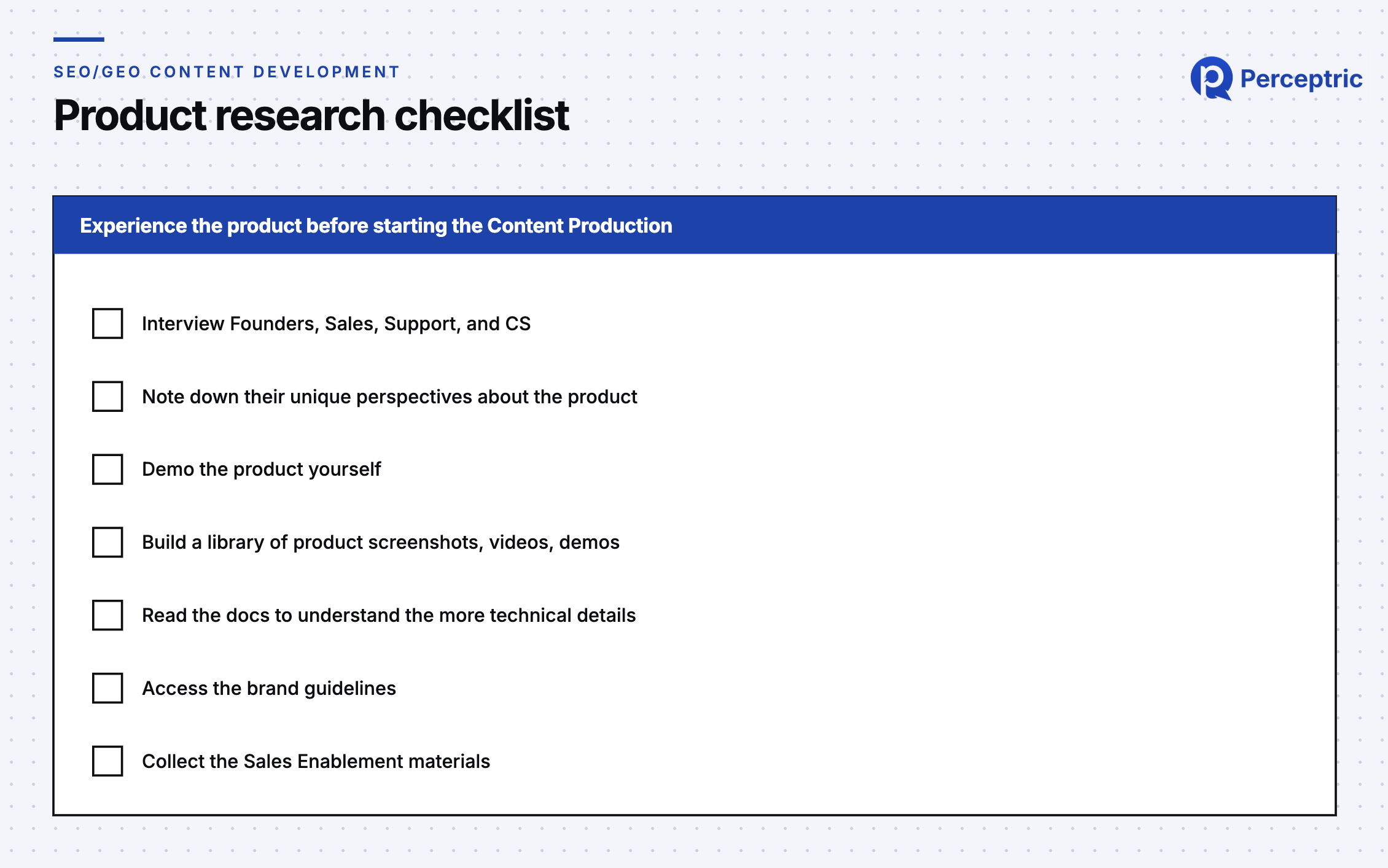
We schedule interviews with several people across the company who know the product inside and out and basically pick their brains. The goal is to get a diverse set of perspectives on where the product actually stands.
We talked with:
- Founders (the product is literally their child, they know it deeply)
- Product (of course)
- Sales (they know what the customers are looking for)
- Support (they know the complaints and what’s hidden in the closet)
- Marketing (they know where the product stands in the market)
We send each of them the questionnaire that we’ll use so they know what to expect in the call. We ask them:
- Who is this product for?
- What problems does it solve?
- Why do customers choose it over alternatives?
- What makes it different from competitors?
- What are its strongest use cases?
- What are customers most excited about?
- What do customers complain about most?
- What alternatives do customers consider before buying?
- Which use cases are the strongest fit?
- What do you wish prospects understood about the product before they book a meeting?
Our AI meeting assistants capture their answers. After we’ve interviewed everyone, we dig through the transcripts and filter out the gems worth writing about.
We don’t stop there. We take the time to actually use the product and explore its features. Just 30-min of free-form exploration gives us plenty of information about the product.
2. Content Strategy
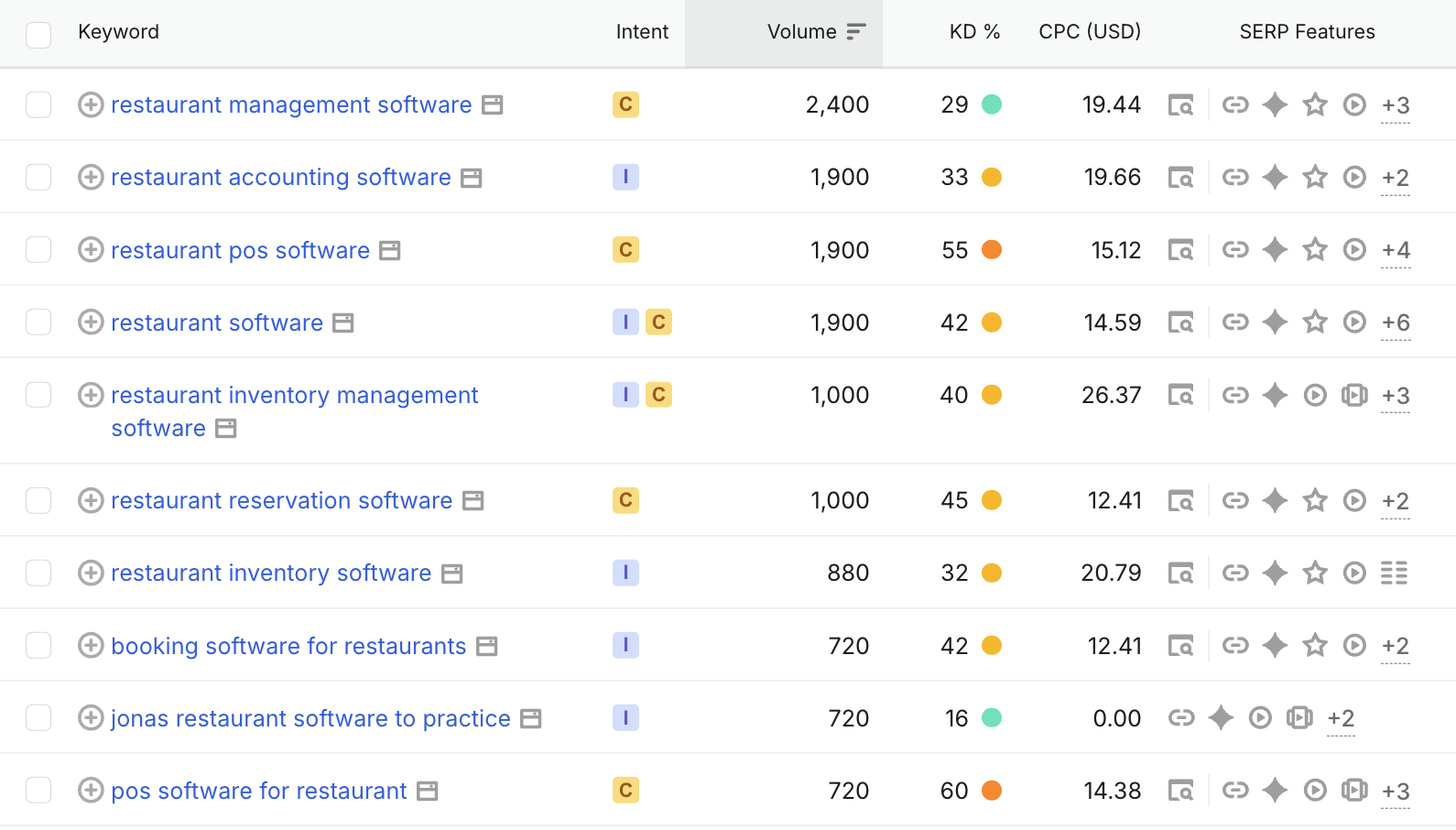
Once we’ve understood the product, we start shortlisting the keywords that align with its positioning. SEMRush is our tool of choice, and the process goes like this:
- Start with Broad Match research. We enter the seed keywords identified during Product Research and use Broad Match to explore the wider keyword universe around them. For example, if our client is a software company targeting the F&B industry, we might start with “restaurant software” as our initial seed keyword. From there, we gradually niche down by use case, restaurant type, or business function to uncover more specific search opportunities.
- Expand the keyword universe. For each seed and relevant keyword, we explore related terms, variations, questions, and long-tail queries. This helps us uncover search patterns we may not have thought of initially. The deeper our understanding of the product and its vertical, the more precise we can be in expanding this universe.
- Run competitor research. We also analyze the keyword profiles of competitors in the niche. They have already invested heavily in SEO/GEO and are likely ranking for valuable keywords that we can compete for. We identify the keywords they rank for, then filter for opportunities that overlap with our positioning and are realistic for us to compete on.
- Filter for relevance and intent. Finally, we balance search demand with product alignment. Some keywords may look highly relevant to the product but have little to no search volume. Others may have significant search volume but attract users who have no reason to buy the product. We prioritize the keywords that sit at the intersection of meaningful search demand, strong product fit, and high commercial intent.
The result is a keyword universe built around the product’s positioning, use cases, and the problems its ideal customers are actively trying to solve. After that, we turn it into an Editorial Calendar, with clear timelines that the team can work on.
3. Content Development & Publication
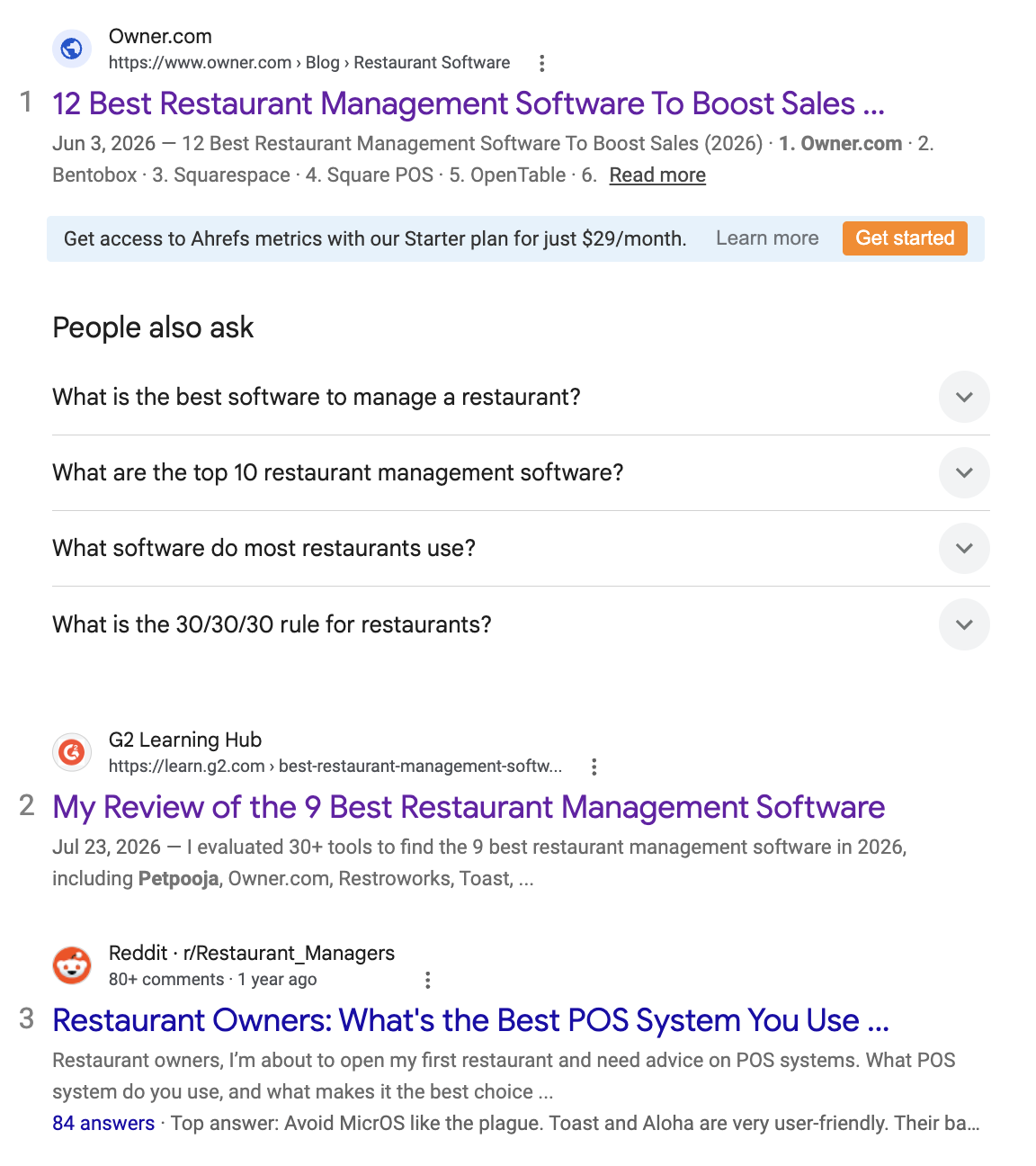
Each article is a project on its own. For example, if we’re writing an article targeting “best restaurant management software,” we start by analyzing the current search results to understand what Google considers relevant for the query:
- Which pages are ranking
- What content formats they use
- Which products and competitors appear repeatedly
- What topics and subtopics they cover
- What search intent the SERP shows
The goal is to understand what Google already rewards. At the core, Google works in similar ways to a social media algorithm: whatever page receives more positive user engagement is ranked at higher positions. The highest ranking page is not necessarily the “best-written” page, but rather, the most positively engaged page.
3 Best GEO Agencies For B2B SaaS Companies
1. Perceptric
Perceptric is a B2B marketing agency that drives pipeline & revenue growth for SaaS & professional services companies
We are an extension of your in-house team. From SEO/GEO to LinkedIn content to PPC, we have the senior experts with unique methodology to help you acquire more customers and grow your ARR.
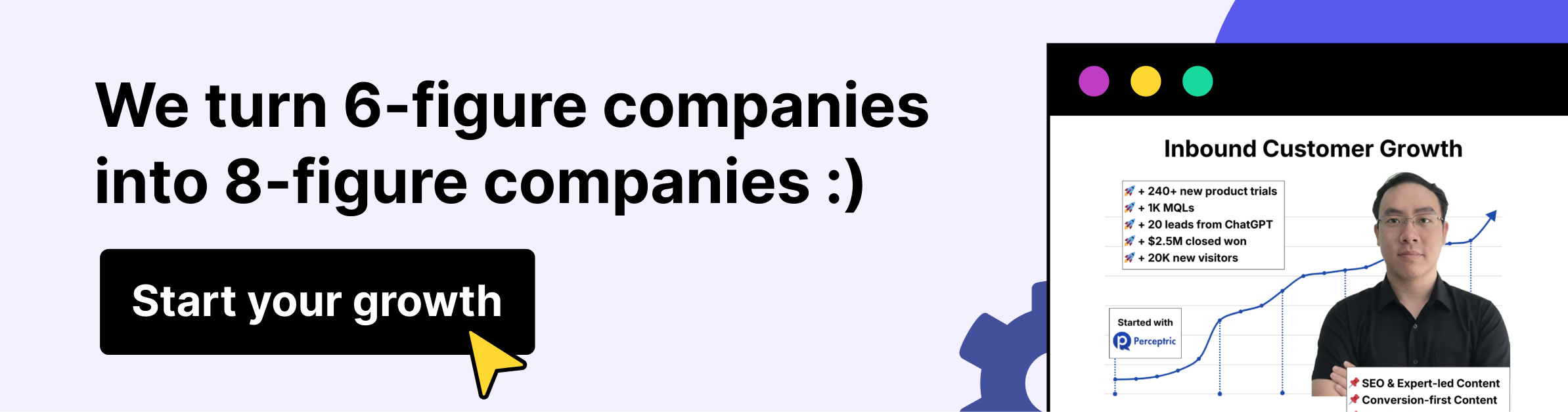
For example, one of our clients in the B2B SaaS industry saw tremendous pipeline growth since working with us in the past 6 months:
Our most notable clients include Katalon (technical SaaS), Momos (AI agent), Anduin Transact (private equity SaaS), ScoutQA (automation testing AI agent), and DeepIDV (KYC software).
See how we grew Katalon’s organic sessions by 150K+ and ARR by 400%.
Perceptric’s key capabilities:
- Conversion-led SEO. Keyword strategy built around commercial intent, targeting the terms buyers search while comparing vendors rather than the ones that only inflate sessions.
- AI SEO (GEO/AEO). A reverse-engineered approach to how LLMs select sources, built to get you cited in ChatGPT, Claude, Perplexity, and AI Overviews for commercial terms.
- Content production. Expert-led articles grounded in SME interviews and original research, written by people who understand the product deeply enough to sound in-house.
- Interactive content experiences. Custom-coded modules embedded in articles that let buyers explore, compare, and self-qualify, driving time on page and brand recall no wall of text can match.
- LinkedIn thought leadership. Story-led posts written in your voice that build demand and funnel a warmed-up audience into the search-led engine.
- Paid search. PPC run off the same bottom-funnel keyword and messaging strategy as your content, so you own the full SERP while organic rankings climb.
If you want a DIY guide to SaaS marketing, here are some guides we produced:
2. Skale
Skale is a B2B SEO agency founded in 2019 and based in London. It works only with SaaS companies. The team is around 50 specialists, and the agency have worked with more than 87 SaaS companies, including Pendo, Maze, G2, Attest, and Flodesk. Their published case studies include a 176% revenue increase for Rezi in four months, 8.5x organic product signups year on year for Attest, and a 450% rise in monthly signups for Holded.
Key Services:
- SaaS SEO, link building and outreach, content production, and site migrations
- Works exclusively with B2B SaaS and technology companies
- GEO included as part of the core engagement
- Verticals covered include cybersecurity and compliance, fintech, dev tools and APIs, martech, HR tech, and AI automation
- Strategy implementation available at additional cost
- Minimum project size of $5,000, with typical retainers between $5,000 and $15,000 per month on six-month terms
Reviews & Results:
Clients consistently highlight Skale’s SaaS specialization, accountability for revenue outcomes, and responsiveness as an extension of the internal team. A data privacy software client called them the only SEO agency that genuinely understands SaaS and feels accountable for revenue generation.
3. Grow and Convert

Grow & Convert is a content marketing and SEO agency built around a simple idea: content should generate leads and customers, not just traffic. The agency has worked with 100+ clients over 10+ years and has expanded its approach into GEO/AEO, with a focus on high-intent content and AI search visibility.
Key Features:
- Content marketing, SEO, and GEO/AEO
- Strong focus on bottom-of-funnel and high-intent content
- Conversion-focused content strategy rather than traffic volume
- SME-driven content for technical and specialized industries
- AI search optimization for ChatGPT, Perplexity, and Google AI Overviews
- Published case studies with measurable signup, lead, and revenue outcomes
- Experience with B2B SaaS, B2C, healthcare, and other industries
Reviews & Results:
Grow & Convert has documented results including 1,745 additional free-trial signups for a self-serve SaaS company, #1–#3 rankings for 26+ buying-intent keywords, and 50% more leads for a healthcare client.
Client reviews also emphasize their strategic involvement, communication, and ability to connect content with revenue. One BuddyPunch client said the work could be directly attributed to paid customers, while User Interviews described the founders as knowledgeable and results-oriented partners. Clutch currently shows a 4.8/5 rating across 10 reviews.