Zero-click searches are Google searches that end without a click to any website. In the first four months of 2026, 68.01% of US Google searches ended this way, based on Similarweb panel data analyzed by SparkToro.
For B2B teams, that changes which keywords deserve a page and how you judge SEO. Below, we show the data by query type and the five changes we make to B2B SEO plans because of it.
What is a zero-click search?
A zero-click search happens when the results page answers the question, or the searcher gives up and searches again. The searcher reads an AI Overview, a snippet or a calculator, then leaves without visiting a site.
The answer can come from several parts of the results page:
- AI Overviews summarize an answer in a block above the organic links.
- Featured snippets quote one page's answer at the very top of the results.
- Knowledge panels show facts about companies, people and places beside the results.
- Built-in tools handle weather, unit conversions, math and time zones on the page.
Zero-click searches vs zero click SEO
Zero-click searches are the trend, and zero click SEO is the response to it. Zero click SEO aims to win visibility on the results page and in AI answers, then earn the click where a buyer needs more detail.
How many searches are zero-click searches?
Every major study shows the share rising, though each one measures it in a different way. In SparkToro's series, the share grew from 45% in 2016 to 50.3% in 2019, 60.5% in 2024 and 68% in early 2026.
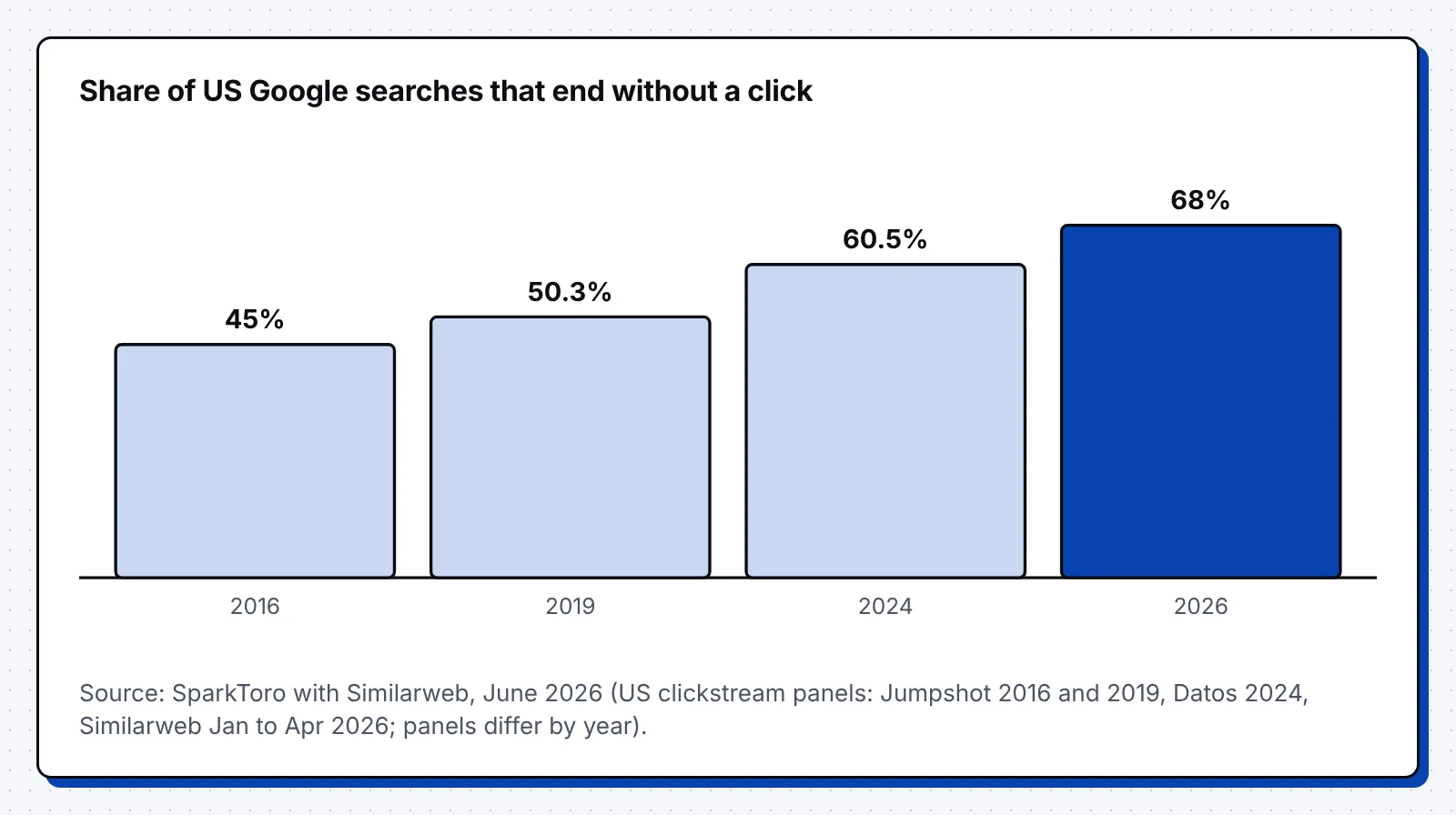
The four points come from three panels, so read the chart as a direction. Jumpshot supplied the 2016 and 2019 data, Datos supplied 2024 and Similarweb supplied 2026.
In early 2026, 39% of US Google searches ended the session and 28.7% led to another search. Only 32% led to a click of any kind, and 0.34% moved into AI Mode.
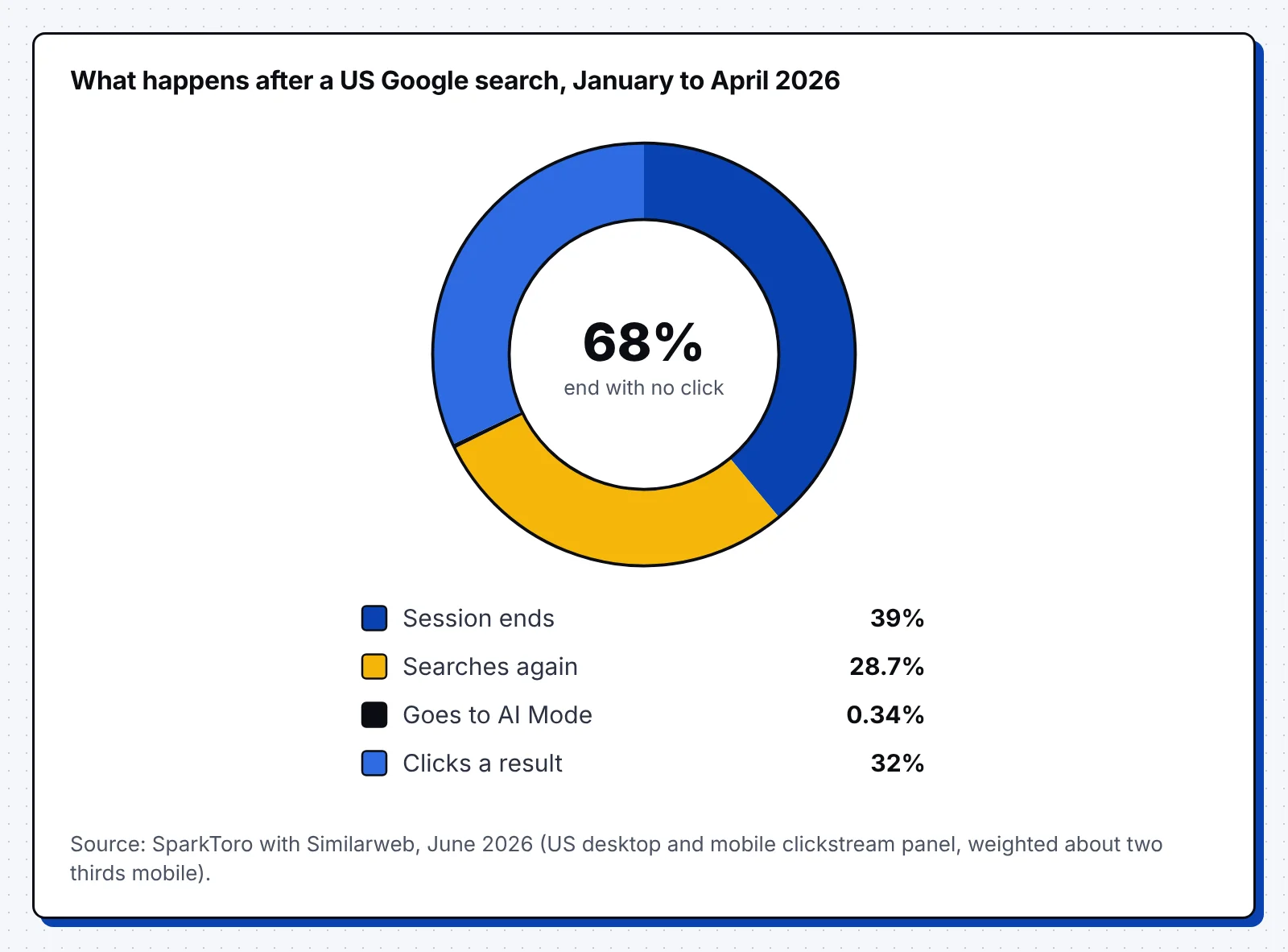
B2B buyers often research at a desk, and desktop search sends fewer clicks out. On desktop, 48% of searches end with no activity at all and 20.4% lead to a click to a non-Google site, in Similarweb data.
News searches show the same shift in Similarweb's zero-click research, where news searches with no click to a website rose from 56% in May 2024 to 69% in May 2025.
What AI Overviews do to clicks
Pew Research Center tracked the browsing of 900 US adults in March 2025. When an AI summary appeared, visits included a click on a regular result 8% of the time, against 15% when no summary appeared.
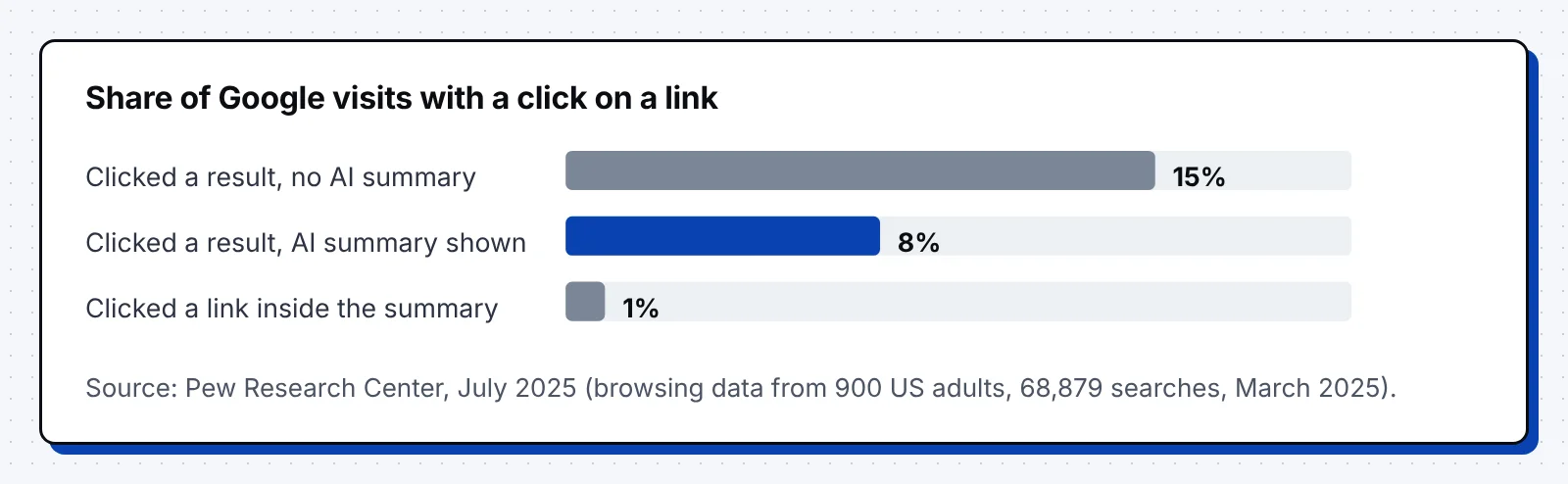
Just 1% of those visits included a click on a link inside the summary itself. Visits with a summary also ended the browsing session 26% of the time, against 16% for visits without one.
In keyword data from Ahrefs, AI Overviews cut the top-ranking page's click rate by 58% in December 2025, up from 34.5% in April 2025.
Thankfully, the drop can ease over time in Seer Interactive client data. Organic click rates on searches with an AI Overview fell from 3.19% in January 2025 to 1.31% in December, then rose to 2.36% by February 2026.
The studies use different methods, so read each number with its source:
- SparkToro and Similarweb use clickstream panels that follow what real users do after a search.
- Pew pairs browsing data from a survey panel with the searches those same adults ran.
- Ahrefs compares click rates on large keyword sets before and after AI Overviews launched.
- Seer reads Search Console data from 53 client brands, so it reflects real impressions and clicks.
Our SEO statistics roundup collects more click and ranking numbers, each with its source.
Which queries lose clicks, and which still send them
AI Overviews favor questions with one clear answer. Across 146 million results pages in Ahrefs data, AI Overviews showed on 21.4% of informational searches, against 4.3% of commercial and 2.1% of transactional ones.
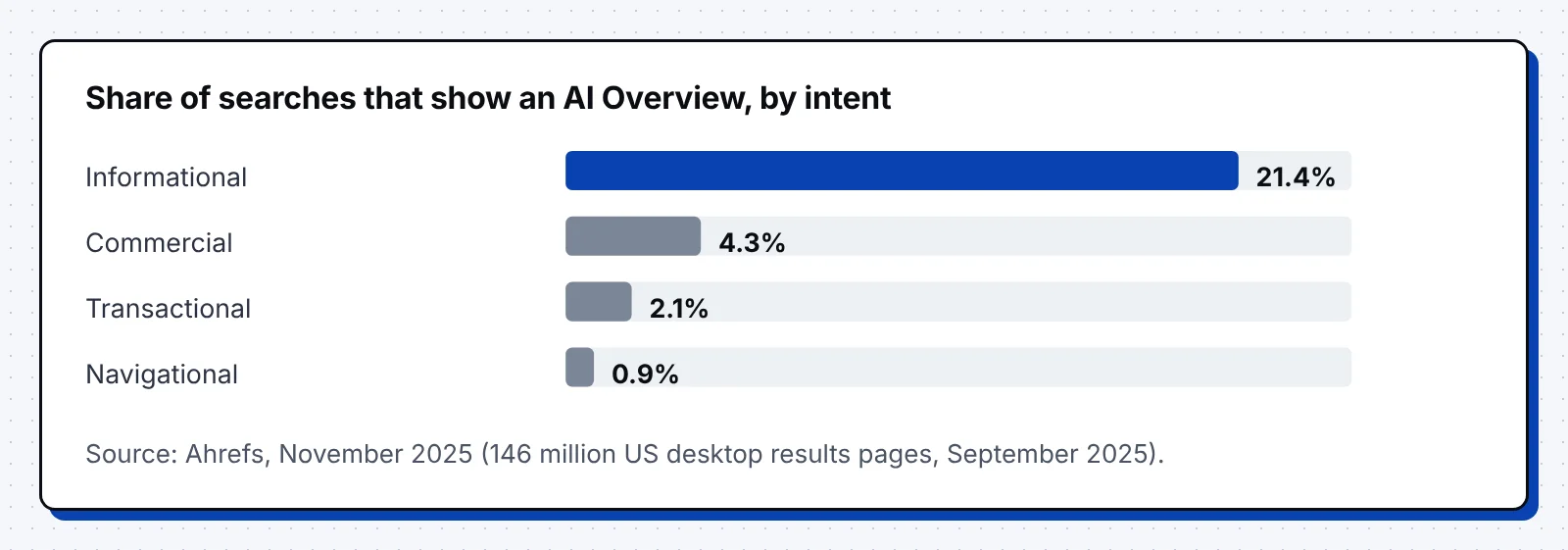
Question searches showed an AI Overview 57.9% of the time, and only 0.9% of navigational searches did. In Pew's data, 60% of searches with question words drew a summary, against 8% of one or two word searches.
Some queries almost never send a click. In Similarweb's keyword data, "grams to pounds" ends without a click 100% of the time, "weather" 85% and "capital of Sweden" 77%.
These query types lose the most clicks:
- Definitions such as "what is a CRM" get answered in one or two lines.
- Facts, dates and simple figures show up in a knowledge panel or an AI Overview.
- Unit conversions and simple math get solved by Google's own tools on the page.
- Quick how-to questions with a short answer get a summary or a featured snippet.
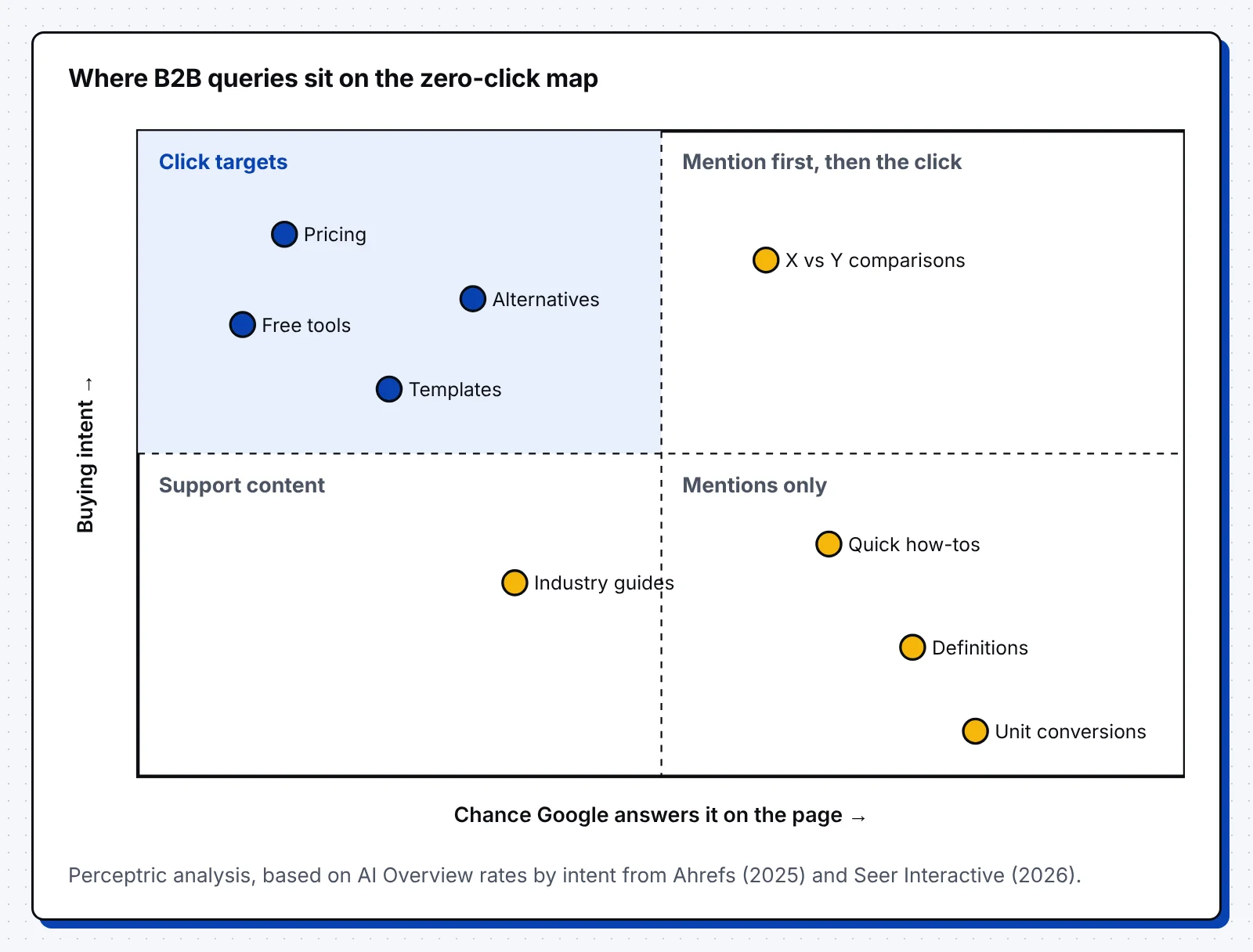
These query types still send clicks, because the buyer needs detail a summary can't hold:
- Comparisons, where buyers want feature tables, screenshots and guidance on which tool fits them.
- Pricing searches, where buyers want plans, limits and the current price for their team size.
- Free tools and calculators, which do part of the buyer's job right on your page.
- Templates, which buyers have to download or copy before they can use them.
Comparisons still draw summaries, so they need depth. Seer saw an AI Overview on 95.4% of the 280 "X vs Y" searches in its sample.
What zero-click searches mean for B2B SEO
SEO keeps its long-term advantages for B2B companies, but the targets and the scorecard change in five ways.
1. Target queries that need a click
Put new pages on searches where the buyer has to visit to finish the task. Pricing, alternatives, comparisons, templates and tools all qualify, and they sit closest to a purchase.
Keep informational posts that feed those pages with links and proof, and fold thin ones into stronger guides. Our guide to BOFU content covers the bottom of funnel formats that turn readers into demos.
2. Build brand demand
Luckily, branded searches hold up better than generic ones, and they make up 45.7% of US Google search volume in Ahrefs data. AI Overviews show on 13.1% of branded searches against 24.9% of non-branded ones, in a separate Ahrefs study.
Every channel that makes buyers remember your name feeds that demand, from LinkedIn posts and podcasts to events and partner content. Track branded search volume each month as an SEO result.
3. Earn mentions in AI answers
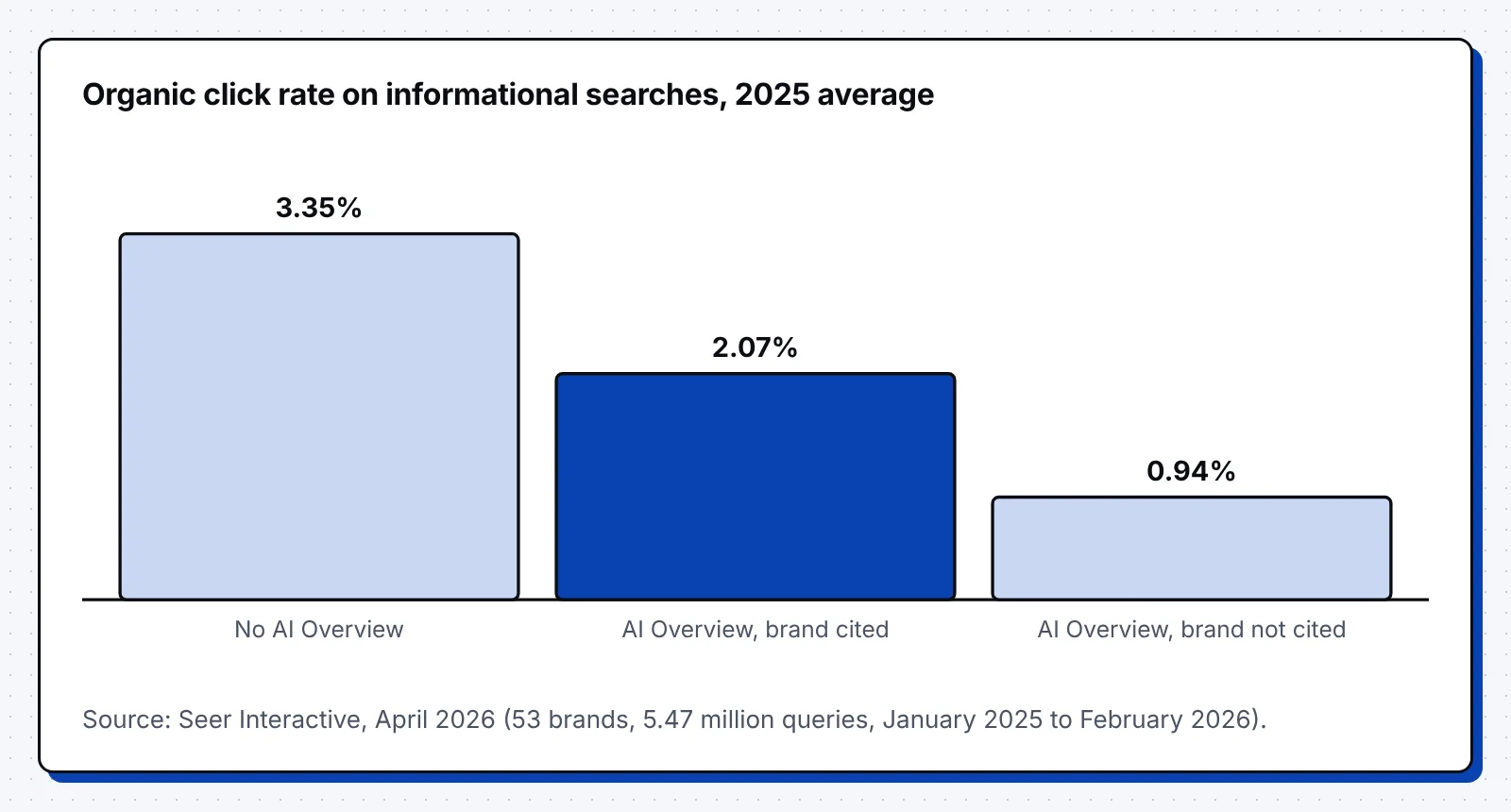
Being named in the answer now counts as a ranking. In Seer's 2025 data, informational searches with an AI Overview had a 2.07% organic click rate when the brand was cited, against 0.94% when it wasn't. Searches with no AI Overview averaged 3.35%.
Mentions across the web drive those citations. Across 75,000 brands in Ahrefs research, branded web mentions had the strongest link to AI visibility, with correlations from 0.656 to 0.709 across ChatGPT, AI Mode and AI Overviews.
Earn mentions with original data, expert quotes in trade press, review sites and comparison lists. If your pages rank but never appear in summaries, our guide on why you're not in AI Overviews covers the fixes.
4. Make pages worth the click
Sites that give searchers something to do held traffic best. Cyrus Shepard studied more than 400 sites after Google's December 2025 core update, and 83.7% of winners let visitors complete a task, against 50.2% of losers.
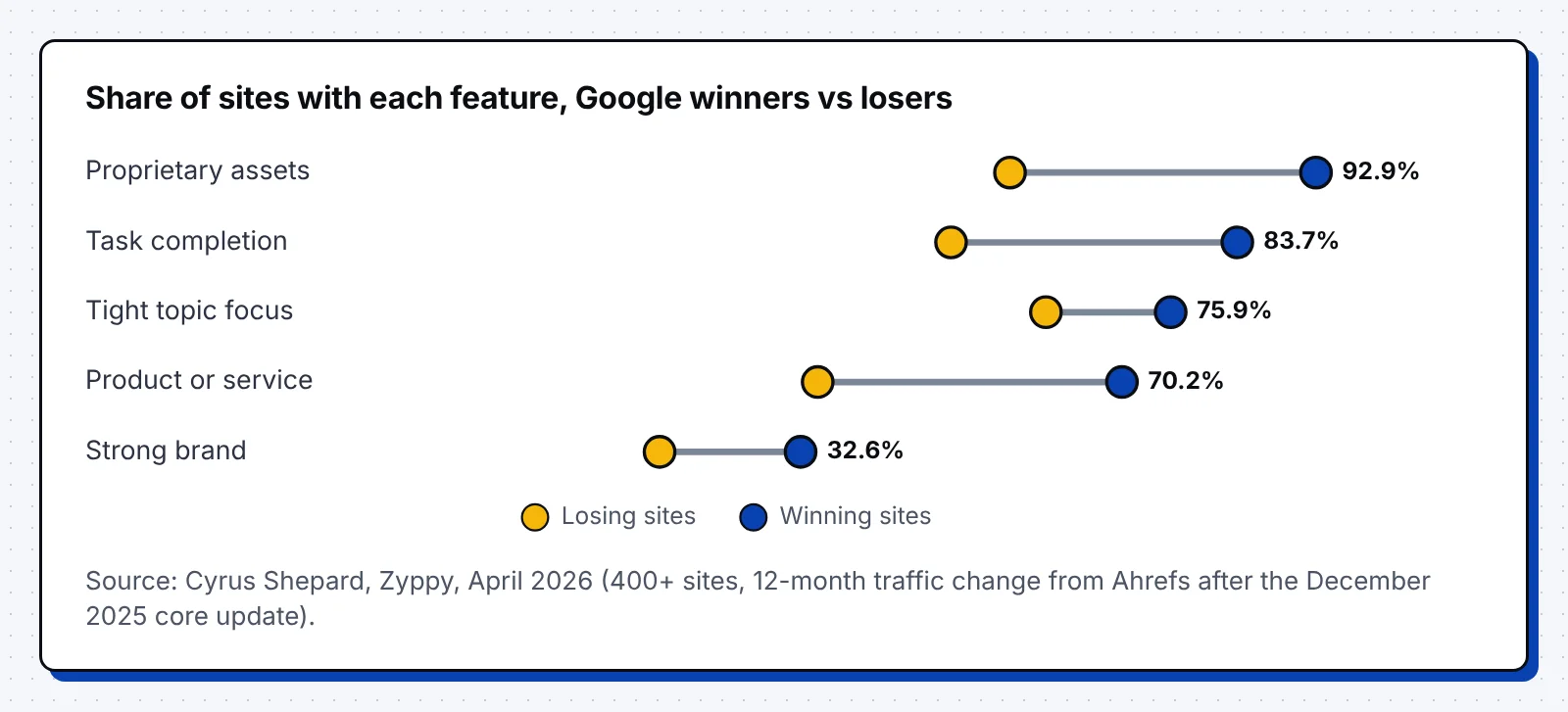
Proprietary assets showed up on 92.9% of winning sites and 57.1% of losing ones. Sites with a product or service made up 70.2% of winners and 34.6% of losers, though the results are correlations from a manual review.
Ways to give a B2B page more than a summary can hold:
- Publish original benchmarks from your own product data or customer surveys.
- Add a calculator, grader or template that does part of the buyer's job.
- Show real screenshots, pricing details and setup steps for your product.
- Write comparisons with tables and clear guidance on which buyer each option fits.
5. Judge SEO by pipeline
Traffic will fall on many informational pages even when SEO is working. Report demo requests, opportunities and revenue from organic and AI search next to sessions, so a traffic drop can't hide a pipeline gain.
Fewer visits can still bring more buyers. AI search sent 0.5% of Ahrefs' traffic over 30 days and 12.1% of its signups in the same period.
Our guide to AI search attribution shows how to track those visits, and our SEO conversion rate benchmarks help you set targets by page type.
FAQ
What is a zero-click search?
A zero-click search is a search that ends without a click to any website, because the results page answered the question or the searcher searched again. In early 2026, 68% of US Google searches ended this way in Similarweb data analyzed by SparkToro.
Do AI Overviews reduce clicks?
Yes. Pew Research Center found people clicked a regular result on 8% of visits with an AI summary, against 15% without one, and Ahrefs measured a 58% lower click rate for the top result.
Which searches are most likely to be zero-click?
Definitions, facts, unit conversions and short how-to questions are the most likely to end without a click. Comparisons, pricing, templates and tools still send more clicks because the buyer needs the page.
Is SEO still worth it for B2B with zero-click searches?
Yes, when you target searches that need a click and judge results by pipeline. Branded searches, which make up 45.7% of US Google search volume in Ahrefs data, also show fewer AI Overviews.
What is zero click SEO?
Zero click SEO is the work of winning visibility on the results page and in AI answers, then earning the click where buyers need more detail. It covers AI citations, brand demand and pages that do more than a summary can.
A good first step is to export your top 50 organic landing pages and mark each one as a click target, support content or mentions only. If you'd like help moving effort toward the pages that bring pipeline, book a discovery call with our team.