AI search attribution is how you trace leads and revenue back to answers in ChatGPT, Perplexity, Gemini and other AI assistants. Last-click analytics credits very little of that influence, so you need four more signals next to GA4 to see the real effect.
We run SEO and GEO programs for B2B and SaaS teams, and this is the setup we use with them. You'll see why the credit goes missing, five ways to measure it and a one-page monthly report.
What is AI search attribution?
AI search attribution links a buyer's research in AI assistants to the visits, leads and deals that follow it. It covers the clicks AI answers send you and the influence that never turns into a click.
Good AI search analytics draws on five sources of data, each one filling a gap the others leave:
- Visits from AI assistants in GA4, grouped in a channel of their own.
- Branded search clicks and impressions in Google Search Console.
- Answers to a "How did you hear about us?" question on your forms.
- Source fields that stay on every contact and deal in your CRM.
- How often AI answers name your brand for the prompts your buyers use.
Why last-click analytics misses AI search
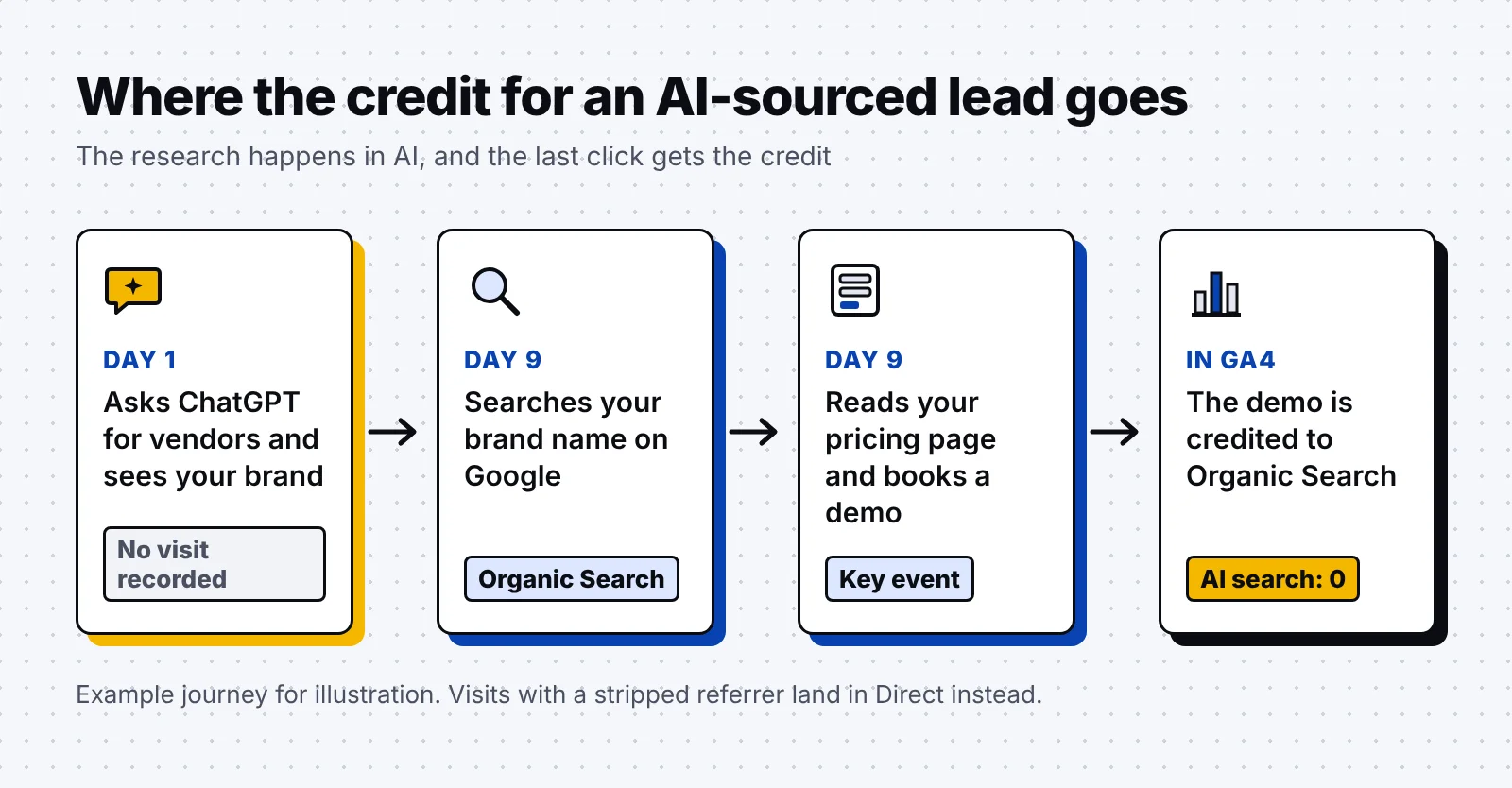
Last-click analytics gives all the credit to the final visit before a conversion. AI research usually happens days or weeks earlier, and it rarely leaves a trace on the visit that converts.
AI answers shape the shortlist before any click
B2B buyers now build vendor shortlists inside AI chatbots, long before they fill in a form. These surveys show how far the shift has gone:
- In G2's March 2026 survey of 1,076 software buyers, 51% start research in an AI chatbot more often than in Google.
- In the same survey, 69% of buyers chose a different vendor than they first planned, and AI chatbots ranked as the top source shaping shortlists.
- Forrester found that 94% of business buyers use AI in their buying process, up from 89% a year earlier.
- In 6sense's 2025 buyer research, 94% of buyers ranked their shortlist before speaking with sales, and nearly 80% bought from their first choice.
None of that research appears as a session in your analytics. GA4 only records the visit that comes after the buyer has already made up their mind.
Many AI visits arrive with no referrer
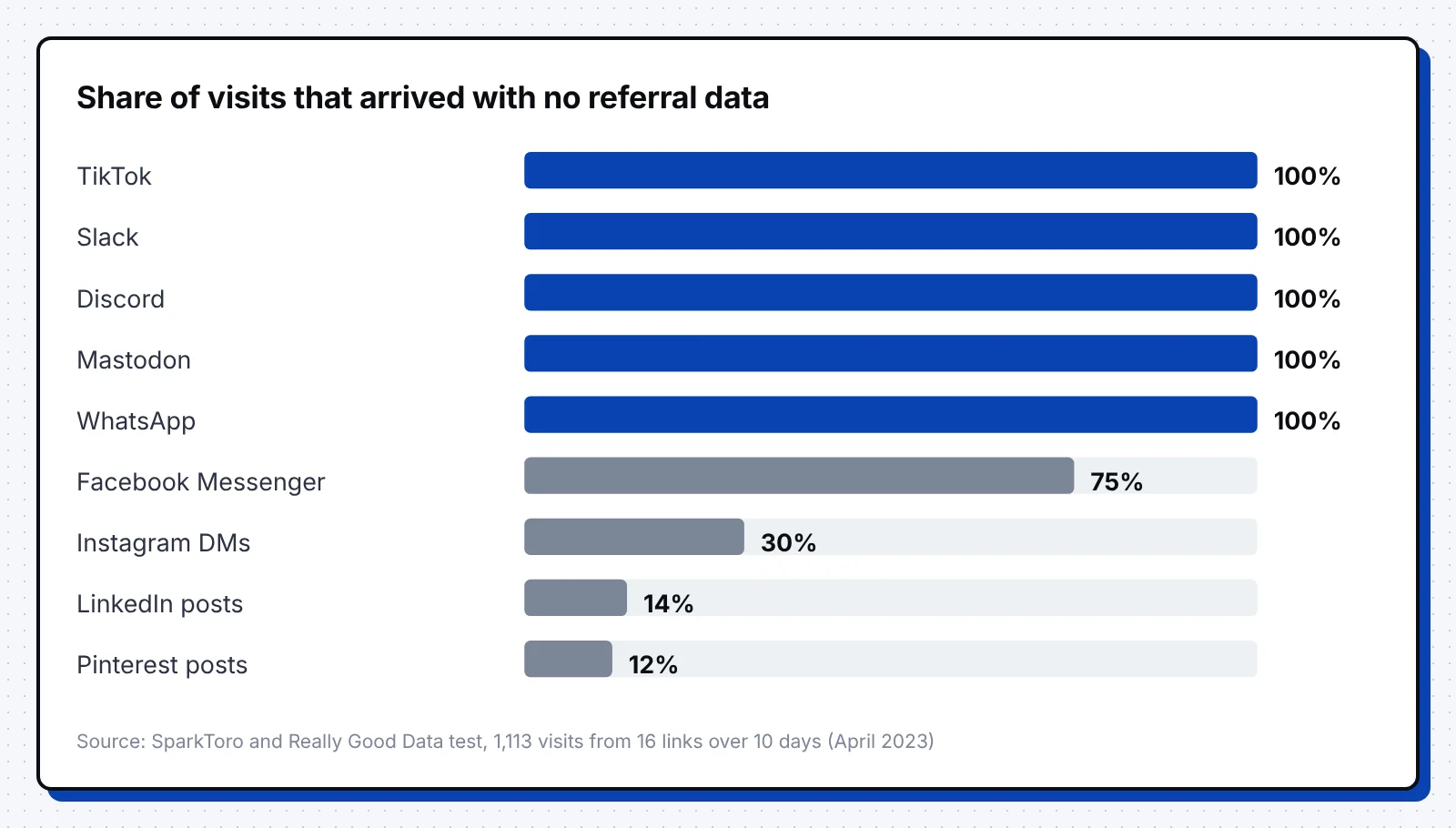
A visit from an AI app often reaches your site without a referrer, so GA4 files it as Direct. Links opened from the ChatGPT mobile app can lose the referrer, and a URL copied out of an answer never carries one.
SparkToro's 2023 test of 1,113 visits showed how big the loss can be with apps. Every visit from TikTok, Slack, Discord, Mastodon and WhatsApp landed in Direct.
Buyers come back later through search or a direct visit
Most buyers who meet you in an AI answer never click the citation. They open a new tab, search your brand name or type your URL, and that later visit takes the credit.
Pew Research found that Google users clicked a link inside an AI summary on just 1% of visits that showed one. Our post on zero-click searches covers that trend in depth.
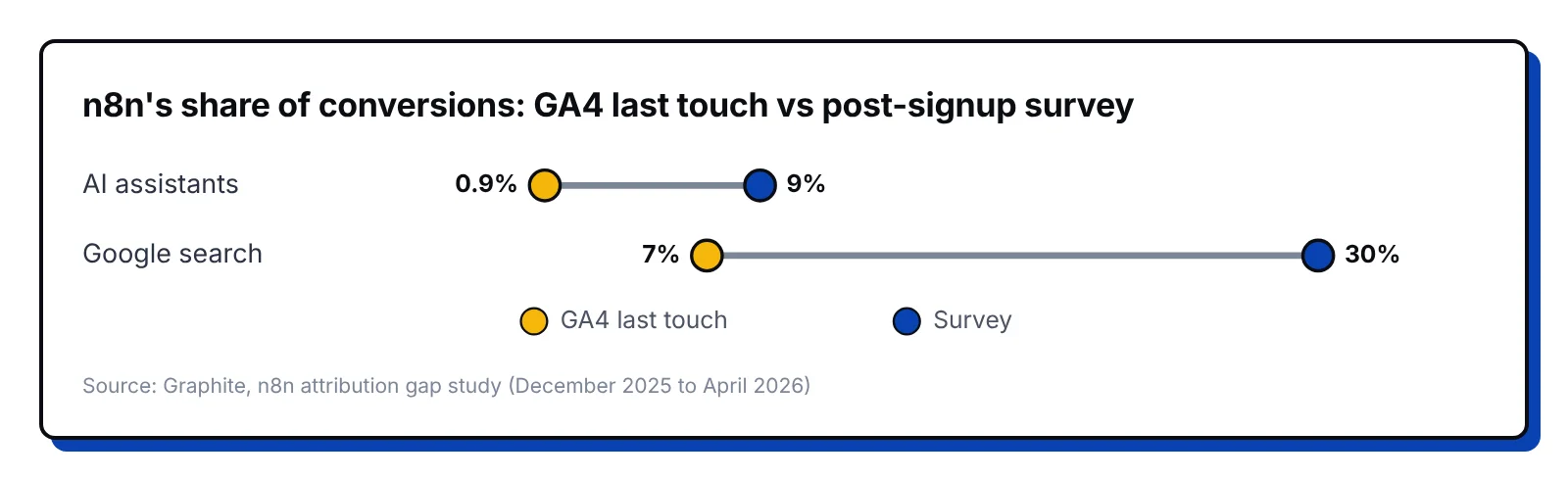
The gap shows up clearly in Graphite's study of n8n. GA4 credited AI assistants with about 1% of conversions, while n8n's post-signup survey put their share near 9%.
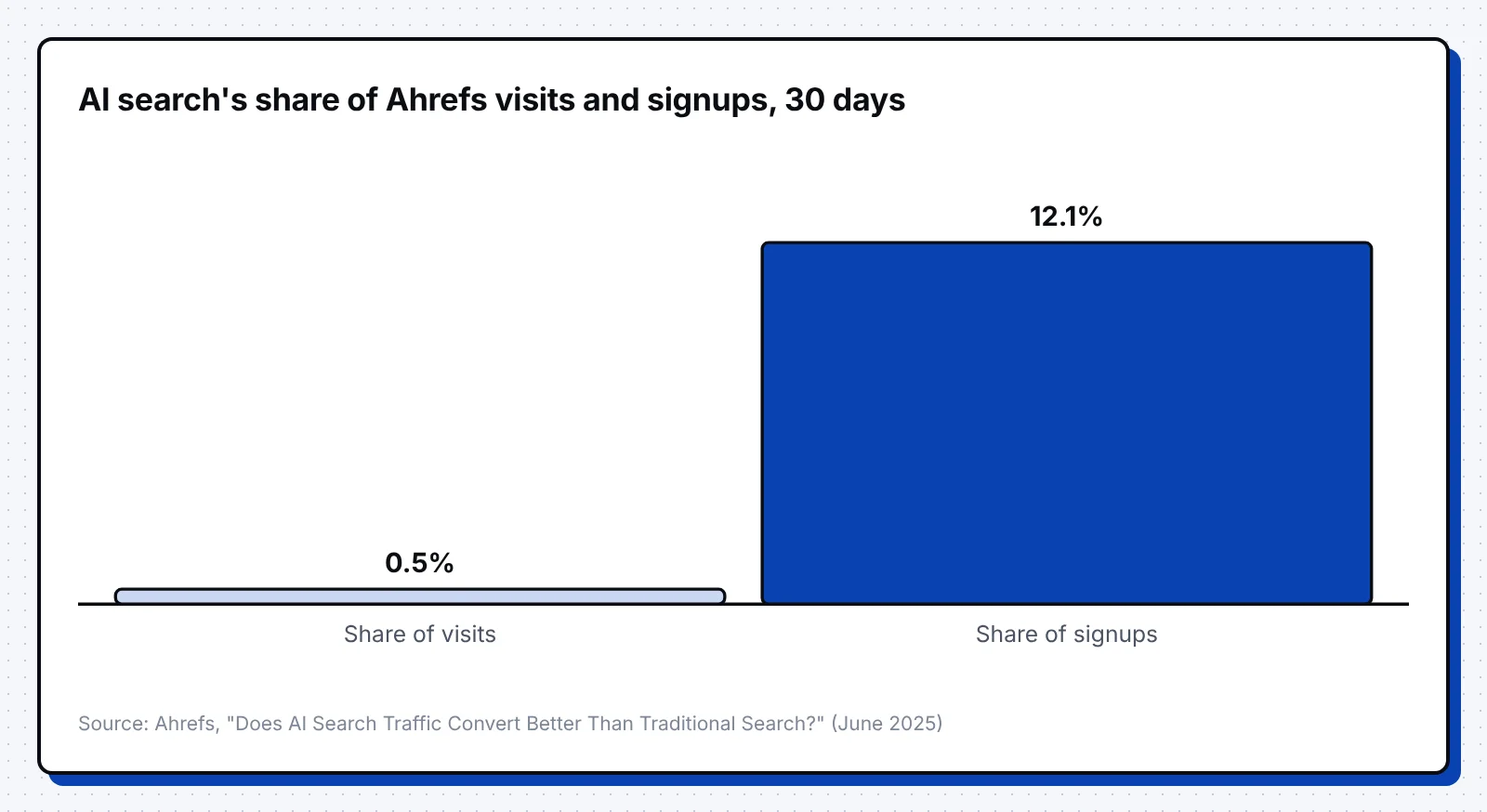
The AI visits you can see are worth a close look too. Ahrefs found that AI search sent 0.5% of its visits over 30 days but 12.1% of its signups.
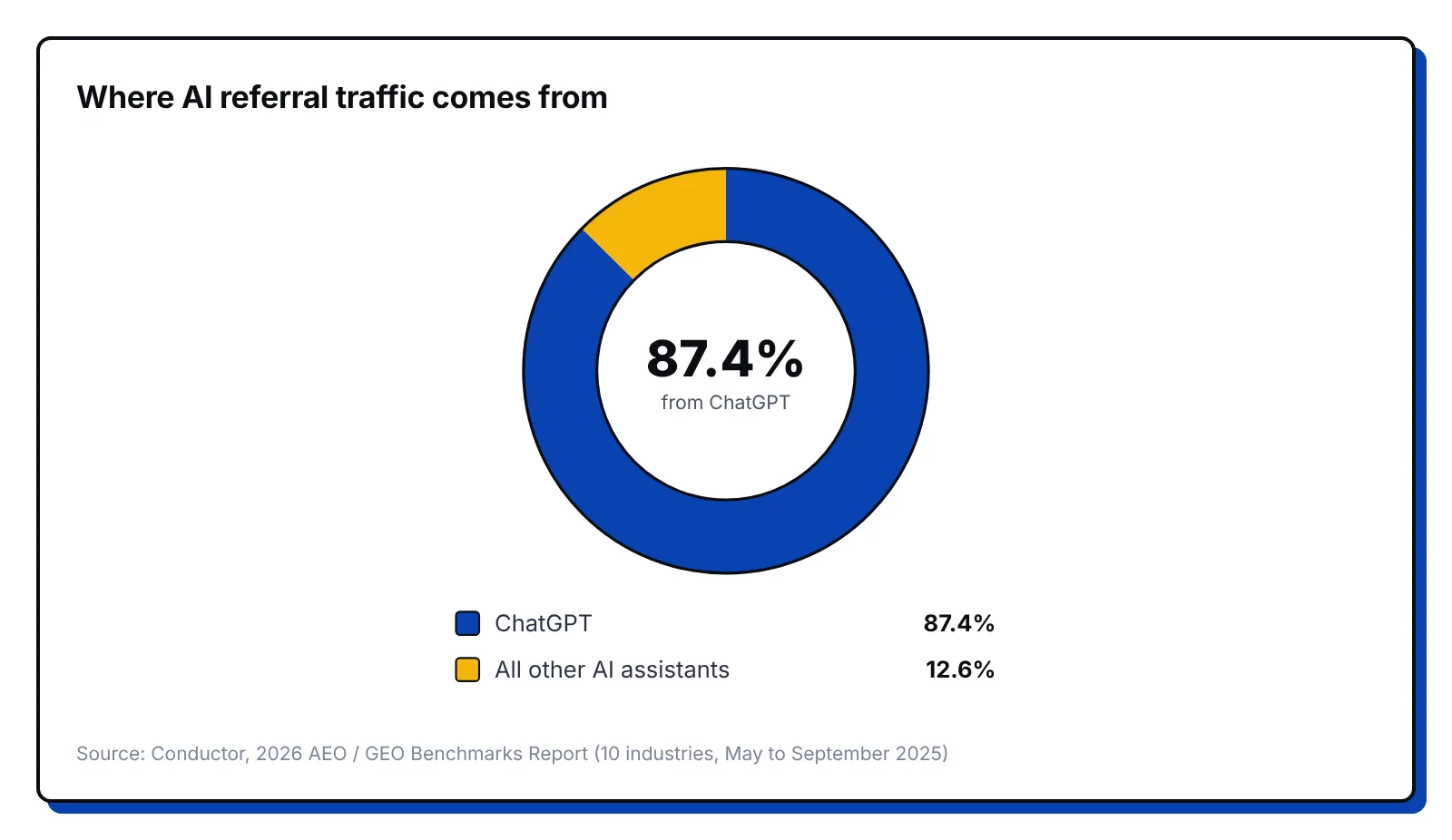
Across 1,215 enterprise sites, Conductor measured AI referrals at 1.08% of all traffic. ChatGPT sent 87.4% of those referrals, so start your setup with ChatGPT.
How to measure AI search attribution in 5 steps
No single report captures AI influence, so we combine five signals and read them together each month. Start with GA4, since the other steps build on that channel.
1. Track AI traffic in GA4 with its own channel
GA4 has a default AI Assistant channel for visits from tools such as ChatGPT, Gemini, Deepseek, Copilot and Grok. Clicks from Google's AI Overviews and AI Mode stay in Organic Search.
We still add a custom channel group, because it lets you choose exactly which AI sources count. Here is how to set it up:
- In Admin, open Data display, then Channel groups, and click Create new channel group.
- Add a channel called AI search with the rule Source matches regex, using the pattern below.
- Click Reorder and move AI search above Referral, since GA4 puts each visit in the first channel it matches.
- Save the group, then pick it as the primary dimension in the Traffic acquisition report.
.*(chatgpt\.com|openai\.com|perplexity|gemini\.google\.com|copilot\.microsoft\.com|copilot\.com|claude\.ai|deepseek\.com|grok\.com).*We checked that each of these domains was live in November 2026. Review the list every quarter, since AI tools change domains and new assistants appear.

Thankfully, custom channel groups apply to past data, so your history shows up right away. Standard GA4 properties allow two custom groups, so keep one free for later.
2. Watch branded search in Search Console
Branded search is where much of the hidden AI demand appears, since buyers who meet you in an answer often search your name next.
Search Console added a branded queries filter in November 2025 and opened it to all eligible sites in March 2026. It sorts queries on its own, including misspellings and product names that leave out the brand.
Log these numbers from the Performance report each month:
- Branded clicks and impressions for the month you are reporting on.
- The change against the same month last year, which removes seasonal swings.
- Your AI visibility score for the same month, so you can compare the two lines.
Branded search rising alongside AI visibility is a strong hint. Check your events and paid campaigns for that month too, since they can lift branded search on their own.
3. Ask "How did you hear about us?" with AI options
Self-reported attribution catches the influence that analytics can't see. In the n8n data above, this one question gave AI about ten times the share of conversions that GA4 did.
Add the field to your demo and contact forms and make it required on high-intent forms. List ChatGPT, Perplexity, Gemini, Copilot and Claude as separate options, plus Google search, peers, review sites and an Other text box.
4. Save the source in your CRM
Analytics data fades after the visit, while CRM fields stay with the deal until it closes. Pass these fields into every new contact and copy them to the opportunity:
- Original source from your analytics, such as AI search, Organic search or Direct.
- Self-reported source from the form, saved exactly as the buyer picked it.
- The AI tool the buyer named, from the form or the first sales call.
- The first page the buyer landed on, which shows what the AI answer pointed to.
Ask sales to confirm the source on the first call as well. Then compare pipeline and win rate by source, and set them against our conversion rate by channel benchmarks.
5. Track your visibility prompt by prompt
Prompt tracking shows whether AI answers name you before any visit happens. Pick 30 to 50 questions your buyers ask, run them every month and record these numbers:
- Visibility, which is the share of answers that name your brand.
- Position, which is where your brand sits among the brands an answer lists.
- Cited pages, which are the URLs from your site that the answers link to.
- Competitors that show up in the same answers in your place.
Tools such as Arrowsterr run these prompts across ChatGPT, Perplexity, Gemini, Claude and Google AI Overviews. Our list of AI rank tracking tools compares more options, and our guide on why you're not in AI Overviews covers what to fix.
A simple monthly AI search report
One page a month is enough for most B2B teams. We order it from early signals at the top to revenue at the bottom, as in the layout below.
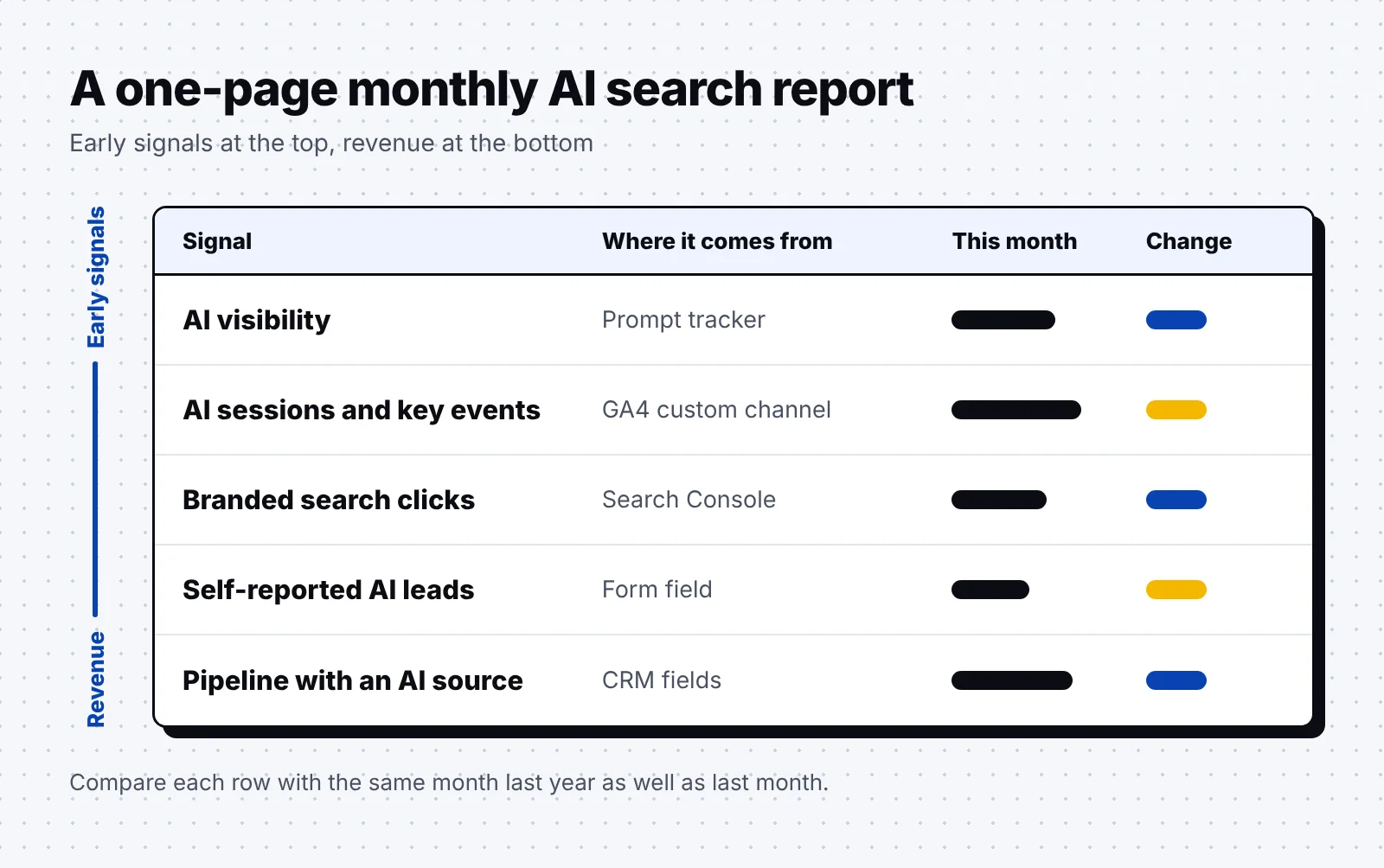
- AI visibility is the share of tracked prompts that name you, with the change from last month.
- AI sessions are the visits in your AI channel, plus the key events they produced.
- Branded search is your branded clicks in Search Console, against the same month last year.
- Self-reported AI leads are the form fills that name an AI tool, split by tool.
- Pipeline counts the opportunities and won revenue where any source field points to AI.
When visibility and branded search rise together and more buyers name ChatGPT on forms, AI search is working even if AI sessions stay small.
Luckily, four of the five rows come from tools you already pay for. Our guide to B2B website metrics shows how to fit this page into your wider dashboard.
FAQ
What is AI search attribution?
AI search attribution is how you trace visits, leads and revenue back to answers in ChatGPT, Perplexity, Gemini and other AI assistants. It combines GA4 data, branded search, form answers, CRM fields and prompt tracking.
How do you track AI traffic in GA4?
Check the AI Assistant channel in the Traffic acquisition report, or build a custom channel group with a regex for AI sources placed above Referral. Clicks from Google's AI Overviews and AI Mode stay in Organic Search.
Why does ChatGPT traffic show up as Direct in GA4?
Links opened from AI apps often arrive without a referrer, and a URL copied out of an answer never carries one. GA4 files those visits as Direct because it has no source to read.
How much of your pipeline comes from AI search?
GA4 shows only a floor, and a "How did you hear about us?" field shows much more. In n8n's data, GA4 credited AI with about 1% of conversions, while its survey showed about 9%.
Which AI search analytics metrics should you report each month?
Report AI visibility for your key prompts, AI sessions and key events, branded search clicks, self-reported AI leads and pipeline with an AI source. Read them together, since each one fills a gap the others leave.
A good first step is to add the AI search channel in GA4 and the "How did you hear about us?" field this week. If you want to know how often AI answers name your brand today, start with a free AI visibility audit.