SEO brings B2B companies steady buyer traffic and cheaper customers over time, but it is slow to pay off and harder to measure than ads. It fits best when your buyers research online first and you can fund it for most of a year before it pays back.
We're an SEO, GEO and content agency for B2B and SaaS companies, so we weigh these trade-offs with clients every month. You'll find eight advantages and six disadvantages below, each with data where it exists, plus a comparison with paid search and ways to lower the risks.
What is SEO?
SEO (search engine optimization) is the work of helping your pages rank in Google and other search engines for the terms your buyers type. In 2026 it also covers GEO, which helps AI tools like ChatGPT and Google AI Overviews find and cite your pages.
For a B2B company, SEO usually covers four kinds of work:
- Keyword research finds the problems, product types and comparisons your buyers search for.
- Content answers those searches with guides, product pages, comparison pages and free tools.
- Technical SEO makes sure search engines can crawl, load and understand every page on your site.
- Links and mentions from trusted sites show Google and AI tools that your pages are worth citing.
If you want the short case for B2B first, our answer to does SEO work for B2B companies covers it in a few minutes.
8 advantages of SEO for B2B companies
The advantages of SEO come from free, repeat traffic from buyers who already search for what you sell. These are the eight advantages we see most often with our B2B clients.
1. Search brings a large share of website traffic
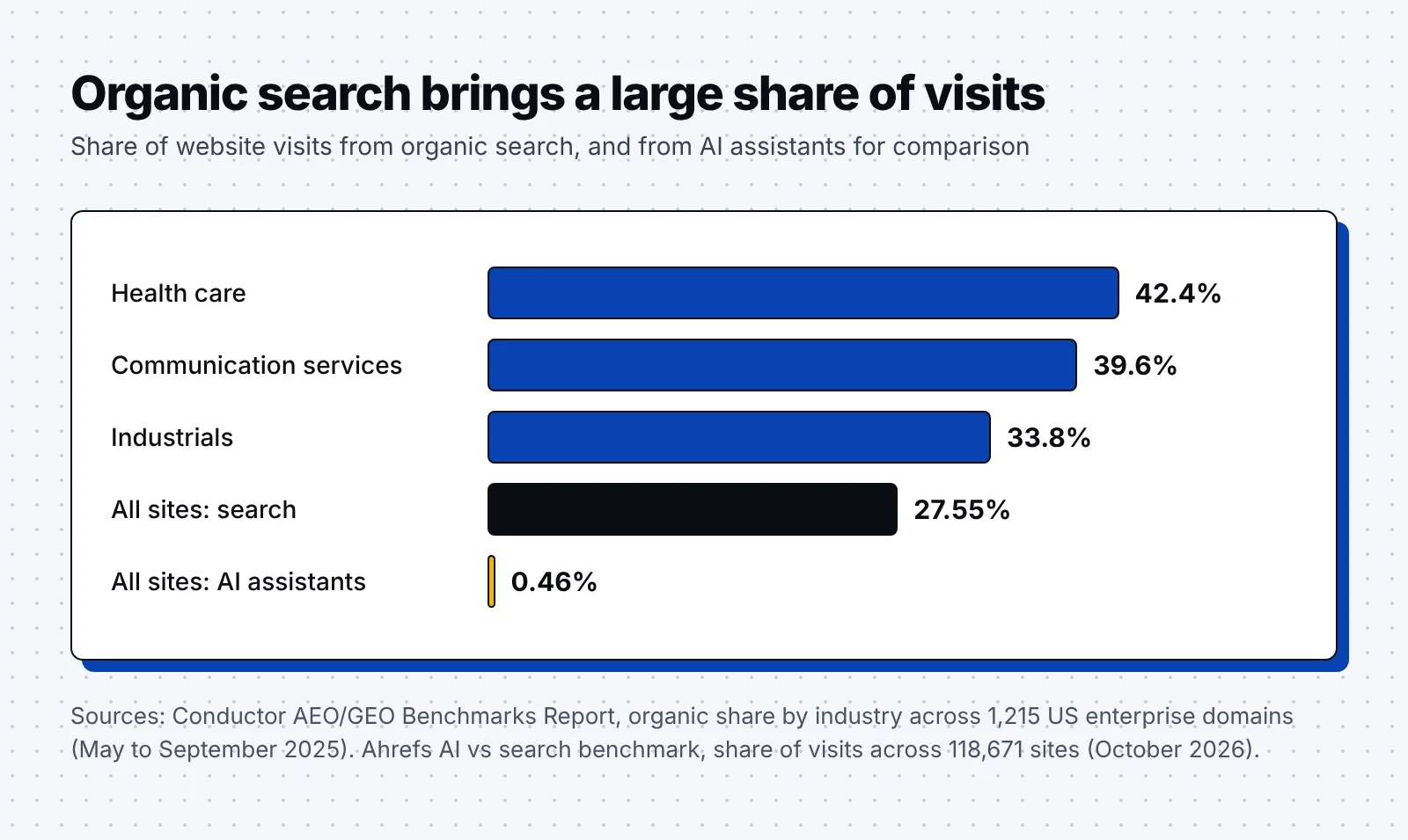
Search is still the biggest single source of visits for most websites. Across 118,671 sites in Ahrefs' October 2026 traffic benchmark, search brought 27.55% of all visits, while AI assistants brought 0.46%.
Some B2B industries get an even larger share of their visits from organic search. In Conductor's study of 1,215 enterprise domains, it drove 42.4% of traffic in health care and 33.8% in industrials. Our SEO statistics roundup has 109 sourced numbers on search share, clicks and rankings.
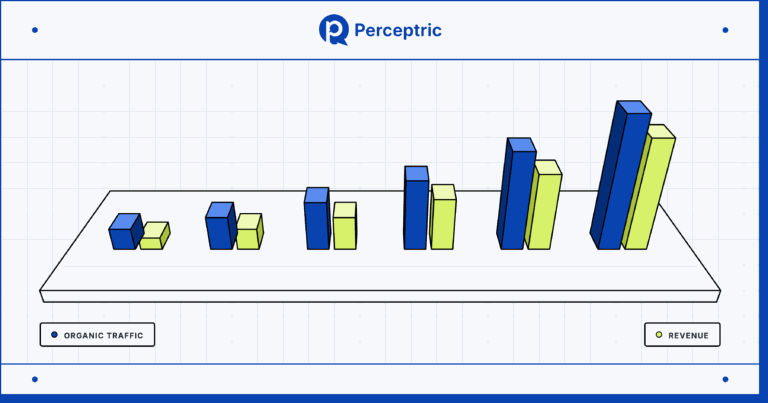
2. Traffic compounds as pages age
A page that ranks keeps bringing visits without new spend, and rankings tend to last for years. Ahrefs' study of 1.3 million keywords shows how long top pages hold their spots:
- 72.9% of pages in Google's top 10 are more than three years old, up from 59% in 2017.
- The average page in position 1 is five years old, up from two years in 2017.
So each new page adds its visits on top of the pages before it. Paid traffic works the other way, since visits from ads end on the day the budget does.
3. Cost per customer drops over time
SEO costs the most at the start and less per customer each month after, because the same pages keep bringing leads. A ranking page brings each new visit at no extra media cost, while every ad click adds to the bill.
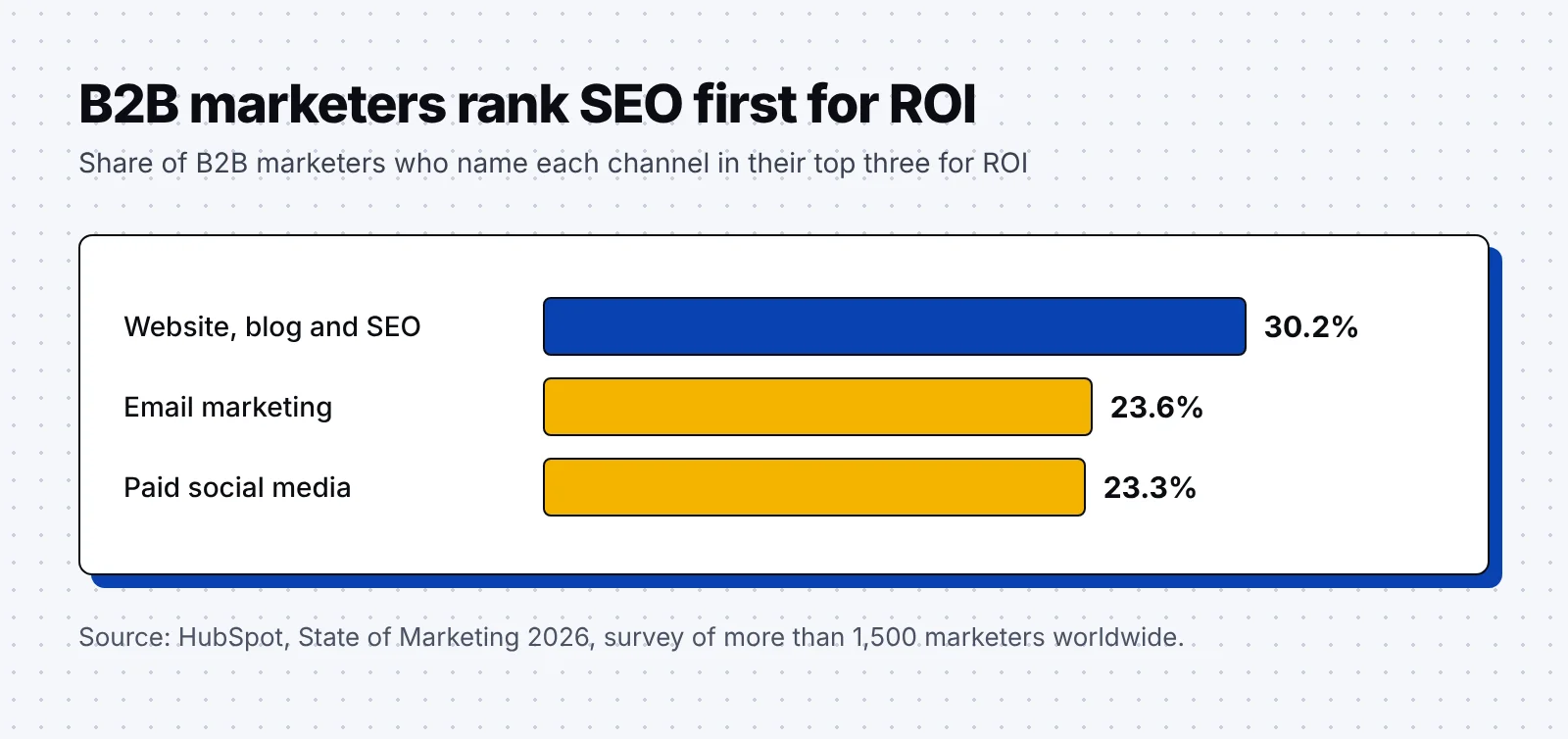
The kind of content you publish shapes the return, and in our work expert pages win more leads than pages written for volume. B2B marketers see the payoff too, and their website, blog and SEO lead the list of top ROI channels in HubSpot's 2026 survey. In that survey, 30.2% of B2B marketers named it a top ROI channel, compared with 23.6% for email.
4. Buyers trust organic results more than ads
Many searchers skip the ads and click the results Google ranked on merit. In a survey of 1,000 Americans by Page One Power, 50% trusted organic results most, while 5% trusted paid results most and 46% trusted both equally.
That trust carries into B2B buying, where a page that ranks for a hard question shows a buyer that you know the problem. Thankfully, it helps sales too, since prospects arrive having already read how you think.
5. AI answers cite pages that already rank
Ranking in Google raises your odds of showing up in ChatGPT and AI Overviews, which matters as more buyers start there. In G2's March 2026 survey of 1,076 software buyers, 51% start research in an AI chatbot more often than in Google, up from 29%.
Pages that rank well also get cited more often in AI answers. In AirOps' study of 43,233 queries, ChatGPT cited 43.2% of pages ranking first in Google, 3.5 times the rate for pages beyond the top 20.
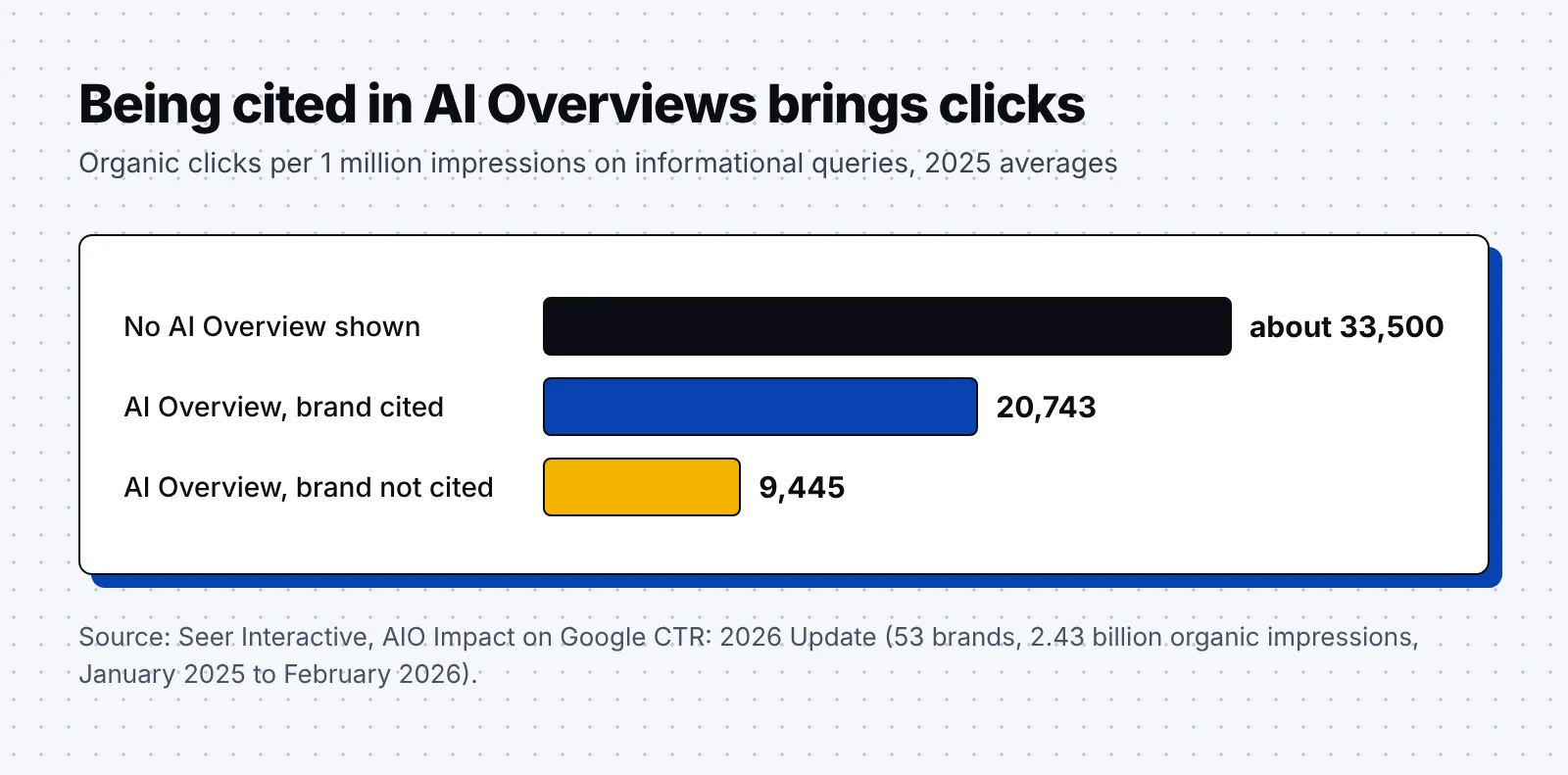
Brands cited in an AI Overview also earn more clicks than brands left out. On 2025 informational queries in Seer Interactive's data, cited brands earned 20,743 organic clicks per million impressions, compared with 9,445 for the rest.
6. SEO reaches buyers at every stage
B2B buyers search at every stage, from naming a problem to comparing vendors, and SEO lets you meet them at each one. In a SurveyMonkey and Reddit study of 1,202 US business decision makers, 57% used search engines in early research, more than any other channel.
The same study found that 83% research on their own before speaking to sales. Each stage has its own kind of search:
- Problem searches like "why do month-end closes run late" reach buyers before they look for a product.
- Category searches like "close management software" reach buyers who are building a list.
- Comparison searches like "best close software for mid-size companies" reach buyers close to a decision.
- Brand searches reach buyers who already know you and want pricing, reviews or a demo.
7. Search data shows what buyers want
Search data tells you which problems buyers have and the words they use to describe them. Google Search Console lists the queries behind each page's clicks and impressions, and it's free for any site you own.
Much of that demand sits in small searches, since 91.8% of US keywords in Backlinko's study get 100 or fewer searches a month. In B2B, a niche search like that often comes from a serious buyer.
Luckily, the same queries help other teams as well, since sales can use them in pitches and product can use them when planning features.
8. You own the pages and the traffic
The pages you publish stay yours, so your traffic doesn't depend on an ad budget or a social platform's rules for reach. A steady SEO program leaves you with assets that keep working:
- A library of pages that answer buyer questions and keep ranking.
- Links from other sites that keep sending authority and referral visits.
- An email list built from readers who sign up on those pages.
- Search and pipeline data that shows which topics bring revenue.
6 disadvantages of SEO for B2B companies
The disadvantages of SEO are mostly about time and uncertainty, since it pays back slowly and search engines keep changing how they show results.
1. Results take months
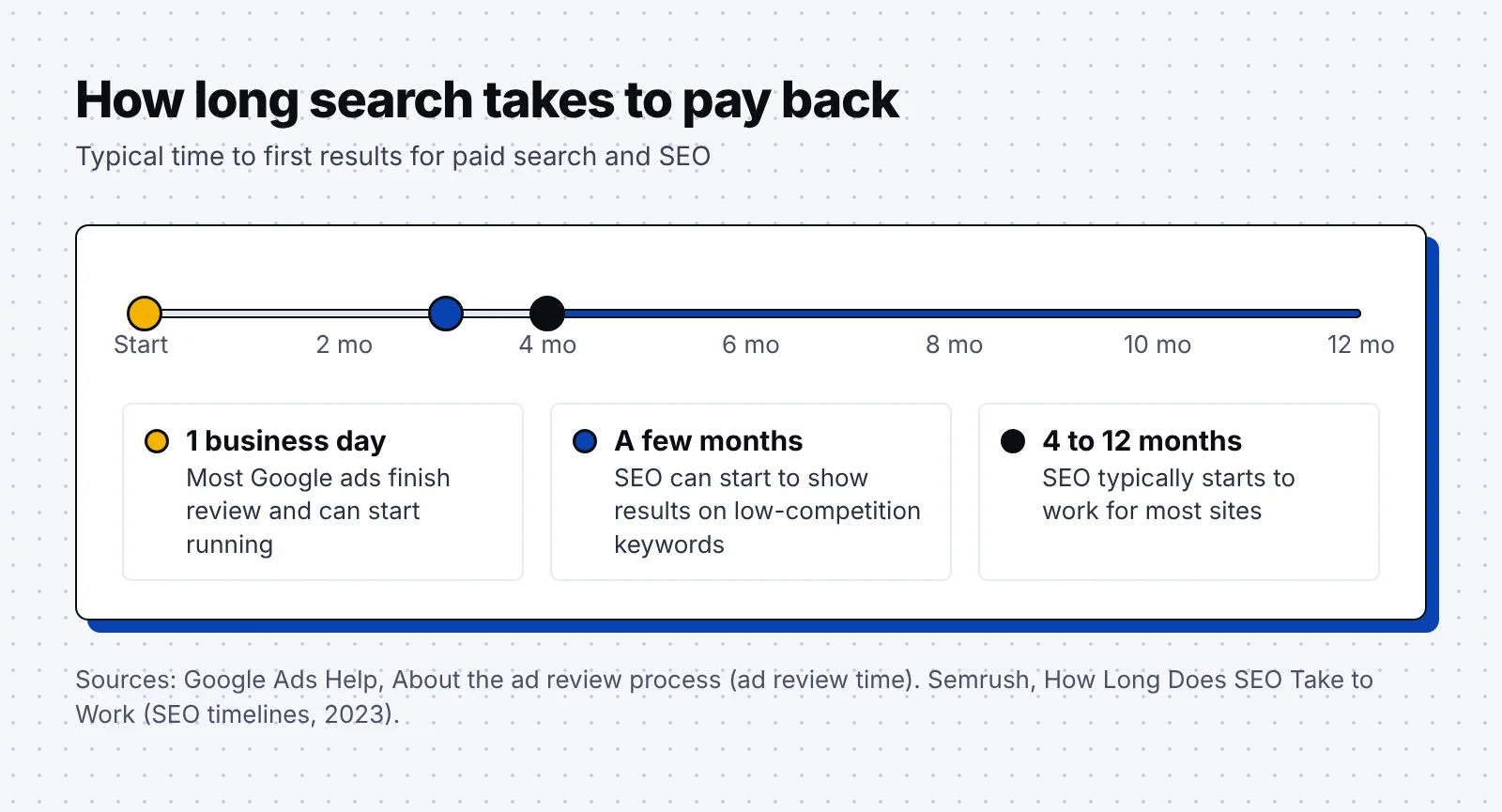
SEO is slow to pay off, and most B2B programs need the better part of a year to return what they cost. SEO typically takes 4 to 12 months to work, though pages that target keywords with little competition can move within a few months.
Paid search moves much faster, since most Google ads are reviewed within one business day and can start running once approved. That speed makes paid search a useful bridge while your new pages climb the rankings.
2. AI Overviews and updates cut clicks
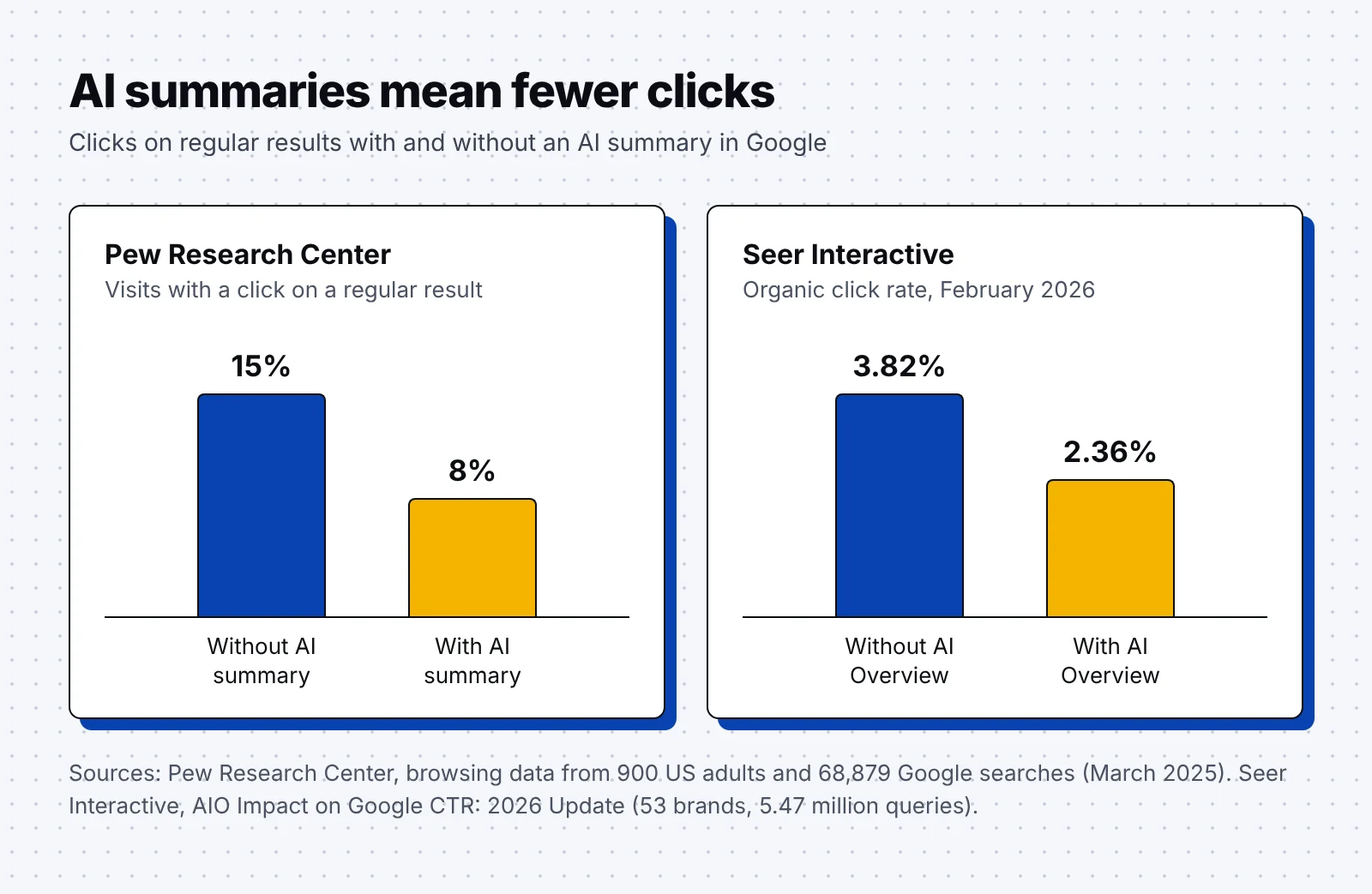
Even when you rank, fewer searchers click than a few years ago, because Google answers more questions on the results page. These studies all point the same way:
- In Pew Research Center's study, users clicked a regular result in 8% of visits with an AI summary, compared with 15% without one.
- In Seer Interactive's data, organic click rates in February 2026 were 2.36% with an AI Overview and 3.82% without.
- In SparkToro's analysis of Similarweb data, 68.01% of US Google searches ended without a click from January to April 2026.
Rankings also move each time Google updates its systems, and Google confirmed five core updates and five spam updates between March 2025 and September 2026.
3. Competition for top spots is steep
Most clicks go to the first few results, and B2B topics with buying intent draw well-funded competitors. In Backlinko's study of 4 million Google results, the top result had an average click rate of 27.6%. Only 0.63% of searchers clicked on anything from the second page of results.
You compete with vendors, review sites, publishers and agencies for the same ten results, and older domains with many links start ahead. Fortunately, smaller teams can still win by picking narrow topics that big sites cover only briefly.
4. It needs money up front
You pay for SEO months before it brings revenue, so it needs budget you can commit without quick proof. Plan for at least a year of spend before you judge the program on revenue.
Expert interviews, writing, design and link building all add to the bill. In Ahrefs' survey of 439 SEO providers, 31.2% charged more than $2,000 a month on retainer.
5. It needs steady work
SEO runs all year, since rankings slip as pages age and competitors publish newer ones. Pages that stall outside the top 10 usually need new work before they climb. A steady program covers this work each month:
- Publish new pages for topics your buyers search.
- Update older pages with new data, examples and screenshots.
- Fix technical issues after site changes and redesigns.
- Earn links and mentions from sites your buyers read.
6. It's hard to attribute
SEO reaches buyers long before they fill in a form, so last-click reports give it little credit. Measuring ROI is the top challenge for 33% of marketers in HubSpot's 2026 survey of more than 1,500 marketers.
AI answers add to the gap, since a buyer may read your page inside ChatGPT and later search your brand name. Happily, a "How did you hear about us?" field on your demo form and pipeline reports by first landing page close much of it.
Pros and cons of SEO at a glance
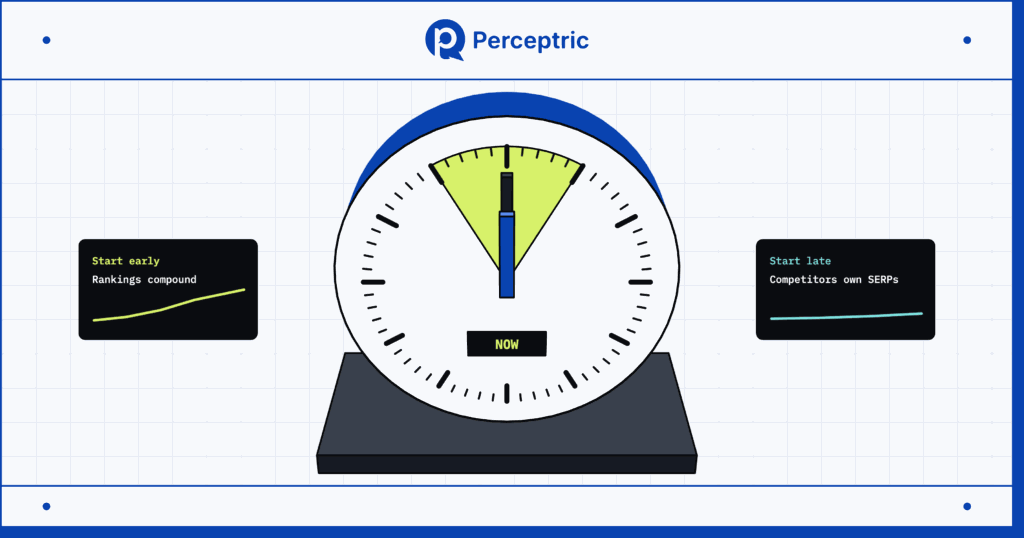
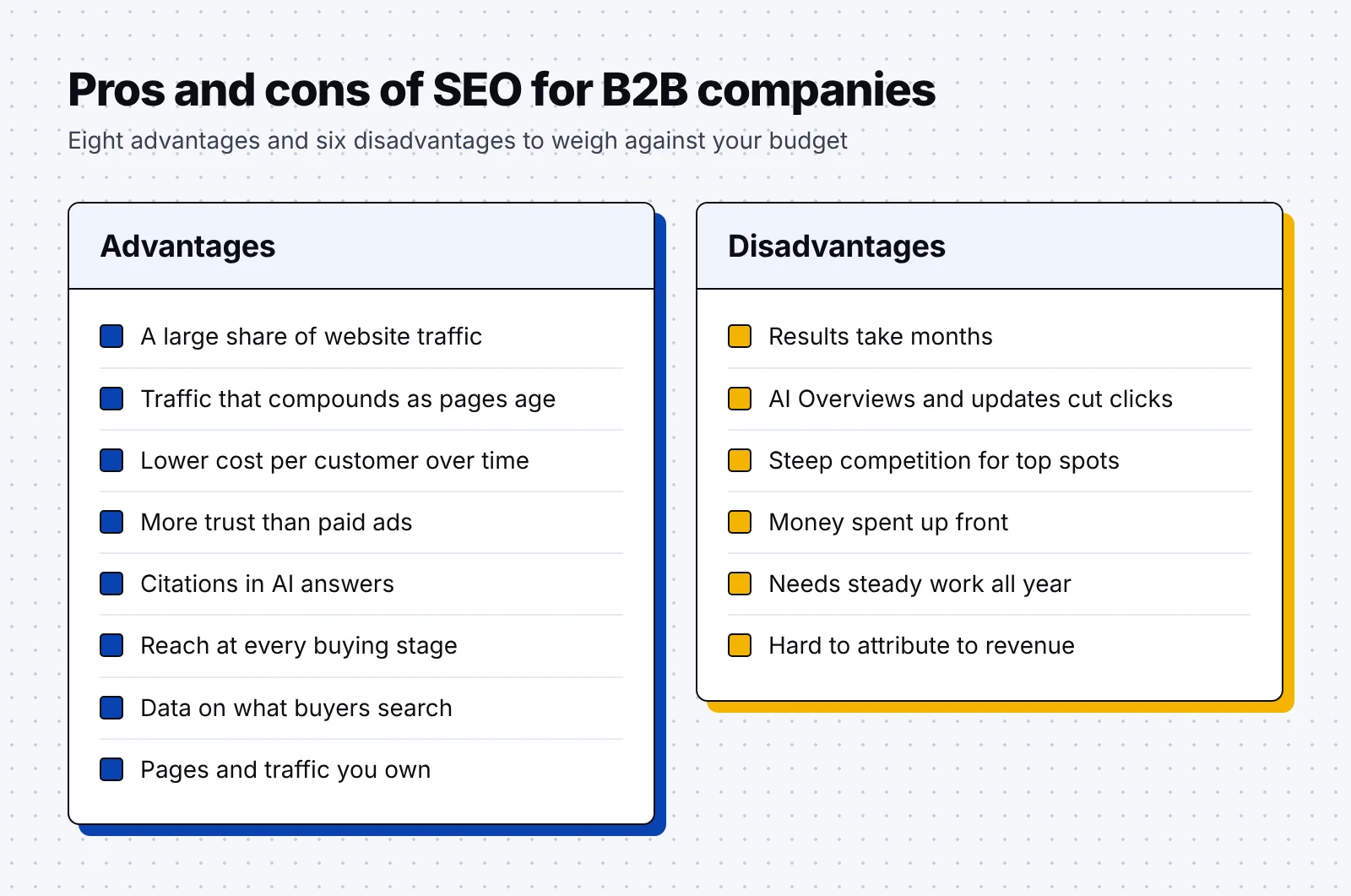
The diagram puts all fourteen points side by side, so you can weigh them against your own sales cycle and budget.
SEO vs paid search
Paid search buys clicks right away, while SEO earns them over time, and most B2B companies end up running both. Our SEO vs PPC statistics roundup goes deeper, and the table sums up the main differences:
| Factor | SEO | Paid search |
|---|---|---|
| Time to results | Typically 4 to 12 months (Semrush) | Ads can run as soon as Google approves them |
| Cost | Mostly content and expert time paid up front, with cost per customer falling as pages rank | You pay for every click, with a $66.69 average cost per lead from search ads in 2026 (WordStream by LocaliQ) |
| Durability | Pages can keep ranking for years after you publish them | Traffic stops when spend stops |
| Trust | 50% of Americans trust organic results most (Page One Power) | 5% of Americans trust paid results most (Page One Power) |
| Control | Google decides rankings and what shows in AI answers | You choose keywords, ad copy, budget and timing |
The return gap grows over the years, because a page that ranks keeps bringing leads while ad spend buys only that month's clicks. Paid search fits launches, short campaigns and testing which keywords convert before you write pages for them.
When SEO is the right call for a B2B company
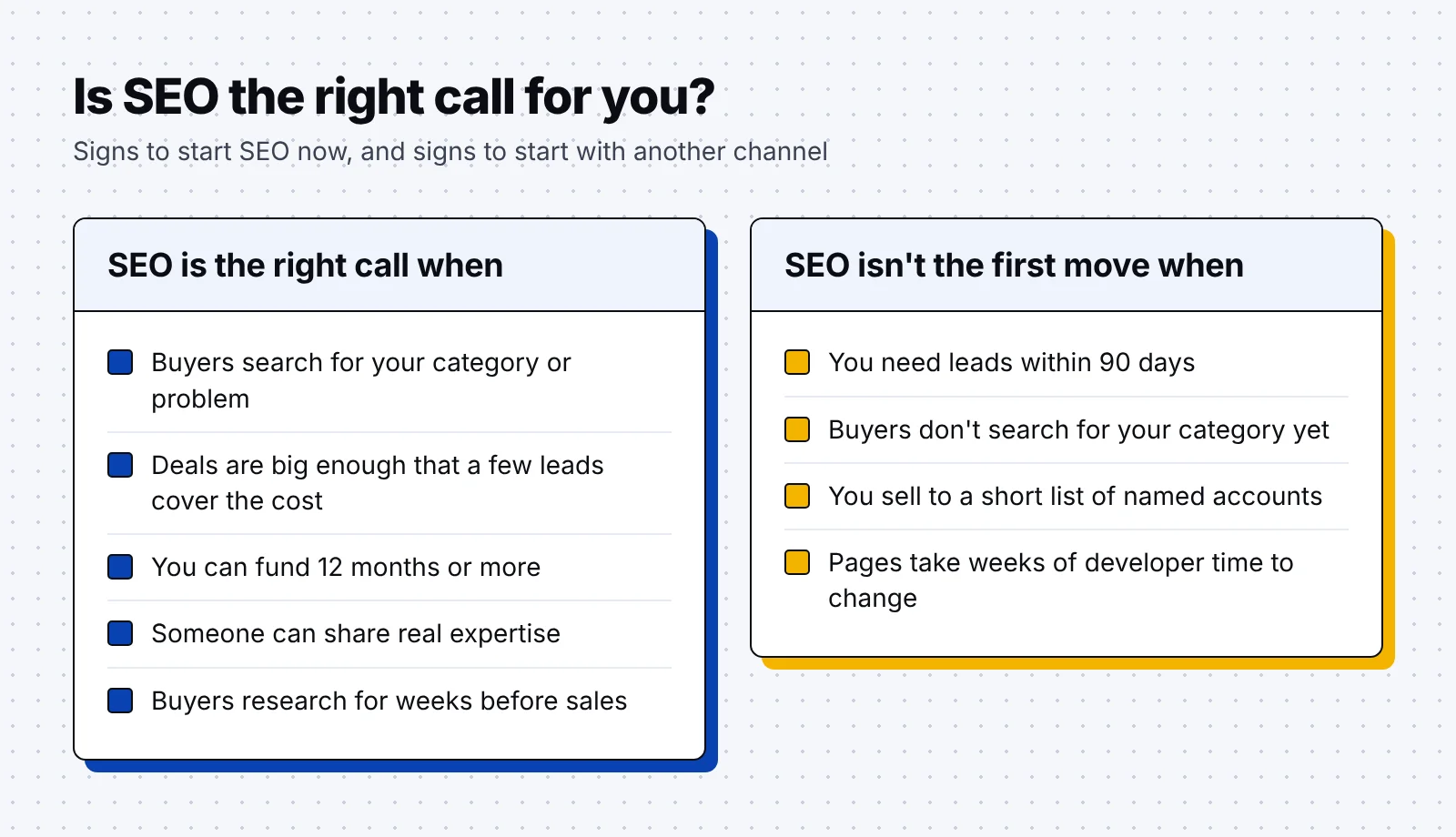
SEO is the right call when your buyers search for the problem you solve and you can fund a program for at least a year. It tends to pay off when these are true:
- Buyers search for your category, their problem or your competitors, even at low volumes.
- Your deals are large enough that a few organic leads a month cover the cost.
- You can commit budget for 12 months or more without needing payback in the first quarter.
- Someone on your team, such as a founder or product lead, can share real expertise for content.
- Your sales cycle is long, so buyers research for weeks before they talk to sales.
When SEO isn't the first move
SEO can wait when you need pipeline this quarter or when buyers don't search for what you sell yet. These are the cases where we suggest starting elsewhere:
- You need leads within 90 days to hit a target or close a funding round.
- Your product creates a new category that buyers don't search for yet.
- You sell to a short list of named accounts that outbound and events reach directly.
- Your site can't publish or change pages without weeks of developer time.
In those cases, start with paid search, outbound or partners, and add SEO once you know which messages convert. Our guide on when B2B companies should invest in SEO covers timing in more detail.
How to lower the risks of SEO
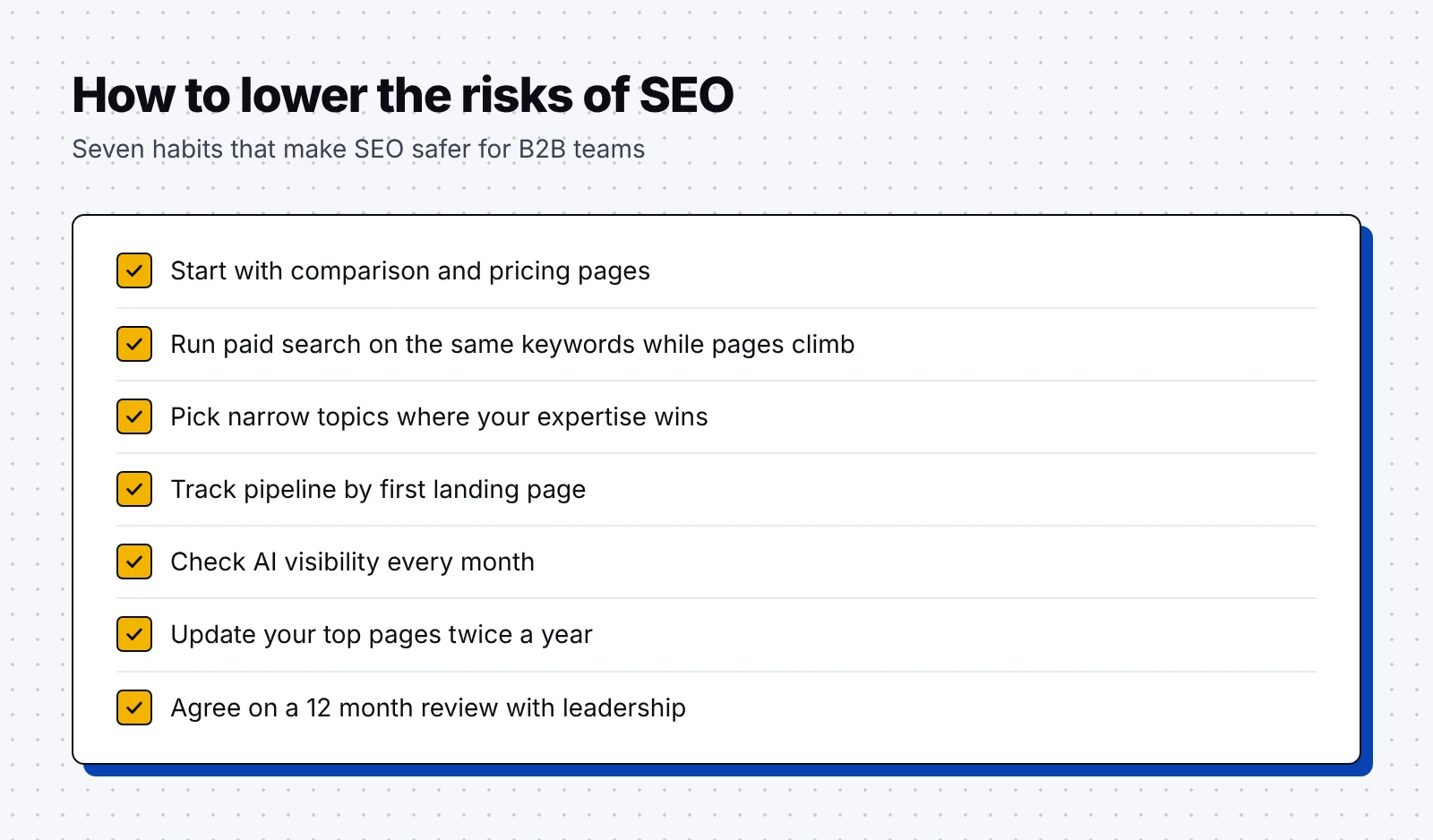
You can shrink the risks of SEO and spot problems sooner with a few habits. These are the ones we use with B2B clients:
- Start with bottom-of-funnel pages, such as comparisons and pricing, since they bring leads sooner.
- Run paid search on the same keywords while your pages climb, then cut spend where you rank.
- Pick narrow topics where your expertise can beat bigger sites.
- Track pipeline by first landing page and ask every lead how they heard about you.
- Check your visibility in ChatGPT and AI Overviews each month, along with your rankings.
- Update your top pages twice a year so they keep their spots.
- Agree on a 12 month review with your leadership team, and track impressions and rankings in the early months.
FAQ
What are the main advantages of SEO for B2B companies?
The main advantages of SEO are steady traffic from buyers who already search for what you sell and a lower cost per customer over time. Pages that rank also have better odds of being cited in AI answers, and they keep working for years.
What are the disadvantages of SEO?
The main disadvantages of SEO are slow results, fewer clicks as AI Overviews answer more searches, strong competition and money spent up front. It also needs steady work and is hard to attribute in last-click reports.
How long does SEO take to work for B2B companies?
SEO typically takes 4 to 12 months to work, though pages that target keywords with little competition can move within a few months. Bottom-of-funnel pages, such as comparison and pricing pages, usually bring leads sooner than guides.
Is SEO better than paid search for B2B?
SEO costs less per customer over time, while paid search brings results in weeks, so most B2B companies run both. In HubSpot's 2026 survey, 30.2% of B2B marketers named their website, blog and SEO as a top ROI channel, the highest share of any channel.
Is SEO still worth it with AI Overviews?
SEO is still worth it for most B2B companies, because AI tools often cite pages that already rank in Google. In AirOps' 2026 study, ChatGPT cited 43.2% of pages ranking first in Google. Plan for fewer clicks per ranking and judge SEO by the pipeline it brings.
A good first step is to list ten searches your best customers made before they found you and check where you rank for each one. To see where you show up in AI answers as well, start with a free AI visibility audit.