Organic search converts 4.9% of visits into qualified leads or sales on average, based on more than 5 million conversions across 13 industries in 2026. The rate runs from 8.1% in professional services down to 1.8% in travel and health care.
We pulled together 54 numbers on SEO conversion rates by industry, page type, search intent, channel and device, plus how AI search referrals compare. Every stat links to the original study, and the link title shows its sample and date.
- Organic search converts 4.9% of visits into qualified leads or sales on average in 2026, with professional services at 8.1% and software at 7.9%.
- Search intent shapes the rate more than traffic does, since alternatives and competitor keywords convert at 8.43% while most SEO content converts under 0.5%.
- Paid search converts slightly better per visit at 5.4%, and organic social trails both search channels at 2.23%.
- Mobile brings 69.9% of site traffic, yet desktop visits convert 74% better, so check each device on its own.
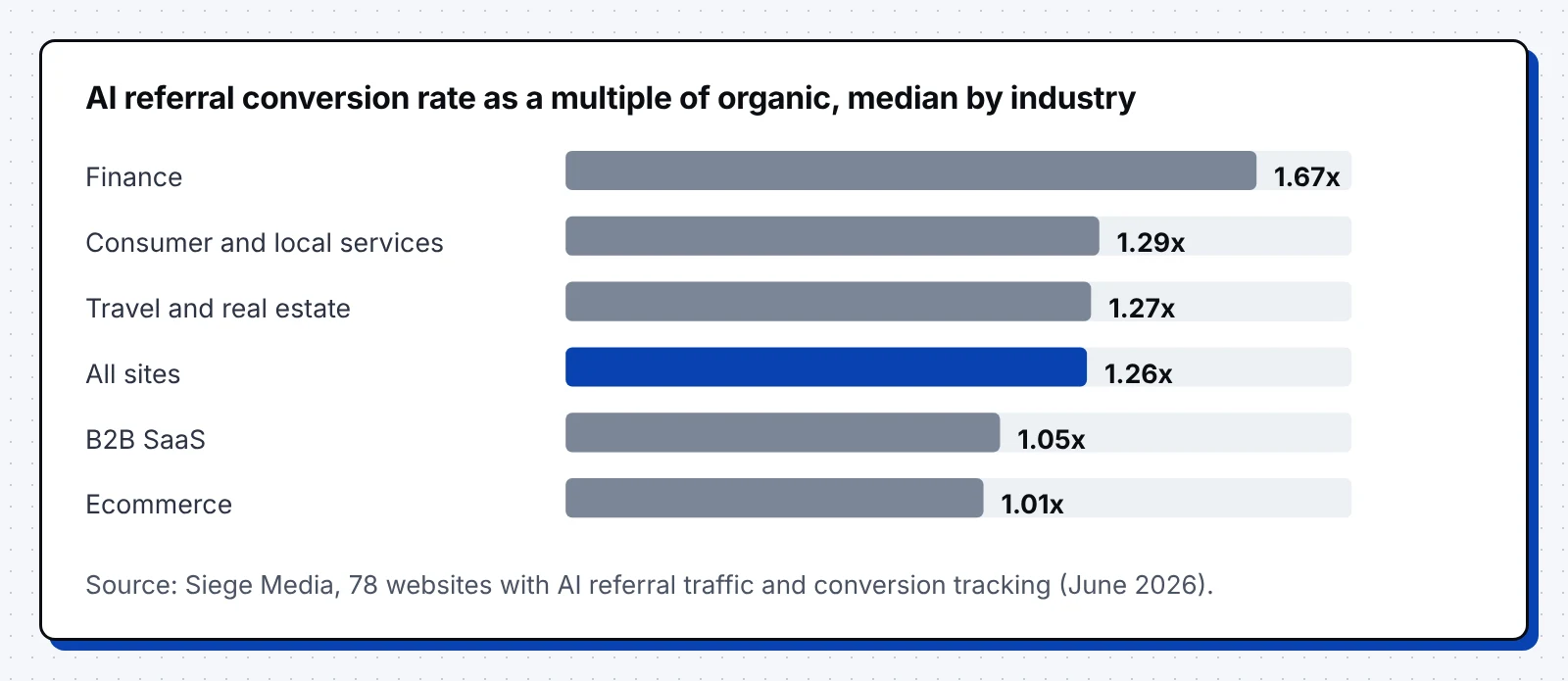
- AI referrals convert at a median 1.26 times the organic rate across 78 sites, a smaller gap than early single-site studies showed.
What SEO Conversion Rate Means: Visitor to Lead and Lead to Customer
SEO conversion rate is the share of organic visits that end in a lead, such as a form fill, demo request or signup. A second rate follows those leads through your CRM and shows how many turn into meetings, pipeline and customers.
- 2.1% of B2B SaaS visitors from SEO become leads, then 41% become MQLs, 51% become SQLs, 49% become opportunities and 36% of those close. (First Page Sage)
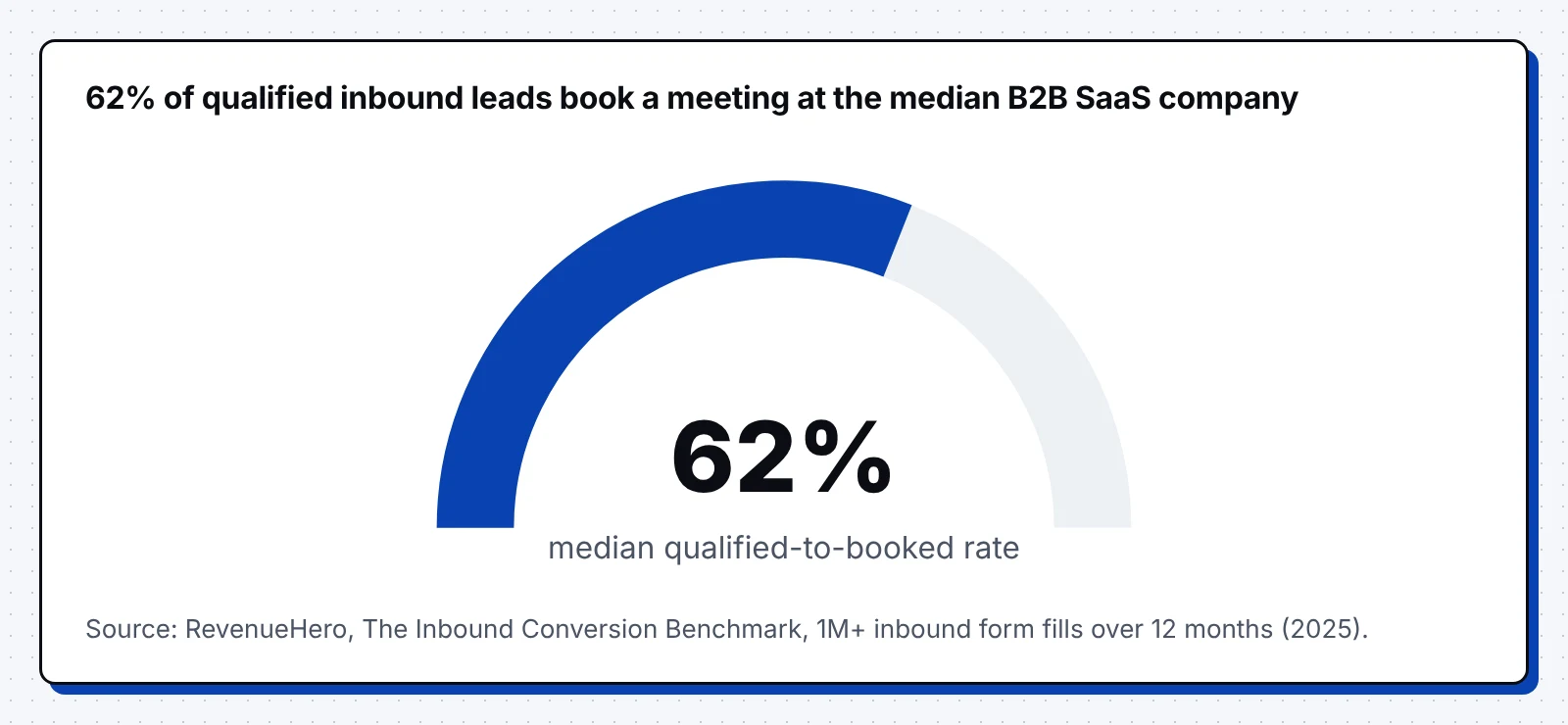
- 62% of qualified inbound form fills become booked meetings at the median B2B SaaS company, and the top 10% book 78% or more. (RevenueHero)
- 53% is the qualified-to-booked rate for the bottom 25% of companies, against 72% for the top 25% and 88% for the best performer. (RevenueHero)
- 17.50% of form fills from transparent pricing pages turn into pipeline, compared with 10.31% from pricing pages that hide their prices. (HockeyStack Labs)
- 40% of B2B marketers name creating content that prompts an action, such as a conversion, as a top challenge, and 33% name measuring content effectiveness. (Content Marketing Institute)
Average Organic Search Conversion Rate
The average organic conversion rate depends on what a study counts as a conversion and which sites it measures. Studies of qualified leads and sales land near 5%, while site-wide and content studies often land under 2%.
- 4.9% of organic search visits turned into qualified leads or sales in 2026, higher than the rate this channel showed in earlier years. (Ruler Analytics)
- 6.6% is the median conversion rate for landing pages across all industries. (Unbounce)
- 2.9% of returning visitors convert, compared with 1.7% of new visitors, and return visits make up 52.8% of site traffic. (Contentsquare)
- 1.1% of unique visitors to B2B SaaS websites submit a form, which works out to one form fill for every 91 visitors. (HockeyStack Labs)
- Less than 0.5% of visitors convert to product calls to action on most SEO content that brands publish, across hundreds of blog posts tracked for clients. (Grow and Convert)
SEO Conversion Rate by Industry (B2B and B2C)
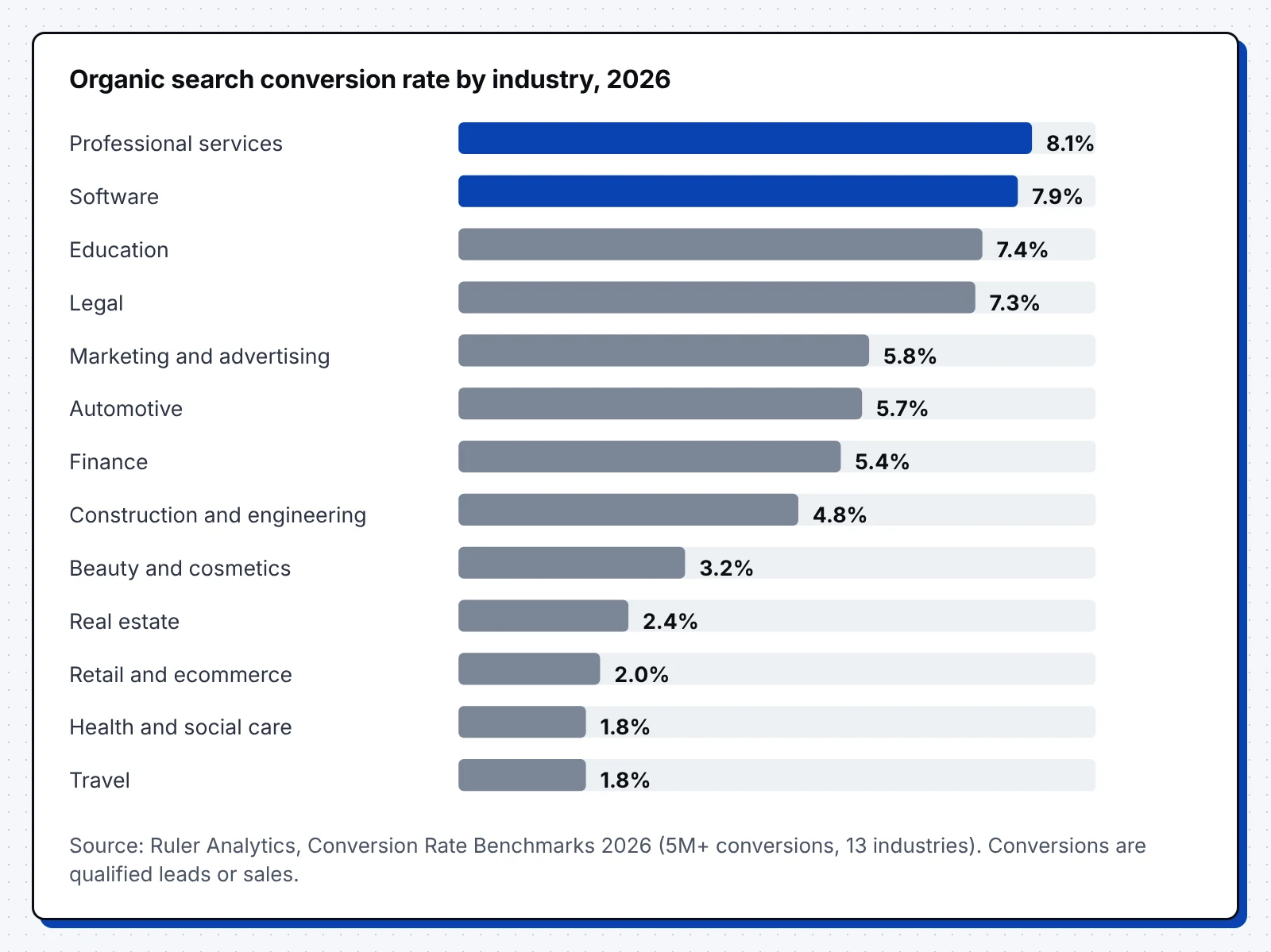
Industries where people search for a specific service or solution convert organic visitors best. Professional services, software and legal lead, while retail, travel and health care convert the fewest visits.
- 8.1% of organic visits convert in professional services, the highest of 13 industries, followed by software at 7.9%, education at 7.4% and legal at 7.3%. (Ruler Analytics)
- 5.8% of organic visits convert in marketing and advertising, against 5.7% in automotive, 5.4% in finance, 4.8% in construction and engineering and 3.2% in beauty. (Ruler Analytics)
- 2.4% organic conversion rate in real estate, with retail and ecommerce at 2.0% and health and social care and travel both at 1.8%. (Ruler Analytics)
- 3.8% is the median conversion rate for SaaS landing pages, 42% lower than the 6.6% median for all industries. (Unbounce)
- 4.2% is the median conversion rate for ecommerce landing pages, while food and beverage pages reach 7.1%. (Unbounce)
For conversion rates across the full B2B funnel, from visit to closed deal, see our B2B conversion rate benchmarks.
SEO Conversion Rate by Page Type and Search Intent
Bottom-of-funnel pages convert many times better than top-of-funnel posts, because their searchers already know what they want to buy. Comparison and alternatives pages lead, and demo and pricing pages beat the site average.
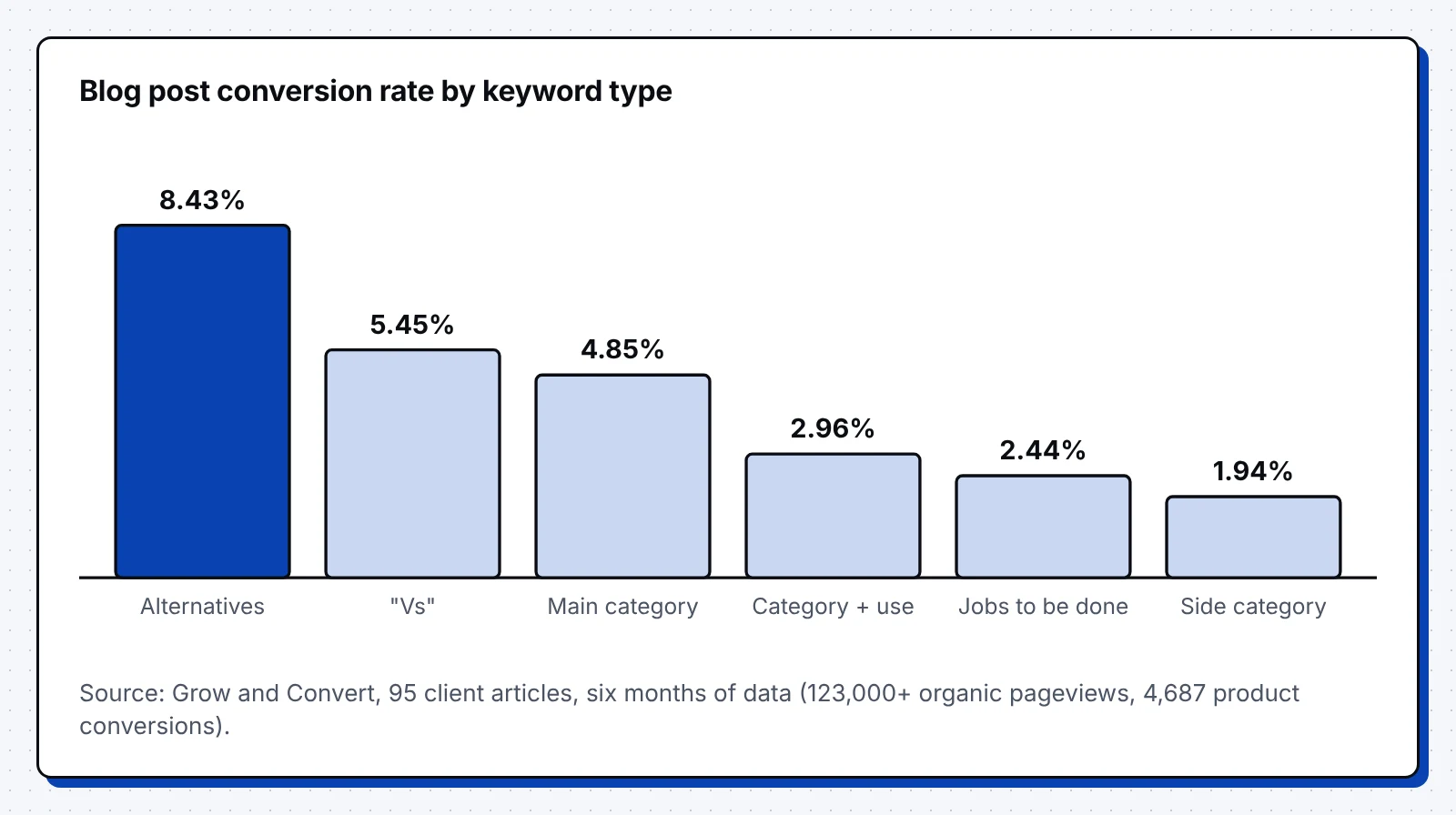
- 8.43% average conversion rate for articles that target alternatives and competitor keywords, the highest of any keyword type in a study of 95 client articles. (Grow and Convert)
- 5.45% for articles that target "vs" keywords, where the searcher compares two named products. (Grow and Convert)
- 4.85% for main category keywords that describe exactly what you sell, against 2.96% when the keyword adds a use case and 1.94% for side features. (Grow and Convert)
- 2.44% for jobs-to-be-done keywords, which describe a problem your product solves. (Grow and Convert)
- 2,400% better conversion for bottom-of-funnel posts than for top-of-funnel posts, across 60+ posts written for one software client. (Grow and Convert)
- 2.4% average SEO conversion rate across page types, with white papers at 4.6%, case studies at 3.5%, product landing pages at 2.9% and blog posts at 2.0%. (First Page Sage)
- 5.5% average conversion rate on B2B SaaS demo pages, compared with 3.8% on pricing pages. (HockeyStack Labs)
- 16.5% of B2B SaaS website traffic lands on pricing pages, while demo pages get 0.91% and case studies get 0.76%. (HockeyStack Labs)
If your site has few of these pages, our guide to BOFU content shows how to plan comparison, alternatives and category pages.
Organic Search vs Other Channels
Organic search converts close to paid search and email in most datasets, and about twice as well as social media. Paid search usually edges ahead per visit, while organic visits carry no cost per click.
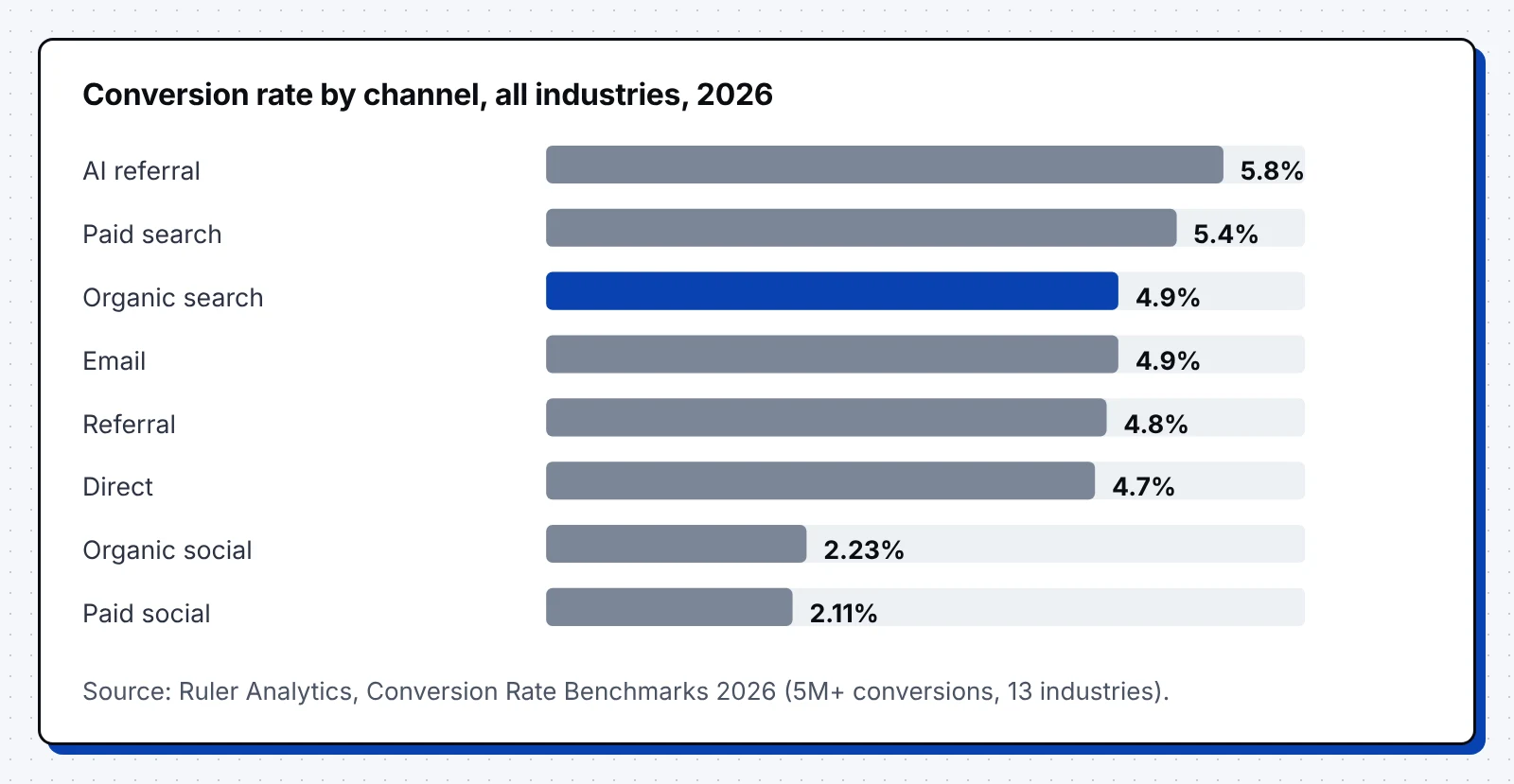
- 5.4% for paid search tops the channels, ahead of email at 4.9%, referral at 4.8%, direct at 4.7%, organic social at 2.23% and paid social at 2.11%. (Ruler Analytics)
- 8.18% average conversion rate for Google Ads across industries in 2026, counted as leads per click, at an average cost per lead of $66.69. (WordStream by LocaliQ)
- 2.8% conversion rate for paid search, the highest of the paid channels, and paid search also converted better than organic search. (Contentsquare)
- 30.2% of B2B marketers name their website, blog and SEO as the channel with the highest ROI, ahead of email at 23.6%. (HubSpot)
For cost per lead and payback as well as conversion rate, see our SEO vs PPC statistics and our conversion rate by channel benchmarks.
SEO Conversion Rate by Device
Most visits now arrive on phones, but desktop visits still convert at higher rates in most datasets. B2B sites get far less mobile traffic than consumer sites, so check your own device split before you copy a mobile benchmark.
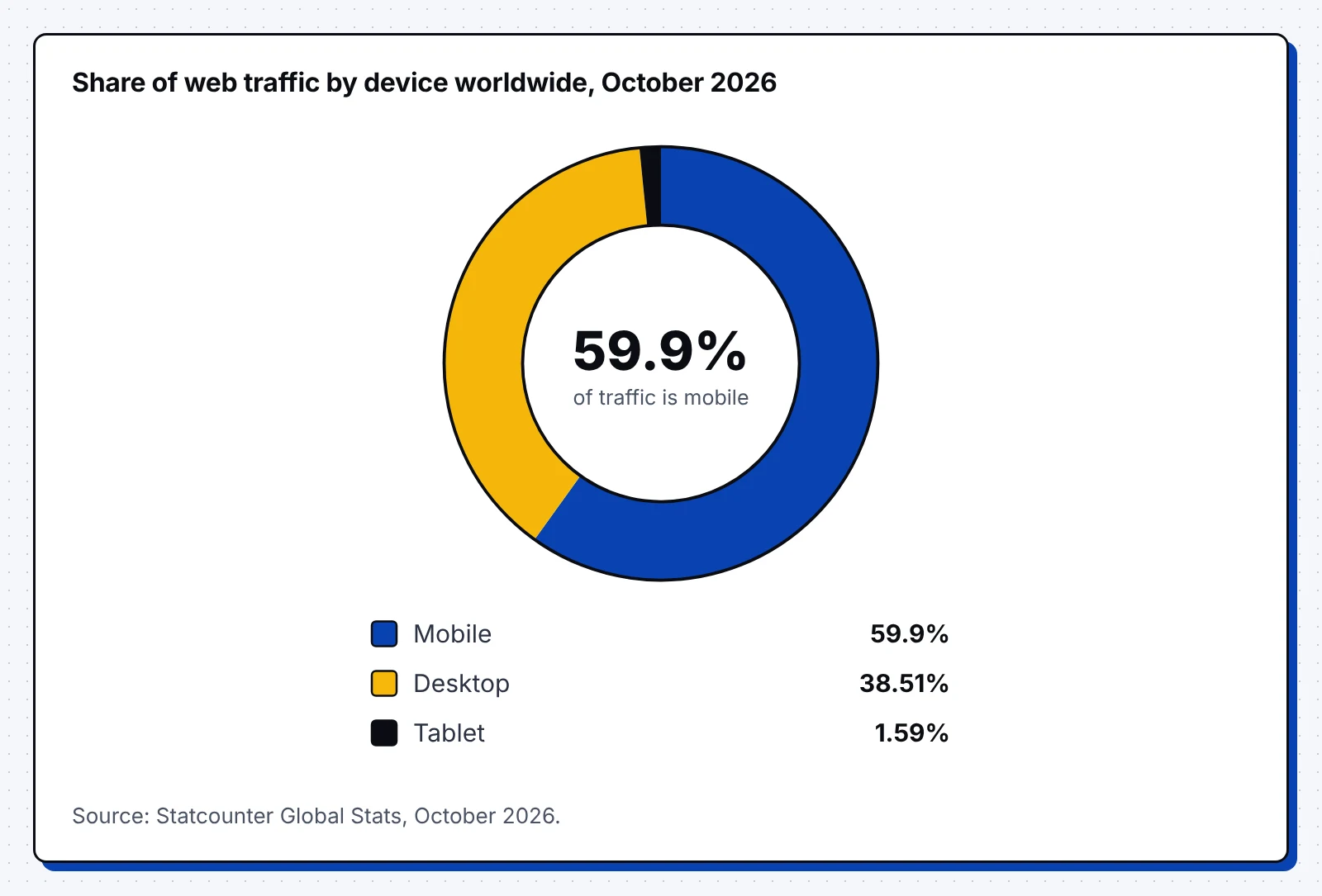
- 59.9% of web traffic worldwide came from mobile devices in October 2026, against 38.51% from desktop and 1.59% from tablets. (Statcounter)
- 74% higher conversion rate on desktop than on mobile, even though mobile brings 69.9% of all site traffic. (Contentsquare)
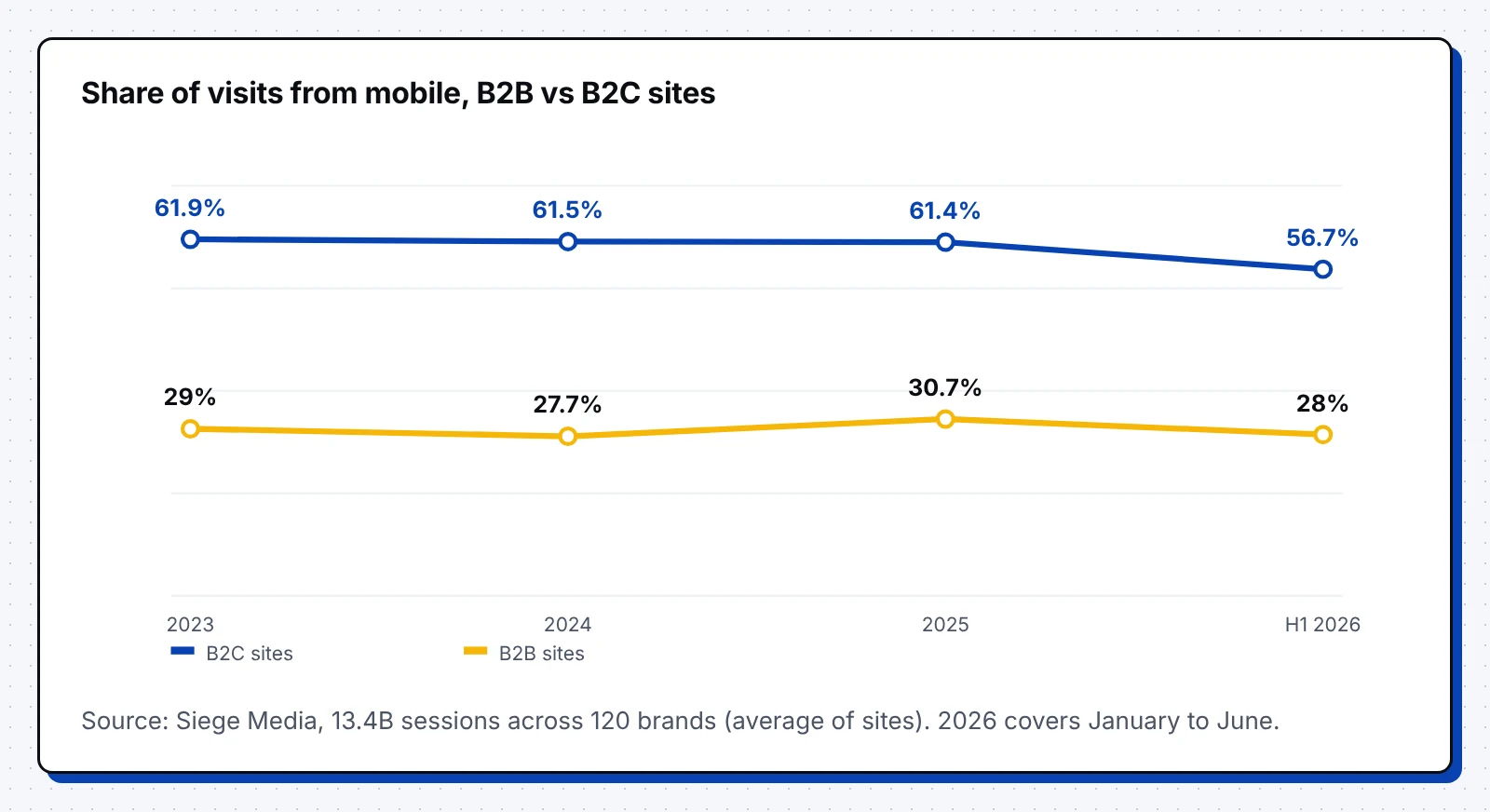
- 28% of visits to B2B sites came from mobile in the first half of 2026, after 29% in 2023, 27.7% in 2024 and 30.7% in 2025. (Siege Media)
- 56.7% of visits to B2C sites came from mobile in the first half of 2026, down from 61.9% in 2023, 61.5% in 2024 and 61.4% in 2025. (Siege Media)
- 79% of visits to SaaS landing pages happen on mobile, and mobile visits convert at 6.4% against 6.2% on desktop. (Unbounce)
- 23.6% average conversion rate for desktop visits to ecommerce landing pages, against 19.4% on mobile, though mobile brings more than 2.5x the visitors. (Unbounce)
Landing Page Benchmarks That Affect SEO Conversions
Page speed, form design and plain copy all change the share of organic visitors who convert. Pages that load in one second convert several times better than slow ones, and simple copy converts about twice as well as complex copy.
- 3x higher conversion rate for B2B lead generation pages that load in 1 second than for 5-second pages, and 5x higher than for 10-second pages, in 2022 data. (Portent)
- 2.5x higher ecommerce conversion rate for pages that load in 1 second than for pages that load in 5 seconds, in the same 2022 study. (Portent)
- 8.4% more retail conversions and 10.1% more travel conversions followed a 0.1 second gain in mobile site speed, in a 2020 study of 37 brands. (Google and Deloitte)
- 8.3% lower bounce rate on lead generation information pages followed the same 0.1 second speed gain in 2020. (Google and Deloitte)
- 11.1% conversion rate for landing pages written at a 5th to 7th grade reading level, against 5.3% for pages in professional-level language. (Unbounce)
- 14.5% of visitors who see a contact form complete it, against 34.6% across all form types, while 47.4% of people who start a contact form finish it. (Zuko)
- 77% or more of qualified leads booked meetings at some top companies with 2 form fields, and 76% or more at some with 13 fields. (RevenueHero)
Interestingly, the form data suggests each field matters more than the number of fields. Keep fields that route the lead or help the sales call, and cut the rest.
AI Search and Conversions: AI Referrals vs Organic
AI referrals convert at or above organic search on most sites, though the gap is far smaller than the first single-site studies suggested. AI assistants still send about 1% of all website traffic, so organic search remains the larger source of leads.
- 1.26x is the median ratio of AI referral conversion rate to organic search conversion rate across 78 sites with AI traffic and conversion tracking. (Siege Media)
- 1.67x AI-to-organic conversion ratio in finance, against 1.29x in consumer and local services, 1.27x in travel and real estate, 1.05x in B2B SaaS and 1.01x in ecommerce. (Siege Media)
- 5.8% conversion rate for AI referral traffic in 2026, above organic search at 4.9%, with education at 8.7% and software at 7.9%. (Ruler Analytics)
- 1.3% conversion rate for AI-referred traffic after a 55% rise in a year, which made AI the only channel whose conversion rate grew. (Contentsquare)
- 12.1% of Ahrefs signups came from AI search, which brought only 0.5% of its visits, so AI visitors converted 23x better than organic visitors on that site. (Ahrefs)
- 15.9% conversion rate from ChatGPT referrals for one client, against 10.5% from Perplexity, 5% from Claude, 3% from Gemini and 1.76% from Google organic. (Seer Interactive)
- 4.4x higher value for the average AI search visitor than for the average organic search visitor, based on conversion rate. (Semrush)
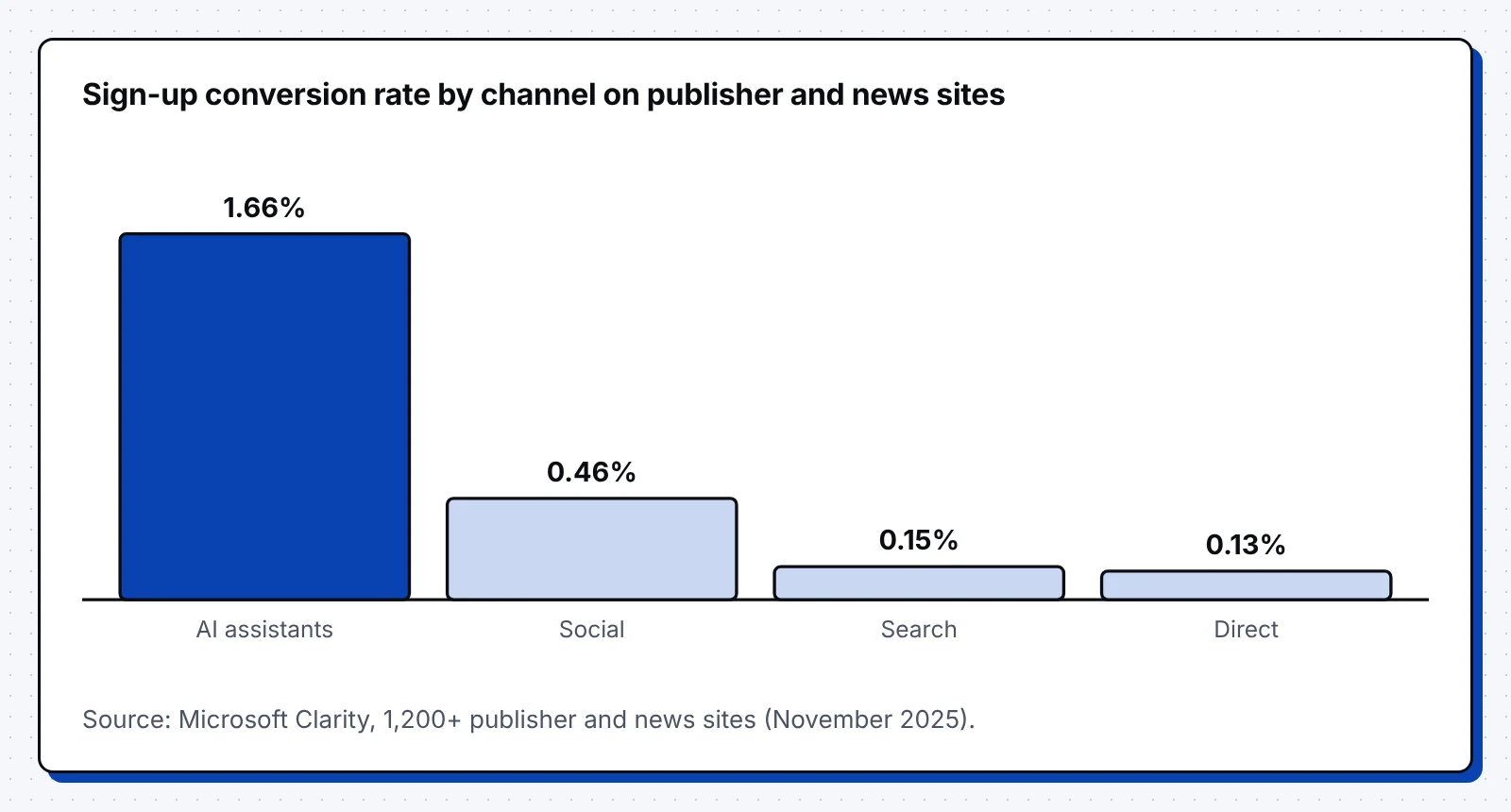
- 1.66% of visitors from AI assistants signed up on publisher and news sites, against 0.46% from social, 0.15% from search and 0.13% from direct. (Microsoft Clarity)
- 1.34% of visitors from AI assistants subscribed on the same sites, against 0.55% from search, 0.41% from direct and 0.37% from social. (Microsoft Clarity)
- 5.24% of visits from AI assistants turn into hand-raisers at the median B2B account, and 2.66% of those hand-raisers become qualified pipeline. (HockeyStack Labs)
- 9% lower conversion rate for generative AI traffic to US retail sites than for other traffic in early 2025, up from 43% lower in July 2024. (Adobe)
- 60% higher conversion rate for AI-referred visits to US retail sites than for other visits in July 2026, the 11th month in a row that AI traffic converted better. (Digital Commerce 360)
How to Use These SEO Conversion Benchmarks
Benchmarks help you set targets and find weak pages, as long as you compare like with like. Use these steps to turn the numbers above into a plan for your own site.
- Check what each study counts as a conversion, such as leads, qualified leads, sales or signups, before you compare it with your own rate.
- Pick the benchmark for your industry and page type, since a blog post and a demo page should never share one target.
- Tag every organic landing page as top, middle or bottom of funnel, then track the conversion rate of each group in GA4.
- Compare desktop and mobile on their own, and if mobile trails far behind, test speed and form length on phones first.
- Set up a separate channel group for AI assistants such as ChatGPT, Perplexity, Gemini and Claude so you can compare them with organic.
- Follow organic leads into your CRM and report meetings, pipeline and revenue, because lead counts alone hide lead quality.
Thankfully, GA4 and your CRM already hold most of what you need for these steps. Our guide to B2B website metrics shows where each report lives and how to set up the AI channel group.
How We Picked These Statistics
We looked for studies published from 2024 to 2026 that state their sample, and we checked every number on the publisher's own page. Two speed studies are older, from 2020 and 2022, because no newer study measures the same thing, and the keyword study dates from 2023 with a 2026 update.
We kept each publisher to six numbers or fewer and favored data from many sites over single-company case studies. Where a number comes from one site or one client, such as Ahrefs or a Seer client, the stat says so.
FAQ
What is a good SEO conversion rate?
A good SEO conversion rate beats the average for your industry, and the cross-industry average is 4.9% in Ruler Analytics' 2026 data. Professional services and software average about 8%, while retail, travel and health care sit near 2%.
How do you calculate SEO conversion rate?
Divide conversions from organic search by organic sessions, then multiply by 100. In GA4, filter the session default channel group to Organic Search and read the session key event rate. Then follow those leads in your CRM to see how many become customers.
Does organic search convert better than paid search?
Paid search converts slightly better per visit in most 2026 data. Ruler Analytics puts paid search at 5.4% and organic search at 4.9%, and Contentsquare also finds paid search ahead of organic.
Which pages convert best from organic search?
Pages that target buyers who are ready to choose convert best. In Grow and Convert's study of 95 articles, alternatives and competitor keywords converted at 8.43%, "vs" keywords at 5.45% and main category keywords at 4.85%.
Do AI search visitors convert better than organic visitors?
Usually yes, by a smaller margin than early studies suggested. Siege Media found a median AI-to-organic conversion ratio of 1.26x across 78 sites, and AI matched or beat organic on 72% of them.
Why is my mobile conversion rate lower than desktop?
Most sites see the same gap, because many people research on a phone and finish on a computer. Contentsquare found desktop converts 74% better than mobile, even though mobile brings 69.9% of traffic.
If you want more of your organic visitors to become pipeline, our B2B SEO agency team plans bottom-of-funnel pages and tracks them to revenue in your CRM.
To keep learning, read our SEO statistics, our AI SEO statistics and our B2B SEO statistics.