The best SaaS marketing campaigns on LinkedIn put a real person in the feed, such as a founder, an employee, a customer or a seller, and keep that person there for months. The 12 B2B SaaS campaigns below did that, and each one has a public source for its results.
We write LinkedIn content for B2B founders and executives (1,000+ posts published), so we read each case for what another team could repeat. By the end you'll be able to pick the campaign type that fits your stage and fill in a one page brief for your own.
| # | Company | Who carried it | Headline result |
|---|---|---|---|
| 1 | Snowflake | A speaker, an attendee and a developer advocate | 21.2% CTR on the advocate's post |
| 2 | Smokeball | Two customers on video | 186% increase in ROAS |
| 3 | Chili Piper | The CEO and employees | $7.5M+ influenced pipeline a quarter |
| 4 | Clay | Customers and partner agencies | One of six bets behind $100M ARR |
| 5 | Gong | Employees on video | 85% page follower growth in 30 days |
| 6 | Firebolt | The team and its culture | Lead to meeting rate up from 2% to 12% |
| 7 | Metadata | Three employees | 2.5x CTR against benchmarks |
| 8 | Salesforce | Hosts of a weekly live show | 600,000+ organic viewers |
| 9 | Muck Rack | Research built on surveys of its buyers | 55 new deals influenced in a year |
| 10 | Adobe | Marketers and sellers on one account list | Deals influenced by LinkedIn 161% bigger |
| 11 | Zendesk | Enterprise sellers | 100 qualified meetings in a quarter |
| 12 | Webflow | Enterprise marketers and sellers | 425% more MQLs year over year |
Source: LinkedIn customer stories and the companies' own posts, 2019 to 2025 (linked in each section below)
Campaign vs strategy in SaaS marketing
A SaaS marketing campaign is a set run of work with one goal, one audience and an end date. A strategy is the longer plan that decides which campaigns you run and why.
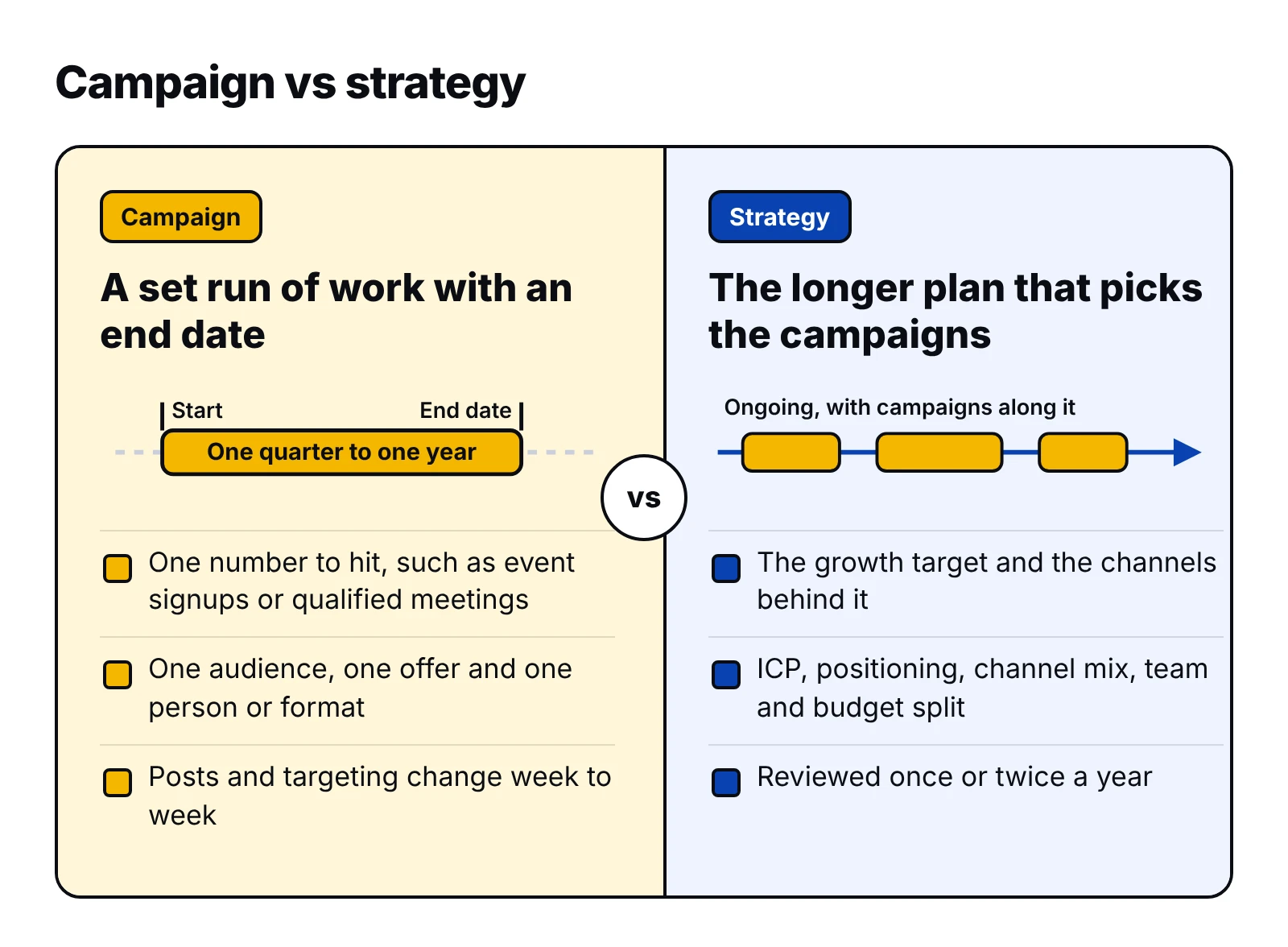
Every example below is a campaign. Our guide to B2B SaaS marketing strategies covers the strategy side.
| Campaign | Strategy | |
|---|---|---|
| Duration | A set run, usually one quarter to one year | Ongoing, reviewed once or twice a year |
| Objective | One number, such as event signups or qualified meetings | The company's growth target and the channels behind it |
| Parts | An audience, an offer, a person or format, a budget and an end date | ICP, positioning, channel mix, team and budget split |
| Flexibility | Posts and targeting change week to week | Changes slowly, and a change means new campaigns |
How we picked these campaigns
We started with about 20 candidates and kept the ones that passed five rules:
- The company sells B2B software.
- We opened a primary source: LinkedIn's own customer story, or the company's own post, guide or report. Roundups on other blogs did not count.
- The result is stated in that source, and we report it as written, with its date.
- LinkedIn was the main channel behind the result.
- It doesn't repeat our content strategy examples. Gong is here for its LinkedIn page videos, and its research program stays in that post.
We dropped Drift, Lavender, Ahrefs and Canva for Teams because we couldn't find a primary source with results.
One limit: most numbers here come from LinkedIn's customer stories, which LinkedIn publishes to sell ads, or from the companies themselves. Almost nobody else publishes campaign numbers, so we kept them and flag the ones a company reports about itself.
The 12 best SaaS marketing campaigns on LinkedIn
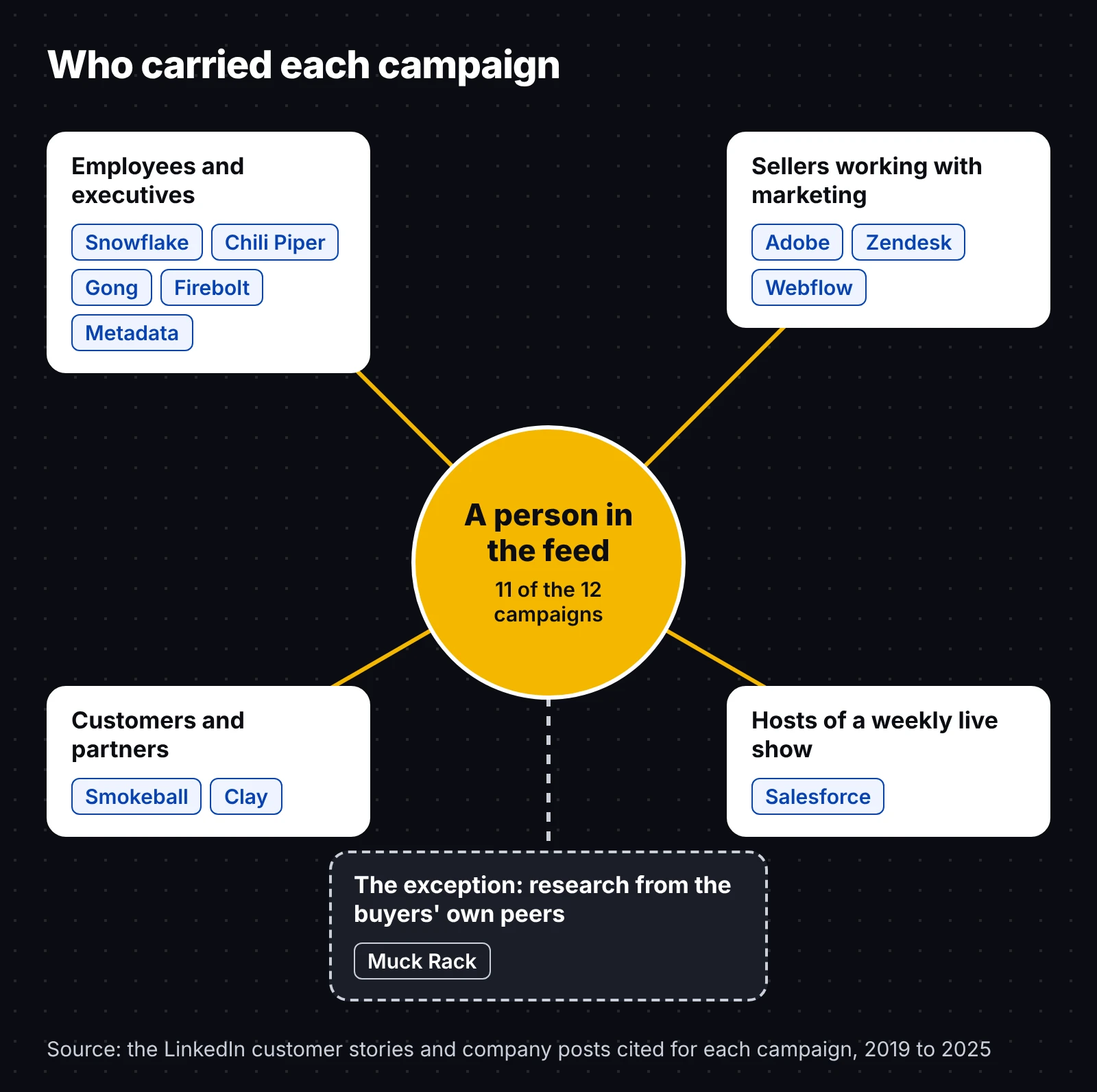
All but one put people from the company or its customers in front of buyers. The exception, Muck Rack, ran for a full year instead.
1. Snowflake: Thought Leader Ads for an event
- What they did: In 2024 Snowflake held its first Dev Day for developers and data scientists, next to its annual Summit. For the Summit it ran Single Image Ads next to Thought Leader Ads that promoted posts from a speaker and an attendee. For Dev Day, Thought Leader Ads were its only event marketing on LinkedIn. Snowflake retargeted people who had already engaged, this time with a post by Dash Desai, its Principal Developer Advocate.
- Why it worked: Developers listen to a developer, and the retargeting put Dash's post in front of people who had already shown interest.
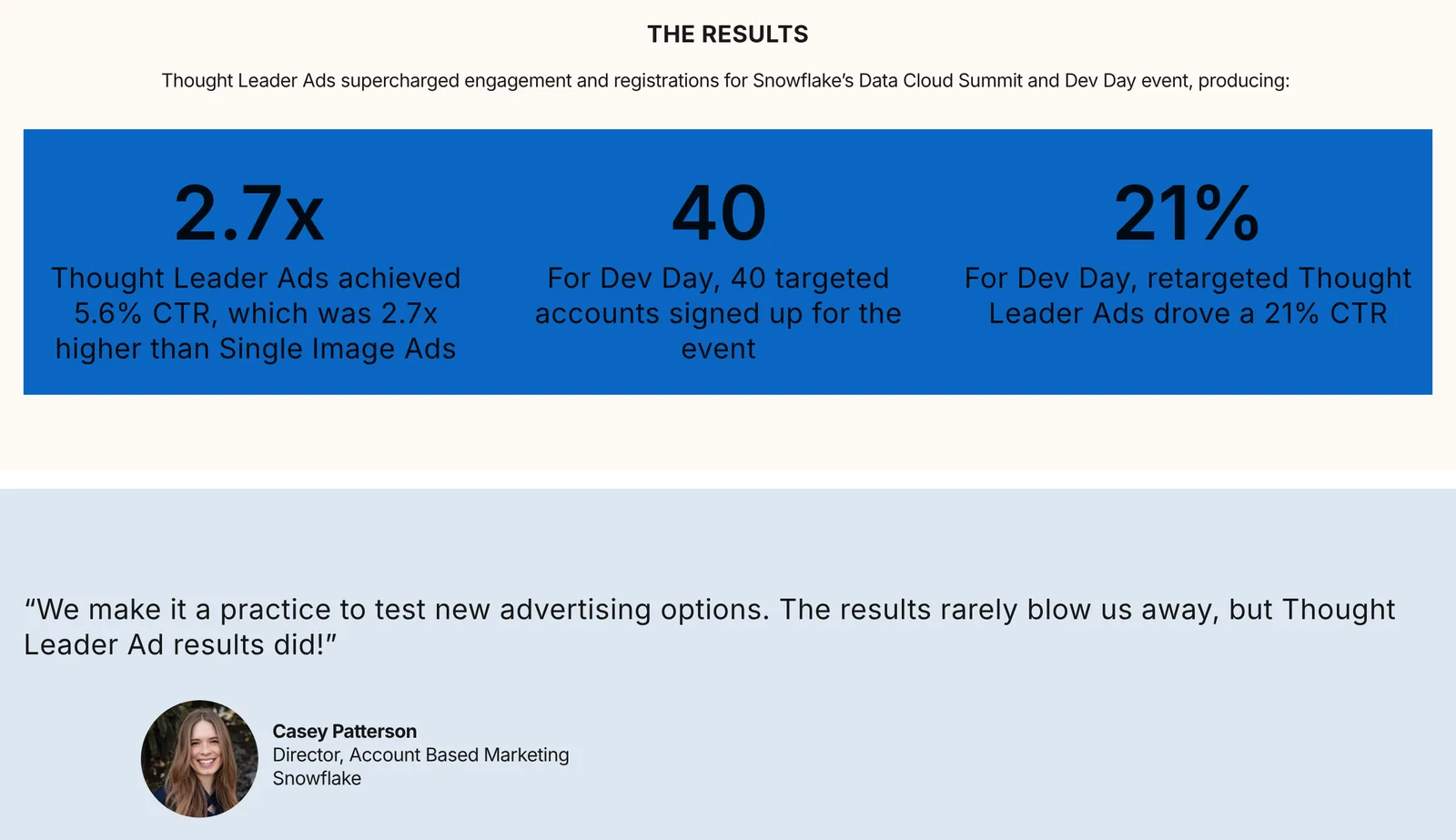
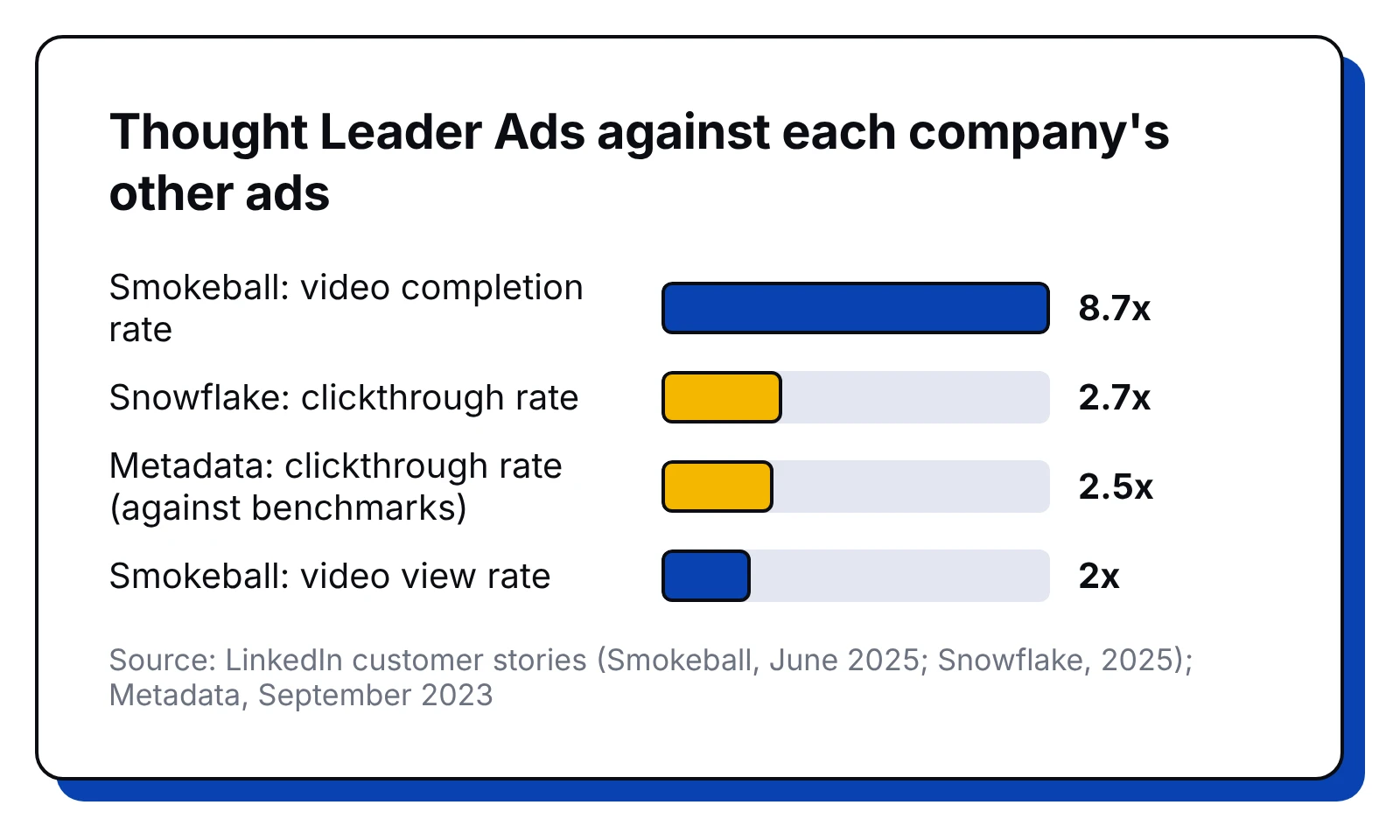
- Results: The Summit's Thought Leader Ads reached a 5.6% clickthrough rate, 2.7x the Single Image Ads. Dash's post earned a 21.2% CTR and 64 signups, and 40 targeted accounts registered for Dev Day (LinkedIn customer story, May 2025).
- What to copy: Before your next event, ask one speaker and one customer who's attending to post why they're going. Promote both posts to your account list, then retarget the people who engage with a post from your own expert.
2. Smokeball: customer video testimonials as Thought Leader Ads
- What they did: Smokeball Australia makes software for law firms. It wanted a brand campaign people would remember, so it filmed a three minute customer video. The team cut it into 30 second clips, which two customers, George and Abi, posted on their own LinkedIn. Smokeball promoted those posts as Thought Leader Ads to Matched Audiences and reused the footage in blogs and sales assets.
- Why it worked: The proof came from peers. Christopher Chow, Smokeball's Head of Growth Marketing, put it this way: "when prospects see their peers endorsing our solution, they're more likely to adopt it themselves."
- Results: Against a video ad campaign that used the same videos, the Thought Leader Ads had a 2x video view rate, an 8.7x completion rate, a 50% lower cost per view and a 186% increase in ROAS (LinkedIn customer story, June 2025).
- What to copy: Pick one customer who already posts on LinkedIn, film once and let them post the clips before you put budget behind them.
3. Chili Piper: a founder and employee creator program
- What they did: Alina Vandenberghe, Chili Piper's CEO and cofounder, posts on LinkedIn herself, and the company's own guide teaches teams to turn employees into creators. Writing in February 2023, she said the first $1M in ARR came from one to one work with customers: "We were Chili Piper, and Chili Piper was us."
- Why it worked: Buyers met the people before they met the product. Chili Piper also tracks a "first engagement" model, which shows how well its best accounts are seeing and interacting with the brand (Chili Piper, February 2023).
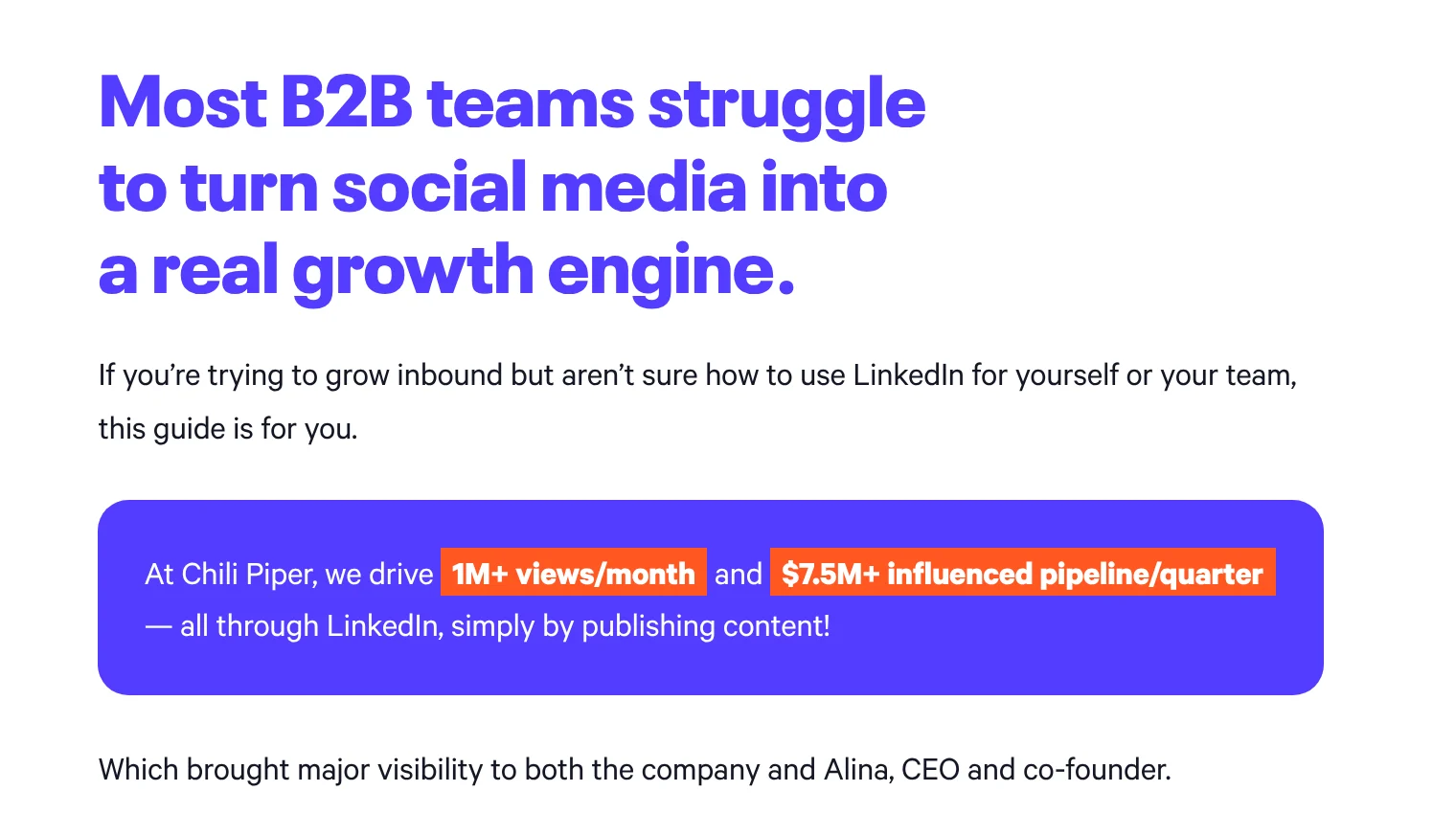
- Results: Chili Piper says it drives "1M+ views/month and $7.5M+ influenced pipeline/quarter" through LinkedIn by publishing content (Chili Piper B2B Social Media Guide, 2024). That's the company's own number, and influenced pipeline is a looser measure than sourced pipeline.
- What to copy: Start with the founder on a weekly schedule, then add a few employees who talk to buyers every day. If the founder has the ideas and no time to write, see how LinkedIn ghostwriting for SaaS founders works.
4. Clay: customers and agencies posting about the product
- What they did: Clay's first customers were cold email agencies. They posted about Clay on LinkedIn to show their skills and win clients, and Clay "pounced on it and enabled them," in the words of cofounder Varun Anand.
- Why it worked: The agencies had their own reason to post, so nobody at Clay had to ask. Anand calls it a self perpetuating cycle: people find Clay through that content, join and post their own.
- Results: Clay lists the agency program as one of six bets behind reaching $100M ARR, two years after it passed $1M (Varun Anand on LinkedIn, December 2025). That's a company result, and Clay doesn't split out what LinkedIn alone added.
- What to copy: Find customers whose business grows when they show their work, such as agencies, and repost their best examples. Our post on AI brand mentions from LinkedIn thought leadership looks at what those posts do for you in AI answers.
5. Gong: employee videos on the company page
- What they did: Gong's employees and executives already posted for the brand. Next, the team set out to grow the company page with video and three rules: keep videos short and casual, make every post useful and run contests and giveaways. The holiday campaign gave away sales books, such as Cialdini's Persuasion. In each video a Gong employee explained why they liked the book. Posts also asked readers who agreed to reply with one word in the comments: "Me".
- Why it worked: Real faces from the company, plus an easy reason to comment. As Udi Ledergor, then VP of Marketing, put it: "We're not selling on social media."
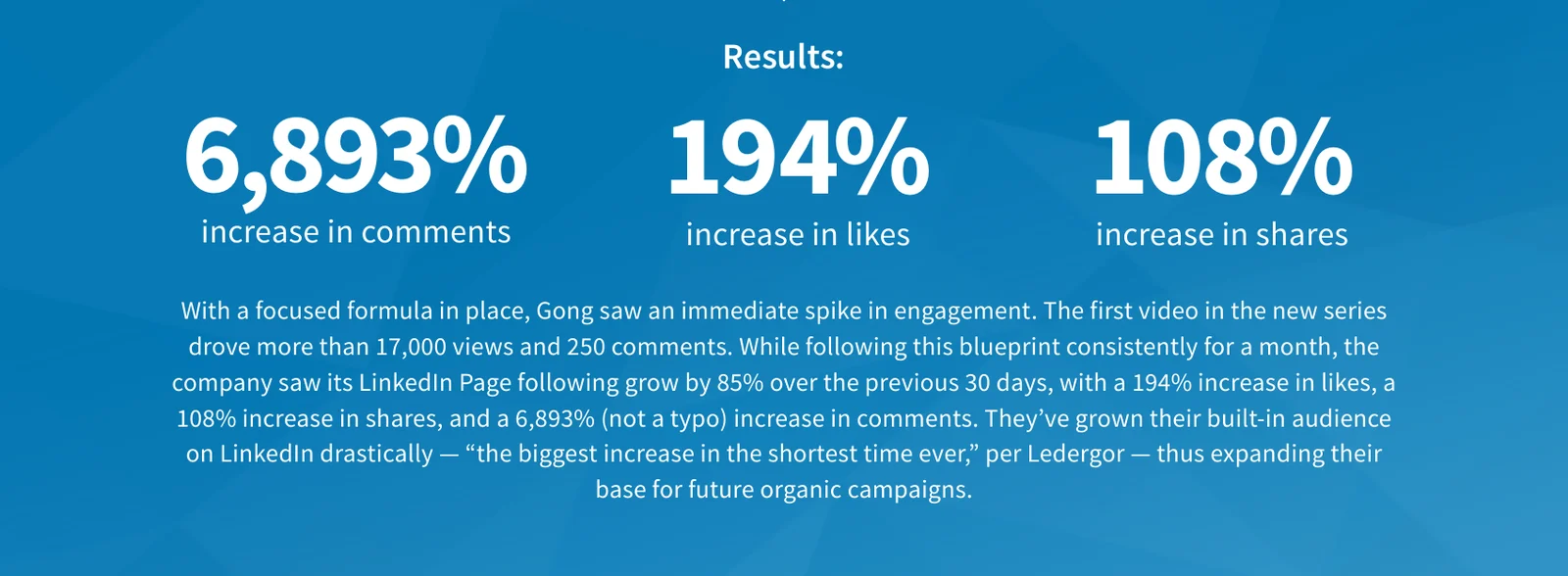
- Results: The first video drew 17,000+ views and 250 comments. After a month of this format, page followers grew 85% over the previous 30 days, likes rose 194%, shares 108% and comments 6,893% (LinkedIn case study, February 2019).
- What to copy: Once a month, give away a book your buyers read and have a rep explain the pick on camera.
6. Firebolt: brand to demand with the team on screen
- What they did: Firebolt, a cloud data warehouse startup, competes with Google, Amazon and Snowflake. Its LinkedIn lead gen campaigns turned only 2% of leads into qualified sales meetings. So it shifted to top and middle of funnel content built around its startup culture and its employees, and cut back on bottom of funnel activity. It ran organic and paid together, always on.
- Why it worked: Buyers needed to know the brand before a demo request made sense. The whole company also agreed to take a long view of ROI.
- Results: Lead volume fell, but the share of leads that became qualified sales meetings rose from 2% to 12% in four months (LinkedIn customer story, March 2022). Itay Waisman, Head of Demand Generation, called the switch "scary."
- What to copy: Agree with your CEO and CFO that lead count will drop for a quarter, and report lead to meeting rate instead.
7. Metadata: a small Thought Leader Ads test
- What they did: In September 2023 Metadata, a B2B ad platform, promoted posts from three employees as Thought Leader Ads and compared them with its standard brand awareness ads. The test used 1% of the budget.
- Why it worked: Each post came from the employee's own area of work, so it read as advice from someone who does the job.
- Results: The best post, about a customer case study, earned 712 engagements and a 6.64% CTR. Overall the Thought Leader Ads reached 2.5x the CTR of benchmarks and cost $18.40 less per click than the brand awareness ads (Metadata, September 2023).
- What to copy: Take 1% of next month's LinkedIn budget, promote three employee posts and compare CTR and cost per click with your company page ads.
8. Salesforce: a weekly LinkedIn Live series
- What they did: Before Dreamforce 2019, Salesforce streamed an 11 part web series, Road to Dreamforce, on LinkedIn Live, then streamed the conference itself. Its LinkedIn page had nearly 2 million followers.
- Why it worked: The show ran at a fixed time. "We had the same people asking questions, and commenting, and sharing the content each Tuesday at 11:00 AM," said Marissa Kraines, Salesforce's Senior Director of Social and Content Marketing.
- Results: The series drew 600,000+ organic viewers with a 3% engagement rate, and the first episode passed 83,000 views (LinkedIn customer story, August 2020).
- What to copy: Pick one weekly slot and one host, and run the show for the 8 to 12 weeks before your event.
9. Muck Rack: a year of research campaigns
- What they did: Muck Rack sells PR management software and started LinkedIn ads in 2020. It ran content campaigns all year, built on its own surveys of PR people and journalists plus long ebooks, gated with Lead Gen Forms. The team tested five to seven versions of each ad and also grew a LinkedIn newsletter, Muck Rack Weekly.
- Why it worked: The offer was exclusive data about the buyers' own peers. "People on LinkedIn are really interested in getting data," said Lindsay Sugarman, Senior Growth Marketing Manager.
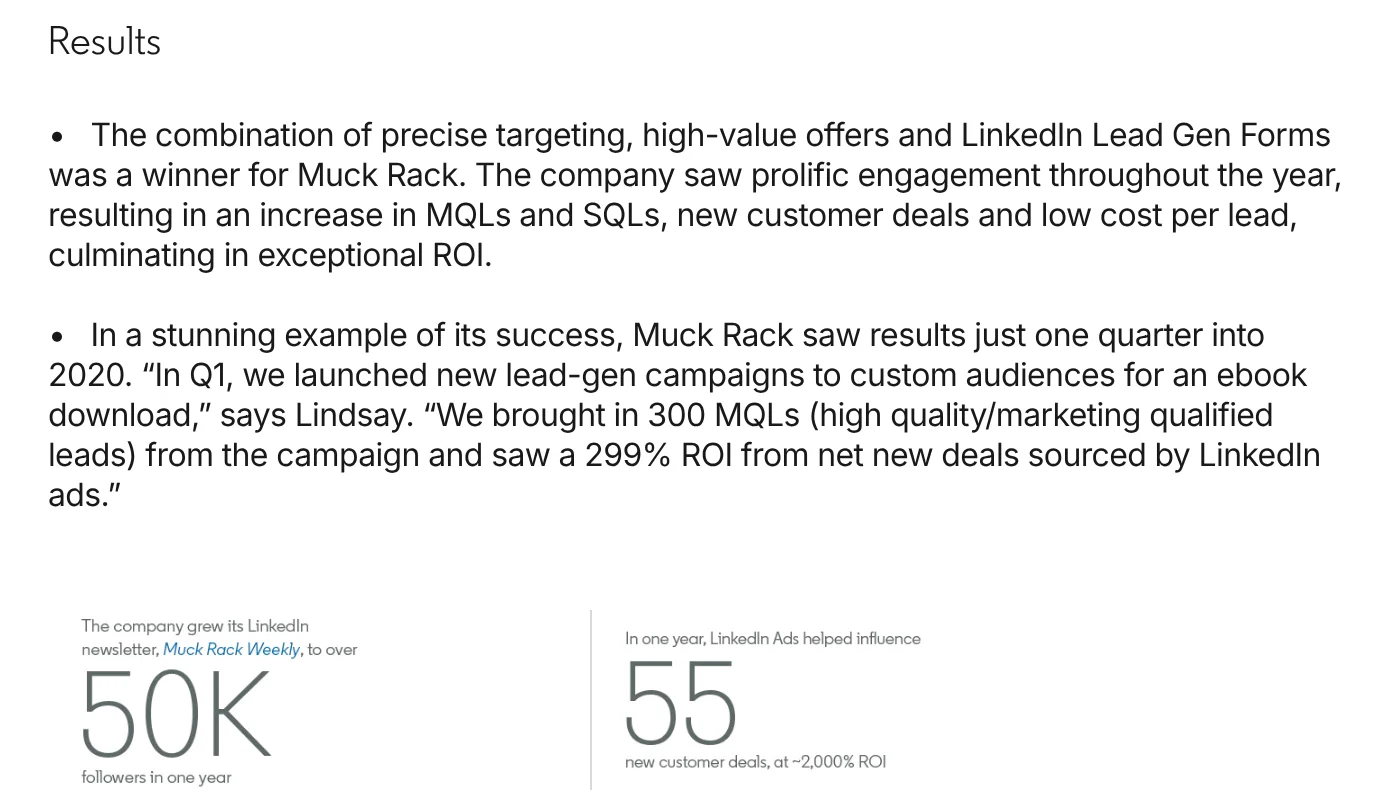
- Results: In Q1 2020 one ebook campaign brought 300 MQLs and a 299% ROI from new deals. Over the year, LinkedIn ads helped influence 55 new customer deals at about 2,000% ROI, and the newsletter passed 50,000 followers (LinkedIn customer story, July 2021).
- What to copy: Run one survey of your buyers a year and cut it into a report, a newsletter issue and a few posts each quarter.
10. Adobe: ABM with marketers and sellers on the same accounts
- What they did: Adobe Experience Cloud's sales and marketing teams worked in silos. So it turned to LinkedIn "to connect relationship-based sales activity with our broader marketing efforts," said Matt Rozen, Director of Enterprise Editorial and Social Media. Ads reached whole buying committees, and sellers worked the same accounts in Sales Navigator.
- Why it worked: Marketing stayed on the account after a lead went to sales. Megan Ybarra, Head of Enterprise Digital Marketing, described the aim as "getting our message to the account and to all people in the buying committee."
- Results: In 2018, 42% of Adobe's closed won deals were influenced by marketing on LinkedIn and 55% by sales using Sales Navigator. Deals influenced by LinkedIn were 161% bigger on average (LinkedIn customer story, January 2020).
- What to copy: Give marketing and sales one shared account list and one message per account. Our guide to LinkedIn ABM for B2B SaaS covers the setup.
11. Zendesk: enterprise sellers trained on Sales Navigator
- What they did: When the pandemic stopped travel, Zendesk's enterprise sellers had to sell online. The enablement team trained them to research each account on LinkedIn before every meeting.
- Why it worked: Sellers showed up with questions written for that customer. Zendesk already had Sales Navigator, and the training got reps to use it.
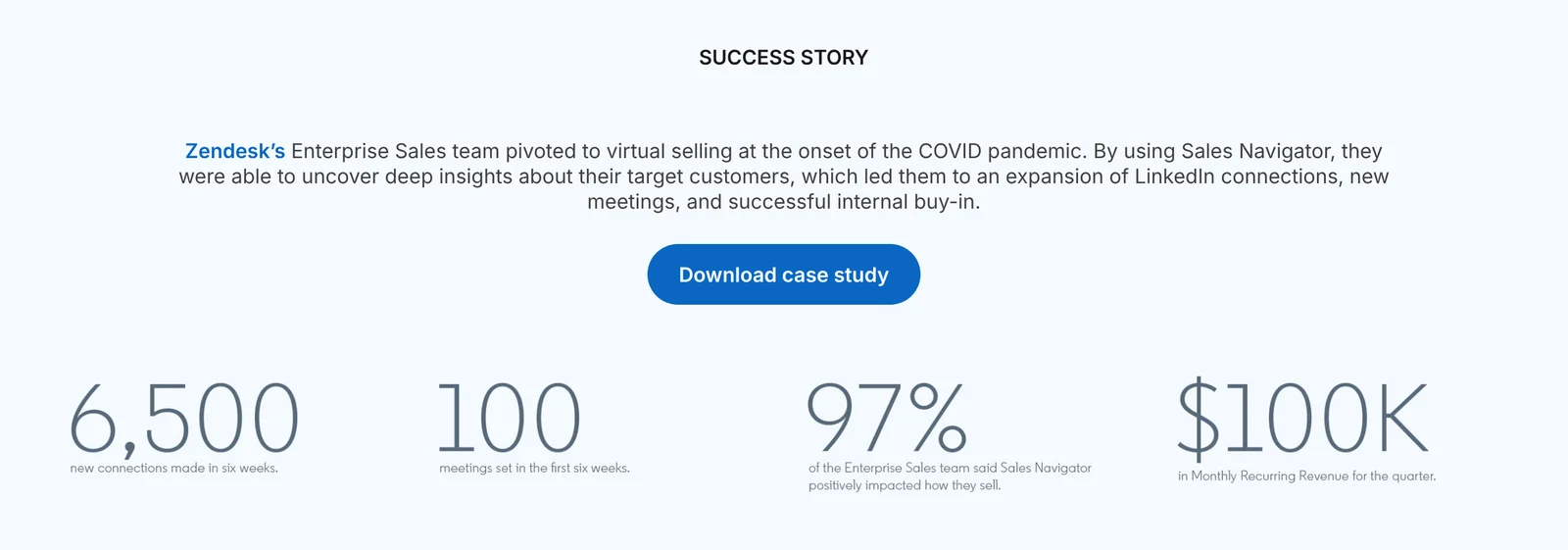
- Results: "6500 new connections that we made via LinkedIn Sales Navigator netted out to 100 qualified meetings, which helped produce over 100K of MRR in that particular quarter," said Marilee Bear, SVP of North America Enterprise Sales. 97% of the enterprise team said Sales Navigator improved how they sell (LinkedIn customer story, December 2022).
- What to copy: Before you add more ads, train your sellers to research every contact on your account list.
12. Webflow: Conversation Ads and Lead Gen Forms tied to sales
- What they did: Webflow grew on self serve signups, then built an enterprise product and hired Aubrey Morgan as its first enterprise marketing leader. Her team tested personas and offered content downloads in place of contact sales forms. It used Sponsored Content, Lead Gen Forms and Conversation Ads, and its sellers used Sales Navigator for outreach that matched the ads.
- Why it worked: The team tested before it spent big. Marketers turned out to be the best audience, and UI and UX designers were another strong one.
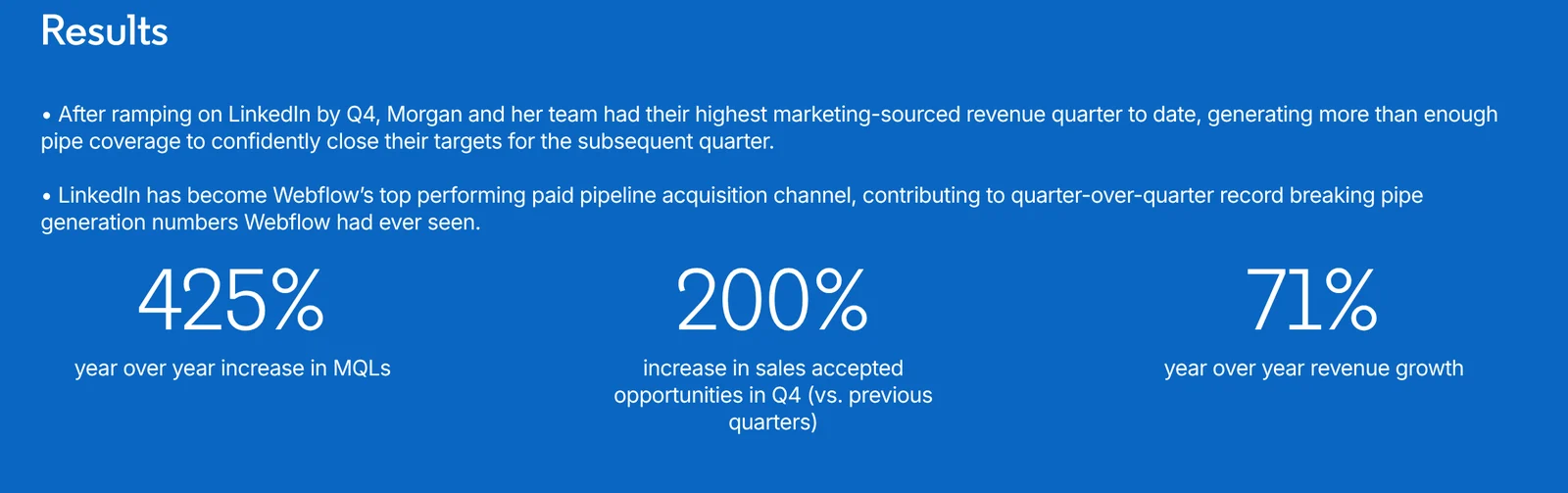
- Results: After ramping up by Q4, Webflow's MQLs rose 425% year over year. Sales accepted opportunities in Q4 rose 200% against earlier quarters (LinkedIn customer story, June 2023).
- What to copy: Test three personas for a month at low spend, then move the budget to the one that books meetings.
LinkedIn campaign types compared
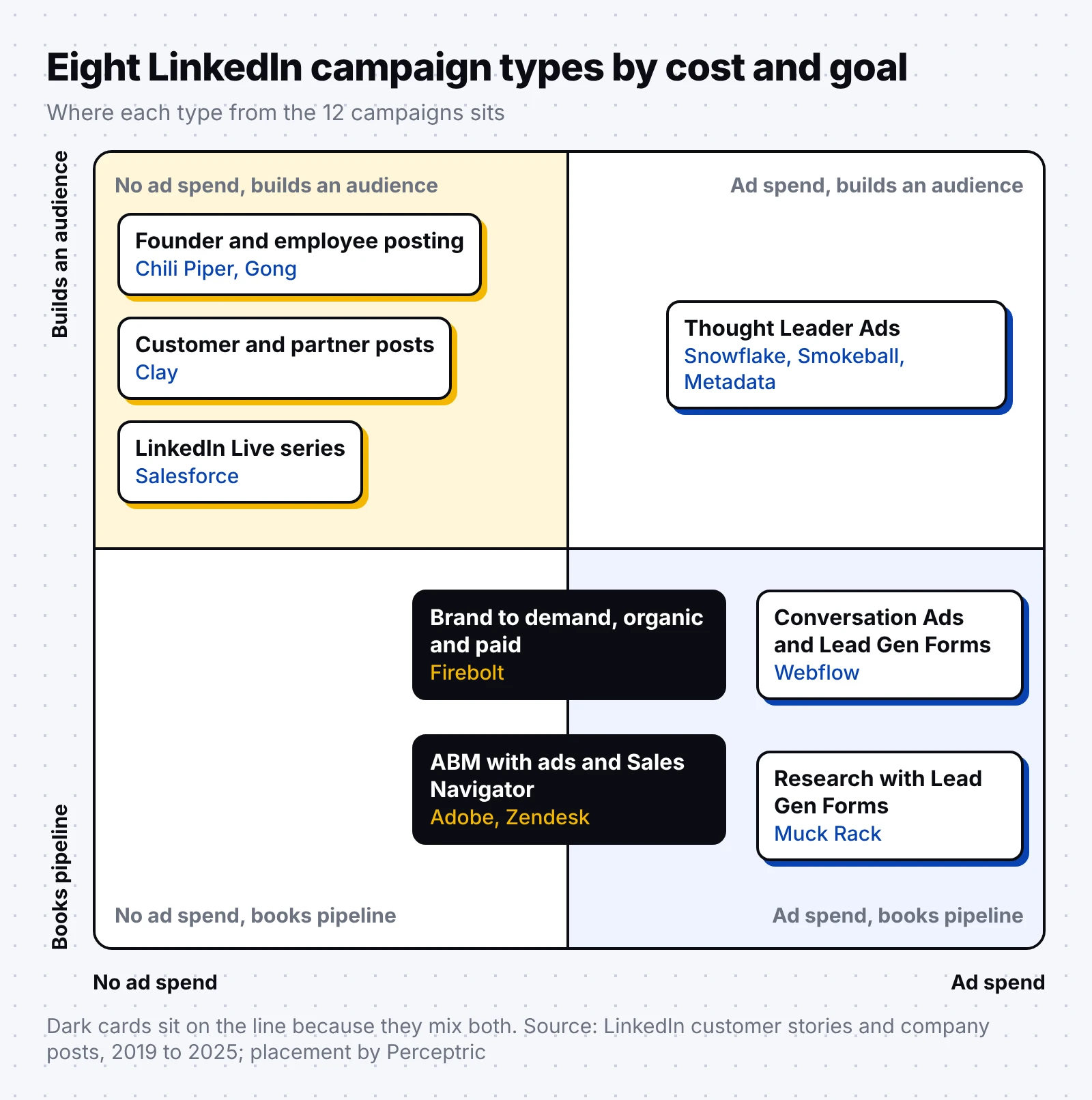
The 12 campaigns use eight types. We list a budget only where a source states one.
| Campaign type | Goal | Budget | Best stage |
|---|---|---|---|
| Thought Leader Ads from employees, speakers or customers | Clicks and signups from a target audience | From $10 a day, LinkedIn's minimum. Metadata tested with 1% of its budget | You have an account list and a trusted voice |
| Founder and employee posting | Reach and influenced pipeline | No ad spend. The cost is time or a writer | Any stage, starting now |
| Customer and partner posts | Discovery through other people's networks | No ad spend | Power users or agencies who gain from posting |
| Brand to demand, always on | A higher lead to meeting rate | Not published | A challenger few buyers know yet |
| LinkedIn Live series | An audience before an event | No ad spend in Salesforce's case | A large page or a flagship event |
| Research with Lead Gen Forms | MQLs and deals | From $10 a day | You own data buyers want |
| ABM with Sales Navigator | Bigger deals and more won deals on target accounts | Not published | Enterprise accounts with a buying committee |
| Conversation Ads and Lead Gen Forms | Sales meetings with new personas | From $10 a day | Moving from self serve to a sales team |
Source: LinkedIn, November 2026 (minimum budget); Metadata, September 2023
Thought Leader Ads can promote posts from "LinkedIn members, creators, or employees of your company," including video and newsletter posts (LinkedIn Help, November 2026). Snowflake and Smokeball used them on employee and customer posts, and Metadata on three employee posts.
How to plan your own LinkedIn campaign
Write the plan on one page before you spend anything. Each row in the brief below maps to a decision one of the 12 companies made.
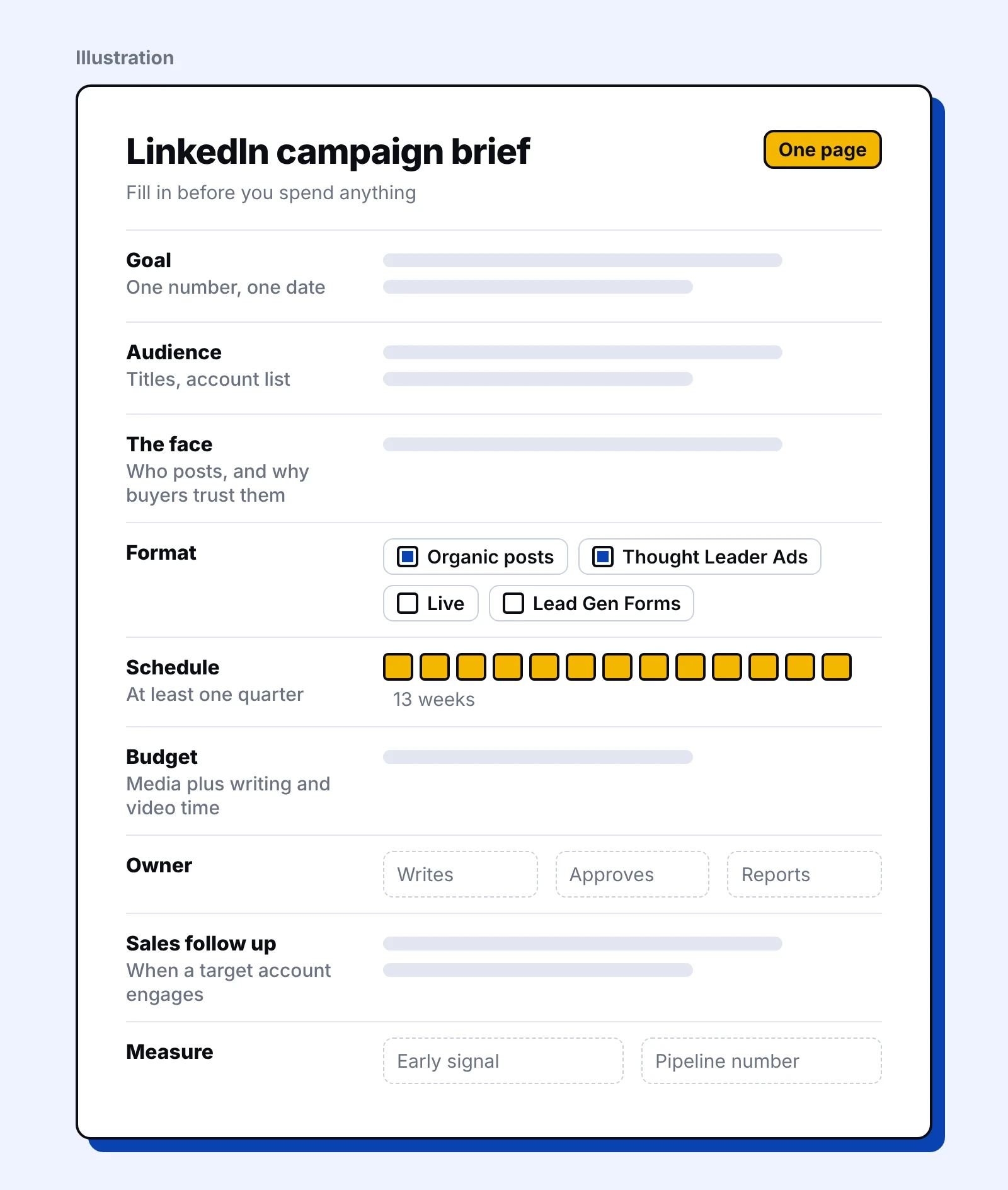
| Field | What to write | Example from this list |
|---|---|---|
| Goal | One number and the date you'll judge it | Lead to meeting rate from 2% to 12% in four months (Firebolt) |
| Audience | Job titles and a named account list | 40 target accounts for Dev Day (Snowflake) |
| The face | The one person who posts and why buyers trust them | A developer advocate for developers (Snowflake) |
| Format | Organic posts, Thought Leader Ads, Live, Lead Gen Forms or a mix | Customer clips promoted as Thought Leader Ads (Smokeball) |
| Schedule | Posting days and a run of at least one quarter | Each Tuesday at 11:00 AM (Salesforce) |
| Budget | Media spend plus writing and video time | A 1% test before a bigger spend (Metadata) |
| Owner | Who writes, who approves and who reports | An enablement team that trained the sellers (Zendesk) |
| Sales follow up | What sellers do when a target account engages | Sales Navigator outreach with the same message (Webflow) |
| Measure | One early signal and one pipeline number | Influenced deals on a shared account list (Adobe) |
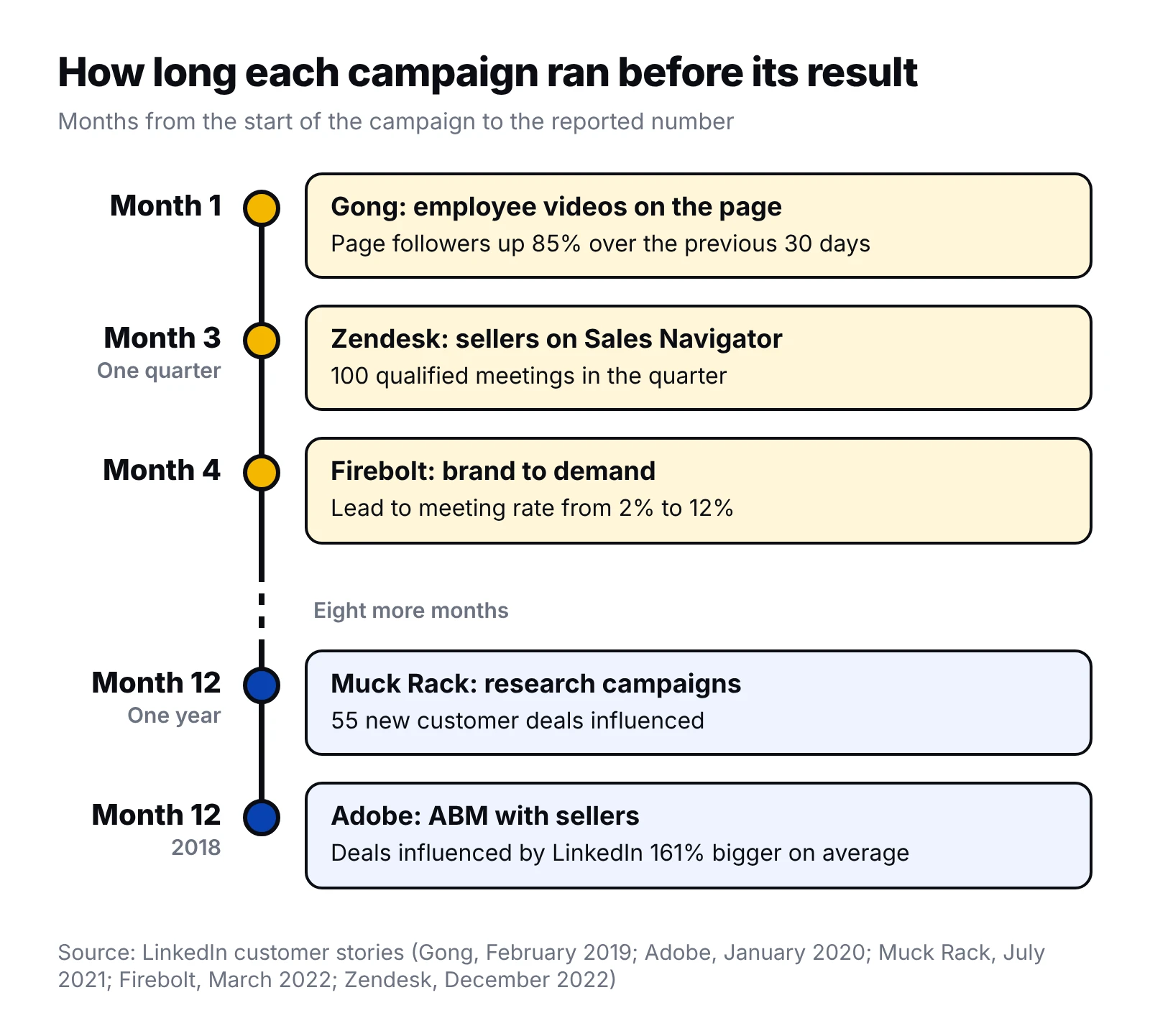
Give the schedule row the most thought. Gong's page result came after a month, but Firebolt took four months and Muck Rack's best numbers took a year.
A schedule also needs an owner. Our post on B2B SaaS marketing team structure covers who should own LinkedIn, and the LinkedIn marketing guide for B2B SaaS shows where a campaign fits in the full channel plan.
FAQ
What are the best SaaS marketing campaigns on LinkedIn?
The best ones put a person in the feed and run for months. Snowflake promoted a developer advocate's post, Smokeball promoted customer videos and Chili Piper built a founder and employee creator program.
What is a LinkedIn B2B campaign?
A LinkedIn B2B campaign is a set run of posts, ads or live video aimed at one business audience with one goal and an end date. It can be organic, paid or both.
How long should a LinkedIn campaign run?
Plan for at least one quarter. Firebolt's lead to meeting rate went from 2% to 12% in four months, and Muck Rack's 55 influenced deals came over a full year.
How much does a LinkedIn campaign cost?
LinkedIn's minimum is $10 a day for any ad format, and $100 as a lifetime budget for a new campaign. Organic founder and employee posting has no media cost, but it needs time or a writer.
Do Thought Leader Ads work for B2B SaaS?
In the published cases they beat the comparison. Snowflake's reached 2.7x the CTR of its Single Image Ads, and Metadata's reached 2.5x the CTR of benchmarks.
A good first step is to pick the one person your buyers already trust and fill in the brief above for a 90 day run. If that person is your founder and the writing is what stalls, our LinkedIn thought leadership service needs 30 minutes a week of their time. You talk, we write.