
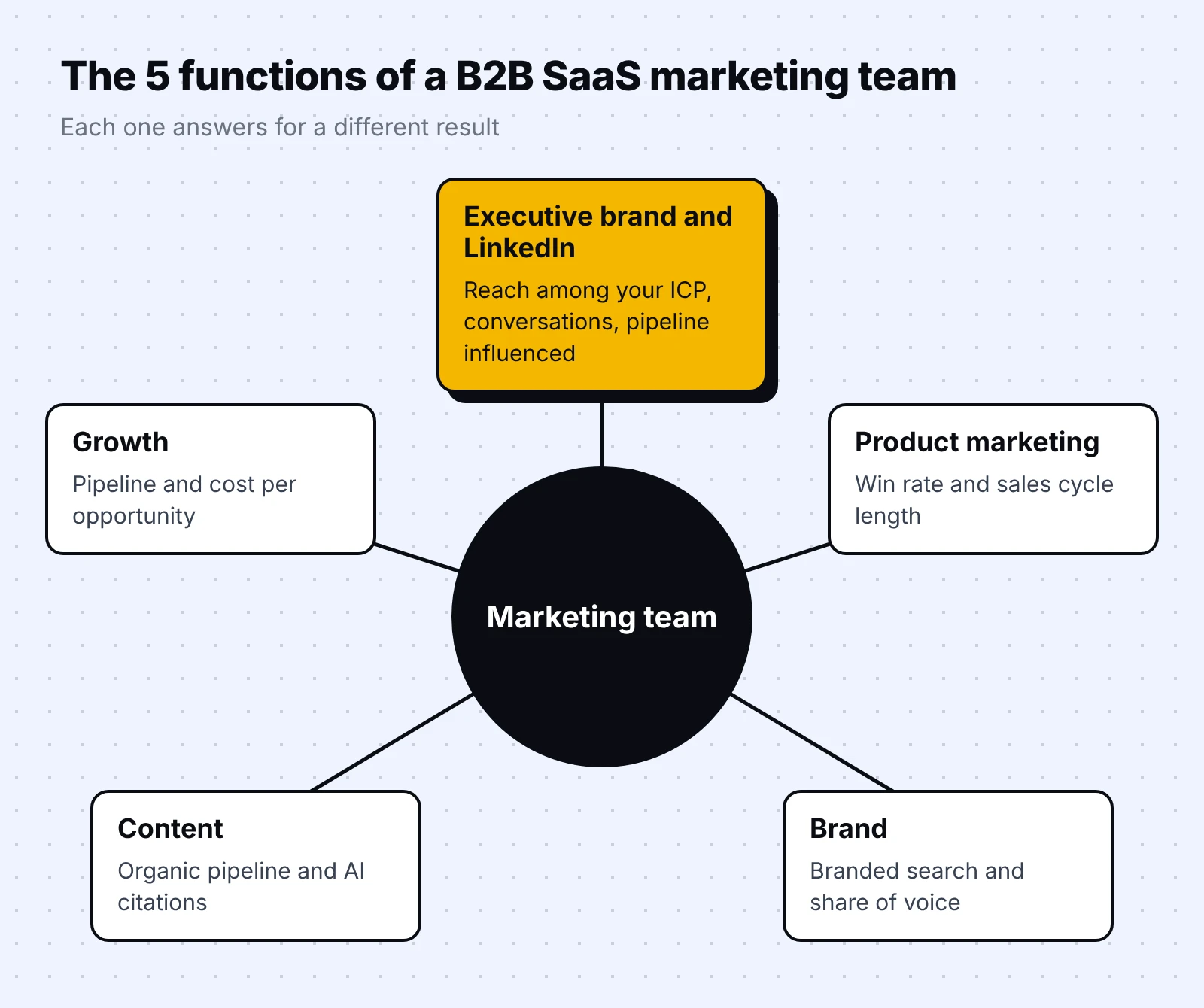
A SaaS marketing team structure is how you split marketing work into roles, who reports to whom and who owns each channel. For a B2B SaaS company it covers five functions: growth, product marketing, content and brand, plus executive LinkedIn.
Below are the org charts we recommend at seed, Series A, Series B and Series C, with the LinkedIn owner named at each stage. You'll also get a RACI for executive posts, the cost of staff, freelance and agency writers, and a job description for your first LinkedIn hire.
Start with your own org chart. The blog has an owner and the company page has an admin. Now look for the name next to your CEO's LinkedIn profile.
If there isn't one, executive LinkedIn is an orphan channel. It gets written when the CEO has a free evening and stops when the quarter gets busy. Give it what every other channel already has: a named owner, a writer and an approval loop.
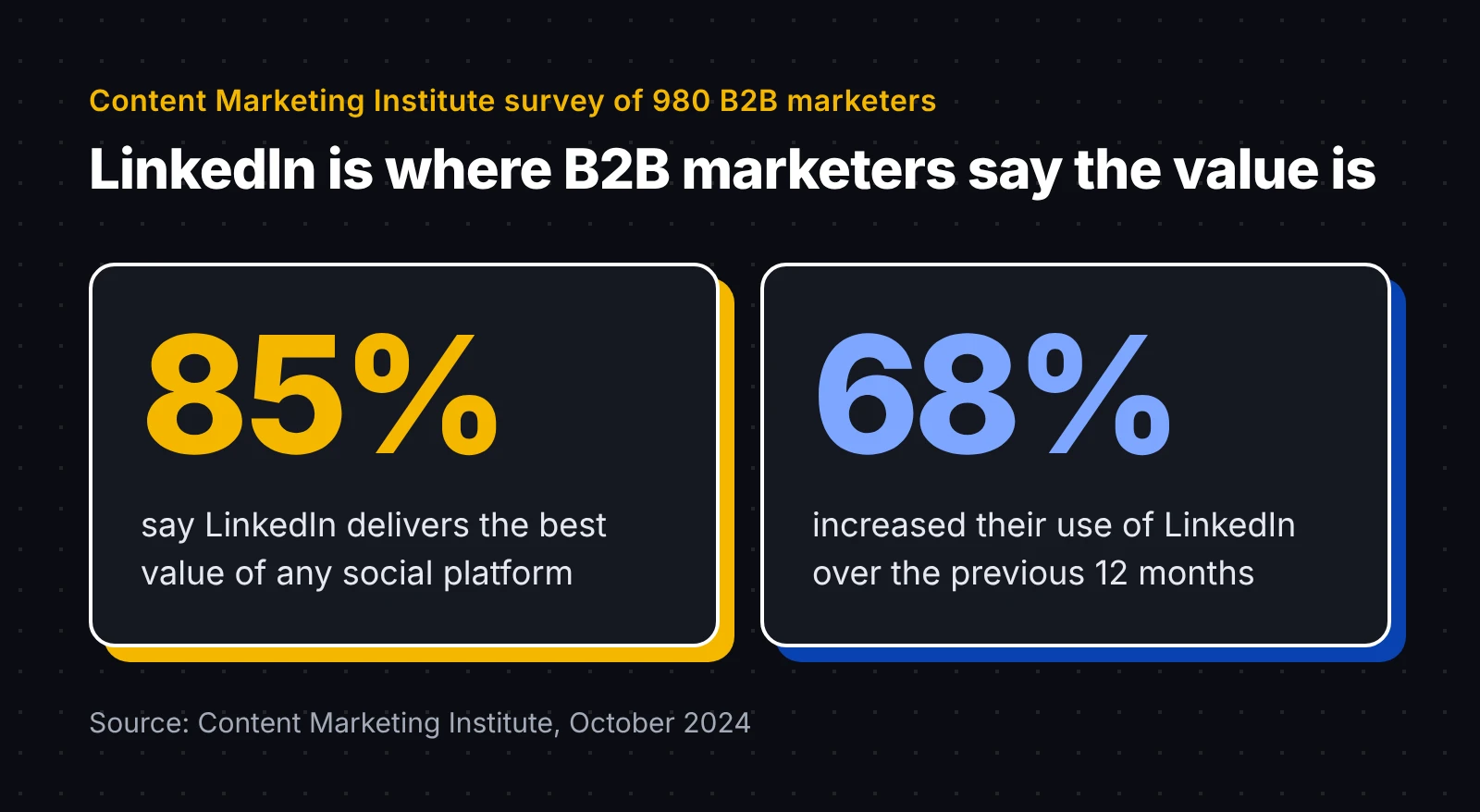
The gap matters because LinkedIn is where B2B marketers say the value is. In the Content Marketing Institute (CMI) survey of 980 B2B marketers, published October 2024, 85% said LinkedIn delivers the best value of any social platform. And 68% had increased their use of it over the previous 12 months.
The 5 functions of a B2B SaaS marketing team
Every B2B SaaS marketing team, from 1 person to 50, does the same 5 jobs. Early on, one person covers several. Later, each one gets its own lead.
| Function | What it owns | What it answers for | Usual first hire |
|---|---|---|---|
| Growth | Paid search, paid social, marketing ops, lead routing | Pipeline and cost per opportunity | Demand gen marketer |
| Product marketing | Positioning, messaging, launches, sales enablement, comparison pages | Win rate and sales cycle length | Product marketing manager |
| Content | Blog, SEO and AI search content, case studies, newsletter | Organic pipeline and AI citations | Content marketer |
| Brand | Visual identity, website design, events, PR | Branded search and share of voice | Designer on contract |
| Executive brand and LinkedIn | Founder and executive profiles, ghostwriting, comments, posts to sponsor | Reach among your ICP, conversations and pipeline influenced | Ghostwriter on contract, then an executive comms lead |
The fifth function earns its own row because buyers make up their minds before your sales team hears from them. In 6sense's 2025 buyer research, 94% of buyers ranked their vendor shortlist before speaking with sales, and nearly 80% bought from their first choice.
Executive posts reach buyers while that shortlist forms. The LinkedIn B2B Institute makes a related case in John Dawes's 95-5 rule: "The majority of your customers are out-market at any given time." Weekly posts from your CEO keep you in front of the 95% who aren't buying yet.
Executive LinkedIn sits with brand and comms once you have that team, and with the Head of Marketing before then. Growth runs the paid side. Our LinkedIn marketing guide for B2B SaaS covers what each side runs. Those posts also shape how AI answers describe your company, which we cover in AI brand mentions from LinkedIn thought leadership.
SaaS marketing team structure by stage
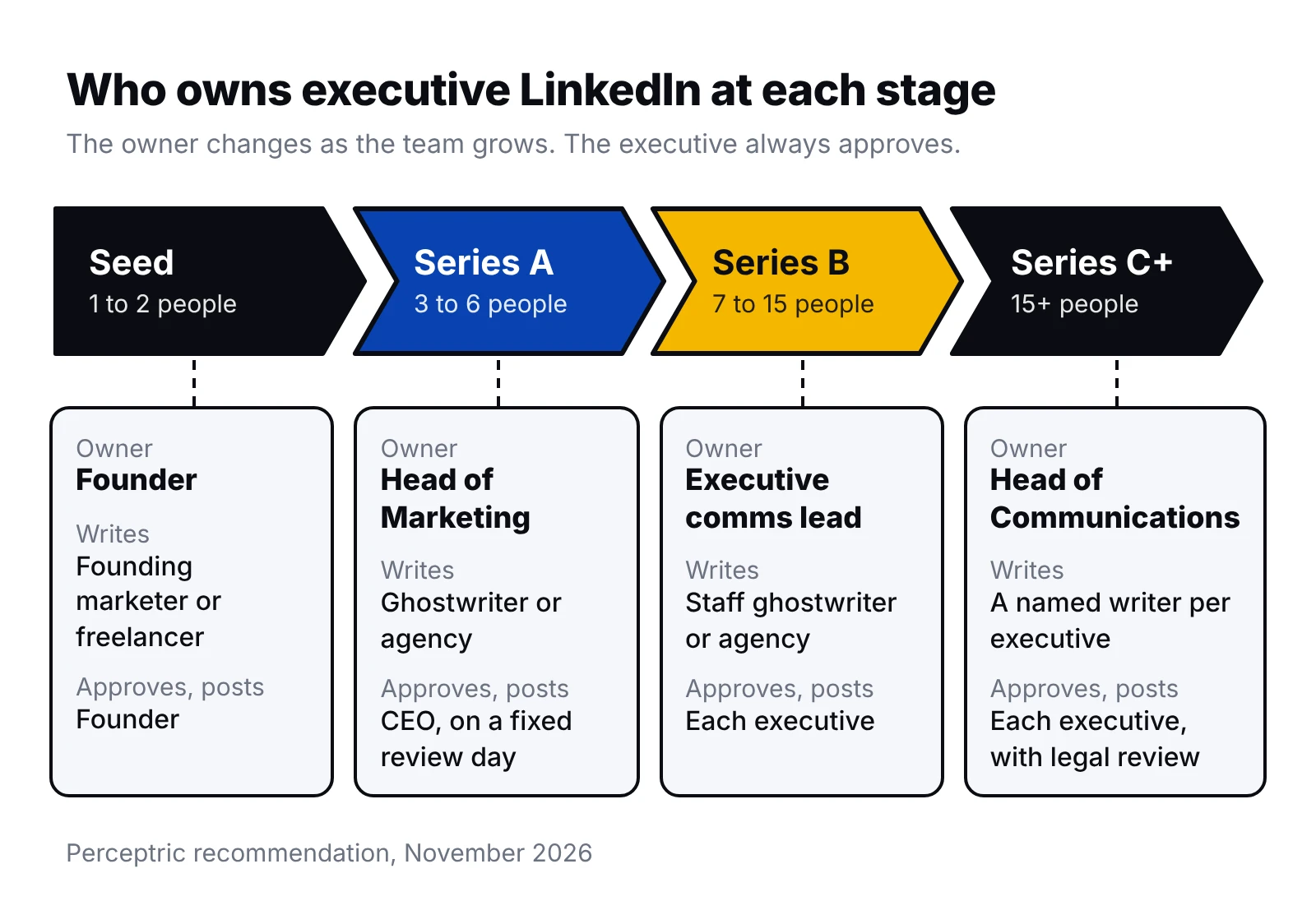
The headcounts below are Perceptric's recommendation, based on what each stage has to prove. We found no public benchmark that splits SaaS marketing headcount by funding round, so treat them as a starting point. The closest outside number comes from CMI: 54% of B2B marketers with a dedicated content team said it has 2 to 5 people.
Seed (1 to 2 people)
At seed, marketing has one job: find the first channel that brings in pipeline more than once. One generalist does most of the work, and contractors fill the gaps.
- CEO or founder
- Founding marketer: paid search, website, first content, email
- Contractors: a designer, and a freelance writer or agency for LinkedIn
Who owns LinkedIn: the founder. It's their voice and their network, so nobody else can own it at this stage. The founding marketer or an outside writer drafts, and the founder approves and posts.
If the founder writes well and enjoys it, skip the writer. Keep the schedule anyway, with a set day each week to post.
Series A (3 to 6 people)
Series A money pays to repeat what worked at seed. A Head of Marketing joins and builds a small team around the channels that already bring in deals.
- Head of Marketing, reporting to the CEO
- Demand gen marketer: paid search, paid social, marketing ops
- Content marketer: SEO, blog, case studies
- Product marketing manager: positioning, launches, sales decks
- Contractors: designer, ghostwriter or LinkedIn agency
Who owns LinkedIn: the Head of Marketing, by name, with a posting target in the quarterly plan. A ghostwriter or agency writes for the CEO, and the CEO approves on a fixed review day. The demand gen marketer runs the first Thought Leader Ads tests on the posts that land best.
We keep SDRs in sales at this stage, with a seat in the LinkedIn loop, because they follow up with the people who engage.
Series B (7 to 15 people)
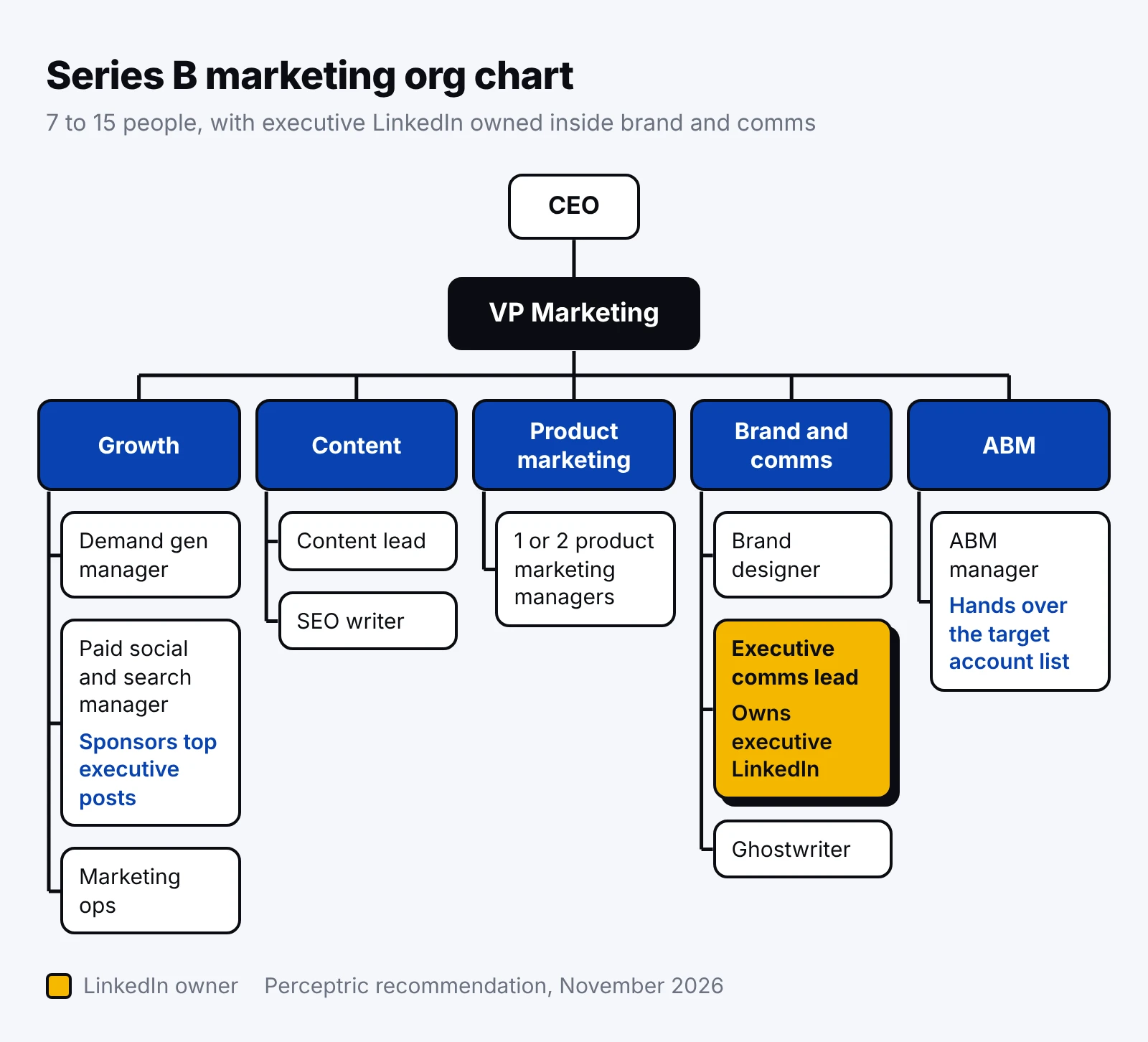
At Series B, the company adds new segments and larger accounts. Marketing splits into teams with their own leads, and named accounts get their own plays.
- VP Marketing
- Growth: demand gen manager, paid social and search manager, marketing ops
- Content: content lead, SEO writer
- Product marketing: 1 or 2 product marketing managers
- Brand and comms: brand designer, executive comms lead, ghostwriter
- ABM manager, working with sales on target accounts
Who owns LinkedIn: an executive comms lead. The program now covers the CEO plus 1 to 3 other leaders, such as the CTO or CRO. A ghostwriter on staff or an agency writes, each executive approves their own posts, and the comms lead checks brand and legal points before anything goes out.
The program also connects to growth. The paid social manager sponsors the best executive posts, and the ABM manager hands over the target account list so posts and comments reach those accounts. Our guide to LinkedIn ABM for B2B SaaS shows how that list turns into plays.
Series C and up (15+ people)
After Series C, marketing runs as several teams under a CMO. Executive LinkedIn becomes part of corporate communications, with its own small team.
- CMO
- Growth, including ABM and paid media
- Product marketing, by product line
- Content and SEO
- Brand and communications: executive comms team (lead and ghostwriters), PR, design, employee posting program
- Marketing ops and analytics
Who owns LinkedIn: the Head of Communications, through the executive comms team. Each executive has a named writer, in house or at an agency. Legal joins the approval loop for claims about customers or security. LinkedIn reporting moves into the same monthly pipeline report as every other channel.
LinkedIn and ABM roles: tasks, timing and pay
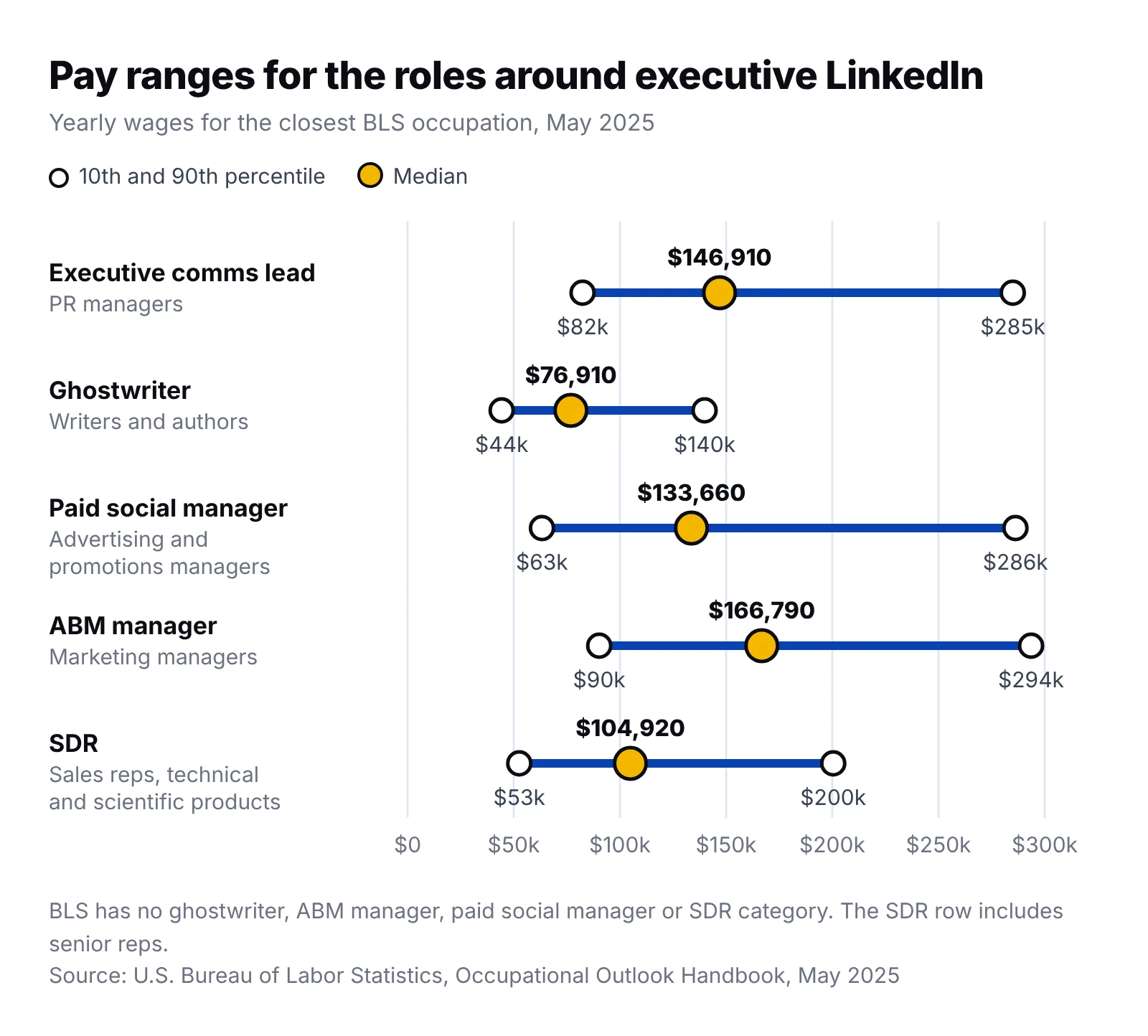
5 roles touch executive LinkedIn. Some sit in marketing and one sits in sales. The pay ranges come from the U.S. Bureau of Labor Statistics (BLS), which uses broader job groups than SaaS titles, so each row names the closest BLS occupation.
| Role | Main tasks | When to hire | Pay: median (10th to 90th percentile) |
|---|---|---|---|
| Executive comms lead | Owns the program, sets topics with each executive, runs approvals, reports results | Series B, or once 2 or more executives post | Public relations managers: $146,910 ($82,410 to $284,990) |
| Ghostwriter | Interviews executives, writes posts and newsletter issues in each executive's voice, drafts comment ideas | Series A on contract; on staff at Series B or later | Writers and authors: $76,910 ($44,310 to $139,870) |
| Paid social manager | Runs LinkedIn Ads, sponsors top executive posts, manages retargeting and budget | Part of the demand gen role at Series A; its own role at Series B | Advertising and promotions managers: $133,660 ($63,300 to $286,240) |
| ABM manager | Picks target accounts with sales, builds audiences, plans plays for each account | Series B, when sales works a named account list | Marketing managers: $166,790 ($90,260 to $293,610) |
| SDR | Follows up with ICP people who engage, books meetings, brings buyer questions back to the writer | Series A, in sales | Sales reps, technical and scientific products: $104,920 ($52,600 to $200,440) |
BLS has no SDR category. The closest group includes senior sales reps, so check that row against your own sales comp plan before you use it.
The ghostwriter is the hire that keeps posts going when the CEO's calendar fills up. Our guide to LinkedIn ghostwriting for SaaS founders covers how the interview and voice guide work.
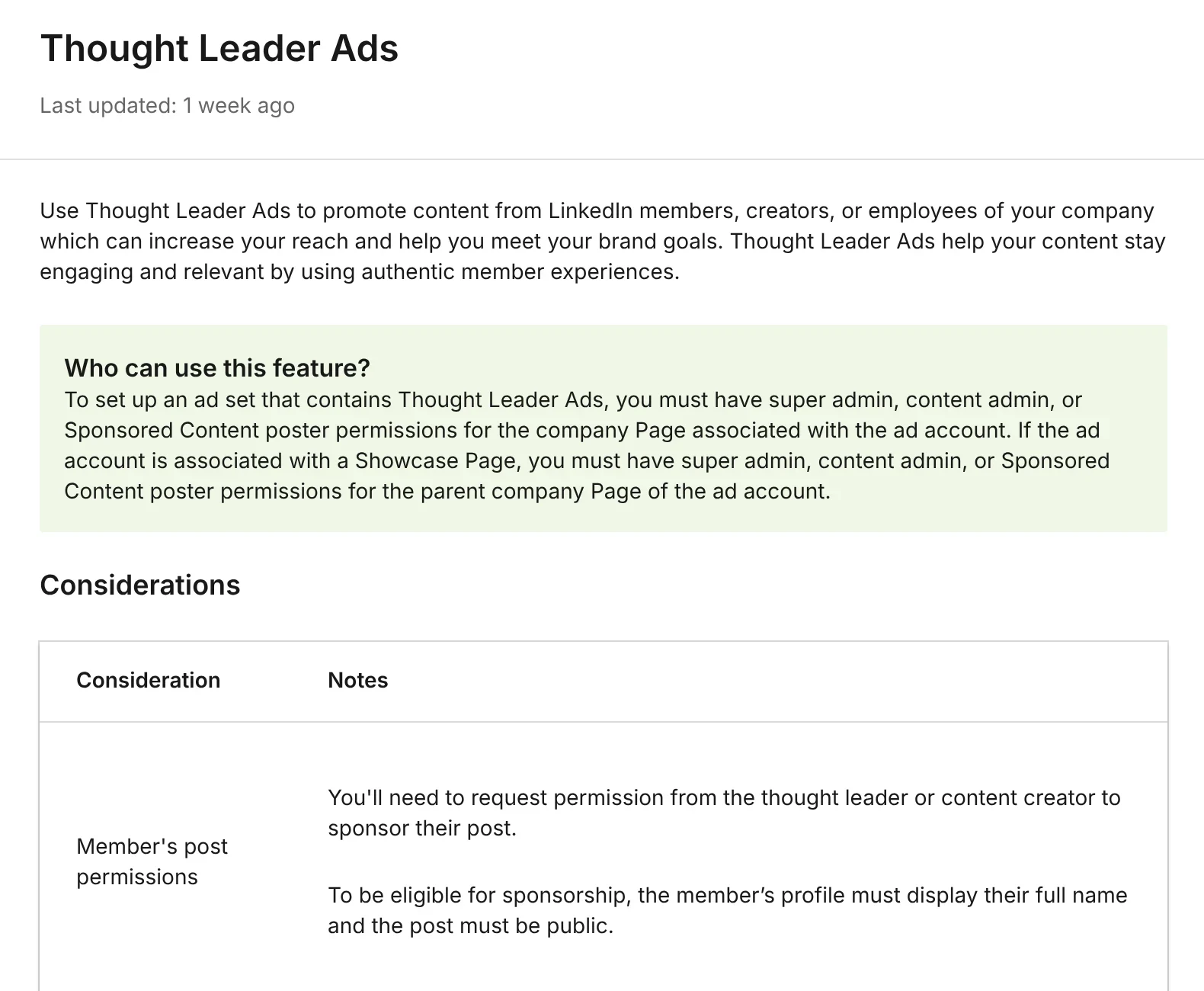
The paid social manager needs one LinkedIn feature in particular. Thought Leader Ads let a company pay to promote a post from a person's profile. LinkedIn's Help Center (read November 2026) sets these rules:
- You need the author's permission for each post you sponsor.
- The author's profile must show their full name, and the post must be public.
- Celebrations, polls and multi-image posts can't be sponsored, and neither can reposts.
- The person setting up the ad needs super admin, content admin or Sponsored Content poster rights on the company Page.
So the paid social manager and the LinkedIn owner have to agree each week on which posts to put money behind. For campaign ideas, see our roundup of B2B SaaS marketing campaigns on LinkedIn.
Who does what on LinkedIn: a RACI for executive posts
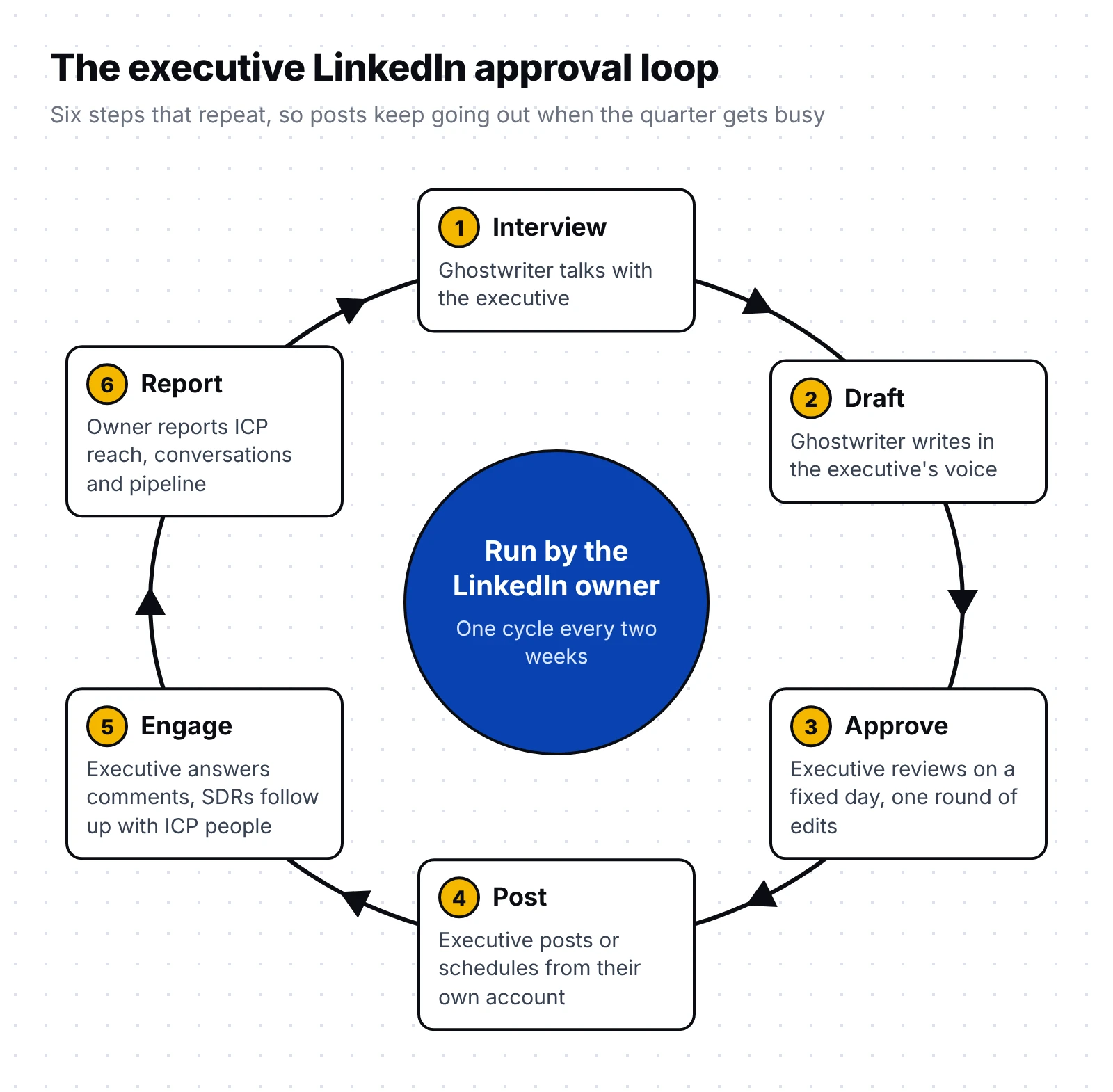
A RACI chart gives every task 4 kinds of people. R is responsible and does the work. A is accountable and has the final say, and there is only one A per task. C is consulted before, and I is informed after.
| Task | Executive | LinkedIn owner | Ghostwriter | Paid social and ABM | Sales and SDRs |
|---|---|---|---|---|---|
| Write | C | A | R | I | C |
| Approve | A | R | C | I | I |
| Post | A, R | C | I | I | I |
| Engage | R | A | C | I | R |
| Report | I | A | C | R | C |
Writing starts with the executive. The ghostwriter interviews them, drafts the posts and checks topics with sales, who hear buyer questions every day. Our post on how your sales team can inform content strategy shows how to collect those questions.
Approval is where a program stalls if nobody runs it. The executive has the final word, but the LinkedIn owner runs the loop: a fixed review slot, a deadline and one round of edits. One of our clients, a fintech founder, described the result this way: "I used to dread the blank page every week. Now I just approve drafts that already sound like me, and our inbound has never been healthier."
Posting belongs to the executive alone. LinkedIn's User Agreement (effective November 3, 2025) says "You will not share your account with anyone else," and its list of don'ts includes "sharing log-in credentials." The ghostwriter never holds the password.
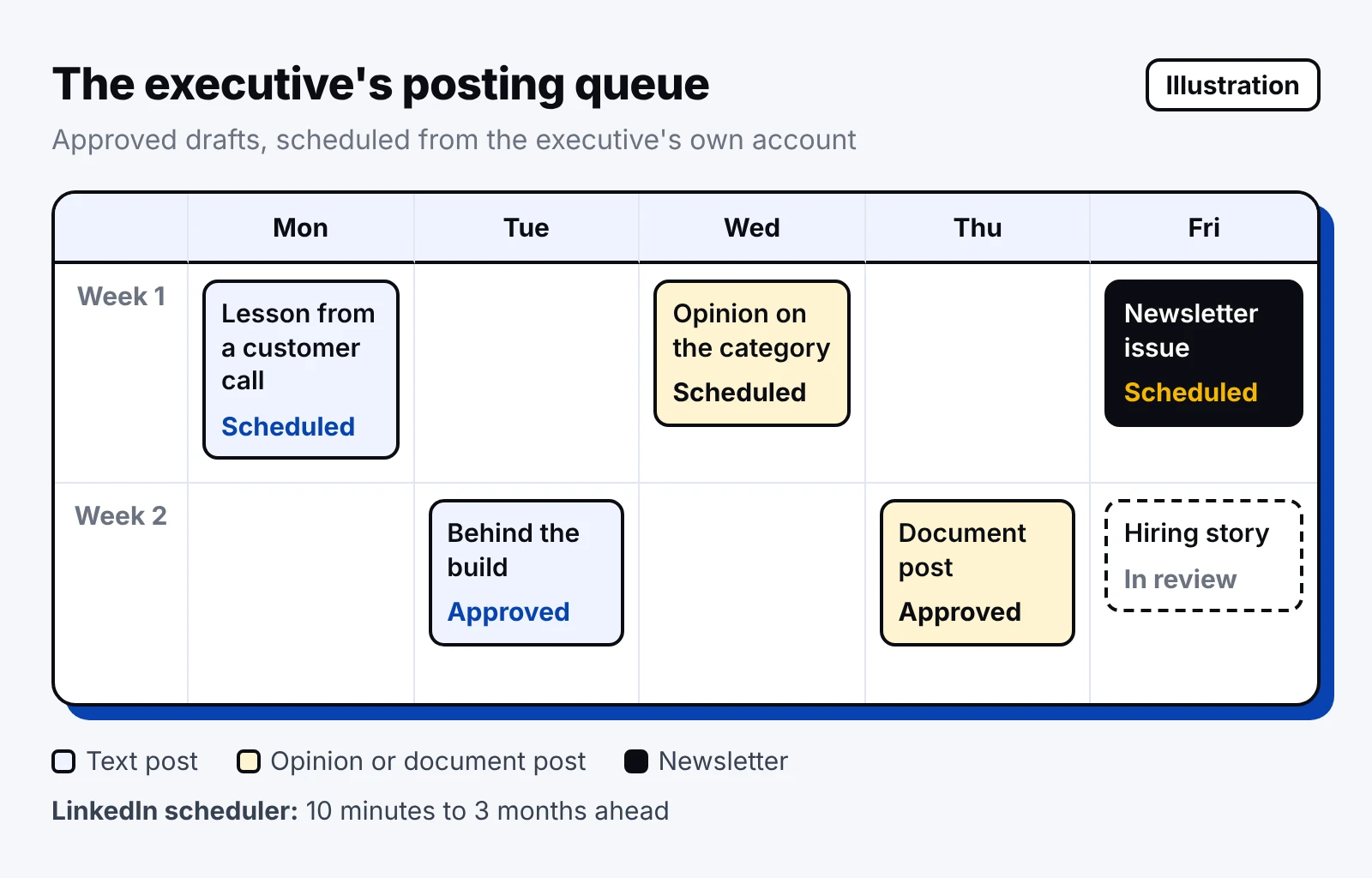
That still leaves room for a schedule. LinkedIn's own scheduler takes a post between 10 minutes and 3 months ahead, and LinkedIn lists Buffer, Hootsuite, Sprout Social and Sprinklr as partners that work with personal profiles. The executive connects the tool to their own account and the queue fills from the approved drafts.
Engagement has 2 owners. The executive answers comments on their own posts. SDRs look at who engaged, pick out the people who fit your ICP and follow up with something useful, which is how a post turns into a meeting.
Reporting belongs to the LinkedIn owner, with numbers from paid social and the CRM. Report reach among ICP accounts, conversations started and pipeline the posts touched. Likes come last.
In-house vs freelancer vs agency: cost and fit
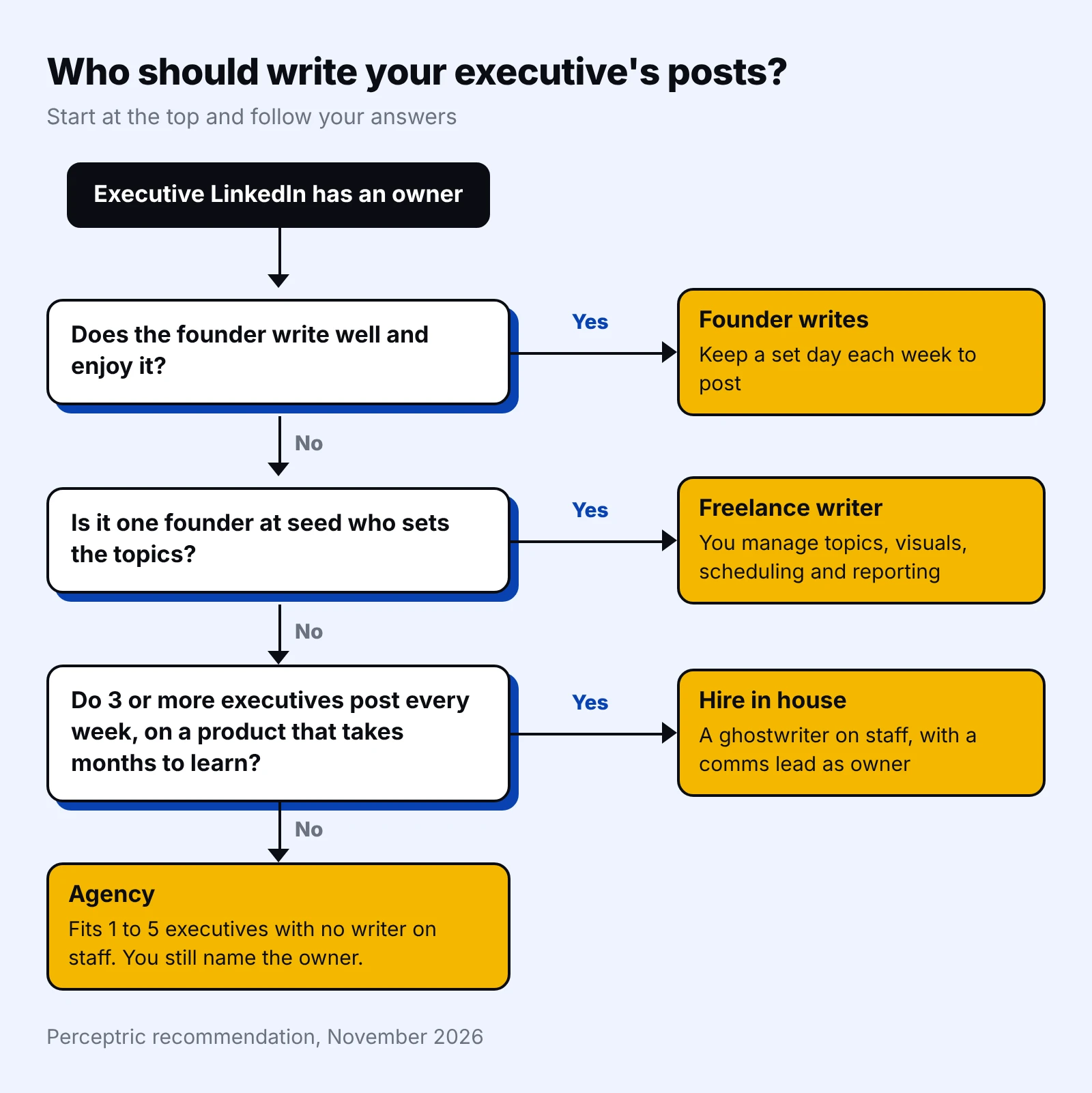
Once LinkedIn has an owner, the next decision is who writes. You can hire a writer on staff, use a freelancer or pay an agency.
| Option | What it costs | Best fit | Watch for |
|---|---|---|---|
| Ghostwriter on staff | Writers and authors earn a median $76,910 a year (BLS, May 2025) | Series B and up, 3 or more executives posting, a technical product | One person carries the program; you still need design and strategy |
| Executive comms lead on staff | Public relations managers earn a median $146,910 a year (BLS, May 2025) | Series B and up, as the owner of the program | Usually manages writers, so budget for them too |
| Freelance writer | No public benchmark we trust; quotes come per post or per month | Seed, one founder who sets the topics | You manage topics, visuals, scheduling and reporting yourself |
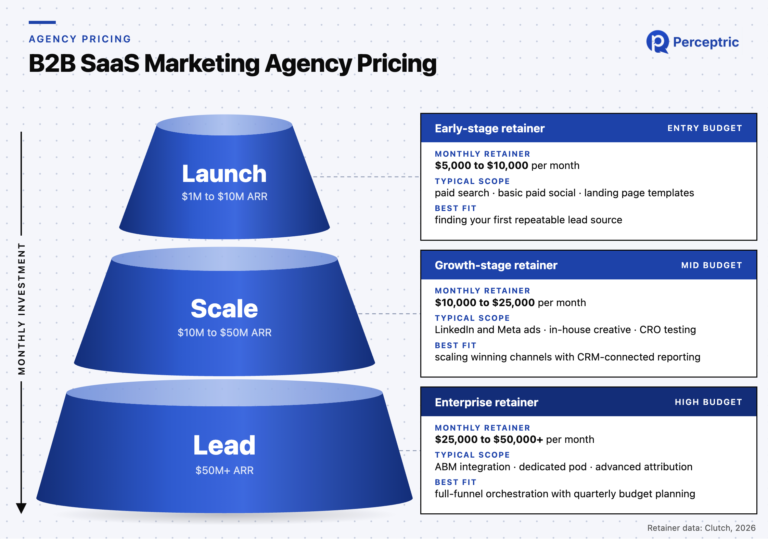
| Agency | Perceptric: $2,500, $3,000 or $5,000 per profile per month on a 12-month term. Clutch: digital marketing retainers of $5,000 to $50,000 a month | Series A to C, 1 to 5 executives, no writer on staff yet | The agency writes, but you still name the owner |
Run the yearly numbers before you decide. Our three LinkedIn plans come to $30,000, $36,000 and $60,000 a year per profile. For one executive on any plan, or two on Presence or Momentum, the agency fee comes in under the median writer wage of $76,910.
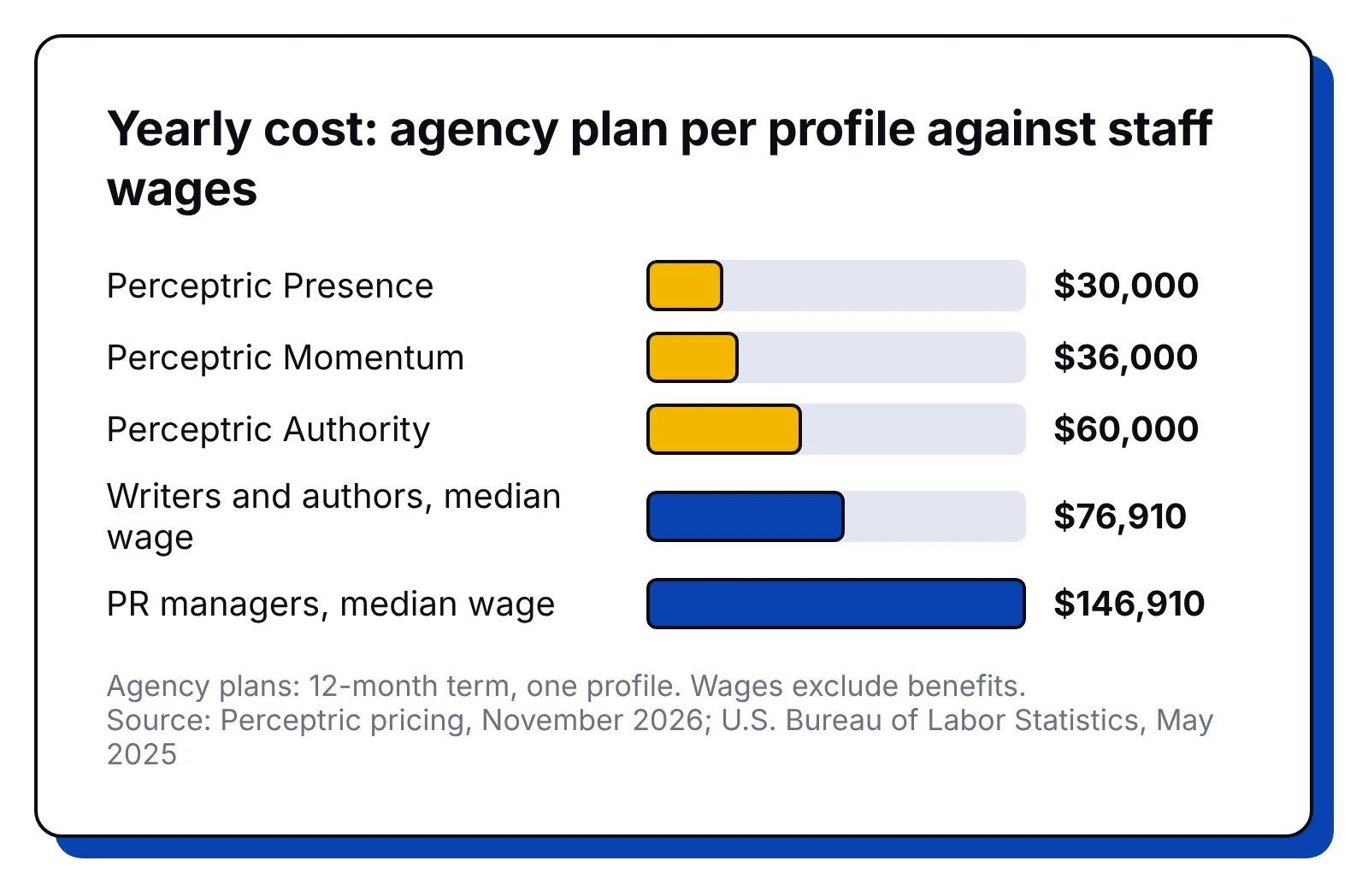
Those BLS figures are wages. Benefits and your own management time come on top, and a staff writer still needs a designer and an editor. Our plans include a content strategist, ghostwriter, graphic designer and editor, and the executive spends under five hours a month on it.
For comparison, Clutch's pricing guide (updated September 21, 2026) lists social media and content marketing work at $100 to $149 an hour. Our guide to B2B SaaS marketing agency pricing breaks costs down by stage, and our list of the best B2B SaaS marketing agencies helps you build a shortlist.
Hire in house once 3 or more executives post every week and the product takes months to learn. The case against an agency is that its writers know your product less well than a staff writer does after a year. The case against hiring first is that one writer can't also cover strategy and design for several executives.
How to hire your first LinkedIn marketer
Your first LinkedIn hire owns the program. They write some of it, but their main job is keeping it on schedule. Use this outline for the job description.
| Section | What to write |
|---|---|
| Title | Executive Communications Manager or LinkedIn Content Lead |
| Reports to | Head of Marketing at Series A; VP Marketing or Head of Communications later |
| Owns | LinkedIn for the CEO and up to 3 other executives: topics, calendar, approvals and reporting |
| Does each week | Interviews executives, writes or edits posts, manages a ghostwriter or agency, picks posts to sponsor with paid social, sends engager lists to SDRs |
| First 90 days | A voice guide for each executive, a posting schedule that holds for 8 weeks in a row, the first monthly report |
| Measured by | Posts shipped against plan, reach among ICP accounts, conversations and meetings started, pipeline influenced |
| Must have | Published work written in someone else's voice, B2B SaaS experience, the nerve to chase a CEO for a review |
Then ask these 5 questions in the interview:
- Show me a post you wrote for someone else. What changed after their first review?
- Our CEO has 30 minutes every two weeks. How do you plan a month of posts from that?
- A post got 40,000 impressions and no comments from our ICP. What do you report, and what do you change?
- The CEO wants to post about a competitor's outage. Walk me through your call.
- How would you pass people who engage with our posts to SDRs without it reading as a cold pitch?
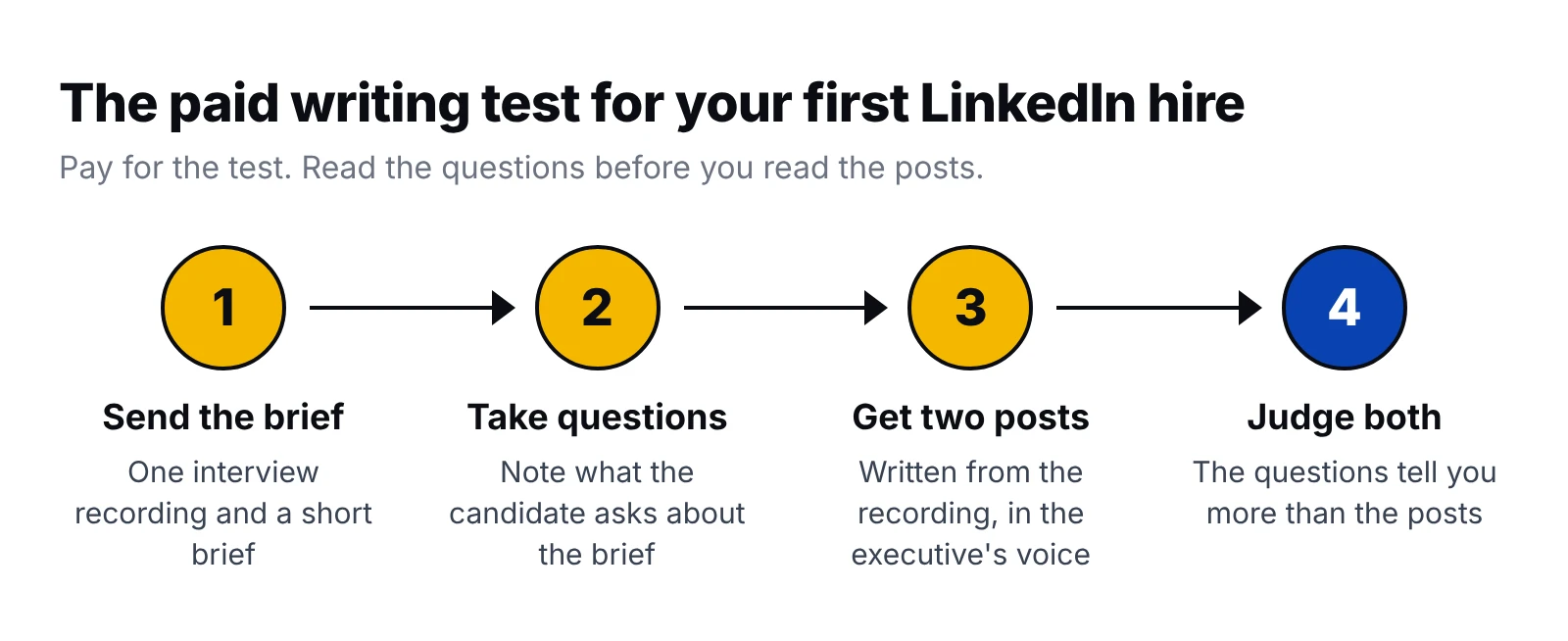
Add a paid writing test. Send one interview recording and a short brief, and ask for two posts back. You'll learn more from the questions they ask about the brief than from the posts.
Marketing tool stack by stage
Tools should follow the team, so buy them when the role that uses them arrives. Prices change often, so check each vendor's page before you budget.
| Stage | CRM and analytics | Content and AI search | ABM and sales | |
|---|---|---|---|---|
| Seed | HubSpot free tools, GA4, Search Console | LinkedIn's own scheduler | Google Docs and a voice guide | None yet |
| Series A | HubSpot | Campaign Manager for Thought Leader Ads; Buffer or Hootsuite | An SEO tool; Arrowsterr for AI visibility | Sales Navigator for SDRs |
| Series B | HubSpot or Salesforce | Sprout Social; Campaign Manager | An SEO tool; Arrowsterr | 6sense or Demandbase |
| Series C and up | Salesforce and a data warehouse | Sprinklr or Sprout Social | SEO and AI visibility tools, by team | 6sense or Demandbase, plus attribution |
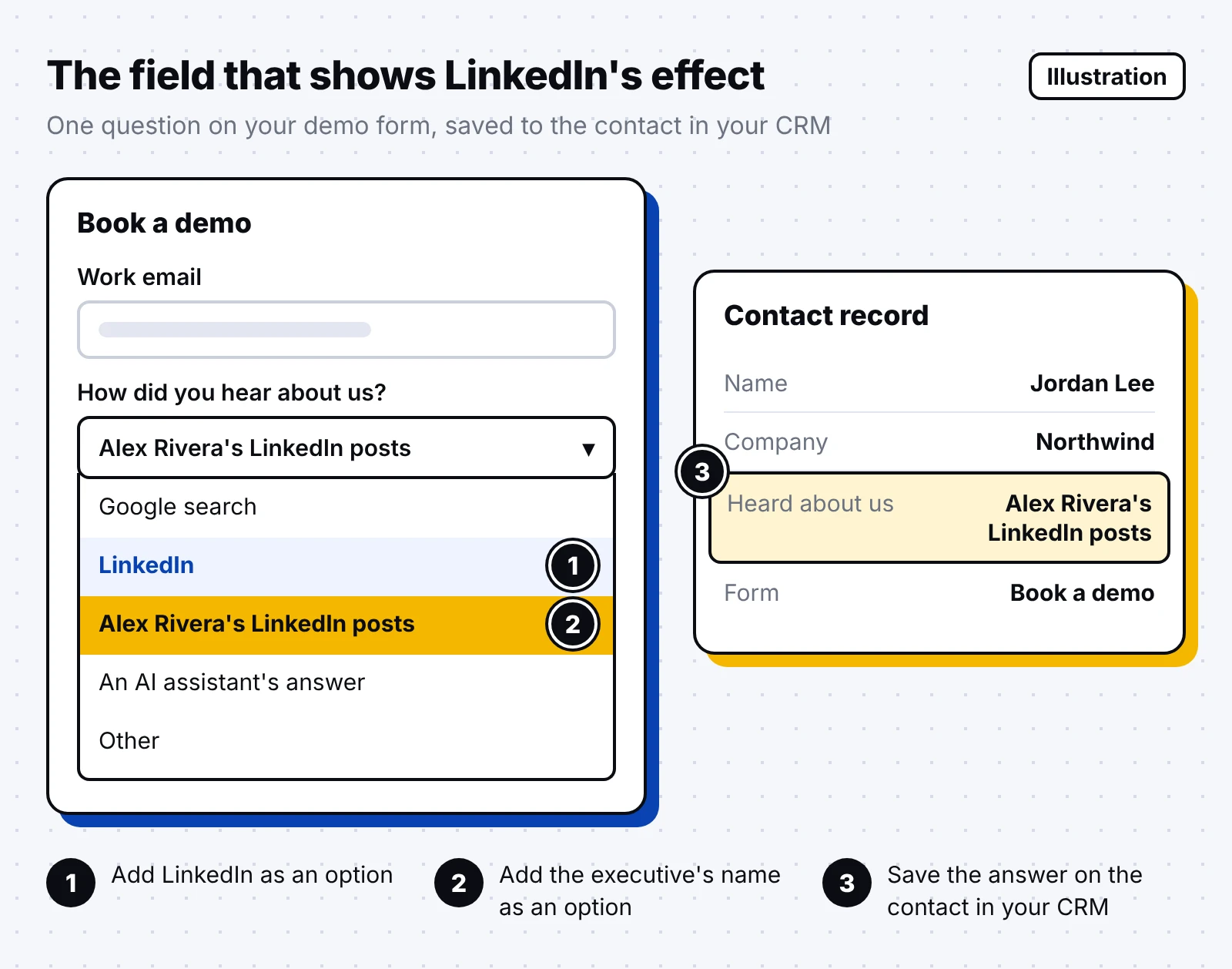
The field that matters most costs nothing. Add LinkedIn and the executive's name as options on your "How did you hear about us?" question, and save the answer on the contact in your CRM. Our post on AI search attribution shows the same setup for AI answers.
FAQ
What is a SaaS marketing team structure?
A SaaS marketing team structure is how you split marketing work into roles, reporting lines and channel owners. In B2B SaaS it covers growth, product marketing, content and brand, plus executive LinkedIn, and it grows from one generalist at seed to separate teams after Series C.
Who should own LinkedIn in a B2B SaaS company?
The founder owns it at seed. From Series A, the Head of Marketing owns it by name, and from Series B an executive comms lead takes it over. Each executive still approves and posts their own content.
How big should a SaaS marketing team be at Series A?
We recommend 3 to 6 people: a Head of Marketing, a demand gen marketer, a content marketer and a product marketing manager, with a designer and a ghostwriter or agency on contract.
Can a ghostwriter post from an executive's LinkedIn account?
No. LinkedIn's User Agreement says members must not share their account or their password. The executive posts the approved draft, or schedules it with LinkedIn's scheduler or a partner tool connected to their own account.
When should you hire a B2B SaaS marketing agency instead of a staff writer?
Use an agency when 1 to 5 executives need to post and you have no writer on staff. Hire in house once several executives post every week and the product takes months to learn.
A good first step is to write one name next to "executive LinkedIn" on your org chart this week and book 30 minutes with your CEO every other week to review drafts. If you want the writing handled, see how our LinkedIn thought leadership program works.