AI brand mentions are the times ChatGPT, Perplexity, Gemini or Google's AI Overviews name your company in an answer, with or without a link. Being named in the answer counts as a ranking, and LinkedIn is one of the sources these tools cite most for work questions.
Read on for what the studies say about LinkedIn as a source for AI answers, seven steps to get your executives cited and a monthly routine to track brand mentions in AI.
What are AI brand mentions?
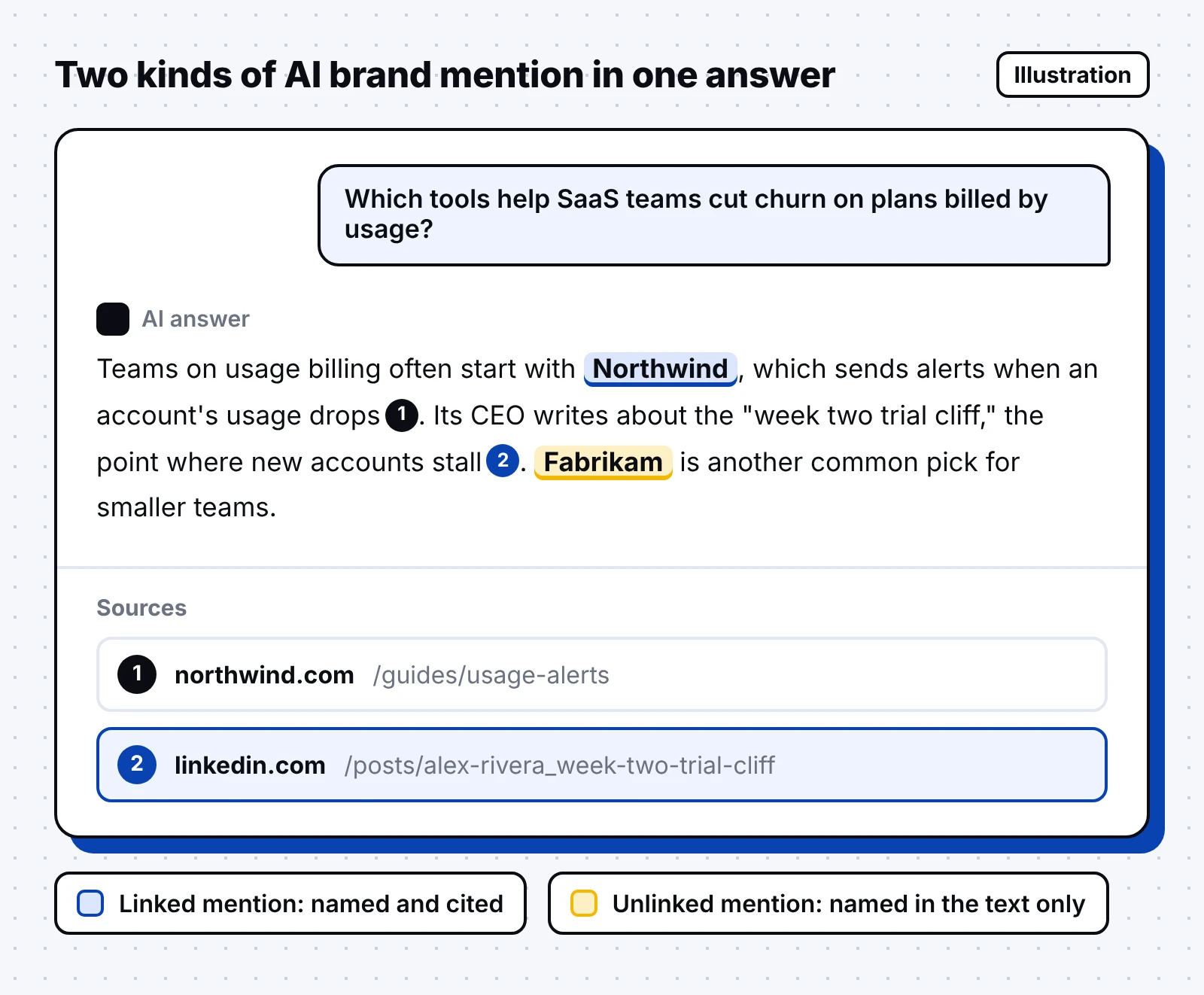
An AI brand mention is any answer from an AI assistant that names your brand. It counts whether the answer links to your site or not.
There are two kinds. A linked mention, also called a citation, names you and adds a link to one of your pages. An unlinked mention names you in the text only. Both put your name in front of a buyer who is building a shortlist.
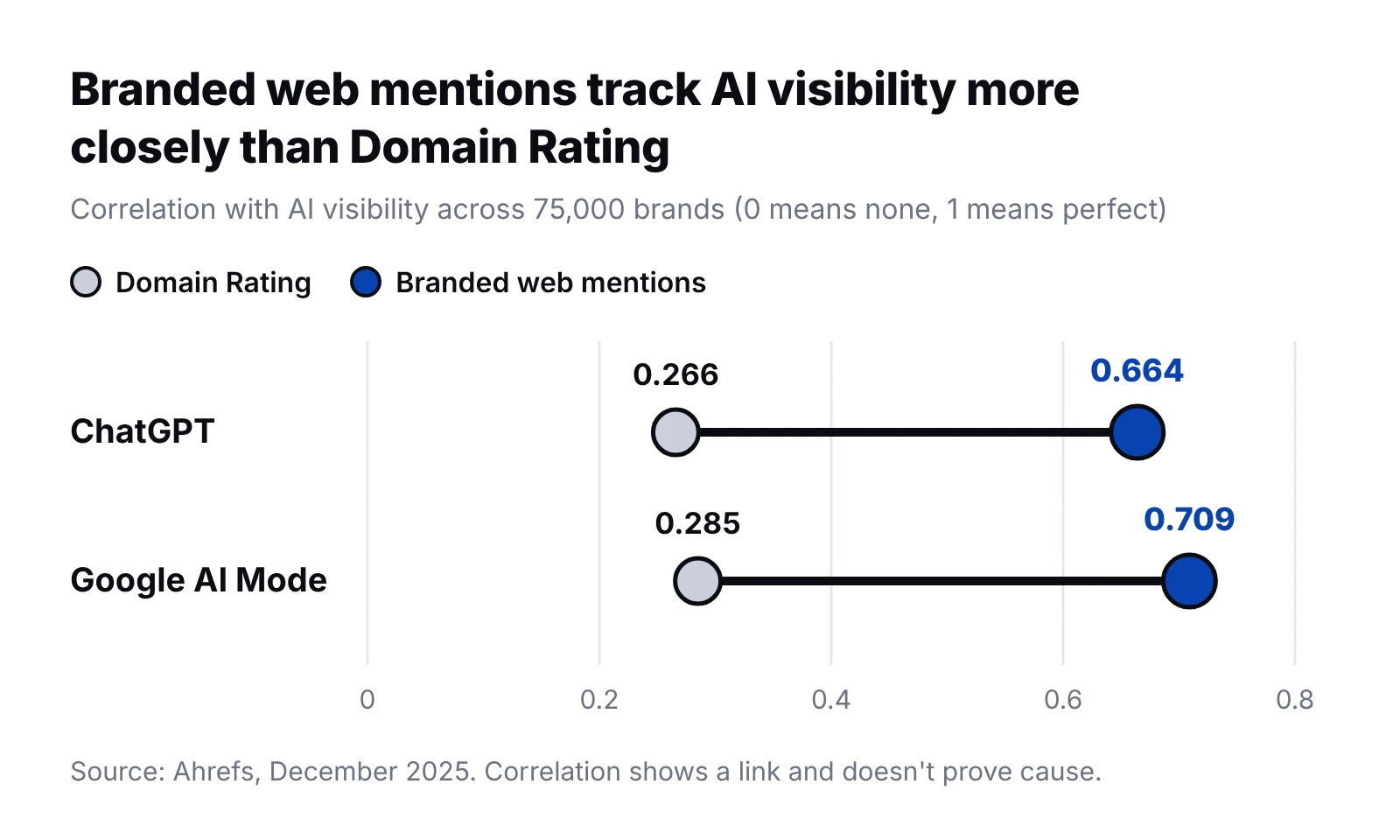
Classic brand mentions SEO was about links. For AI answers, mentions on other sites look more important than links. In Ahrefs' study of 75,000 brands, branded web mentions correlated with AI visibility at 0.664 in ChatGPT and 0.709 in Google AI Mode. Domain Rating correlated at 0.266 and 0.285. Ahrefs adds the usual warning that correlation isn't causation.
So the job changes. You want more public places where your name sits next to the problem you solve. For a B2B company, LinkedIn is one of the few places like that your own team controls. Our guide to GEO for B2B SaaS covers the website side of the same work.
Why LinkedIn content shows up in AI answers
LinkedIn content reaches AI answers for a plain reason. LinkedIn lets AI search tools read public posts, and those tools cite it often when the question is about work.
LinkedIn lets AI search tools read public posts
LinkedIn's help center says posts set to "Anyone" can be crawled and shown by search tools. It names them: "These search tools (such as Google, Bing, or ChatGPT) may use that content to enhance their search experiences. For example, they might show LinkedIn posts in search results or include them in AI-generated summaries."
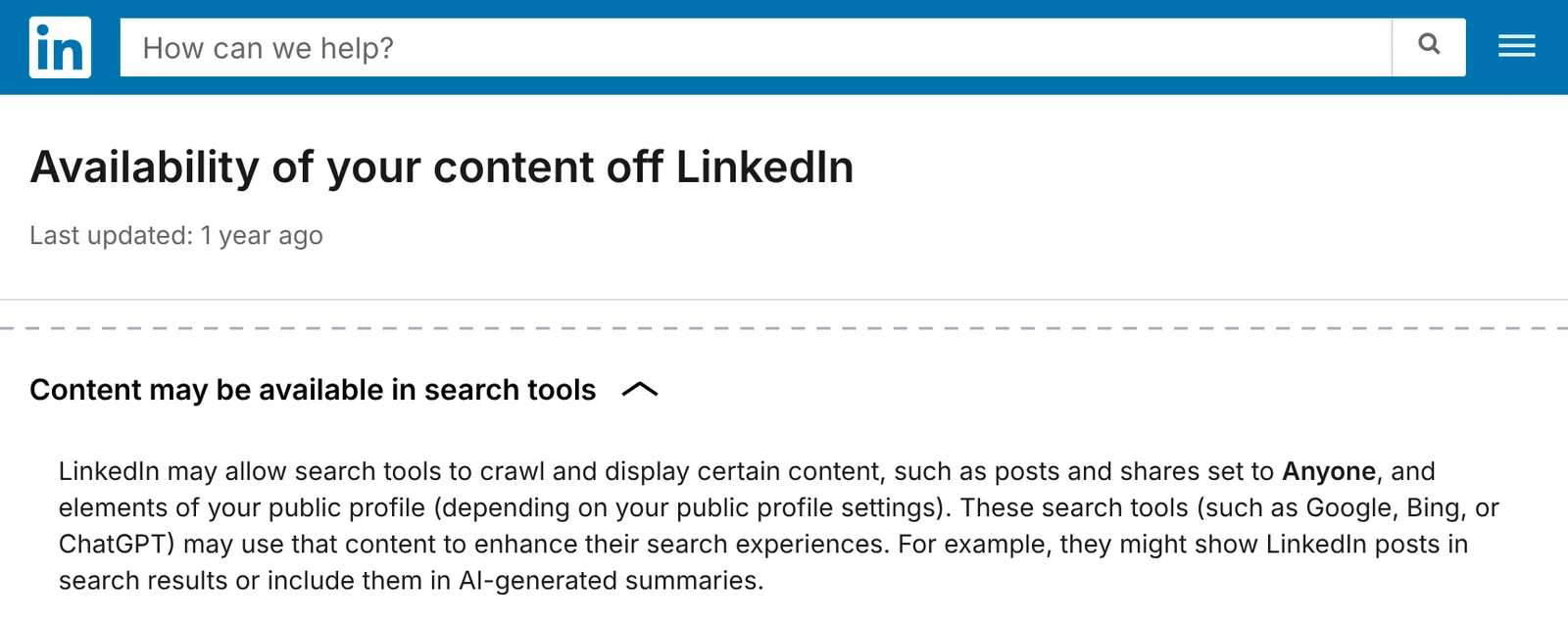
Posts set to "Connections only" stay inside LinkedIn. You can't change a post's audience after you share it, so set "Anyone" as the default on every executive profile before the first post goes out.
LinkedIn ranks near the top for professional questions
Three studies from early 2026 put LinkedIn among the most cited domains in AI search.
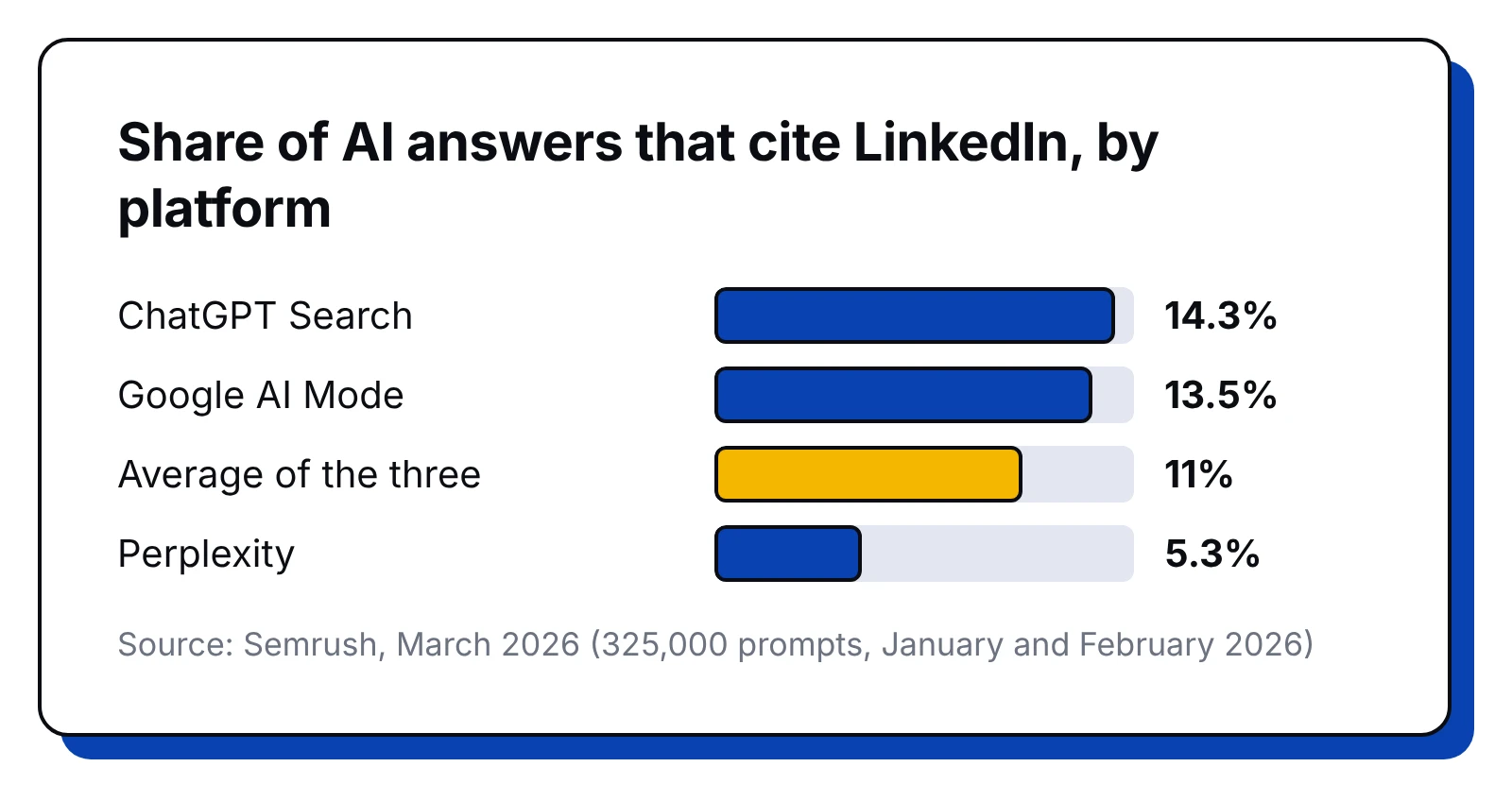
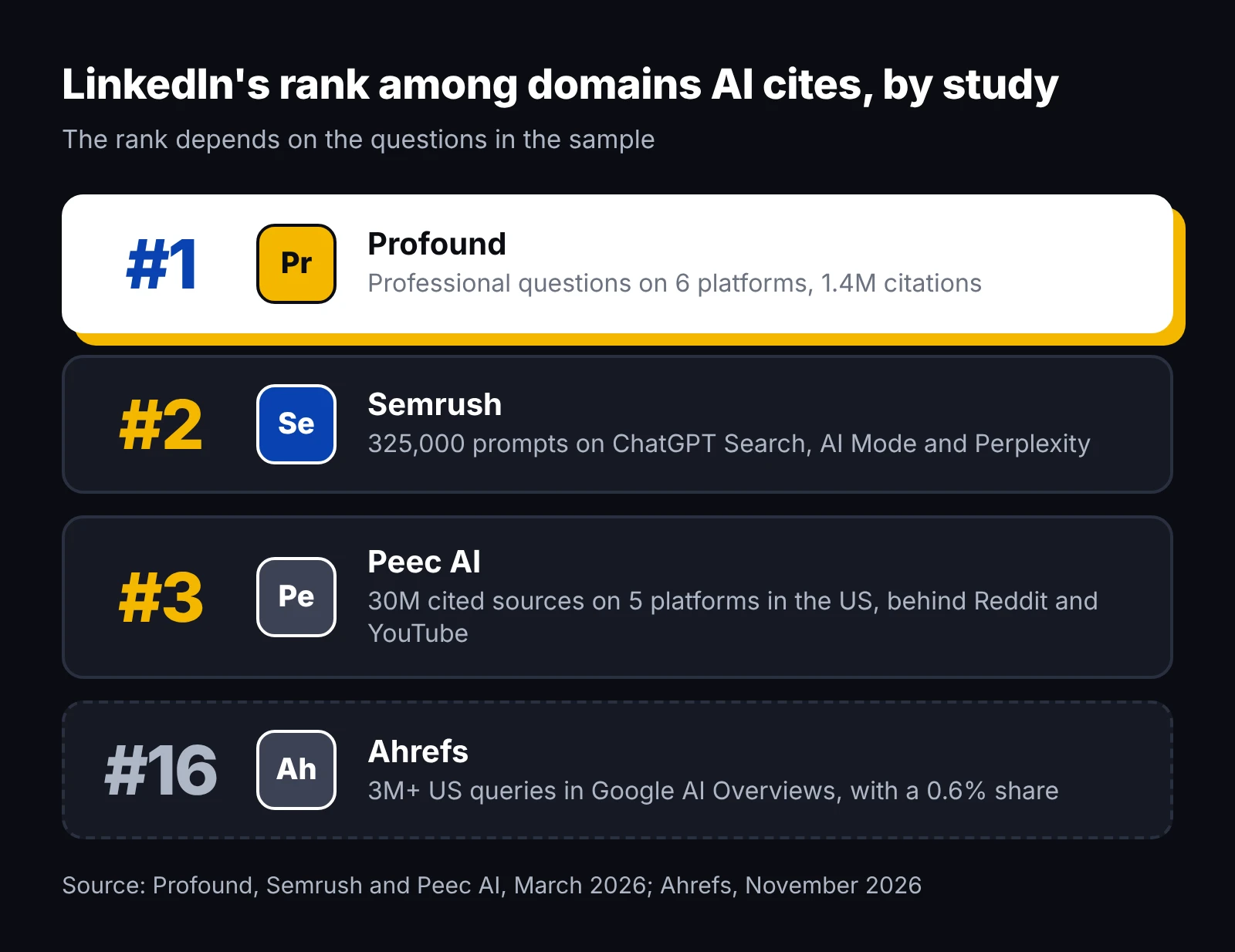
Semrush analyzed 325,000 prompts in January and February 2026 and found 89,000 LinkedIn URLs cited in the answers. LinkedIn ranked second in citations on ChatGPT Search, Google AI Mode and Perplexity, ahead of Wikipedia, YouTube and every major news publisher. On average, 11% of AI answers cited LinkedIn.
Profound tracked 1.4 million citations for professional questions from November 15, 2025 to February 15, 2026. LinkedIn was the most cited domain for those questions on all six platforms it checked: ChatGPT, Gemini, AI Overviews, AI Mode, Copilot and Perplexity. On ChatGPT, LinkedIn climbed from about 11th to about 5th among all cited domains. Profound calls it "over a 2x increase in citation frequency."
Peec AI ranked LinkedIn third across 30 million sources cited by five AI platforms in the US in March 2026, behind Reddit and YouTube.
Where LinkedIn shows up less
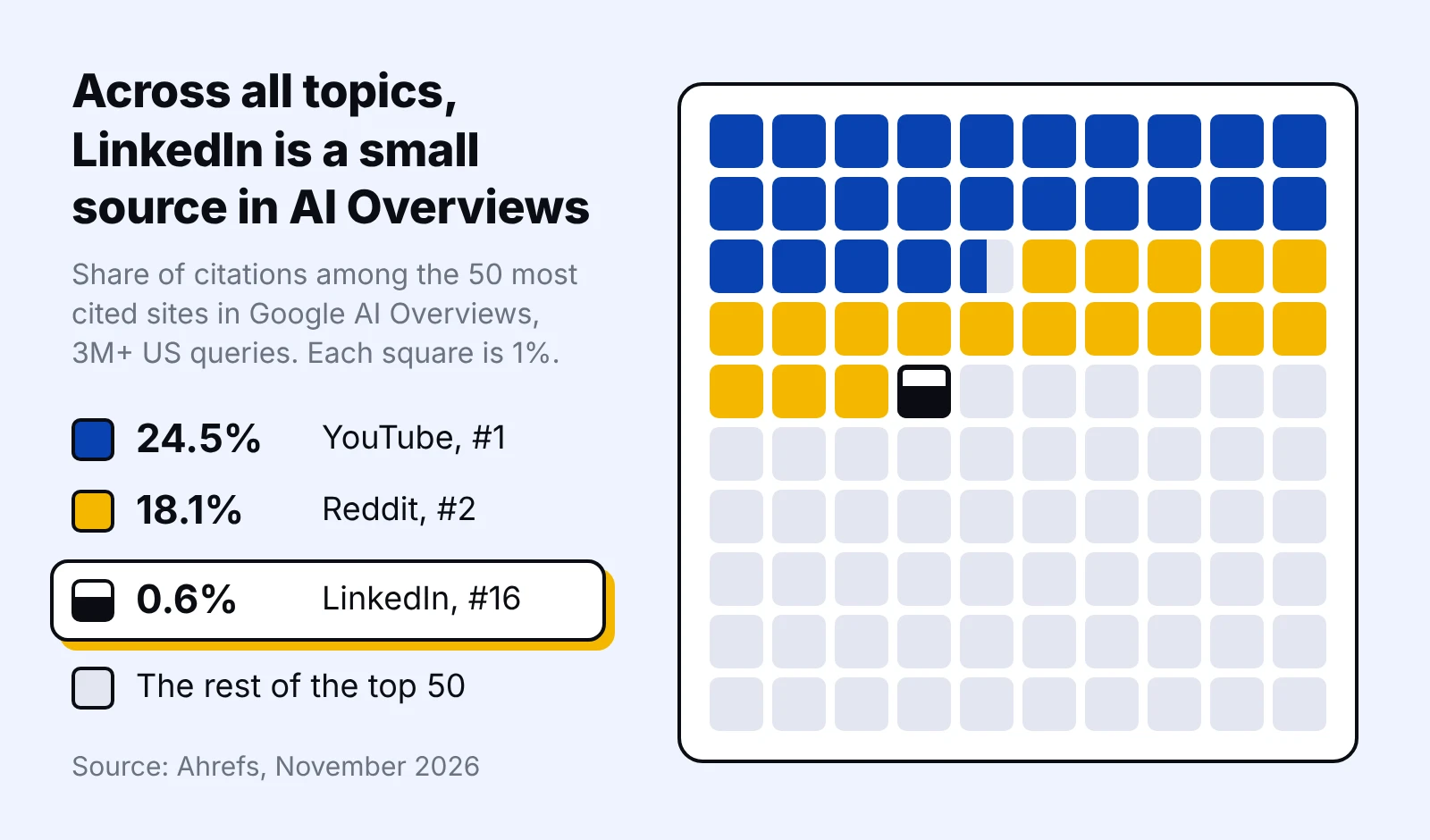
LinkedIn's lead holds for work questions. Across every kind of question, it shrinks. In Ahrefs' November 2026 list of the 50 most cited sites in Google AI Overviews, based on more than 3 million US queries on all topics, linkedin.com ranked 16th with a 0.6% share. YouTube had 24.5% and Reddit had 18.1%.
Our own tracking shows a second limit. We track 5 "best B2B SEO agency" style prompts for Perceptric in Arrowsterr. In the 80 answers logged from October 6 to November 5, 2026 across ChatGPT, Gemini, AI Overviews, AI Mode, Claude and Perplexity, linkedin.com was not among the 25 most cited domains. The answers pulled from agency lists and agency sites instead. Grow and Convert was cited in 18.8% of answers, Optimist in 16.3% and YouTube in 15%.
So LinkedIn won't win every prompt.
We found no study that gives one share for LinkedIn across all AI answers. The number depends on the questions in the sample. Shortlist prompts such as "best agency for X" lean on ranked lists. Advice prompts lean on people. In Semrush's data, 54% to 64% of the LinkedIn posts AI cited shared knowledge or practical advice. Plan LinkedIn for the advice prompts and keep earning list placements for the shortlist prompts.
AI answers stay close to LinkedIn wording
Semrush also scored how closely AI answers matched the meaning of the sources they cited. LinkedIn content scored 0.57 to 0.60, against 0.53 to 0.54 for Reddit threads in an earlier Semrush study. The answers paraphrase LinkedIn less. The words your executive picks have a better chance of reaching the answer intact.
Types of LinkedIn brand mentions
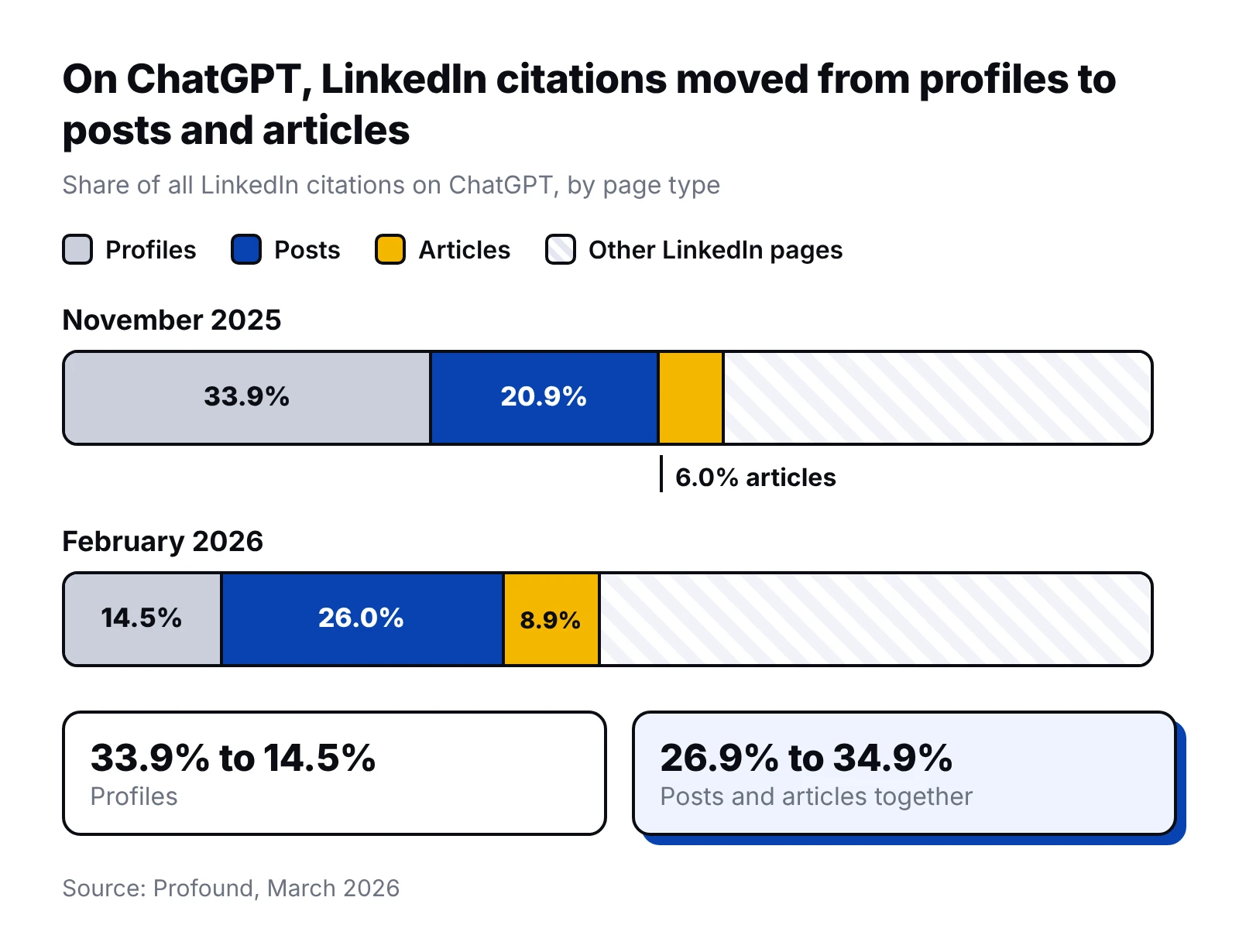
On ChatGPT, LinkedIn posts and articles now get cited more often than profiles. Profound found posts and articles rose from 26.9% to 34.9% of LinkedIn citations between November 2025 and February 2026, while profiles fell from 33.9% to 14.5%.
Not every mention on LinkedIn does the same job. The table shows six kinds and what each one does for AI answers. For the wider LinkedIn plan, see our hub on LinkedIn marketing for B2B SaaS.
| Type | Example | Why it matters for AI |
|---|---|---|
| Executive posts | Your CEO's post of about 200 words on why free trials stall in week two | Feed posts were 15% to 28% of cited LinkedIn content, and most cited posts ran 50 to 299 words. On ChatGPT Search and AI Mode, individual members drew 59% of LinkedIn citations. |
| LinkedIn articles | An article of about 1,200 words from your CTO on how you price usage | Articles were 50% to 66% of cited LinkedIn content, and most cited articles ran 500 to 2,000 words. |
| Newsletters | A monthly newsletter from your head of product | Each issue is an article. Subscribers get a notification or email for every new edition, so the schedule is built in. |
| Comments | Your VP of Sales answering a question under a prospect's post | No study we found measured comments as a cited source. They put your name in front of the people who write the posts AI cites. |
| Company Page | Your Page sharing a benchmark report | On Perplexity, Company Pages drew 59% of LinkedIn citations. |
| Other people tagging you | A customer naming your company in a post about switching tools | Other people's words about you, on a public page. Ahrefs found branded mentions across the web tracked closely with AI visibility. Page admins see tagged ones under Activity, then Mentions. |
Source: Semrush, March 2026; Ahrefs, December 2025; LinkedIn Help, read November 2026
How to earn AI brand mentions with LinkedIn in 7 steps
Semrush's data shows what AI picks from LinkedIn: relevant, original posts from people who post often. Popularity matters less. The median cited post in Semrush's data had 15 to 25 reactions and no more than 1 comment.
Posting often matters. About three in four cited post authors had published more than 5 posts in the previous four weeks.
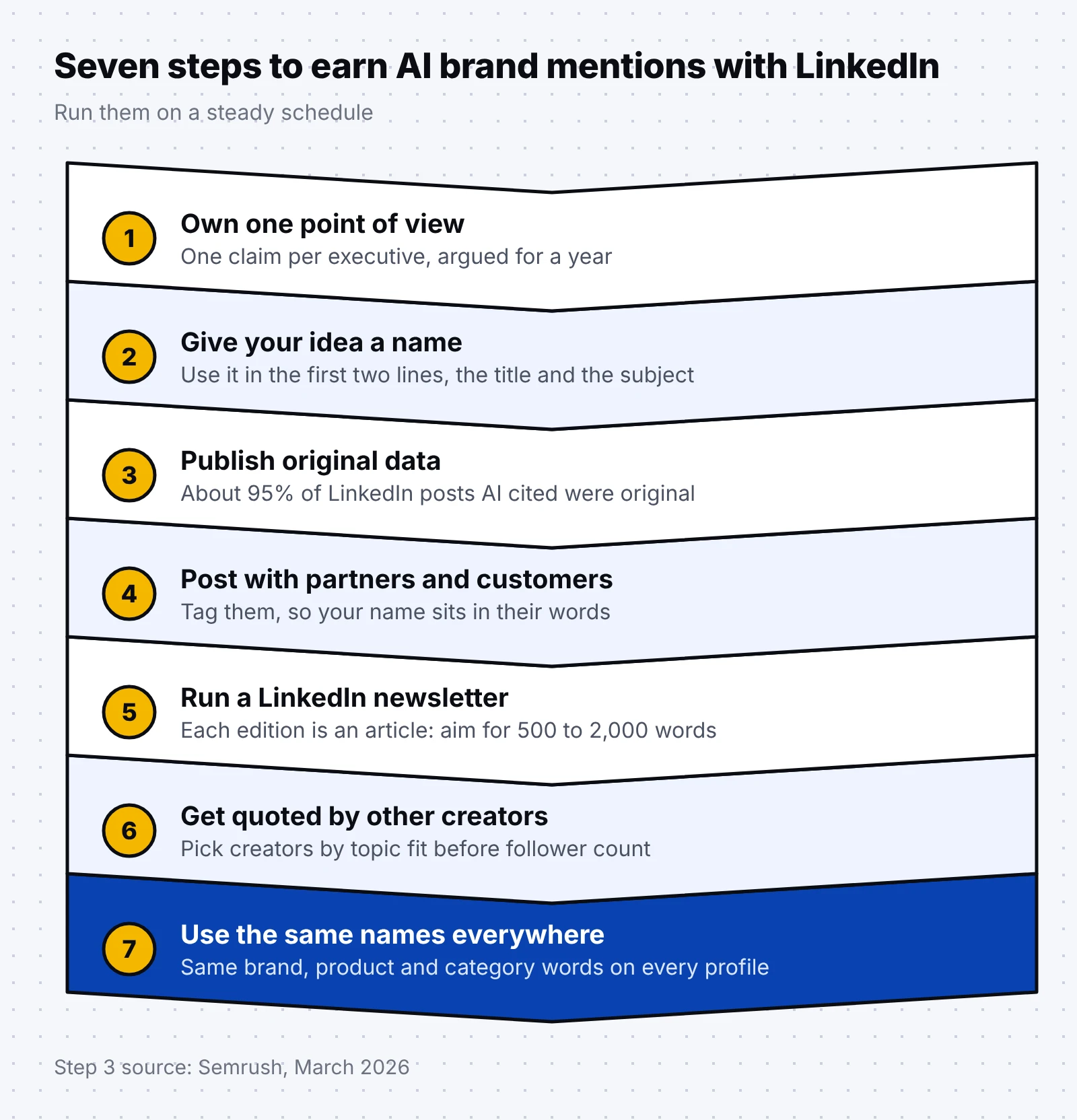
1. Own one point of view
Pick one claim each executive will argue for a year, and write every post as evidence for it. An AI answer can name your CEO on "how should SaaS teams measure content" only if your CEO has said something specific about it, in public, many times.
Ours is that content earns its place by the pipeline it produces. Every post we write for ourselves argues some part of it. If you run several executives, give each one a different claim so they don't compete for the same prompts. Our post on LinkedIn ghostwriting for SaaS founders covers how to pull those claims out of an executive in an interview.
2. Give your idea a name
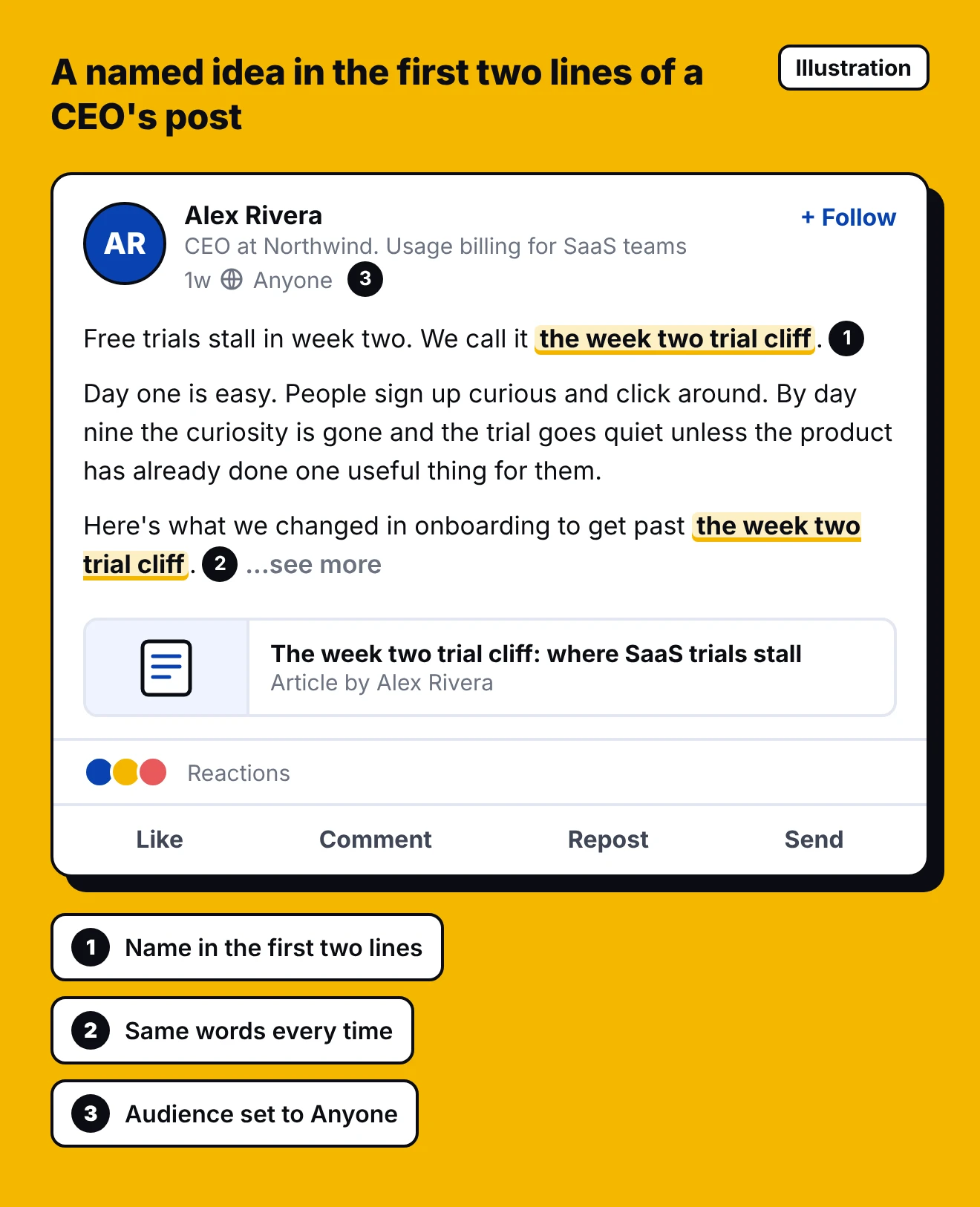
A named idea is easier for a model to repeat than a loose opinion. If your CEO keeps calling it "the week two trial cliff," and your product page and podcast use the same phrase, the phrase and your brand start to travel together.
Use the name in the first two lines of the post, in the article title and in the newsletter subject. Then keep using it. A name used once is a slogan. A name used for a year becomes a term.
3. Publish original data
About 95% of the LinkedIn posts AI cited in Semrush's study were original. Reshares made up about 5%. One of the most cited posts was a Krazy Coupon Lady post promoting a data report, cited in at least 26 ChatGPT search prompts.
You already hold data no one else has: product usage, win rates by segment, survey answers from your customers. Put one number in the opening line of a post. Publish the method and the full set as an article, so the post has a page to point to.
4. Post with partners and customers
LinkedIn lets members collaborate on posts and tag each other in posts, comments and photos. Use it. Write a post with a customer about a result they're happy to share, and tag their company. Ask partners to tag your Page when they announce an integration.
Each of these puts your name in someone else's words, on a public page. Our post on LinkedIn ABM for B2B SaaS covers how to pick the accounts worth posting with.
5. Run a LinkedIn newsletter
A newsletter turns a steady schedule into a promise. When you publish the first edition, LinkedIn invites your connections and followers by notification to subscribe. After that, subscribers get a notification or email each time you publish a new edition.
Each edition is an article, the format that made up 50% to 66% of cited LinkedIn content in Semrush's data. Aim for 500 to 2,000 words, the range where the most cited articles sat. A Company Page needs more than 150 followers or connections to be considered for newsletter access.
6. Get quoted by other creators
Your own posts are you talking about you. Mentions from other people are the ones you can't write yourself.
Offer your data to creators who write for your buyers. Go on their podcast or their LinkedIn Live. Comment under their posts with a specific answer and a number. Pick creators by topic fit before follower count. Nearly half of cited post authors in Semrush's study had 2,000 or more followers, and authors with fewer than 500 followers were "just as likely to be cited."
7. Use the same brand and product names everywhere
A model connects your brand to a topic by seeing them together many times. If your site says "Acme Revenue Cloud," your CEO says "our platform" and your Page says "Acme RC," that's three names doing the work of one.
Write down your brand name, your product names and the category phrase you want to own. Put them in each executive's headline and About section, your Page tagline and your website, in the same words. Then check that every executive's posts default to "Anyone."
Do the seven steps on a steady schedule. The case against is executive time: a CEO who writes 15 posts a month has less time to run the company. Our fix is an interview. "You talk, we write." Clients spend under five hours a month on our LinkedIn thought leadership service, and we've published more than 1,000 posts. If you're deciding who should own this work in house, see our post on B2B SaaS marketing team structure.
How to track brand mentions in AI in 5 steps
Here's a monthly routine that works in a spreadsheet or in a tool.
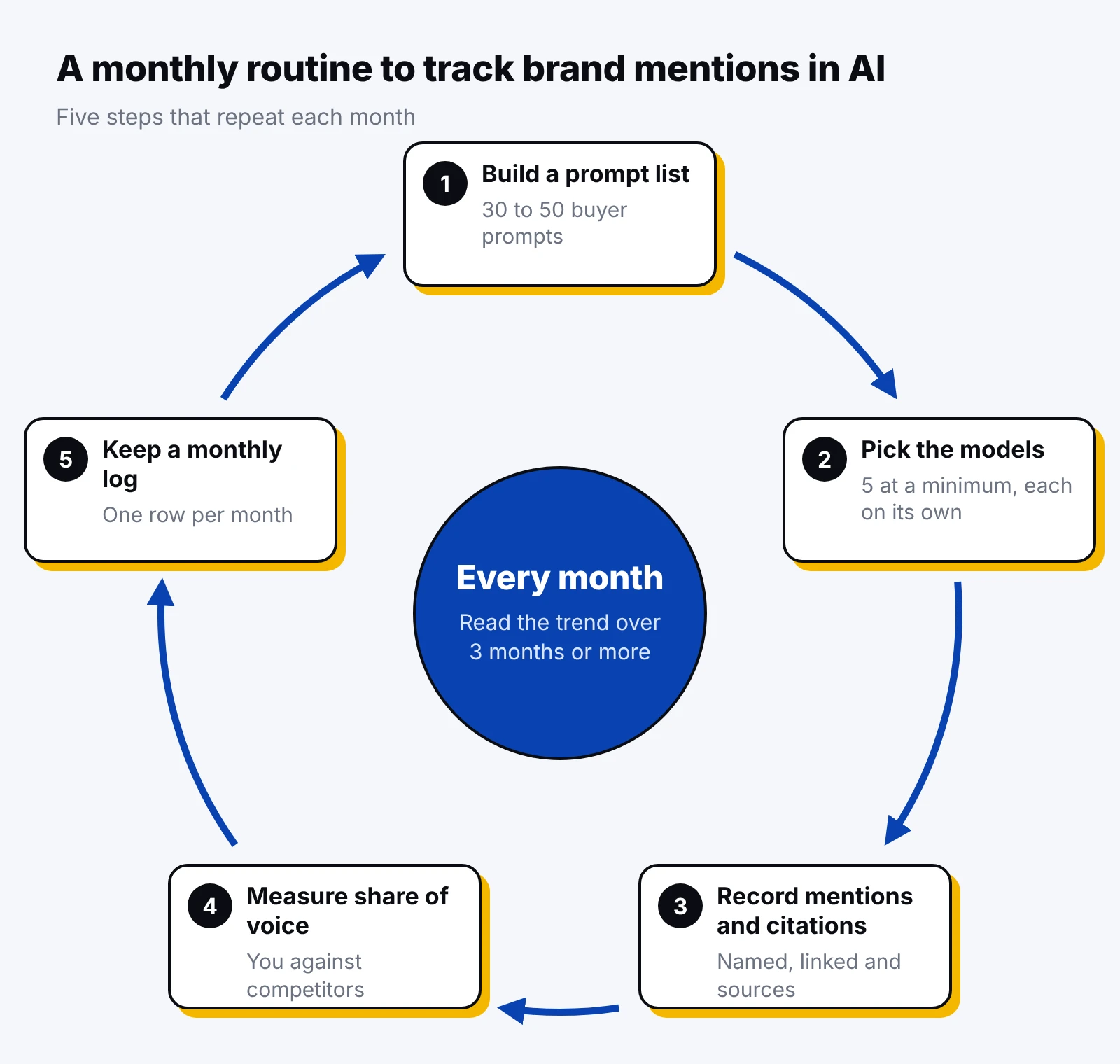
1. Build a prompt list
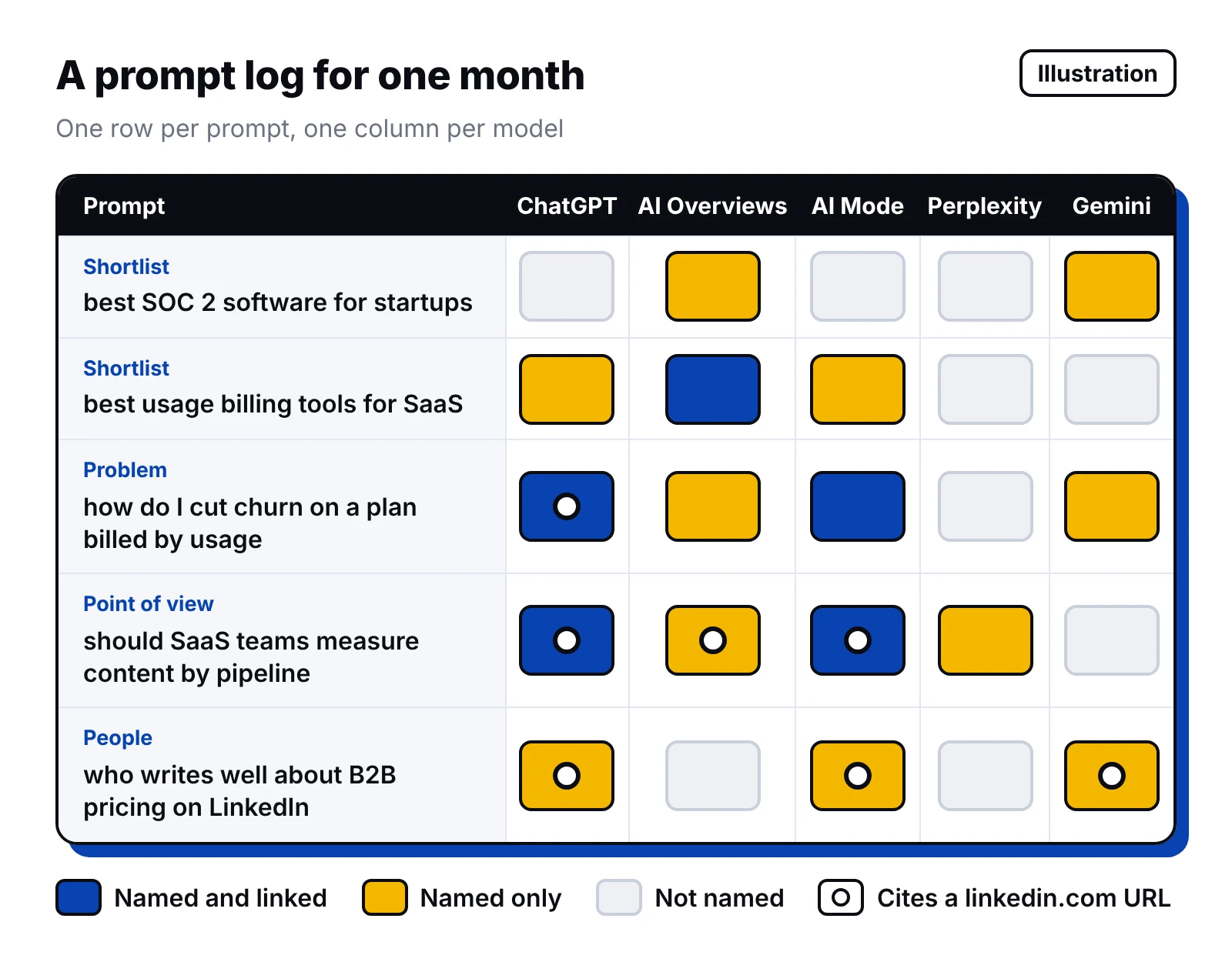
Write 30 to 50 prompts your buyers ask. Mix four kinds:
- Shortlist prompts, such as "best SOC 2 software for startups."
- Problem prompts, such as "how do I cut churn on a plan billed by usage."
- Point of view prompts, which match the claims your executives post about.
- People prompts, such as "who writes well about B2B pricing on LinkedIn."
The point of view and people prompts are the ones LinkedIn can move. The shortlist prompts tell you which lists you need to be on.
2. Pick the models to check
Check ChatGPT, Google AI Overviews, AI Mode, Perplexity and Gemini at a minimum. Add Claude and Copilot if your buyers use them. Check each model on its own, because they cite LinkedIn at different rates. In Semrush's study, 14.3% of ChatGPT Search answers cited LinkedIn against 5.3% on Perplexity.
3. Record mentions and citations separately
For each answer, log whether it names you, whether it links to you and where you sit in the list of brands. Also log the cited sources. Count how many linkedin.com URLs appear, and whose posts they are.
4. Measure share of voice
AI share of voice is the share of answers in your prompt set that mention or cite your brand, compared with your competitors. Ahrefs defines it that way in Brand Radar. Visibility tells you whether you're in the answer. Share of voice tells you whether you're winning it.
5. Keep a monthly log
Put one row per month in a sheet: prompts run, answers logged, visibility, share of voice, linkedin.com URLs cited, your executives' posts cited and posts published. Set the posting count next to the citation count. AI answers can change from one run to the next, so read the trend over three months or more. Our post on AI search attribution shows how to connect the same log to pipeline.
You can run all of this by hand in a spreadsheet. A tool saves the hours. We use Arrowsterr for our own tracking. It covers ChatGPT, Claude, Gemini, Perplexity, AI Overviews and AI Mode, and its free plan checks 10 prompts a week on ChatGPT and AI Overviews. Ahrefs Brand Radar reports mentions, citations and AI share of voice. Peec AI shows visibility, position, sentiment and the sources AI cites. Semrush's AI toolkit tracks prompts on platforms including ChatGPT and AI Mode.
How to monitor LinkedIn brand mentions
AI tools are one half of the picture. The other half is what people say about you on LinkedIn itself, since those posts are what AI tools may cite next. No single tool catches all of it. The table shows what each one sees.
| Tool | What it catches | Limits | Cost |
|---|---|---|---|
| LinkedIn Page admin view, Activity, then Mentions | Posts and comments that tag your Company Page | Tagged mentions only. Page admins only. | Free |
| LinkedIn post search | Posts that contain your brand name, plus filters for "Mentioning company" and "Mentioning member" | Manual. Run it weekly with the "Date posted" filter. | Free |
| Google site: search, such as site:linkedin.com/posts "your brand" | Public LinkedIn posts and articles Google has indexed, which is close to what AI tools that search the web can find | Google says site: doesn't return every indexed URL | Free |
| Brand24 LinkedIn integration | Your Page posts, comments on them and posts where your company is tagged or mentioned | Needs a LinkedIn superadmin. Set up per project. Brand24's help page doesn't say whether it catches untagged mentions. | Paid plans |
| AI visibility tool cited sources report | The linkedin.com posts and articles AI answers cite for your prompts | Covers only the prompts you track | Free plans and paid plans |
Source: LinkedIn Help, Brand24 Help Center, Google Search Central and vendor pages, read November 2026
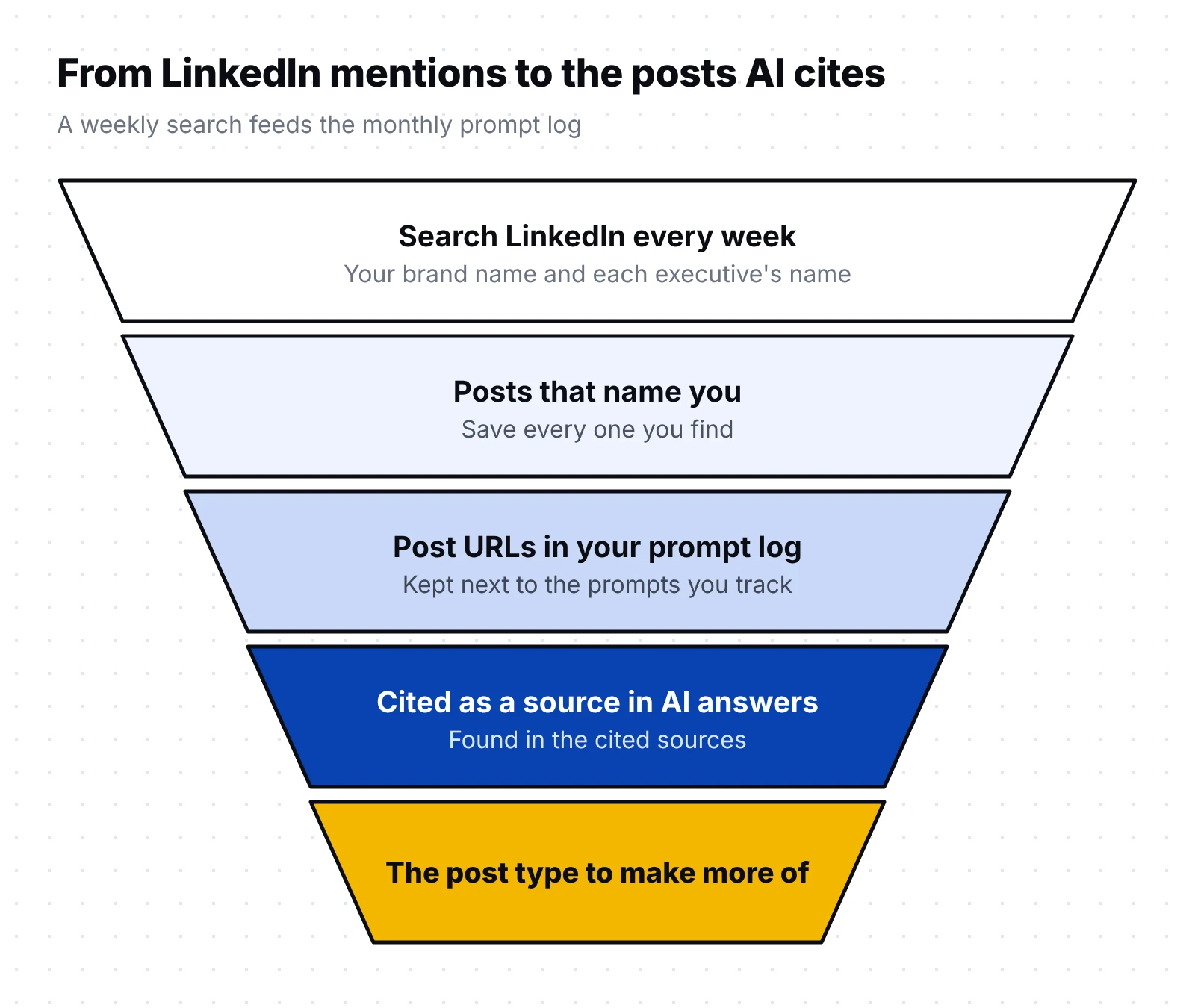
Run LinkedIn search for your brand name and each executive's name once a week. Save any post that names you, and add its URL to your prompt log. When one of those URLs later shows up as a cited source, you've found the post type to make more of.
FAQ
What are AI brand mentions?
AI brand mentions are the times an AI assistant such as ChatGPT, Perplexity, Gemini or Google's AI Overviews names your brand in an answer. A linked mention adds a link to your site. An unlinked mention names you in the text only.
How do you track brand mentions in AI?
Write 30 to 50 prompts your buyers ask and run them each month in ChatGPT, AI Overviews, AI Mode, Perplexity and Gemini. Log whether each answer names you, links to you and which sources it cites. Track share of voice against your competitors over at least three months.
Do LinkedIn posts show up in ChatGPT answers?
Yes, when they're public. LinkedIn says posts set to "Anyone" can be used by search tools such as ChatGPT. In Semrush's study, 14.3% of ChatGPT Search answers cited LinkedIn.
Do brand mentions help SEO?
They're linked to AI visibility. In Ahrefs' study of 75,000 brands, branded web mentions correlated with AI visibility at 0.664 in ChatGPT and 0.709 in AI Mode, much more than Domain Rating did. Ahrefs notes that correlation isn't causation.
What is the best brand mentions tool?
It depends on where the mention happens. For tagged LinkedIn mentions, use your Page's Activity tab. For the wider web and social, use a listening tool such as Brand24. For AI answers, use an AI visibility tool such as Arrowsterr, Ahrefs Brand Radar or Peec AI.
A good first step is to write down 10 prompts your buyers ask, run them in ChatGPT and Perplexity and list every source the answers cite. If linkedin.com shows up and your executives don't, you've found the gap. Start with a free AI visibility audit and we'll run your prompts for you. If the gap is LinkedIn, see how our LinkedIn thought leadership service works.