Content activation is the work of getting each published piece used by sales, in email, in ads, by partners and inside your product. A content activation strategy plans that work for every piece, so your content reaches buyers and helps move deals forward.
We run content programs for B2B and SaaS teams, and this guide follows the process we use with clients. You'll get six steps, four real examples and a checklist you can copy for your next launch.
What is content activation?
Content activation is the process of putting a published piece to work wherever your buyers, sellers, partners and customers spend time, then tracking how each version gets used.
One research report, for example, can become several assets that each do a different job:
- A one-page summary and a short email that reps send in open deals.
- A nurture email and a LinkedIn post built around one chart from the data.
- Two or three paid social ads that point to the full report.
- A co-branded webinar with a partner who serves the same buyers.
- An in-app message for customers who face the problem the report covers.
Each asset reuses the same research and the same proof, so the extra work is small next to writing a new piece from scratch.
Content activation vs content distribution
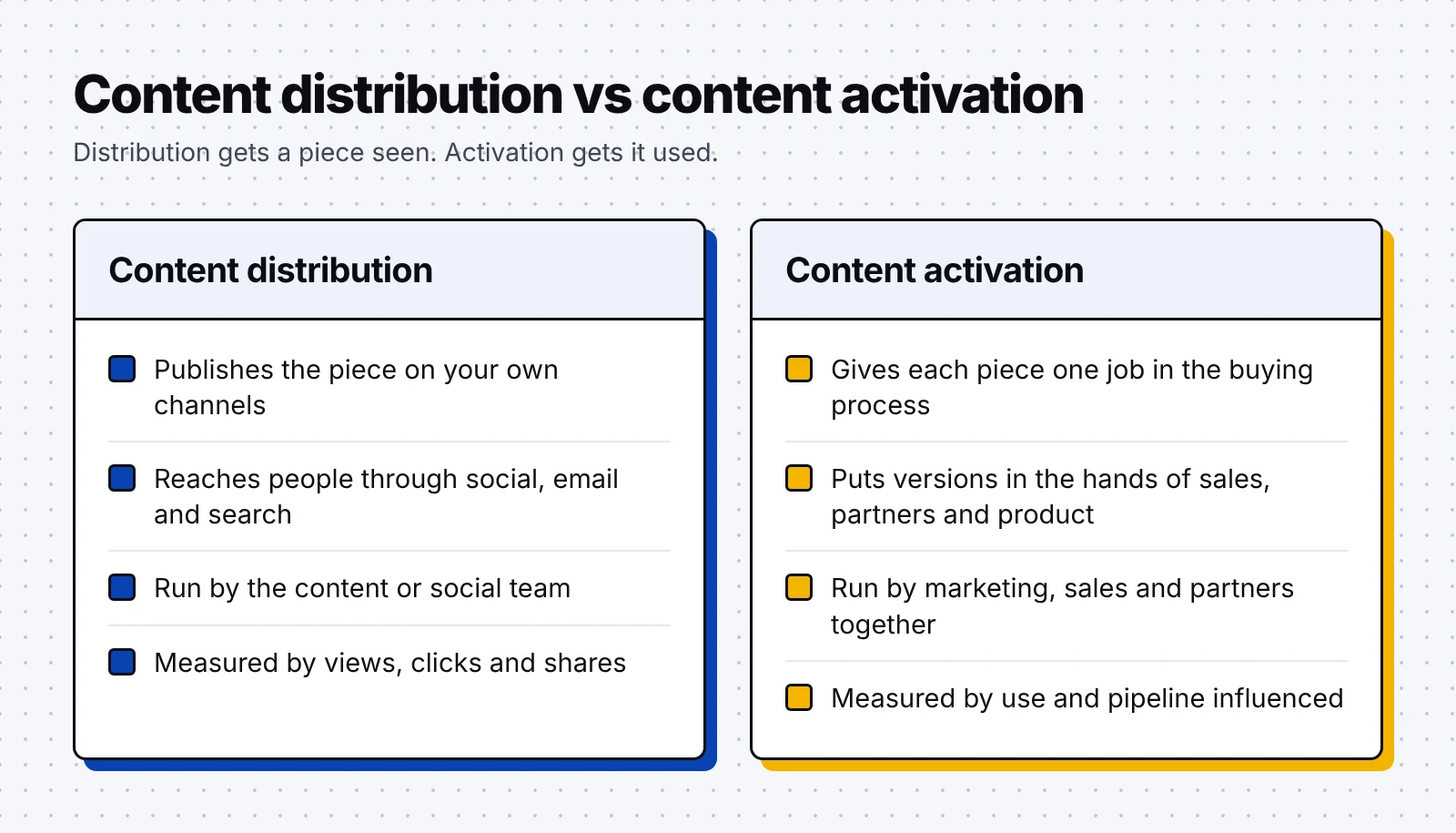
Content distribution gets a piece in front of an audience through channels like social media, email newsletters and search. Content activation includes that work and adds a job for each piece, plus versions for the sales team, partners and your product.
Luckily, activation builds on the distribution you already do, so you can start with the channels you have. The cards below show how the two compare:
Our guide to B2B content marketing covers the wider plan that both of them sit inside.
Why content activation matters in 2026
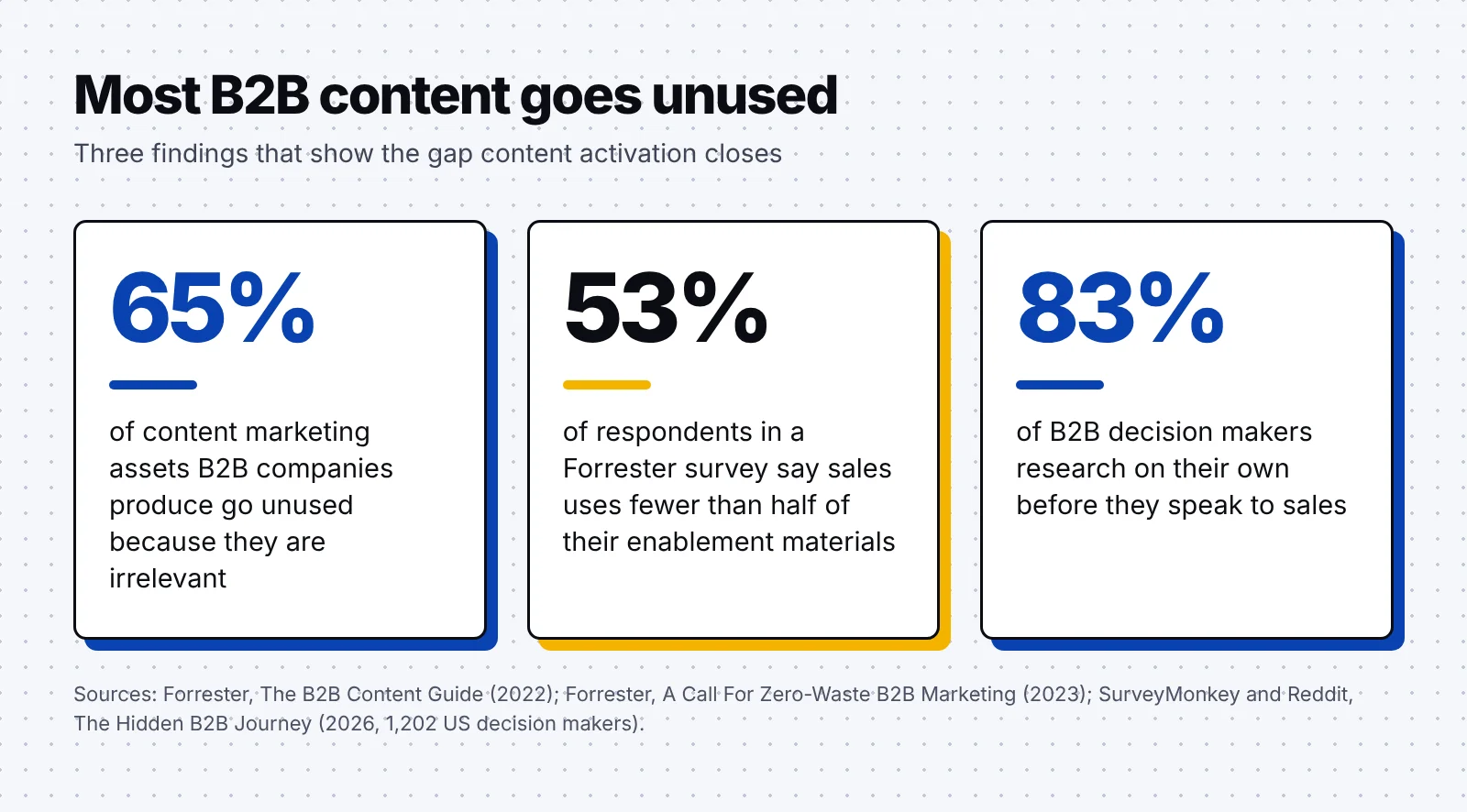
Content activation matters because much of the content B2B teams make never gets used, while buyers do most of their research before they talk to sales. These findings show the gap:
- Forrester estimates that 65% of the content marketing assets B2B companies produce go unused because they are irrelevant.
- In a 2023 Forrester survey, 53% of respondents said sales used fewer than half of their sales enablement materials.
- In Forrester's content preferences research, three in four tech buyers said it's important that sales reps share only content tailored to them.
- In a SurveyMonkey and Reddit study of 1,202 US business decision makers, 83% research on their own before speaking to sales.
How to build a content activation strategy in 6 steps
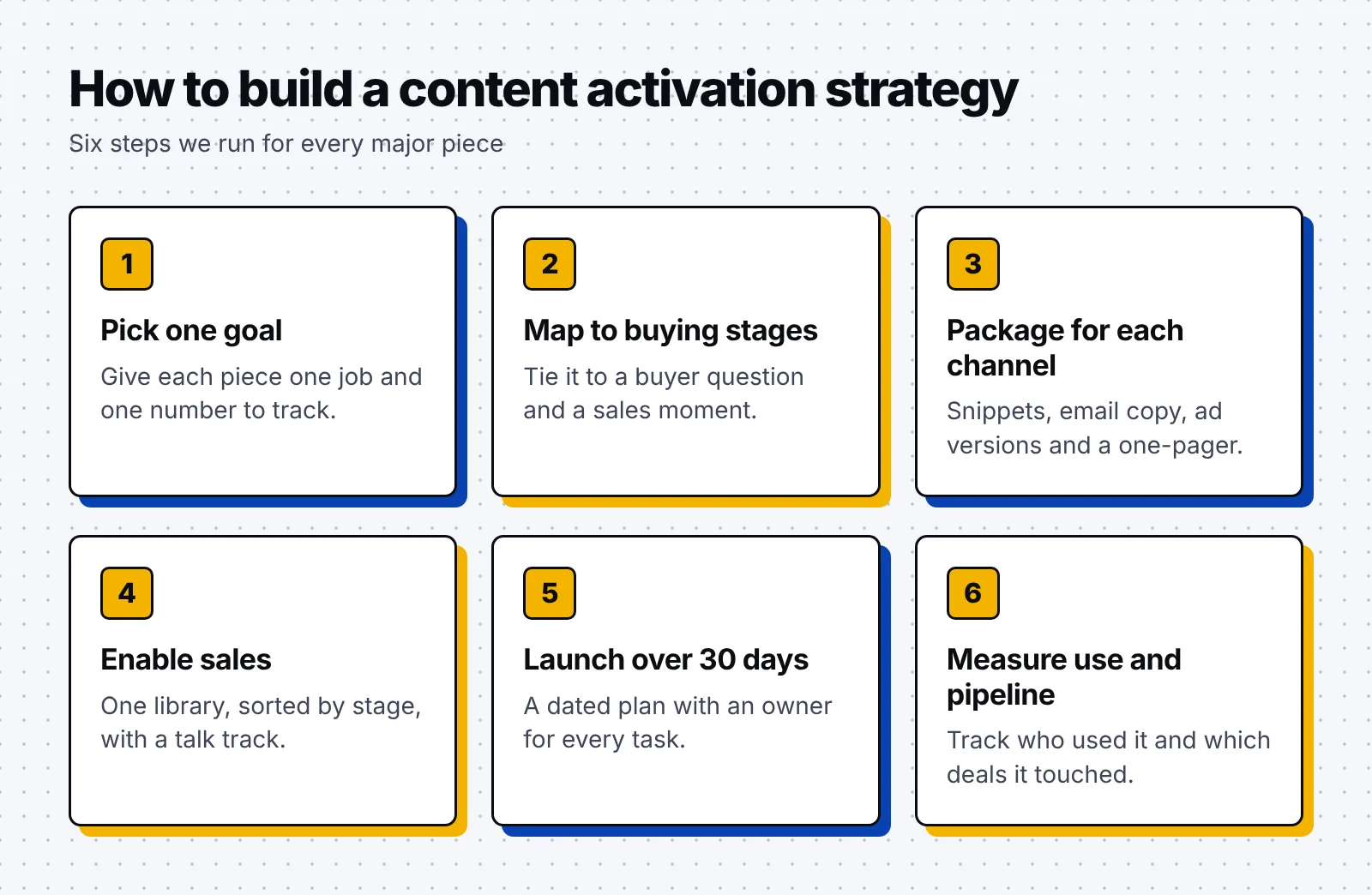
These six steps take one piece from plan to pipeline. Run them for your next big asset first, then save them as a template for every piece after it.
1. Pick one goal for each piece
Give every piece one main goal before anyone writes it, since the goal decides where the piece goes and how you judge it. Most B2B pieces serve one of these goals:
- Reach new buyers who don't know your brand or your product yet.
- Capture leads with an asset that's worth an email address.
- Help sales move an open deal past a doubt or a rival.
- Help customers get more value, so they renew and expand.
Write the goal at the top of the brief with one number to track, such as meetings booked or deals influenced. For lead goals, our guide to lead generation with B2B content marketing shows what to gate and how to score the leads.
2. Map pieces to buying stages and sales moments
Next, tie each piece to the buying stage where people need it and to the sales moment where a rep would share it. A sales moment is a point in a deal where reps hear the same question again and again.
| Buying stage | Buyer question | Content that answers it | Sales moment |
|---|---|---|---|
| Problem | Is this problem worth fixing now? | Research report, opinion piece | First outreach |
| Solution | How do teams like ours solve it? | How-to guide, webinar | Discovery call follow-up |
| Vendor | Why you over the others? | Comparison page, case study | After the demo |
| Decision | Will it work for us and pay off? | ROI calculator, security pack, references | Business case and procurement |
Honestly, your best reps already know which questions stall their deals, so ask them first. Each answer points to a sales moment, and any moment without a matching piece goes on your content plan.
3. Package each piece for every channel
Packaging turns one finished piece into ready-to-use versions for each channel, so nobody has to rewrite it later. Build the kit in the same week you publish, while the writer still has the details fresh.
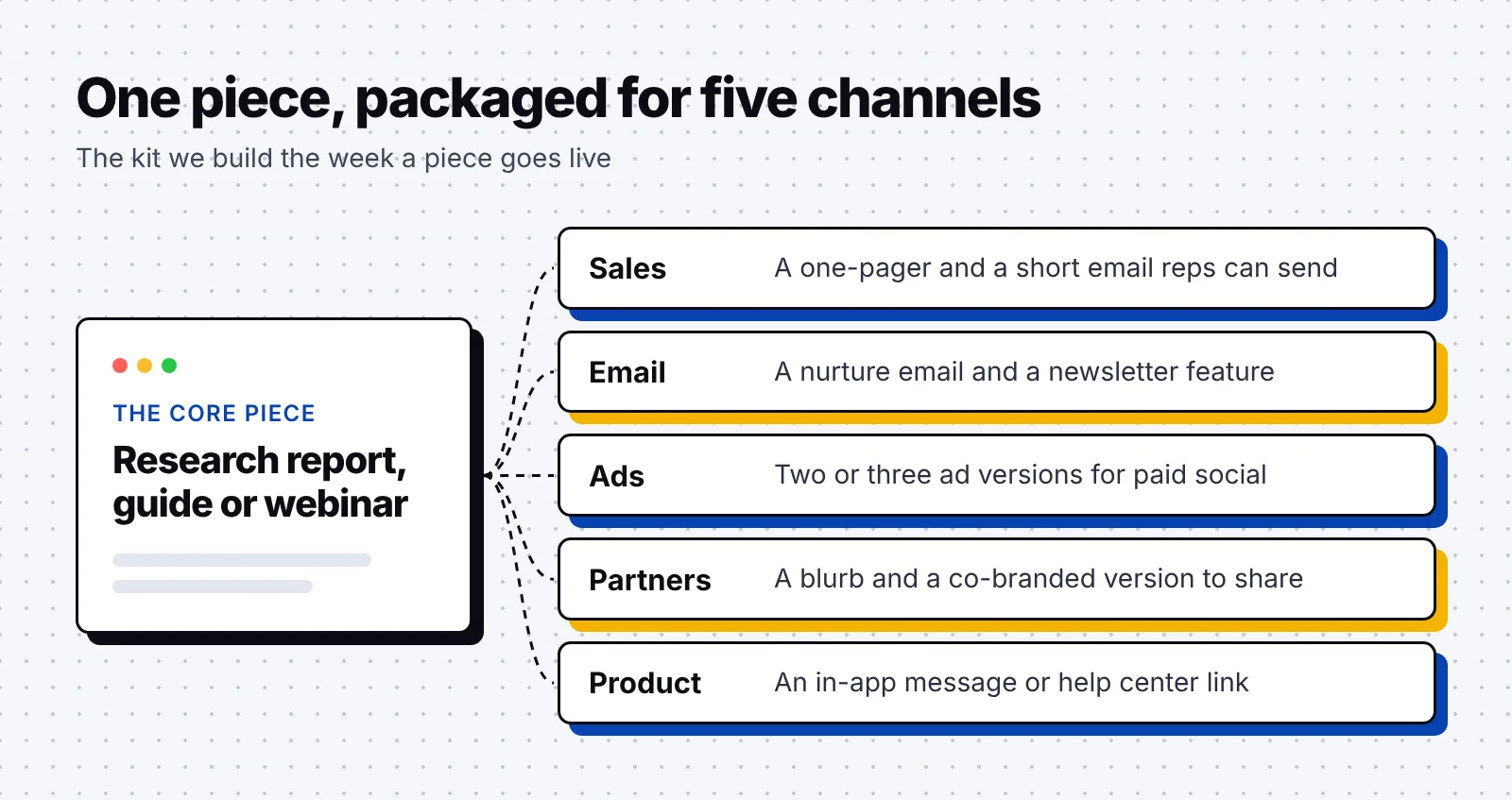
A full kit for one major piece usually holds these assets:
- Three to five social posts, each built around one finding, quote or chart.
- One nurture email for marketing and one short email reps can send as is.
- Two or three ad versions with their own headline and image for paid social.
- A sales one-pager with the main point, three proof points and a link to the full piece.
- A short blurb partners can share and a line of copy for your in-app messages.
Happily, one folder named after the core piece is enough to keep every version in order, so anyone can find the right asset in seconds.
4. Enable sales with a library and talk tracks
Reps use content they can find in seconds and explain in their own words. Give reps one library sorted by buying stage and sales moment, inside the tool they already work in every day.
For each key piece, add a short talk track that answers these questions:
- Which buyer and which deal stage is this piece for?
- What is the one point the buyer should take away from it?
- What should the rep write in the email when they send it?
- What next step should that email ask the buyer to take?
Thankfully, you don't need a long training session, since a 15-minute slot in the weekly sales meeting is enough to walk through one new piece. Opinion pieces fit early sales moments well, and our guide to thought leadership content marketing shows how to write them.
5. Plan the first 30 days after launch
Most pieces get one push on launch day and then sit in a folder. A 30-day plan spreads the work out, so each channel gets the piece when its version is ready.
| Days | What happens | Owner |
|---|---|---|
| Days 1 to 3 | Publish, feature it in the newsletter, post the first snippet and brief sales | Content lead |
| Days 4 to 10 | Start paid ads, add it to nurture emails and send the kit to partners | Demand gen |
| Days 11 to 20 | Reps send it in open deals, more snippets go out and the data goes to press | Sales and PR |
| Days 21 to 30 | Review use and results, fix weak versions and plan the next reuse | Content lead |
Fortunately, the calendar your team already uses is enough for this plan, as long as every task has one name next to it.
6. Measure use and influence on pipeline
Measure two things for every piece: how often people use it and which deals it touched. In CMI's 2026 trends research, 33% of B2B marketers named measuring content effectiveness as a top challenge, so start with a few simple numbers:
- Use counts how often reps, emails, ads, partners and in-app messages share the piece.
- Engagement covers time on page, downloads and replies to emails that carry it.
- Pipeline counts the opportunities created and deals won where a contact viewed it.
- Feedback records what reps and customers say about the piece.
Check these numbers at day 30 and again after a quarter. Retire the pieces nobody uses, and give the strong ones a second round of activation.
Content activation examples from real companies
These four B2B companies each show one part of activation, from research that sales can use to lessons inside onboarding. We opened every page in November 2026 and describe what each one shows today.
1. Gong Labs
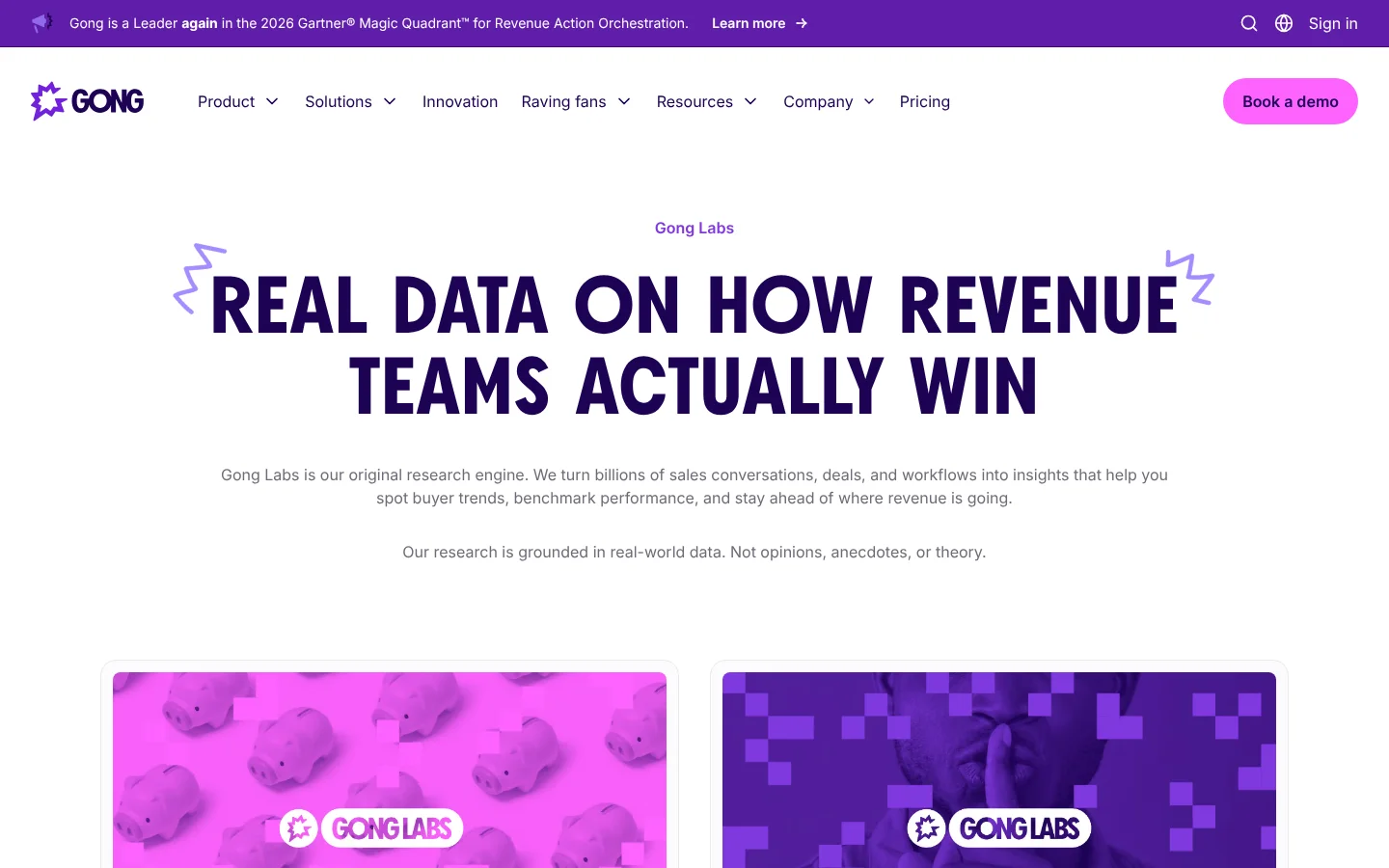
Gong is a revenue intelligence software company that records and analyzes sales calls, emails and deals. Gong Labs publishes monthly research drawn from billions of sales interactions across more than 5,000 companies.
The research goes out as articles, playbooks and a LinkedIn newsletter. Anyone can cite the findings for free with credit to Gong and a link back to the report.
Why it works:
- One data source feeds articles, playbooks and social posts every month.
- Free citing turns press, analysts and partners into extra channels for the research.
- Each finding speaks to revenue leaders, who are the people Gong sells to.
What you can borrow:
- Turn the data your product already collects into a regular research series.
- Let others quote your research for free, as long as they link back.
2. Ahrefs
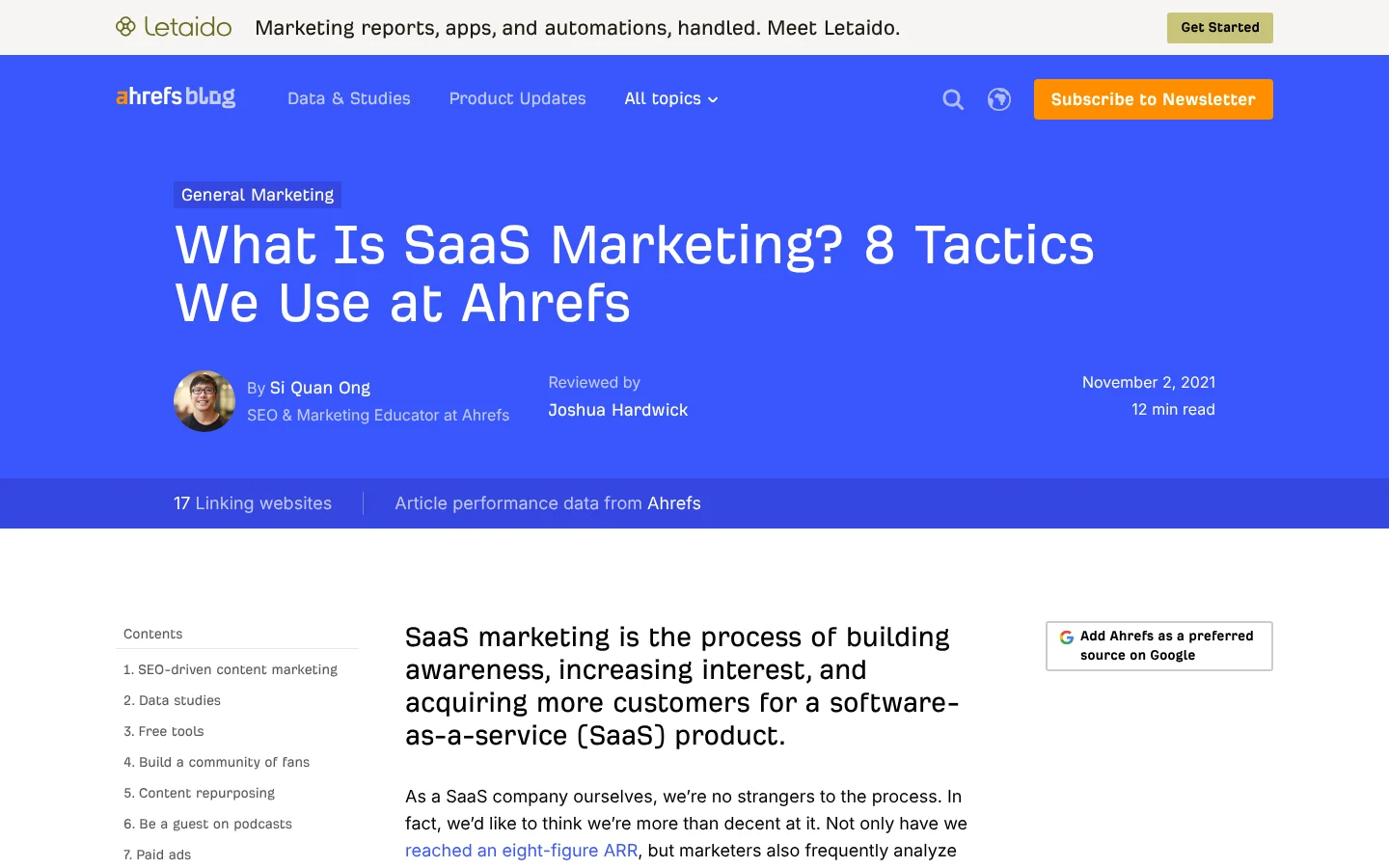
Ahrefs is an SEO software company that sells tools for keyword research, backlink analysis and site audits. Ahrefs pitches its product in every piece of content it creates, from blog posts to YouTube videos.
The team picks topics with a business potential score, which rates how naturally the product fits a topic. Each main piece then gets cut into smaller versions for other channels, such as a blog post turned into a Twitter thread.
Why it works:
- Readers see the product solve their problem while they learn how to solve it.
- Smaller versions reach people on the channels they already use each day.
What you can borrow:
- Score topics by how well your product fits them before you write.
- Plan the smaller versions in the brief for every main piece.
3. Atlassian Team Playbook
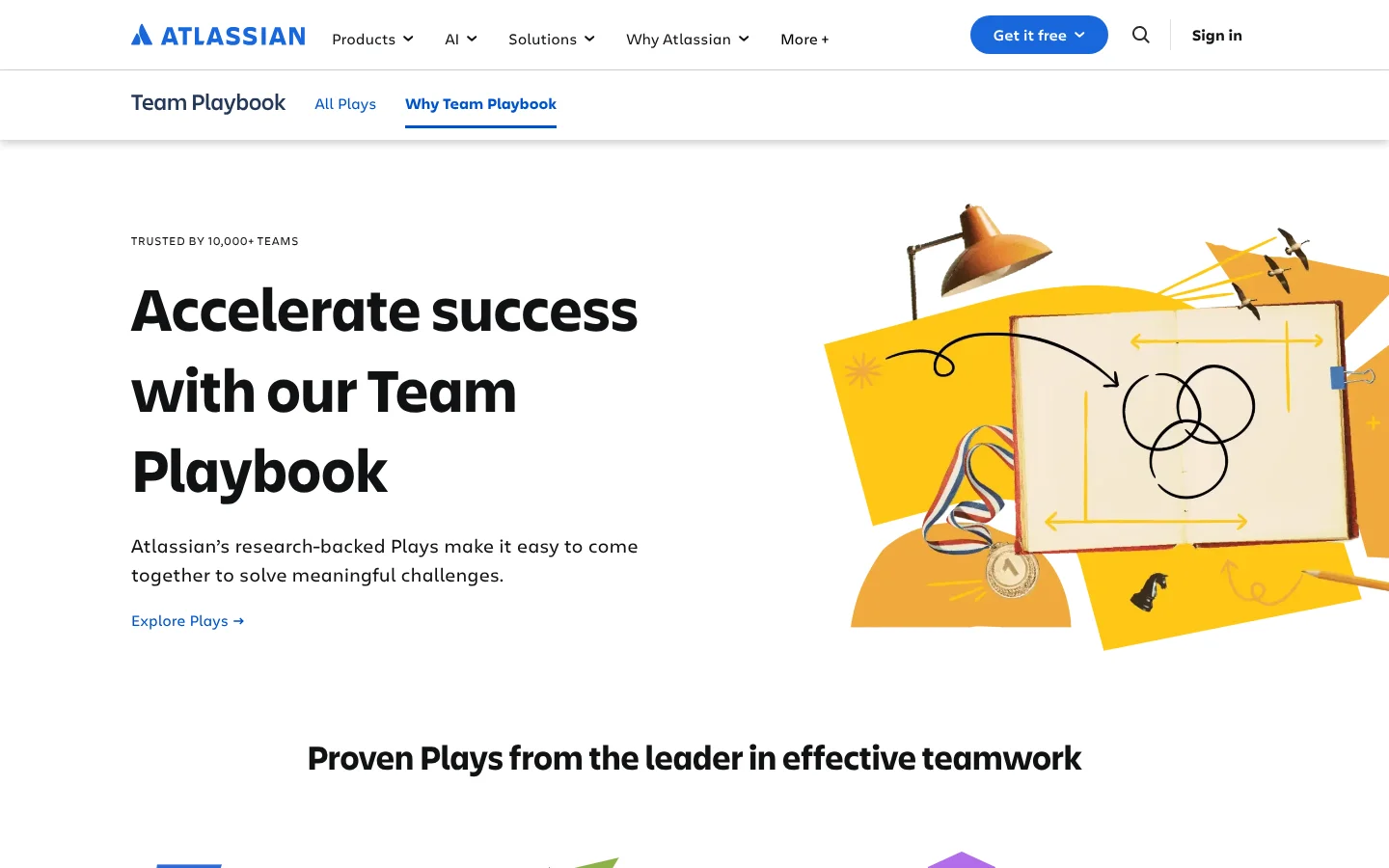
Atlassian is a software company that makes team tools such as Jira and Confluence. Its free Team Playbook holds research-backed exercises, called Plays, for goal setting, decisions, project planning and meetings.
More than 10,000 teams use the Playbook, and some Plays come with optional templates for teams that want them.
Why it works:
- The content becomes part of how teams run their week, which keeps Atlassian close to their work.
- Optional templates give readers a natural path toward the product.
What you can borrow:
- Turn your best how-to guide into an exercise teams can run in one meeting.
- Offer a matching template inside your product for each exercise.
4. HubSpot Academy

HubSpot is a CRM software company that sells tools for marketing, sales and customer service teams. HubSpot Academy offers free online courses and certifications, and more than 200,000 professionals have earned a certificate.
The same teaching library supports Academy Onboarding, which helps new customers get the most out of HubSpot tools. Live workshops and user groups carry the lessons into the community.
Why it works:
- One library of lessons serves people who are learning and customers who are onboarding.
- Free certifications give learners a reason to finish each course.
What you can borrow:
- Turn your core guides into a short course with a certificate at the end.
- Reuse the same lessons in your customer onboarding emails and calls.
Content activation checklist
Run this checklist for every major piece before launch, and again at day 30. The card below holds the six checks that matter most:
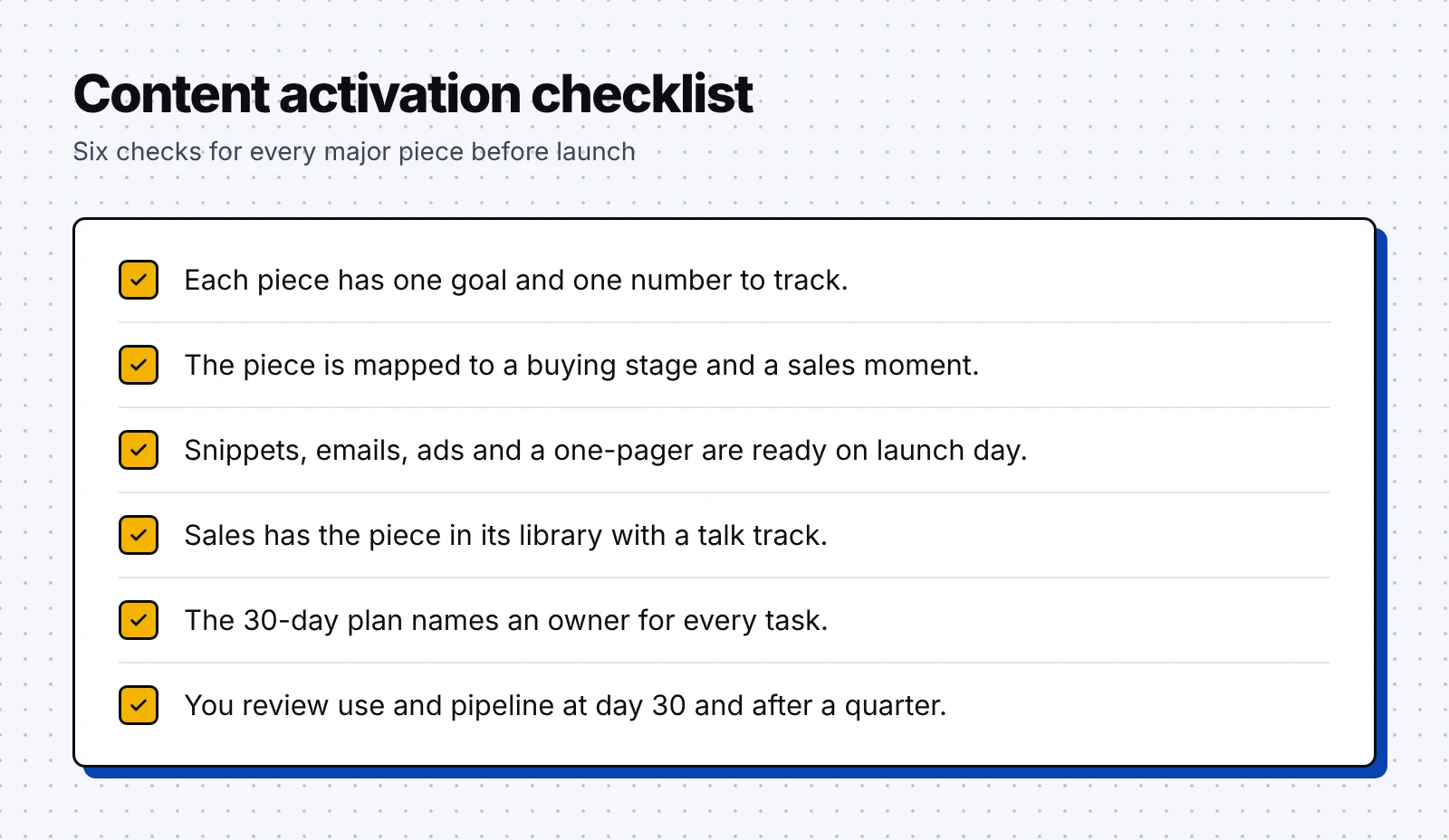
The full list follows the steps in this guide, so you can hand each group to the person who owns it.
Plan
- The brief names one goal and one number to track.
- The piece maps to a buying stage and at least one sales moment.
- Your best reps have checked the angle against real deal questions.
Package
- Social posts, emails and ad versions are written before launch day.
- The sales one-pager has the main point, three proof points and a link.
- Partners and the product team have their own short versions.
Launch
- The piece sits in the sales library with a talk track.
- Sales has seen a short walkthrough at its weekly meeting.
- Every task in the 30-day plan has a date and an owner.
Measure
- You can see how often reps, emails, ads and partners share the piece.
- Your CRM links the piece to the opportunities it touched.
- You review results at day 30 and after a quarter, then retire or reuse.
For the planning work that comes before activation, use our B2B content marketing strategy checklist.
FAQ
What is content activation?
Content activation is the work of getting each published piece used by sales, in email, in ads, by partners and inside your product. It gives every piece a goal, a set of channel versions and an owner, so it reaches buyers and helps move deals.
What is the difference between content activation and content distribution?
Content distribution puts a piece in front of an audience through channels like social media, email and search. Content activation includes distribution and adds sales use, partner reach, in-product placement and pipeline tracking.
How much B2B content goes unused?
Forrester estimates that 65% of the content marketing assets B2B companies produce go unused because they are irrelevant. In a 2023 Forrester survey, 53% of respondents said sales used fewer than half of their enablement materials.
Who owns content activation?
The content lead usually owns the plan, while demand generation, sales enablement and partner teams run their own channels. Name one owner for each piece, so every task in the 30-day plan has someone behind it.
How do you measure content activation?
Track how often reps, emails, ads and partners share each piece, then link it to the opportunities where a contact viewed it. Review the numbers at day 30 and again after a quarter.
How long should a content activation plan run?
Plan the first 30 days in detail, since most channel work happens in that window. After that, keep strong pieces in nurture emails and the sales library, and refresh them each quarter.
A good first step is to pick your strongest piece from last quarter and build its kit this week, starting with a one-pager and an email for reps. If you'd like a hand with the plan, book a discovery call with our team.