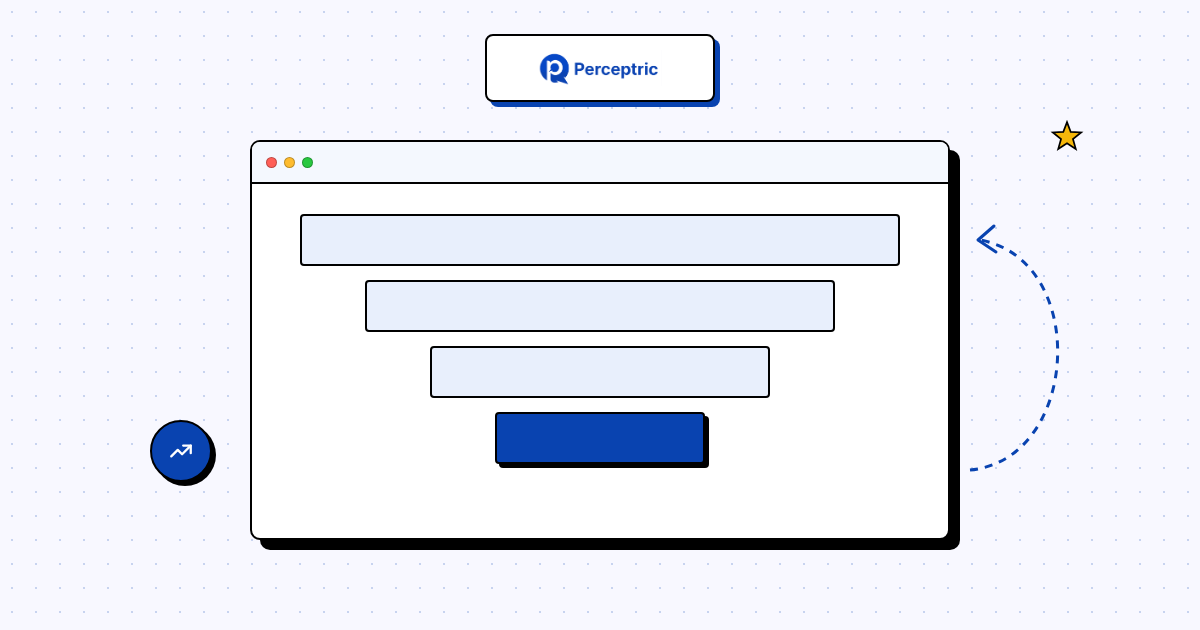
Every B2B marketer has drawn the funnel. Awareness at the top and a sale at the bottom, with buyers moving down in a neat line. The trouble is that real buyers don't move in a line. They jump around and do most of their research where you can't see it.
This guide shows you how a demand generation funnel works in 2026. You'll get the four stages, what to run at each one, the one metric that matters at each stage and real conversion benchmarks. There's also a calculator to work out what your funnel needs to hit your revenue goal.
- The funnel is a loop. B2B buyer journeys average 88 touchpoints over 272 days, and buyers move back and forth between stages (Dreamdata).
- Most of the funnel happens before sales. Buyers first contact a seller 61% of the way through the journey (6sense).
- Each stage has one job. Create demand, capture it, convert it, then expand it.
- Inbound demand converts far better. At Cognism, it took 25 inbound leads to close a deal, compared with 500 content downloads.
- Fix the leakiest stage first. Working backward from your revenue goal shows exactly where the funnel breaks.
What Is a Demand Generation Funnel?
A demand generation funnel maps how buyers go from not knowing you to becoming customers who stay and grow. It covers the full journey, starting well before anyone fills out a form.
A sales funnel usually starts when a lead enters the CRM. A demand gen funnel starts earlier. It includes the posts and peer conversations that make a buyer trust you before they ever visit your site.
| Sales funnel | Demand generation funnel | |
|---|---|---|
| Starts at | A lead or first sales contact | First exposure to your brand |
| Main focus | Moving leads to a closed deal | Building, capturing and growing demand |
| Owned by | Sales | Marketing and sales together |
| Ends at | Closed-won | Retention, expansion and referrals |
Why the Classic Funnel Doesn't Match How Buyers Buy
The old funnel assumes you can see and guide every step. Today's B2B buyers research alone and talk to peers long before they talk to you.
| Stat | Insight | Source |
|---|---|---|
| 88 touchpoints | make up a typical B2B buyer journey, up from 76 | Dreamdata2026 · Client data |
| 272 days | is the average B2B buyer journey, up from 211 days | Dreamdata2026 · Client data |
| 19% of the journey | is the sales cycle. The rest happens before buyers talk to sales. | Dreamdata2026 · Client data |
| 61% of the journey | is done before buyers first contact a seller | 6senseNov 2025 |
| 83% of software buyers | change their first vendor list after research | Gartner2025 |
So think of the funnel as a loop. A buyer might read a comparison page, leave for months, see your founder's post, ask ChatGPT about you, and then book a demo. Your job is to be useful at every one of those moments.
The 4 Stages of the B2B Demand Generation Funnel
| Stage | Goal | Main channels | Key metric |
|---|---|---|---|
| 1. Create | Make buyers aware of the problem and of you | LinkedIn, thought leadership, podcasts, research | Branded search and direct traffic |
| 2. Capture | Be found when buyers start looking | Bottom-funnel SEO, AI search, paid search, review sites | Inbound demo requests |
| 3. Convert | Turn interest into a closed deal | Demos, trials, sales calls, case studies | Opportunity to close rate |
| 4. Expand | Keep customers and grow accounts | Onboarding, customer content, referrals | Net revenue retention |
Stage 1: Create demand
Most of your future buyers aren't looking yet. A common rule of thumb from the LinkedIn B2B Institute says only about 5% of B2B buyers are in-market at any time. Creating demand means reaching the other 95% with ideas that stick, so you come to mind when their time comes.
- Founder-led LinkedIn postsShare real lessons and opinions every week. People trust people more than logos.
- Original researchPublish data your market can't get anywhere else. It earns links and AI citations.
- Podcasts and communitiesShow up where buyers already listen and ask questions.
Stage 2: Capture demand
When buyers start looking, you need to be easy to find and easy to choose. Capture is where demand you created turns into hand-raisers.
- Bottom-funnel SEOComparison, alternatives, pricing and use-case pages for the searches buyers make right before they choose.
- AI searchClear, sourced answers so ChatGPT and Google's AI Overviews cite you when buyers ask for options.
- Paid searchBranded and competitor terms first, then category terms that convert.
- Review sitesA strong G2 or Capterra profile. 45% of software buyers say review citations make them trust AI answers most (G2).
Stage 3: Convert
Conversion is where marketing and sales work as one team. The buyer has done most of their homework. Now they want proof, a clear price and a fast, helpful sales process.
- Fast follow-upThe vendor a buyer favors before talking to sales wins about 80% of deals (6sense). Reply to demo requests in minutes.
- Focused demosShow the outcome the buyer cares about, using their use case.
- Proof at every stepCase studies and ROI numbers that answer the doubts of each person in the buying group.
- Help sales check AI answers69% of B2B buyers want a sales rep to confirm what AI told them (Gartner). Give reps clear facts to share.
Stage 4: Expand
The funnel doesn't end at the sale. Happy customers renew, buy more and tell peers about you, which feeds the top of the funnel again. That's the loop.
- Onboarding contentHelp new customers get value fast, so they stay.
- Customer storiesTurn results into case studies that help the next buyer decide.
- Referral and review asksAsk happy customers for reviews and introductions at the right moment.
Demand Generation Funnel Benchmarks
Here's what real data says about conversion at each stage. Use these as a rough guide and compare them with your own CRM numbers.
| Stat | Insight | Source |
|---|---|---|
| 2.6% of B2B visitors | from SEO become leads, compared with 1.5% from PPC | First Page SageMar 2025 · Client data |
| 51% of SEO leads | become SQLs in B2B SaaS, compared with 26% of PPC leads | First Page SageJun 2025 · Client data |
| 36% of SEO opportunities | close, about the same as PPC at 35% | First Page SageJun 2025 · Client data |
| 20% of demo requests | became sales opportunities at Cognism, compared with 2% of content leads | Cognism2021 data · Client data |
| 25 inbound leads | closed one deal at Cognism. It took 500 content downloads to close one. | Cognism2021 data · Client data |
| 80% of deals | go to the vendor the buyer favored before talking to sales | 6senseNov 2025 |
Two patterns stand out. First, the source of a lead matters more than the volume. Demand that buyers create themselves, like demo requests, converts many times better. Second, once a deal is an opportunity, channels close at similar rates. That means the biggest gains usually come from the top and middle of the funnel.
Work Backward From Your Revenue Goal
The best way to use a funnel is to plan with it. Start with your revenue goal and work backward to see what each stage needs to deliver. Change the numbers to match your business.
What you need each month
Monthly numbers assume an even pace across the year. Use your own CRM rates for the most useful answer.
If the visitor number looks out of reach, look at the conversion rates above it. Raising lead to SQL from 40% to 60% cuts the leads you need by a third. Often the fastest fix is better targeting.
How to Find and Fix a Leaky Funnel Stage
Every funnel leaks somewhere. Use these symptoms to find the weak spot.
| Symptom | Likely cause | What to try |
|---|---|---|
| Plenty of traffic, few leads | Content attracts the wrong readers or has no clear next step | Build bottom-funnel pages and add one clear call to action per page |
| Lots of leads, few SQLs | Most leads are downloads with little buying intent | Shift budget toward hand-raiser offers like demos and assessments |
| SQLs stall before opportunity | Slow follow-up or weak discovery calls | Respond within minutes and prepare reps with account context |
| Opportunities lose to competitors | Buyers had a favorite before talking to you | Invest in demand creation and comparison content earlier in the journey |
| Customers churn after year one | Poor onboarding or wrong-fit customers | Tighten your ICP and improve onboarding content |
Common Demand Gen Funnel Mistakes
- Treating the funnel as a straight lineBuyers loop and jump. Make every page useful on its own, with a clear next step.
- Only measuring the bottomIf you only track closed deals, you can't see whether demand is growing. Watch the leading signals too.
- Stopping at the saleCustomers who stay and refer others are the cheapest growth you'll get.
- Optimizing each stage aloneA cheap lead that never closes is expensive. Judge each stage by its effect on revenue.
Want to go deeper on strategy? Read our guides on SaaS demand generation and the B2B demand generation playbook.
Work With Perceptric
Perceptric helps B2B SaaS companies build every stage of the demand generation funnel, from founder-led LinkedIn that creates demand to bottom-funnel SEO that captures it.
- Conversion-led SEOKeyword strategy built around commercial intent, so you rank for the searches buyers make when they compare vendors. See how it works.
- AI SEO (GEO)Content built to get cited in ChatGPT and Google AI Overviews for the questions your buyers ask. Learn more.
- LinkedIn thought leadershipFounder-led posts in your voice that build demand before buyers ever search. See the service.
FAQ
What is a demand generation funnel?
A demand generation funnel maps how buyers move from first hearing about your brand to becoming loyal customers. It usually has four stages: create demand, capture demand, convert and expand. It starts earlier than a sales funnel and includes brand building.
What are the stages of the demand generation funnel?
The four stages are create demand (build awareness and interest), capture demand (be found when buyers look), convert (turn interest into a closed deal) and expand (retain customers and grow accounts).
How is a demand generation funnel different from a sales funnel?
A sales funnel starts when a lead enters the CRM and ends at the sale. A demand generation funnel starts at first brand exposure and continues past the sale into retention and referrals.
What are good demand generation funnel conversion rates?
Benchmarks vary by company. In First Page Sage's B2B data, about 2.6% of SEO visitors become leads, 51% of SEO leads become SQLs in B2B SaaS, and about 36% of SEO opportunities close. Compare these with your own CRM data.
How do you optimize a demand generation funnel?
Work backward from your revenue goal to find the stage that needs the biggest improvement. Then fix that stage first, for example by adding bottom-funnel pages or speeding up sales follow-up.
Is the B2B funnel still relevant?
Yes, as a planning tool. Buyers don't move through it in a straight line, since journeys now average 88 touchpoints over 272 days (Dreamdata). Treat it as a loop and make every stage useful on its own.
Want to keep learning? Read our guides on lead generation vs demand generation, marketing-as-a-service agencies, lead generation strategies and content marketing for lead generation.