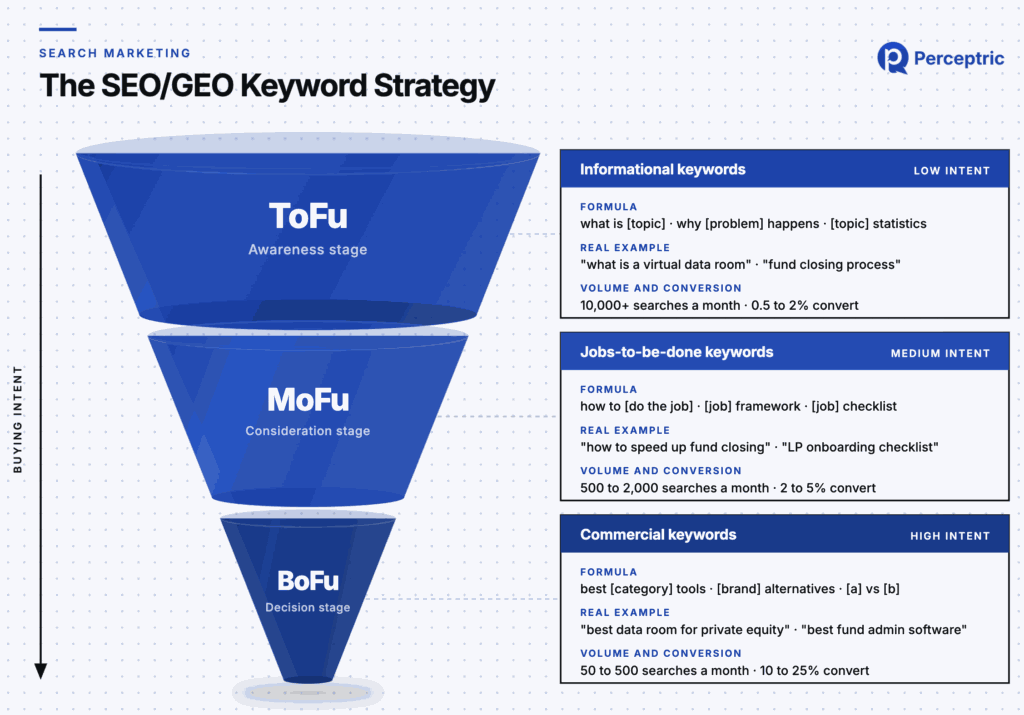
According to a HockeyStack study of 150 B2B SaaS companies, the average B2B deal takes 266 touchpoints from first touch to closed-won. Deals worth $100K or more take about 417.
That means no single ad, webinar or cold email wins a B2B deal. A long run of useful contact does, and most of it happens before the buyer ever talks to your sales team.
That's why I'm sharing the demand generation playbook I use for B2B companies with long sales cycles. It combines SEO and GEO, Google Ads and organic LinkedIn content, and it's built around one idea: buyers at different levels of intent need different things from you.
What is B2B demand generation?
B2B demand generation is building awareness and trust with the companies that will buy from you, long before they're ready, then spotting the ones that are ready and helping them buy.
Lead generation collects contact details. Demand generation makes sure that when a buyer finally makes a shortlist, your name is already on it. Selling software? Our SaaS demand generation guide shows how to fit this playbook to your sales motion and budget.
Why demand generation is hard with long sales cycles
These are the complaints I hear most from B2B teams with six- or twelve-month sales cycles:
- Channels give less for more: Paid and organic channels bring in less pipeline, while acquisition costs rise every quarter.
- Inbound is unpredictable: Some months are full and some are empty, and most inbound leads aren't worth much.
- Leads don't convert: Marketing hits its lead target, and sales says the leads were never going to buy.
- Outbound gets no replies: Target accounts have never heard of you, so cold emails go unanswered.
All four come from the same gap. The buyer's decision starts long before your funnel does.
What it takes to win a B2B deal
The bigger the deal, the more contact it takes. Here's how HockeyStack's numbers break down by deal size, counting every touchpoint and ad impression from first touch to closed-won:
| Deal size | Touchpoints to close | Ad impressions to close |
|---|---|---|
| Up to $10K | 157 | 1,390 |
| $10K to $20K | 202 | 1,797 |
| $20K to $50K | 264 | 2,589 |
| $50K to $100K | 309 | 3,035 |
| Above $100K | 417 | About 5,500 |
And that's only what software can track. You never see when your guide gets forwarded inside a company, or when a former colleague recommends you over lunch, unless you ask.
So B2B deals aren't won because someone clicked a LinkedIn ad and booked a demo. They're won through months of useful contact that builds trust before the first sales call.
The lead gen tactics that stop working
Most B2B teams still run some version of this playbook:
- Ads to demo pages: Paid ads send traffic to landing pages that give little product information and push visitors to "book a demo".
- Informational SEO: Blog posts rank for broad topics, but they attract people learning about a subject, and few of them are looking to buy.
- Gated content: Ebooks, whitepapers and webinars collect emails, on the assumption that a download means buying intent.
- Sales follow-up on every download: Someone downloads a whitepaper to learn something, and suddenly they get calls as if they were comparing vendors.
Here's why it stops working.
Buyers know who they want before they research
B2B buyers don't buy on a whim. According to Wynter's research, 92% of B2B buyers only buy from vendors on their day-one shortlist.
That means by the time someone books a demo, the shortlist is mostly set. Buyers don't compare 10 or 15 options. They pick two or three, and they usually go with the one they liked first, whether they realize it or not.
So the deal is won much earlier, when buyers first learn who knows their problem best.
Buyers want to do their own research
Buyers don't want to be pushed into a funnel, and they don't want to sit through a webinar that turns out to be a product pitch. They'd rather find you and decide on their own.
Here's what a real B2B buyer journey can look like. It starts with a LinkedIn post from a founder they follow and ends with a pilot 14 months later, and only some of the steps show up in your reporting:
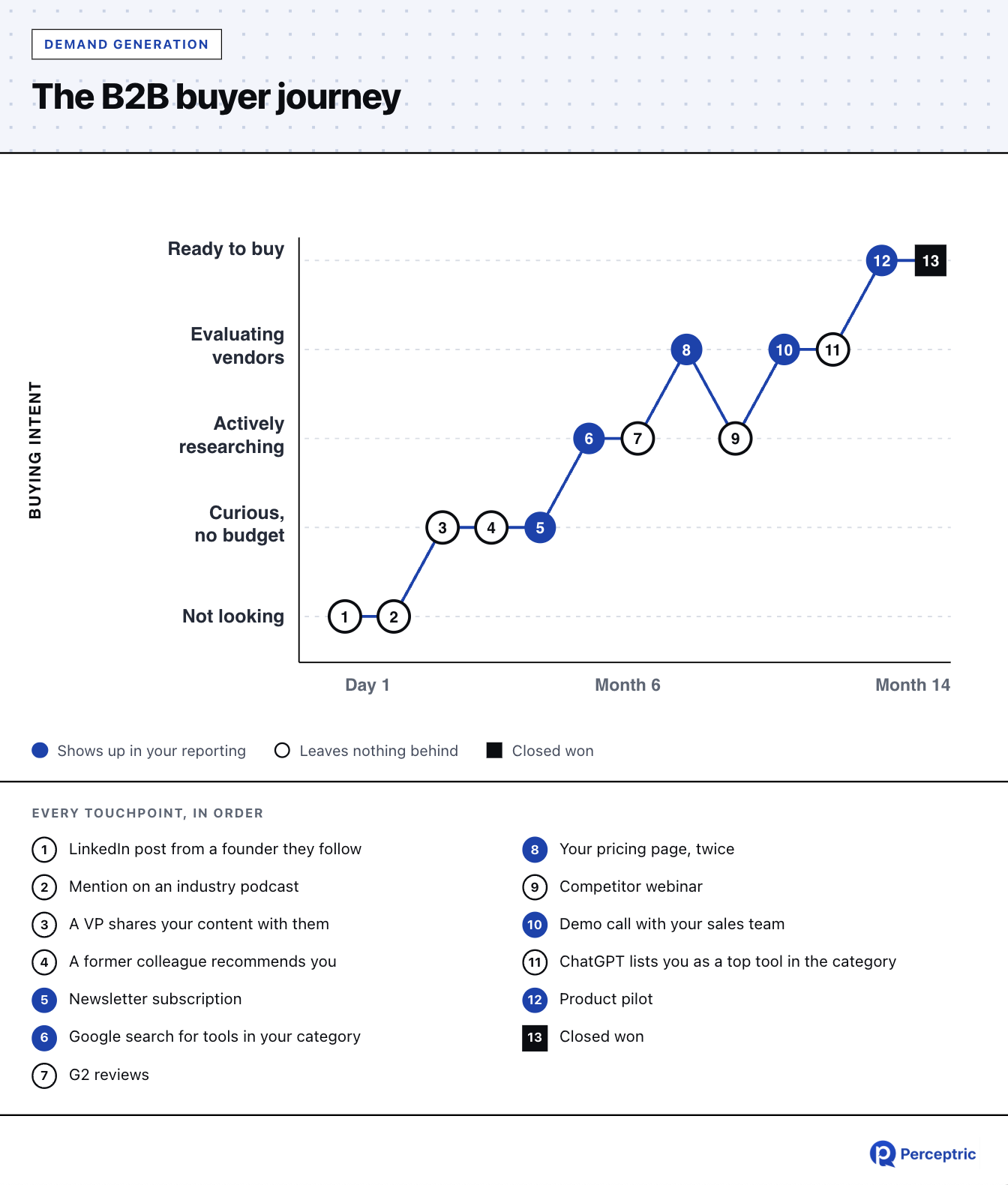
Two things stand out. The path jumps back and forth, and the steps that move the buyer most, like a former colleague's recommendation or a podcast mention, leave nothing in your CRM. Buyers also trust peers who have used your product more than they trust your website.
The B2B demand generation playbook
Here's my process. It has three parts, and each one builds on the last.
1. Plan content for three levels of intent
At any moment, only about 5% of your market is ready to buy, a rule of thumb from the LinkedIn B2B Institute. The other 95% are reading, subscribing and looking around, without a budget or a deadline.
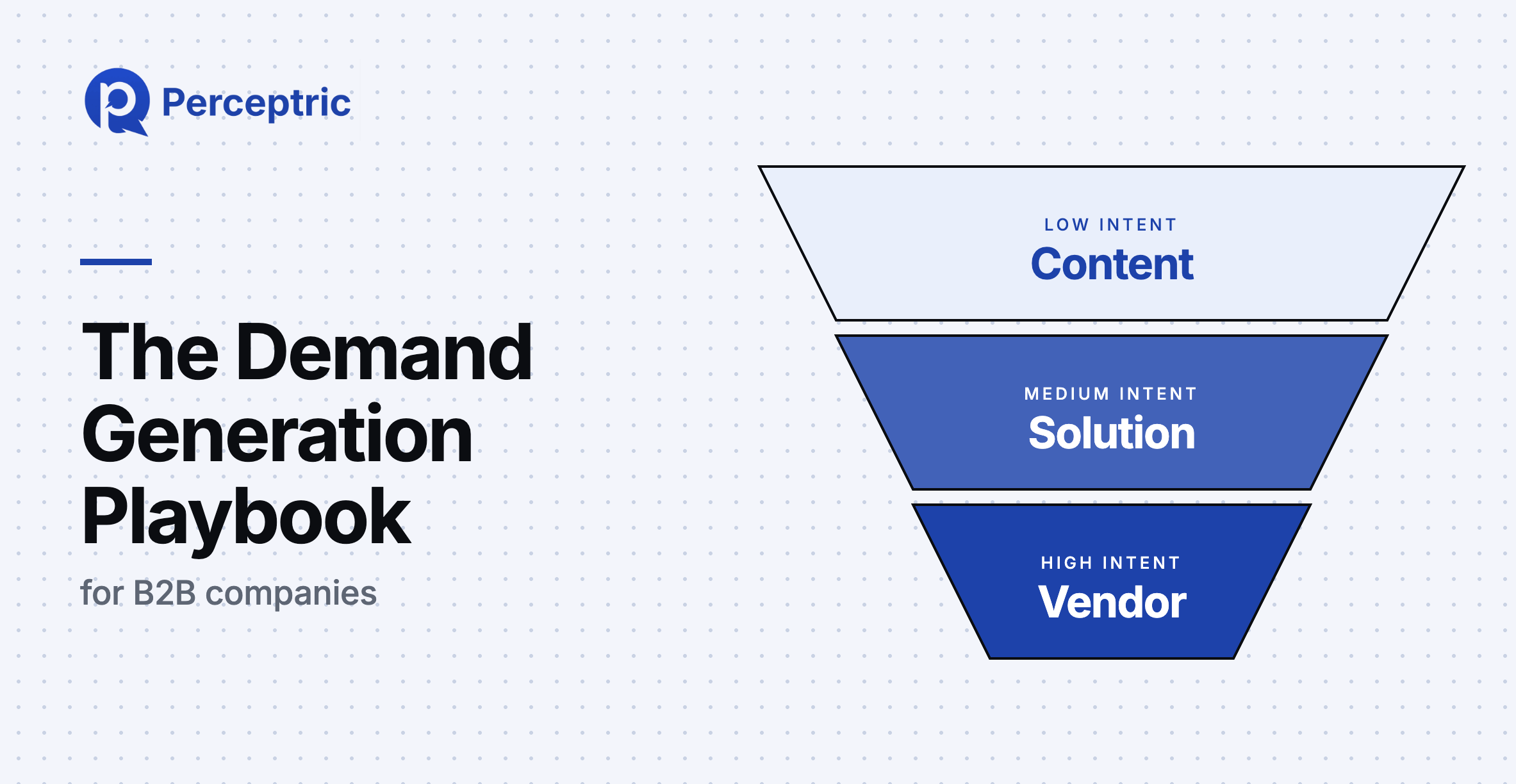
You need content for both groups, so I split buyers into three levels of intent:
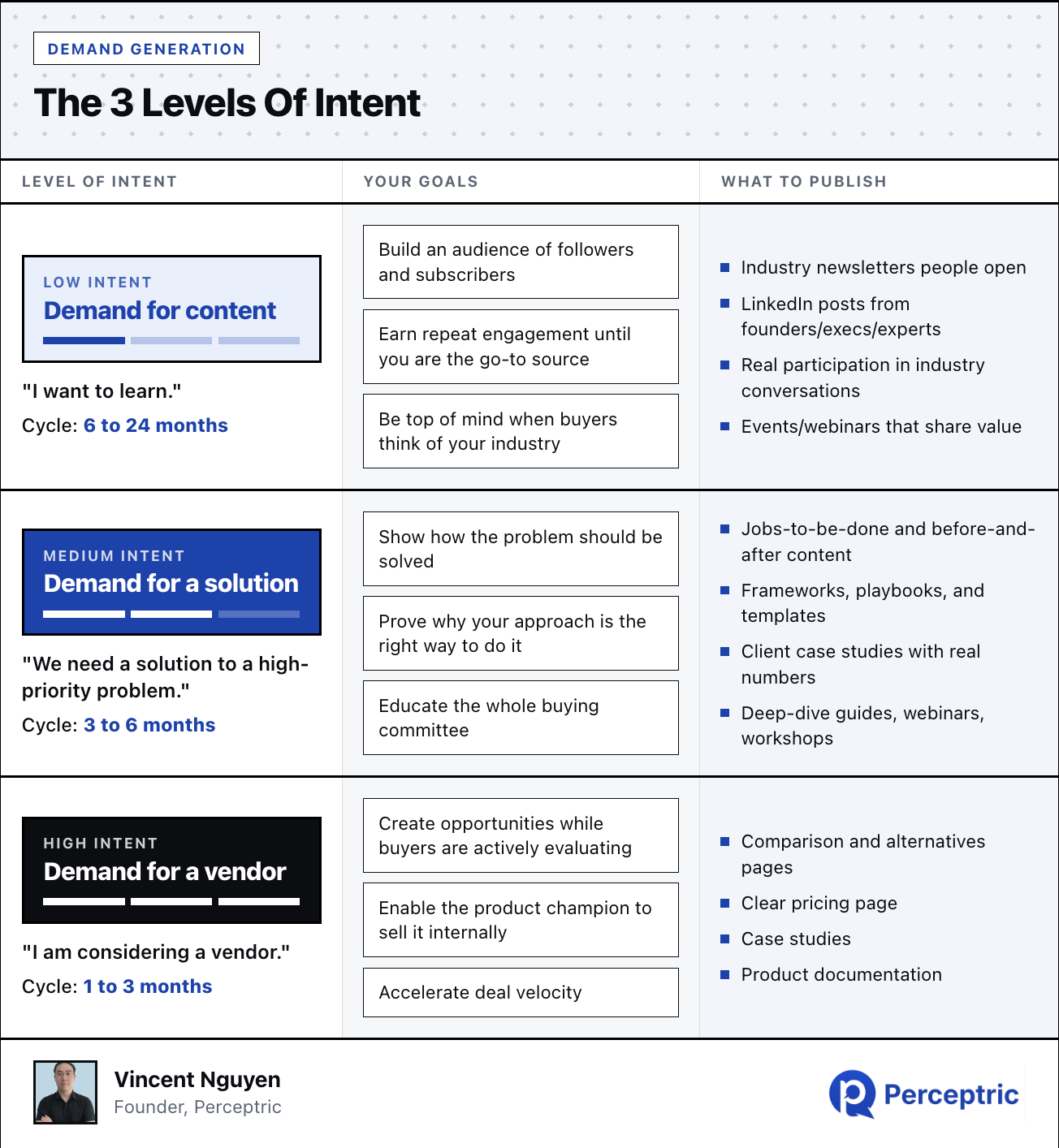
- Low intent, "I want to learn": These buyers are 6 to 24 months from a purchase. Build an audience with LinkedIn posts from founders and experts, a newsletter people open and real participation in industry conversations.
- Medium intent, "We need to solve this problem": These buyers are 3 to 6 months out. Show how the problem should be solved with frameworks, templates, case studies with real numbers and guides the whole buying committee can read.
- High intent, "I'm considering a vendor": These buyers are 1 to 3 months out. Give them comparison and alternatives pages, a clear pricing page, case studies and product documentation, so your champion can sell you internally.
Most B2B teams only publish for the high-intent group, then wonder why their pipeline is thin. The low-intent group is where next year's pipeline comes from.
2. Distribute every piece four ways
No matter how good your content is, it won't do anything if nobody sees it. Traffic doesn't show up because you published a blog post, so plan content distribution before you write.
Here are the four ways I distribute each piece:
- Organic: Post on LinkedIn, X or YouTube, wherever your ICP is, join the Reddit threads and Slack groups where they talk, and use SEO so the piece keeps getting found months later.
- Paid: Put ad money behind what already works, such as your best-performing LinkedIn posts, and retarget people who showed intent on your website.
- One to one: Give your account executives a shared library of your best content. Instead of "just checking in", an AE can send the security guide to the IT lead who joined the last call.
- Partners: Borrow audiences through guest posts, podcast interviews and research you create with a partner, since a trusted voice in your industry builds trust much faster than a brand ad.
3. Match your next move to the buyer's signal
Once you've built demand, you need to capture it. What a buyer does tells you how much intent they have, and your next move should match it.
A webinar sign-up doesn't mean someone is ready to buy, so it shouldn't trigger a sales call. But when several people from one company read your pricing page in the same week, that's a strong signal. Here's how I'd respond to the most common ones:
| What the buyer did | Intent | What to do next |
|---|---|---|
| Engaged with a LinkedIn post | Low | Connect, ask one question about their work and send one piece of content that helps |
| Subscribed to your newsletter | Low | Tag their topics, send your best pieces in the welcome email and wait for a second signal |
| Signed up for a product webinar | Medium | Send the recording, retarget with case studies and offer a call with an expert |
| Viewed your pricing page twice in a week | High | Route to sales, retarget with a customer story from their segment and offer a scoped pilot |
| Booked a demo | High | Check fit with your ICP, route to the right AE and prepare a business case for the champion |
The goal is to stay useful at every level. Low-intent buyers get content, medium-intent buyers get proof and high-intent buyers get a person.
Conclusion
It takes hundreds of touchpoints to close a B2B deal, and the shortlist is set long before the first call. My principles for demand generation in long sales cycles are simple:
- Build awareness long before the buyer is ready
- Publish for every level of intent
- Distribute each piece four ways
- Let the buyer's signal decide your next move
If you only try to capture people who are already buying, you're competing for the 5% everyone else is fighting over. Wouldn't you rather be the name the other 95% already know?
Work with Perceptric
At Perceptric, we run this playbook for B2B SaaS companies, with conversion-led SEO, AI SEO (GEO) and LinkedIn thought leadership. We've worked with B2B software brands like Katalon, Arrowsterr and Omniscient, and at Katalon we helped grow ARR 4x.
FAQ
What is B2B demand generation?
B2B demand generation is building awareness and trust with the companies that will buy from you before they're ready, then spotting the ones that are ready and helping them buy. Its goal is to get you on the buyer's shortlist early.
How many touchpoints does it take to close a B2B deal?
A HockeyStack study of 150 B2B SaaS companies found the average deal takes 266 touchpoints from first touch to closed-won, and deals worth $100K or more take about 417. Many more interactions, like word of mouth, never show up in analytics.
Why do gated content and demo-first ads stop working in B2B?
Most people who download an ebook just want to learn, so sales follow-up comes too early. Buyers also prefer to research on their own, and Wynter found 92% of B2B buyers only buy from vendors on their day-one shortlist.
What percentage of B2B buyers are ready to buy right now?
About 5% of the market is ready to buy at any given time, according to the LinkedIn B2B Institute's 95:5 rule of thumb. The other 95% are researching, so you need content that reaches them before they need a vendor.
What are the three levels of buyer intent?
Low intent buyers want to learn and are 6 to 24 months from buying. Medium intent buyers need to solve a problem within 3 to 6 months, and high intent buyers are comparing vendors and could buy within 1 to 3 months.
Want to keep learning? Read our guides on marketing-as-a-service agencies, content marketing for lead generation, inbound vs outbound lead generation and SaaS marketing agency pricing.