According to Bain & Company's Global Private Equity Report 2026, buyout fundraising dropped 16% to $395 billion in 2025, and LPs have become much more demanding.
That means a good track record alone may not close your next fund. Bain found that LPs favor funds with a clear, repeatable and easily explained strategy. Explaining your strategy in public, again and again, is exactly what content does well.
Most of my 10+ years have gone into growing B2B SaaS brands, which is the world many venture and growth equity firms invest in. A lot of that playbook carries over to selling a fund. So here's how I'd approach content marketing for private capital, in six steps, with real examples from firms that do it well.
What is content marketing for private capital?
Content marketing for private capital is publishing insights, research, guides and stories that help LPs, founders and business owners understand how your firm thinks and why they should work with you. It applies to private equity, venture capital, growth equity and private credit firms.
It works like any B2B content program, with two big differences. You write for several audiences at once, and if your firm is an SEC-registered adviser, compliance has to review anything that could count as an advertisement.
Why private capital firms need content marketing
Your firm sells twice. You raise money from LPs, and you compete for deals with founders and owners who can often choose between several investors. Both groups research you long before the first meeting, and the long, complex way they make decisions looks a lot like B2B buying.
Paid ads don't help much here. A founder doesn't pick a lead investor from a banner ad, and fund marketing comes with legal limits. Content keeps working instead: a strong guide for founders can bring in deal flow for years, and a clear market view gives LPs a reason to take the meeting.
My approach: Knowledge and Narrative content
I plan every program with my Knowledge-Narrative content strategy. It splits your content into two jobs:
- Knowledge content: It answers the questions founders and owners already search for, such as "how to prepare for due diligence" or "what is a recapitalization." This is your SEO content, and it brings in new readers every month.
- Narrative content: It shares your thesis, your market view and the lessons your partners have learned from real deals. This is your thought leadership, and it's what LPs and founders remember.
You need both. Knowledge content gets you found, but on its own it can sound like every other firm. Narrative content shows how you think, which is what people are really buying when they pick an investor.
How to build a private capital content program: 6 steps
Here's my process. Work through the steps in order, since each one feeds the next. And start with one channel you can do well, usually your website and your partners' LinkedIn profiles, before you add a podcast or a newsletter.
1. Decide which audience each piece is for
An LP deciding on a commitment and a founder deciding on a term sheet read your content for very different reasons. One piece rarely works for both, so I'd give every piece one main reader.
Here's who you're usually writing for:
- LPs and consultants: They want to see a strategy they can explain to their own investment committee. Your market views, your sector focus and how you create value inside companies matter most to them.
- Founders and business owners: They want to know what it's like to take your money. Guides on raising, selling or preparing for diligence, plus stories from portfolio CEOs, help them decide.
- Intermediaries: Bankers, brokers and advisers send you deals. A clear page on what you invest in, with check sizes and sectors, makes it easy for them to think of you.
- Future hires and operating partners: Strong people look at how a firm thinks before they join. Your content tells them that too.
To find their real questions, ask your deal team what founders ask in first meetings and ask your investor relations team what LPs ask in diligence. Those questions become your first topics.
2. Write compliance into your content process
If your firm is an SEC-registered investment adviser, the SEC Marketing Rule covers communications that offer your advisory services to prospective clients or private fund investors. Firms have had to comply since November 4, 2022, and the rule sets limits on how you show performance and use testimonials.
Fundraising adds another limit. A fund raised under Rule 506(b) can't use general solicitation, so public content shouldn't promote a fund that's in the market. Content about your sector and your thinking is a different thing, but let your counsel draw that line.
None of this means you should stay quiet. It means you should agree on the rules before you publish. Here's how I'd set it up:
- Keep fund performance out of public content: Leave returns, IRRs and multiples for materials compliance has approved. If performance does appear, the rule requires net performance next to any gross figures.
- Treat testimonials with care: A portfolio CEO praising your firm can count as an endorsement under the rule, and endorsements and testimonials come with disclosure requirements. Check with compliance before you publish one.
- Add a review step: Agree on a turnaround time with compliance, so every piece goes through review without stalling for weeks.
- Keep an approved language library: Store approved descriptions of your firm, strategy and portfolio in one place. Writers reuse that wording, which makes every review shorter.
Our guide to content marketing for financial services covers compliance workflows in more detail, and our guide to financial content writing covers how to write for finance readers.
3. Start with the questions founders and owners search
Many firms start with broad pieces like "what is private equity." The problem is that a business school student searches for that too. You'll get traffic, but very few founders who are ready to raise or sell.
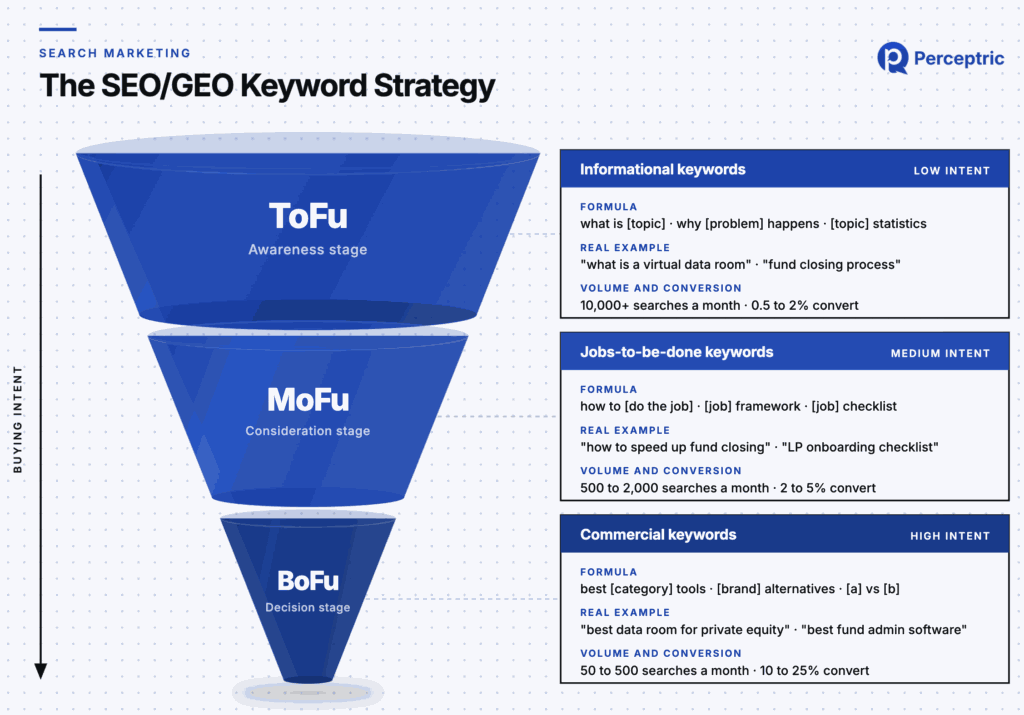
That's why I start at the bottom of the funnel (BOFU). Let's say your firm does lower middle-market buyouts. Here are the three groups of keywords I'd go after:
- Comparison keywords: Searches like "lower middle market private equity firms" or "growth equity firms for SaaS." The reader is already comparing investors, so make sure you're on the list.
- Problem keywords: Searches like "how to sell a family business" or "how to value an acquisition target." Write the most useful answer on the page, from the view of someone who has done many deals.
- Tool keywords: Searches like "due diligence checklist" or "valuation model template." Build the checklist or template, and offer it in exchange for an email.
I do my keyword research with SEMRush, Google and Reddit. Once you've covered the BOFU terms, move up the marketing funnel to broader topics. Our content marketing strategy checklist helps you put the plan together.
4. Teach founders what your partners know
Your partners have sat through hundreds of board meetings and deals. That knowledge is the most useful thing you can publish, because it's exactly what a founder can't get anywhere else.
First Round Capital does this better than almost anyone. Its First Round Review has published long, practical articles from founders and operators since 2013, on topics like hiring, management and finding product-market fit:
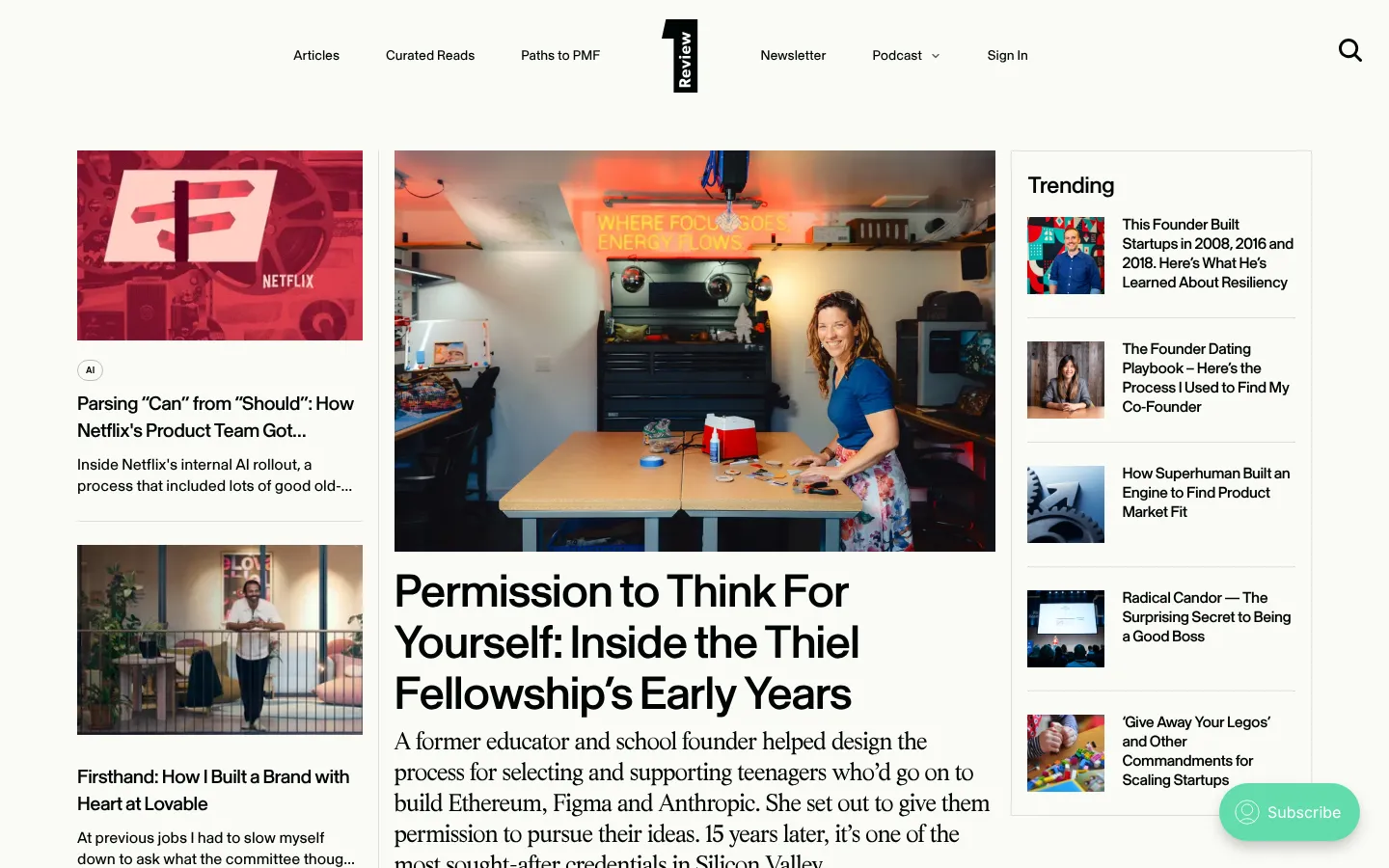
More than 200,000 readers subscribe. The articles are written to help founders, and every founder who learns from one knows which firm published it.
You don't need a full publication to start. Here's how I'd build founder-facing content:
- Interview your partners: A 30-minute call about one topic, such as building a board or a first sales team, gives you more material than any brainstorm. Record it and write from the transcript.
- Feature portfolio CEOs: Founders trust other founders. Let your CEOs share what they learned, in their own words, with compliance checking anything that praises your firm.
- Be specific: Share the actual board deck structure, the actual hiring plan or the actual diligence request list. Specific advice is what gets bookmarked and forwarded.
- Keep it practical: Write for the founder who has a board meeting next week. If they can't use it right away, cut it.
5. Share your market view on a schedule
Your market view is the Narrative part of my Knowledge-Narrative content strategy. When LPs, founders and reporters hear the same clear view from you every week, your firm becomes the one they think of for that sector.
Apollo's The Daily Spark is a good example. Apollo's chief economist, Torsten Slok, publishes a short note on the economy, inflation or capital markets almost every day, usually with one or two charts and a plain bottom line:
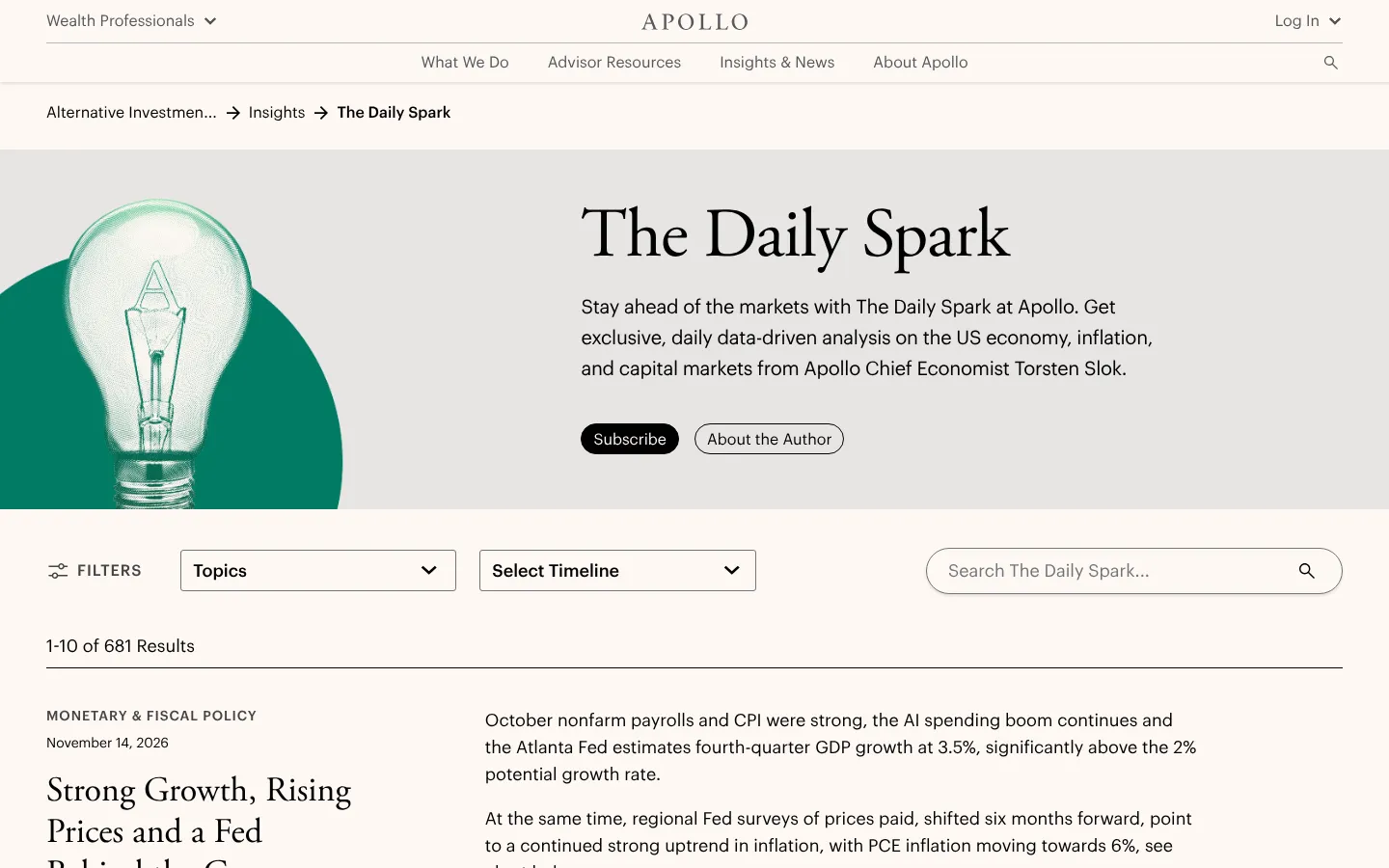
Each note takes a few minutes to read, and the archive now runs to hundreds of posts.
Your market view doesn't need to be a daily chart. A partner's short post on LinkedIn can do the same job. Here's Noah Greenberg, CEO of Stacker, sharing a simple, casual take that still gets people talking:

Here's how I'd build your market view into content:
- Write down your thesis: Most firms started because the founders saw a market others were missing. Interview them about what they saw and why they still believe it.
- Pick a format you can keep up: A weekly chart, a monthly letter or a quarterly sector note all work. A smaller format you publish every time beats a big one you publish twice.
- Use your own data: Deal teams see valuation trends, sector benchmarks and deal terms that few people outside the firm can see. Anonymized and approved by compliance, that data makes content nobody can copy.
- Give it a face: Put a named partner on each piece. Readers remember a person's view far more easily than a firm's.
6. Distribute through your partners and your portfolio
After you publish, you can't expect LPs and founders to find everything on their own. Search brings steady traffic over time, but everything else needs a push.
Here are the channels I'd use for private capital:
- Your website: Link your articles to each other, especially from high-traffic guides to your market views, which get little search traffic on their own.
- Partners' LinkedIn profiles: Break articles into short posts and share them from your partners' personal profiles. People read posts from people far more than posts from a firm's page.
- A newsletter: Email is the one channel you own. Platforms like beehiiv, MailerLite, Kit and Substack make it easy to start, and your LP updates can link to your best public pieces.
- Your portfolio: Ask portfolio CEOs to share the pieces they appear in. Their networks are full of the founders you want to meet.
- Intermediaries: Send bankers and brokers your guides and your investment criteria. Make it easy for them to forward you to the right owner.
Then measure what matters: inbound deals and the source of each one, founder and LP meetings where content came up and newsletter growth among the people you want to reach. Our guide to content distribution channels compares the options in more detail.
Conclusion
Private capital comes with extra rules. Even so, my principles stay the same as in any other niche:
- Write each piece for one reader
- Agree on the compliance rules before you publish
- Teach what your partners know
- Share your view on a schedule you can keep
Getting partners to write takes time they don't feel they have. But if you were a founder choosing who sits on your board for the next five years, wouldn't you want to know how they think first?
Work with Perceptric on private capital content
Perceptric is a B2B SaaS SEO/GEO and LinkedIn thought leadership agency. We build an Organic Content Engine that brings pipeline every quarter, and we've worked with B2B software brands like Katalon, Arrowsterr and Omniscient.
To be honest, we know software buyers best. So we fit best if you're a venture or growth equity firm that invests in B2B software and wants founders to find you. Here's how we work:
- Your deal team shapes the plan: We start from the questions founders ask in first meetings, because the people closest to the deal should inform your content strategy.
- BOFU comes first: We go after the comparison, problem and tool keywords founders search when they're ready to raise or sell.
- Partners shape every piece: We interview your partners, so the content has details a generalist writer can't make up.
- LinkedIn is part of the plan: We turn your partners' views into LinkedIn posts, so each piece reaches people beyond search.
FAQ
What is content marketing for private capital?
Content marketing for private capital is publishing insights, research and guides that help LPs, founders and business owners understand how a private equity, venture or private credit firm thinks. Good content makes a firm's strategy easy to explain and easy to remember.
Why do private capital firms need content marketing?
LPs have become more selective and favor strategies that are clear and easy to explain, while founders research investors before they take a meeting. Content explains your strategy to both groups and keeps bringing in deal flow over time.
Does the SEC Marketing Rule apply to private capital content?
It can, if your firm is an SEC-registered adviser and the content offers your services to prospective clients or fund investors. Keep fund performance out of public content and have compliance review anything that could count as an advertisement, a testimonial or an endorsement.
What type of content works best for private capital?
Start with bottom-of-funnel guides for searches like "lower middle market private equity firms" or "growth equity for SaaS." Then add practical advice for founders, portfolio stories and a regular market view from your partners.
How should private capital firms measure content marketing?
Track business outcomes instead of traffic alone: inbound deals and where they came from, founder and LP meetings where content came up and newsletter growth among your target readers.
Pick the question founders ask most in your first meetings and publish one great answer to it this month. To plan the full program with us, book a discovery call with our team.
Want to keep learning? Read our guides on content marketing for manufacturing industry, content marketing for industrial equipment, industrial content marketing and B2B healthcare content marketing.