

Financial content writing is the work of explaining money topics, like loans, investing, payments and taxes, in a way readers can trust and act on. It runs under stricter rules than most marketing, because Google and regulators both care about what happens when a reader follows your advice.
I've worked on content for financial companies for years, and the most common problem is good articles stuck in review because nobody planned the expert and compliance steps.
In this guide, I'll walk you through:
- What financial content writing is and why Google treats it as a special case
- The SEC and FINRA rules that shape what you can say, with links to the source text
- A writing and review workflow you can copy, plus a pre-publish checklist
- How to explain hard topics in plain words and fact-check every number
- Six real examples of strong financial content, with what you can borrow from each
What is financial content writing?
Financial content writing covers any written piece that helps people understand or decide something about money, from blog posts and product pages to market commentary. The readers range from someone opening their first savings account to a CFO comparing payment platforms.
Several things make financial writing harder than ordinary marketing copy:
- Mistakes can cost readers real money, so search engines judge finance pages more strictly.
- Regulated firms follow advertising and communication rules, and someone usually has to approve content before it goes live.
- Many readers find money topics hard. In the FINRA Foundation's 2024 National Financial Capability Study, only 27% of respondents answered at least five of seven basic financial knowledge questions correctly.
- Rates, limits and rules change often, so an accurate article can turn wrong within a year.
Why Google holds financial content to a higher standard (YMYL and E-E-A-T)
Google's Search Quality Rater Guidelines put finance under "Your Money or Your Life," or YMYL. These are topics where a poor page could hurt a person's health, financial stability or safety, so raters review them with extra care.
The finance group covers advice or information about taxes, loans, banking, investments and similar topics. It also covers pages where people can transfer money or buy financial products online.
One detail people often miss is that rater scores don't move rankings directly. Google uses rater feedback to test changes to its systems, so E-E-A-T describes the pages those systems are built to reward.
E-E-A-T stands for four signals, and this table shows what each one looks like on a real finance page:
| Signal | What it means | What it looks like on a finance page |
|---|---|---|
| Experience | Firsthand knowledge of the topic | An advisor explaining how they walk clients through a Roth conversion |
| Expertise | Real knowledge and qualifications | Bylines from CFPs or CPAs, or a named expert reviewer |
| Authoritativeness | Recognition as a trusted source | Original data and citations from other sites |
| Trustworthiness | Accurate and honest content | Linked sources, dates, disclosures and clear site ownership |
Google's guide to creating helpful, reliable, people-first content suggests asking "Who, How, and Why" about every page. For finance, I turn that into questions at the top of every brief:
- Who wrote this, and can a reader see their credentials?
- How was it made, including who reviewed it and where the numbers came from?
- Why does it exist, and would you still publish it without any search traffic?
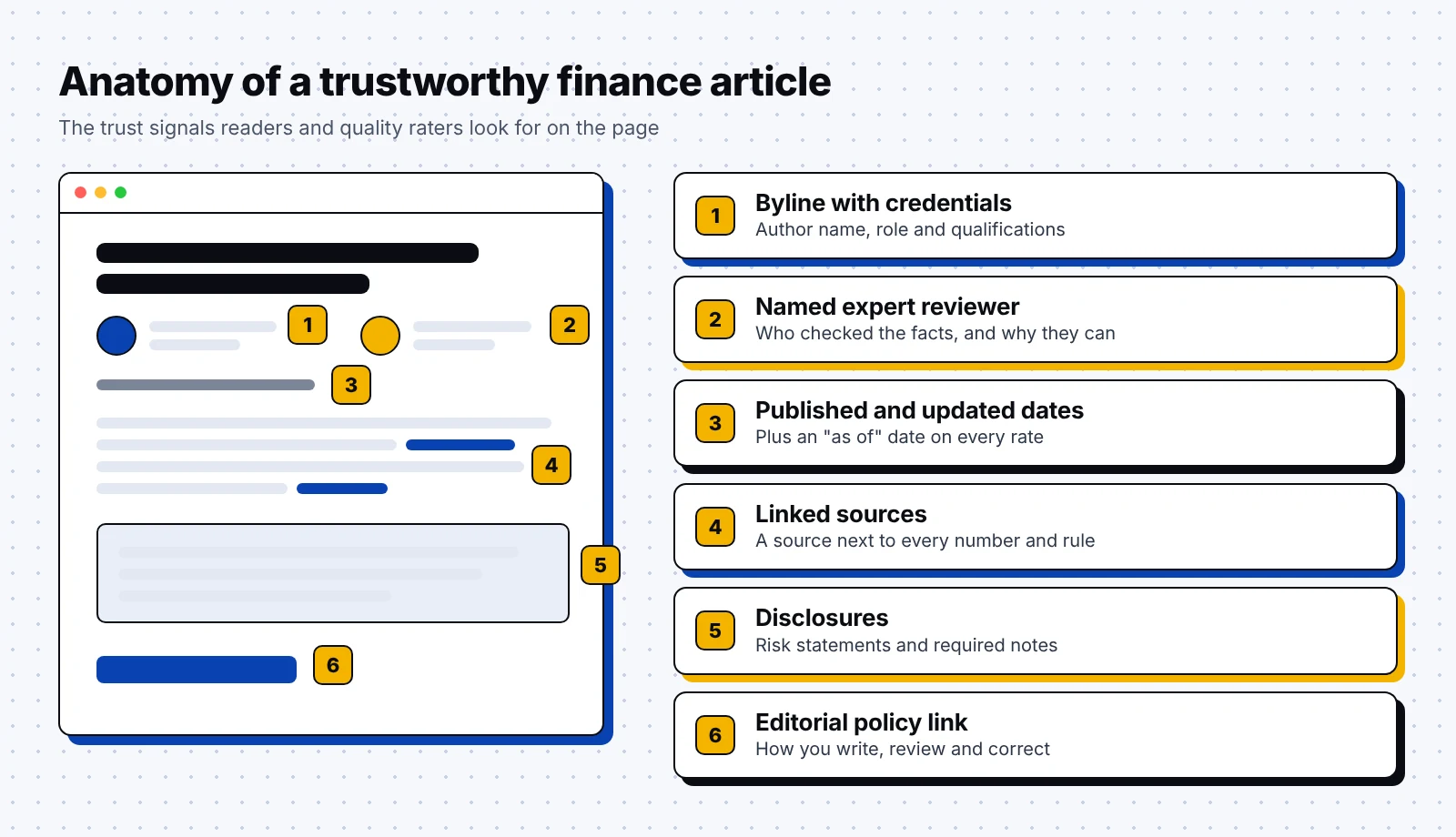
Thankfully, most of these signals cost very little to add. A real author bio, a named reviewer, a "last updated" date and a link to your editorial policy can go on every page this week.
The compliance rules that shape financial content
Honestly, the most useful thing you can do here is bring your compliance team in at the brief stage. I don't give legal advice, so treat this section as a map to the source text and confirm the details with your own legal advisers.
FINRA Rule 2210 for broker-dealers
FINRA Rule 2210 governs how member firms communicate with the public. These are the parts that matter most for writers:
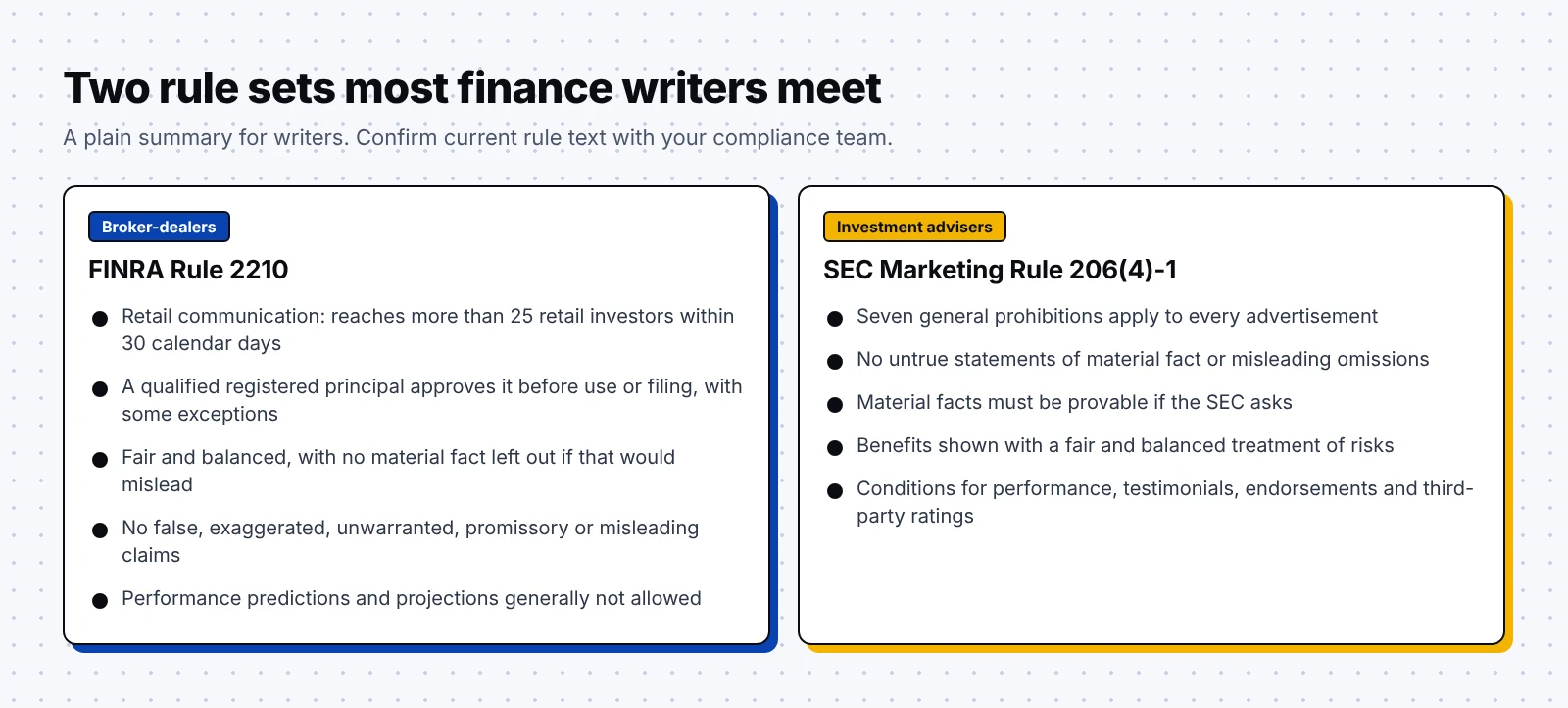
- A retail communication is any written or electronic piece that reaches more than 25 retail investors within 30 calendar days, so a public blog post counts.
- A qualified registered principal must approve each retail communication before it is used or filed with FINRA, with some exceptions.
- Content must be fair and balanced, and you can't leave out a material fact if that would mislead.
- False, exaggerated, unwarranted, promissory or misleading claims are banned, and predictions or projections of investment performance are generally not allowed.
FINRA's case against M1 Finance shows the rule covers influencer posts too. In the settlement document, FINRA found that influencer posts promoting M1 were not fair and balanced and included exaggerated and promissory statements.
This rule may change soon, because in Regulatory Notice 26-14, FINRA proposed replacing the fixed pre-use approval requirement with risk-based supervision, so check its status with compliance before you change any process.
The SEC Marketing Rule for investment advisers
Registered investment advisers follow the SEC's Marketing Rule, Rule 206(4)-1, which has required full compliance since November 4, 2022. Its seven general prohibitions apply to every advertisement, and these come up most in content work:
- No untrue statements of material fact, and no omissions that make a statement misleading.
- No material statement of fact that the adviser can't back up if the SEC asks for proof.
- Any benefits you mention need a fair and balanced treatment of the risks.
- Performance has to be shown fairly, with extra conditions for hypothetical, extracted, related and predecessor performance.
- Testimonials, endorsements and third-party ratings are allowed only when you meet the rule's conditions.
The SEC's compliance guide on investment adviser marketing is the clearest summary I've found, and I send it to every writer on adviser content.
Records, banks and everyone else
Firms also have to keep copies of what they publish. FINRA's books and records rules cover communications, and its exam guidance lists emails, text messages, chat messages and interactive blogs as examples.
Banks and insurers usually have their own advertising rules, and fintechs that work through partner banks often inherit them. Fortunately, you don't have to memorize them, because compliance can list the rules and disclosures that apply for your brief.
In my experience, these phrases come back from review with red marks more than any others:
| Phrasing that gets flagged | A safer way to say it |
|---|---|
| "Guaranteed returns" | "Returns can go up or down, and you could lose money." |
| "Risk-free" | Name the specific protection, like FDIC insurance up to the stated limit, and its conditions. |
| "The best savings account" | "Our pick for [criteria], based on [method], as of [date]." |
| "You'll retire early" | "This could help you reach a retirement goal sooner, depending on returns and fees." |
| "Beat the market" | Describe the strategy, what it aims for and the risks in plain words. |
A financial content writing workflow you can copy
Most delays I see come from review steps that start too late, so this workflow puts the expert and compliance checks early.
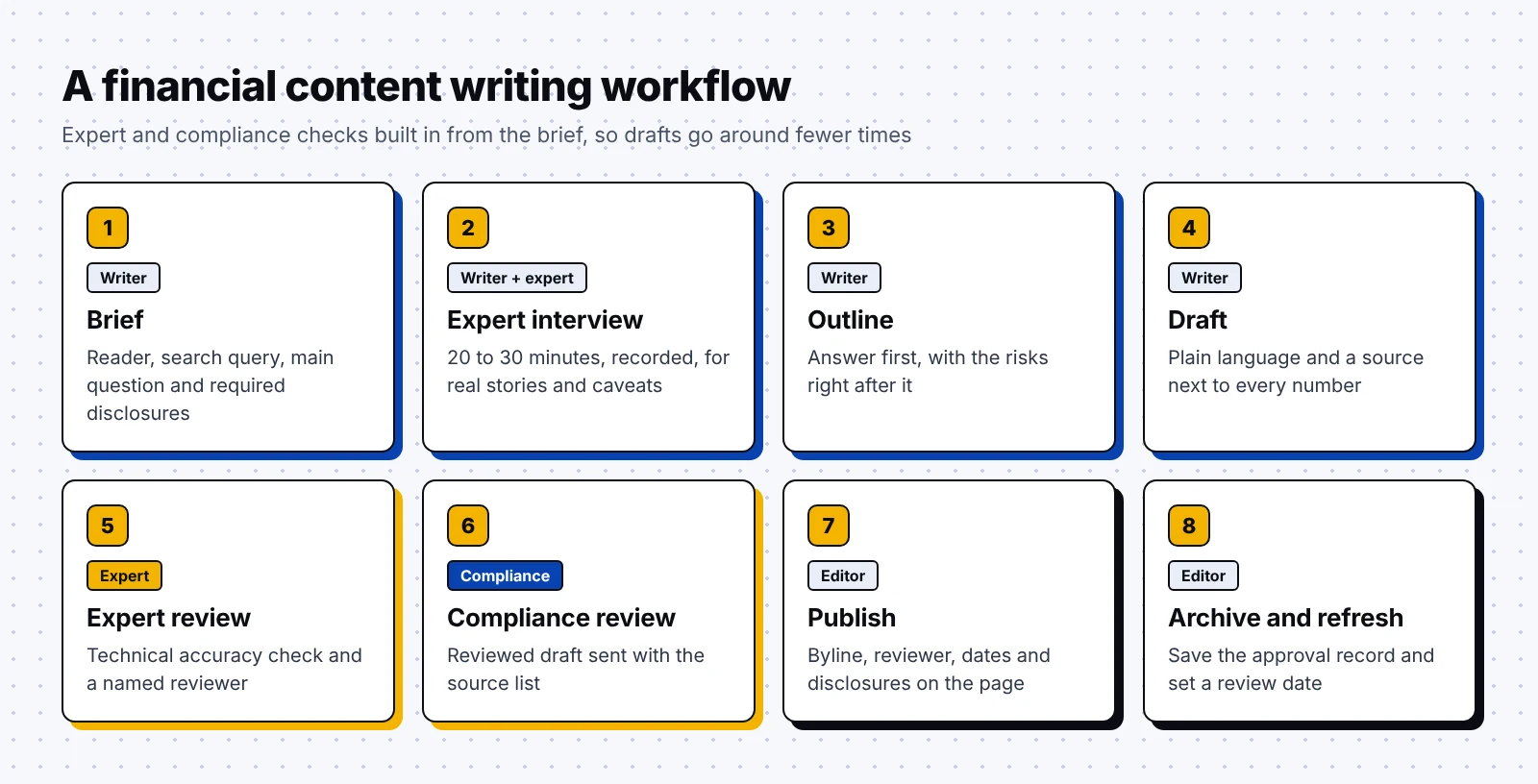
- Write a brief that names the reader, the search query, the main question and the disclosures compliance needs.
- Interview a subject matter expert for 20 to 30 minutes and record it, because their stories and caveats give the piece real experience.
- Outline with the answer first and put the risks right after it.
- Draft in plain language and add a source link next to every number and rule as you write.
- Send the draft to the expert for a technical accuracy review, and ask if you can list them as the reviewer.
- Send the reviewed draft to compliance with the source list attached.
- Do a final edit, add the byline, reviewer, "last updated" date and disclosures, then publish.
- Save the approved version and the approval record, and set a review date based on how fast the topic changes.
Luckily, this workflow gets easier with use. Once compliance sees the same brief format and source list every time, you can reuse approved wording like disclosures across many pieces.
How to make complex financial topics easy to understand
The SEC published A Plain English Handbook in 1998 to help companies write clearer disclosure documents, and it still holds up. I use these techniques on every finance draft:
- Define each term the first time you use it, in one plain sentence, and link to a glossary after that.
- Use worked examples with numbers, such as showing that a 1% annual fee on a $100,000 portfolio costs $1,000 a year.
- Keep one idea in each paragraph and put the conclusion first.
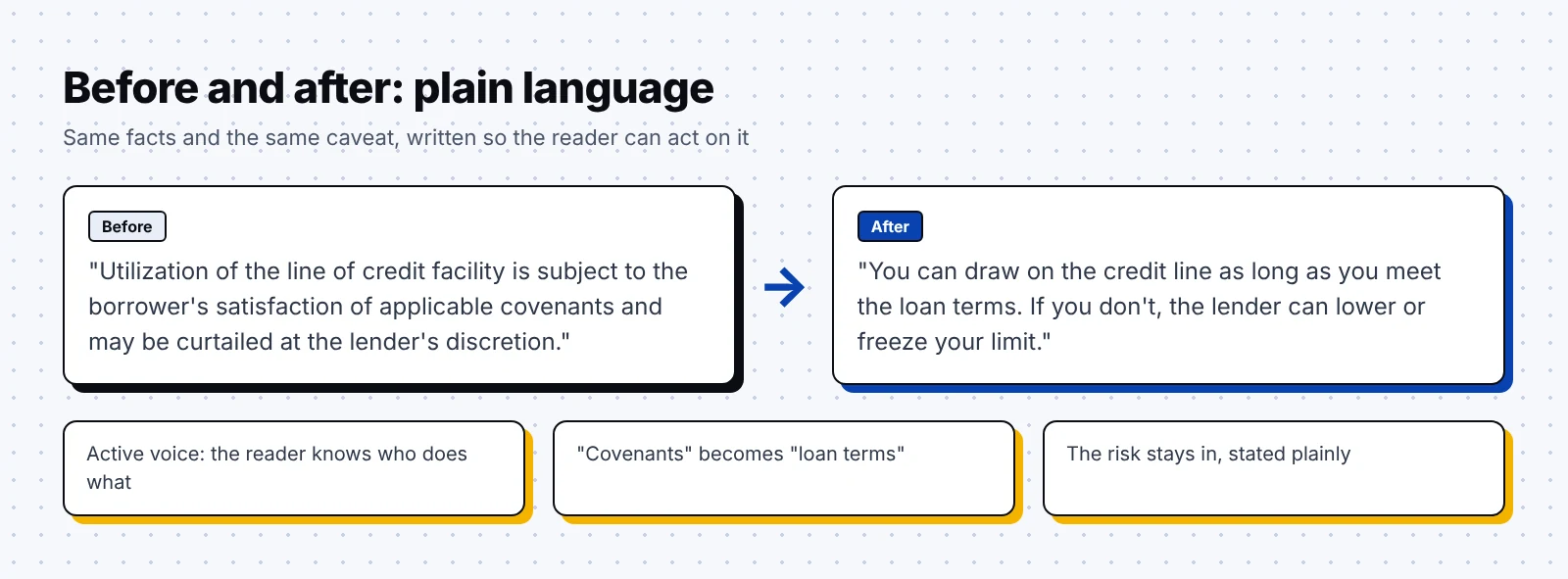
- Write in active voice, so "the bank charges a $25 fee" replaces "a fee may be assessed."
- Use a table when readers compare options, such as a Roth IRA and a traditional IRA.
This is the edit I make most often, and in my experience expert readers like the plain version too:
How to source and fact-check financial content
Readers act on the numbers in a finance article, so each one needs a source you'd be happy to show them. I rank sources in tiers and only move down a tier when the higher one doesn't have the answer:
- Primary sources, such as rule text from regulators, government data, central bank releases and company filings
- Original research from named institutions that publish their method
- Reputable financial press that cites its own sources
- Your own data, clearly labeled with how and when you collected it
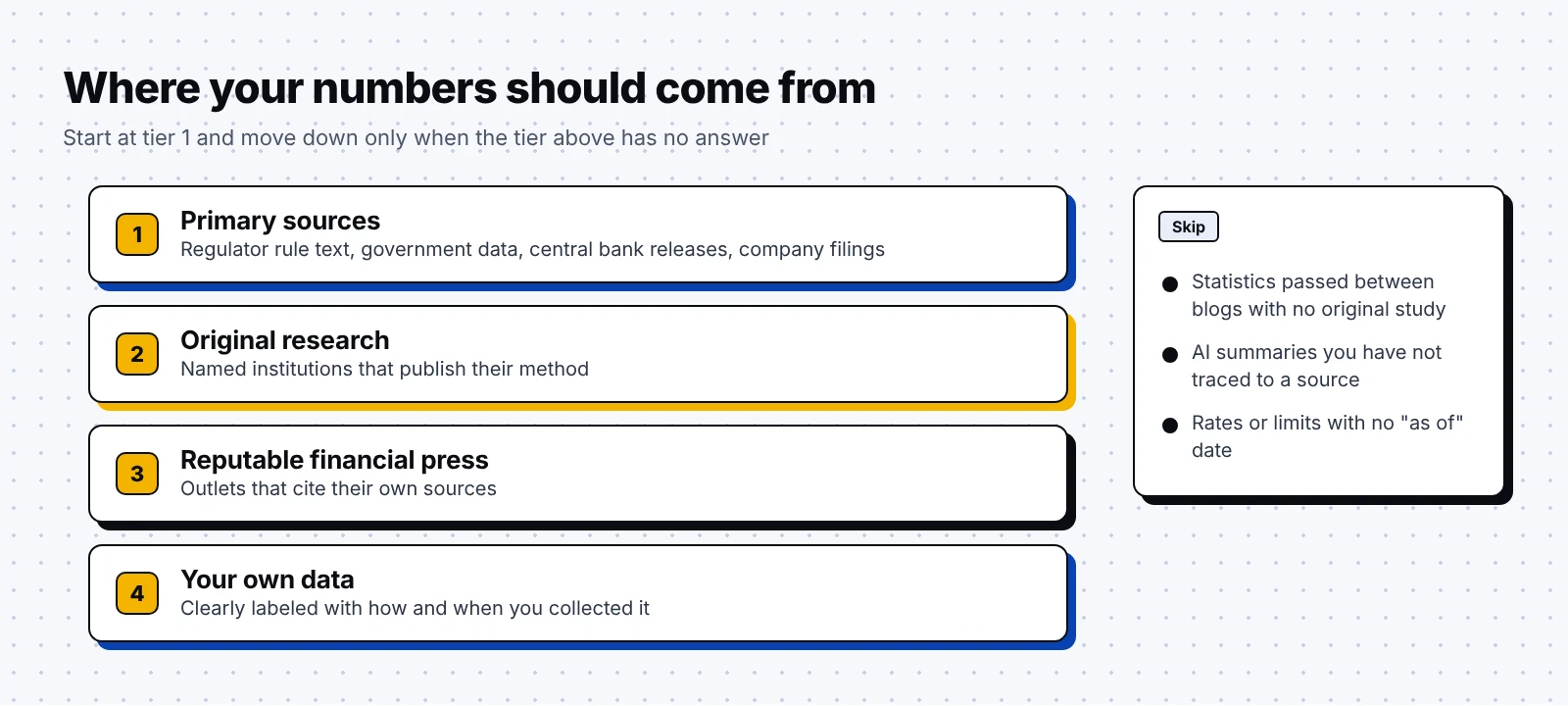
I skip statistics that circle around blogs with no link to an original study, and I never trust an AI summary until I've traced each claim to its source.
Once the draft is done, I run a fact-check pass:
- Check each number against its original source and skip pages that only quote it.
- Confirm the date and the country, since a UK rule or a 2022 limit can slip into a US article.
- Rerun every calculation, including fee and compound growth examples.
- Keep a source log with links so compliance and future editors can audit the piece.
Happily, a published fact-checking policy does a lot of the trust work for you, as NerdWallet's example below shows.
Financial content formats that work for banks, fintechs and advisors
The right format depends on who you serve and what they need to decide. This table shows where I'd start for each type of firm:
| Type of firm | Formats to start with | Why they fit |
|---|---|---|
| Banks and credit unions | Financial education hubs, calculators, guides by life stage and product comparison pages | They meet people while they research a money decision, before they pick a provider |
| Fintechs | Guides for buyers close to a decision, comparison pages, integration docs and original data reports | Buyers compare vendors and need proof the product fits their stack |
| Financial advisors and RIAs | Planning explainers, market commentary, client newsletters and scenario walkthroughs | Clients choose an advisor partly on how they think, and this content shows it |
| Asset managers | Market outlooks and chart books | Advisors and institutions need data they can reuse in their own client conversations |
If you sell to businesses, start with pages that match searches from buyers close to a decision. I explain how to pick those topics in my guide to fintech SEO, and how to plan the wider program in content marketing for financial services.
Examples of strong financial content
These six examples come from a bank, three investment firms, a personal finance site and an advisor publication. Each one does something specific well that you can borrow.
1. Bank of America Better Money Habits
Bank of America is a US bank, and Better Money Habits is its free financial education site. It launched in 2013 with Khan Academy, and its first lessons were short videos in plain language on topics like saving and budgeting.
Today the homepage asks about your priorities, then points you to resources for your life stage, with a note that the material is for information only.
What you can borrow:
- Route readers by goal or life stage, so each person lands on content that fits their situation.
- Add a short note that says the content is education and doesn't count as personal advice.
- Use video for topics that are easier to show than to describe.
2. J.P. Morgan Guide to the Markets
J.P. Morgan Asset Management is the investment management business of JPMorgan Chase, and its Guide to the Markets is a chart book of market and economic data. It shows market and economic history through clear charts, with regional editions that have historically come out each quarter.
J.P. Morgan presents it as building blocks for client conversations, so advisors have a reason to open each edition.
What you can borrow:
- Build one asset full of data that your audience can reuse in their own work.
- Let each chart carry one clear point, with a headline that says what it shows.
3. Vanguard's Principles for Investing Success
Vanguard is an investment management company, and Principles for Investing Success is a research paper it publishes for investors. Surprisingly, the whole paper comes down to four principles: goals, balance, cost and discipline.
The November 2023 paper runs about 32 pages and draws on the Dimson-Marsh-Staunton dataset, which covers returns across 35 markets. Vanguard also publishes a short article on the four timeless principles for everyday investors.
What you can borrow:
- Turn a large body of research into a few principles people can remember.
- Publish a long version for experts and a short version for everyone else.
- Name your data source and its time span so readers can judge the evidence.
4. Fidelity Viewpoints
Fidelity is a financial services company, and Viewpoints is its editorial hub for insights on markets, investing, taxes and personal finance. Interestingly, Fidelity introduced Viewpoints back in 2008 to give investors information that is easy to understand.
Articles sit under topic hubs such as Where to invest, and a weekly email sends the top pieces to subscribers.
What you can borrow:
- Group articles into topic hubs that match the decisions your readers face.
- Use a weekly email to bring readers back to new pieces.
5. NerdWallet's editorial guidelines
NerdWallet is a personal finance company that compares financial products and publishes money guides. Its editorial guidelines page explains how its content gets made.
The guidelines say all editorial content is fact-checked for accuracy, timeliness and relevance, and that sources should be diverse and verifiably reputable. They also state that advertisers and business partners don't influence product reviews, and that errors get corrected fully and promptly.
What you can borrow:
- Publish your editorial and review process on one page and link to it from every article.
- Explain how you make money and how you keep that separate from reviews.
6. Kitces.com Nerd's Eye View
Kitces.com is a publication for financial advisors, and its Nerd's Eye View blog covers financial planning research in depth. Michael Kitces launched the site in 2008 to help advisors improve the quality of their advice.
A team now writes the blog, including a managing editor and a technical editor. Kitces says the blog reaches more than 200,000 unique visitors each month.
What you can borrow:
- Write for practitioners at their level, with detailed tax and planning mechanics.
- Add a technical editor to the workflow so experts check expert content.
Financial content pre-publish checklist
I run this checklist on every finance piece before it goes live. Copy it into your brief template or your CMS so nobody skips a step.
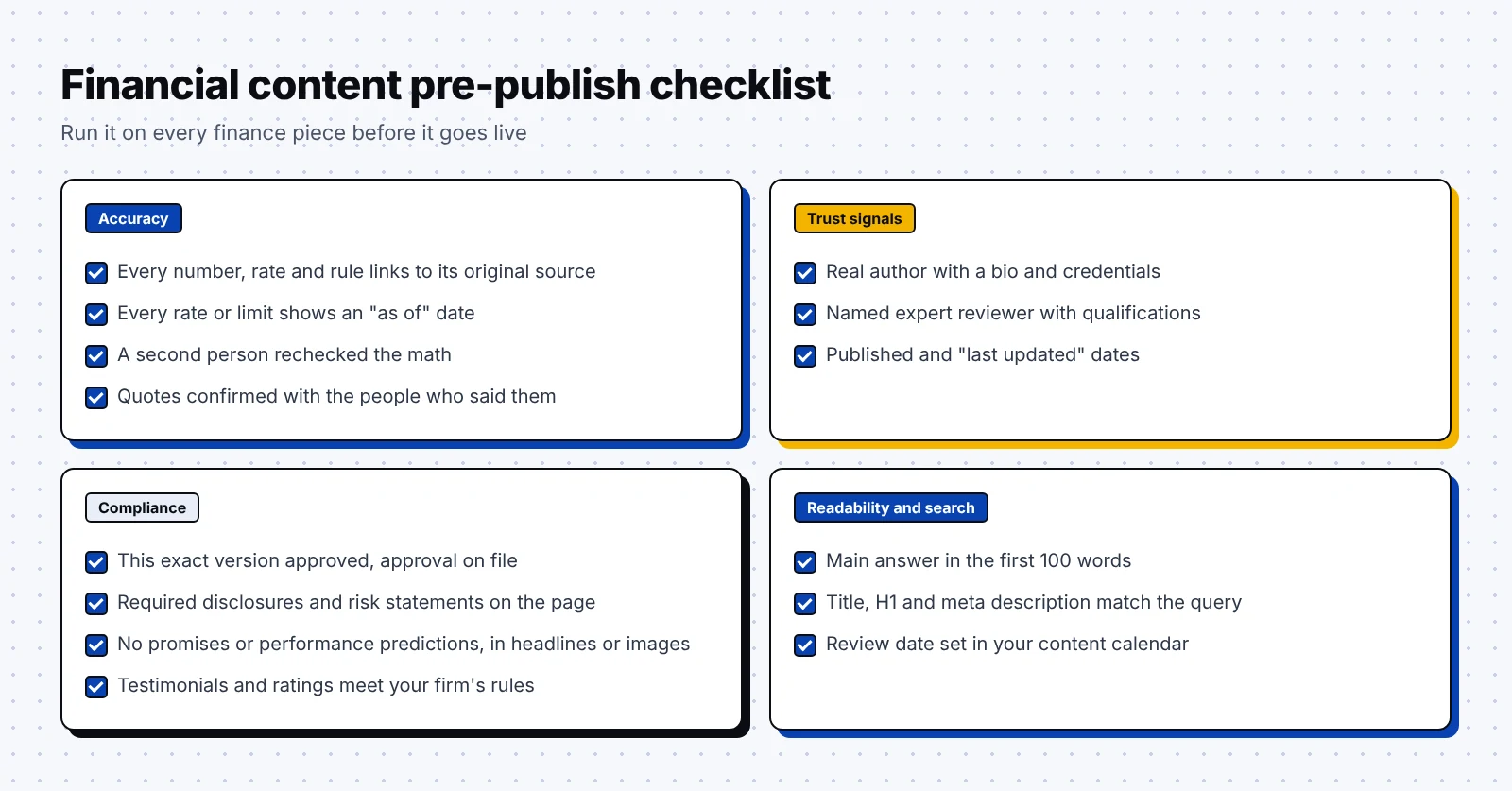
Accuracy
- Every number, rate and rule links to its original source.
- Every rate or limit shows an "as of" date.
- A second person has rechecked all the math.
- The people you quoted have confirmed their quotes.
Trust signals
- The byline names a real author with a bio and credentials.
- A named expert reviewer appears with their qualifications.
- The page shows a published date and a "last updated" date.
Compliance
- Compliance approved this exact version, and the approval is on file.
- Required disclosures and risk statements appear on the page.
- No promises or performance predictions appear anywhere, including headlines and image text.
- Testimonials and ratings meet the rules that apply to your firm.
Readability and search
- The answer to the main question appears in the first 100 words.
- The title, H1 and meta description match the search query.
- A review date sits in your content calendar.
Where to start
If you change only one thing this quarter, move the expert review and compliance steps into the brief. You'll publish faster, and every page will carry the trust signals Google looks for.
If you'd like help, my team at Perceptric writes and reviews content for fintechs and financial firms through our B2B SEO agency work. You can also request an AI visibility audit to see how often AI answers name your brand today.
Financial content writing FAQ
What is financial content writing?
Financial content writing is writing that helps people understand or decide something about money, such as guides, product pages and market commentary. It has to be accurate and compliant, because Google treats finance as a YMYL topic and many firms follow SEC or FINRA rules.
Does financial content need compliance review?
For many firms it does, because FINRA Rule 2210 requires a qualified principal to approve most broker-dealer retail communications before use, and investment advisers follow the SEC Marketing Rule. Banks and lenders have their own rules, so ask compliance which apply.
How do you show E-E-A-T on financial content?
Use a real author with credentials, list a named expert reviewer, link every number to its source and show published and updated dates. A public editorial policy and firsthand examples help too.
Can you use AI for financial content writing?
You can use AI for research help and rough drafts. A human expert still needs to check every claim and number against the original source, and compliance approves the final version where your rules require it.
How often should you update financial content?
Update pages with rates, limits or tax figures whenever the official numbers change. Review evergreen explainers every six to twelve months, and change the "last updated" date only after a real edit.
Want to keep learning? Read my guides on content marketing for financial services, fintech SEO and content marketing for private capital, or browse the best financial services content marketing agencies.