The answer to why listicles drive traffic is buyer intent: people who search "best X" or "X alternatives" are comparing options right now. AI tools cite the same pages, and "best X" blog lists made up 43.8% of the pages ChatGPT cited in an Ahrefs study of 750 prompts.
The lists that earn rankings and citations for years share a few habits. They publish their criteria, test each option, take prices from vendors, treat competitors fairly and keep their dates honest.
Why listicles drive traffic from Google
A "best X" search usually means a buyer is building a shortlist and wants the options compared side by side. Someone typing "best CRM for startups" or "Asana alternatives" already knows the problem and is choosing a vendor.
Google tends to answer those searches with lists. Across 250 "best X software" results pages, Ahrefs found that 169 (67.6%) featured a list written by a company that ranked itself first.
Alternatives pages work the same way for a narrower group of buyers. The reader already pays for a tool, knows its limits and wants a better fit, so a fair comparison helps them decide.
One list also covers a whole cluster of searches with the same intent. The listicle SEO patterns we target most for B2B software are these:
- "Best [category] software", such as "best project management software" or "best expense tracking software".
- "Best [category] for [industry or team]", such as "best CRM for real estate teams".
- "[Competitor] alternatives", which reaches buyers who already use a tool and want to switch.
- "[Category] tools compared", for buyers who want features and prices in one table.
All four are bottom-of-funnel searches, and we explain how to plan and prioritize them in our guide to BOFU content.
Why AI answers cite listicles
AI assistants answer "what is the best X" by reading pages that already compared the options. A list gives the model names, strengths and a "best for" line on one page, which makes it easy to quote.
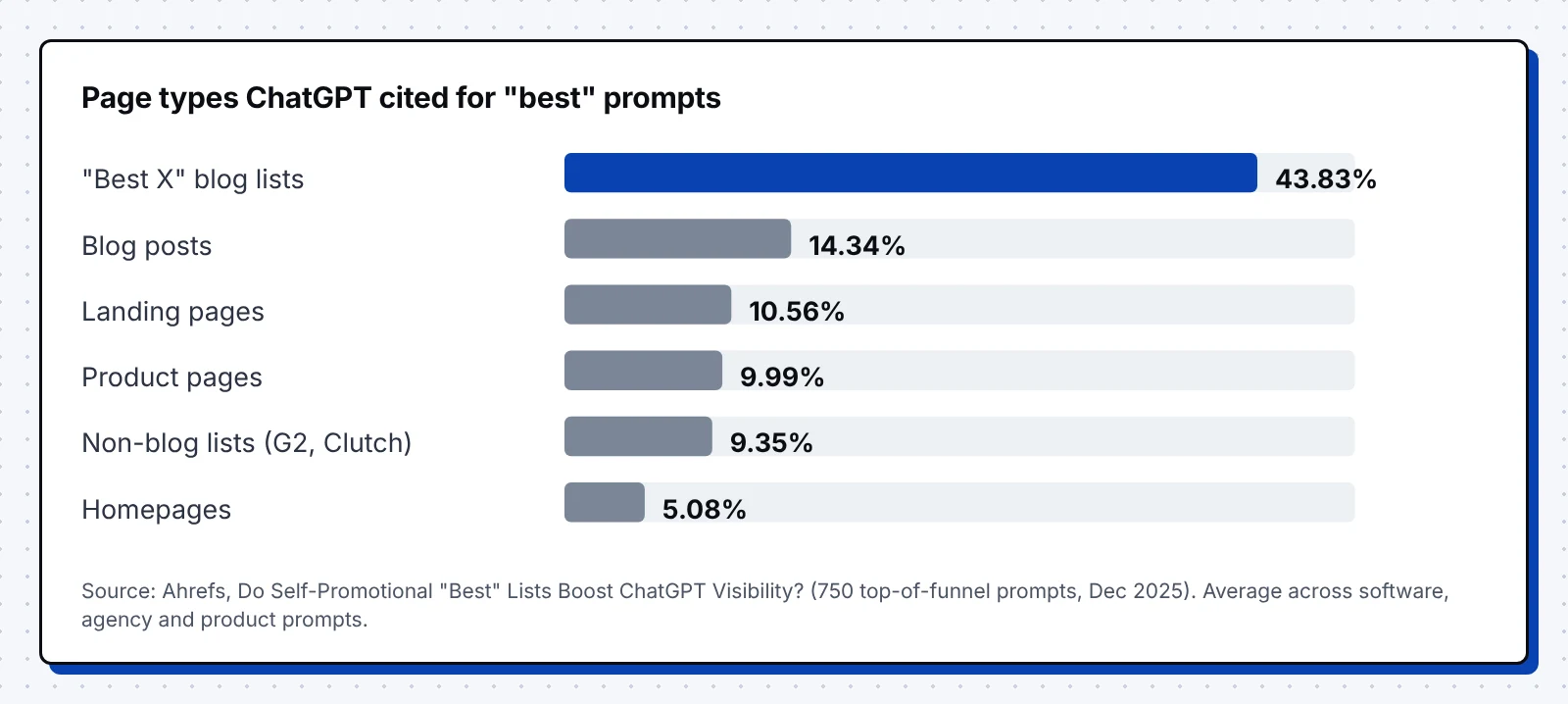
Ahrefs checked the sources behind ChatGPT answers to 750 top-of-funnel prompts about software, agencies and products. "Best X" blog lists made up 43.83% of cited pages, about three times the share of plain blog posts at 14.34%.
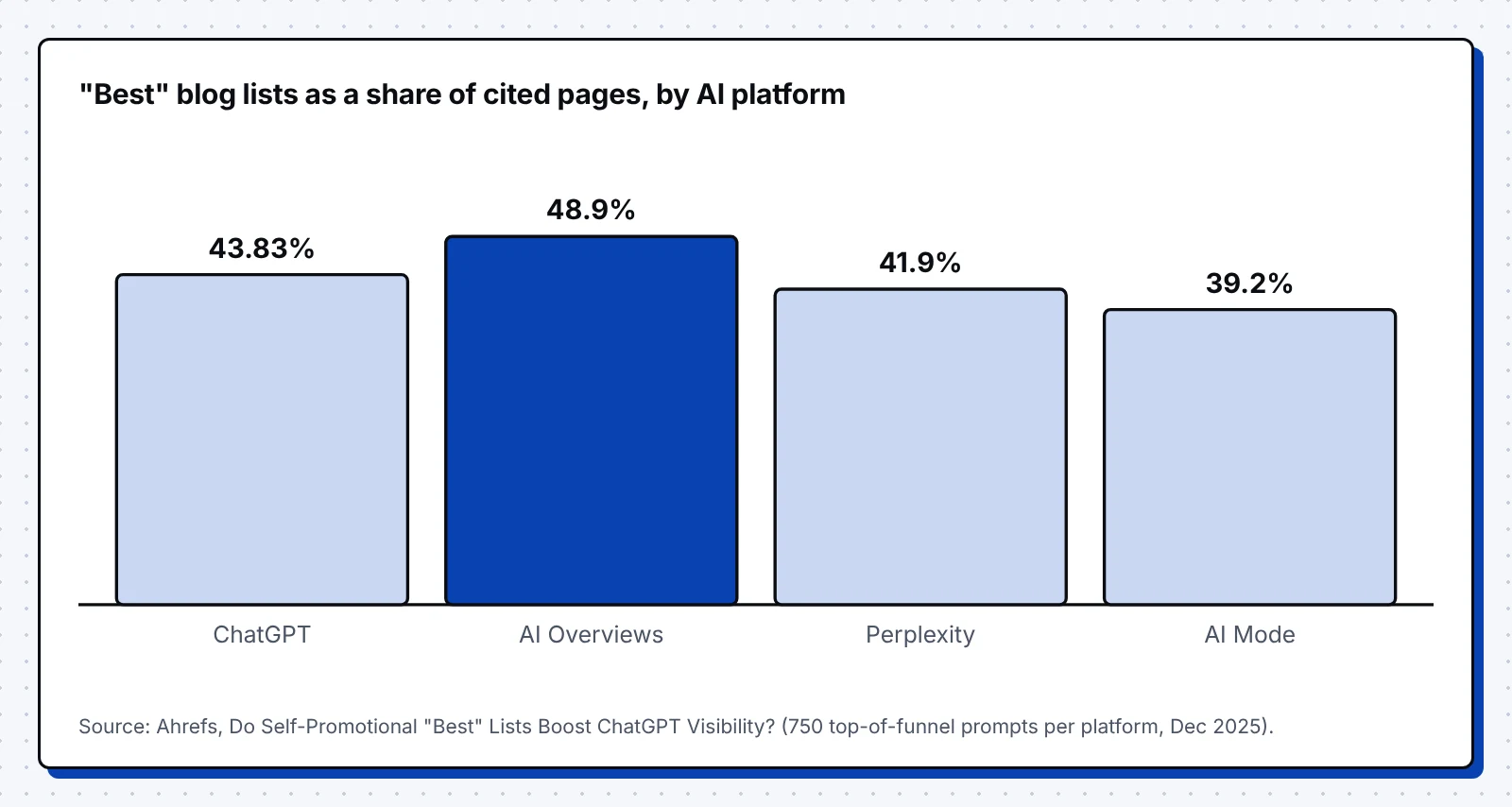
Lists lead on other platforms too, making up 48.9% of cited pages in Google AI Overviews, 41.9% in Perplexity and 39.2% in AI Mode.
Commercial intent drives the citations
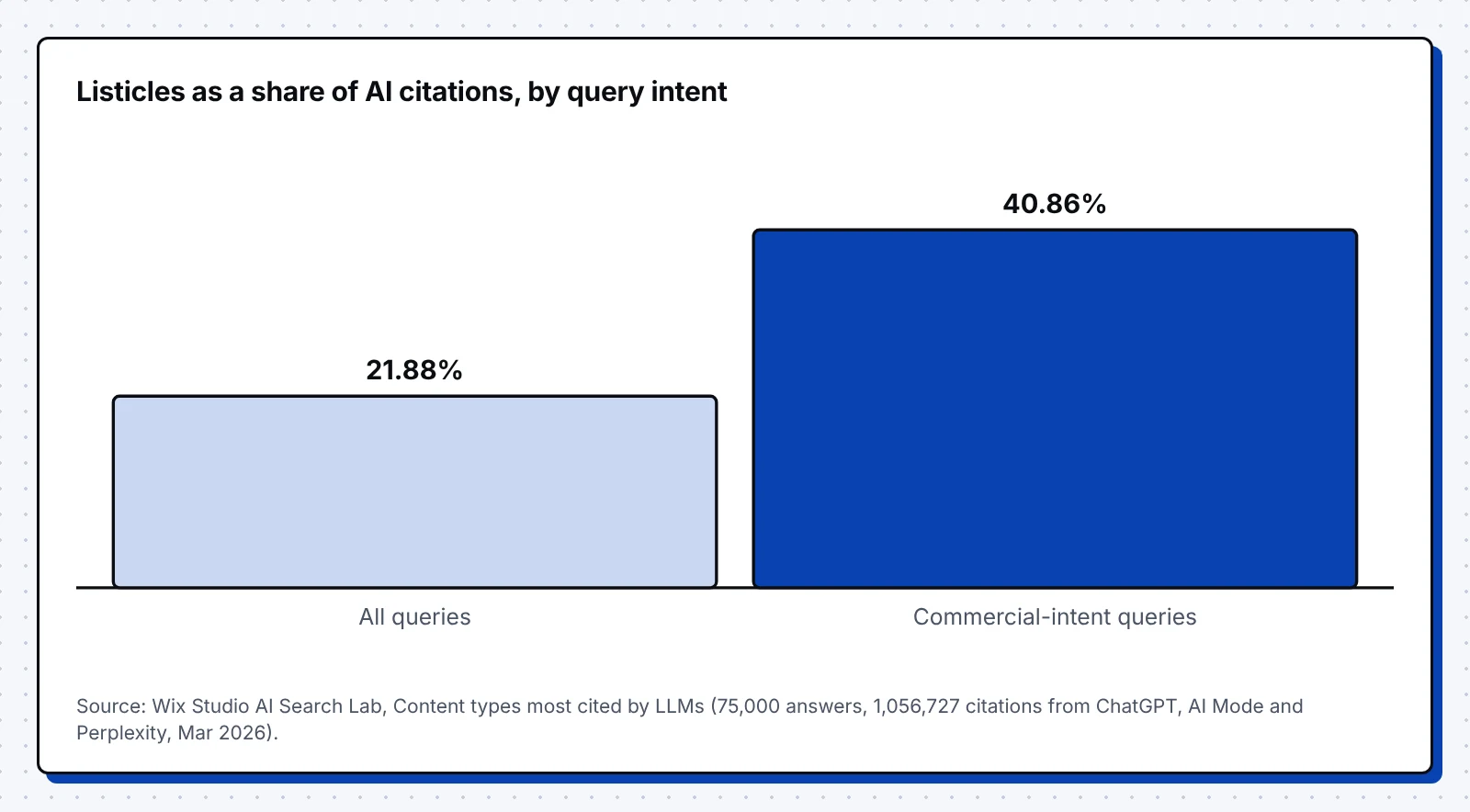
The type of question matters more than the AI tool. Across 1,056,727 citations studied by the Wix Studio AI Search Lab, listicles earned 21.88% of all citations and 40.86% of citations for commercial-intent queries.
Buyers now start many of these comparisons in a chat window. In a March 2026 survey of 1,076 B2B decision makers, 51% said they start software research with an AI chatbot more often than with Google.
Citation share moves with freshness
Lists can lose their citations as fast as they earn them. Seer Interactive tracked over 2 million ChatGPT citations and saw the listicle share fall from 17.8% in November 2025 to 15.5% in January 2026.
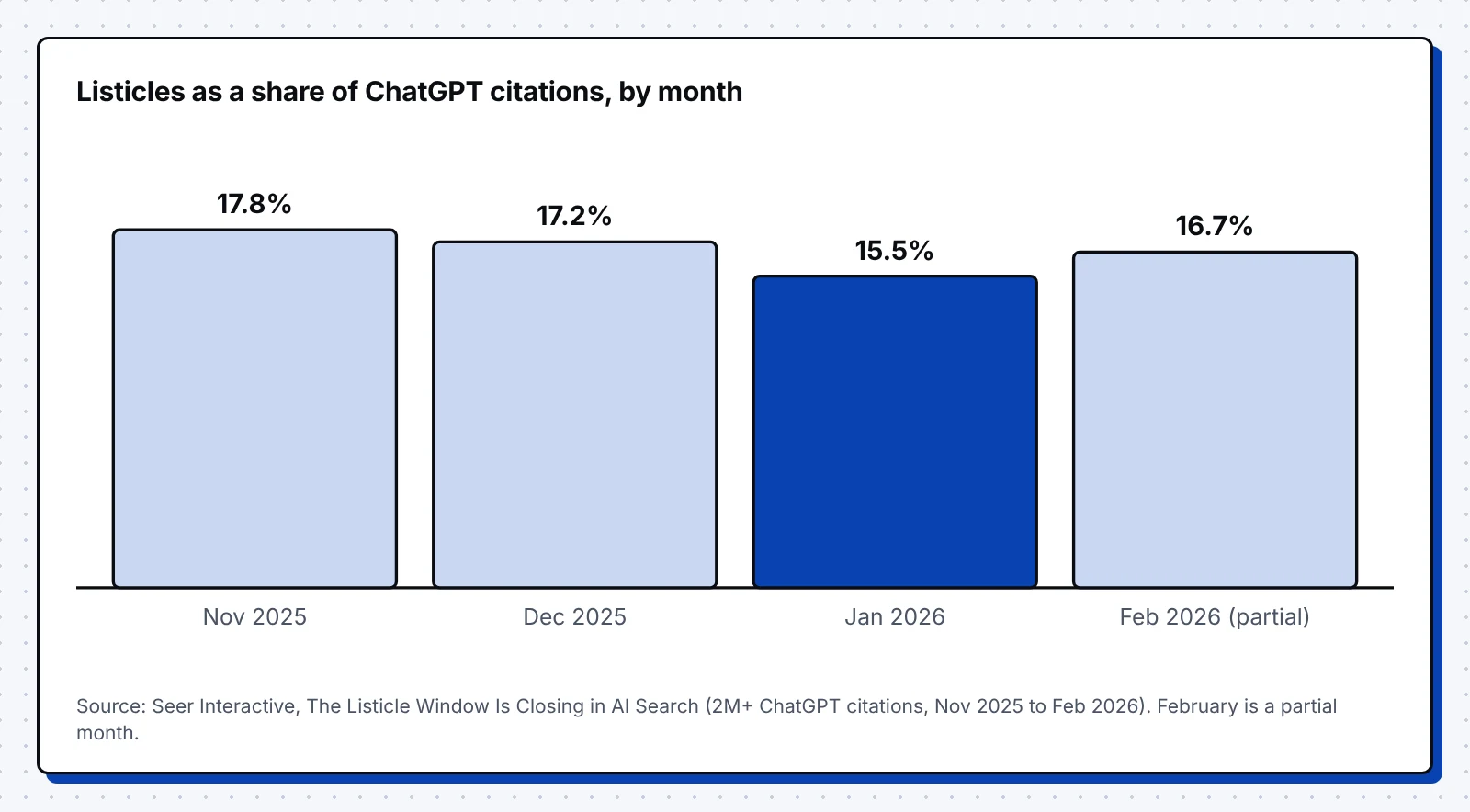
The lists that kept growing against that trend had clear things in common:
- They were recently updated, often with the current year on the page.
- They covered 10 to 20 options, while the lists that declined usually covered 5 to 8.
- They backed claims with outside data, such as G2 ratings, and explained their method.
- They used numbered entries with features, pros and cons, pricing and a "best for" line.
Luckily, those are the same habits that make a buyer trust a list, so one piece of work serves both readers.
What our Arrowsterr data shows
We track AI answers about B2B SEO agencies in Arrowsterr. In 30 AI answers, 10 of the 24 most cited pages were "best agencies" listicles, and the two most cited pages were both listicles, each cited in 13.3% of answers.
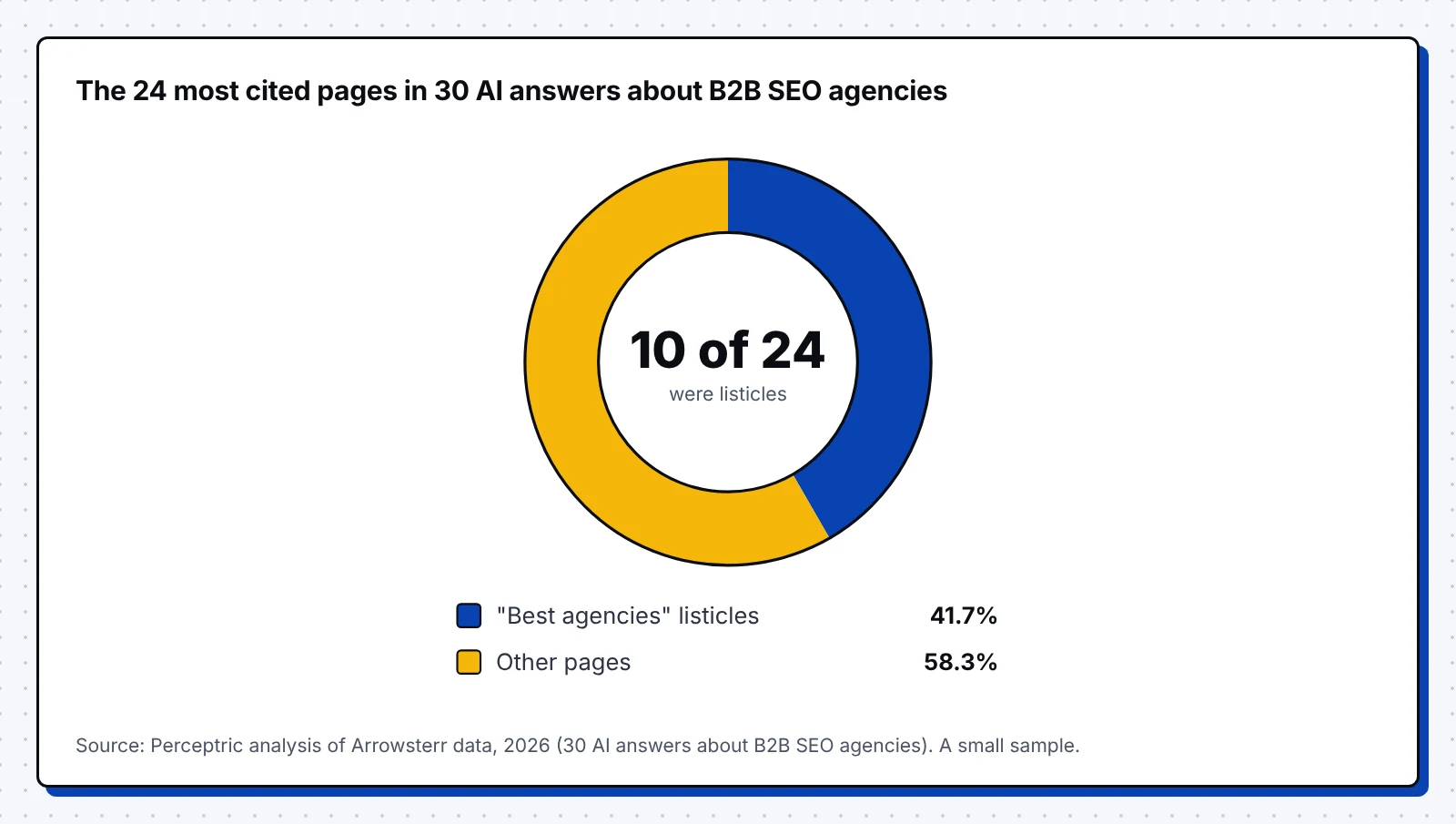
This is a small sample from one topic, so we read it as a signal and nothing more. It still matches the larger studies: when a buyer asks AI to name a vendor, lists of vendors supply much of the answer.
Other people's lists matter as much as your own. Among the 1,000 most cited professional services URLs, third-party listicles drew 80.9% of citations and self-promotional listicles drew 19.1%.
How to write best software lists buyers trust
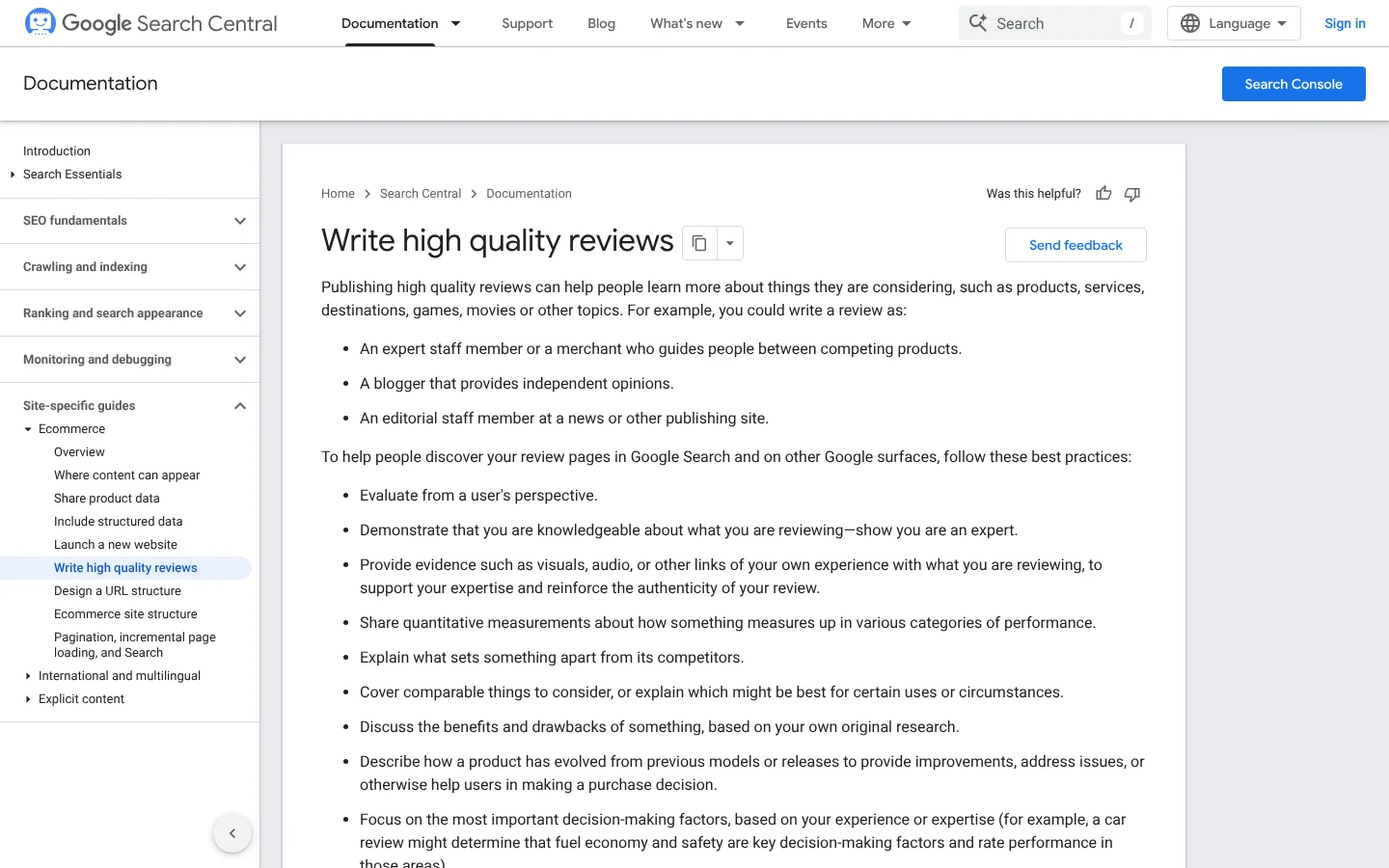
Google's advice on reviews works as a checklist for honest lists. It asks for evidence of your own experience, quantitative measurements and a clear view of which option suits which use.
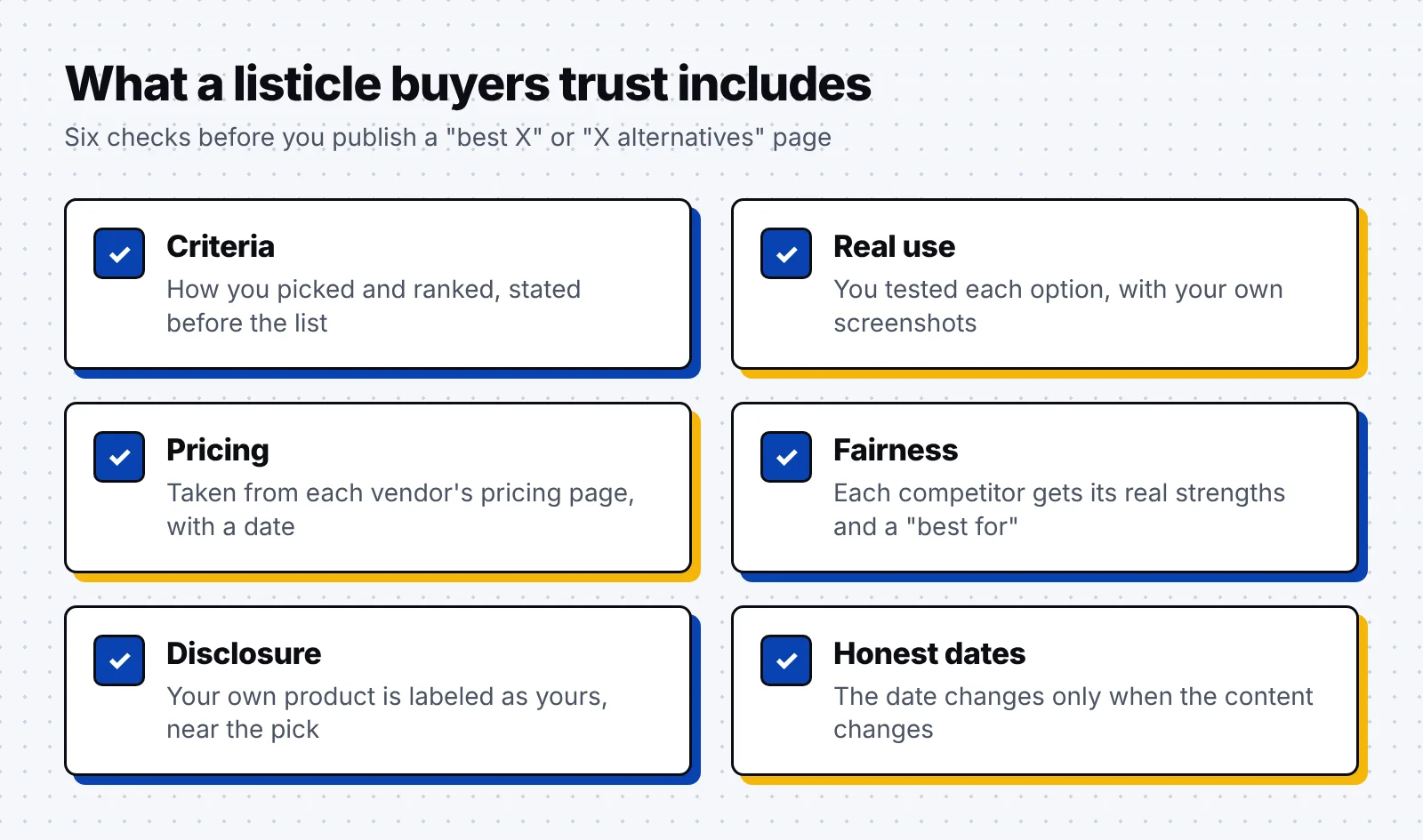
Publish your criteria first
Open the list with how you picked and ranked each option. Google notes that readers trust reviews more when they understand the number of products that were tested and how the testing worked.
- Name the criteria, such as price, integrations, support and fit for a team size.
- Say how many options you reviewed and how many made the final list.
- Give each pick a "best for" line so readers can jump to their own case.
Use the products and show screenshots
Sign up, run a real task in each tool and capture your own screenshots of the result. Google asks reviewers to provide visuals or other evidence of their own experience, and vendor graphics show none of that.
- The setup screens, so readers can see how long onboarding takes.
- The main workflow your buyers care about, done with realistic data.
- One limit or rough edge you found, with the screen that shows it.
Write down what surprised you, good or bad, while you test. Those notes become the details that set your list apart from pages built from feature tables.
Take pricing from the vendors
Copy each price from the vendor's own pricing page, with the plan name, billing period and the date you checked. If a vendor shares pricing only on request, say so and link to its sales page.
- Write the starting price, the plan it belongs to and whether it is billed monthly or yearly.
- Note any free trial or free plan, along with its main limits.
- Link each price to the vendor's pricing page so readers can check it themselves.
Be fair to competitors
Give every competitor its real strengths and the buyers it suits best. Ahrefs keeps comparison posts under half a percent of its blog and won't always put itself in the top spot, which is a useful standard for any vendor.
Fairness also means saying who should pick something else. A line such as "teams under five people will find this simpler" tells readers that the rest of the list is honest too.
If your own product is on the list, label it as yours right next to the pick. The FTC says the closer a disclosure is to the recommendation, the better.
Update dates honestly
Change the date only when the content changes. Google lists changing dates to make pages seem fresh without real changes as a warning sign.
Real updates pay off, since 79.1% of the 1,100 lists ChatGPT used as sources had been updated in 2025. Each update should change something a buyer would notice, such as these:
- Re-check every price and plan name on the vendors' pricing pages.
- Add new options that buyers ask about and remove tools that shut down.
- Replace screenshots when a product's interface changes in a visible way.
- Add a short line at the top that says what changed and when.
Thankfully, none of this needs a big team, and we run listicles inside a full SEO and GEO program. Our case study of a $500K pipeline program for a B2B SaaS company shows how. For the AI side in more depth, read our guide to GEO for B2B SaaS.
FAQ
Why do listicles drive traffic?
Listicles match commercial intent: people who search "best X" or "X alternatives" are comparing vendors, and one list answers that comparison on one page.
Do AI tools cite listicles?
Yes, often. In an Ahrefs study of 750 prompts, "best X" blog lists made up 43.8% of the pages ChatGPT cited.
What is listicle SEO?
Listicle SEO is the work of ranking "best X", "X alternatives" and comparison pages for commercial searches. It works best with clear criteria, real testing and pricing taken from each vendor.
Should you rank your own product first on your list?
You can include your own product, but label it as yours next to the pick and give every competitor a fair "best for" line. Buyers trust lists that treat each option fairly.
How often should you update a listicle?
Update it whenever prices, features or the available options change, and change the date only then. A quarterly check of prices and screenshots is a good minimum.
Your next step is to pick one "best X" or "X alternatives" search your buyers use and write that list with criteria, testing and vendor pricing from day one. If you want help turning listicles into pipeline, talk to us about a Perceptric program.