Grounding
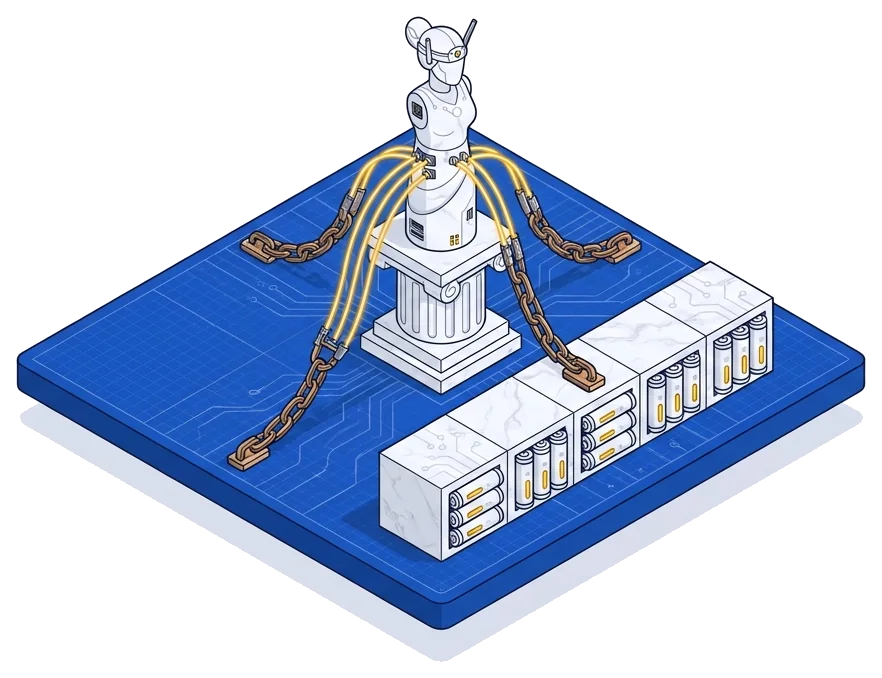
Grounding is when an AI tool ties its answer to sources it found, like web pages or documents, instead of answering from memory alone. When Perplexity answers "best SOC 2 tools for startups" and links each claim to a page, that answer is grounded.
What is grounding?
Grounding is how an AI tool ties its answer to real sources. Google Cloud's grounding overview defines it as the ability to connect model output to verifiable sources of information. In practice, the tool searches, reads what it found, writes from it and shows you the links.
Grounding and RAG are close cousins. RAG is the method: retrieve documents, then generate an answer. Grounding is the goal: an answer you can trace back to a page. ChatGPT search, Perplexity, Gemini and Google's AI Overviews all ground their answers this way when they search the web.
Let's say you sell SOC 2 compliance software. A founder asks Perplexity "what does SOC 2 software cost for a 50-person startup?" Perplexity searches, reads a few vendor pricing pages and a review site, then writes an answer with a small source link after each claim. Your pricing page can be one of those links, or it can be missing from the answer entirely.
How grounding works
Google's Gemini API documentation walks through what happens behind a grounded answer. Most AI search tools follow a similar path:
How a grounded answer gets made
- 1The buyer sends a prompt
- 2The model decides whether a search would help
- 3It writes and runs one or more searches
- 4It reads the results and writes the answer
- 5The answer comes back with links to its sources
Step 3 is where your SEO work pays off. The searches the model writes are often longer and more specific than the prompt, which is what query fan-out describes. If your page ranks for those searches, it gets read in step 4.
Developers can see the link between answer and source in the API response. Here's a shortened example with the field names from Google's docs and a made-up search:
"groundingMetadata": {
  "webSearchQueries": ["soc 2 compliance software pricing startup"],
  "groundingChunks": [
    {"web": {"uri": "https://...", "title": "example.com"}}
  ],
  "groundingSupports": [
    {"segment": {"startIndex": 0, "endIndex": 92},
     "groundingChunkIndices": [0]}
  ]
}
Each support ties a stretch of the answer to the source it came from. That's what an AI citation is underneath: one sentence in the answer, linked to the page that backs it.
Why grounding matters for B2B SaaS
Grounding is the reason a page you publish this month can show up in AI answers this month. The tool doesn't need to have learned about you in training. It needs to find you in the search step and quote you in the answer.
Here's how a grounded answer compares with one written from training data alone:
Grounded answer
- Searches the web or a set of documents before it writes
- Links each claim to a page you can open and check
- Can use a page published last week
- A wrong fact traces back to a page you can fix
Ungrounded answer
- Writes from what the model learned in training
- Shows no sources, or links that don't back the claim
- Knows nothing after the model's training cutoff
- A wrong fact has no page behind it to correct
Google says grounding helps reduce model hallucinations. It doesn't make answers perfect, though. A grounded answer that reads your 2023 pricing page will repeat 2023 pricing, with a link. That's why I treat AI hallucination fixes and grounding as the same job.
How to become a grounding source
You can't choose which pages a tool reads. You can make yours the easiest to find and quote. Here's my process:
- Rank for the fan-out searches: Write down the prompts your buyers use, then guess the specific searches a tool would run for each one. "SOC 2 software cost" and "SOC 2 audit timeline for startups" might both come from one founder's question. I check those searches in Google and SEMRush like any other keyword.
- Answer in the first two sentences: Open each section with the plain answer. Tools pull passages, and a passage that answers on its own is easier to use.
- Keep facts in plain text: Prices in an image or a PDF are hard to quote. Put plan names, prices and limits in the HTML of the page.
- Date your facts: "As of November 2026, plans start at $X" tells the reader and the tool how current the number is.
- Let the crawlers in: Check that your robots.txt and CDN allow search bots like OAI-SearchBot and PerplexityBot. If an AI crawler can't reach a page, it can't ground an answer in it.
A grounding example
Here's a hypothetical. Two SOC 2 vendors show up in the same Perplexity answer for the founder's pricing question. Vendor A's pricing page says "Plans start at $7,500 a year for teams under 100 people." Vendor B's page says "Talk to sales for pricing."
The answer quotes Vendor A's number with a link and says Vendor B doesn't publish prices. Both pages were found. Only one gave the tool a fact it could ground a sentence in, and that vendor is the one the founder clicks.
How to measure grounding
- Citation rate: How often your pages appear as sources across your tracked prompts, per tool.
- Cited pages: Which URLs get used. If it's always your blog and never your pricing page, your pricing page needs work.
- Accuracy of what's quoted: Whether the cited sentence about you is correct and current.
- AI referral traffic: Sessions from chatgpt.com, perplexity.ai and gemini.google.com in GA4, by landing page.
Common grounding mistakes
- Reading a citation as a seal of approval: A link next to a claim means the tool found a source. Check that the source says what the answer says.
- Writing only for the prompt: The tool searches with its own queries. Pages that only target the buyer's exact words miss the searches that matter.
- Gating the key facts: Pricing, security details and integration lists behind a form can't ground anything.
- Blocking AI search bots by accident: A blanket bot block in your CDN can remove you from every grounded answer at once.
Try this today. Ask Perplexity one question your buyers ask and open every source it links. Is any of them yours?
Read more

FAQ
What is the difference between grounding and RAG?
RAG is the method, where a system retrieves documents and then writes an answer from them. Grounding is the result you want from it, an answer whose claims trace back to real sources you can open.
Does grounding mean an AI answer is correct?
No. Grounding cuts down on made-up facts, but the answer can only be as accurate as the pages it read. If the top source is outdated, a grounded answer repeats the outdated fact with a link.
Do ChatGPT and Google AI Overviews use grounding?
Yes, when they search. ChatGPT search, Perplexity, Gemini and Google's AI Overviews all pull in web results and show links to the pages behind the answer.
How do I get my pages used as grounding sources?
Make sure AI search crawlers can reach your pages, rank for the specific searches the tools run and state key facts in plain text near the top of each section.