Sales cycle
The sales cycle is the time from a buyer's first sales conversation to a signed contract. Selling a $5,000 tool to a startup might take two weeks, while a $200,000 enterprise deal can take nine months or more.
What is a sales cycle?
The sales cycle is the time it takes to turn a potential buyer into a paying customer. Most B2B SaaS teams measure it from the day an opportunity is created in the CRM to the day the contract is signed.
Let's say you sell a security compliance tool. A 40-person startup books a demo on Monday, gets a trial, and its CTO signs a $6,000 annual plan two weeks later. A bank with 5,000 staff books the same demo, then runs a security review, a legal review, a pilot and a procurement process. That deal closes eight months later. Same product, very different sales cycles.
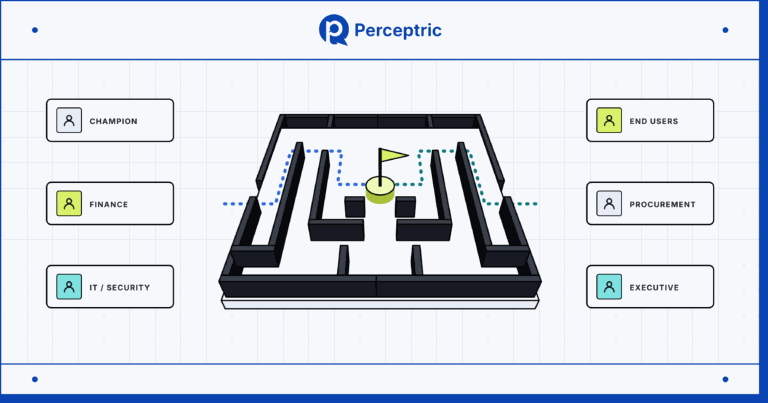
What changes the length is mostly who has to say yes. The more people in the buying committee and the bigger the price, the longer the cycle.
Why the sales cycle matters for B2B SaaS
Cycle length shapes your cash flow, your hiring plan and how fast you can learn. A team with 30-day cycles sees the result of a pricing change within a quarter. A team with 9-month cycles waits most of a year.
It also changes what marketing should do. In Ebsta and Pavilion's 2025 GTM Benchmarks, based on 655,000 opportunities, new business deals took 91 days on average to close, against 52 days for expansion deals with existing customers. That's three months where a buying group reads your pages and asks questions between calls.
Here's why I think content teams should care about it:
- Buyers do homework between meetings: Long cycles are mostly waiting. The champion has to convince finance, IT and a manager, and each of them goes looking for answers on their own.
- Late questions stall deals: A deal that waits two weeks for a security answer is two weeks longer. A page that answers it on day one removes that gap.
- Cycle length decides how you judge SEO: If your deals take six months, a page published in January may not show up in closed revenue until summer. Judge it by pipeline first.
How to shorten the sales cycle
You can't make a bank skip its procurement process. You can make sure nobody waits on you. Here's my process:
- Ask sales where deals stall: Sit with your reps and go through the last 10 deals that took longest. Note the stage where each one paused and the question that caused it, like "Do you support SSO?" or "How long does migration take?" We wrote about this in how your sales team can inform content strategy.
- Publish answers to late-stage questions: Build public pages for pricing, security and compliance, implementation timelines and integrations. These are the BOFU pages that a champion forwards to their IT lead.
- Give the champion something to share: A one-page business case, a short ROI example or a case study from a similar company helps your contact sell internally when you're not in the room.
- Write for every role in the committee: The CFO cares about cost and payback, while the IT lead cares about access controls. Give each role a page or section written for them.
- Send content at the right stage: Ask reps to share the security page after the first call and the implementation guide before the pilot. Content that arrives before the question saves a round trip.
A sales cycle example
Here's how cycles could differ for a hypothetical data security company that sells three plans:
| Plan | Typical buyer | Who signs off | Cycle length |
|---|---|---|---|
| Starter, about $5,000 a year | Startup CTO | One person | 1 to 3 weeks |
| Growth, about $40,000 a year | Mid-size IT director | IT, finance and a manager | 2 to 4 months |
| Enterprise, $200,000+ a year | Large company CISO | Security, legal, procurement and an executive | 6 to 12 months |
If this company only reported one average cycle, it would hide what's going on. A few enterprise deals would pull the number up, and the team might think all its sales were slow.
The fix is to report cycle length by segment and deal size. Then the team can see that Growth deals stall at the security review, and build a public security page that answers it.
How to measure the sales cycle
The math is simple. The hard part is keeping the start and end points the same every time. Here's what I track:
- Average and median cycle length: In your CRM, average the days from opportunity created to closed won for every deal won in the quarter. Add the median, since one 400-day deal can skew the average.
- Cycle length by segment: Split the number by deal size or plan. Each segment usually has its own normal range.
- Time in each stage: HubSpot and Salesforce both report how long deals sit in each pipeline stage. A stage where deals sit twice as long as the others is where content can help.
- Cycle length by first touch: Compare deals whose contacts first came from organic search, referrals or outbound. Buyers who read your comparison and pricing pages before the first call often arrive with fewer open questions.
- Content viewed during the deal: Track which pages contacts on open deals visit. If won deals often include a visit to the implementation guide, ask reps to send it earlier.
Common sales cycle mistakes
- Mixing start points: Some reps create the opportunity at the first email and others after the demo. Agree on one rule, or the number means nothing.
- Reporting only the average: Small and large deals blended together hide where the delays really are. Report by segment.
- Blaming sales for every delay: Many stalls come from questions nobody answered in writing. Marketing can fix those with pages.
- Judging content too early: In a six-month cycle, pipeline moves first and revenue comes later. Check influenced pipeline before you cut a page.
- Hiding pricing and security details: Making buyers book a call to learn the basics adds a step to every deal. Publish what you can.
Here's a good first step. Pull your last 10 won deals and find the stage where each one waited the longest. What question was the buyer waiting on?
Read more
FAQ
How do you calculate sales cycle length?
Take the deals you won in a period, count the days from when each opportunity was created to when it closed, and average them. Use the median as well if a few very long deals pull the average up.
What is a typical B2B SaaS sales cycle?
It depends mostly on deal size. Ebsta and Pavilion's 2025 GTM Benchmarks put new business deals at 91 days on average, while self-serve tools can close in days and large enterprise deals often take most of a year.
Can marketing shorten the sales cycle?
Yes, mostly by answering late-stage questions before sales has to. Pricing, security, implementation and comparison pages let a buying group check the details on its own time, which removes waiting between calls.
Should lost deals count in sales cycle length?
Track them separately. Won deals tell you how long a good deal takes, and lost deals tell you how long your team spends before a no, which is useful for spotting deals to close out earlier.