Buying committee
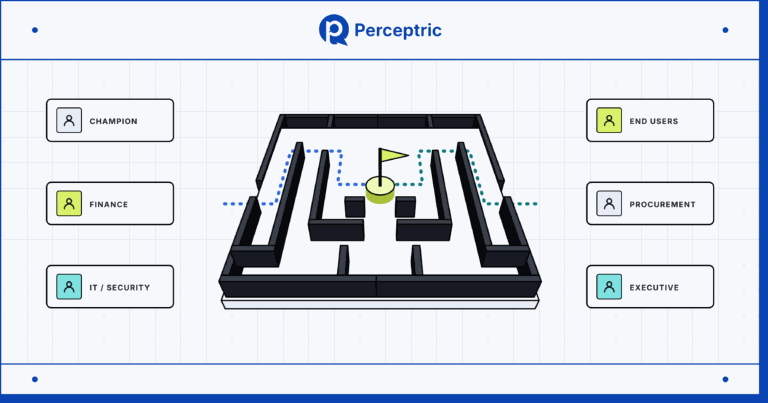
A buying committee is the group of people at the customer's company who take part in a purchase. For a security tool, that could be the CISO, a security engineer, IT, procurement and the CFO, each with different questions your content needs to answer.
What is a buying committee?
A buying committee is the group of people at a customer's company who take part in a purchase. Some of them use the product, some pay for it and some can block it. You'll also hear it called a buying group. It's the same idea.
Let's say you sell a cloud security platform to companies with about 1,000 staff. The CISO sponsors the project. A security engineer runs the trial and checks whether alerts are useful. Someone from IT asks about single sign-on and how you connect to their cloud accounts. Procurement wants contract terms, and the CFO wants to know what it costs next to the tool it replaces. Any one of them can slow the deal down.
So the person who finds you is rarely the person who signs. That person, often called the champion, has to sell you to everyone else when you're not in the room.
Why the buying committee matters for B2B SaaS
B2B purchases involve more people than most marketers plan for. In Forrester's 2026 State of Business Buying, a typical decision involved 13 internal stakeholders and nine outside influencers. Software deals for smaller teams can be leaner. G2's 2025 buyer research found groups of three to four people becoming more common in software, while committees of five to eight shrank.
Either way, most of the people deciding will never book a demo or talk to your sales team. They'll read what your champion forwards them, search your name and check a page or two on their own.
Here's why that changes your content plan:
- Your champion needs material: They have to explain your product to people who don't care about the features. Short pages and documents they can forward do that job for them.
- Any role can say no: A deal the users love can still stall in a security review or in procurement. The questions those people ask deserve pages as much as the user's questions do.
- Each role searches differently: The engineer searches "how to reduce alert noise in AWS". The CFO searches your name plus "pricing". IT searches your name plus "SSO". One blog post can't answer all three.
How to create content for a buying committee
Start with the deals you already have, since they tell you who really shows up. Here's my process:
- Map the roles from real deals: Look at the contacts on your last 20 won and lost opportunities in the CRM, and listen to a few recorded sales calls. Write down every role that joined, even for one meeting.
- Write down each role's question: For each role, note the one question that decides their vote. For a CFO it's often "What does this replace, and when does it pay back?"
- Give each question a page: Build a security page, a pricing page, an implementation timeline, integration docs and a page on the business case. Many of these are MOFU and bottom-of-funnel pages that also rank in search.
- Build a champion kit: Make a one-page business case, a short security summary and a few slides your champion can drop into an internal deck. Keep them plain enough to forward with no extra explanation.
- Reach the rest of the account: Use ABM campaigns on LinkedIn to put role-specific ads and posts in front of the other people at accounts that are already in a deal.
- Write for non-experts too: The CFO and procurement lead won't know your jargon. Explain the outcome in plain words on the pages they're likely to read.
A buying committee example
Here's how the cloud security platform from earlier could map its committee. The company is hypothetical, and the roles follow the example above:
| Role | The question that decides their vote | Content that answers it |
|---|---|---|
| CISO | Will this lower our risk enough to defend the cost? | A business case page with customer results by company size |
| Security engineer | Will the alerts be useful, or just noise? | A hands-on guide and a free trial with sample data |
| IT | Does it work with our SSO and cloud accounts? | Integration docs and a setup checklist |
| Procurement | Are the contract terms standard? | A page with the order form, DPA and renewal terms |
| CFO | What does it replace, and when does it pay back? | A pricing page and a simple cost comparison |
When every row has a page, the champion can answer most questions with a link. That's a lot easier than waiting a week for the next sales call.
How to measure buying committee reach
Most of this lives in your CRM, so set up contact roles on opportunities before you start. Here's what I'd track:
- Contacts per opportunity: Compare the average number of contacts on won deals with lost deals. If won deals have more people involved, multi-threading is working for you.
- Roles reached: Note which roles engaged with any content during a deal. A pattern of lost deals with no finance or IT contact tells you which pages to build next.
- Content viewed during deals: Use your marketing automation tool to see which pages contacts on open opportunities read. Security and pricing pages often show up here.
- Win rate and cycle length: Compare win rate and sales cycle length for deals where three or more roles engaged against deals with one.
- Security review time: Track the days from a security questionnaire to sign-off. A good security page and a ready summary should shorten it.
Our post on SEO for complex buying journeys covers how search fits into these longer deals.
Common buying committee mistakes
- Writing only for the user: Feature pages and how-to guides help the person who found you. They don't help the CFO or procurement say yes.
- Hiding pricing and security details: If the CFO can't estimate cost and IT can't find your certifications, the deal waits for a call. Put the basics on public pages.
- Treating the champion as the buyer: Your champion is one vote. Ask them early who else needs to approve and what each person will worry about.
- Using the same jargon for everyone: A security engineer and a CFO need different words. Write each page for the role most likely to read it.
- Forgetting outside influencers: Consultants, analysts and peers at other companies shape decisions too. Reviews, community answers and partner pages reach them.
Here's a first step for this week. Pull your last five lost deals and list every role that joined them. Which of those roles never got a page that answered their question?
Read more
FAQ
What's the difference between a buying committee and a buying group?
They mean the same thing. Gartner and Forrester tend to say buying group, and many sales teams say buying committee. Both describe everyone at the customer's company who shapes the purchase.
How many people are in a B2B buying committee?
Forrester's 2026 State of Business Buying found a typical decision involves 13 people inside the company and nine outside influencers. Smaller software deals often involve far fewer, sometimes three or four people.
Who is usually on a SaaS buying committee?
Most include the people who will use the tool, a budget owner, someone from IT or security, and procurement or legal for larger deals. The person who found you and pushes for you inside the company is usually called the champion.
How do you create content for a buying committee?
List each role from your won and lost deals, write down the question each one asks and make sure a page answers it. Then give your champion short, easy-to-forward material like a business case and a security summary.