Creative content is the type of piece people bookmark and send to their boss, because it helps them do their job. In B2B, that usually means a tool, a dataset, a template or a model that solves a real problem better than another blog post could.
In this guide, I walk you through what creative content is and the six types I see work most often. Each type comes with a real B2B example and a real B2C example, plus what you can borrow from it.
After that, I show you how I come up with ideas, how to build them without a big agency budget and how to measure what each piece brings in.
What is creative content?
Creative content is any piece of marketing that gives your audience something they can’t easily get anywhere else. It can be a new answer, a new dataset, a new format or a tool that does the work for them.
The format matters less than the value, so a plain spreadsheet can count as creative content if it saves a finance lead two hours every month, while a flashy animation can be forgettable if it repeats what everyone else already said.
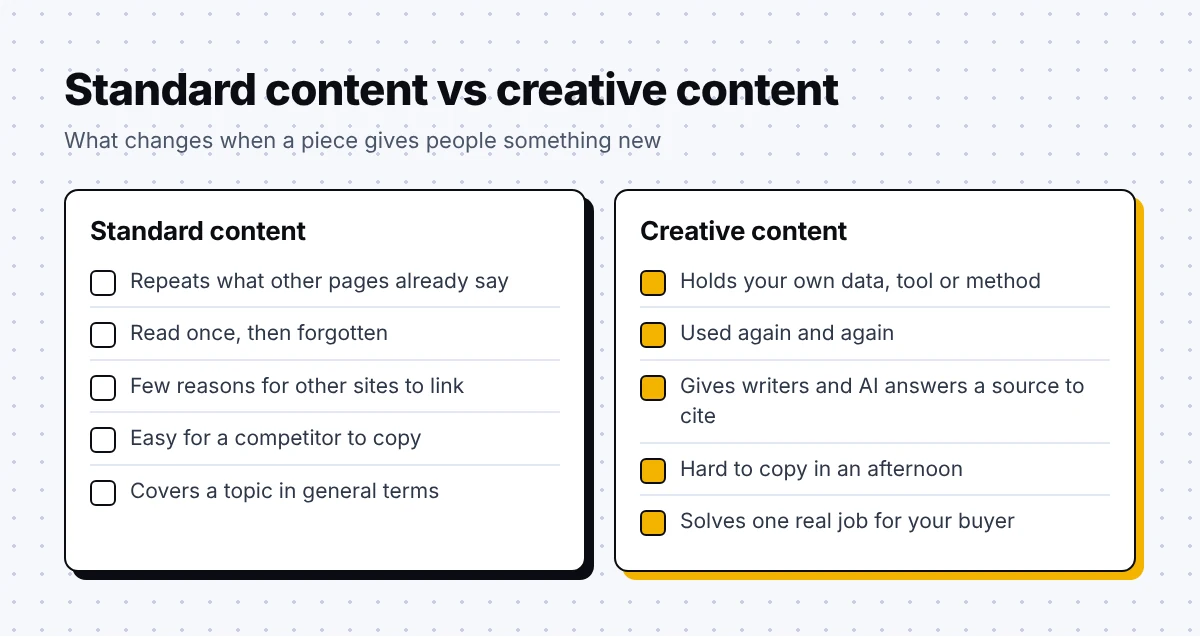
I use a few simple tests to tell creative content apart from standard content:
- It holds something original, such as your own data or your own tool.
- People use it more than once, so it keeps earning visits after launch week.
- Other sites can cite it, which makes it a natural magnet for links and AI search mentions.
- It is tied to a real job your buyer has to get done.
- It would be hard for a competitor to copy in an afternoon.
Why creative content matters in B2B marketing
Honestly, most content never gets found by anyone. When Ahrefs looked at about 14 billion pages in its index in 2023, it found that 96.55% of them got no traffic from Google at all.
Standard articles compete in that crowded pile. Creative content gives people a reason to link to your page and come back to it, and that is what pulls a page out of the pile.
Why it works for B2B teams:
- Buyers often research on their own before they talk to sales, and a useful tool keeps your brand in that research.
- Journalists, bloggers and AI answers need sources, and original data gives them one.
- Sales reps can send a calculator or template in a deal, which a generic post rarely earns.
- One strong asset can feed months of smaller posts and social clips.
If you want the bigger picture of how this fits into a full program, my guide to B2B blog strategy covers how creative assets sit next to your SEO library.
6 types of creative content (with B2B and B2C examples)
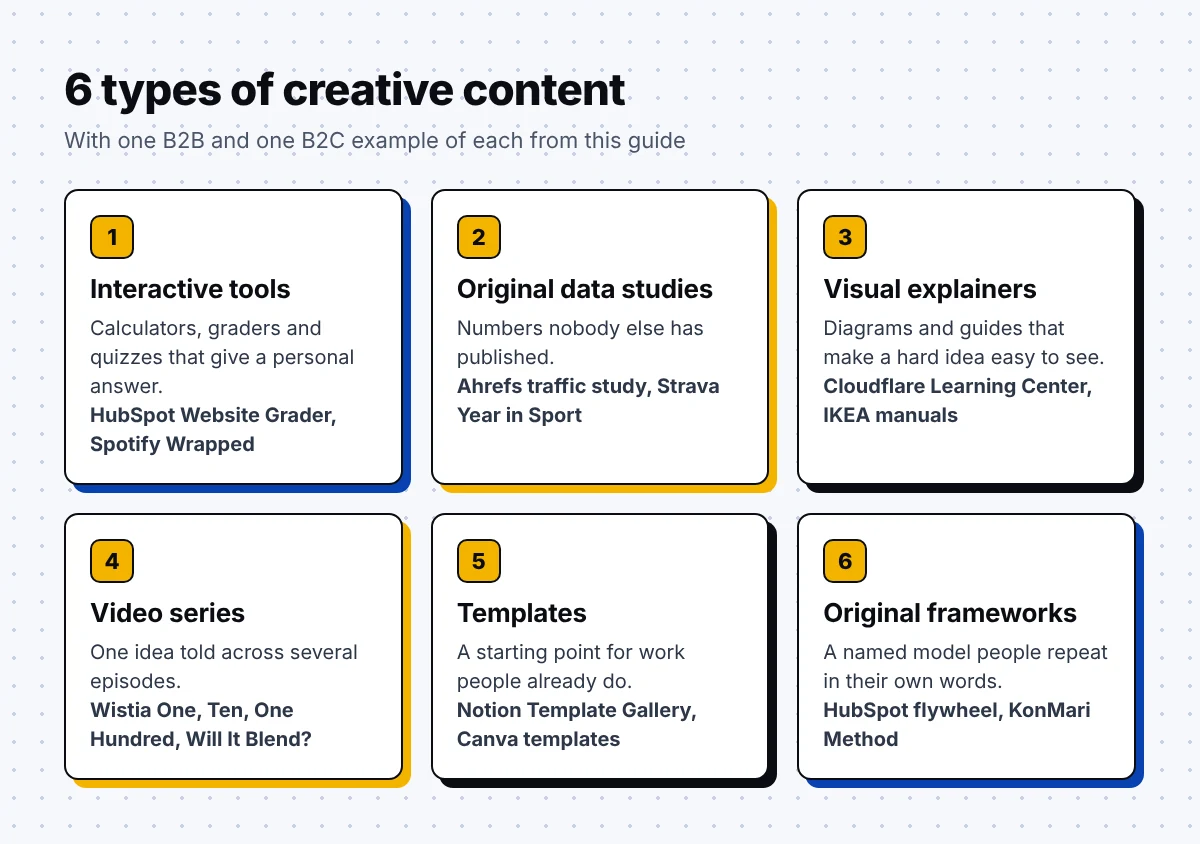
Each type below includes one B2B example and one B2C example. I picked consumer brands on purpose, because B2B teams can borrow a lot from how they package ideas.
1. Interactive tools
An interactive tool takes the reader’s own input and gives them a personal answer, and calculators, graders, quizzes and assessments all fit here.
B2B example: HubSpot Website Grader
HubSpot is a customer platform company that sells marketing and sales software. Its free Website Grader scores any site out of 100 across performance, mobile, SEO and security.
HubSpot says it first launched the tool in 2007. When the company relaunched it, it said the grader had already evaluated about 4 million websites.
B2C example: Spotify Wrapped
Spotify is an audio streaming company that turns each listener’s yearly data into a personal story called Wrapped. Wrapped is built to be shared, with results laid out as short data stories people can post.
Interestingly, for 2025 Spotify also built separate Wrapped versions for artists, songwriters, podcasters, authors and advertisers. That last one shows how a consumer idea can stretch into a B2B audience.
What you can borrow:
- Score something your buyer already worries about, such as site speed, security or cloud spend.
- Show a result on screen first, then offer a full report by email.
- Make the result easy to share, because a score invites people to compare.
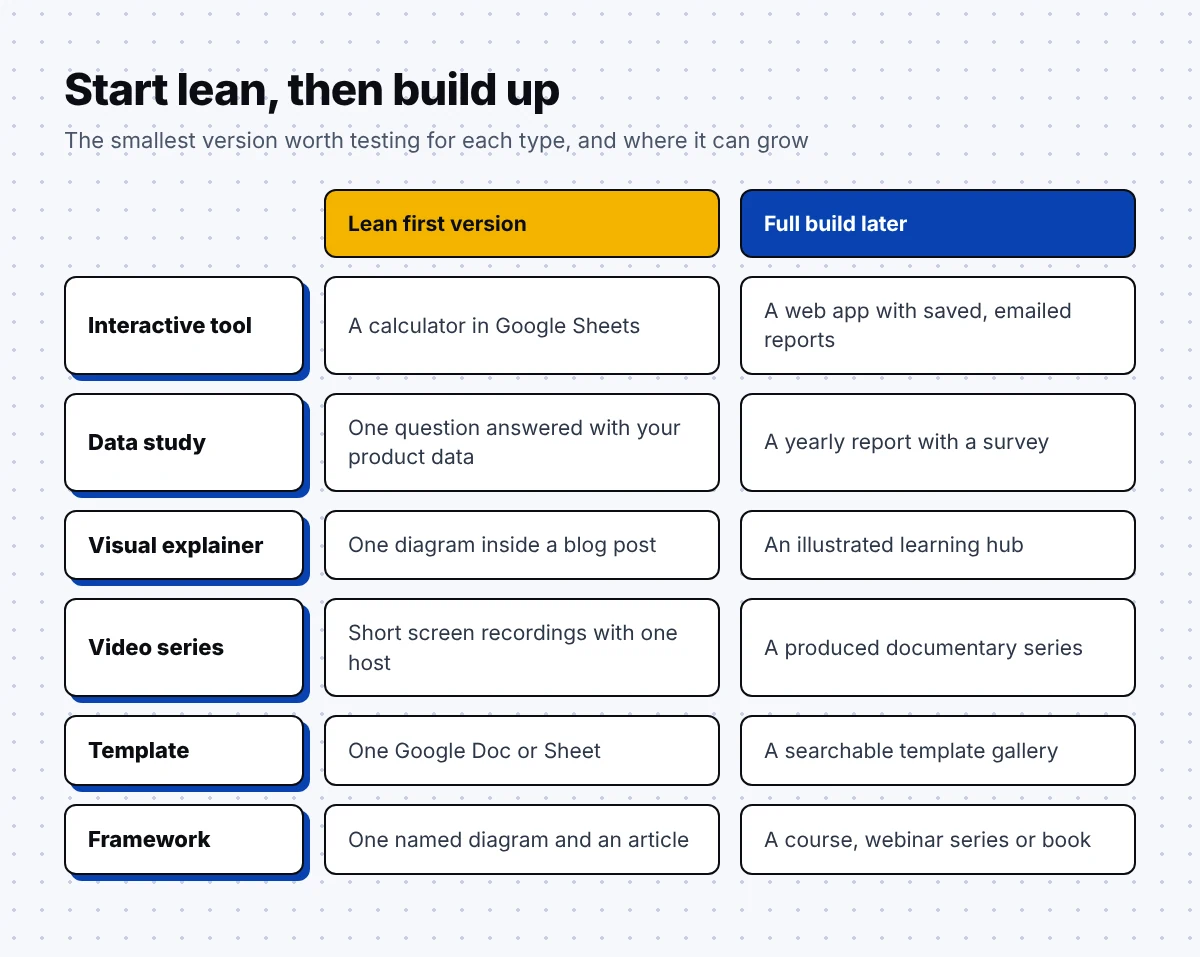
- Start with a spreadsheet version before you pay for a custom build.
2. Original data studies
A data study answers a question with numbers nobody else has published. You can use product data, a survey or public data you clean up and analyze.
B2B example: Ahrefs’ search traffic study
Ahrefs is an SEO software company that publishes research from its own crawler data. In December 2023, CMO Tim Soulo shared a study of about 14 billion pages showing that 96.55% get zero traffic from Google.
The headline number is simple and easy to quote, so other SEO writers can drop it straight into their own articles.
B2C example: Strava Year in Sport
Strava is a fitness tracking company that runs an app where runners and cyclists log their workouts. In December 2025, it released its 12th annual Year in Sport Trend Report.
The report mixes activity data with a survey of more than 30,000 people. Its 2025 headline was that Gen Z is moving away from doomscrolling and toward movement.
What you can borrow:
- Publish on the same schedule every year so people expect it and wait for it.
- Lead with one finding that fits in a headline.
- Combine your own product data with a survey to add the human side.
- Share the method so other writers feel safe citing you.
3. Visual explainers
A visual explainer makes a hard idea easy to see, and diagrams, annotated charts, illustrated guides and anatomy breakdowns all count.
B2B example: Cloudflare Learning Center
Cloudflare is a web security and performance company that protects and speeds up websites. Its Learning Center explains topics such as DDoS attacks in plain language for people who are new to them.
These pages help buyers who are still learning the basics. They also rank for broad questions that a product page would rarely win.
B2C example: IKEA assembly instructions
IKEA is a home furnishing company known for furniture that ships flat in a box. Its assembly instructions use drawings in place of words, so the same manual can work across many languages.
Design writers point out that the manuals start with the finished product and move step by step. That order gives people an early win before the harder parts.
What you can borrow:
- Draw the process your buyers find most confusing, step by step.
- Use one simple visual style across every diagram on your site.
- Show the end result first, then the steps that get there.
- Turn each diagram into a social post and a slide for your sales deck.
4. Video series
A video series follows one idea across several episodes. It works best when each episode has a clear hook and the whole series has a story arc.
B2B example: Wistia’s One, Ten, One Hundred
Wistia is a video hosting and marketing company that helps businesses publish and track video. Its documentary series One, Ten, One Hundred asked the agency Sandwich Video to make three ads for $1,000, $10,000 and $100,000.
The four episodes follow each budget from the first pitch to the final shoot. Wistia says the series went on to win two Webby awards.
B2C example: Blendtec’s Will It Blend?
Blendtec is a blender company based in Utah. Its Will It Blend? videos show CEO Tom Dickson blending odd objects, each one opening with the same question.
By 2015, the Content Marketing Institute reported more than 140 videos and 256 million combined YouTube views. Blendtec later added influencer content to reach people more likely to buy a blender.
What you can borrow:
- Pick one question your audience argues about and test it on camera.
- Keep a fixed format, so every episode feels familiar.
- Plan how the series leads to your product before you film.
- Cut each episode into short clips for LinkedIn and YouTube Shorts.
5. Templates
A template gives people a starting point for work they already do, and spreadsheets, briefs, checklists, decks and workspace setups all fit.
B2B example: Notion Template Gallery
Notion is a workspace software company whose app combines docs and project tracking in one place. Its Template Gallery holds templates built by and for the community, sorted into more than 250 categories.
Cleverly, each copied template puts someone inside the product, so the gallery works as a helpful resource and a way in for new users at the same time.
B2C example: Canva templates
Canva is an online design company that lets anyone make graphics and presentations in the browser. Canva says its template library holds more than 400,000 templates, from business decks to event invites.
People search for a specific template, such as a birthday invite or a resume, and land straight in the editor, so the template does the marketing for Canva.
What you can borrow:
- Build the template your best customers already made for themselves.
- Give it a clear name that matches what people search for.
- Make it work in a tool your buyer already uses, such as Google Sheets.
- Add a short note inside on how your product makes the job faster.
6. Original frameworks
This type gives a name and a shape to a way of thinking. Once people adopt your model, they start using your words when they explain the problem.
B2B example: HubSpot’s flywheel
HubSpot’s Brian Halligan presented the flywheel at INBOUND 2018 as a replacement for the funnel. It has three stages called attract, engage and delight, with happy customers feeding new growth.
Marketers still debate whether the flywheel replaces the funnel or sits beside it. That debate is part of why the idea keeps getting written about.
B2C example: The KonMari Method
Marie Kondo is a Japanese tidying expert and author whose books lay out her method for decluttering a home. The KonMari Method asks people to tidy by category and keep only what sparks joy.
It also sets a clear order of clothes, books, papers, miscellaneous items and then sentimental items. A named method with clear steps is easy for people to explain to a friend.
What you can borrow:
- Name the process you already run with clients.
- Draw it as a simple diagram with stages people can remember.
- Write one article for each stage and link them together.
- Teach it on webinars and podcasts so others repeat it.
When you plan your roadmap, it helps to compare the six types side by side. The effort and time columns are my own rough guide from client projects, so treat them as a starting point.
| Type | Effort to build | Time to launch | Best for |
|---|---|---|---|
| Interactive tools | Medium to high | 3 to 8 weeks | Leads and repeat visits |
| Original data studies | Medium | 4 to 10 weeks | Links, press and AI citations |
| Visual explainers | Low to medium | 1 to 3 weeks | Rankings for broad questions |
| Video series | High | 6 to 12 weeks | Brand recall and social reach |
| Templates | Low | 1 to 2 weeks | Signups and sales enablement |
| Original frameworks | Low to medium | 2 to 6 weeks | Thought leadership |
How to come up with creative content ideas
Luckily, the best ideas are usually sitting inside your company already. You just need to look in the places where buyers show you their problems.
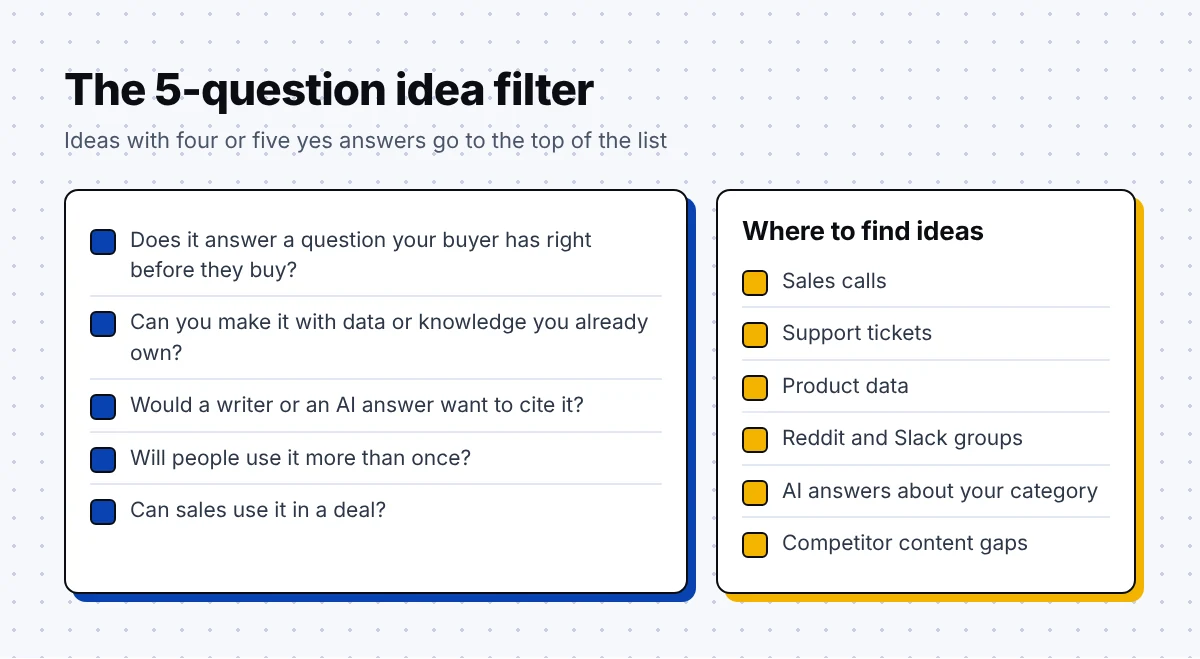
These are the sources I check first:
- Listen to sales calls and note every question a prospect asks twice.
- Read support tickets and look for tasks customers keep doing by hand.
- Ask your product team which data you collect that nobody else has.
- Search Reddit and Slack communities for spreadsheets and checklists people swap.
- Look at what AI tools say about your category and spot the gaps they can’t fill.
- Review your top competitors’ content and find formats they have skipped.
I wrote more about two of these in how I use Reddit to inform content strategy and how your sales team can inform content strategy.
Once you have a list, score each idea before you build anything. My quick checklist:
- Does it answer a question your buyer has right before they buy?
- Can you make it with data or knowledge you already own?
- Would a writer or an AI answer want to cite it?
- Will people use it more than once?
- Can sales use it in a deal?
Ideas that get four or five yes answers go to the top of the list, and the rest can become regular articles.
How to create creative content on a B2B budget
Thankfully, you don’t need a huge budget to make something people remember. Most of my client projects start small and grow once the first version proves it can attract an audience.
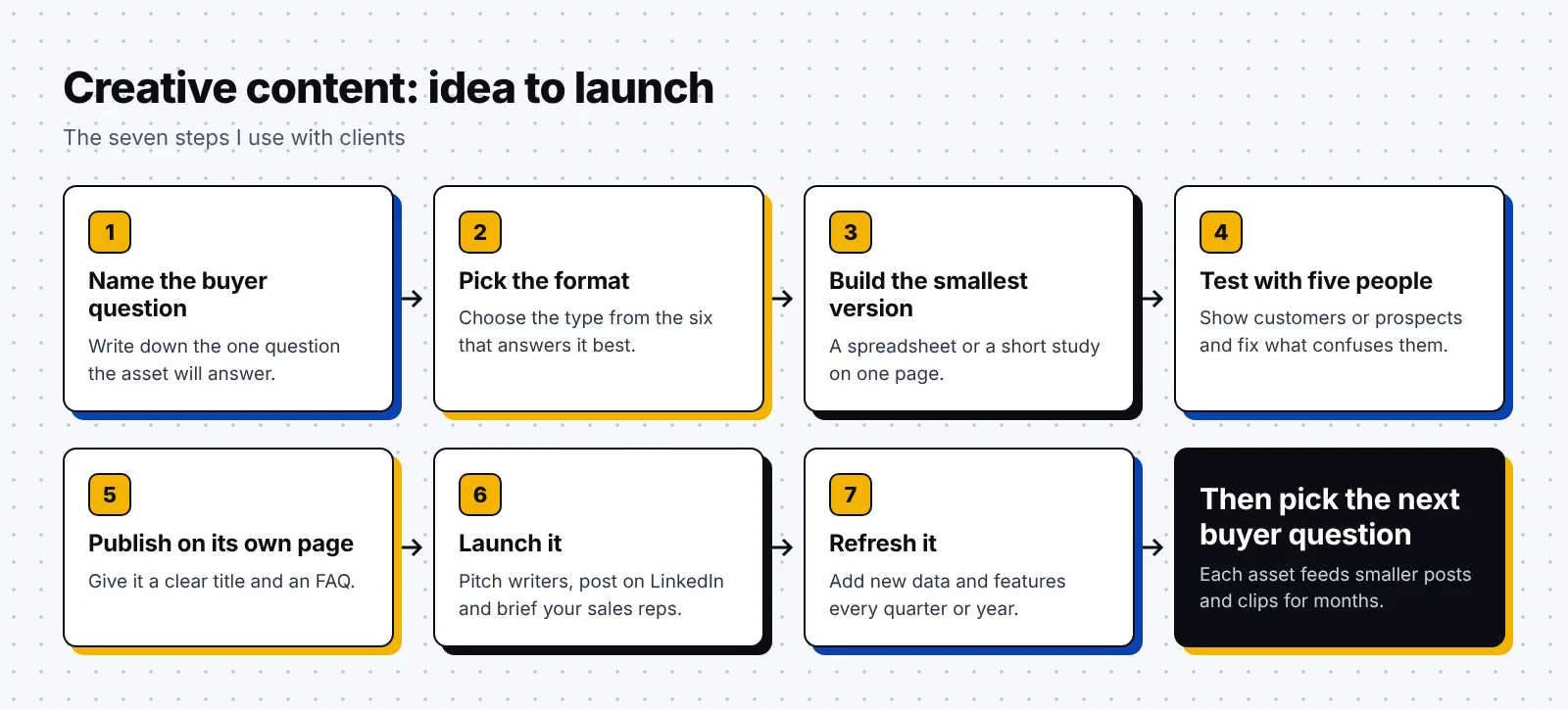
My flow for taking an idea to launch has seven steps:
- Write down the one buyer question the asset will answer.
- Pick the format from the six types that answers it best.
- Build the smallest version that works, such as a spreadsheet or a short study on one page.
- Test it with five customers or prospects and fix what confuses them.
- Publish it on its own page with a clear title and an FAQ.
- Pitch it to writers and share it on LinkedIn, then give your sales team a short note on when to send it.
- Refresh it every quarter or year with new data and new features.
Do and don’t for budget builds:
- Do use Google Sheets or a simple form builder for your first calculator.
- Do reuse product data, because it is the one thing competitors can’t buy.
- Do brief a designer on one visual style and use it everywhere.
- Don’t build a custom app before you know people want the tool.
- Don’t run a survey with too few answers to trust.
- Don’t publish a study without explaining how you got the numbers.
Surprisingly, the launch often matters more than the build, because a strong asset with no distribution plan can sit unseen for months. Plan the first month of promotion before you start making it.
If you would rather hand this work to a team, our B2B SaaS content marketing agency builds creative assets alongside SEO content. You can also see the thinking behind it in our creative SEO methodology.
How to measure creative content
Admittedly, creative content usually pays off over months, so track it on a longer timeline than a regular post. Set your goals before launch so you know which number matters most.
The metrics I track:
- Referring domains, which show how many sites link to the asset.
- AI citations, which show whether answers in ChatGPT or Google AI Overviews mention it.
- Repeat visits, which show whether people come back to use it again.
- Leads or signups from the page, including email reports from tools.
- Sales usage, which you can track by asking reps how often they send it.
- Branded search, which can rise after a strong study or tool launch.
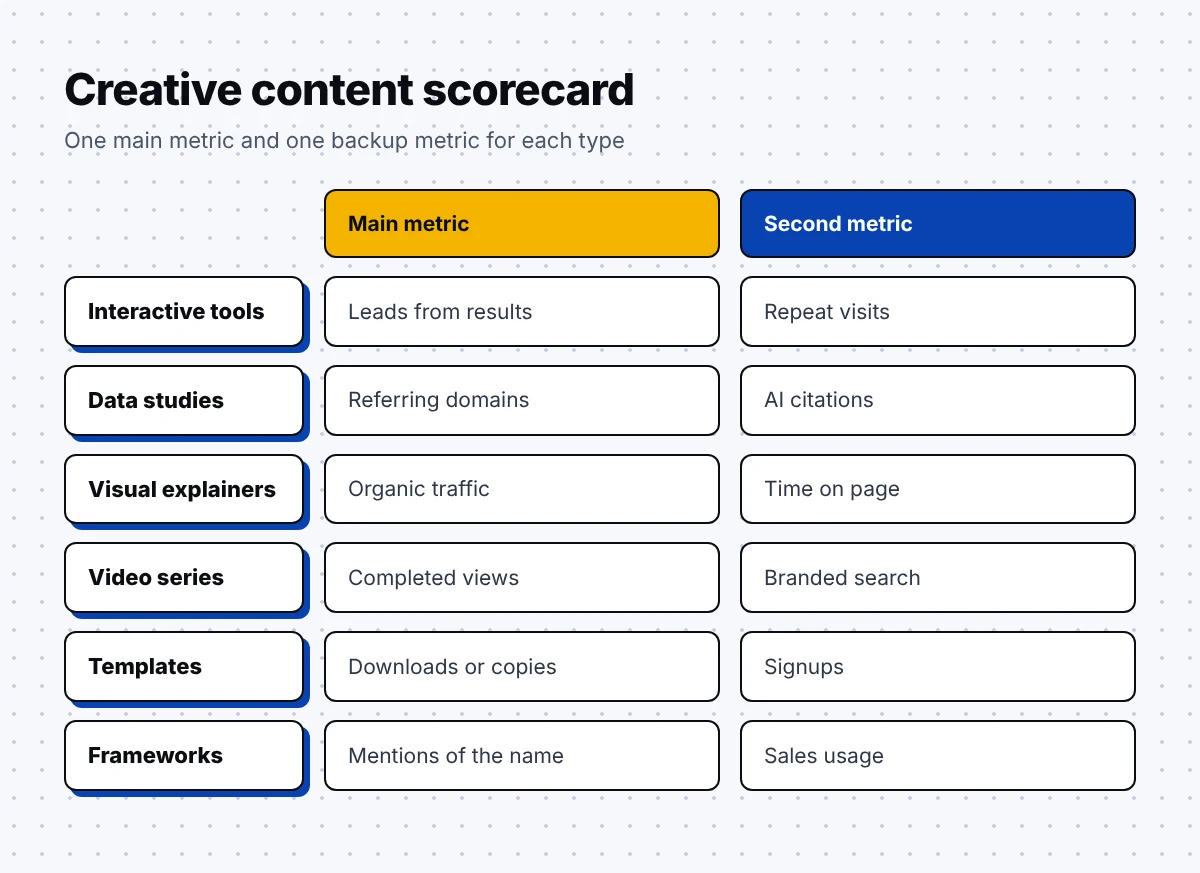
I match each type to one main metric and one backup metric:
| Type | Main metric | Second metric |
|---|---|---|
| Interactive tools | Leads from results | Repeat visits |
| Original data studies | Referring domains | AI citations |
| Visual explainers | Organic traffic | Time on page |
| Video series | Completed views | Branded search |
| Templates | Downloads or copies | Signups |
| Original frameworks | Mentions of the name | Sales usage |
If you want to know how often AI tools already mention your brand, our AI visibility audit is a good place to start.
FAQ
What is creative content in marketing?
Creative content is marketing that gives your audience something original, such as your own data, a tool, a template or a named method. It stands out because people can’t easily find the same thing elsewhere, so they link to it and come back to it.
What are the main types of creative content?
The six types I see work most often are interactive tools, original data studies, visual explainers, video series, templates and original frameworks. Each one suits a different goal, from leads to links.
How do you come up with creative content ideas?
Start with sales calls, support tickets, your product data and the communities where your buyers talk. Look for questions people ask over and over and tasks they still do by hand, then score each idea on whether you can build it with what you already own.
How much does creative content cost to make?
The cost depends on the type you choose. A template or a single diagram can take a week or two of one person’s time, while a custom tool or video series can take months and a larger team. I suggest building a small first version and investing more once it proves itself.
How do you measure the success of creative content?
Track referring domains, AI citations, repeat visits, leads from the page and how often sales sends it. Pick one main metric per asset before launch, and measure it over several months, since creative pieces often keep growing long after launch week.
Your next step
Pick one buyer question from your last five sales calls and sketch the smallest asset that could answer it. If you want help turning that sketch into something that ranks and gets cited, book a call with us.