Content marketing is incredibly powerful as part of your inbound marketing strategy. With good content, you educate prospects about your product and nudge them toward the final buying decision.
Content marketing takes time, sure, but you know what they say, good things take time.
In this article, we’re going to share with you:
- Why you should do content marketing to grow your B2B SaaS
- Why content marketing actually works
- Examples of the best B2B SaaS content marketing programs
- How to attribute pipeline & revenue growth to content marketing
Let’s dive right in!
Key Takeaways
- B2B SaaS content marketing is about influencing the buying journey. Buyers often consume multiple pieces of content before they ever speak to sales, so your content can shape how they understand the problem, your category, and your product before they become a lead.
- The best place to start is where buying intent already exists. Build content around high-intent searches such as use cases, industries, alternatives, comparisons, and pricing to capture buyers who are already looking for a solution.
- Your best content ideas are often already inside your company. Founders, product teams, salespeople, and customer-facing teams constantly hear questions, objections, use cases, and problems that can be turned into useful content.
- A strong content program combines demand capture with demand creation. Search-focused content captures people who are already looking, while thought leadership, original research, and social content can introduce new ideas and build interest before someone starts searching.
- Content works better when it is connected to the rest of your marketing system. Your website, forms, CRM, attribution, conversion tracking, and sales process should be ready to capture and follow up on the demand your content creates.
- The goal of content marketing is to contribute to pipeline. Traffic, rankings, and engagement can show whether content is being discovered, but qualified leads, opportunities, pipeline, and revenue show whether it is contributing to the business.
What is B2B SaaS Content Marketing?
Content marketing is the practice of attracting, educating, and influencing potential customers for your B2B SaaS by creating useful content around the problems they are trying to solve, the solutions they are evaluating, and the products they are considering.
With content marketing, you will build familiarity, credibility, and trust with potential customers long before they ever speak with your sales team.
How Content Marketing Brings Lead and Pipeline For Your B2B SaaS
Here’s what the buyer journey of a content-driven lead might look like:
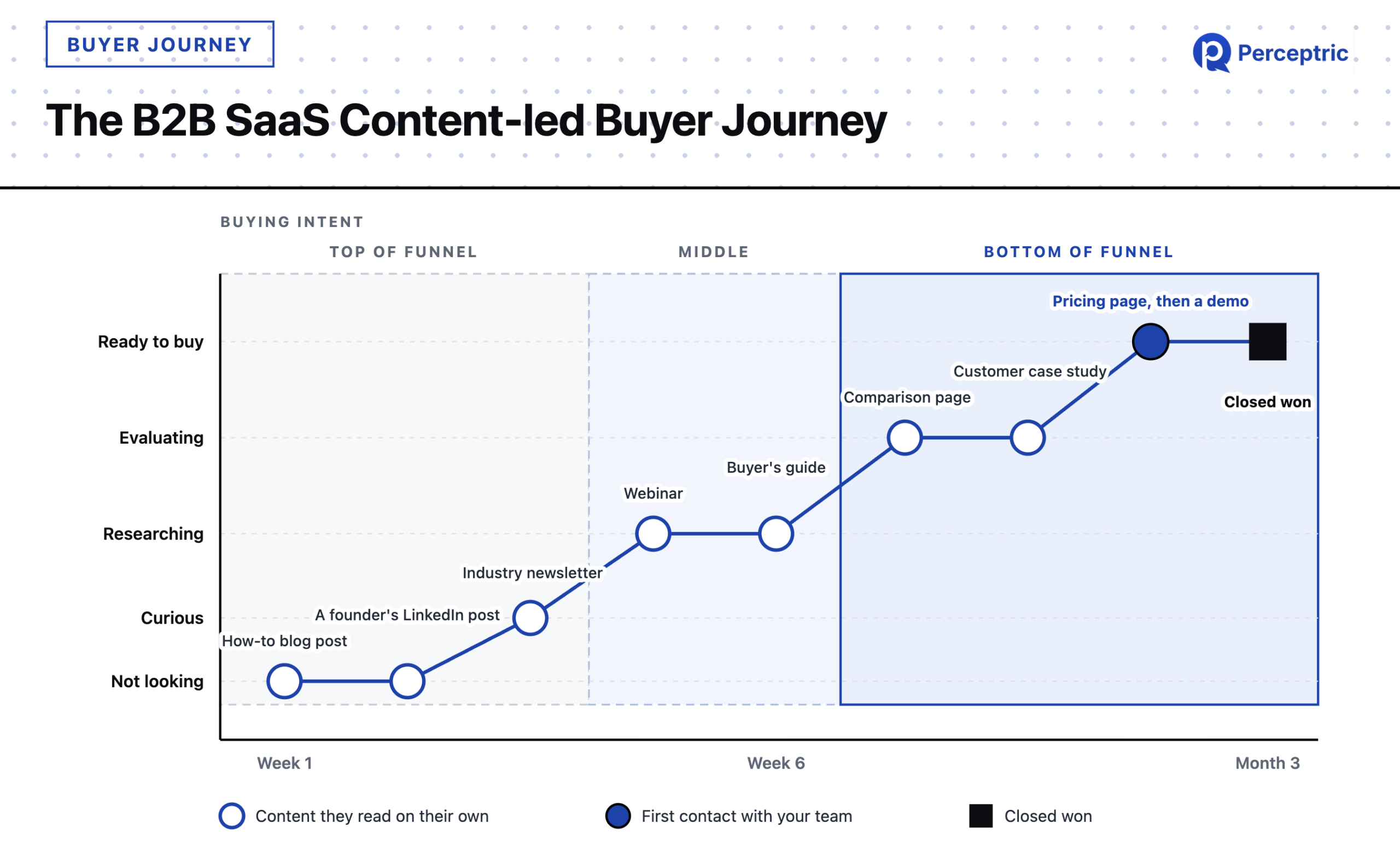
As you can see, for every piece of content they read, their interest in your brand and product gradually increases.
They may:
- Read your LinkedIn posts
- Listen to a podcast where you’re mentioned
- Have your product recommended by a peer
- Find an article about your product that ranks #1 on Google
They’ve read all of that, and they realize that you’re a pretty good vendor that can solve their problems. After some further vendor comparison and review checking, they decide to book a demo with your company. You now got a new prospect without having to doing any outreach.
With good content marketing, you can educate your prospects 24/7. If they decide to book a meeting with you, rest assured that they’ve already developed some trust with your brand. As a result, the sales process tends to move much more smoothly.
Does Content Marketing Work For B2B SaaS?
Content marketing is probably the most effective channel to generate leads for B2B SaaS companies. Here are some statistics to prove that:
 Content marketing in B2B SaaS, by the numbers
| Statistic | Source |
|---|---|
| Why content matters | |
| B2B buyers consume 13.4 pieces of content on average before contacting sales, and 67% of the buying journey is self-directed. | Content Marketing InstituteVia Digital Applied, 2026 |
| 91% of B2B marketers use content marketing, and 74% say it works for generating leads. | Power Digital, via MartalLead generation statistics, 2026 |
| Organic search accounts for roughly 29% of total B2B website traffic, making it the largest single source. | MartalB2B benchmarks, 2026 |
| How effective it is | |
| Content marketing generates 3x more leads than outbound while costing 62% less per lead. | DemandSage, via MartalLead generation statistics, 2026 |
| B2B SaaS content programs average 844% ROI over three years. SEO alone averages 702%, breaking even around month seven. | AveriContent ROI benchmarks, 2026 |
| Companies publishing 15 or more posts a month generate an average of 1,200 new leads monthly. | DemandSage, via CallboxLead generation report, 2026 |
Best Types Of Content Formats For B2B SaaS
Content formats for B2B
| Format | Why it works | Where it falls short |
|---|---|---|
| Blog posts | Marketers who prioritise blogging are 13 times more likely to report positive ROI. A good post can keep bringing in traffic through search while giving your other channels useful content to share and build on. | You need to target the right SEO keywords to turn blog posts into a reliable source of organic traffic and conversions. Without SEO, posts often need ongoing promotion through paid ads or social media. |
| White papers | Around 22% of business leaders prefer them. Their longer format gives you room to explore a complex topic, share original research, and make a detailed case for your point of view. | White papers take a lot of time to produce and are often gated. They can also be difficult to discover organically, so you usually need to promote them through paid ads, email, or social media. |
| Organic LinkedIn posts | These work best from personal profiles, not the company page, because people connect with people. Founders and experts can share useful insights directly with customers on LinkedIn. Over time, this builds familiarity and trust before a buyer is ready to talk to sales. | Reach depends on LinkedIn’s algorithm, and individual posts have a short shelf life. Results also require consistent posting over time, and the audience is tied to the person rather than the company. |
| Case studies | Valued by nearly half of business leaders, case studies show buyers what your product actually achieved for a real customer. They’re especially useful when prospects are comparing vendors or looking for proof from companies like theirs. | They depend on having successful customers willing to participate. Getting approval, gathering the right information, and turning it into a strong story can also take time. |
| Infographics | Infographics make complex information easier to understand and share. They’re a good fit for data, statistics, processes, frameworks, and other ideas that are easier to grasp visually. | They can take significant design time, and search engines can’t understand visual information as easily as text. They’re also less useful when an idea needs a lot of explanation or nuance. |
| Podcasts | Podcasts let buyers consume your content while commuting, exercising, or doing other things where reading isn’t practical. They can also create a stronger connection with the people behind your brand through longer, more conversational discussions. | Building an audience takes time, and it’s difficult to connect downloads or listens directly to revenue. Producing a regular show also requires a significant ongoing commitment. |
| Video | Companies using video report 27% higher clickthrough rates and 34% higher web conversion rates than those that don’t. Video is also useful for demonstrating products, explaining complex ideas, and building trust quickly. | Video usually takes more time and resources to produce than written content. It can also become outdated when your product, positioning, or interface changes. |
| Newsletters | Newsletters give you a direct channel to people who already want to hear from you. You can regularly share insights, new content, company updates, and useful resources while bringing readers back to your website and staying top of mind. | Newsletters are mainly useful for building and nurturing an existing audience, rather than reaching completely new buyers. Growing the subscriber list takes time, and you need to keep publishing useful content to maintain engagement. |
How To Build Your B2B SaaS Content Strategy?
1. Choose the right type of content to produce
There are 3 levels of buying intent, and for each level there’s a different kind of content to produce.
Intent-Based Content Strategy
“I want to learn about this topic.”
Stage: Top of funnel
Rank for broad questions your buyers search
Earn trust with useful, original insight
Grow your email list and repeat readers
- Thought leadership articles
- Industry trend and data reports
- Educational explainers and glossaries
- Newsletters people open
“How do we solve this problem?”
Stage: Middle of funnel
Show how the problem should be solved
Prove your approach works with real proof
Turn engaged readers into leads
- How-to guides and playbooks
- Frameworks and templates
- Client case studies with real numbers
- Original research and benchmarks
“Which vendor should we pick?”
Stage: Bottom of funnel
Win buyers who are comparing vendors
Help your champion sell it internally
Clear the last doubts before they sign
- Bottom-funnel SEO: alternatives and “X vs Y” pages
- Clear pricing and ROI calculators
- Sales one-pagers, demo videos, and battlecards
- Security, onboarding, and product docs

The rule of thumb is:
- If you want more qualified leads and pipeline → High intent
- If you want buyers to understand and trust your solution → Medium intent
- If you want more people to discover you → Low intent
Our recommendation is to always start with high-intent content to capture existing demand and generate pipeline, then expand into medium- and low-intent content to build trust and grow your audience over time.
2. Interview Founders & SMEs
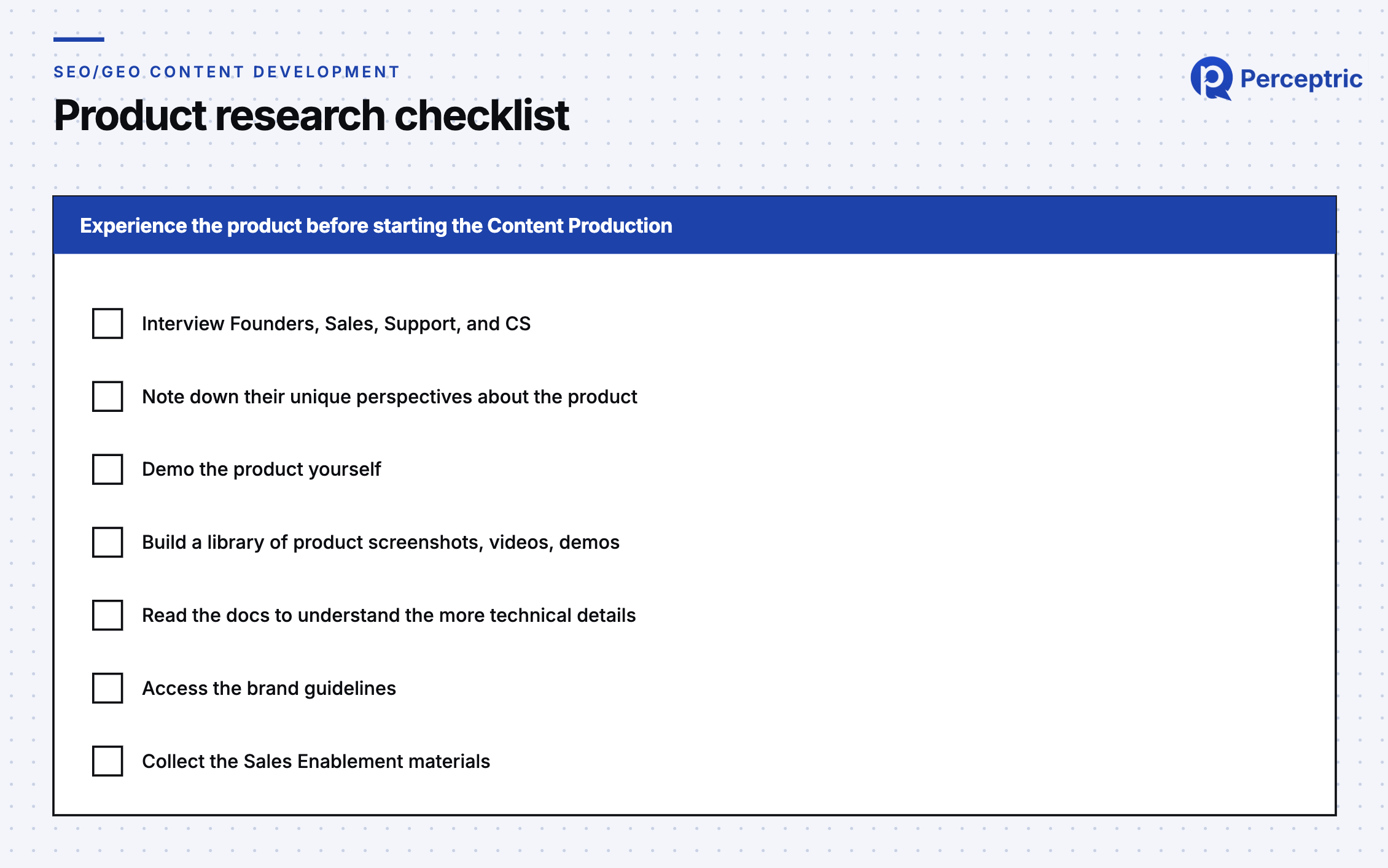
Some of the best content ideas are already sitting inside your company. You just need to talk to the people who know the product, customers, and market best.
Start by interviewing a few subject-matter experts across the company. Ideally, include people with different perspectives:
- Founders: They understand the product vision, why it was built, and what they believe makes it different.
- Product: They know how the product works, its strongest use cases, and what it can actually do.
- Sales: They hear what prospects ask about, what they compare you against, and what ultimately drives buying decisions.
- Customer support: They know where customers struggle, what questions come up repeatedly, and which problems aren’t obvious from the outside.
- Marketing: They understand how the product is positioned and where it fits within the broader market.
Before each interview, send a short list of questions so the person knows what to expect. You can ask things like:
- Who is this product really for?
- What problems does it solve?
- Why do customers choose it over alternatives?
- What makes it different from competitors?
- Which use cases are the strongest?
- What are customers most excited about?
- What do customers complain about most?
- What alternatives do prospects consider?
- What questions do prospects ask repeatedly?
- What do you wish prospects understood before they talk to sales?
The goal is to extract ideas for your content later down the road. Make sure to record these interviews with an AI meeting assistant, so later you can go through the transcripts and pull out the most interesting opinions. These become your raw material for articles, LinkedIn posts, case studies, newsletters, and other content.
Finally, don’t forget to use the product yourself. Spend 30–60 minutes exploring the product like an end user. Combining firsthand product experience with SME interviews gives you a much deeper understanding of what is actually worth writing about.
3. Set your website up for success
Before launching any content program, make sure your website is set up to track the leads your content generates. A few things we recommend:
- Set up conversion tracking so leads generated from your content are automatically sent to your CRM, such as HubSpot or Salesforce.
- Set up lead notifications so sales reps are alerted whenever a new inbound lead comes in and can follow up quickly.
- Capture attribution data such as source, medium, campaign, landing page, and first-touch source so you can see which content and channels are generating leads.
- Keep forms short and easy to complete. Only ask for the information you actually need at this stage.
- Add social proof throughout the website, including customer logos, testimonials, reviews, and case studies, to give new visitors more reasons to trust you.
4. Launch your Bottom-funnel SEO content program
We highly recommend SEO content for B2B SaaS teams because:
- Bottom-funnel SEO captures existing demand: You can reach buyers who are already searching for a vendor on Google.
- It compounds over time: A strong SEO article can keep generating traffic and leads months (sometimes years) after it is published.
- It builds authority: Consistently answering important questions helps establish your company as a credible source of expertise.
- It supports the sales process: Buyers can research your product, use cases, and expertise before they ever talk to sales.
- It can generate qualified pipeline: When you target the right keywords and connect content to clear conversion paths, organic traffic can turn into leads and opportunities.
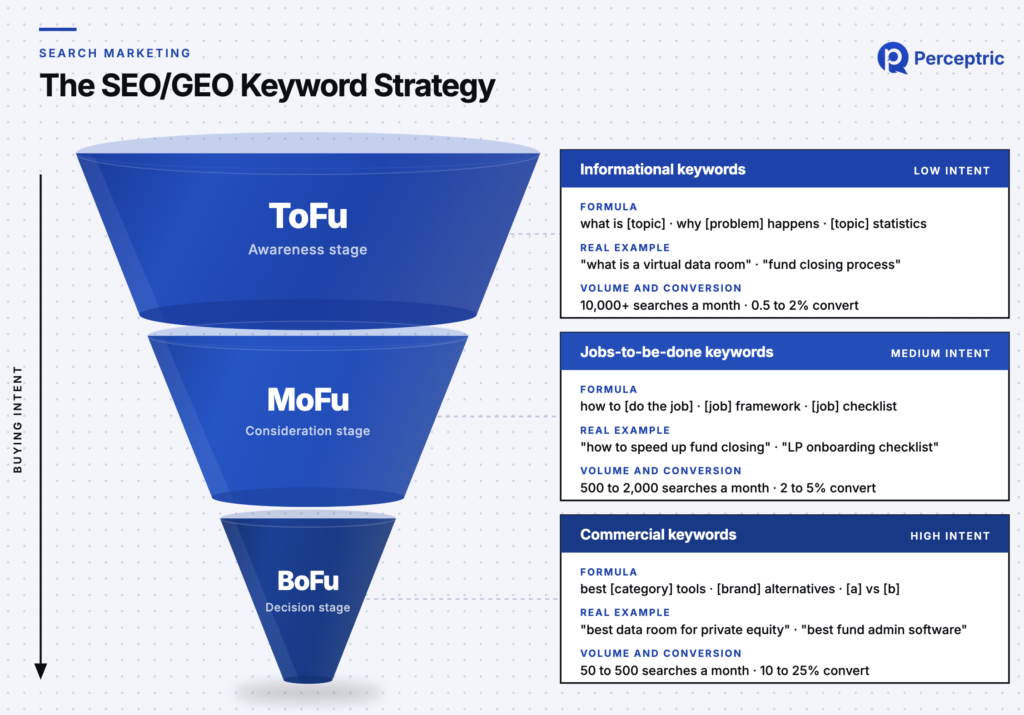
For B2B SaaS companies, some of the most valuable keywords to target are bottom-funnel, use-case-driven searches. These are searches made by buyers who already know what they need and are actively looking for a solution.
They often look like:
- “[Industry] + [Use case] software”
- “[Use case] software for [Industry]”
- “[Industry] software for [Use case]”
- “[Competitor] alternatives”
The more use cases, industries, and customer segments your product serves, the more opportunities you have to build relevant content around these searches.
Many of these bottom-funnel topics naturally lend themselves to listicles, comparison pages, and alternatives pages. These formats are particularly useful because buyers often use them when evaluating vendors, and they also align well with how AI search engines generate product recommendations. We explain why this happens in our guide to AI SEO.
This gives B2B SaaS teams a useful overlap between SEO and GEO:
- SEO: Target searches made by buyers who are actively evaluating solutions.
- GEO: Structure the content in formats that AI search engines can easily understand, compare, and cite when buyers ask for recommendations.
- Content marketing: Turn those search opportunities into useful pages that help buyers evaluate your product and move closer to a purchase.
5. Launch your LinkedIn Thought Leadership content program
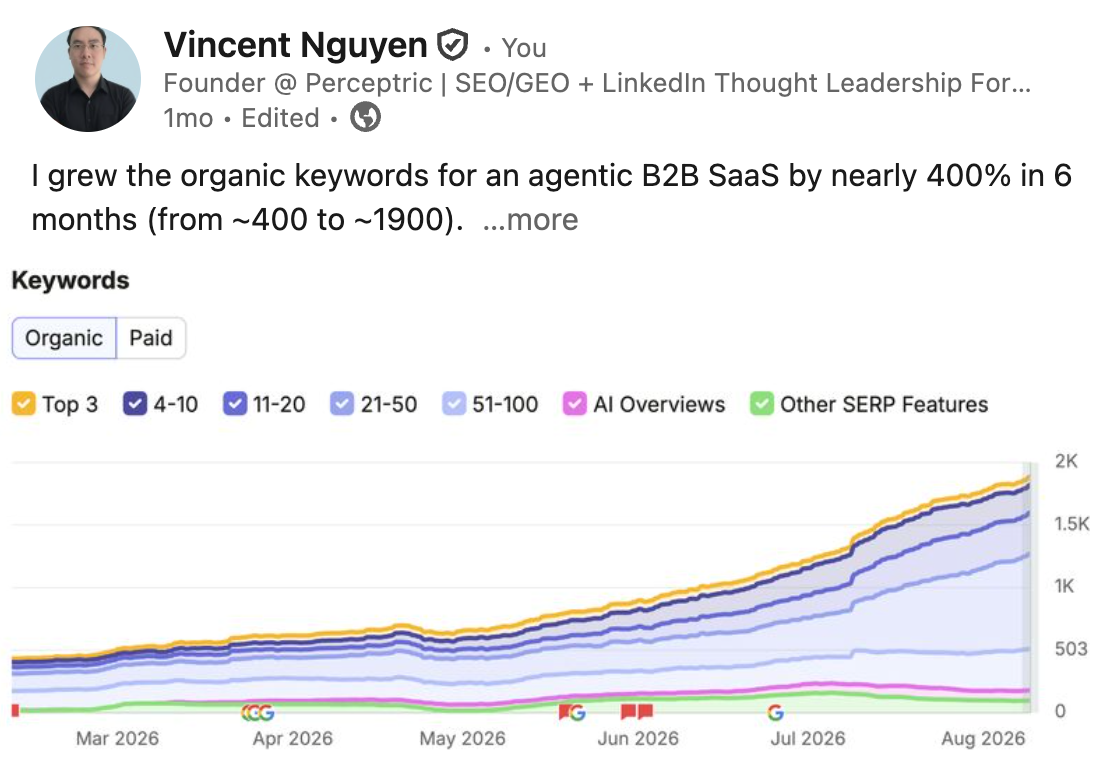
Many people still think of LinkedIn as the place to announce new jobs or career milestones. However, when used strategically, it can be an incredibly powerful lead generation channel.
In fact, founder-led LinkedIn content has been used by so many successful B2B SaaS brands:
- Devin Reed was the content mastermind behind Gong’s explosive growth, helping take the company from $20M to $200M ARR. He then built a LinkedIn strategy for Clari’s CEO that pulled in 6.1 million views in 12 months. This is the kind of reach that would have cost a fortune to buy with LinkedIn ads.
- Tommy Clark started his B2B social media agency as a side hustle while working full-time at Triple Whale. His LinkedIn expertise brought in so much client demand that he had to pick between the salary and the roster (take a wild guess which one won).
- And Kait Stephens, CEO of Brij, grew her company’s revenue 7x in a single year while inbound went from 0 to 40%+ of pipeline, all thanks to LinkedIn.
The playbook is:
Start with one word you want to be known for. Do not write about everything. Be very specific about what you share. You don’t need a massive following to see results; you want to attract people who genuinely care about what you have to say.
You should ideate and build your editorial calendar based on the three levels of intent:
- Top of funnel: Business, entrepreneurship, personal content (once a week is fine)
- Middle of funnel: Industry-specific content (bulk of your content should be this, whatever you want to be known for)
- Bottom of funnel: New product features, book a demo, sign up, etc. (no more than once a week)
- Timely content (like current events): this should definitely be incorporated into your strategy, but only supplemental. Treat those as bonus posts when you can.
If you’re starting from scratch, just write text-based content first. Literally any type of content works on LinkedIn, you just need to make sure what you write resonates with your target audience. Once you’re comfortable with text-based content, lean into other formats like infographics or video clips. These can accelerate trust-building massively since they help viewers put a face and personality (not just a photo of you) to your name and get to know you better.
Being consistent is the hard part. Anyone can post a LinkedIn post, but having the commitment to post every day, over a period of several months, is an entirely different story.
Spend 5-10 minutes throughout your day liking and commenting on posts. Keep in mind your responses don’t have to be anything crazy. Something as simple as “Good stuff” or “love this” can be perfect.
Give your LinkedIn strategy several months to compound, and look beyond likes and followers. Key signals include:
- Recognition: People mention that they follow your content or recognize you from LinkedIn.
- Inbound pipeline: More qualified leads, demos, and opportunities start coming directly from LinkedIn.
- Business impact: LinkedIn contributes to measurable growth in revenue, deals, or pipeline.
- Qualitative feedback: People send messages or comments telling you that your content is useful or has influenced how they think.
- Sales conversations: Prospects mention your posts during sales calls or arrive already familiar with your expertise.
Once you’ve started to see success on LinkedIn, it’s going to be so much easier to get the rest of the team on board. Because you have the receipts to prove how powerful it can be.
How To Distribute Your Content
Without distribution, your content will unfortunately be forgotten on your website. Some types of content have high discoverability (such as SEO articles and LinkedIn content, which is naturally pushed by the algorithm). Some content doesn’t have high discoverability, and the need to actively promote the pice.
The Content Discoverability–Creativity Matrix helps you decide what role a piece of content should play in your B2B SaaS content strategy. It looks at two dimensions:
- Discoverability is how easily a potential buyer can find that content when they are actively looking for information. It includes things like search demand, keyword relevance, distribution, platform reach, and how likely the content is to appear in Google or AI search results.
- Messaging creativity is how original, distinctive, and memorable the content is. It looks at the strength of the idea, the point of view, storytelling, format, examples, data, and how differently you communicate the topic compared with everyone else.
A piece of content can be highly discoverable but not particularly creative, or highly creative but difficult for anyone to discover.
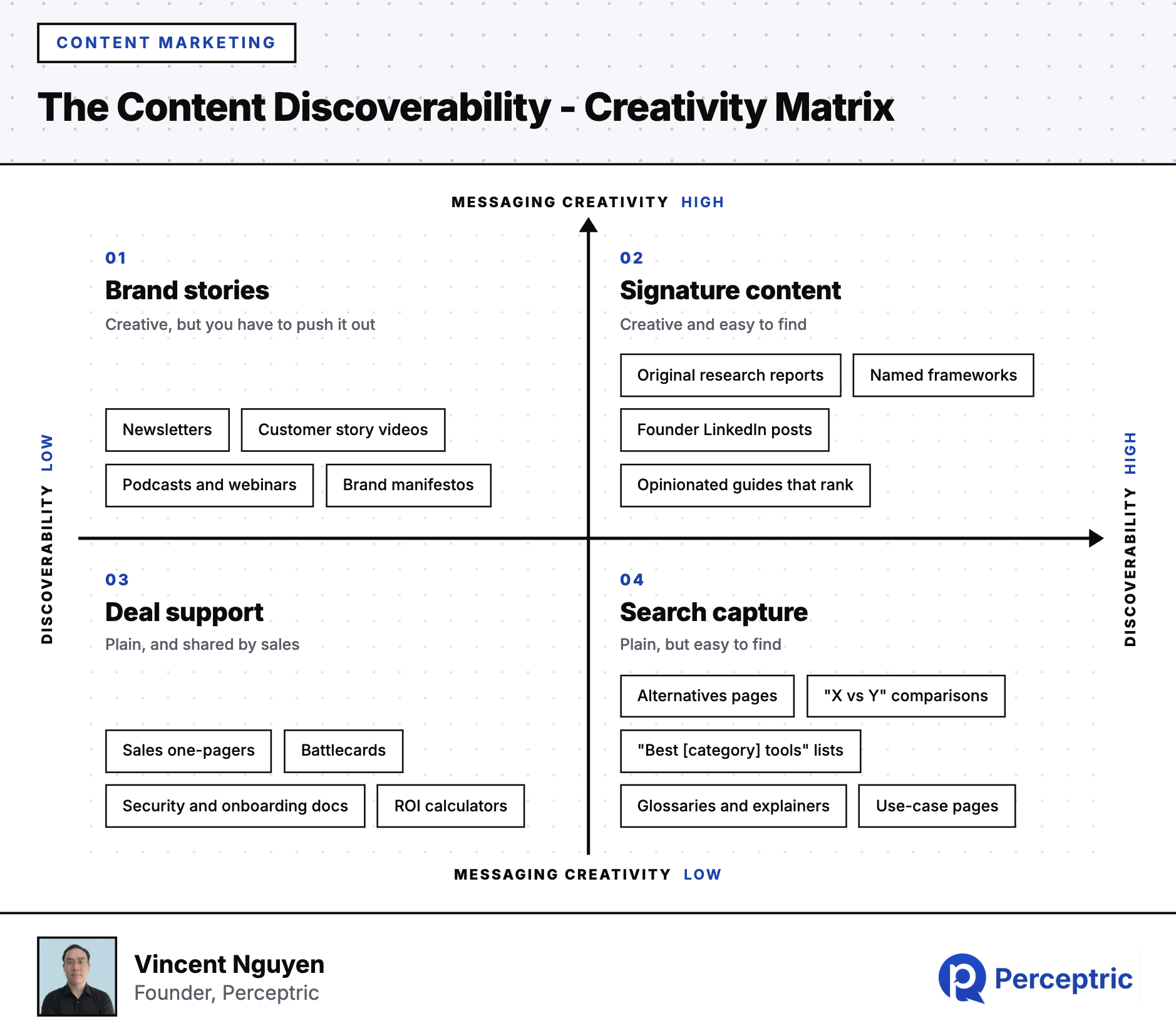
This gives us 4 types of content:
- High Discoverability – High Creativity: these are your founder-led thought leadership LinkedIn posts and the in-depth industry guides that rank high on Google. Thanks to Google and LinkedIn algorithm, these content pieces can easily reach readers and bring traffic to your website, which eventually turns into leads and pipeline.
- High Discoverability – Low Creativity: these are your landing pages, listicles, use-case pages that rank high on Google thanks to SEO. It brings traffic, but the guardrails of SEO don’t allow too much creative freedom on these pages.
- Low Discoverability – High Creativity: these are your newsletters, customer stories, brand manifestos, etc. These content pieces are usually written creatively, but aren’t always optimized for SEO, which leads to low discoverability. Your team must consistently promote these content on social media or community forums.
- Low Discoverability – Low Creativity: these are your sales enablement materials and documentation. The Sales team can use these content assets during their conversation when necessary to nudge buyers toward the final decisions.
Work With Perceptric To Kickstart Your B2B SaaS Inbound Marketing Engine
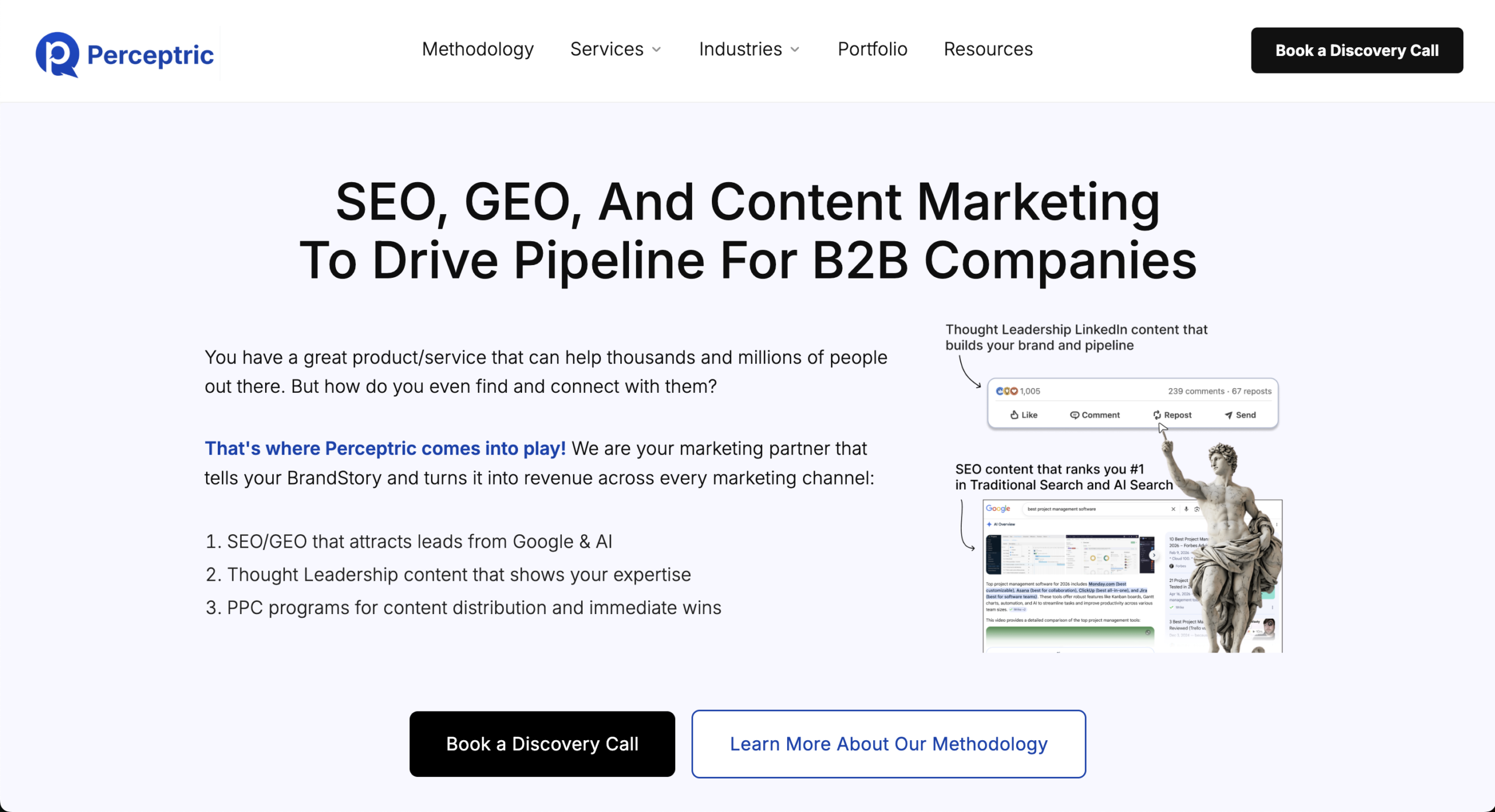
Perceptric is a B2B marketing agency that drives pipeline & revenue growth for SaaS companies. We are an extension of your in-house team. From SEO/GEO to LinkedIn content to PPC, we have the senior experts with unique methodology to help you acquire more customers and grow your ARR.
For example, one of our clients in the B2B SaaS industry saw tremendous pipeline growth since working with us in the past 6 months:
Our most notable clients include Katalon (technical SaaS), Momos (AI agent), Anduin Transact (private equity SaaS), ScoutQA (automation testing AI agent), and DeepIDV (KYC software).
See how we grew Katalon’s organic sessions by 150K+ and ARR by 400%.
Perceptric’s key capabilities:
- Conversion-led SEO. Keyword strategy built around commercial intent, targeting the terms buyers search while comparing vendors rather than the ones that only inflate sessions.
- AI SEO (GEO/AEO). A reverse-engineered approach to how LLMs select sources, built to get you cited in ChatGPT, Claude, Perplexity, and AI Overviews for commercial terms.
- Content production. Expert-led articles grounded in SME interviews and original research, written by people who understand the product deeply enough to sound in-house.
- Interactive content experiences. Custom-coded modules embedded in articles that let buyers explore, compare, and self-qualify, driving time on page and brand recall no wall of text can match.
- LinkedIn thought leadership. Story-led posts written in your voice that build demand and funnel a warmed-up audience into the search-led engine.
- Paid search. PPC run off the same bottom-funnel keyword and messaging strategy as your content, so you own the full SERP while organic rankings climb.