![7 Lead Generation Strategies & Tactics That Work [2026]](https://perceptric.com/wp-content/uploads/2026/09/Screenshot-2026-09-18-at-12.03.37-PM-scaled.png)

Lead generation is the #1 activity that all businesses prioritize.
That’s exactly what we’re going to share in this article.
1. Do SEO + AEO/GEO
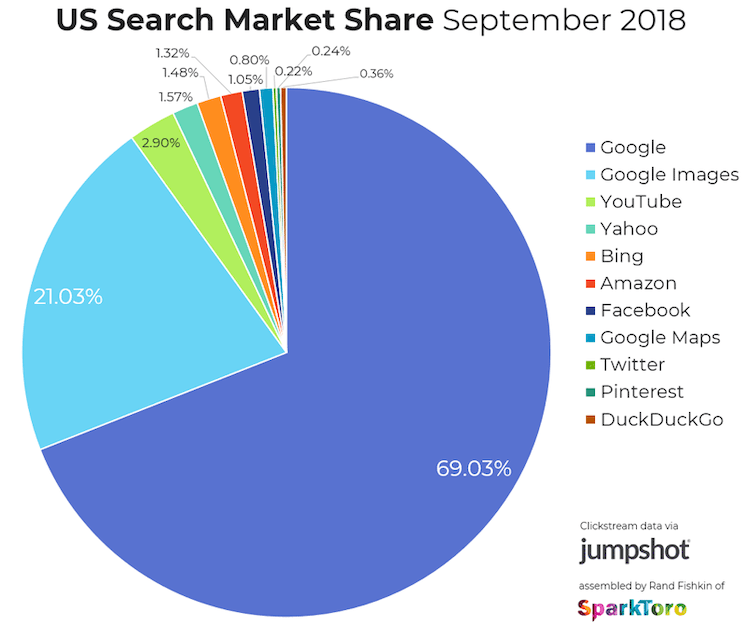
Despite claims that “SEO is dead”, SEO is still very much alive. In fact, it is the most powerful lead generation channel out there for your business:
- In a 2026 Belkins study of 90 B2B marketing leaders, 7 out of 10 marketers rated content marketing and SEO as top performers, making it the strongest digital channel, with paid advertising (51%) and email marketing (46%) behind it.
- HubSpot’s State of Marketing Report found that in 2024, the top channels driving ROI for B2B brands were website, blog, and SEO efforts, followed by paid social media content and social media shopping tools.
- In a Databox survey of B2B companies, every company surveyed used organic search, and more than 50% credited it with generating a lot of leads.
- A First Page Sage benchmark report found that 57% of B2B businesses say SEO is the single biggest factor in lead generation, and the average organic search lead closes 14.6% of the time, compared to 1.7% for outbound leads.
- In a March 2026 G2 survey of 1,076 B2B software buyers, 51% said they now start their research with an AI chatbot more often than with Google, up from 29% in G2’s 2025 report. 69% chose a different vendor than they first planned based on AI chatbot guidance, and one-third bought from a vendor they had never heard of before.
In other words, if you’re not doing SEO (and its AI version, AEO/GEO), you’re leaving leads on the table.
The SEO/GEO playbook for modern brands involves:
- Target bottom-of-funnel keywords with strong commercial and lead-generation potential.
- Create high-quality, product-led content that answers search intent while naturally showcasing your products or services.
- Build relevant brand mentions by partnering with credible websites, publications, and industry resources.
- Build and optimize profiles across relevant platforms to strengthen your brand’s digital presence and visibility in search and AI-generated recommendations.
2. Start Founder-led LinkedIn Content
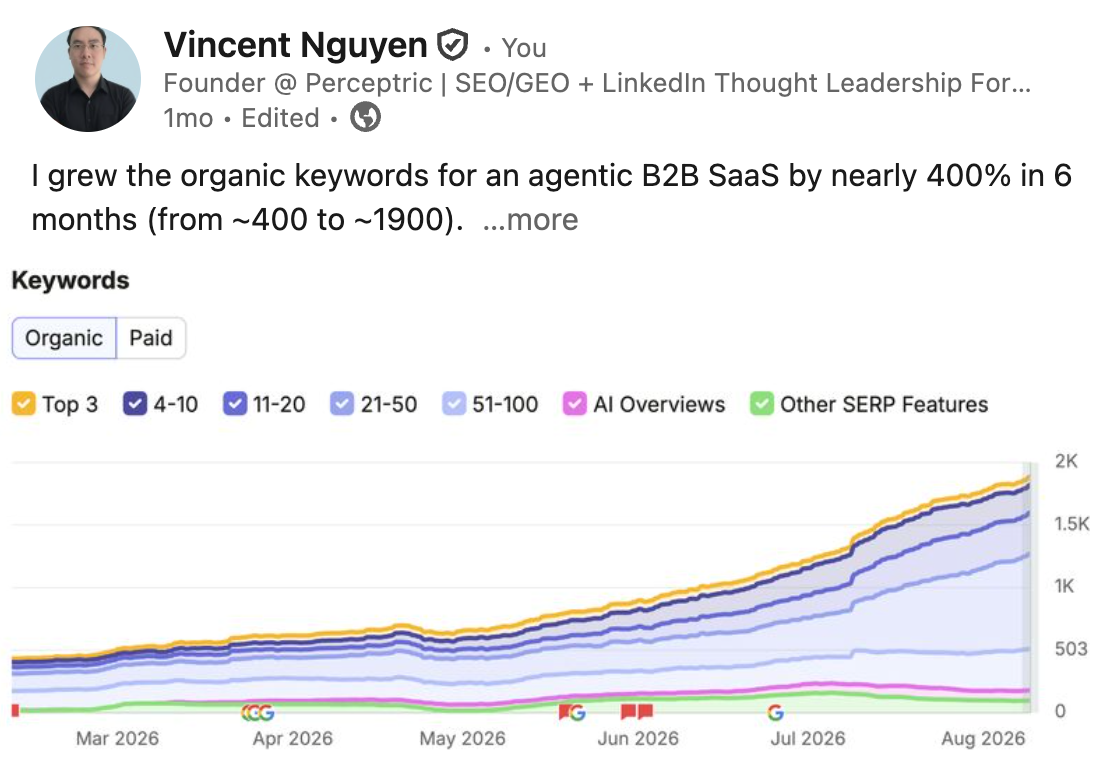
Many people still think of LinkedIn as the place to announce new jobs or career milestones. However, when used strategically, it can be an incredibly powerful lead generation channel.
In fact, founder-led LinkedIn content has been used by so many successful B2B SaaS brands:
- Devin Reed was the content mastermind behind Gong’s explosive growth, helping take the company from $20M to $200M ARR. He then built a LinkedIn strategy for Clari’s CEO that pulled in 6.1 million views in 12 months. This is the kind of reach that would have cost a fortune to buy with LinkedIn ads.
- Tommy Clark started his B2B social media agency as a side hustle while working full-time at Triple Whale. His LinkedIn expertise brought in so much client demand that he had to pick between the salary and the roster (take a wild guess which one won).
- And Kait Stephens, CEO of Brij, grew her company’s revenue 7x in a single year while inbound went from 0 to 40%+ of pipeline, all thanks to LinkedIn.
The playbook is:
Start with one word you want to be known for. Do not write about everything. Be very specific about what you share. You don’t need a massive following to see results; you want to attract people who genuinely care about what you have to say.
You should ideate and build your editorial calendar based on the three levels of intent:
- Top of funnel: Business, entrepreneurship, personal content (once a week is fine)
- Middle of funnel: Industry-specific content (bulk of your content should be this, whatever you want to be known for)
- Bottom of funnel: New product features, book a demo, sign up, etc. (no more than once a week)
- Timely content (like current events): this should definitely be incorporated into your strategy, but only supplemental. Treat those as bonus posts when you can.
If you’re starting from scratch, just write text-based content first. Literally any type of content works on LinkedIn, you just need to make sure what you write resonates with your target audience. Once you’re comfortable with text-based content, lean into other formats like infographics or video clips. These can accelerate trust-building massively since they help viewers put a face and personality (not just a photo of you) to your name and get to know you better.
Being consistent is the hard part. Anyone can post a LinkedIn post, but having the commitment to post every day, over a period of several months, is an entirely different story.
Spend 5-10 minutes throughout your day liking and commenting on posts. Keep in mind your responses don’t have to be anything crazy. Something as simple as “Good stuff” or “love this” can be perfect.
Give your LinkedIn strategy several months to compound, and look beyond likes and followers. Key signals include:
- Recognition: People mention that they follow your content or recognize you from LinkedIn.
- Inbound pipeline: More qualified leads, demos, and opportunities start coming directly from LinkedIn.
- Business impact: LinkedIn contributes to measurable growth in revenue, deals, or pipeline.
- Qualitative feedback: People send messages or comments telling you that your content is useful or has influenced how they think.
- Sales conversations: Prospects mention your posts during sales calls or arrive already familiar with your expertise.
Once you’ve started to see success on LinkedIn, it’s going to be so much easier to get the rest of the team on board. Because you have the receipts to prove how powerful it can be.
3. Run outbound Campaigns
Outbound isn’t dead. But it certainly is getting much, much harder.
Belkins analyzed more than 7.5 million cold emails sent in 2025 and found an average reply rate of just 0.45%. Their data also shows that email works better when combined with other channels, while their 2025 follow-up research found that email paired with light LinkedIn engagement produced an 11.87% reply rate.
That’s why you want to run warm outbound campaign: create familiarity and reach out when there’s a reason to have the conversation.
From siloed functions to a cross-functional ABM pod
One pod owns the account. Seven functions feed it.
Here’s the playbook:
- Pick the right accounts. Start with companies that are valuable to you and have a clear reason to buy. Look for a strong use case, a relevant problem, and signs that they may be looking for a solution.
- Group similar accounts. Put similar companies into groups based on their industry, problems, and use cases. This lets you create one strong message for a group of accounts instead of starting from scratch every time.
- Research the accounts. Take time to understand what is happening inside each account. Look at their company, hiring, recent news, intent signals, and past interactions with your business. The goal is to find something that makes your outreach more relevant.
- Warm them up. Do not go straight from a spreadsheet to a sales pitch. Follow people on LinkedIn, engage with their content, share something useful, or use an existing relationship to get on their radar first. A little familiarity makes the conversation much easier.
- Create relevant content. Build content around the problems your target accounts actually care about. Focus less on explaining your product and more on helping them understand a problem, opportunity, or industry trend.
- Personalize the outreach. Make it clear why you are contacting that particular company. Use what you learned from your research to shape the message, rather than sending the same pitch to everyone.
- Match the CTA to intent. Not everyone is ready for a demo. If someone is just discovering you, start with something lighter, such as a useful resource, conversation, event, or introduction to an expert. The more interested they are, the more direct you can be.
- Use multiple channels. ABM works across multiple touchpoints. Combine LinkedIn, email, events, webinars, communities, partnerships, and direct outreach where it makes sense. Different people respond to different channels.
- Align sales and marketing. Both teams should regularly look at the same account list and decide what happens next. Who is engaging? Who should we contact? What should we send them? A short weekly review keeps everyone moving in the same direction.
- Measure pipeline. Track whether target accounts are engaging, starting conversations, taking meetings, creating opportunities, and generating pipeline and revenue. Those are the signals that tell you whether the program is actually working.
4. Launch Google Ads Campaigns
Google Ads are another B2B SaaS staple for lead generaetion, and what sets them apart from paid social (LinkedIn/Facebook) is the targeting mechanism. Rather than reaching people based on who they are, you’re bidding on keywords and capturing people based on what they’re actively searching for.
This makes Google Ads uniquely powerful for in-market demand capture. By reverse engineering the intent behind a keyword, you can identify prospects who are already looking for a solution like yours.
To identify the right keywords and allocate budget effectively, we recommend starting with a structured keyword framework tailored to B2B SaaS buying behavior.
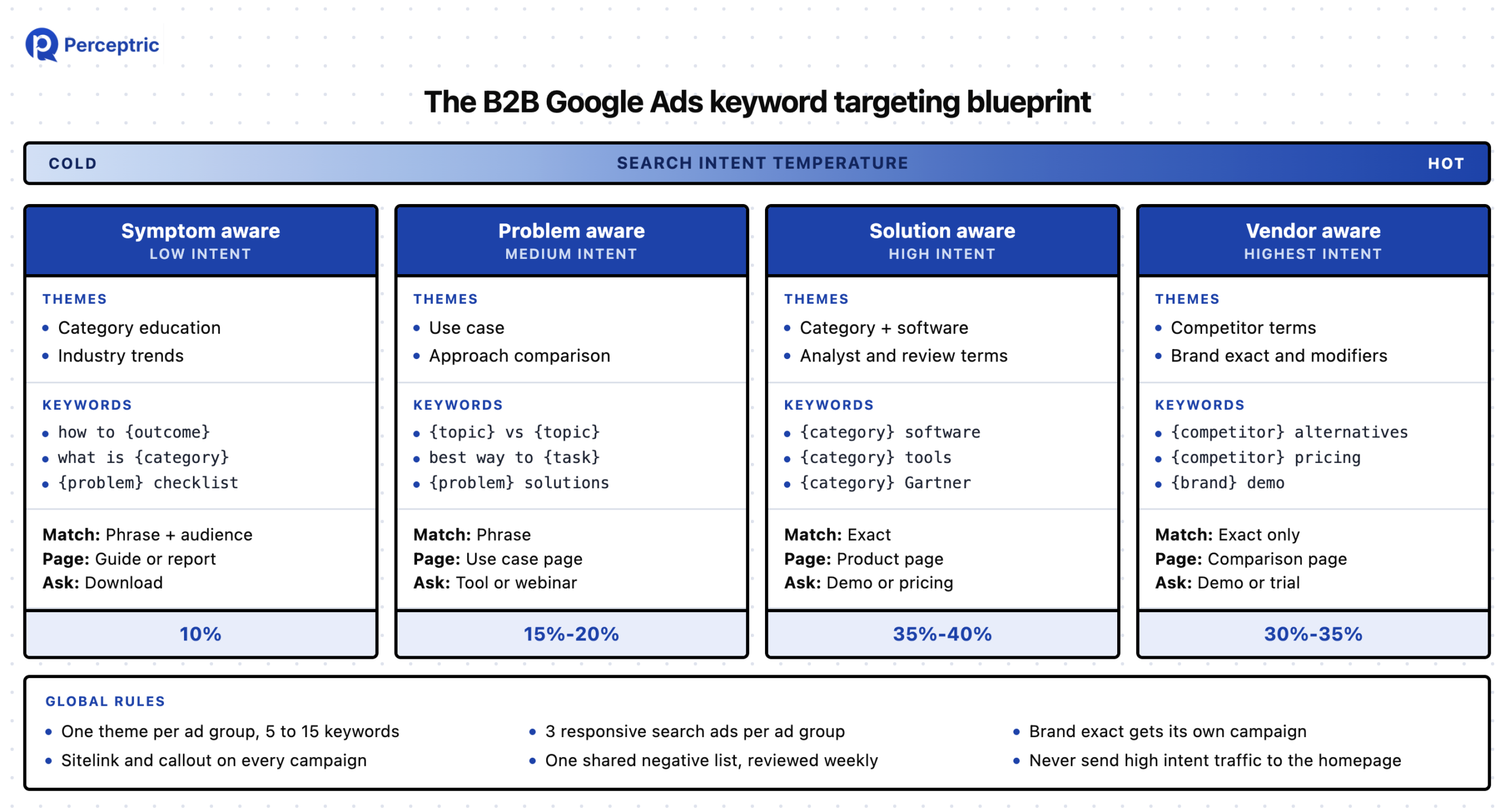
From there, here are the additional best practices we recommend:
- Three RSAs per ad group. Running only one or two ads per ad group doesn’t give the platform enough data to optimize. Three responsive search ads per group gives the algorithm room to learn and improve conversion rates over time.
- Sitelink and callout extensions. These expand your footprint in the search results, surface additional reasons to click, and push competitor listings further down the page.
- Dedicated landing pages. Sending paid traffic to a generic homepage is one of the most common and costly mistakes we see. Match each ad to a dedicated landing page that reflects the prospect’s stage in the buying journey and pairs it with an appropriate call to action.
- Exclude existing customers. Build a customer exclusion list and apply it to brand campaigns. Upselling existing accounts is almost always better handled through email or other lower-cost channels.
5. Networking
Your net worth is your net worth. When someone you respect vouches for a person or company, their credibility becomes borrowed credibility. The prospect doesn’t need to evaluate you from zero because they start with the assumption that if their trusted contact thinks you’re worth talking to, you probably are.
That’s why having a strong network can be your most powerful lead generation channel ever. Work on building a network of partners, influencers, or sales professionals who understand your product and can represent your brand with credibility.
6. Launch Your YouTube Channel
YouTube is one of the most cited websites by LLMs. By appearing on YouTube, you also increase your chance of getting cited by AI/LLMs. Posting educational videos on YouTube also build your brand awareness.
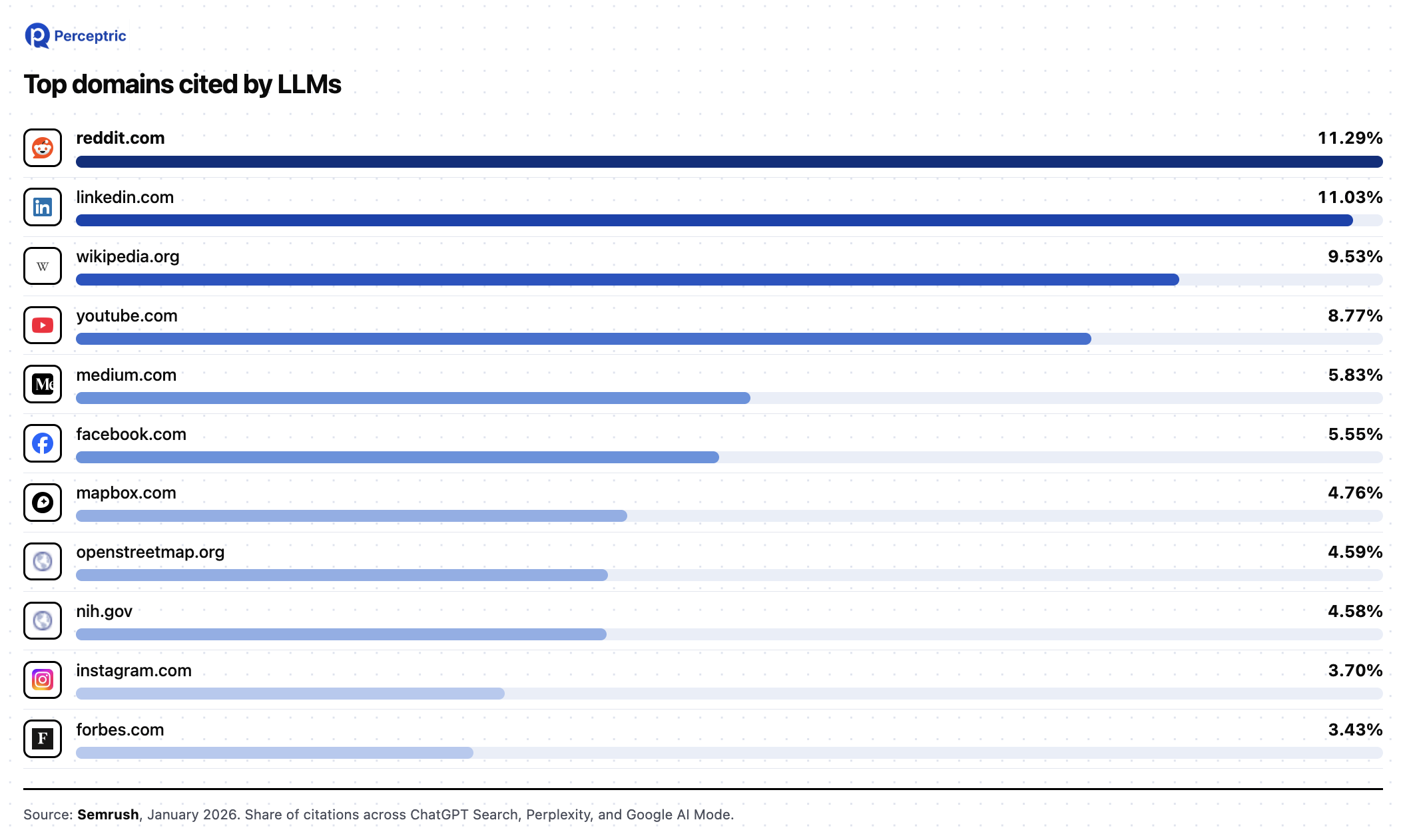
Here’s the YouTube playbook:
- Research demand first. Before recording, find what your target audience is already searching for on YouTube. Review the results in your niche and identify two or three topics with clear business intent that you can realistically compete for.
- Build three content pillars. Use search-based evergreen videos as the foundation, algorithm-driven videos for timely topics and broader reach, and case studies or customer interviews for viewers who are already familiar with your company.
- Optimize for YouTube search. Use the target search phrase in the title and cover the topic clearly in the video. Include relevant terms naturally in your spoken content so they are also reflected in the transcript.
- Record videos in batches. Plan your videos in advance and record them together. For example, set aside a couple of hours once a month to record four videos.
- Repurpose existing content. Review your blog posts, LinkedIn posts, newsletters, webinars, and internal presentations for topics that can be turned into videos.
- Assign the right skills. YouTube requires strategy, thumbnail design, editing, and an understanding of audience retention. Make sure these areas are properly covered, either internally or through external specialists.
- Keep the SME commitment manageable. Prepare topics and scripts in advance so subject matter experts only need to spend a limited amount of time recording. Schedule the recording sessions in advance to keep the process consistent.
- Set up attribution from the start. Add UTM links to video descriptions and include a “Where did you hear about us?” question on your booking form. This helps measure YouTube’s contribution, including viewers who do not convert immediately after watching.
7. Attend Conferences/Trade Shows
Conferences and trade shows are useful lead sources because they bring together people from the same industry, often including decision-makers who already have a relevant business need. Unlike cold outreach, you have a natural reason to start a conversation and can build a relationship in person. If you’re in B2B, attending conferences is always a must.
Here’s the playbook:
- Choose the right events. Focus on conferences and trade shows where your ICP is likely to attend. Look at the attendee profile, companies represented, and topics covered before committing your time and budget.
- Prepare before the event. Identify the companies and people you want to meet. Reach out beforehand, connect on LinkedIn, and try to schedule a few meetings before you arrive.
- Focus on conversations. Don’t treat the event as a place to hand out as many business cards as possible. Ask about their company, current priorities, and challenges, then look for genuine opportunities to help.
- Follow up quickly. Connect on LinkedIn, send a relevant resource, and continue the conversation within a few days. Record the contacts and next steps in your CRM so promising conversations do not get lost.
Work With Perceptric To Drive Pipeline & Growth For Your SaaS
Perceptric is a marketing agency specializing in B2B SaaS, with expertise in SEO/GEO + Paid Ads + LinkedIn Thought Leadership. With these 3 areas, we’ve driven millions of dollars in pipeline and revenue for global SaaS companies with ARR ranging from $5M to $30M.
Perceptric’s key capabilities:
- Conversion-led SEO. Keyword strategy built around commercial intent, targeting the terms buyers search while comparing vendors rather than the ones that only inflate sessions.
- AI SEO (GEO/AEO). A reverse-engineered approach to how LLMs select sources, built to get you cited in ChatGPT, Claude, Perplexity, and AI Overviews for commercial terms.
- Content production. Expert-led articles grounded in SME interviews and original research, written by people who understand the product deeply enough to sound in-house.
- Interactive content experiences. Custom-coded modules embedded in articles that let buyers explore, compare, and self-qualify, driving time on page and brand recall no wall of text can match.
- LinkedIn thought leadership. Story-led posts written in your voice that build demand and funnel a warmed-up audience into the search-led engine.
- Paid search. PPC run off the same bottom-funnel keyword and messaging strategy as your content, so you get the best of both words.