AI SEO: How To Grow Visibility In LLMs and AI Overviews

When brands realize that AI are making product recommendations in their answer, and those recommendations actually turn into leads, AI SEO becomes the hot topic in town.
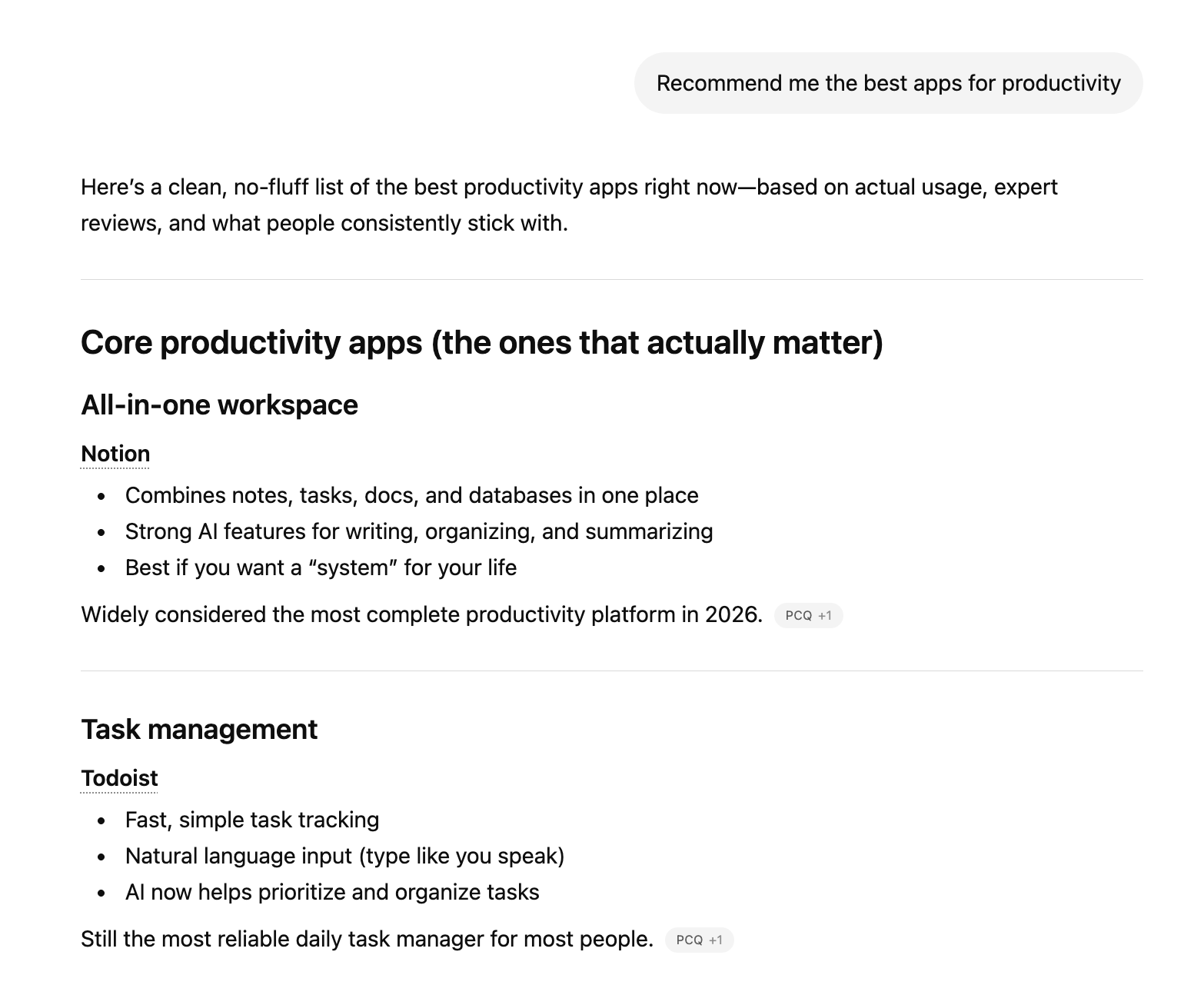
With 900M+ weekly active users on ChatGPT and ~30M on Claude, no one can afford to ignore this brand new user acquisition channel.
Suddenly, everyone has an opinion to say about how they approach GEO/AEO/LLMO/AIO, or whatever acronym floats their boat.
Our opinion? We think that it's all just SEO.
When you do good SEO, you appear in AI search.
And we didn't just base that opinion on speculation. Our clients are consistently being mentioned, and our articles are cited in ChatGPT, Perplexity, and Google AI Overviews.
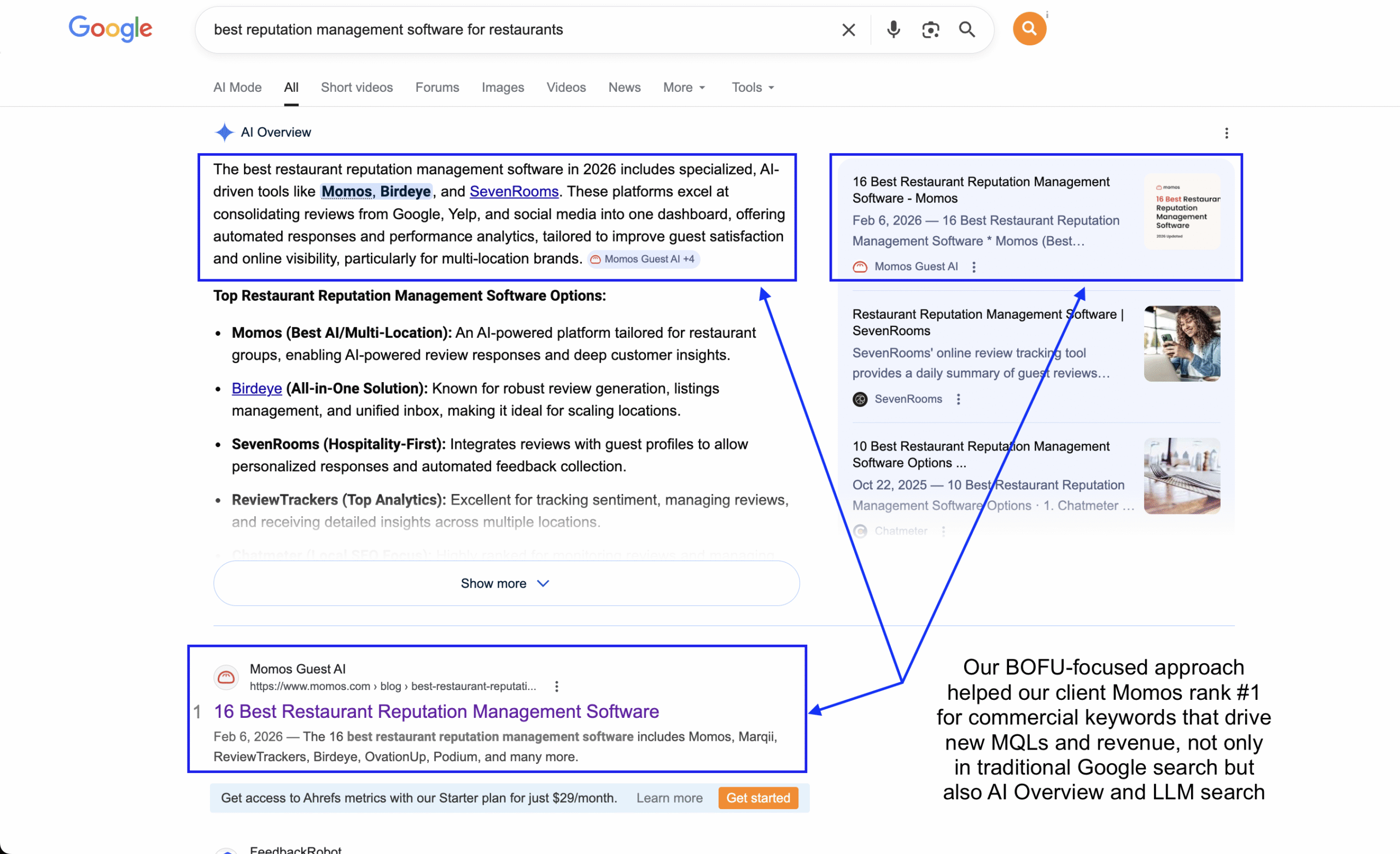
One of them is Momos, a leading reputation management software built for restaurants, who consistently appears in LLMs thanks to our content designed specifically for LLMs to cite:
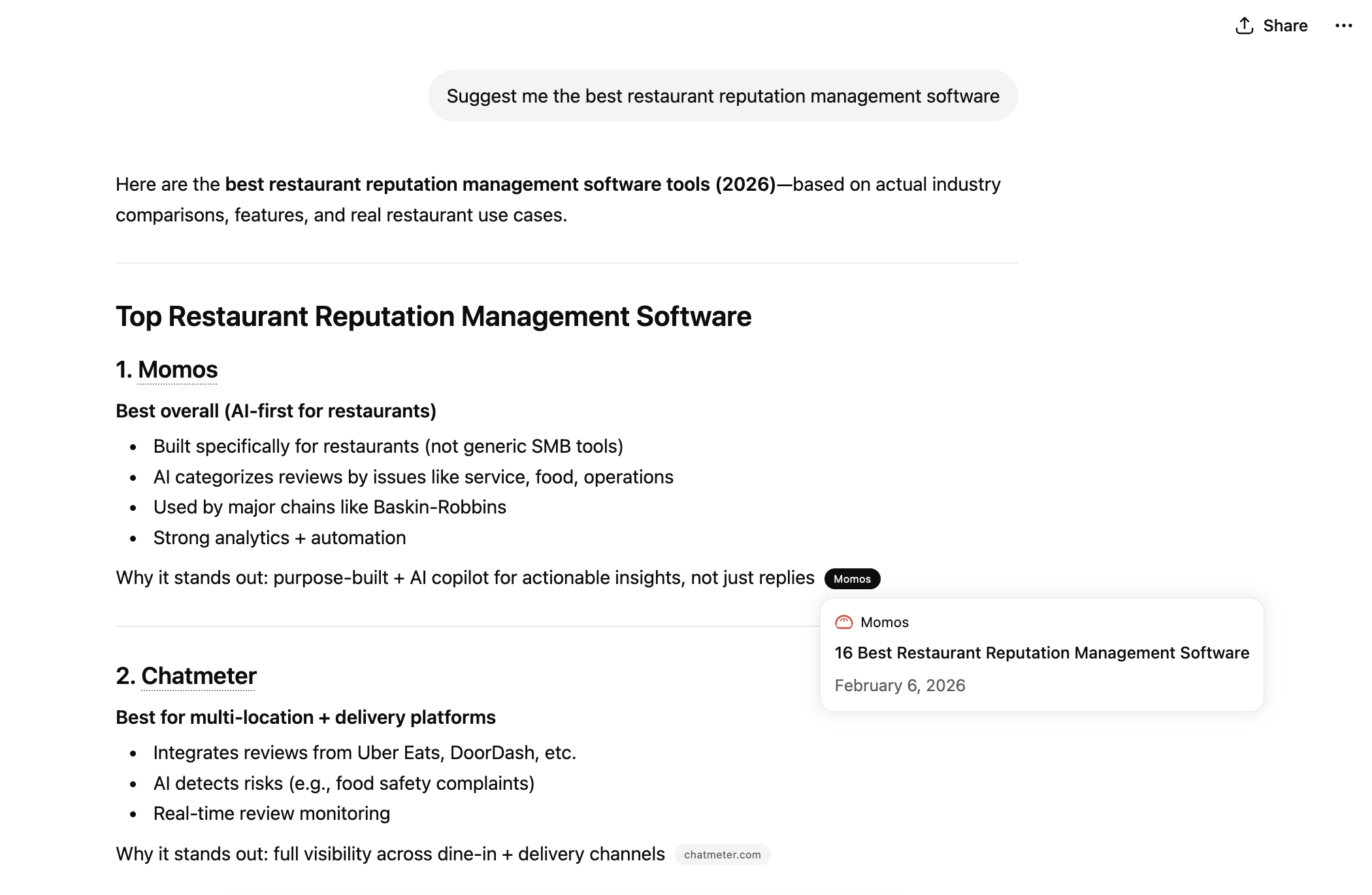
And this is how we do it.
A simplified understanding of how LLMs cite content
When you ask an LLM a question, it pulls from two primary sources to form its answer:
1. Training data: The model relies on patterns and knowledge absorbed during training. This works well for established topics that rarely change, like scientific principles or historical events.
2. Live web search: The model searches the internet in real time, reads the results, and synthesizes a response. This is essential for fast-moving topics like news, market trends, or product updates.
In practice, most LLMs blend both sources to give you the best possible answer.
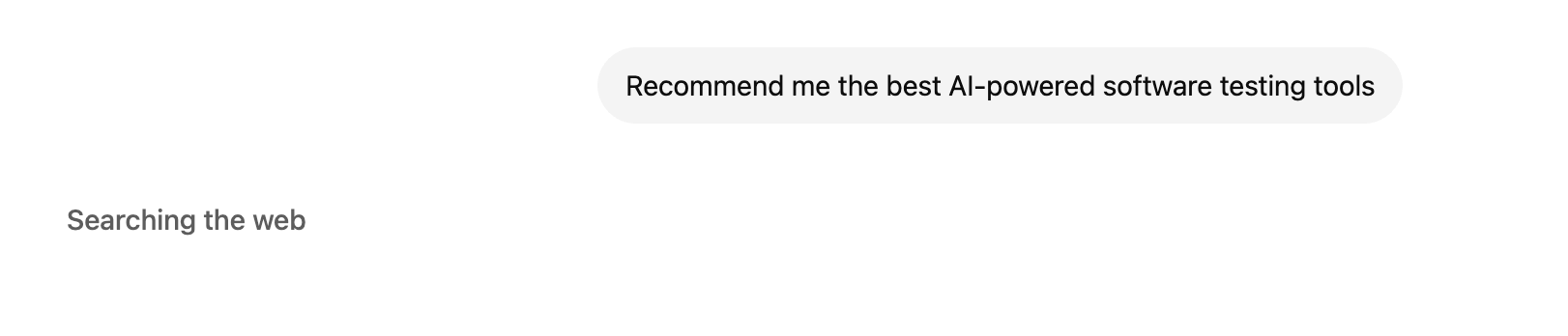
But here's the important part: when does an LLM decide to search the web instead of relying on its own training?
The answer: when the question demands dynamic information.
Think about it. An LLM doesn't need to Google "how photosynthesis works" or "when was the French Revolution." That's static knowledge. LLMs already know the answer, so there's no point venturing into the web to fetch one.
But "best CRM for startups in 2026"? "Is Notion still worth it?" "Alternatives to HubSpot"? That's dynamic information. The answers change every quarter, and so the LLM has no choice but to search the web.
And here's the key insight: almost every buying decision lives in the dynamic zone. LLMs don't have a built-in sense of objectivity to make product recommendations on their own. They will always need third-party sources from humans, such as reviews, comparisons, listicles, to form an answer.
I mean, even us humans need third-party validation when confronted with that question. If someone asks you to recommend the "best AI testing tools", don't you have to browse around, check reviews, consult trusted sources, even trying the product yourself before arriving at the final list?
Look at this example. To answer a simple prompt about top AI testing tools, ChatGPT also had to crawl through several listicles, pull data from each, and synthesize a recommendation. It's literally browsing the web on the user's behalf.
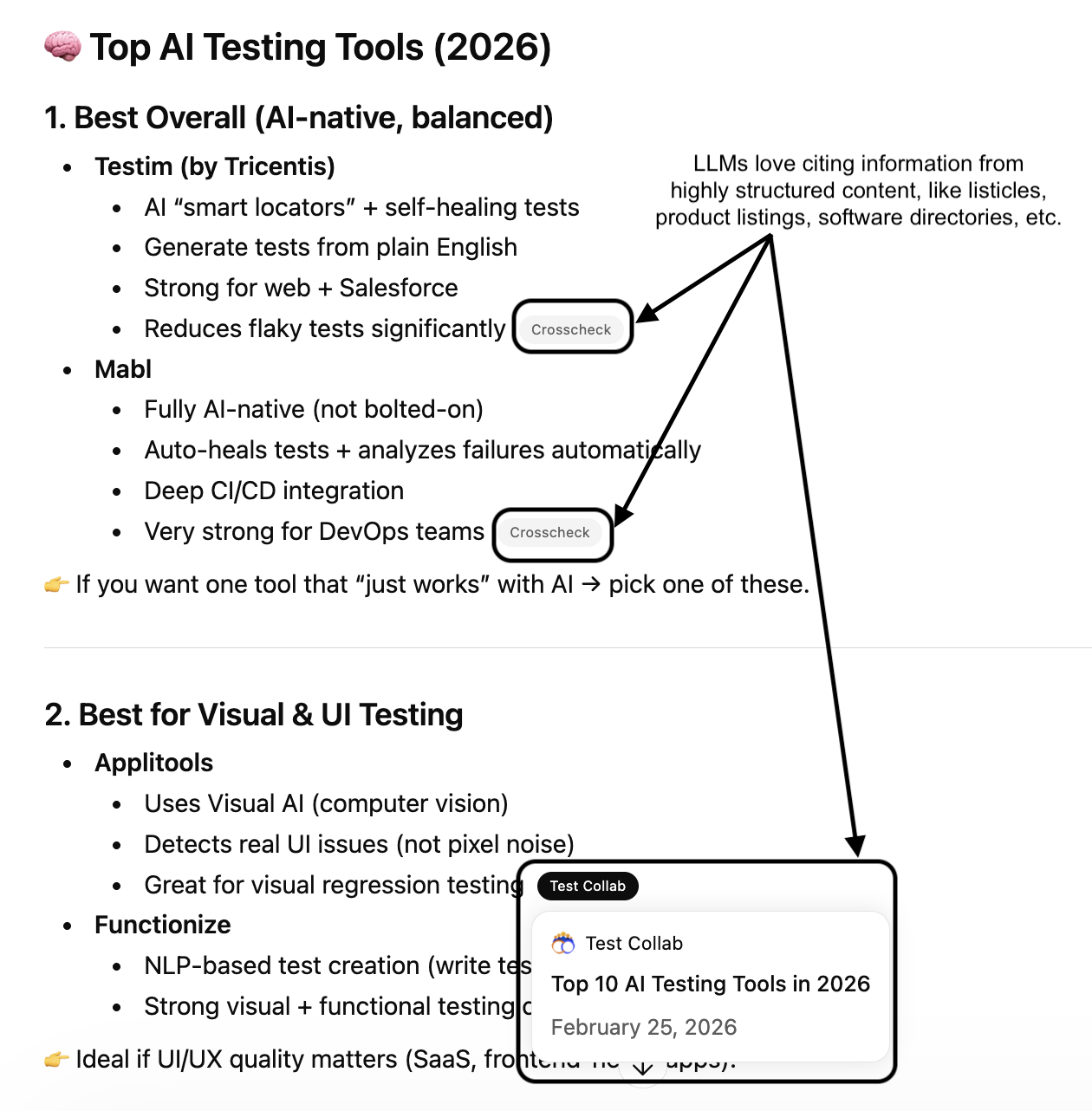
Which means the content that gets cited isn't top-of-funnel thought leadership or brand awareness fluff. It's bottom-of-funnel content. LLMs need you to feed it that kind of content because it can't make product recommendations on its own, by nature.
Isn't it a perfect opportunity?
The Perceptric AI SEO Playbook
Part 1. Build your library of owned BOFU content
As we have argued, top-of-funnel is purely informational. The chance of getting cited is slim because the LLMs already have the answer in its database.
Bottom-of-funnel topics are an entirely different story. For these product-related topics, LLMs are very likely to search the web, because they know that their training data isn't likely to have the most up-to-date information on the best products in a particular space.
But more importantly, BOFU content is where conversions happen.
Someone asking "best CRM for SaaS startups" has already decided they need a CRM. They've moved past the awareness stage. They're shopping. That's an incredibly valuable moment to show up, because you're capturing demand that already exists.
When we focus on BOFU content for one of our B2B SaaS clients, their conversion rates skyrocket, literally.
As you can see in this chart, TOFU content (static information) tends to drive a lot of traffic, but buying intent is really low. For BOFU content, it's the complete opposite: low traffic but super-high buying intent.
We've written an article to demonstrate why you should invest into BOFU content here. Not only does this strategy aligns with AI SEO best practices, it also brings tremendous benefits to your traditional SEO. The two complements each other and boosts each other up. Hitting two birds with one stone.
Part 2. Build up your Reputation
If Reddit threads, G2 reviews, analyst reports, journalist recommendations, podcast mentions, and conversations scraped from the public internet collectively associate your brand with a specific quality, a specific problem, a specific point of view, then the model will surface you.
Why? Because the statistics say you are the chosen solution.
Let's not forget that LLM is a powerful statistical engine. The more your brand name is associated with positive information, the more likely it is for you to get cited.
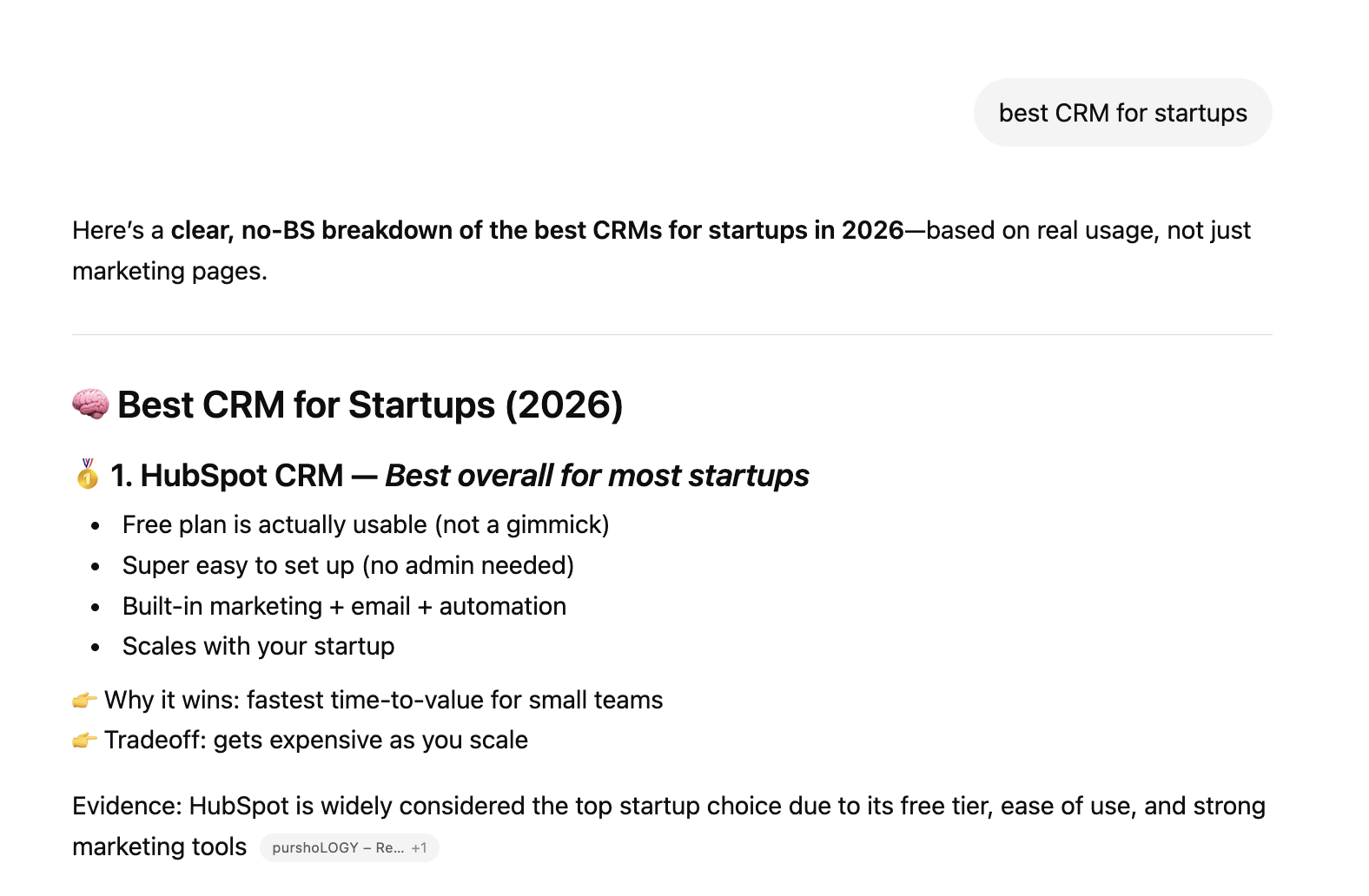
Can you guess what CRM will ChatGPT recommend when you ask it about the "best CRM software for startups"?
That's right. HubSpot. To earn that top spot, HubSpot needs nearly two decades of helping thousands of businesses around the world. It has earned millions of positive mentions across the vast Internet. Statistically speaking, HubSpot is the most likely answer.
You don't have to be the 2nd HubSpot. You just need to earn a good reputation, in your tiny little niche, and that's more than enough. After all, having a third party vouching for your product is always better than none, right?
After you build up your owned BOFU content library, start your traditional link building to earn backlinks from contextually relevant domains. At its core, link building is just digital PR.
Momos | Restaurant Reputation Management Software
For our client Momos, a reputation management software built for restaurants, the goal was to associate their brand name with the topic of "restaurant reputation management software", because that's exactly what they do.
Simply by publishing BOFU content assets that associate Momos with that topic and doing outreach to get the brand cited in major magazines, we influenced LLMs and AI overviews to recommend them. When users ask ChatGPT or Perplexity about restaurant reputation management tools, Momos shows up.
In summary
LLMs recommend what the market believes
AI recommendations are a statistical mirror of how the market perceives your product. Not how good it is, but how good it is perceived to be.
LLMs search the web to decide
For product recommendations, all major LLMs use live web search (grounding) to build their answers. Showing up in Google is the key to showing up in AI.
Focus on bottom-of-funnel topics
Top-of-funnel topics don't drive traffic or mentions in the AI era. BOFU queries are where LLMs name brands, search the web, and where conversions happen.
Owned content first, citation outreach second
Build your content foundation on your own site, then expand with citation outreach on the specific domains that LLMs actually cite for your target queries.
Perceptric helps B2B SaaS companies get recommended by ChatGPT, Perplexity, and Google AI Overview through BOFU content and citation outreach.
Let's talk strategy