The Perceptric Editorial Guidelines

Persona
Perceptric is 'The Wise Mentor'.

Perceptric is the mentor we wish all mentors could be: sharp, specific, and genuinely useful, but not preachy or jargon-heavy.
We write for our readers with depth, directness, and a real interest in helping them think better. And like any good mentor, we keep our focus on what matters most: respecting the reader's intelligence while guiding them to see their work in a clearer light.
Our Voice
We write from a position of expertise earned through doing the work. Our voice carries the weight of evidence, specificity, and considered opinion. We take positions our readers could disagree with, then defend them with reasoning the reader can follow.
Our language is precise and considered. We choose the exact word over the close-enough word, and the simpler word over the complex one when the meaning holds. We respect our reader's time by cutting filler, hedging, and corporate phrasing that delays the actual point.
Our voice is professional but not cold. We treat the reader as a capable peer, not a target or a beginner. We allow personality, occasional wit, and genuine interest in the topic to come through. The reader should feel the writing was made for them by a thinking human, not assembled for them by a content machine.
Our brand voice is fun, creative, and engaging. We aim to create memorable experiences for our audience by incorporating wordplay, storytelling, and subtle humor wherever appropriate.
Summarized Actions
- Write short sentences and short paragraphs. One subject + verb with 1-2 supporting clauses per sentence. 3-4 lines per paragraph maximum. Break anything longer.
- Use the simpler vocabulary. "Use" not "utilize." Keep technical terms only when they carry precise meaning simpler words would lose.
- Write as a teacher, not a content writer. Communicate with the reader as if you are interacting with a student. Include your own research and opinions, ideally after you've delivered the core information.
- Don't use academic language. Rather than saying "It's important to note that," "In today's landscape," "When it comes to," "There are many factors to consider", just start with the actual point.
- Apply the LEMA framework before writing. Define what the reader already knows, what they want to know, what they didn't know they needed, and what action they should take after reading.
- Anchor every article to the client's Brand Story. Use the Who / Where-to / How-to / Why-so framework. The writing must push the brand narrative forward without sacrificing informational value.
- Use a diverse range of content mediums. Use images for what text can't describe well. Use tables when comparison is the goal. Build interactive modules when the reader needs to do something to understand it. Use video as a deeper option, never as a replacement.
- Follow the five SEO non-negotiables, then prioritize UX. Target keyword in slug, H1, first paragraph, and naturally in H2/H3s. Beyond that, treat the article as a landing page: whitespace, visuals between text, sections that stand on their own.
Content Principles
Perceptric content is readable and understandable
Perceptric content satisfies the reading's intent
Perceptric content pushes forward a narrative
Perceptric content guides readers to a new knowledge
Perceptric content leverages a wide range of content medium
Perceptric content is conservatively optimized for search engine
1. Perceptric content is readable and understandable
Goal: help readers acquire the information they need effortlessly
- Use "I" and "we" to establish a storytelling tone, use "you" to address the reader
- Write short sentences with one subject + verb structure and 1-2 additional relative clause(s). Do not chain ideas together in one big sentence.
- Write short paragraphs. Each paragraph should be 3-4 lines maximum. Break longer paragraphs into smaller ones.
- Put one idea in each paragraph. If a paragraph has two ideas, split it into two paragraphs.
- Use the simpler word when it carries the same meaning. "Use" not "utilize." "Help" not "facilitate." "Show" not "demonstrate."
- Keep technical terms only when they carry precise meaning that simpler words would lose.
- Do not use formal and academic structures like "It's important to note that," "In today's landscape," "When it comes to," "There are many factors to consider."
- Use bullet lists to break down ideas
- Use tables
- Do not use bold or italics for emphasis-as-decoration.
- Write each sentence so it naturally leads to the next sentence.
- Assume the reader is smart but tired. Every sentence must justify the reader staying for the next one.
Qualified content samples
Most agencies fail at SEO because they treat it as a checklist instead of a strategy.💡 Comment 1: Simple, straight-forward sentence. Lead with the main point — no warm-up, no preamble. 1
Usually what they do is:
- Run an audit💡 Comment 2: A bullet list to break down chains of information. Instead of listing three actions in one long sentence, break them into scannable items the reader absorbs at a glance.
- Fix the errors
- Publish a few keyword articles 2
And then they wonder why traffic plateaus six months later.
I think we should all remember that SEO is not a series of tasks. It is a system of compounding bets that needs time and structural support to pay off.💡 Comment 3: Refer to yourself as "I" and "we", refer to the reader as "you". Write as if you're telling a story to the reader rather than optimizing for the Search Engine. 3
This is exactly why so many SaaS companies have a content library full of articles that rank for nothing and erode the brand every time a sharp prospect reads one.
If you do content marketing in B2B SaaS, you'd probably notice this fascinating dilemma:
- SEO content is optimized for the search engine, but the confines of keywords and SEO guidelines make it difficult for the brand to freely express its perspective on the topic and stand out among the crowd.💡 Comment 4: Another example of a bullet list to break down information. 4
- Thought leadership content gives more space for brand building and expressing opinions. However, it's usually never optimized for a specific keyword, and that means it does not rank on Google. No one is going to organically discover your content unless you actively promote it.
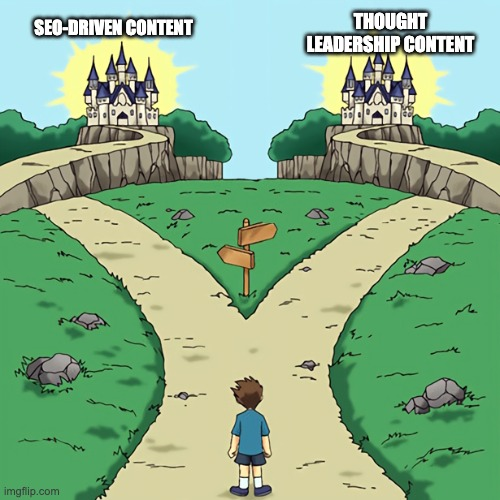
That's why B2B SaaS brands need a best-of-both-worlds approach.
Here's my process of doing SEO for B2B SaaS companies, especially in high tech fields:
- Extract the expertise: The target audience of most B2B SaaS companies is made up of leaders and people who know their craft. The biggest challenge of SEO content is that it is outsourced to experts who don't really understand the nuances of the field. You need to sit with SMEs who know the field in-and-out to devise a proper SEO & content strategy.💡 Comment 6: Usage of bullet list with bold headers to demonstrate a process. Bold labels act as signposts — readers scan them first to find the step most relevant to them. 6
- Do keyword research: Once you have listed down what pain points and insights from experts, start doing keyword research with your favorite keyword research tool. Mine are SEMRush, Google, and Reddit. Yes, Reddit is actually a great tool for keyword research in B2B SEO.💡 Comment 7: Address the reader as "you". Using "you" makes the instruction feel personal and direct, not generic. "Mine are…" also injects a first-person opinion that builds credibility. 7
- Focus on BOFU: If your SEO strategy only targets broad "what is X" or "how to use Y" searches, you're just attracting beginner-level people without cashing in. BOFU content is where the real money lives. These are the keywords people type when they're ready to buy, such as "best [tool] alternatives," "[competitor] vs [your brand]," or "[solution] pricing." Your job is to show up right there, at the decision moment. Be honest, compare fairly, and make it easy for them to say, "Yep, this is the one." BOFU content doesn't need to be sexy, it just needs to convert.💡 Comment 9: Write freely and creatively, don't be afraid to use "taboo" words once in a while. Inject your personality into every part of the content. "Sexy" and "convert" are casual, confident word choices that make the writing feel human rather than corporate. 9
- Focus on JTBD keywords: Now, once you've got the BOFU stuff handled, it's time to go one layer deeper: the Job-To-Be-Done (JTBD) level. This is where you stop chasing keywords like "project management software" and start answering how people use it to get actual work done. Think "how to automate onboarding workflows" or "how to track team productivity with X." Brands like Zapier absolutely dominate this space.💡 Comment 10: Use adverbs and adjectives generously to better demonstrate the "emotion" of your opinion. "Absolutely dominate" is stronger and more vivid than "do well in" — it signals conviction and makes the point memorable. 10
2. Perceptric content satisfies the reading's intent
Goal: deliver the right information that readers are looking for
Prioritize reader's happiness and search completion over keyword insertion.
We use the LEMA framework to determine the reader's intent:
What does the person who searches for this keyword already know?
What does the person who searches want to know?
What should they know about this topic that they didn't know they needed?
What action should they take after reading?
Worked example: "B2B SEO Statistics For 2026"
- SEO is a relevant channel for their business and worth paying attention to
- Statistics and data exist around SEO performance but they have not seen them consolidated in one place
- They are likely already doing some form of SEO or content marketing and want to benchmark or validate their current approach
- They understand basic SEO concepts like rankings, traffic, and keywords
- What does good B2B SEO performance actually look like in numbers
- How long does SEO take to show results and what ROI should they expect
- How does B2B SEO compare to paid search in terms of cost and return
- What do the best-performing B2B companies do differently with their SEO
- How is AI search changing the way B2B buyers find vendors
- Most B2B SEO statistics are pulled from B2C-dominated studies and do not reflect the reality of long sales cycles, committee buying decisions, and low search volumes in technical niches
- The statistics that matter most are not about traffic but about pipeline influence and revenue attribution
- A single high-intent BOFU keyword ranking can outperform hundreds of top-of-funnel informational rankings in terms of actual revenue generated
Use the statistics for their internal use. Explore Perceptric's offerings.
Once the reading intent is defined, ask yourself:
- What topics should be covered to satisfy that intent?
- What content type should be used to satisfy the reading intent?
The detailed guide of content type can be found at Section #5.
3. Perceptric content pushes forward a narrative
Goal: build awareness about the Brand Story of the client
At the end of the day, content is still written for a business purpose, and therefore it must either drive the reader toward the conversion action or at least educate the reader about the existence of the brand and why it exists in the first place.
We use the Who, Where-to, How-to, and Why-so framework to define the Brand Story:
Who the brand is
Where the brand takes the customer
How the brand gets them there
Why the brand believes in doing it

For Perceptric
Who: Perceptric is a content marketing agency for B2B/SaaS companies.
Where-to: Perceptric helps them improve visibility on Google/AI/LLMs and drive revenue while building a memorable brand.
How-to: Perceptric does that by creating content that is genuinely engaging and informative to the reader while still following SEO best practices.
Why-so: Perceptric does that because we believe that content designed with good UI/UX wins in the long-term.
For Zapier
Who: Zapier is a workflow automation platform for businesses and individuals.
Where-to: Zapier helps them connect their apps and automate repetitive tasks so they can focus on the work that actually matters.
How-to: Zapier does that by offering thousands of pre-built integrations and a no-code builder that lets anyone create automations without writing a single line of code.
Why-so: Zapier does that because we believe that work should be about creativity and judgment, not copying data between tabs.
Actionable items for writers
- The Brand Story should guide the writing. Ask yourself: how can my writing best tell this story to the readers without sacrificing informational value?
- Structure your introduction of the Brand according to the Brand Story when you're writing a product review
- For more informational topics, seamlessly structure your writing so you can align the information and the Brand Story
Sample content from Zapier
I work at Zapier, so I'm a little biased, yes. But I was a Zapier power user even before I talked (bamboozled?) the Zapier team into paying me full-time to nerd out about work apps.💡 Comment 11: Natural story-telling writing style. The writer discloses bias upfront (building trust), then immediately subverts it with humor — "bamboozled" is playful, self-aware, and completely memorable. 11 Whether you're running a one-person marketing agency like I was or managing an enterprise team, Zapier lets you build and customize automated systems to power your digital marketing efforts.💡 Comment 12: Applying the framework: Who Zapier is. This sentence establishes what Zapier does at the most fundamental level — the "Who" in the Brand Story framework. 12
With Zapier, you can connect thousands of apps with no coding knowledge required.💡 Comment 13: Applying the framework: Where-to. This is the destination — what transformation Zapier enables for the customer. Simple, concrete, and benefit-led. 13 The AI-powered assistant, Copilot, helps you build automations just by describing what you'd like to accomplish (like "when someone clicks on my Google Ad, enrich that lead data with Clearbit and use it to create a new contact in HubSpot"). From there, Copilot will suggest an outline, connect all your accounts, and even help you test each step.
Beyond automated workflows, you can use Zapier's suite of interconnected tools to build a fully automated digital marketing ecosystem. For instance, you can:💡 Comment 14: Applying the framework: How-to. This list unpacks the specific tools and mechanisms Zapier uses to get the customer to the "Where-to". Each bullet is a concrete capability, not a vague claim. 14
- Pull the power of LLMs into your Zaps with AI by Zapier.
- Create custom forms that instantly trigger automations across your other business apps with Zapier Forms.
- Store and act on important information with Zapier Tables, an automation-first database tool.
- Delegate real work to your own custom AI agent with Zapier Agents.
- Create shareable chatbots and train them on your own knowledge sources with Zapier Chatbots.
- Take action across your tech stack from inside AI tools with Zapier MCP.
Zapier makes it possible to orchestrate complex, interconnected workflows with efficiency and ease, no matter your business's size or budget.💡 Comment 15: Applying the framework: Why-so. This closing line captures Zapier's underlying belief — that complex work should be accessible to everyone, regardless of scale. It's aspirational without being vague. 15
4. Perceptric content guides readers to acquire new knowledge
Goal: You must assume the identity of a teacher rather than a "content writer". Your job is so much more than writing content; you are helping people understand something better, gain information they need for their job, make comparisons before they buy, and even challenge their normal ways of thinking.
- Communicate with your readers when writing, as if you're a teacher interacting with students
- Take the time to do your own research and include your insights/opinions in your article, ideally after you have delivered all the information
- Use analogies to bridge unfamiliar territory. When a concept is hard, anchor it to something the reader already knows.
5. Perceptric content leverages a wide range of content medium
Goal: Reduce the dominance of text-based content and introduce multimedia
While text should still be the prioritized content medium, we can incorporate a much wider range of content formats to improve the overall content experience.
Answer their question with text in the form of sentences, paragraphs, and bullet lists. However, we've found that text is a relatively difficult medium to convey information. Let's leverage other forms of medium to better satisfy reading intent.
Use images to show what prose can only describe. Real screenshots of real tools, real product UIs, real dashboards, real LinkedIn posts. Avoid stock photography and generic illustrations. An image should be used when it lets the reader understand something or gain information faster than reading would. The use of screenshots with self-edited diagrams within the screenshot is highly recommended.
Prioritize the use of internal videos. They are product walkthroughs, demos, founder explainers, conference talks. The reader should be able to skip the video and still understand the article; the video is a deeper option for those who want it rather than a replacement for content.
Use tables when comparison is the goal. Pricing across tools, features across competitors, options across tiers. The reader should be able to scan the table and answer their question without reading the surrounding prose.
This is the differentiation of Perceptric. We build interactive components when the reader needs to do something to understand it. Calculators, configurators, decision trees, explorable diagrams, comparison wheels. The interaction must both teach and entertain the reader.
Use code, schema, or configuration examples when the reader's job is to implement something. The snippet must be copy-pasteable and accurate. Pseudo-code or simplified examples that don't actually work damage trust with the technical reader.
6. Perceptric content is conservatively optimized for the Search Engine
Goal: prioritize UI/UX over search engine compliance
While we are writing SEO content, we must acknowledge the fact that content with good UI/UX wins in the long-term. At the same time, we must balance the creativity of UX-led content with the SEO best practices.
The five SEO non-negotiables
Target keyword in slug
The slug must contain the target keyword. Keep it short, lowercase, hyphenated, no symbols.
Target keyword in H1
The H1 must contain the target keyword.
Target keyword in first paragraph
The first paragraph must naturally contain the target keyword.
Target keyword in H2 and H3
The H2 and H3 must naturally include target keywords and their variants.
Keyword placement must be natural
The paragraph must be written as naturally as possible, and the keywords shall be inserted by themselves. Do not force keyword insertion.
The mindset shifts
The value-added part of SEO is the content strategy, where we select keywords that best map with the Product. The ultimate ranking factor of your SEO content is the level of UI/UX it delivers to the user. Here are some important mindset shifts:
-
01
Treat the article as a landing page rather than a blog post
A landing page can do so many more things than a text-based article. It can include components, modules, interactive elements, custom diagrams that allow users to consume information more intuitively, interactively, and visually.
-
02
Use whitespace as a reading aid
Short paragraphs, generous line height, breathing room between sections.
-
03
Place visuals between text
Long stretches of prose eventually tire readers. A well-placed screenshot, diagram, or pull-quote re-engages them. The pacing matters as much as the content.
-
04
Build the page so each section is its own complete thought
Readers arrive from search, jump to the section that matches their query, and leave. Each section should answer a specific sub-question and stand on its own. Inter-section dependency is fine, but the reader who lands mid-page should still get the value they want.
Perceptric writes B2B content the way these guidelines describe: expert-led, conversion-driven, and engineered for both humans and LLMs to love.
Let's talk strategy