
SEO has always been, and will continue to be, the highest-ROI, lowest-cost lead acquisition channel for a lot of B2B brands. Prospects always have to use Google to research and find information before they contact you. That’s why you should continuously invest into this channel.
If you’re a B2B company, you have some SEO traction going, and you want to further improve it, here are 8 action items I highly recommend, backed by data and experience.
1. Focus into BOFU keywords
In B2B SEO, I always advocate for starting at BOFU stage, Bottom-of-the-Funnel.
BOFU keywords are the search terms people use when they’re very close to making a purchase decision. They already understand their problem, they’ve done their research, and now they’re evaluating specific solutions. BOFU keywords help you meet them where they need you.
These keywords usually look like:
- [service provider] case studies in [industry]
- [vendor] alternatives
- [solution] vs [solution]
- best [category] platforms for [industry/role]
- [vendor] pricing
- [vendor] reviews
- top [industry] providers
- [solution] for [specific workflow or department]
- [solution] ROI
Most BOFU keyword has low volume, but it’s alright. People are actually competing for it intensely in the search ads. For example, this BOFU keyword “B2B SEO agencies” only has a volume of 390 in the US, but it has a cost per click of $28.76, which is pretty high. Imagine ranking on the top position for this keyword and bringing in around 200 clicks per month. That’s $5752 in ad spend you saved!

2. Write listicles
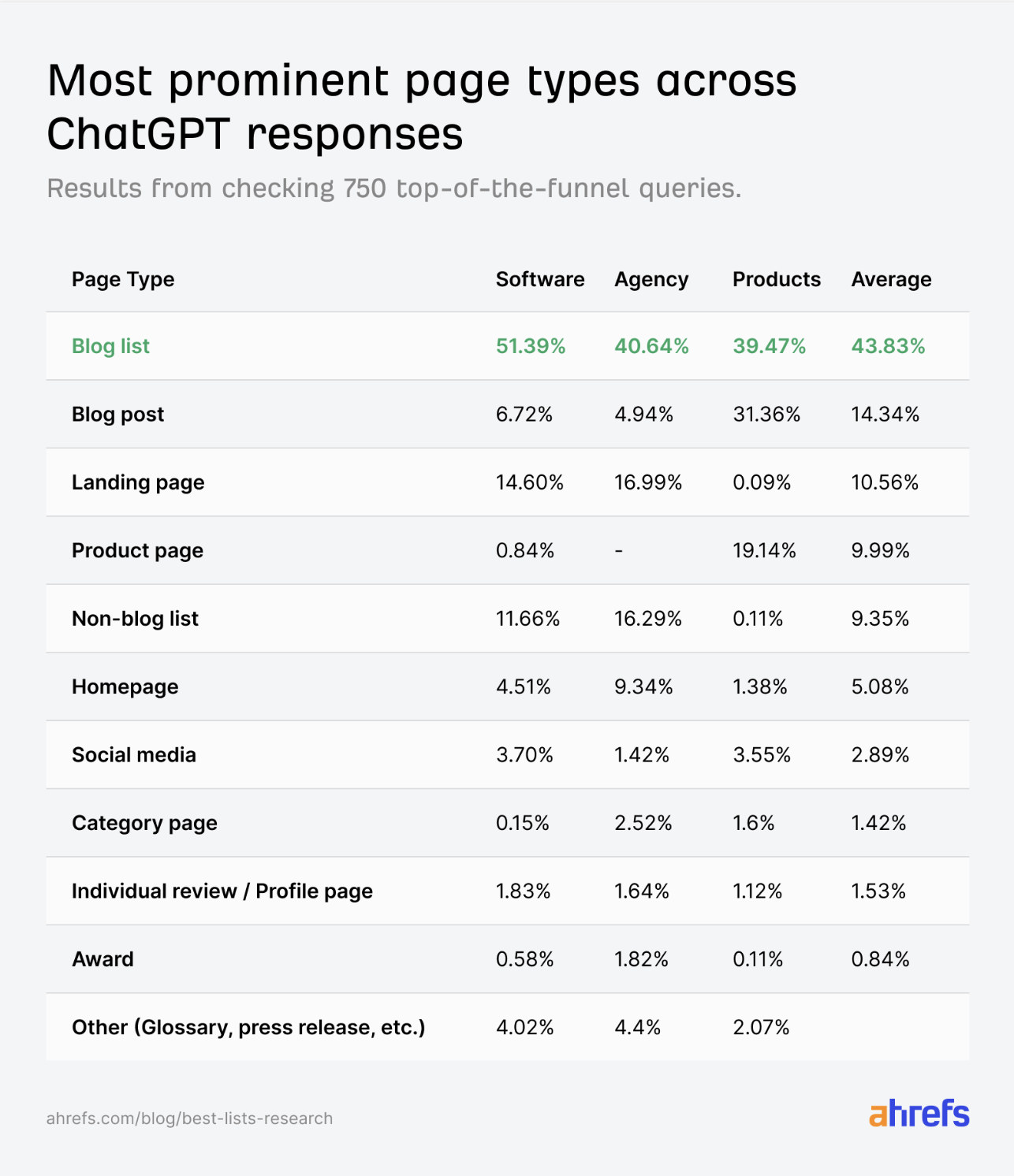
Listicle is basically the most effective type of content for B2B. According to Ahref’s research on 26,283 Source URLs to see whether self-promotional “Best” lists boost ChatGPT visibility, it’s clear that most prominent page types across ChatGPT responses are blog list.
It makes sense, because listicles achieve a lot of goals:
- Listicle keywords are usually BOFU keywords, such as “Best [X] tools” or “Best [X] services”. They capture high-intent search demand from buyers actively comparing options.
- Listicles match B2B buyer behavior where stakeholders research broadly before shortlisting vendors
- They attract backlinks from blogs, newsletters, and sales enablement content
- They stay evergreen and easy to refresh as markets evolve
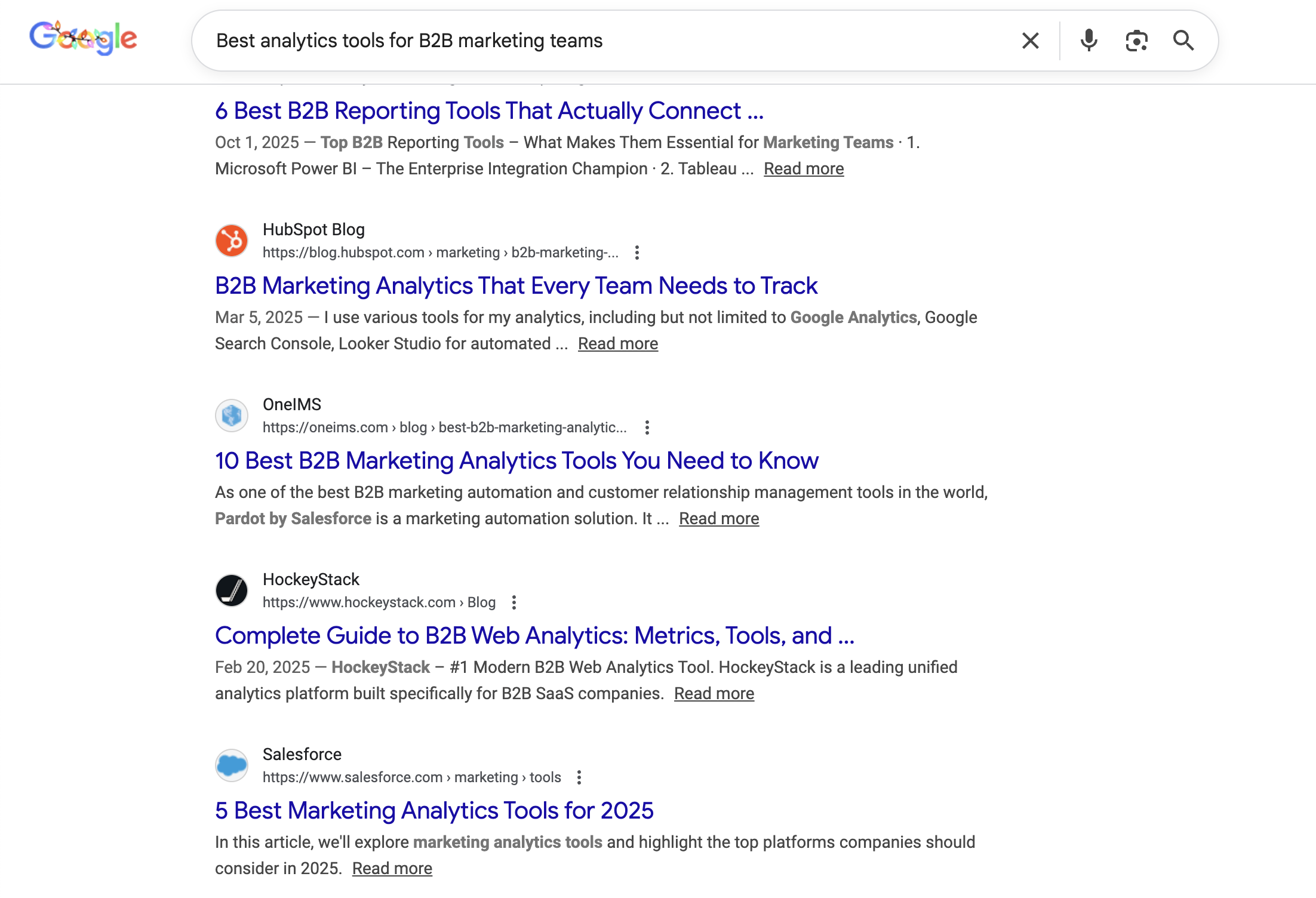
For example, if you search for “Best analytics tools for B2B marketing teams”, you should see how listicles are dominating the SERP:
Here are the action items you should do:
- Start with “best / top / tools / software / platforms / alternatives / vs” modifiers in your core B2B category
- Pull comparison-style queries from Search Console. If you have keyword research tools like Ahrefs or Semrush, simply filter keywords that contains best, top, vs phrases.
- You should open the article with a clear selection criteria section (who it’s for, use case, budget, maturity). Use that evaluation framework consistently throughout your article.
3. Build topical authority
Topical authority is one of the most easily controlled variable that you can when it comes to SEO optimization. Google doesn’t evaluate pages in isolation; it sees pages in relation to the entire website and the entire Internet.
When multiple pages on your site cover the same topic, and they are linked to each other, Google models begin to form a site-level understanding of what your website is about. This allows Google’s systems to confidently cluster your site into a specific topical index.
Thanks to this topical authority, when users search for anything within that topical index, your site is shown more frequently.
A good example of a B2B website that has achieved tremendous success thanks to topical authority is HubSpot.

They have written so many authoritative articles covering the topic of inbound marketing that Google will have to rank them in the highest position when it comes to any search queries in that space.
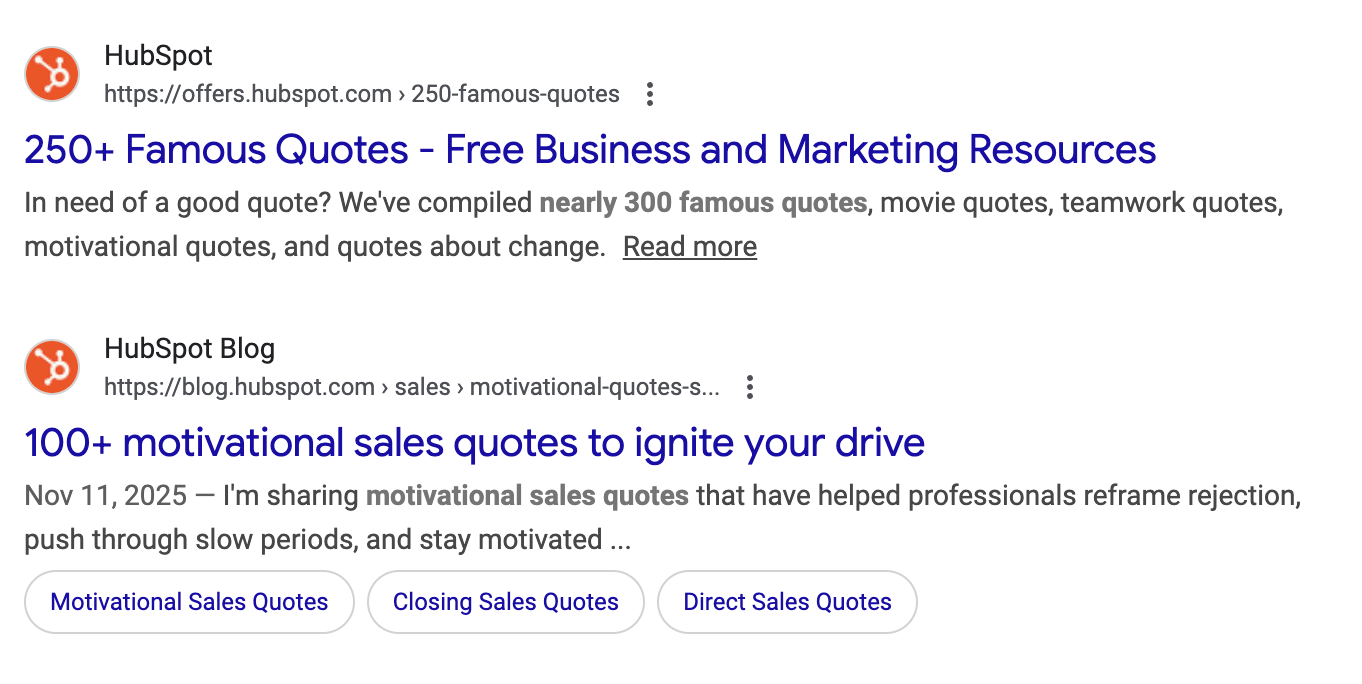
However, they made one critical mistake, and that is they over-extended themselves and tried to write content for topics that they aren’t REALLY experts in, such as “emojis” and “quotes”. That led to the “collapse of HubSpot”, bringing their monthly organic traffic from around 5M-8M to 2M (as you can see in the huge drop around mid 2024).
So here are the steps you can take to boost topical authority for your B2B website:
- Pick one primary topic per site section and commit to owning it
- Map all subtopics users search within that topic
- Create one core page (pillar) that defines the topic
- Publish supporting pages that go deeper on each subtopic. They don’t have to be long-tail. It’s better for users when you serve them 1 short article that answers their question immediately than an essay that makes them scroll 100 times before they find the answer.
- Internally link from subpages to pillar page and between related subpages.
- Use descriptive, topic-rich anchor text
- Keep content tightly scope. Do not mix unrelated topics on the same URLs since that confuses Google.
- Update older pages to align terminology, entities, and intent. If you have old pages that aren’t related to your ultimate topical cluster, don’t be afraid to delete them
- Only expand to the next cluster when you have exhausted the subtopics in the current one.
Want to go from $1M to $10M with content marketing? Here are 20 Best B2B Content Marketing Agencies You Should Know
4. Improving your link profile
It’s been decades since Google introduces their PageRank algorithm, and there’s still no better information retrieval algorithm than that.
Remember, PageRank, the core technology behind Google, works “by counting the number and quality of links to a page to determine a rough estimate of how important the website is”. The underlying assumption is that more important websites are likely to receive more links from other websites.
Here’s the graph explaining the mechanism of PageRank:

I highly recommend that you let links build naturally. However, you can always invest in some link building tactics for the more competitive keywords. Here are some tactics:
- Method #1 – Ahrefs Content Explorer for guest posts and link insertions: You can use Ahrefs Content Explorer with a core keyword to surface thousands of relevant articles already ranking or indexed in your niche. These pages indicate topical relevance and often include competitor mentions. You can filter by traffic, DR, authors, or site type to identify guest post and niche edit opportunities. To find listicles mentioning competitors, search for multiple competitor brand names together and include your own brand to identify missing mentions, then reach out to editors or webmasters to request inclusion.
- Method #2 – Help a B2B Writer: You may know HARO, the journalist request platforms where reporters seek expert input. But do you know that there’s a B2B version called “Help a B2B Writer“? Sign up for them, monitor weekly emails to find relevant ones and respond with concise, credible insights tied to your expertise. If your contribution is used, you typically earn an editorial mention and backlink from authoritative media sites with minimal outreach friction.
- Method #3 – Content exchange: Once a target site is identified, you can propose value-driven offers such as writing a free article based on uncovered content gaps, negotiating paid placements, or arranging link exchanges using a vetted pool of partner sites. Long-term results come from tracking which sites accept which models and reusing that intelligence to streamline future outreach.
5. Calculate SEO’s CAC
SEO is often excluded from CAC (customer acquisition cost) conversations, largely because SEO teams are uncomfortable justifying spend in financial terms. SEO costs feel scattered across content, tools, engineering, and time, and returns arrive months later. But avoiding CAC does more harm than good, because leadership will eventually demand customer-level accountability.
Paid acquisition has fixed economics. If you pay $1 per click and need 100 clicks to convert, your CAC is $100 every time. Spend another $100, and the next customer still costs $100. Improvements only come from better conversion rates or lower ad costs.
SEO works differently. You might invest heavily upfront, see high CAC in year one, and look inefficient compared to paid. But in year two and three, if conversions continue without proportional new spend, CAC drops sharply. Over time, SEO often becomes significantly cheaper than paid channels.
Here’s a simple table to demonstrate that:
| Month | Content Creation ($) | Link Building ($) | SEO Tools ($) | Total Monthly SEO Spend ($) | Cumulative SEO Spend ($) | Monthly SEO Conversions (First-Touch) |
|---|---|---|---|---|---|---|
| 1/1/2026 | 5,000 | 3,000 | 2,000 | 10,000 | 10,000 | 2 |
| 2/1/2026 | 5,000 | 2,500 | 2,000 | 9,500 | 19,500 | 6 |
| 3/1/2026 | 5,000 | 2,000 | 2,000 | 9,000 | 28,500 | 12 |
| 4/1/2026 | 5,000 | 1,800 | 2,000 | 8,800 | 37,300 | 20 |
| 5/1/2026 | 5,000 | 1,500 | 2,000 | 8,500 | 45,800 | 30 |
| 6/1/2026 | 5,000 | 1,200 | 2,000 | 8,200 | 54,000 | 42 |
| 7/1/2026 | 5,000 | 1,000 | 2,000 | 8,000 | 62,000 | 55 |
| 8/1/2026 | 5,000 | 1,000 | 2,000 | 8,000 | 70,000 | 62 |
| 9/1/2026 | 5,000 | 1,000 | 2,000 | 8,000 | 78,000 | 68 |
| 10/1/2026 | 5,000 | 1,000 | 2,000 | 8,000 | 86,000 | 72 |
| 11/1/2026 | 5,000 | 1,000 | 2,000 | 8,000 | 94,000 | 76 |
| 12/1/2026 | 5,000 | 1,000 | 2,000 | 8,000 | 102,000 | 80 |
You can see how SEO has:
- Heavy upfront investment with slow early conversions
- Monthly SEO spend stabilizes after the foundation phase
- Conversions compound over time without proportional spend increases
- CAC improves every month when viewed cumulatively
- SEO economics outperform paid channels over longer time horizons
6. Write content for the users, not for the search engine
Yes, seriously. You should write content for the users.
Google doesn’t have a common standard for content quality. What matters to Google is whether you have topical authority in the niche of the content you publish, and whether you have links to that content. That’s why you see mediocre content rank high on authoritative website like Forbes.
That means you don’t have to worry about an “SEO standard” for your content apart from having good meta titles and slug. The actual content should be written in a way that best answers the problem that the meta title was set out for.
For example, this article has the meta title of “How to improve SEO in B2B?”. I simply write whatever is needed to answer that question for you. I don’t care about the SEO best practices apart from ensuring my titles and slug are optimized for that query. The rest is to be judged by you, the readers.
7. Write content for specific queries rather than generic ones
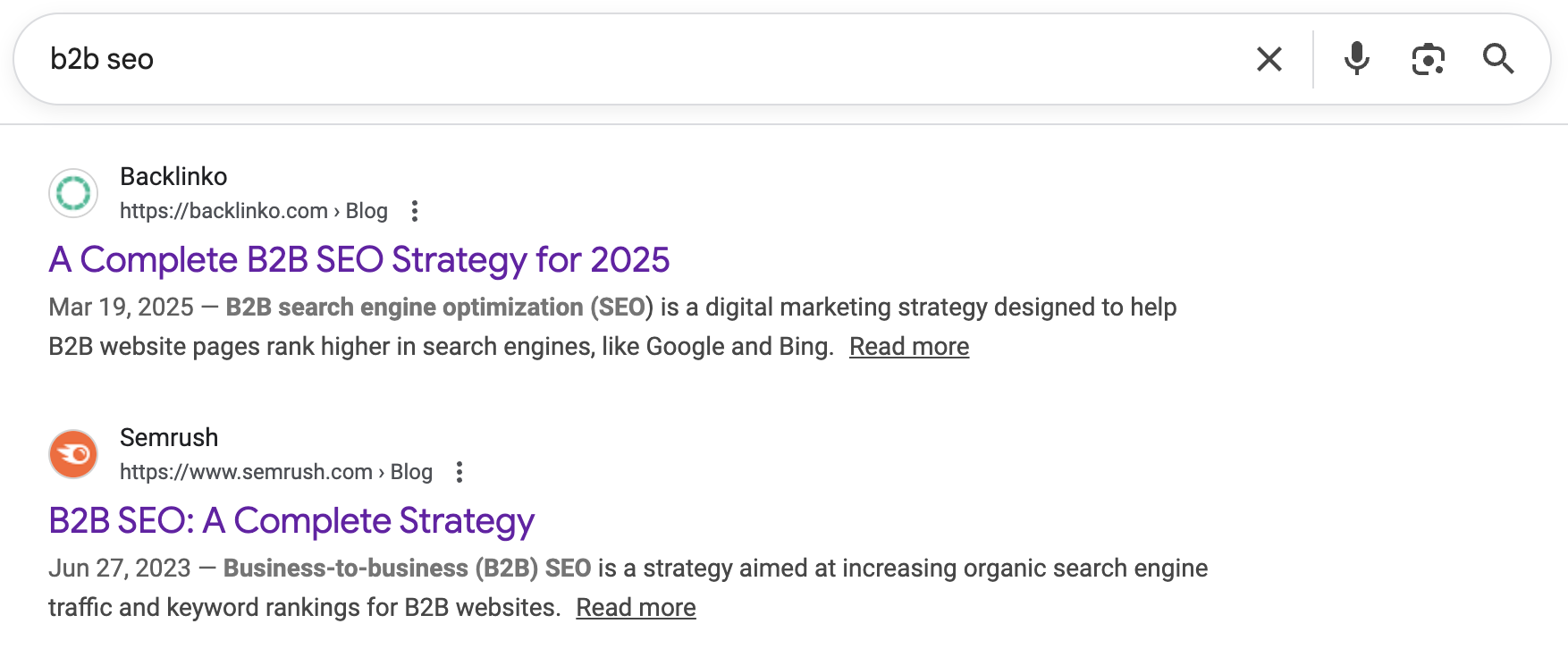
When I search a generic query like “B2B SEO”, the comprehensive guides from Backlinko and SEMRush pop up. These are incredibly long articles from big players with thousands of backlinks. Outranking them is kinda challenging.
It’s because “B2B SEO” is a very generic search term. Google doesn’t know if you’re trying to search for the definition of B2B SEO, or how to do B2B SEO, or best practices of SEO, or how to improve SEO. Statistically speaking, Google has a better chance of satisfying your search query when it surfaces a generic article from a big player who’s proven their reputation than a short article from someone’s writing from their bedroom.
What makes better sense for you is longer tail keywords, like this:
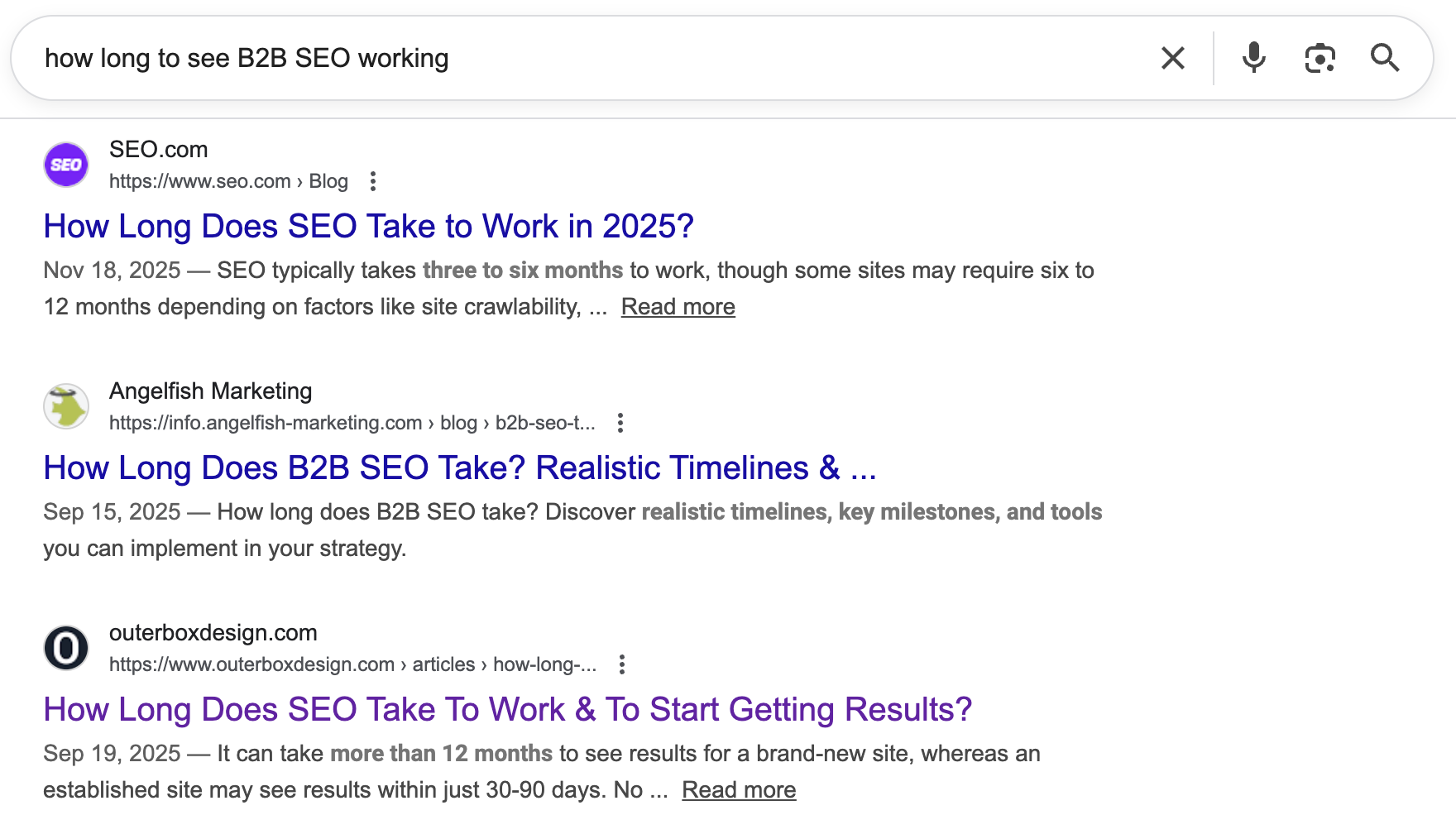
Long-tail keywords work wonders because:
- Long-tail keywords clarify search intent: they tell Google exactly what the user wants, reducing ambiguity compared to broad terms like “B2B SEO.”
- They face significantly less competition: fewer sites target them directly, making rankings more achievable for non-brand or smaller domains.
- They align with how B2B buyers actually search: buyers ask specific, problem-driven questions rather than broad industry terms.
- They convert better: specificity usually means higher purchase or evaluation intent, even with lower traffic.
- They map cleanly to BOFU and MOFU stages: long-tail queries naturally support evaluation, comparison, and solution-seeking content.
- They’re easier to satisfy with focused content: you don’t need massive “ultimate guides” to rank effectively.
- They compound over time: dozens of small wins add up to meaningful organic traffic and pipeline impact.
- They appear in Search Console before tools: many long-tail queries don’t show volume in third-party tools but still drive impressions.
8. Use Google Search Console for long-tail keyword ideas
Google Search Console is fundamentally different from most keyword research tools because it shows what your site is already ranking for, not what you might rank for. Moreover, Search Console is first-party data straight from Google, tied directly to your pages, impressions, clicks, and real queries. That makes it the most accurate source for understanding actual search demand your site already touches.
Another reason Search Console outperforms other tools for long-tail work is intent clarity. When a query appears in Search Console, you already know Google believes your page is relevant to that intent.
Instead of starting with seed keywords, you start with pages that already perform:
- Go to the Performance report
- Filter by a specific page
- Review the list of queries driving impressions.
- Pay close attention to queries with high impressions but low clicks or average positions between 8–30. These are often perfect long-tail opportunities
There are a few high-leverage patterns to look for when mining long-tail queries in Search Console:
- Queries that are more specific than your main target keyword
- Question-based queries you haven’t explicitly answered on the page
- Use-case, industry, or role-based modifiers
- Variations that imply comparison, evaluation, or next-step intent
Create content for those terms. You don’t even have to write long-form. Just short and sweet answers to the query is more than enough.
Conclusion
Too long didn’t read? Here’s the recap of the things you can do to improve SEO of your B2B website:
- Revenue intent beats volume: the most effective B2B SEO work consistently prioritizes BOFU and high-intent queries over generic, high-volume keywords.
- Specificity wins in B2B search: content that targets clear, narrow problems and use cases outperforms broad “ultimate guides” against entrenched brands.
- Listicles act as a conversion bridge: “best,” “vs,” and “alternatives” content repeatedly shows up as the highest-impact format for evaluation-stage buyers.
- Topical focus compounds results: sites that commit to owning a narrow topic cluster outperform those that spread content across unrelated themes.
📊 Want B2B SEO experts to do SEO for you? Here’s a list of the best B2B SEO agencies