

B2B content often fails to deliver results when it does not rank well. If it is not reaching the desired audience, you are actually wasting time, effort, resources, and losing valuable clients.
To avoid such an issue, it is essential to optimize your B2B content according to the search engine best practices. From understanding the search intent to optimizing keywords and improving clarity, every element plays a role in how visible your content will be in the SERPs.
In this blog post, we have gathered and discussed seven of the best ways to optimize B2B content for SEO.
Top 7 Ways to Optimize B2B Content for SEO
Here are some of the best ways through which you can effectively optimize the B2B content.
- Understand Search Intent and Align Content with It

Search intent is basically the purpose or intent behind a search query. And the B2B audience often conducts detailed research online to make business decisions. So, understanding the search intent acts as a foundation of effective SEO. Typically, search intent is categorized into four types:
- Informational: Indicates that the business is actually looking for information to gain knowledge.
- Navigational: Searching for a specific website or brand.
- Commercial: The business is actively comparing different vendors, reading reviews, etc., with a goal of acquiring services.
- Transactional: Indicates that the buyer is ready to purchase a product/service, and is seeking pricing and demos.
To optimize B2B content, you need to understand what exactly its search intent is, and then start tailoring the content accordingly. Obviously, when your content addresses what a B2B buyer is actually looking for, it will most likely improve its chances of ranking well.
- Research Keywords and Use Them Strategically
When it comes to optimizing content for SEO, keywords are still considered valuable. These are words and phrases that are searched by B2B buyers on Google.
Google strives to provide the most appropriate results according to the searched query. So, when your content contains the searched keywords, it increases the likelihood of your page ranking higher in the SERPs. That’s how keywords work.
For this reason, you should research relevant and high-volume keywords for your content with the help of tools like Google Keyword Planner.
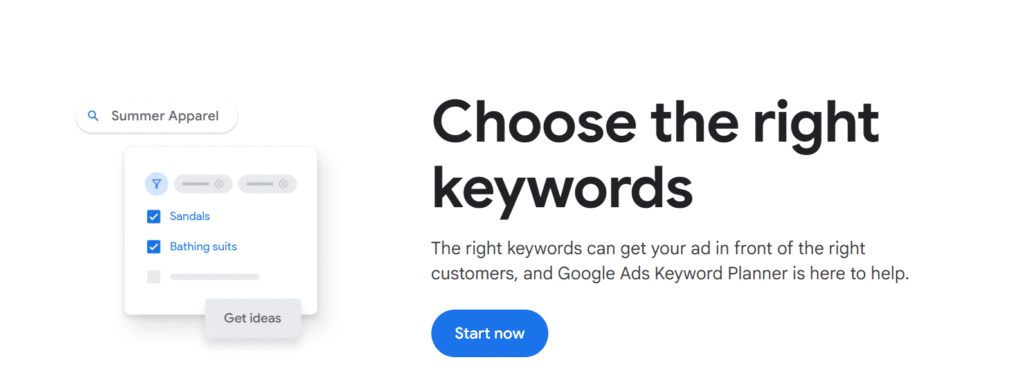
Try to find different kinds of keywords, including primary, secondary, and long-tail. The long-tail keywords are particularly valuable because they often reflect specific needs and usually have lower competition.
When found, strategically incorporate them within the content. This means, only add them where they look natural and appropriate. Do not overuse keywords, as this is considered a black hat strategy to manipulate the SERPs.
- Optimize Title and Heading Tags

A title is one of the key elements of B2B content, as it helps search engine crawlers to understand what the content is about. Besides this, the title also plays a key role in deciding whether the audience will click on it or not.
So, it is essential to optimize it properly. Here are the things that should be done in this regard.
- Must use the primary keyword in the title
- Keep it relevant and concise
- Use numbers, power words, and emotional triggers
When it comes to heading tags, these are HTML elements that help Google understand the hierarchy of a webpage. These range from H1 to H6, with H1 being the most important one. The H1 tag is used for the title, while the remaining ones are for the subheadings.
Below, we have listed some tips for using heading tags efficiently:
- Follow the right sequences, i.e., H2, H3, H4…H6
- Ensure readability and conciseness
- Use a mix of keywords
- Improve Readability, Fluency & Uniqueness
No matter how valuable the information your B2B content contains, if it doesn’t sound readable, original, and fluent to read, it may not drive results. Such content will not be able to engage the audience properly, giving a negative signal to Google, resulting in a lower visibility in SERPs.
Therefore, to make B2B content optimized for SEO, it is essential to work on elevating its:
- Clarity
- Uniqueness
- Fluency
For clarity, simply find complex or unclear wording in the content, and replace them with easy yet contextually appropriate synonyms.
When it comes to improving fluency, modify the sentence structure by changing the voice from passive to active.
We know improving all these elements at once is a tough task and requires a strong grip on writing. To make it easier and quicker, you can get help from rephrasing tools. There are many options available online, with Paraphrasing.io being the most reliable one.
It effectively rephrases the given content to improve its clarity and uniqueness. Additionally, its different modes help adjust the tone for consistency.
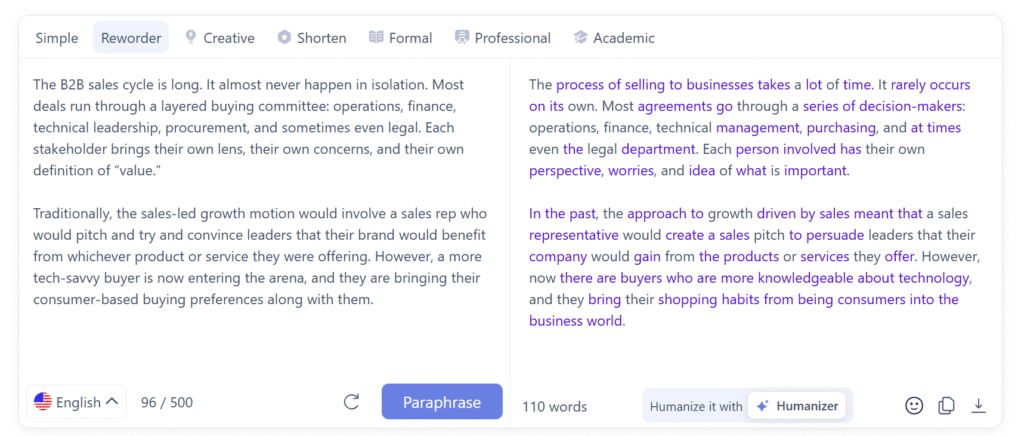
Readable and fluent content engages the audience for a longer period, ultimately leading to improved rankings.
- Optimize Visuals

There is no doubt that adding visuals to your B2B content is helpful in many ways. For instance, these allow the readers to better understand the given information, and are also useful for breaking the pattern of plain text.
However, if the added visuals aren’t properly optimized, they will negatively impact the content’s performance instead of improving it.
There are multiple things that should be done for visual optimization.
- Use relevant and descriptive file names.
- Compress photos, infographics, etc., by using compressor.io to reduce their overall size.
- Add alternative text by using relevant keywords to each image.
- Do not upload videos manually from your side. Instead, host them on platforms like YouTube to ensure quick loading.
Optimizing visuals of your content not only contributes to improving the loading speed of the page, but also increases the chances of visuals appearing in Google image results.
- Add Internal and External Links

Linking is an essential component of SEO that helps strengthen the relevance and credibility of your B2B content. There are two types of links.
- Internal: These links redirect the visitor from one page to another page of the same website.
- External: These links redirect the audience from a webpage to a third-party website.
Both types have their importance in the optimization process. For example, internal links help crawlers to discover relevant pages of your website.
That’s why, you should add relevant internal links to the content. Ensure the anchor text on which the link is added is also similar to the page it is referring to. However, this does not mean you should rely heavily on exact match anchors, as overusing them can appear unnatural and may negatively impact SEO.
Whereas the external links add credibility and authority to your B2B content, giving a positive signal to Google. For this reason, it is recommended to add external links to websites that are trustworthy.
- Monitor and Optimize
Finally, you should keep a close eye on the performance of B2B content. This will help you determine where you are doing well and where improvement is required.
You should start by tracking the following metrics:
- Organic traffic
- Keyword rankings
- Average session duration
- Conversion rate
There are numerous advanced tools available online that help track these insights. One of the most reliable ones is Google Analytics.

Keeping track of such key metrics will provide you with the opportunity to tailor your B2B optimization strategy for maximum impact.
Bottom Line
It does not matter how valuable your B2B content is if it is not optimized for SEO, it may not drive useful results. The optimization process is basically a tree, covering numerous aspects including search intent, keyword and title optimization, and many more. There are a number of ways in which B2B content can be optimized. This blog has explained seven of the best ways in detail.