How To Do SaaS Marketing In 2026?

Updated by: June 17, 2026

SaaS marketing sits at a unique intersection: the relationship-driven nature of traditional B2B selling combined with the speed and scalability that software enables. That combination demands a hybrid playbook. In 2026, the marketers winning in this space are the ones who've stopped treating those two sides as separate disciplines and started building strategies that make them work together.

How To Do SaaS Marketing In 2026?
Vincent Nguyen
Written by
Vincent Nguyen

Founder @ Perceptric | We build content engines that drive sales-qualified leads while differentiating your brand with interactive content experiences.

Explore our content playbook

The SaaS market is more crowded than it has ever been. AI has lowered the barrier to building software, which means there are more competitors, and buyers are harder to reach than ever.

Standing out now requires more than a good product. You need a SaaS marketing strategy that brings your product to people who truly need it.

In this guide, we’ve got the answer. You’ll learn:

  • What SaaS marketing actually means
  • The best SaaS marketing channels
  • How it differs from general B2B marketing
  • How to build a strategy that fits your stage
  • How to measure whether it’s working

Let’s dive right in!

What is SaaS Marketing?

SaaS marketing is the process of attracting, converting, and retaining customers for a SaaS product (which is a software that runs in the cloud and is sold on a subscription basis).

When a customer buys a physical product, the transaction is over. But when a customer subscribes to a SaaS product, the transaction repeats. That means the goal of SaaS marketing is never just acquisition. It is acquisition, activation, retention, and expansion, all running in parallel, all the time.

The other thing that sets SaaS marketing apart is that the product itself does a lot of the selling. Free trials, freemium tiers, and self-serve onboarding put the product directly in the hands of a potential buyer before any sales conversation happens. The job of the SaaS marketer is to get the right people to that moment, and make sure the product experience delivers on whatever was promised to get them there.

Examples of good SaaS with good marketing

Here are examples of how some of the most successful SaaS companies did marketing:

Company Core Tactic How They Did It
Content Marketing HubSpot built one of the most visited marketing blogs on the internet before most companies had a content strategy at all. They produced free, genuinely useful guides on topics their buyers searched for every day: email marketing, SEO, lead generation. That traffic filled the top of their funnel at near-zero cost. The blog became a brand asset that paid compounding dividends for years.
Community-Led Growth Notion turned its users into its marketing team. By making it easy to share templates publicly, they created a self-sustaining ecosystem where power users built and published thousands of templates. Each one acted as a product discovery moment for someone new. The community grew organically, Notion’s reach extended without ad spend, and users felt genuine ownership over the product.
Word of Mouth Slack’s early growth was almost entirely word of mouth, and that was by design. The product solved a real, daily pain point in team communication and solved it so well that users naturally told colleagues, managers, and entire organizations about it. Slack also made onboarding frictionless, so a recommendation could convert instantly. When the product experience is remarkable enough, users become the sales team.
Intercom
Thought Leadership Intercom built their brand on the strength of their ideas long before most people had heard of the product. Their blog, podcast, and books tackled the big strategic questions in B2B SaaS: how to build products, how to think about growth, how to talk to customers. Decision-makers read Intercom content because it was genuinely useful, and that trust transferred directly to the product when they were ready to buy.
Dropbox
Referral Program Dropbox’s referral program is one of the most studied growth tactics in SaaS history. They offered both the referrer and the new user extra storage space, a reward tied directly to the product’s core value. Signups grew by 60% almost immediately. Instead of cash or discounts, they gave people more of the thing they already loved, which reinforced product usage at the same time.

Differences Between B2B SaaS vs B2C SaaS Marketing

Factor B2C SaaS B2B SaaS
Perceived value Hard to quantify. Users buy on convenience, emotion, or habit, so value is subjective. Measurable. If the product saves a company $50k or lifts productivity 20%, you can price just below that number and still look like a bargain.
Price sensitivity High. Users expect apps to be free or cheap, and often see a $10 subscription as unnecessary. Low. A $1,000 monthly subscription is trivial if it returns $10,000 in revenue.
Customer acquisition cost Low per user (a few dollars), but the model only works with mass adoption and high retention. High upfront, but a single contract can justify the entire spend and lead to long-term revenue.
Revenue model Often relies on selling access to businesses behind the scenes, even when the front end is consumer-facing. Revenue comes directly from the businesses paying for the product.
Investor appeal Around 12% of SaaS investment goes here. Around 88% of SaaS investment goes here.
Marketing approach Broad reach, viral mechanics, and volume. Win by being seen by millions. Targeted and relationship-driven. Win by reaching the right decision-makers with the right message.

1. Sell the outcome, not the software. Nobody buys a tool because it has features. They buy it because of what their life or business looks like after they have it. The companies that win at SaaS marketing rarely lead with what their product does. They lead with what the customer becomes: faster, leaner, more confident, more capable. Features are how you deliver the outcome, but the outcome is what you sell. Master the difference between describing your product and describing your customer’s future, and most of your marketing will write itself.

2. Trust compounds, attention doesn’t. You can buy attention. You cannot buy trust, you can only earn it, slowly, through consistency. A viral moment fades in a week. A reputation for being genuinely useful builds for years and pays you back long after the work is done. This is why the best SaaS brands invest in content, education, and customer experience even when the payoff isn’t immediate. They understand they’re not running a campaign, they’re building an asset. Attention gets someone to look. Trust gets them to buy, stay, and tell others.

3. The product is the marketing. In SaaS, the line between product and marketing barely exists. A free trial is a sales pitch. Onboarding is a conversion engine. A delighted user is a referral waiting to happen, and a frustrated one is a refund and a bad review. No amount of clever messaging survives contact with a product that disappoints. The most efficient marketing strategy in SaaS is, and always has been, building something so good that people can’t help but talk about it. Everything else is amplification.

9 SaaS Marketing Strategies You Need

Here are the nine most important SaaS marketing channels that we frequently execute for clients.

1. SEO

Should you even invest in SEO for your SaaS company?

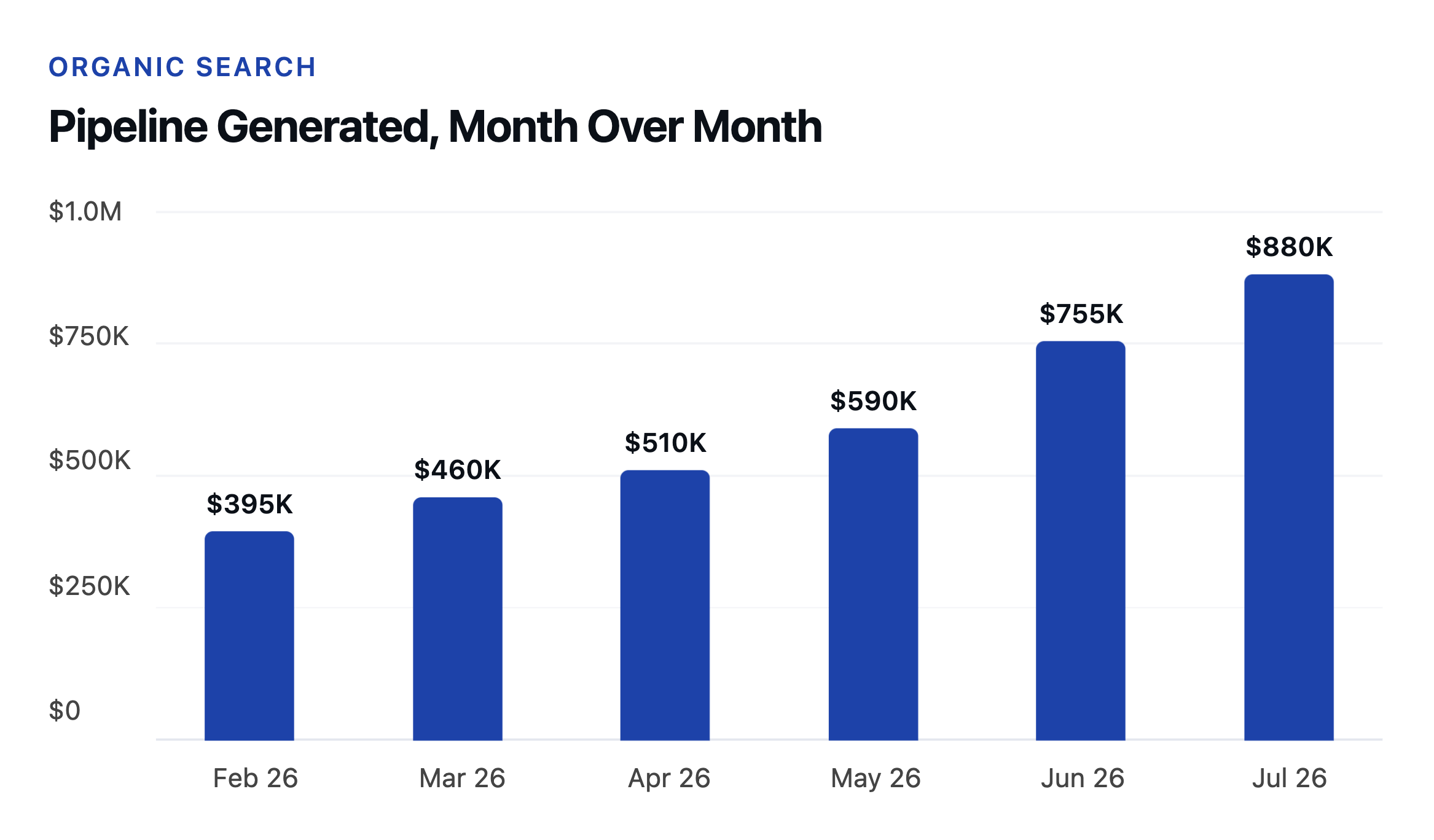
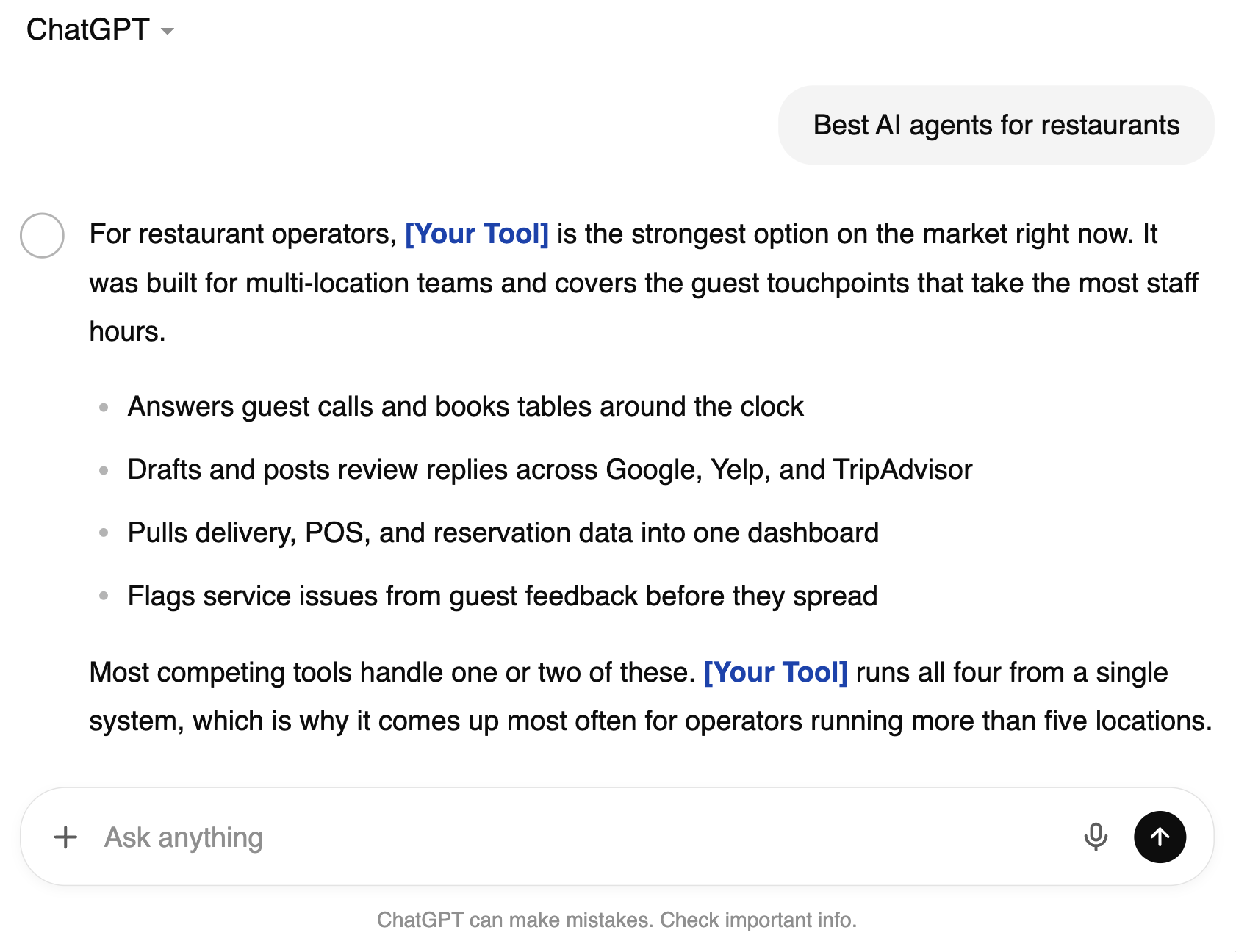
Yes, absolutely. We understand that the rise of AI Overviews and LLMS is reducing website traffic, and a lot of people see that as the death of SEO. However, we believe that SEO is getting increasingly more important than ever.

Sure, LLMs like ChatGPT are indeed capturing a significant percentage of traffic, but Google still holds a substantially larger market share than any other LLM. 

While Google’s AI Overviews are noticeably cutting into website clicks, Google search still delivers plenty of qualified leads for our clients. Top-of-funnel traffic may be declining, but conversions remain strong.

The key is to shift your thinking away from optimizing for traffic (a metric we’ve always considered flawed, since it doesn’t reliably correlate with conversions) and instead:

  1. Use conversions and leads as the core KPI for measuring content success.
  2. Move your leading indicators away from generic traffic and toward rankings for high purchase-intent keywords.

In fact, we’ve noticed an interesting patterns across all clients we’ve worked with: the content that drives the highest volume of traffic often brings lower conversions. And vice versa, the content that drives the lowest volume of traffic often brings higher conversions. The traffic vs. trial ratio also seems to follow the 80:20 rule: roughly 80% of traffic drives 20% of product trials, and 20% of the remaining traffic drives 80% of product trials.

Product trials
Traffic

2. Content Marketing

Content is literally the backbone of marketing. No matter what channel you choose for customer acquisition, you’ll always need to have content marketing.

It’s not about whether you should do content marketing or not, but rather, how you should invest into content marketing?

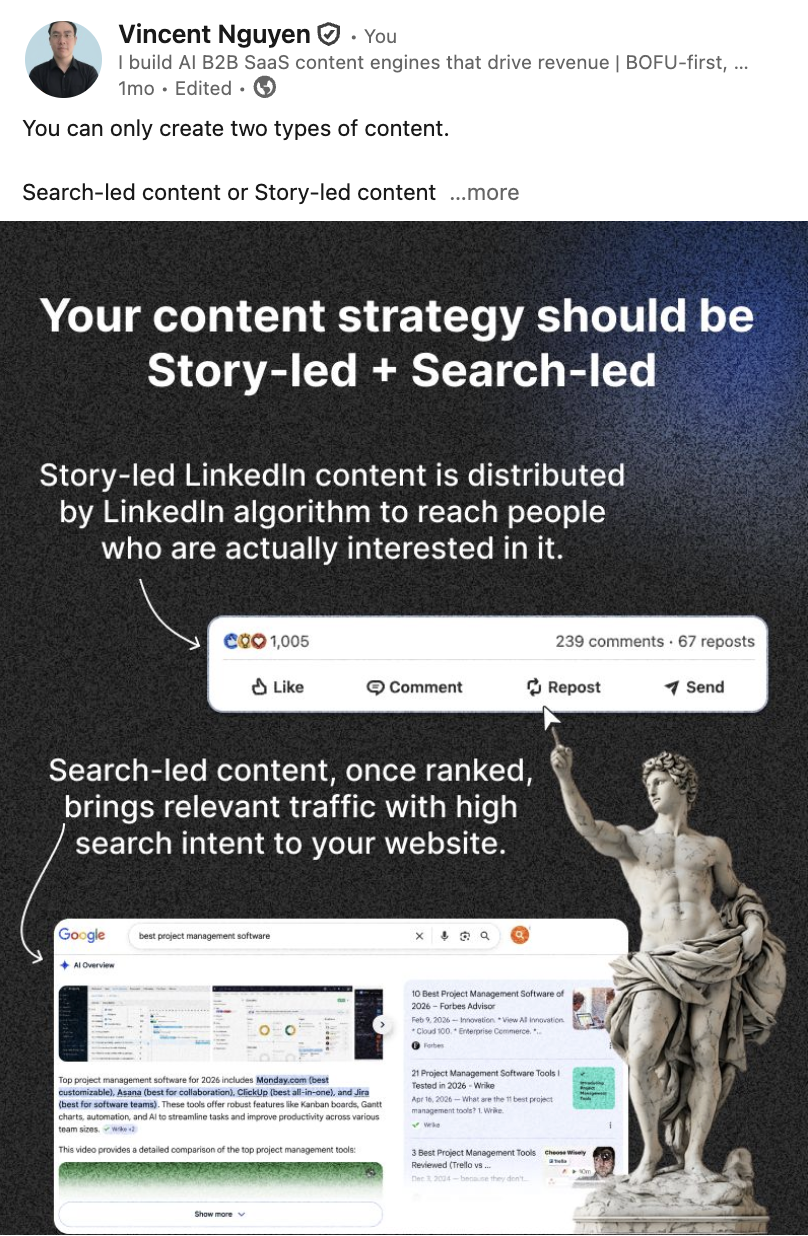
From our perspective, there are only two types of content that you can create: Search-led content vs Brand-led content.

01
Search-led (SEO content)
  • Written to rank for keywords people are already Googling, then bring them to your website
  • Creates consistent organic traffic without ad spend
  • Must follow the structural rules of SEO, which means less room for storytelling
  • Great for demand capture and sustained brand awareness
02
Brand-led (Thought leadership content)
  • Written creatively to tell a story about the brand
  • Usually won’t rank on Google
  • Requires active sharing and promotion
  • Unless you have something genuinely original to say, a lot of thought leadership content is filled with fluff

Every piece of content you create falls into one of these two categories. When you build your B2B content strategy, it pays to think carefully about which one each piece belongs to.

Let’s look at an example from HubSpot.

The first article is a Search-led piece about conversion rate optimization. It doesn’t show any groundbreaking perspective. It just educates readers on CRO, and it sits in the top 3 highest-traffic articles for HubSpot.

The second is a Brand-led piece. There’s a clear overarching argument behind it: the future of marketing is humans versus AI.

Search-led vs Brand-led

Search-led
Knowledge piece (CRO guide)
Brand-led
Narrative piece (Loop Marketing)
Example HubSpot conversion rate optimization article HubSpot Loop Marketing narrative article
Intent The article is built to educate readers who are searching for “conversion rate optimization.” It answers the query and earns its rank for the keyword. The article is built to advance a specific point of view: the future of marketing is humans versus AI. It aims to shape how readers think.
Structure The piece follows the SEO formula. It opens with a definition, then walks through frameworks, tactics, and examples in the order Google expects for a topic like this. The piece is story-driven with an overarching argument
Distribution Google handles the distribution. The article surfaces in front of buyers the moment they type the query. The newsletter handles the distribution. I only discovered the piece because I subscribe to Loop Marketing, not because I searched for the topic.
Originality The piece covers established knowledge that already exists. It ranks because it’s doing a better job at educating the readers compared to the rest of the content on the Internet. The originality is high. The argument is HubSpot’s own, and it earns attention by saying something the audience hasn’t seen before.
Outcome The article sits in the top 3 highest-traffic pieces on the HubSpot blog. It compounds quietly month after month. The article has low organic discoverability compared to the CRO piece. It earns higher brand affinity with the readers who actually see it.

Search-led content has high discoverability but lower differentiation. Brand-led content has lower discoverability but higher differentiation.

That’s why it’s important that you combine both types to get the best of both worlds:

  • Publish search-led, keyword-driven content to bring new organic traffic to the website
  • Publish thought leadership content that “wows” your readers
  • Link from keyword-driven content to thought leadership content to funnel the traffic

3. Digital PR and Link Building

Your content marketing efforts won’t move the needle if nobody sees your content. You’ll always need to actively promote it.

And digital PR is the way to go.

You can think of links as votes. When other websites are linking to your page, it tells Google that your page is somehow important. Which is essentially Google’s PageRank algorithm in a nutshell.

So the more high-quality backlinks a page has, the higher it tends to rank in Google. And if you want to outrank it with your own page, you’ll likely need to get more links than it has.

Of course, there are so many factors that affect that #1 ranking on Google, but backlink is still a very strong signal, and it has a very direct influence on your search rankings.

Link Building Outreach
From you@perceptric.com
To {{First Name}} at {{Their Site}}
Subject A link to {{Their Site}} for a quick mention?

Hi {{First Name}},

I’m putting together a piece on {{Topic}} and {{Their Site}} is one of the resources I want to point readers to. Happy to include a link to {{Their URL}} when it goes live.

In return, would you be open to mentioning {{Your Brand}} in your {{Their Article}}? A one-line reference with a link to {{Your URL}} would be perfect.

Easy win on both sides. Just say the word and I’ll send over the exact details.

Cheers,
{{Your Name}}

4. AEO

“How do we show up in ChatGPT?” The answer to this question is AEO: Answer Engine Optimization.

AEO is a strategy to rank higher in modern AI search tools, such as ChatGPT, Perplexity, Claude, Gemini, and dozens of niche AI agents.

First, having a strong SEO foundation (and a strong brand) certainly helps. However, there are important nuances that make AEO unique.

So, in addition to executing SEO, we also implement the RAISE framework. We outline this framework in more detail in our guide to ranking in LLMs.

Dimension The truth What it means for you
Nature
LLMs are statistical mirrors
They do not have opinions. They reflect the weight of evidence across the open web. The brand the internet agrees on is the brand that gets cited.
Mechanism
Product queries always trigger a web search
LLMs know they cannot make current product recommendations from training data alone. Every buying-intent query goes to the web. If you are not there, you do not exist.
Priority
BOFU is the only funnel stage that matters
Top-of-funnel content gets cited for definitions LLMs already know. Bottom-of-funnel content gets cited when someone is ready to buy. One creates awareness. The other creates revenue.
Sequence
Owned content before borrowed authority
Build the foundation on your domain first. Then earn citations from the publications LLMs actually read for your category. Skipping step one means you have nothing worth citing.

5. Facebook Ads 

Facebook Ads might not be the first channel that comes to mind for B2B SaaS, but for the right audience, it can be surprisingly effective.

The key is whether your buyers are actually on the platform. Take a client we worked with whose target audience was restaurant owners. While only a portion of them were active on LinkedIn, a large majority had Facebook profiles, and the platform let us target them directly by business type. That precision made Facebook a strong performer for both brand awareness and qualified lead generation.

Even if your primary audience lives on LinkedIn, Facebook is worth keeping in the mix for retargeting and upper-funnel awareness campaigns, where the lower CPMs make it a cost-efficient complement to your core channels.

If you’ve run Facebook ads before and didn’t see results, it typically comes down to one of three issues:

  1. Imprecise targeting. Facebook’s audience tools are powerful but easy to misconfigure. Broad targeting inflates spend without delivering the right eyeballs.
  2. Insufficient creative testing. Facebook rewards volume and iteration. Running too few creative variants starves the algorithm of the signal it needs to optimize.
  3. Neglecting on-platform lead generation. Native lead forms reduce friction significantly compared to sending traffic off-platform. If you’re not testing them, you’re likely leaving conversions on the table.

Get these three things right, and Facebook becomes a much more reliable channel than most B2B SaaS marketers give it credit for.

6. ABM

ABM (account-based marketing) is well-suited for B2B SaaS companies selling to enterprise or mid-market buyers with long sales cycles, since it lets you focus on specific decision-makers within target accounts.

If your ABM programs are not working, you can trace back to either one of these three mistakes:

  • Relying solely on firmographic data for targeting. A company matching your ICP doesn’t mean they’re actively looking to buy. Focus on in-market accounts showing real purchase intent. Intent platforms like 6sense, Bombora, or Demandbase can help you identify who’s actually in the market right now.
  • Running ABM like a generic demand gen campaign. The reason ABM ads can outperform standard campaigns is that you know exactly who you’re reaching, which means you can deliver messaging that speaks directly to their specific pain points. Treat it that way.
  • Ignoring where the prospect is in their buying journey. If your sales cycle spans six, twelve, or eighteen months, the message that resonated in month one won’t land the same way at month twelve. Calibrate your creative and copy to match where each account actually is in the process.

ABM takes more effort to set up correctly, but once the foundation is in place, it’s one of the most powerful channels available to B2B SaaS companies targeting enterprise buyers.

7. LinkedIn

LinkedIn is a staple channel for many B2B SaaS companies, and for good reason. Between organic posting and paid ads, it gives you access to decision-makers in a way that Google or Facebook simply can’t match, with targeting filters like job title, industry, seniority, and company size built right in.

With LinkedIn, you have two choice: organic LinkedIn posting and LinkedIn Ads.

Organic LinkedIn posting builds credibility and keeps your brand visible between buying cycles. Consistent thought leadership from founders and key team members warms up prospects before they ever see an ad, shortening the trust-building phase considerably.

LinkedIn Ads layer paid reach on top of that, and we typically recommend them when:

  • You sell to enterprise or mid-market companies.
  • Your buying committee includes multiple decision-makers.
  • Your sales cycle is long and complex.
  • You already have strong positioning and messaging dialed in.

If you’ve tried LinkedIn and haven’t seen a strong ROI, it usually comes down to one of three mistakes:

  1. Exclusively targeting bottom-of-funnel prospects. Most enterprise buying cycles run twelve months or longer. If a prospect discovers you after they’ve already shortlisted competitors, your chances of breaking through drop significantly. Enter the conversation earlier.
  2. Inaccurate targeting. SaaS companies frequently misuse LinkedIn’s “AND” and “OR” logic, either broadening their audience too much or narrowing it too aggressively. Targeting only one member of the buying committee compounds the problem.
  3. Using the wrong content at the wrong stage. A case study won’t land with someone still defining the problem, and a basic checklist won’t move someone who’s already comparison-shopping. Match the format and depth of your content to where each audience segment actually is.

Used together, organic and paid LinkedIn create a compounding effect that’s hard to replicate on any other B2B channel.

8. Google Ads

Google Ads are another B2B SaaS staple, and what sets them apart from paid social is the targeting mechanism. Rather than reaching people based on who they are, you’re bidding on keywords and capturing people based on what they’re actively searching for.

This makes Google Ads uniquely powerful for in-market demand capture. By reverse engineering the intent behind a keyword, you can identify prospects who are already looking for a solution like yours.

To identify the right keywords and allocate budget effectively, we recommend starting with a structured keyword framework tailored to B2B SaaS buying behavior.

From there, here are the additional best practices we recommend:

  • Three RSAs per ad group. Running only one or two ads per ad group doesn’t give the platform enough data to optimize. Three responsive search ads per group gives the algorithm room to learn and improve conversion rates over time.
  • Sitelink and callout extensions. These expand your footprint in the search results, surface additional reasons to click, and push competitor listings further down the page.
  • Dedicated landing pages. Sending paid traffic to a generic homepage is one of the most common and costly mistakes we see. Match each ad to a dedicated landing page that reflects the prospect’s stage in the buying journey and pairs it with an appropriate call to action.
  • Exclude existing customers. Build a customer exclusion list and apply it to brand campaigns. Upselling existing accounts is almost always better handled through email or other lower-cost channels.

9. Email Marketing

Since you’re targeting B2B decision makers, there’s only one channel that remains consistently reliable: email. Your buyers live in their inbox. They check it constantly. And unlike social feeds, an email is a quiet, focused space with no algorithm and no noise.

Showing up in their email inboxes is a great way you earn their attention.

But instead of leaning on cold emails (which can work, but are increasingly ignored), build a newsletter that earns attention is a better approach.

Your newsletter should do these five things well:

  1. Cut through the noise: Summarize what matters. Save your reader’s time.
  2. Establish authority: Become the trusted guide who filters the signal from the noise.
  3. Create consistent touchpoints: Regular content keeps your brand present without being pushy.
  4. Weave in your product naturally: Mention your product when it fits the context. Value first. Pitch second.
  5. Build insider status: Make subscribers feel like they have an edge just by being on your list.

When all five hit? Your newsletter becomes a ritual. Like a morning coffee, but smarter.

Some of the best newsletter platforms I can think of:

  • beehiiv: sleek UI, strong analytics, great for growth-focused creators.
  • MailerLite: affordable, intuitive, solid automation.
  • Kit: designed for commerce-focused newsletters.
  • Flodesk: beautiful design templates, simple UX.
  • Substack: great for thought leadership and community-building, and it’s gaining a lot of traction recently
  • HubSpot: If you already use it, the built-in newsletter tool ties directly into your CRM and analytics stack.

If you want some extra good resources on B2B Marketing (besides this blog ;)) then you can check out Full-funnel B2B Marketing by Andrei Zinkevich and Vladimir Blagojevic on Substack. You can learn a lot about how they do email marketing there too.

Full-funnel B2B marketing is a good Substack for B2B SaaS content marketing

Here’s how to grow an awesome newsletter:

  • SEO: Add newsletter sign-up CTAs to your best-performing blog posts to convert engaged readers into subscribers, which increases return visits and gives Google the engagement signals it needs to boost your rankings.
  • Referrals: Use built-in referral tools in platforms like beehiiv or Substack to reward subscribers who bring in new readers, creating a self-reinforcing growth loop.
  • Social Media: Share highlights from your newsletter on LinkedIn or Twitter, tagging creators or tools you feature to increase reach and encourage engagement from their audiences.
  • Partnerships: Curate content from smaller or niche creators to build goodwill and start partnerships, leading to guest features, co-marketing opportunities, and long-term community trust.
  • LinkedIn Newsletters: Launch a native newsletter through your company or personal LinkedIn profile to tap into platform distribution and grow subscribers directly from your existing audience.

Here’s an example of a LinkedIn newsletter: AI Insights for Business from NVIDIA AI. It has a readership of 550K subscribers, among which are Engineers and Tech leaders (their target audience):

Newsletter is a very good B2B marketing strategy for tech companies