
The B2B sales cycle is naturally long. Most deals take around 1-3 months to close, some even taking 3-5+ months.
This happens because B2B consumers tend to take longer to make a buying decision. A lot of stakeholders have to be involved, with many rounds of approval needed.
That’s why you need content marketing to support each part of the sale funnel helps you close your deal easier.
However, most stakeholders don’t want to (and don’t have the time to) consume long, wordy content.
They just want answers to questions they have.
If you know what questions they’re asking and what answers they need, the rest is just delivery and format.
And so, in this article, Perceptric is going to share with you:
-
1
What makes good content marketing in B2B?
-
2
What content types work in B2B
-
3
How to build a B2B content marketing strategy
-
4
Examples of good B2B content marketing to inspire you
Let’s dive right in!
What is B2B Content Marketing?
B2B content marketing is the practice of creating and distributing content (articles, videos, reports, podcasts, case studies, newsletters, etc.) to attract, educate, and convert other businesses into customers.
The goal is to publish material that helps your buyer think through a problem they’re having. Along the way, you show them how your product can easily solve that problem and make their lives way easier.
B2B Content Marketing vs B2C Content Marketing
Content marketing in B2B is drastically different from B2C. The rules from B2C do not translate to B2B.
And there are four reasons why:
-
1
There are many people involved in the buying process
A B2B purchase usually involves 6 to 10 people across the org. You have the end user who needs a solution, a manager, a person from Finance who signs off on the budget. Sometimes legal and IT need to weigh in too. Your content has to work for all of them.
-
2
The sales cycle is long
B2B deals take weeks or months to close, as we’ve shown above. Content marketing in B2B is a long-running asset that warms a buyer up over time. The same article might get read three times by the same account before they ever book a demo.
-
3
The value is in expertise
B2C content can win on emotion or humor. B2B content wins on being genuinely useful to someone doing a job. The companies that do this well like Stripe, HubSpot, Notion, and Linear all publish material that practitioners actually save and send to their teammates months later.
-
4
The goal is pipeline
Good B2B content marketing is measured in demo bookings and influenced revenue. A 500-visit-per-month article that drives 20 demos beats a 50,000-visit article that drives none.
The Framework To Do B2B Content Marketing
Before we build the content marketing strategy, it’s worth going back to the fundamentals.
Every piece of content you create falls into one of these two categories. When you build your B2B content strategy, it pays to think carefully about which one each piece belongs to.
Let’s look at an example from HubSpot.
The first article is a Search-led piece about conversion rate optimization. It doesn’t show any groundbreaking perspective. It just educates readers on CRO, and it sits in the top 3 highest-traffic articles for HubSpot.
The second is a Brand-led piece. There’s a clear overarching argument behind it: the future of marketing is humans versus AI.
Search-led vs Brand-led
|
Search-led
Knowledge piece (CRO guide)
|
Brand-led
Narrative piece (Loop Marketing)
|
|
|---|---|---|
| Example |

|

|
| Intent | The article is built to educate readers who are searching for “conversion rate optimization.” It answers the query and earns its rank for the keyword. | The article is built to advance a specific point of view: the future of marketing is humans versus AI. It aims to shape how readers think. |
| Structure | The piece follows the SEO formula. It opens with a definition, then walks through frameworks, tactics, and examples in the order Google expects for a topic like this. | The piece is story-driven with an overarching argument |
| Distribution | Google handles the distribution. The article surfaces in front of buyers the moment they type the query. | The newsletter handles the distribution. I only discovered the piece because I subscribe to Loop Marketing, not because I searched for the topic. |
| Originality | The piece covers established knowledge that already exists. It ranks because it’s doing a better job at educating the readers compared to the rest of the content on the Internet. | The originality is high. The argument is HubSpot’s own, and it earns attention by saying something the audience hasn’t seen before. |
| Outcome | The article sits in the top 3 highest-traffic pieces on the HubSpot blog. It compounds quietly month after month. | The article has low organic discoverability compared to the CRO piece. It earns higher brand affinity with the readers who actually see it. |
Search-led content has high discoverability but lower differentiation. Brand-led content has lower discoverability but higher differentiation.
That’s why it’s important that you combine both types:
- Publish search-led, keyword-driven content to bring new organic traffic to the website
- Publish thought leadership content that “wows” your readers
- Link from keyword-driven content to thought leadership content to funnel the traffic
8 Best Content Formats For B2B Marketing
All content formats work. What matters is not the format, but the message it delivers.
With that said, some formats genuinely punch above their weight in B2B. Here’s how the eight most common ones compare, so you can pick the ones that fit your team and your audience.
The 8 most common B2B content formats
| Format | Description | Advantages | Disadvantages |
|---|---|---|---|
|
SEO Blog articles 
|
Long-form written pieces published on your own site. If you’re building a content program from scratch, this is almost always where you start. The blog is the backbone of any SEO strategy with strongest compounding value. |
|
|
|
Newsletters 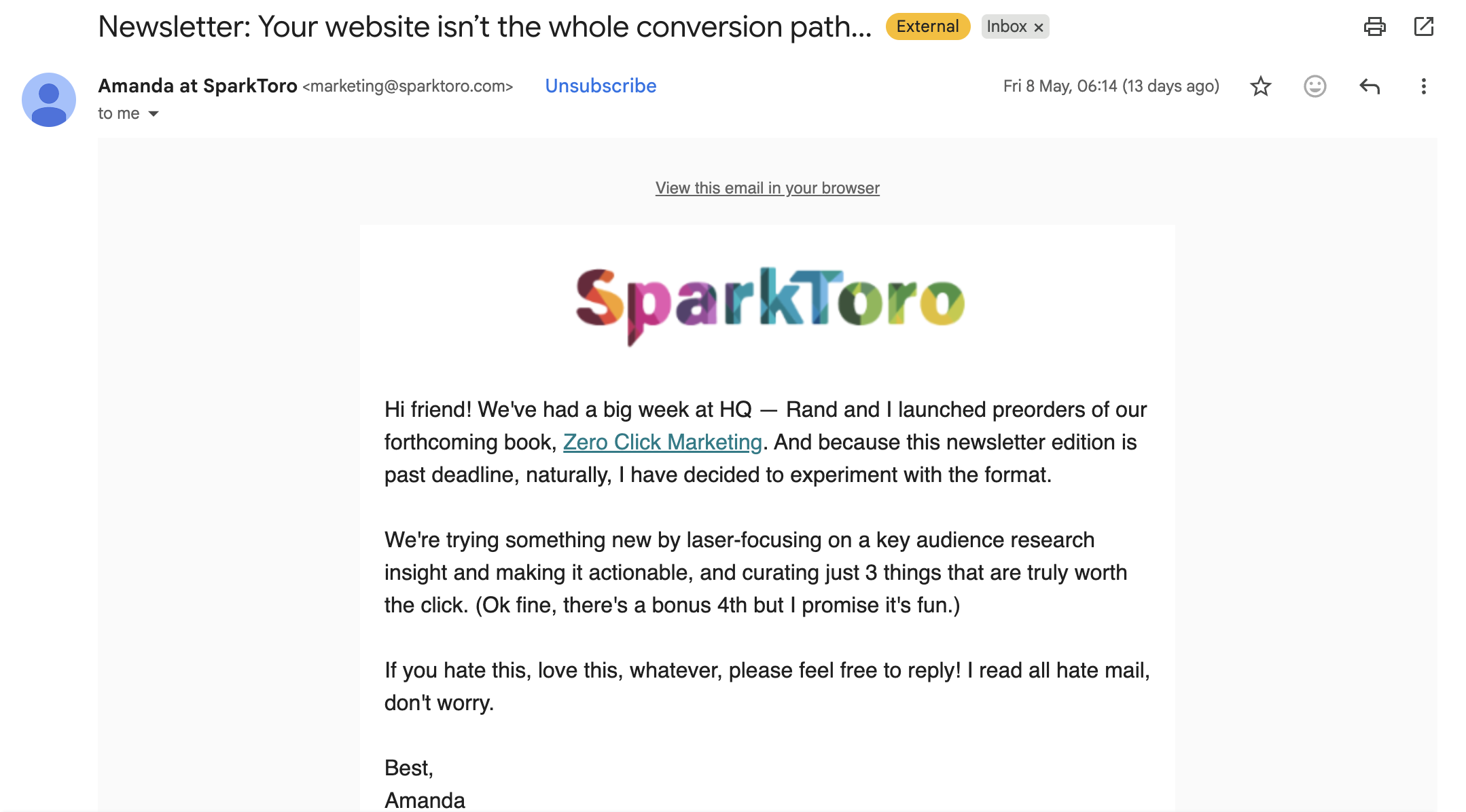
|
A regular email publication sent directly to subscribers. This is the most underrated channel in B2B because you own the relationship with every reader on the list. No algorithm sits between you and your audience. |
|
|
|
Case studies 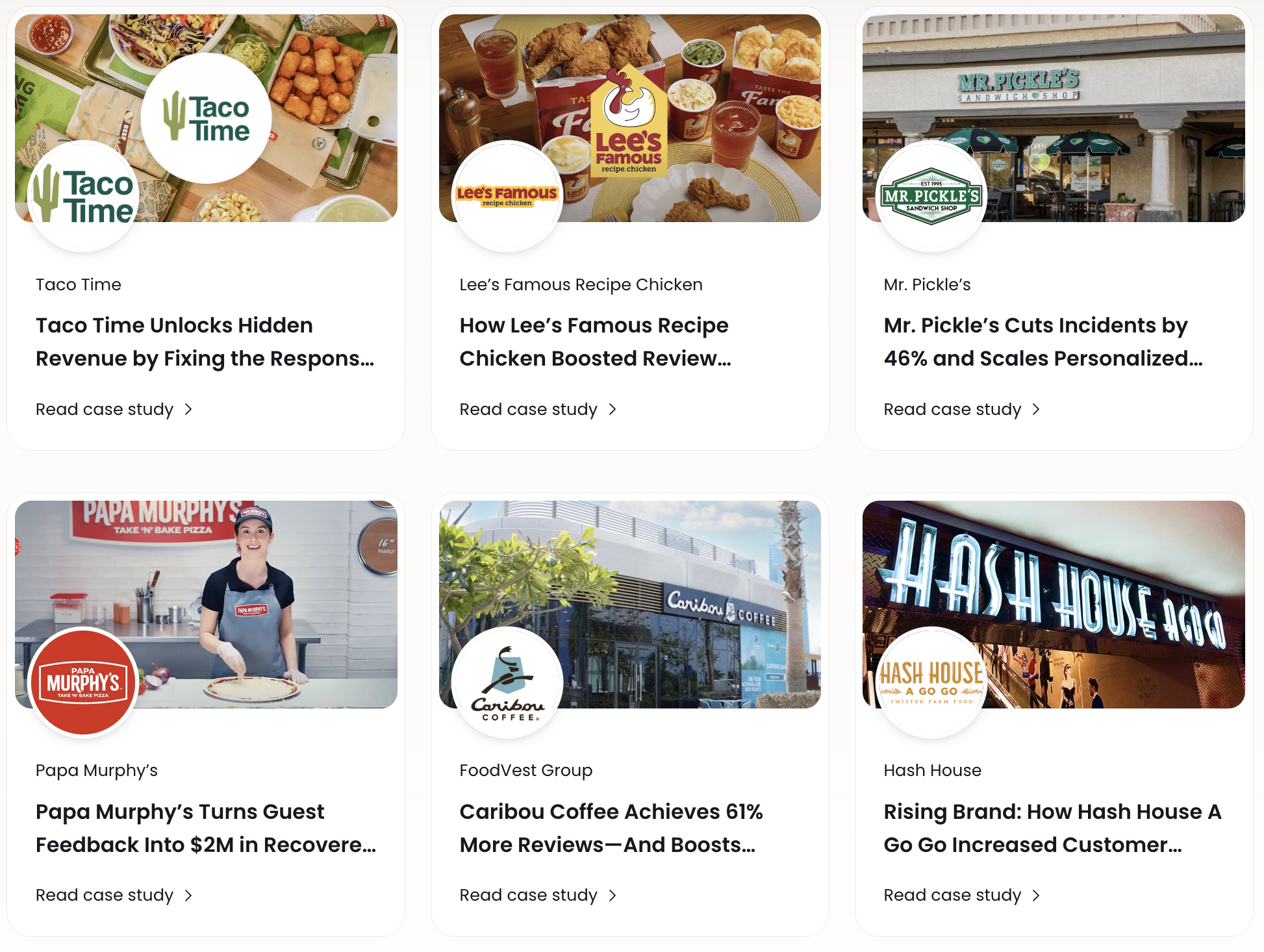
|
A documented account of how a real customer achieved a real outcome. When you’re trying to close a deal, this is often the asset that does the heaviest lifting because it shows past success. |
|
|
|
LinkedIn posts 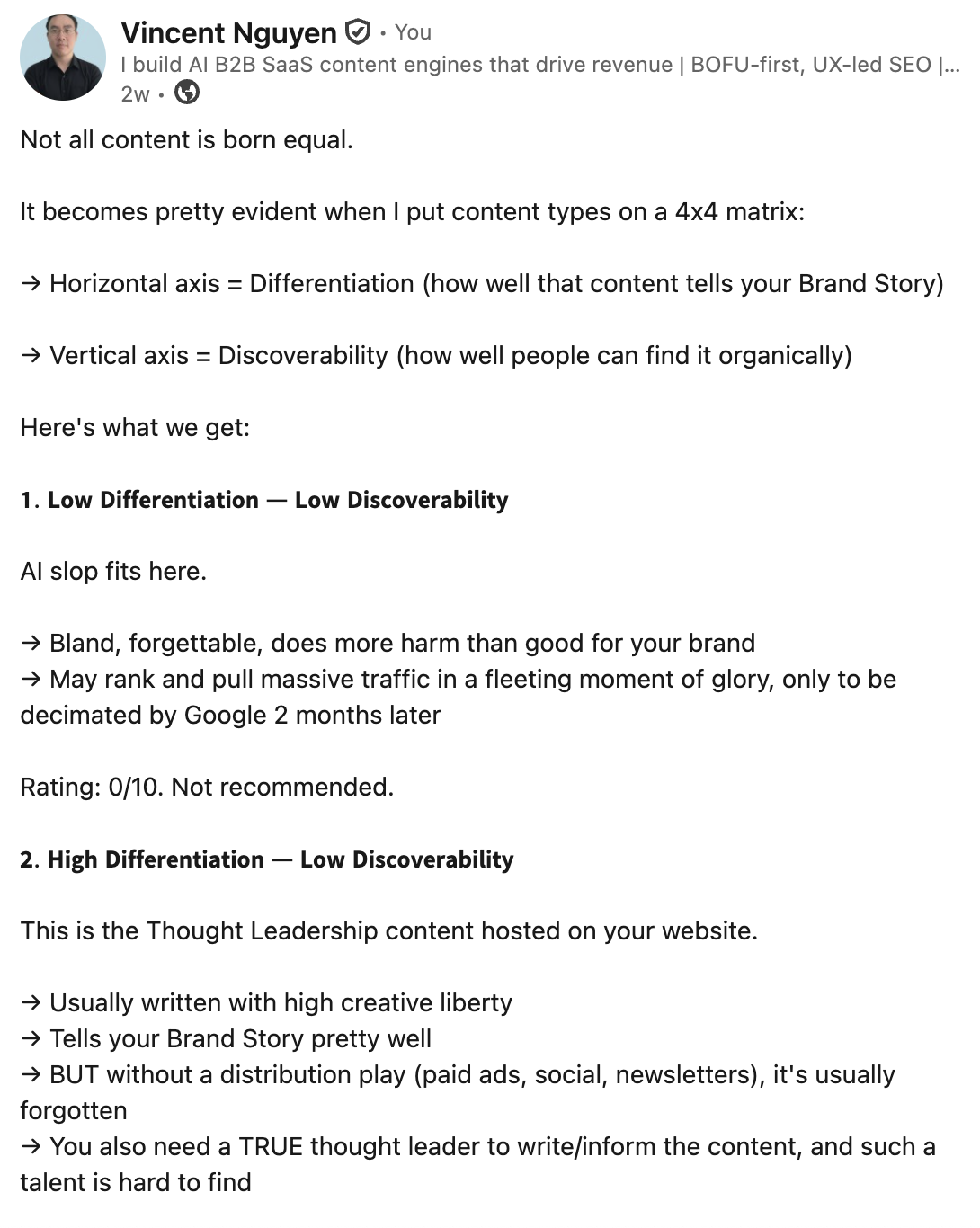
|
Short-form social content published on a personal profile. Right now, this is the highest-leverage organic channel in B2B. The algorithm rewards content from the right voice, which means a founder posting consistently can generate leads and build trust at the same time. |
|
|
|
Podcasts 
|
Audio episodes published on a regular schedule. A podcast is a slow burn, but the listeners who actually show up tend to trust you in a way no other format can match. |
|
|
|
YouTube videos 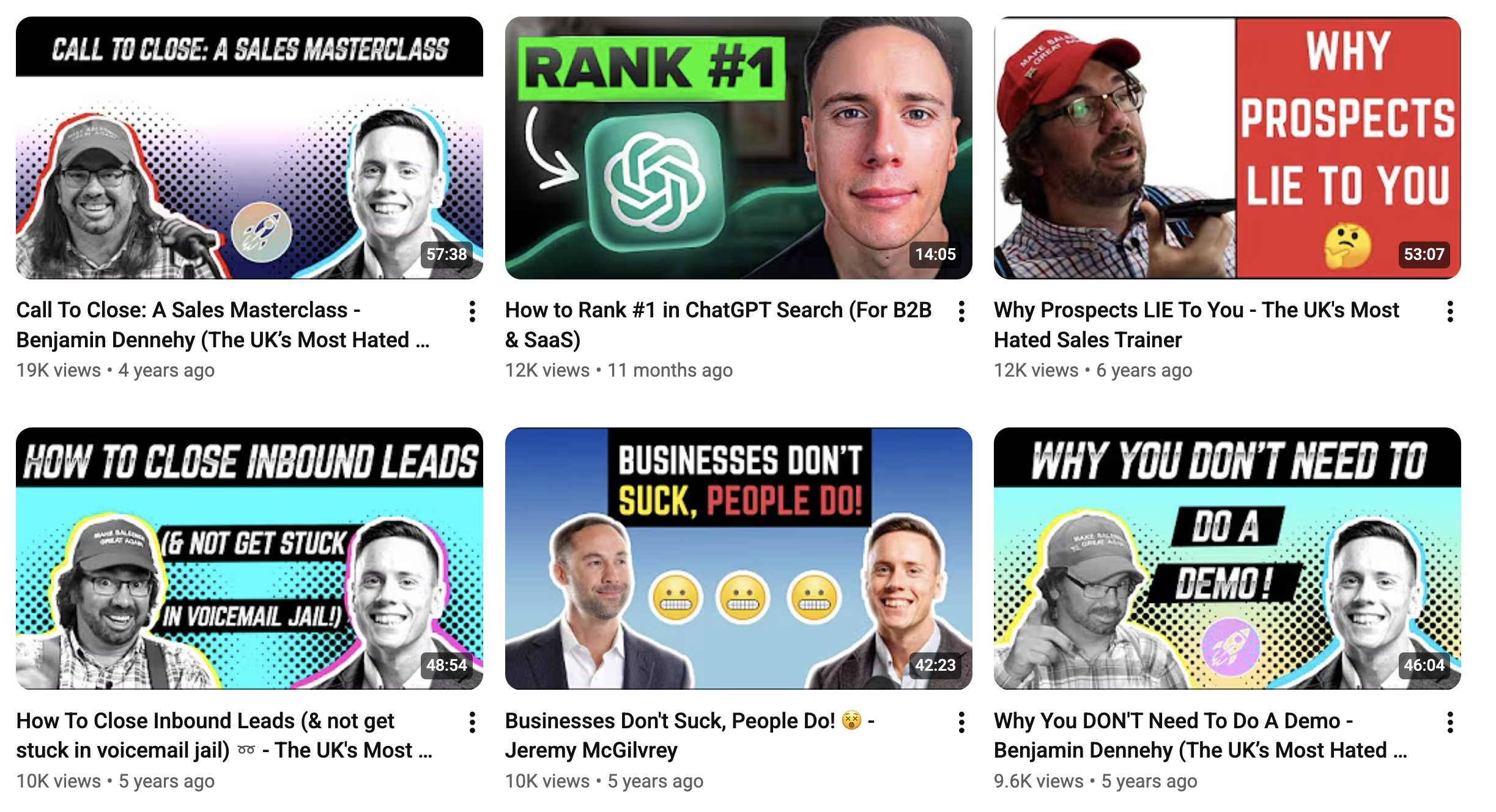
|
Long-form video content published on YouTube. The interesting thing about YouTube is that it’s both a social platform and a search engine, so the videos you publish today can still bring you viewers years from now. |
|
|
|
Lead magnets 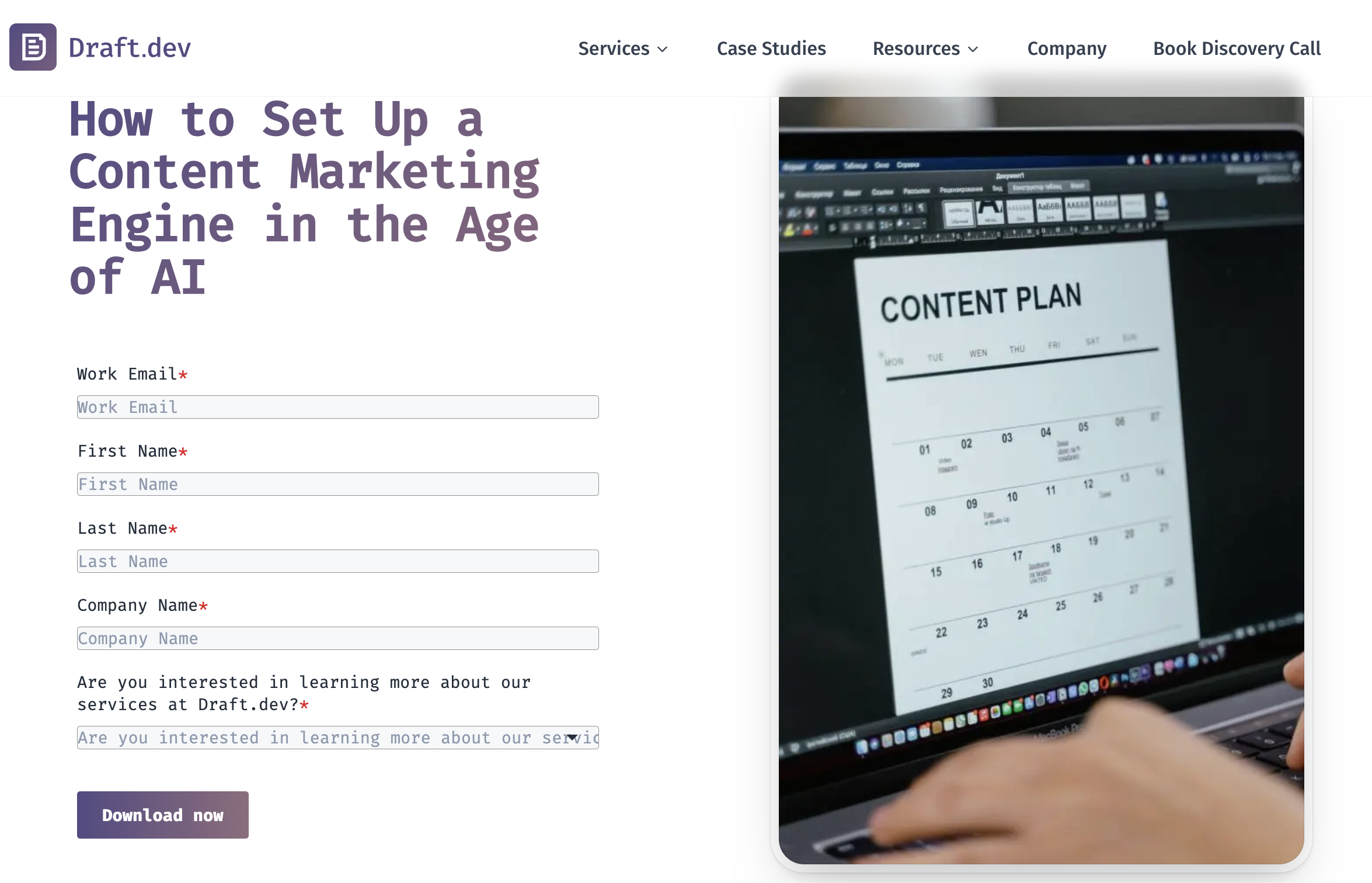
|
Downloadable assets like templates, calculators, frameworks, and guides offered in exchange for an email address. |
|
|
|
Comparison and listicle pages 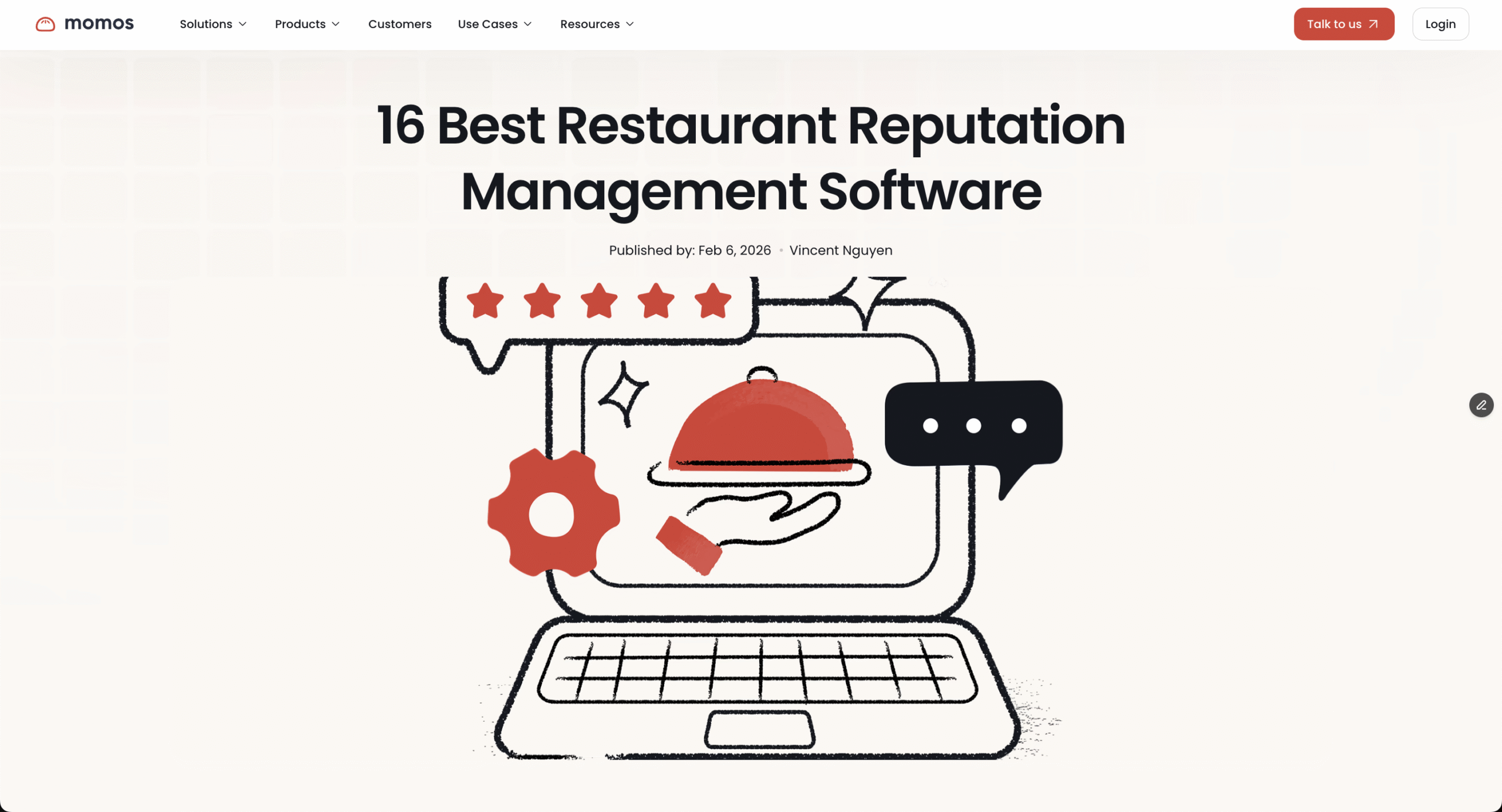
|
Pages built around bottom-funnel keywords like “best X tools” or “X vs Y.” This is some of the highest-intent traffic on the open web because the people searching are ready to buy. |
|
|
3 Steps To Crafting Your B2B Content Marketing Strategy
Here are the steps you should follow when crafting your B2B content marketing strategy:
Step 1. Define your ICP
If you don’t know who you’re writing for, how can your content resonate with them?
Before creating any content, make sure that you:
This Discovery Phase is essential for you to have a high-level overview over the product you’re about to create content for.
By the end of this step, you should be able to clearly define the brand identity in terms of:
- Who you are
- Where-to (you’re heading)
- How-to
- Why-so
For example, if you’re doing content for Zapier, here’s how you define the Brand Identity:
- Who: Zapier is a workflow automation platform for businesses and individuals.
- Where-to: Zapier helps them connect their apps and automate repetitive tasks so they can focus on the work that actually matters.
- How-to: Zapier does that by offering thousands of pre-built integrations and a no-code builder that lets anyone create automations without writing a single line of code.
- Why-so: Zapier does that because we believe that work should be about creativity and judgment, not copying data between tabs.
This will be the basis of every piece of content you create.
Step 2: Plan your Search-led content
Once you understand the product, it’s time to plan your SEO (search-led) content.
The success of your Search-led content strategy heavily depends on what keyword you picked.
There are three criteria I use to evaluate whether a keyword should be picked or not:
-
1
It must have commercial value
Commercial value means the person searching for that keyword is either evaluating a purchase or already in the market for a solution. Those keywords usually have structures like “best [X] software”, “best [X] tools”, or “best [X] services”.
-
2
It must map cleanly to your product features or use cases
The keyword has to connect naturally to something your product actually does. If you have to stretch the article to mention your product, that keyword is probably wrong for you. The best keywords are the ones where your product is a direct, obvious answer to the query. That alignment makes the content easier to write as well as more likely to convert because the person searching is already looking for what you built.
-
3
It must have decent volume
Volume is a proxy for demand, and demand is what makes ranking worth the effort. A keyword that nobody searches is a keyword that produces no pipeline. “Decent” volume doesn’t mean chasing the highest-traffic terms in your category. It means there are enough people searching every month to justify the investment. For most B2B companies, a keyword with 200 to 2,000 monthly searches and strong commercial intent is the sweet spot to go for.
This chart is the content performance data from one of our clients. As you can see, TOFU articles targeting informational keywords tend to bring tremendous amounts of traffic, but very little product trials.
On the other hand, BOFU articles targeting high-intent keywords with commercial value drive less traffic, but end up converting significantly more product trials, which means more pipeline and revenue.
That’s the power of choosing the right keywords.
If you have a keyword research tool like Ahrefs or SEMRush, here are what you should do:
- List out a few of your competitors
- Type those competitors into Ahrefs/SEMRush to reverse-engineer what keywords they are ranking for. Or you can also pick a seed keyword and use the tool to generate keywords that contain that seed.
- Pick the ones that satisfy the three criteria I laid out
- Rinse and repeat
For example, I’ll demonstrate to you how to do keyword research for a startup called Social Rails, a tool to automate content scheduling:
Immediately I come up with 4 major competitors:
- Hootsuite
- Buffer
- Sprout Social
- Social Pilot
- Postiz
I go to Ahrefs, type “Buffer” into the Site Explorer, and filter out all keywords that they are ranking for that contain the word “top/best” AND “tools”.
This should give me a list of all the high-intent keywords that Buffer is ranking for:
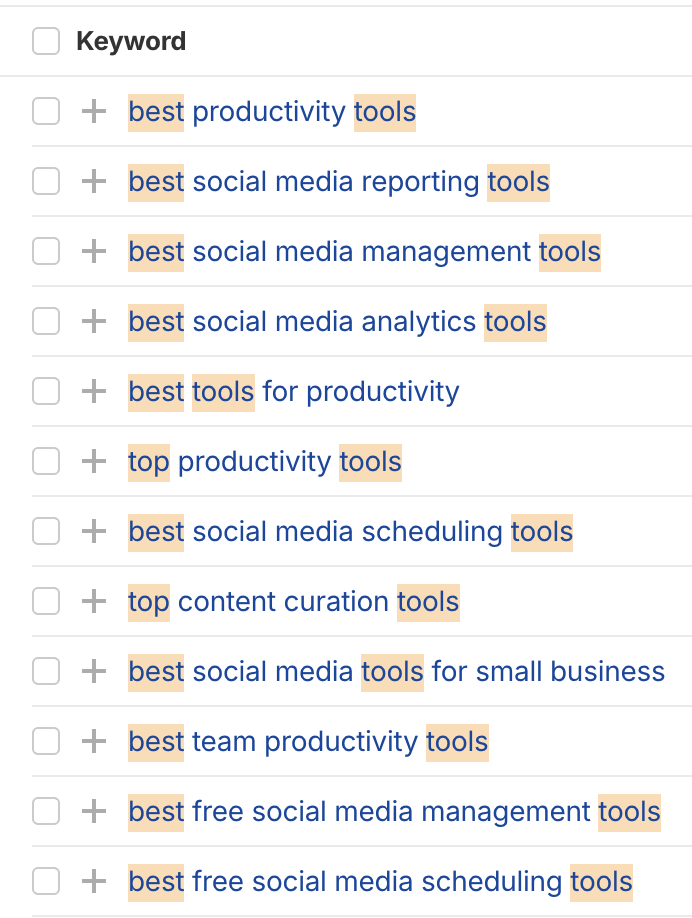
These are all keywords with incredibly strong commercial value. I only need to pick out the ones that best align with Social Rails’ features while also having decent search volume. After that, I create the absolute best content that answers the query better than every other competitors.
Step 3. Plan your Brand-led content
A B2B content marketing strategy would be incomplete without the Brand-led content.
Remember: Search-led content organically brings in new visitors, but you still need Brand-led content to nudge your readers toward the final conversion action.
There are around 4 types of brand-led content for B2B:
A short text post (150–300 words) delivering a single insight, contrarian take, or behind-the-scenes moment. Keeps the brand in-feed and gives the founder a daily voice in front of buyers.
A recurring email sent to a self-built subscriber list, typically weekly or biweekly. Owns the relationship with readers directly, free from platform algorithms, and compounds in value as the list grows.
A 30–90 second talking-head or product walkthrough clip. Drives stronger algorithmic reach than text and lets buyers see the team behind the brand before a sales call.
A structured slide deck used by the sales team in pitches, demos, and follow-ups. Codifies the brand’s positioning, proof points, and differentiation into a repeatable narrative buyers can re-share internally.
Exactly what type of brand-led content to create is unique to each company, but the process generally looks like this:
Pick a Thought Leader or someone with decent social media presence (usually the Founder)
Interview them to extract their POV and insights
Turn those insights into a content piece in one (or more) of the aforementioned formats
Post on a channel with natural distribution power (email newsletter with a following or a personal LinkedIn profile)
Establish a cadence to do this consistently over 90–120 days
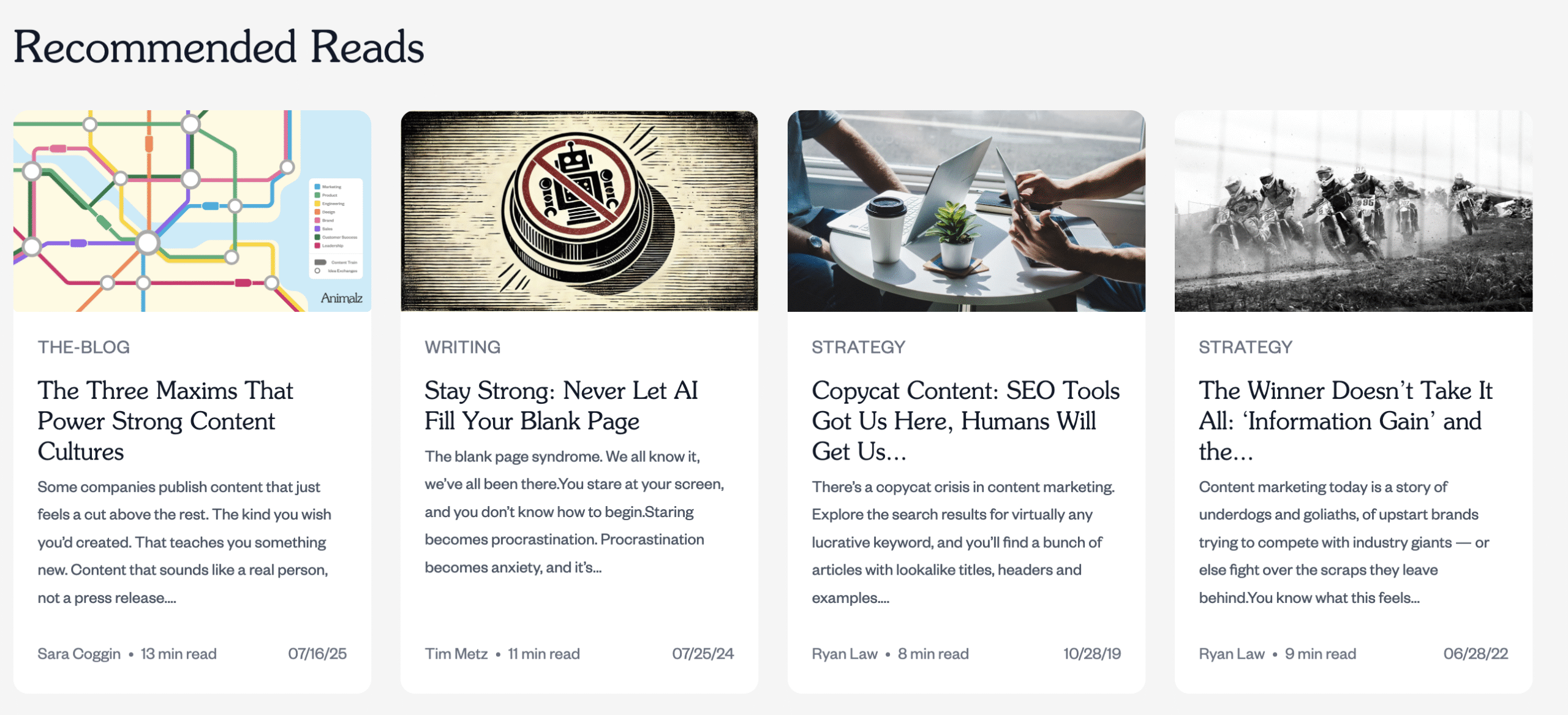
Here’s a good example of how Brand-led content looks like in the B2B SaaS content marketing niche. Animalz publishes a lot of articles on their approaches to content marketing, which immediately earns trust and establishes them as the thought leader in their niche:
What Makes Good Content In B2B?
When it comes to content marketing, engagement is KEY. You don’t want people landing on your page and bouncing.
In the best-case scenario, your content should have an emotional impact on your reader.
You want to make your reader feel excitement, desire, surprise, intrigue, etc. All of these feelings can help people build a bond with your brand, which can help with sales and lead generation.
From my perspective, there are four criteria for a good piece of content:
-
1
It delivers real value to the reader
Readers don’t have time for rambling. If it’s an SEO piece, the article needs to answer their question fast and in a digestible format. If it’s a thought leadership piece, it has to give them a perspective they can’t easily find elsewhere. When readers consistently walk away with something useful, they come back for more, share the piece, and spend more time on the page. Google notices that behavior, and your rankings reflect it.
-
2
It is engaging and interactive
Most SaaS articles are a wall of text with a few stock illustrations. If you want to stand out, you need to treat content as a product experience. I love embedding “interactive modules” wherever helpful, like a calculator that lets readers plug in their own numbers, a comparison table they can filter, a diagram they can step through. Interactivity does two things at once: it deepens understanding, because readers learn by doing instead of just reading, and it signals a level of expertise, because let’s be honest it’s not easy to build those modules. A reader who interacts with your article remembers your brand longer than one who skims it.
-
3
It is tied closely to business value
Good content isn’t measured by traffic or word count. It’s measured by whether it moves the business forward. When you can draw a straight line from an article to MQLs, demos booked, or deals closed, content becomes a growth lever. Without that line, even well-written content is just noise.
-
4
It carries a recognizable point of view
The fastest way to be ignored is to sound like every other blog in your category. Good content takes a position. It tells the reader what the author actually thinks. That doesn’t mean being contrarian for the sake of it though. It means having enough conviction to say “this approach is wrong” or “most teams get this wrong, and here’s why”.
Top 3 B2B content marketing ideas to inspire you
1. Ahrefs
Ahrefs is THE authority on content marketing. They publish world-class data-backed pieces that position them as the true thought leader in the industry.
Here’s why Ahrefs wins:
- They follow the Knowledge-Narrative approach (mixing SEO-driven content that brings in consistent traffic with thought leadership pieces that positions themselves as the true leader in the field).
- 100% in-house production, written by experts in content marketing
- Tactical, search-optimized tutorials with advanced use cases
- Every article is tied to a pain point their product solves
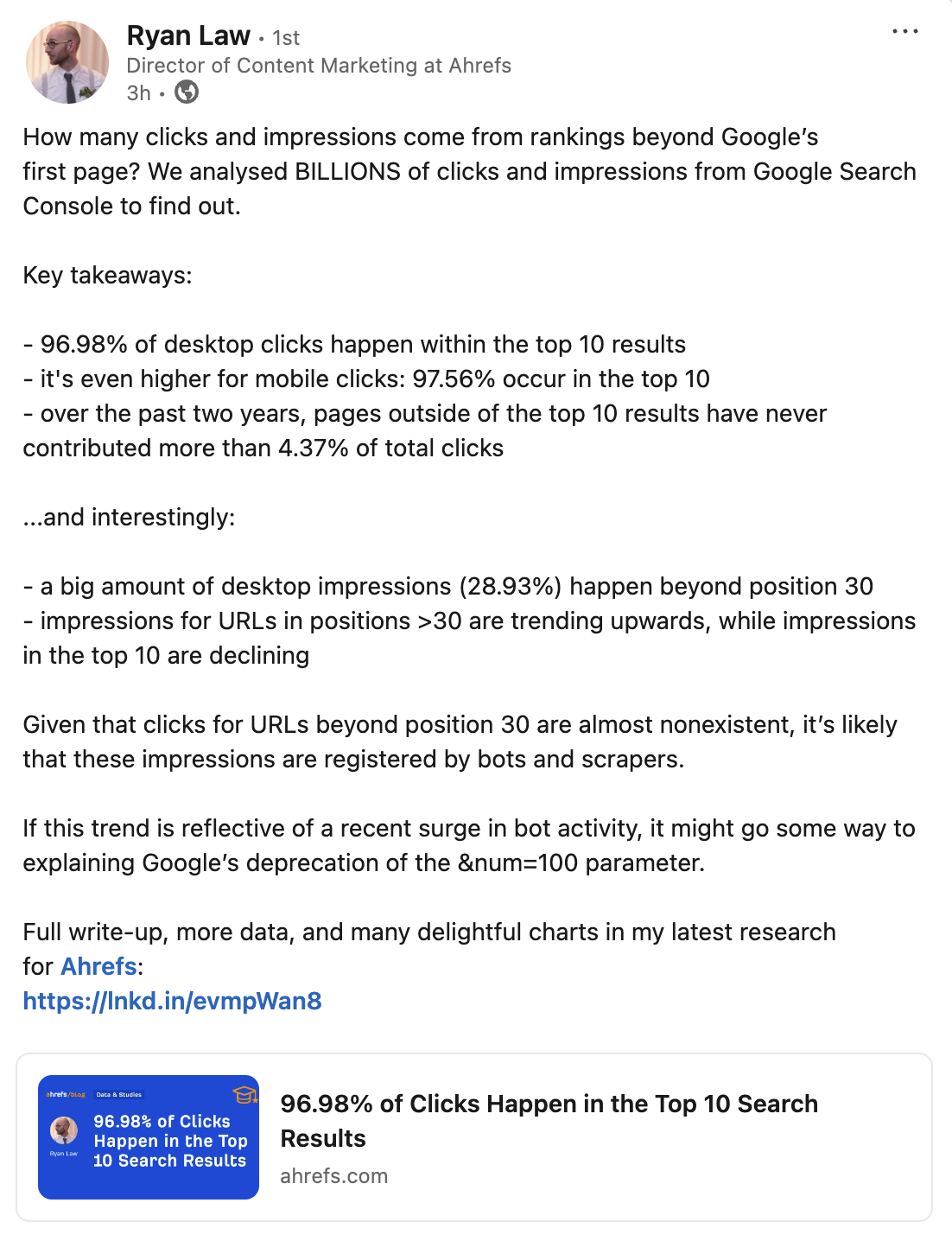
- Their writers are really active on LinkedIn, continuously engaging and sharing their articles and ideas, which earns extra attention to the website. Stuff like this:
2. Wise
Wise is a cross-border payments platform in the fintech space, best known for offering fast, low-cost international money transfers. It’s used by individuals and businesses alike to send and receive money globally, often as an alternative to traditional banks.
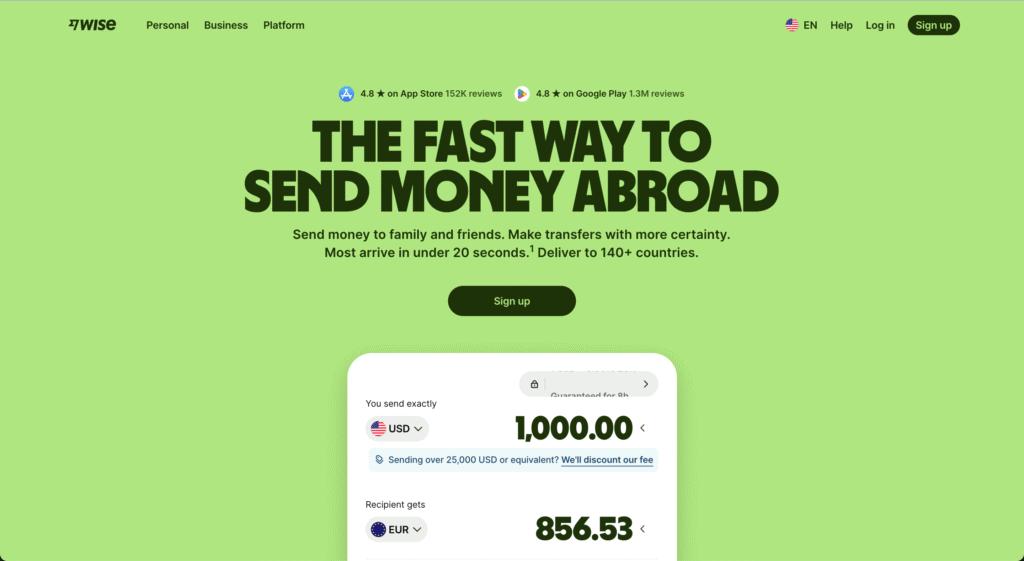
Wise has a really fascinating B2B content marketing strategy: they publish helpful articles that explain how to open or close accounts with their competitors.
Here are a few real examples from their blog:
- How to close your UBank account?
- How to open a bank account with Westpac?
- How to open a Chase bank account?
Why does this work? Let’s take a closer look at the psychology here. Someone Googling “how to close a UBank account” is likely done with UBank. They’re actively searching for a change, perhaps even evaluating alternatives. That puts them at the bottom of the funnel, primed to switch.
By creating content around this intent, Wise does two things at once:
- Owns the search intent: Instead of letting competitors or third-party forums rank for those terms, they capture the traffic directly.
- Inserts themselves into the conversation: Without being pushy, Wise gets to say, “Here’s how to close that account, and by the way, here’s what we offer.” It’s educational first, persuasive second.
Even when someone is looking to open an account with a competing bank, if they’re reading that guide on Wise’s site, Wise controls the environment and narrative.
3. Gong
Gong has mastered content marketing with a well-balanced mix of formats and topics. Each piece of content is also carefully tailored to resonate with distinct audience segments.
For example, as you arrive at the Gong Revenue AI blog, you can choose to read blogs by Blog Type, Role/Persona, and Topic.
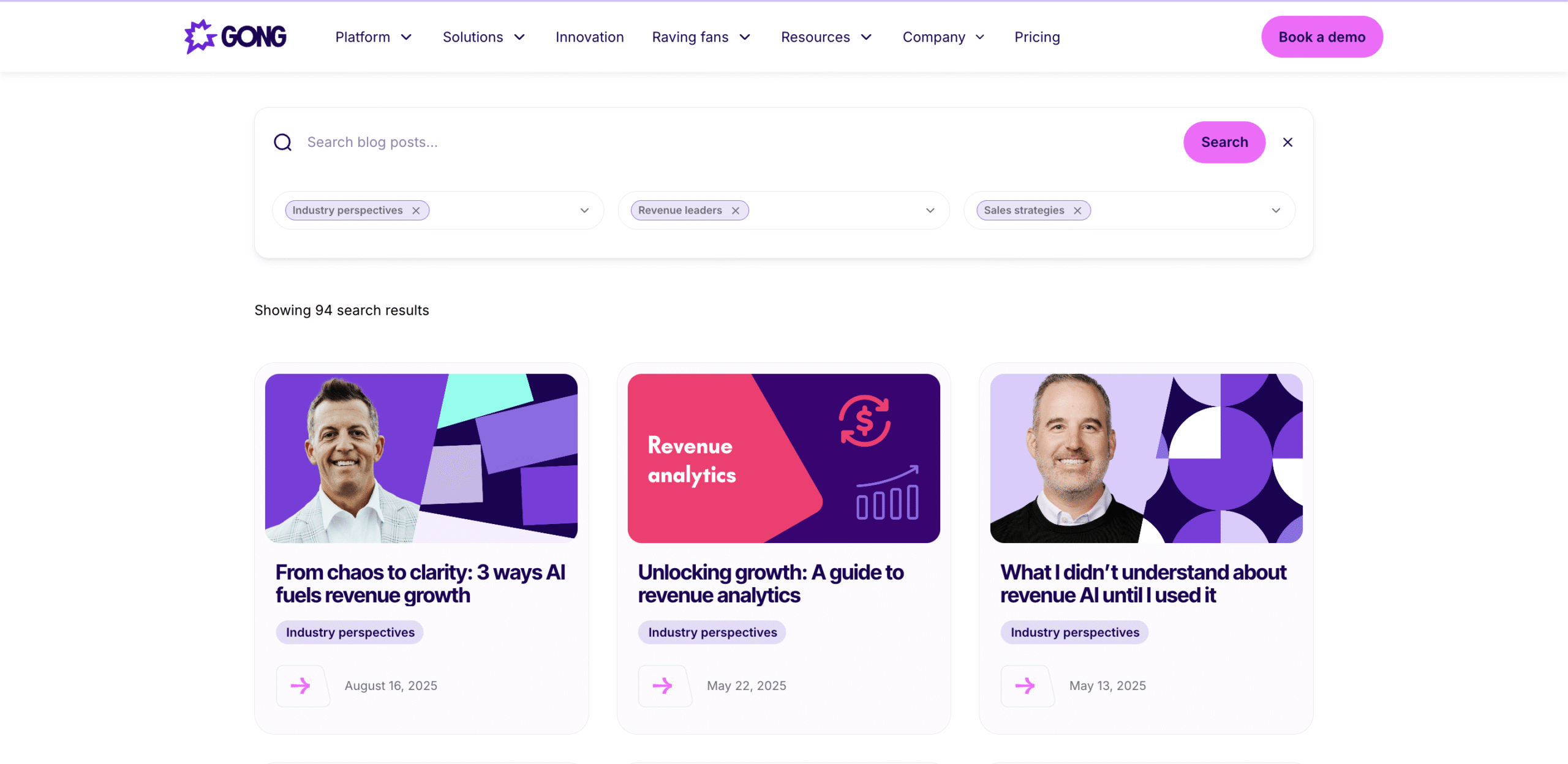
Gong also covers a wide range of B2B content formats, from reports, content with proprietary data, SME-led expert insights, and SEO-driven content. They definitely know how to turn content into their competitive advantage.
Conclusion
B2B content marketing is ultimately all about earning trust from intelligent, skeptical buyers who don’t make decisions lightly. The strategies that work in B2B tech are the ones that respect how people consume content:
- Content that solves real problems.
- Social strategies built on human connection and technical credibility.
- Performance marketing that builds up on thought leadership.
- Newsletters that build habits.
- Communities that foster collaboration
Of course, each niche of B2B requires a slightly different approach, but the general principles stay the same. My personal principles when doing B2B marketing, no matter what industry, is:
- Give them value first, and as much as possible
- Be original
- Showcase your expertise
If you’ve read so far, thank you! I hope that you’ve gained new insights from this article. If you find it helpful, don’t forget to share it to a wider audience.
See you in the next awesome article. Much love, peace out, and cheers to better B2B content marketing!