
According to Wynter’s State of B2B SaaS Brand Marketing report, 92% of B2B buyers only purchase from the vendors already on their Day-1 shortlist.
That means by the time a prospect books a demo, they already have several “final options” in their mind. In fact, customers do 60+% of research before ever talking to the company. Being on the short list to be considered is already half the battle.
That’s why I’m sharing what I’ve learned over the past 10+ years growing B2B SaaS brands so you can appear on that Day-1 list more proactively.
What is B2B SaaS Marketing?
B2B SaaS marketing is the marketing strategies used by businesses that sell software solutions to other businesses rather than individual consumers.
In this model, the product is a cloud-based software platform delivered over the internet, not a physical item.
“B2B” stands for business to business, and “SaaS” stands for software as a service. Together, they describe companies that develop and distribute cloud-hosted software for use by other companies.
With that in mind, B2B SaaS digital marketing involves positioning your software in front of the right decision-makers.
Differences between doing marketing for B2B vs B2C SaaS
The general sentiment in the SaaS world is that B2B SaaS is where the real money is at, not B2C SaaS, and they’re not wrong.
According to Dealroom, 88% of SaaS investment goes into B2B, while only 12% goes into B2C.
Here’s why B2B SaaS is more attractive to investors:
- In B2B, value is measurable. If your product boosts productivity by 20% or saves a company $50k, you can price your offering just below that saved amount, and still be seen as a bargain.
- B2C users expect free or low-cost apps, and they’re very budget-sensitive. They’re likely to see a $10 subscription as unnecessary, while for B2B a $1,000 monthly subscription is nothing if it brings them $10,000 in revenue.
- Even many B2C apps generate revenue by selling access to businesses, not from individual consumers. The front-end may be consumer-facing, but the model behind it is B2B.
- B2C CAC is lower per user (a few dollars), but requires mass adoption and high retention. In contrast, B2B CAC is higher upfront, but one contract can justify the entire expense and lead to long-term revenue.
That’s why B2B SaaS is such a lucrative field. However, doing B2B SaaS marketing requires very different strategies, which I’m going to share below.
1. Ensure your website is awesome
Your website is your headquarters. In the B2B SaaS space, where you don’t have a storefront or physical touchpoint, it’s the one asset that’s always working 24/7.
But, of course, with tens of thousands of SaaS companies competing for attention, just having a site isn’t enough. You need one that performs.
Before chasing growth tactics or paid channels, invest in the foundation: a high-performing website built for usability, scalability, and search visibility. A solid technical structure paired with on-page SEO makes future improvements faster and cheaper.
Need a gold mine of web‑design inspiration for SaaS brands? Check out SaaS Landing Page, it’s a curated gallery of landing page examples from top SaaS companies. For example, here is the homepage of Peec AI, one of the rising AI search analytics tools that I’ve explored recently.
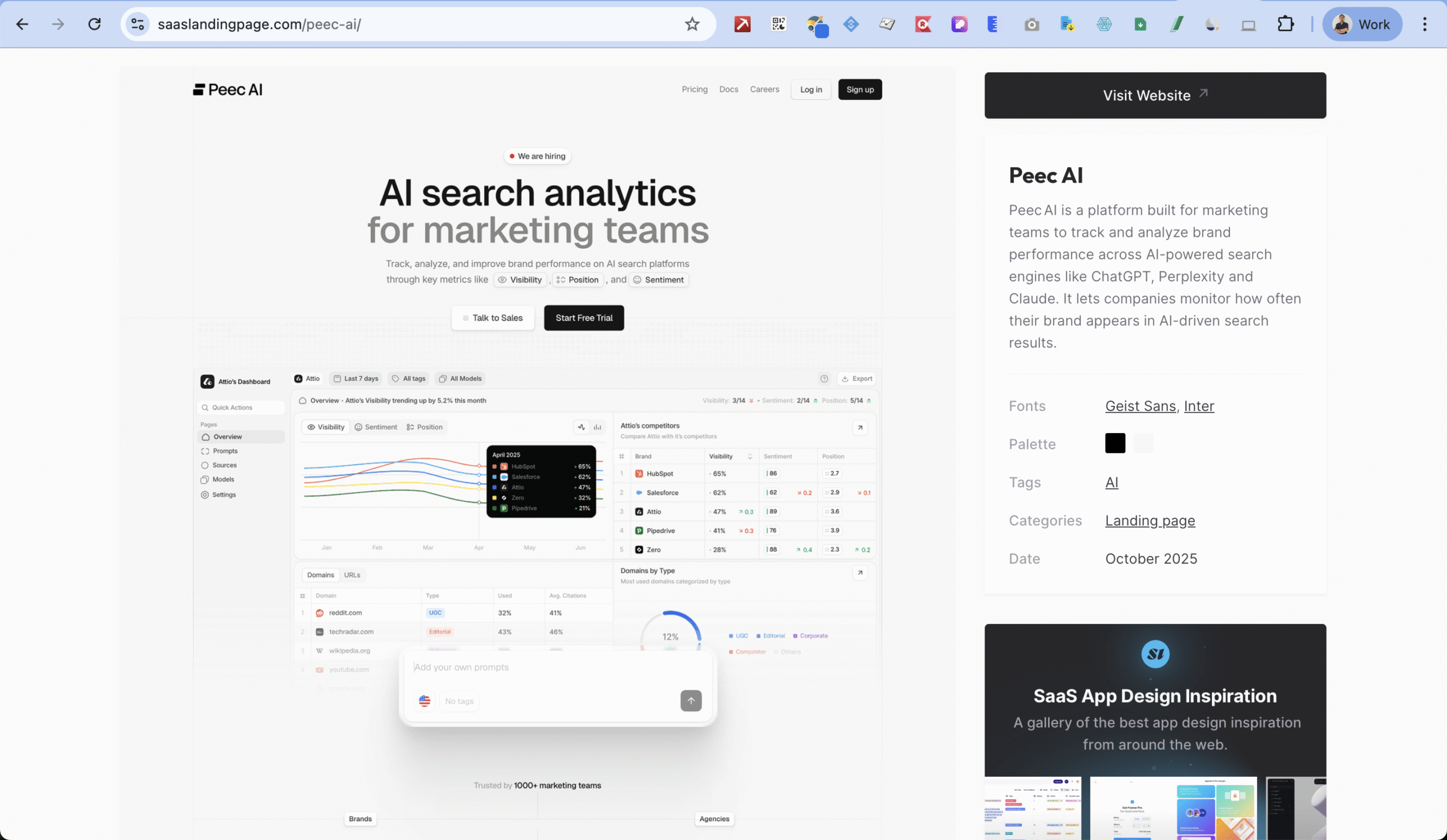
Browsing through saaslandingpage is genuinely fun. You get inspiration for your own website, you can reverse-engineering how other SaaS websites are optimizing for conversion, and you get an idea of the “industry best practices”.
As you design your site, carve out space for a blog or resource hub. It’s the simplest way to create a content engine that drives traffic, educates visitors, and builds long-term authority.
Explore further: 12 Examples of Good B2B Website Designs To Inspire You
2. Invest in expert-led, high-quality content
There are 3 reasons why content marketing is still the number one strategy for B2B SaaS:
- B2B is the arena for high-stakes content: unlike B2C, where purchasing is often emotional, B2B buying is logical and high-risk. You’re not selling a soda, you’re pitching a six-figure solution that multiple stakeholders must justify. You have to solve the problems your buyers are actively researching because they’re reading content to make a business case.
- Content is your strongest brand differentiator: In saturated B2B markets, your product may not be wildly unique, but your perspective can. If you’re saying what everyone else is saying, you’ll disappear. Instead, treat content is your competitive advantage by sharing opinionated, sharp, and useful short-form articles that leave an impression.
- Content is the foundation for SEO: Yes, SEO compounds. Done well, it builds an organic moat that competitors can’t easily replicate. However, you shouldn’t also chase keywords for the sake of it. After all, Google doesn’t buy your product, humans do. You must balance it with thought leadership, original frameworks, and user-driven insights.
Here are some more stats from Content Marketing Institute to even further justify your investment into content marketing for B2B SaaS:
- Content marketing generates 3x more leads per dollar compared to paid search (and keeps working long after you stop spending)
- Content costs 62% less and brings in more leads than outbound methods like cold calls or ads.
- Blogs influence purchase decisions. 61% of U.S. consumers bought something after reading a blog recommendation.
Further reading: A guide to B2B content marketing
3. Invest in SEO, the right way
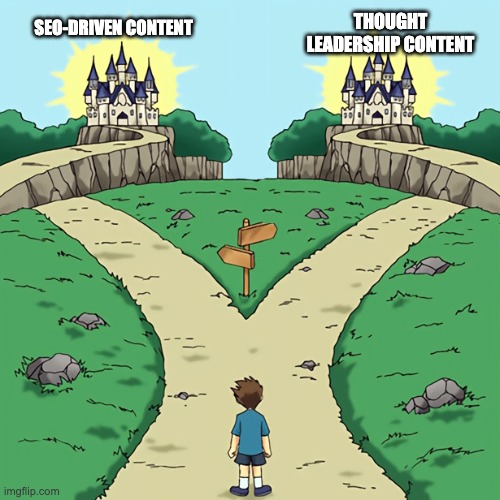
If you do content marketing in B2B SaaS, you’d probably notice this fascinating dilemma:
- SEO content is optimized for the search engine, but the confines of keywords and SEO guidelines can make it difficult for the brand to freely express its perspective on the topic and stand out among the crowd.
- Thought leadership content gives more space for brand building and expressing opinions, but since it’s not optimized for a specific keyword, such articles can easily get drown in the endless sea of content. However, thought leadership is exactly the kind of content that builds trust with prospects.
That’s why B2B SaaS brands need a best-of-both-worlds approach.
Here’s my process of doing SEO for B2B SaaS companies, especially in high tech fields:
- Extract the expertise: The target audience of most B2B SaaS companies is made up of leaders and people who know their craft. The biggest challenge of SEO content is that it is outsourced to experts who don’t really understand the nuances of the field. You need to sit with SMEs who know the field in-and-out to devise a proper SEO & content strategy.
- Do keyword research: Once you have listed down what pain points and insights from experts, start doing keyword research with your favorite keyword research tool. Mine are SEMRush, Google, and Reddit. Yes, Reddit is actually a great tool for keyword research in B2B SEO.
- Focus on BOFU: If your SEO strategy only targets broad “what is X” or “how to use Y” searches, you’re just attracting beginner-level people without cashing in. BOFU content is where the real money lives. These are the keywords people type when they’re ready to buy, such as “best [tool] alternatives,” “[competitor] vs [your brand],” or “[solution] pricing.” Your job is to show up right there, at the decision moment. Be honest, compare fairly, and make it easy for them to say, “Yep, this is the one.” BOFU content doesn’t need to be sexy, it just needs to convert.
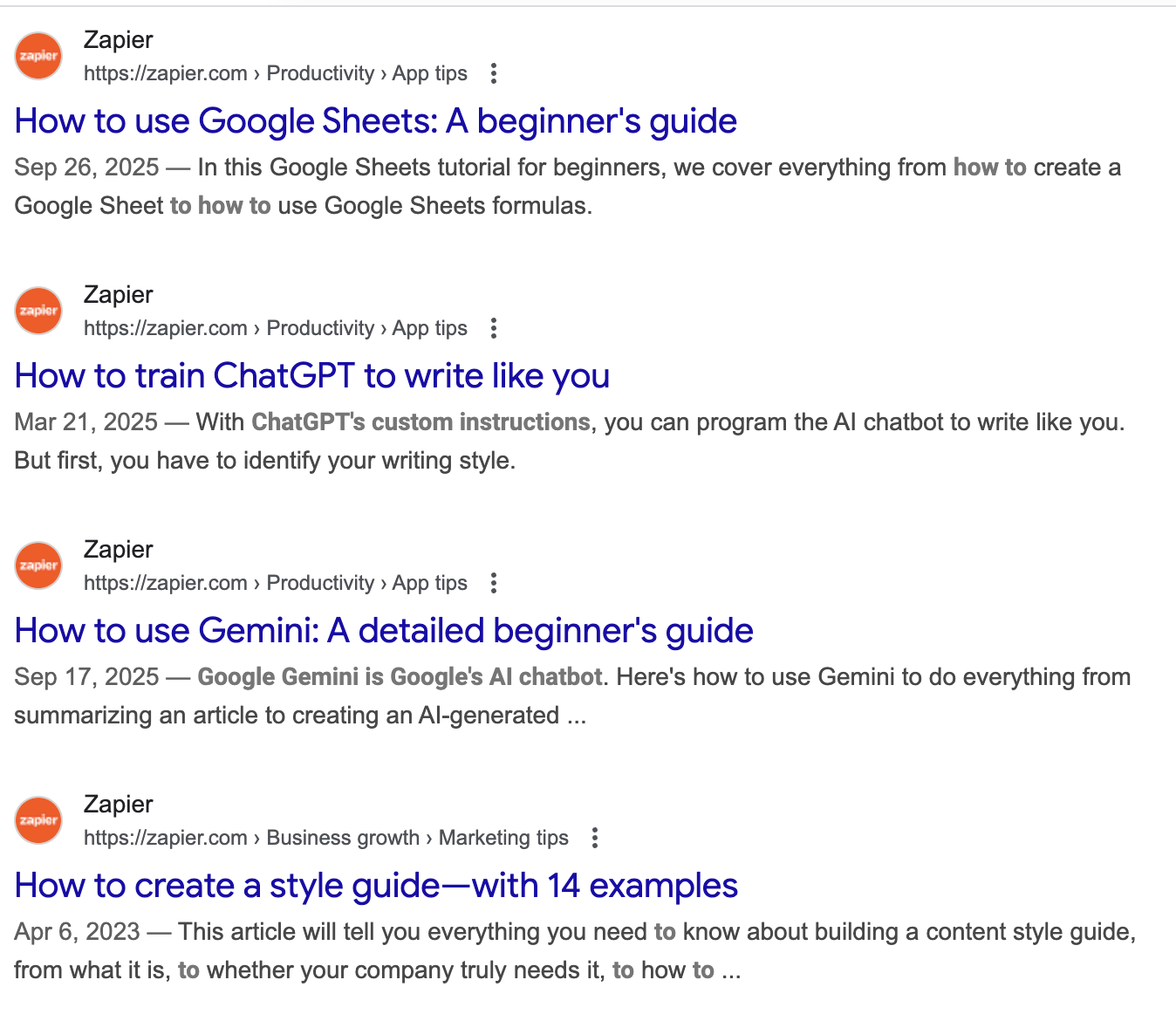
- Focus on JTBD keywords: Now, once you’ve got the BOFU stuff handled, it’s time to go one layer deeper: the Job-To-Be-Done (JTBD) level. This is where you stop chasing keywords like “project management software” and start answering how people use it to get actual work done. Think “how to automate onboarding workflows” or “how to track team productivity with X.” Brands like Zapier absolutely dominate this space.
Further reading: My approach to B2B SaaS SEO
4. Invest in thought leadership content
Once you’re done with SEO content, it’s time to move to thought leadership content.
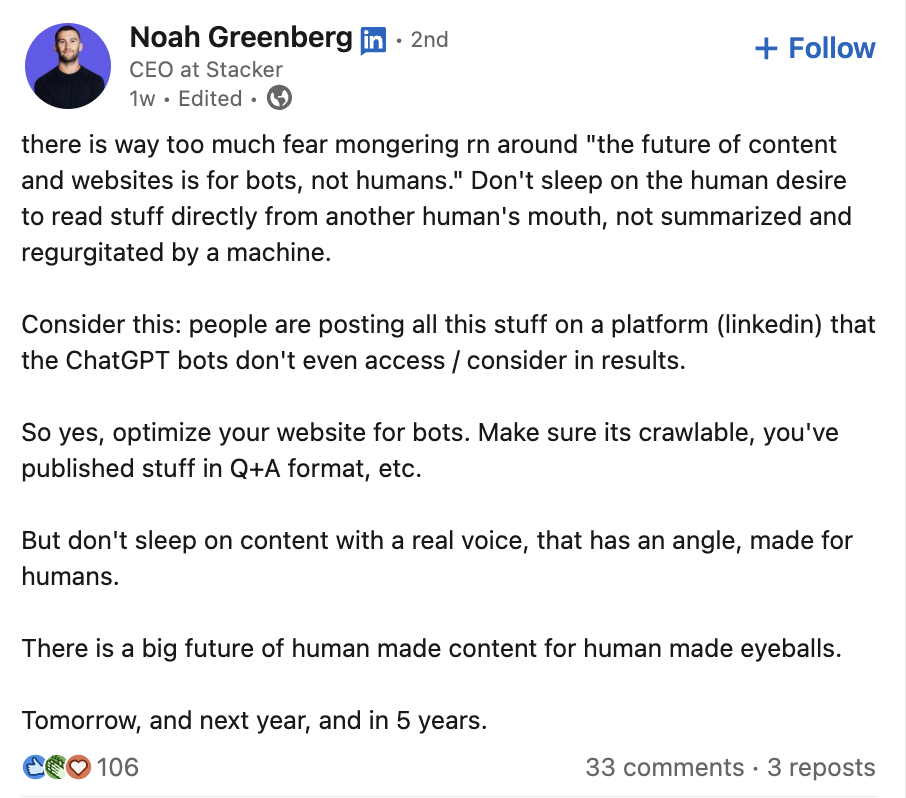
You’re no longer just answering questions people are asking; you’re planting ideas they haven’t even considered yet. Or maybe you’re just expressing an opinion about the state of things, like what Noah Greenberg from Stacker is saying in this LinkedIn post:
Thought leadership is the Narrative part of my Knowledge-Narrative content strategy:
| Aspect | Knowledge (SEO-driven Content) | Narrative (Thought Leadership) |
|---|---|---|
| Purpose | Builds visibility and captures demand through search traffic. | Shapes perception and creates new demand through ideas. |
| Focus | Answers what people are already searching for. | Introduces what people should start thinking about. |
| Tone | Educational, practical, keyword-aligned. | Opinionated, visionary, and story-driven. |
| Formats | Blog posts, guides, tutorials, comparison pages. | Essays, LinkedIn posts, industry reports, founder letters. |
| Goal | Drive qualified traffic and leads. | Build authority and long-term brand trust. |
Here’s my process to create thought leadership content:
- Define the story: content marketing, at its very core, is brand building. What does your brand believe in? What frustrates you about the industry? What hill are you willing to die on? That belief becomes your north star, so that everything else, from posts, talks, to essays, should reinforce that stance.
- Extract the experience: just like SEO content, the best thought leadership should also be built from scars of people who have “walked the walk”. Talk to your founders, execs, product leads to pull real stories from them. These moments show you understand the reality behind the theory, and that’s what makes people trust you.
- Distribute where your audience already hangs out: don’t hide your best thinking on a forgotten blog page. Take it to where your audience lives: LinkedIn, podcasts, industry newsletters, even Slack communities. Turn one insight into multiple formats: a post, a short video, a quote graphic, a slide. Distribution is the strategy when it comes to thought leadership since it doesn’t have innate organic discoverability like SEO content. Or you can just place a thought leadership article on a high-traffic SEO article, like this:
Need a good thought leadership agency? Here are some good Thought Leadership Content Agencies For B2B SaaS
5. Offer a free trial/freemium model
We’re venturing more into growth marketing strategies, but yes, one of the best ways to get a paying customer is to give them a free experience of your product. It’s the product-led growth motion. You can learn more about Product Led Growth from the Product Led blog.
Nearly 25% of free trial users end up converting to paid plans. Compared to other strategies, this one is incredibly low-cost and carries little risk to your bottom line.
You’ve got two main paths:
- Free trial: Ideal for complex products. The longer the learning curve, the longer the trial should be.
- Freemium model: Offer a limited set of core features at no cost to hook users early.
Both approaches give users a chance to experience real value without spending a dime. It’s your opportunity to show them how your product genuinely solves their problems.
6. Implement product-led content
With a freemium model, you unlock the potential for product-led content.
According to the Product Led blog themselves, there’s no one-size-fits-all definition of product-led content, and that’s a good thing. Each SaaS company needs to define what product-led content means in the context of their product, audience, and go-to-market motion.
But while your exact execution may vary, one thing should never change: product-led content is always about experience + value.
You can design your content to match the user journey inside your product with stages like:
- Discover – Help users recognize the value of solving the problem
- Try – Show them how to take action with your product
- Use – Deepen their understanding of key features
- Expand – Introduce new use cases and advanced capabilities
There should also be a consistent flow: every piece of content to move the user forward. Link blog posts to tutorials. Embed product tours in onboarding emails. Add CTAs that lead to the next best action. Create a seamless, guided path from first touch to product activation.
7. Network at events and conferences
Traditionally, trade shows and conferences have consistently been the number one channel for B2B lead generation. Although digital channels have risen in popularity, events still bring home big deals.
Make sure to match event format with your objectives:
| Objective | Best Format | Target Personas |
|---|---|---|
| Product demo / solution walk-through | Classroom-style workshop, private suite, or in-booth live session | Mid-level technical decision-makers, IT managers, product owners |
| Thought leadership / strategic framing | C-level roundtable (8–12 execs max) | CXOs, VPs, Directors |
| Brand awareness / buzz | Large expos, panel speaking slots | Broad industry audience, marketing and sales teams |
Events are highly relationship-driven, so whether you’re on stage, moderating a panel, or hosting a dinner, show up with intention:
- Get a panel slot with a smart but punchy POV.
- Offer interactive tools or short experiences (e.g., benchmark calculators).
- Show just one slick use case with a live demo, don’t showcase the whole product.
8. Partner with niche influencers
No matter your niche, there are likely influential voices and content creators already shaping the conversation.
They might not have the follower counts of TikTok beauty stars, but they’re showing up where it counts: in the feeds of your potential customers.
For example, I used to work in automation testing, and everyone in the niche knows about Joe Colantonio, a really cool guy who hosts the Test Guild Automation podcast. He’s very popular in the QA circles, but you need to be in the field to know about him. Outside of this circle, he’s just another (cool) guy.

Connect with those micro-influencers to explore potential partnerships, but keep in mind that it may involve compensation or offering free access to your product.
9. Start a newsletter
Since you’re targeting B2B decision makers, there’s only one channel that remains consistently reliable: email. Your buyers live in their inbox. They check it constantly. And unlike social feeds, an email is a quiet, focused space with no algorithm and no noise.
Showing up in their email inboxes is a great way you earn their attention.
But instead of leaning on cold emails (which can work, but are increasingly ignored), build a newsletter that earns attention is a better approach.
Your newsletter should do these five things well:
- Cut through the noise: Summarize what matters. Save your reader’s time.
- Establish authority: Become the trusted guide who filters the signal from the noise.
- Create consistent touchpoints: Regular content keeps your brand present without being pushy.
- Weave in your product naturally: Mention your product when it fits the context. Value first. Pitch second.
- Build insider status: Make subscribers feel like they have an edge just by being on your list.
When all five hit? Your newsletter becomes a ritual. Like a morning coffee, but smarter.
Some of the best newsletter platforms I can think of:
- beehiiv: sleek UI, strong analytics, great for growth-focused creators.
- MailerLite: affordable, intuitive, solid automation.
- Kit: designed for commerce-focused newsletters.
- Flodesk: beautiful design templates, simple UX.
- Substack: great for thought leadership and community-building, and it’s gaining a lot of traction recently
- HubSpot: If you already use it, the built-in newsletter tool ties directly into your CRM and analytics stack.
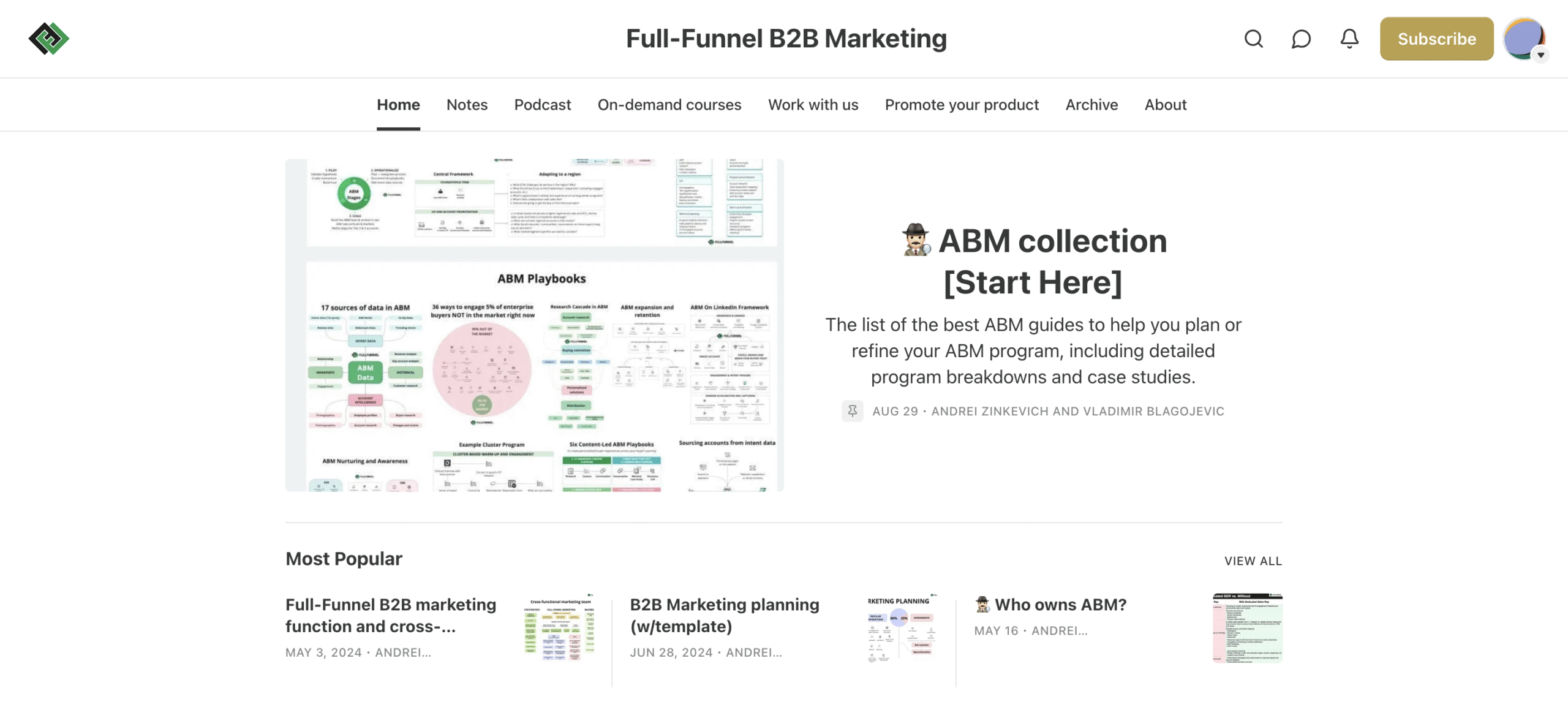
If you want some extra good resources on B2B Marketing (besides this blog ;)) then you can check out Full-funnel B2B Marketing by Andrei Zinkevich and Vladimir Blagojevic on Substack. You can learn a lot about how they do email marketing there too.
Here’s how to grow an awesome newsletter:
- SEO: Add newsletter sign-up CTAs to your best-performing blog posts to convert engaged readers into subscribers, which increases return visits and gives Google the engagement signals it needs to boost your rankings.
- Referrals: Use built-in referral tools in platforms like beehiiv or Substack to reward subscribers who bring in new readers, creating a self-reinforcing growth loop.
- Social Media: Share highlights from your newsletter on LinkedIn or Twitter, tagging creators or tools you feature to increase reach and encourage engagement from their audiences.
- Partnerships: Curate content from smaller or niche creators to build goodwill and start partnerships, leading to guest features, co-marketing opportunities, and long-term community trust.
- LinkedIn Newsletters: Launch a native newsletter through your company or personal LinkedIn profile to tap into platform distribution and grow subscribers directly from your existing audience.
Here’s an example of a LinkedIn newsletter: AI Insights for Business from NVIDIA AI. It has a readership of 550K subscribers, among which are Engineers and Tech leaders (their target audience):

10. Use performance marketing
There’s an uncomfortable truth: do ads really drive conversions for B2B brands?
We all know that in B2B buyers don’t buy because they “saw” an ads. They buy because they trust. And trust is built over a long period of time: useful content, consistent messaging, credible signals, and a brand that actually knows what it’s talking about.
Expecting conversions from a cold click is like pitching a million-dollar deal after one LinkedIn message. That’s not how B2B decisions work.
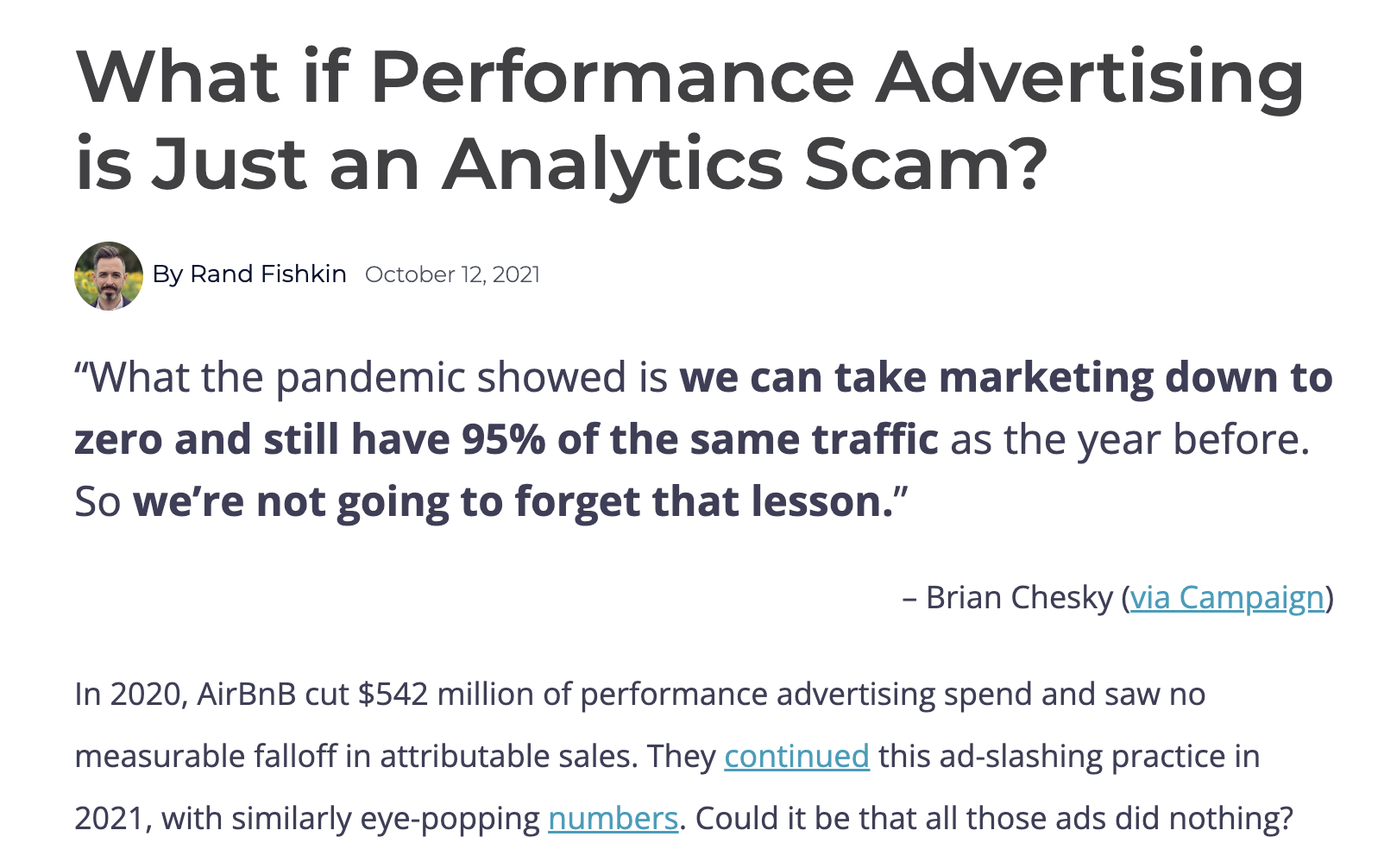
In 2021, Rand Fishkin from SparkToro published a thought-provoking article on this exact topic:
That’s why I don’t recommend B2B brands to “just run ads”. For small business that doesn’t need a “brand” and has short sales cycle, ads work wonders. But in B2B SaaS, ads play a different role:
- Demand generation, which is about seeding awareness: bringing attention to pain points and solutions for those pain points long before a buyer begins searching. Here, high-value content like webinars, research reports, thought leadership pieces work far better than direct offers. This stage expands your reach and fills the top of your funnel. Don’t expect direct conversion, any leads generated from this stage must be followed up by really well-thought nurturing campaigns.
- Demand capture, on the other hand, focuses on active intent. It targets those already researching solutions, either through prospecting new visitors or retargeting previous ones who’ve shown interest via site visits, content downloads, or webinar attendance (thanks to your Demand Gen work).
11. Run webinars and workshops
The truth is, most B2B webinars fail not because the format is broken, but because they’re built backwards.
They start with “how do we pitch our product?” instead of “what is our audience dying to learn?”
The best-performing webinars focus on education. When you teach something that actually helps, like how to fix a broken funnel, or how to automate a painful process, people trust you. And trust builds pipeline in B2B.
This is exactly the kind of webinars that win:
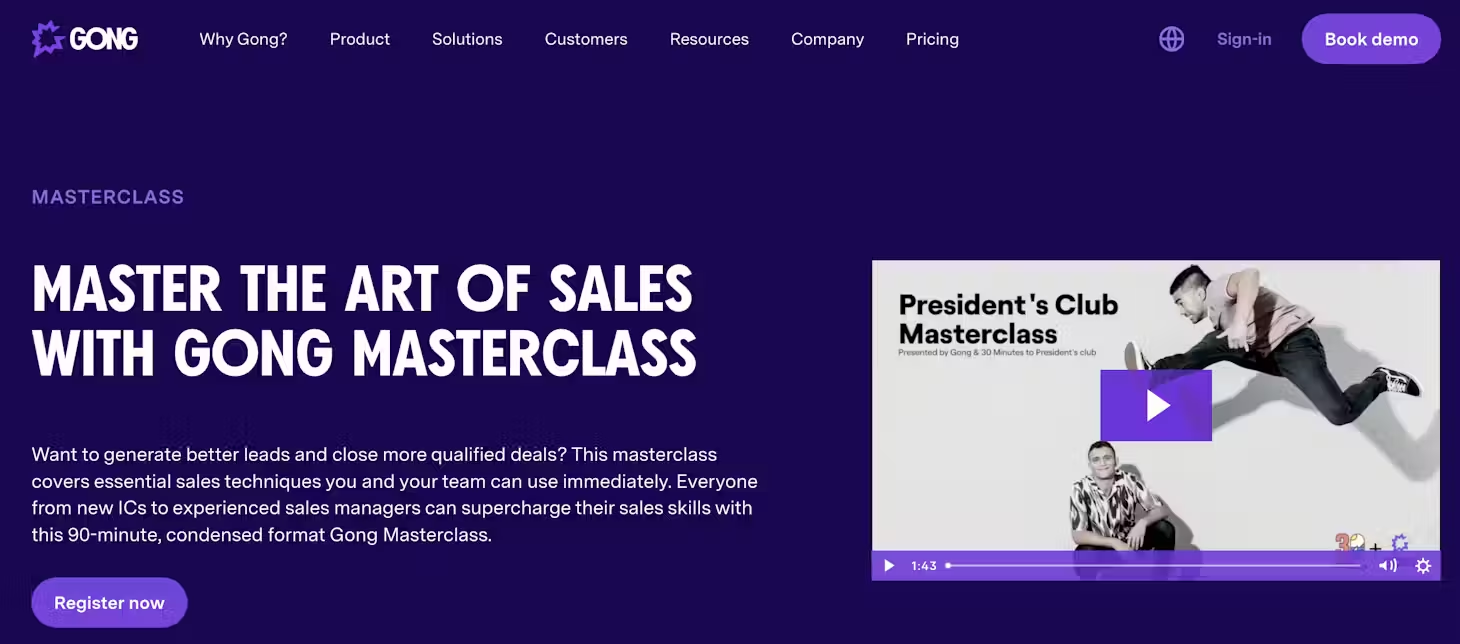
You won’t get hundreds of MQLs on day one. In fact, your first webinar might only have 10 people. And that’s okay. Those 10 people are often more engaged, more relevant, and more likely to convert than a cold lead from a paid ad.
But the real power of a webinar is actually in the content it generates later down the road. Turn it into a blog, social posts, or even a sales sequence. Repurpose to the max of it, and of course, follow up on the leads that signed up. Conversions happen in the inbox after.
So, should you run webinars? Maybe. But only if you’re ready to treat them as a content investment, and only if you’re committed to creating something people actually want to attend. The rest is just noise.
12. Push for Reviews
In B2B SaaS, G2 is huge. It is the industry-leading software review platforms, and companies compete to get as many reviews as possible up here.
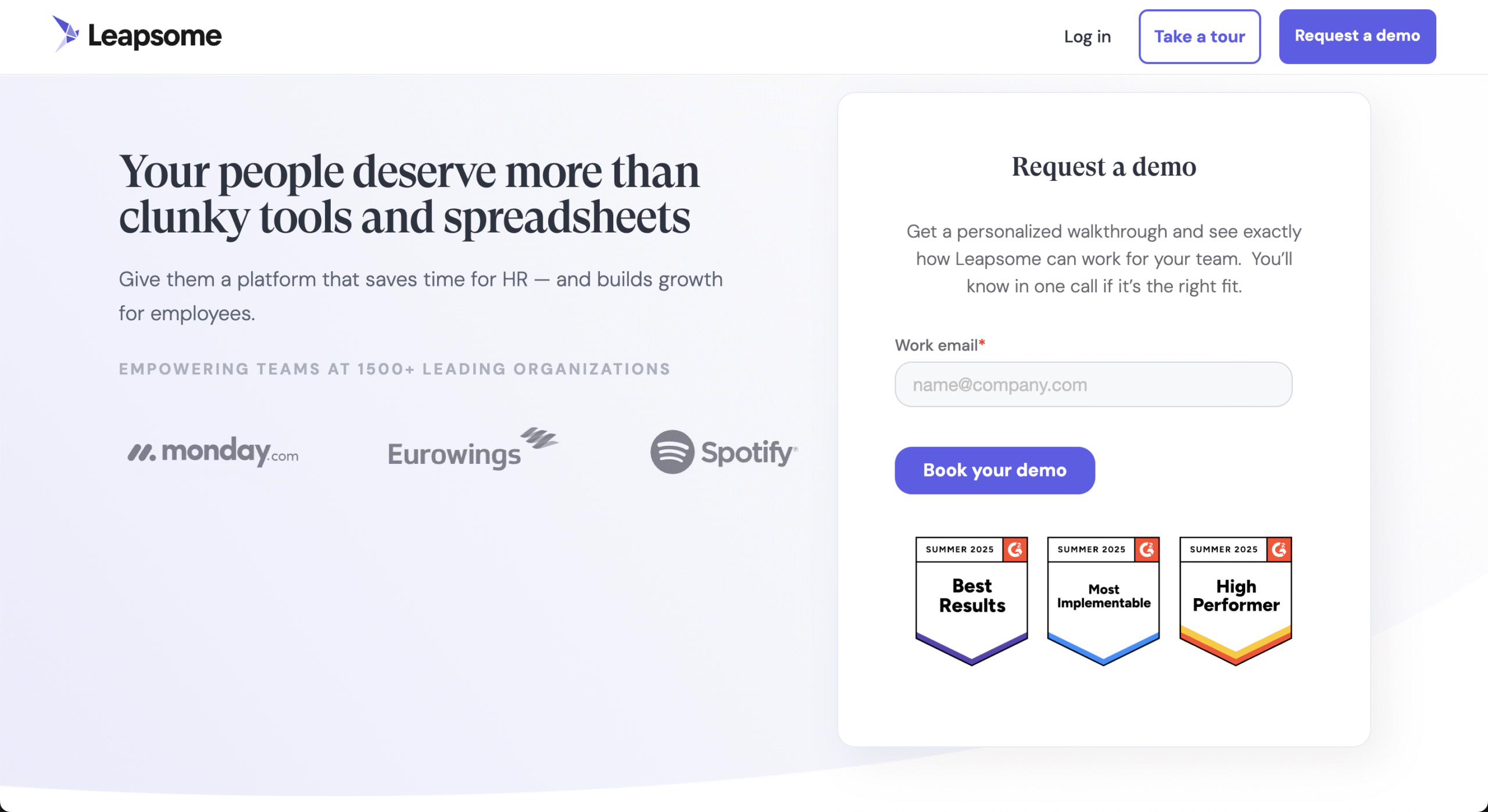
G2 is great because:
- You get mentions from a high-DR website, which is really beneficial for SEO and GEO
- G2 gives you a lot of marketing materials to use. The most notable is the G2 badges that you can place on strategic positions (sign-up forms, homepage, product pages) as trust signals.
Getting listed on G2 matters beyond badges because AI recommendation engines scan review platforms, Reddit, and editorial coverage simultaneously to detect consensus across independent sources before surfacing any product. Research into how AI recommends B2B SaaS tools shows that distributed presence across hard-to-fake third-party platforms is what determines whether your product gets cited, not review volume alone.
To be honest, there’s no shortcut to building real trust on review platforms. If your product is genuinely good, reviews come naturally. But of course, you can encourage users to leave more reviews by this process:
- Start by segmenting your users: A power user on a freemium plan is not the same as a high-value customer running enterprise deployments. For free users, offering product credits in exchange for a review might be meaningful. For paid customers, a small gift card or personalized thank-you often goes further. For active users who show up in your MAU list but haven’t converted, consider creative gamified rewards like badges or in-product shoutouts. The goal is to offer the right incentive for the right persona.
- Ask for a review when your user is happy: after a support resolution, a successful onboarding call, or right after a positive NPS rating. This is when their emotional momentum is high. Follow up once or twice via email or in-app message, but keep it natural. The ask should feel like a moment of gratitude, not a transaction.
- Treat G2 review generation as part of your customer marketing strategy: Automate the process once you’ve proven it works, as well as include review language in your CS playbooks, make it part of post-onboarding workflows, or even bake it into contracts for early customers (“we’ll offer a discount in exchange for a published review”).
13. Double down in video marketing
Let’s not forget: B2B buyers are still people. Titles like “VP of Sales” or “IT Director” don’t turn anyone into a spreadsheet robot. These are real humans with stress, goals, KPIs, and YouTube watch histories.
Video works because it creates human connection in an increasingly digitalized world. But to make video work, you need strategy.
Start by asking the most important question: what is the business goal? Are you trying to build brand awareness? Drive pipeline? Reduce churn? Make internal ops more efficient? Whatever your objective, your video content should be a tool that moves that goal forward.
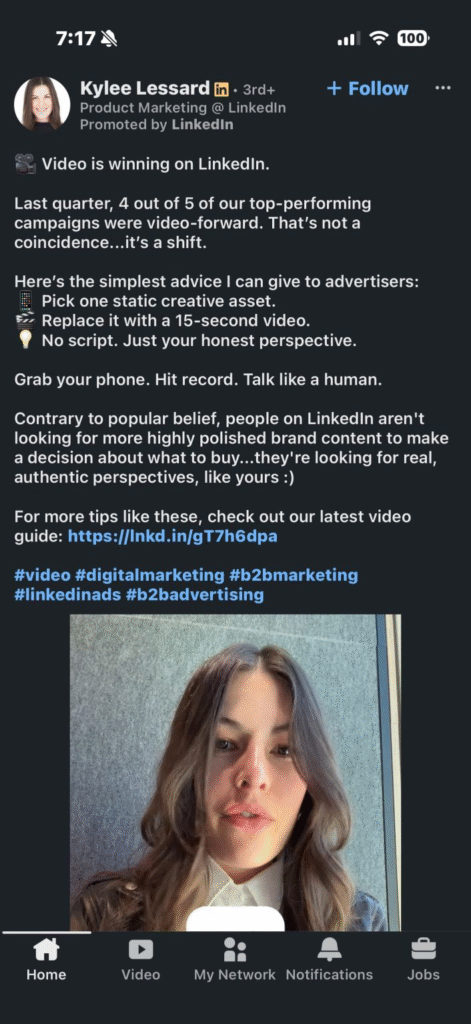
Let’s say your goal is sales. Then you need bottom-of-funnel content: product demos, pricing breakdowns, competitor comparisons, customer testimonials. Basically anything that helps remove friction from a buying decision.
If your goal is to build trust and become the go-to voice in your space, you need educational content. Answer the questions your ICP is already asking. Teach them something useful. Don’t sell yet, just show up, solve problems, and give real value.
Your videos can (and should) live on sites like YouTube, Facebook, or X (formerly Twitter), but you can also embed them in your articles for an added lift.
14. Embrace founder-led and exec-led social media
LinkedIn’s algorithm reinforces founder-led content: content posted by an individual profile (a founder, partner, consultant) tends to get much higher reach and engagement than the same message pushed from a company page.
That’s why you need to find an “influencer” on LinkedIn.
LinkedIn social media is a long-term game for B2B SaaS. You have to post daily, consistently. Again, most B2B SaaS content aren’t designed to convert instantly. They’re there to amplify your presence.
Here are some best practices I recommend:
- Consistency wins: Post every day, but have a good mix of content. Some product updates, some industry stats, some evergreen posts that got recycled throughout the year. The biggest growth lever is actually frequency, so don’t overthink every individual post, just post. Start with imperfect and refine gradually.
- Keep the language and message aligned with your brand across every channel.
- Try to creative native content: Instead of always linking out to a landing page (which tanks post reach), use in-app forms when running gated content campaigns. Let LinkedIn capture the lead, then sync to your CRM.
- Consider the format: Videos pulled the most impressions, but carousel posts had the best engagement. Both formats played a role, depending on whether the goal was awareness or discussion.
- Be patient: Early posts might get 5–15 likes, or just a handful of views. But staying consistent compounds over time. Use early traction to test what resonates, then double down on what works.
Of course, that’s the long-term strategy.
In the short-term, you can instead create a lead magnet and posted it on LinkedIn. The key is that you must go viral, so make sure you strike a very critical pain point of your target audience.
Conclusion
Each niche of B2B SaaS requires a slightly different approach, but the general principles stay the same. My principles when doing B2B SaaS marketing, no matter what industry, is:
- Give your audience value first
- Be original
- Showcase your expertise
It is not always easy to “be original”, but don’t you think that the end goal of marketing is to make your product stand out from the crowd?
Partner with B2B SaaS marketing specialists at Perceptric
Welcome to Perceptric, where you’ll get the best-in-class:
- We understand your product (we’ll work with your internal team to make sure our content strategy strikes!)
- Revenue-driven SEO strategy tailored for the tech industries
- Expert-written content to build trust with your audience
- Conversion tracking configuration for your favorite CRM