
Picture yourself as ChatGPT.
At your disposal is an unfathomably massive volumes of data and information about virtually everything, since you have been trained pretty extensively by the most brilliant AI scientists on the planet.
People see you as the answer to (most) questions, the key to (most) doors, the solution to (most) problems. You may hallucinate here and there, make up information once in a while, but at least you are the most popular AI on the market. And so, people come to you and ask you a lot of questions.
One Monday morning, a human, after sipping their morning coffee, feeling all awake and excited, decides to ask a tricky question:

How would you answer that question?
The way humans search
To answer that prompt, a human would have:
- Asked a colleague they respect & trust
- Recalled the name that people keep talking about
- Remembered the tool someone complained about at dinner.
- Googled it, skimmed a few Reddit threads, landed on a G2 comparison page
Do you see the pattern?
Humans have to look for convergence across independent sourcess.
Humans have to ask: what does the world already seem to believe about this?
Humans need third-party validation.
Fascinatingly, the same is true with AI.
The way AIs search (and make recommendations)
LLMs aren’t “intelligent” in the same sense as humans. LLMs are closer to autocorrect, at massive scale.
When ChatGPT recommends HubSpot over nine other competitors, it’s not “impressed” with HubSpot the way a human might be. It doesn’t understand that HubSpot is an industry-defining invention, or that HubSpot has meaningfully solved problems for thousands of businesses.
Under the hood, it’s doing one thing: predicting the most probable next token, in a sequence, given everything it has ever been trained on.
This is what ChatGPT answered after being prompted “best CRM for SaaS startups”. To ChatGPT, after “The 5 best CRMs for SaaS startups (by use case)”, the statistically most likely continuation is “1. HubSpot CRM.”
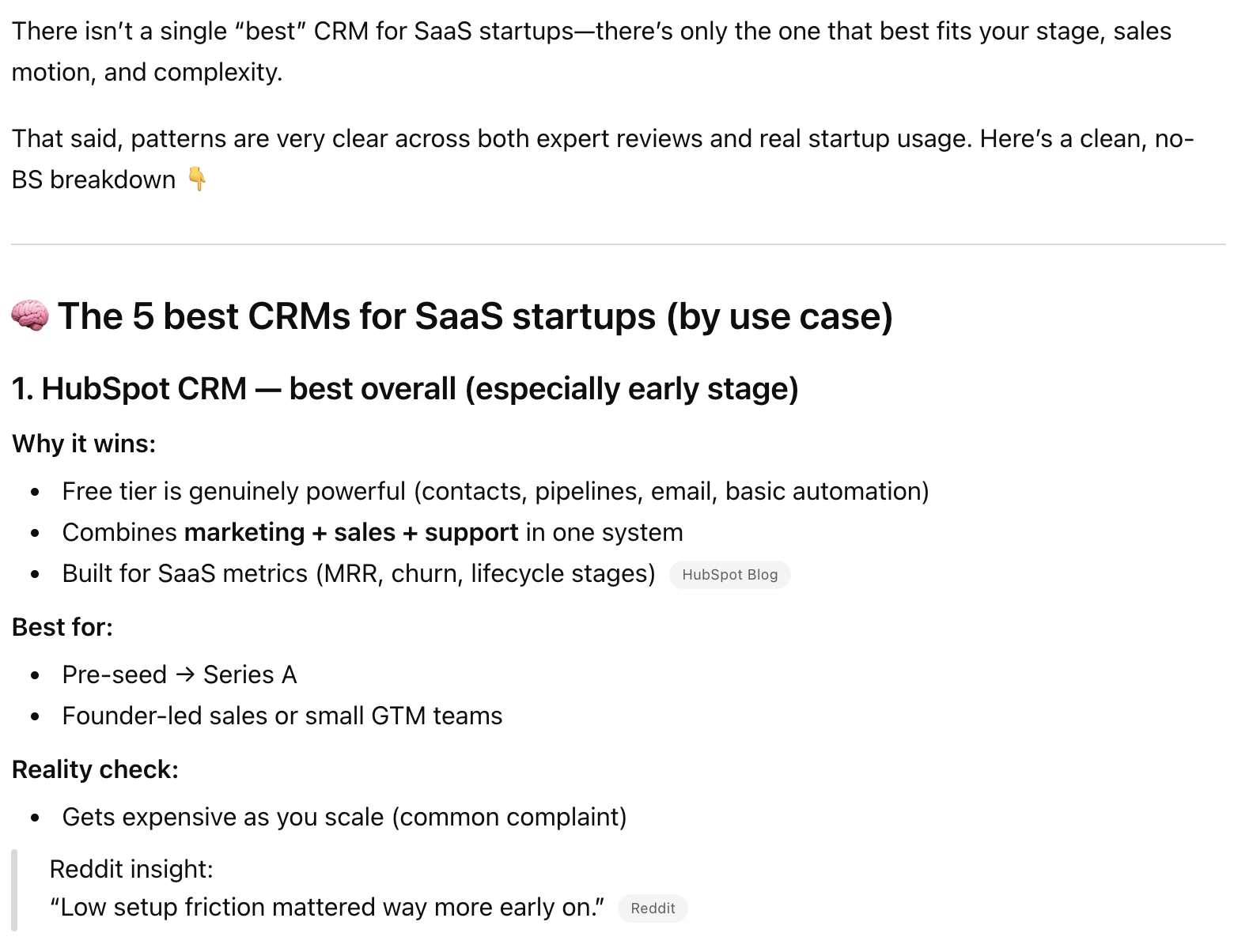
Across its training data, HubSpot is the most likely answer. Most likely, not the most accurate. It’s just a pattern that frequently shows up in its training data.
In that sense, it works a lot like autocorrect:
- It looks at context
- It weighs probabilities
- It suggests what most often comes next
The difference is scale and sophistication. Instead of learning from your personal texting habits, it has absorbed patterns from millions of documents, conversations, and examples.
This allows it to produce answers that feel intentional, even though they’re fundamentally probabilistic.
Connecting the humans and AIs
Can you guess what have LLMs been trained on?
- Human language
- Human opinion
- Human trust, expressed in the form of citations, mentions, reviews, forum threads, editorial recommendations, and the quiet consensus of ten thousand conversations it absorbed before it ever spoke a word.
The recommendation that LLMs make is not a judgment on how good your product is.
It is more of reflection of how good your product is perceived to be, by the market. A statistical mirror held up to the collective record of what the market already believes about your product.
In other words, ChatGPT and LLMs aren’t making recommendations that it believes to be the best. It is recommending what the market believes to be the best.
All roads lead to Brand

At the end of the day, it’s all about getting your name out there.
Some call it “Building a Brand”. I’d love to call it “Reputation Management”.
If Reddit threads, G2 reviews, analyst reports, journalist recommendations, podcast mentions, Slack conversations scraped from the public internet collectively associates your brand with a specific “quality”, a specific problem, a specific point of view, then the model will undoubtedly surfaces you.
Because the statistics say that you are the chosen solution.
That is exactly what we achieved for our client: Momos, a reputation management software built for restaurants:
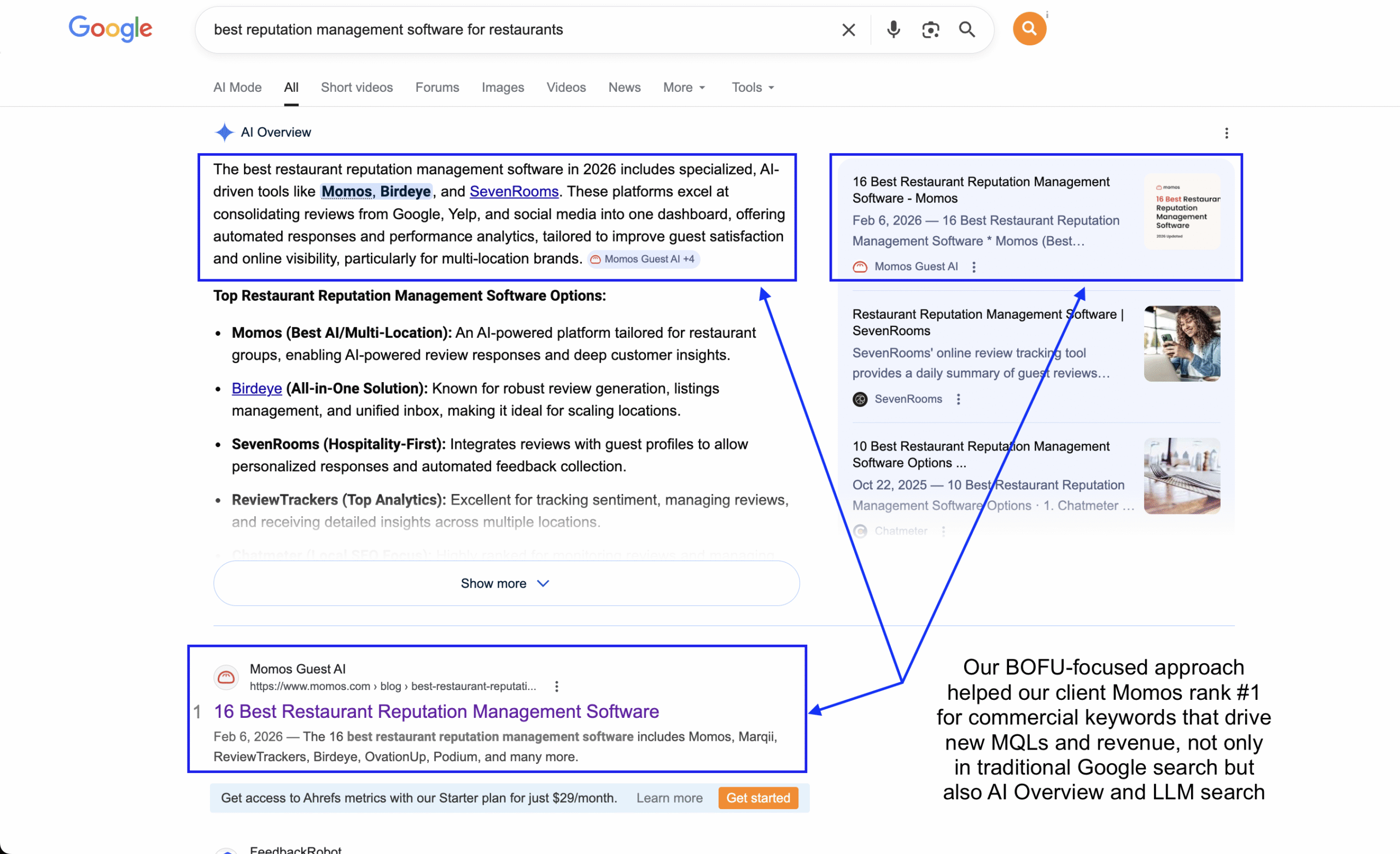
The goal is simply to associate their brand name with that specific problem/issues/niche. In Momos’ case, it means associating their name with the topic of “Restaurant Reputation Management Software”, because that’s exactly what they do.
Simply by publishing content assets that associate Momos with that topic, we influenced the LLMs to recommend them.
Building your reputation
At the execution level, building your reputation means:
- Getting your product mentioned in the places LLMs already trust.
- Reviews of your product on G2, Capterra, and Trustpilot that use the exact language their buyers use when describing the problem.
- Reddit threads where your name appears organically in conversations about the problems you solve.
- Press mentions that frame you as an answer to a known, named problem.
But those are just tactics. Writing a press release, or publishing an article, or launching a campaign, are all just tiny little tactics.
We are playing a longer game here. We’re building a reputation.
Reputation can be built publicly, sure. But it’s also built in the quiet accumulation of signal, across sources you don’t control, in conversations you weren’t part of, over a timeline that resists the quarterly planning cycle.
The returns are invisible for longer than most companies are willing to wait. But you must do it nonetheless. Those returns compound until your name becomes the statistical inevitability. The model doesn’t recommend you because you asked it to. It recommends you because the record is overwhelming.
After all, HubSpot definitely earned their top spot, having been the industry leader for decades. That’s the value of good reputation.
Ready to build a reputation?