
If you’re running customer acquisition/marketing for a B2B company, SEO must have been one of your consideration. I think it’s pretty well known that SEO has a reputation of being slightly slower than other channels, but as someone who’s done enough SEO for a decade, I can tell you that SEO absolutely works for B2B companies.
I’ll explain why, with experience and data.
1. Customers always research on Google before they connect with you
According to Wynter’s State of B2B SaaS Brand Marketing report, 92% of B2B buyers only purchase from the vendors already on their Day-1 shortlist.
That means by the time a prospect books a demo, they already have several “final options” in their mind. In fact, customers do 60+% of research before ever talking to the company. Being on the short list to be considered is already half the battle.
So how do you earn a spot on that shortlist? It doesn’t happen overnight. You need buyers to recognize your name and associate it with competence and insight along with proof that your company understands their problems better than anyone else.
Without SEO, you have to do all of that manually and unscalably: outbound emails, cold calls, networking, conference booths, LinkedIn DMs, referrals, paid placements, and repeated explanations of who you are and why you’re credible.
You have to earn buyer confidence one conversation, one touchpoint, and one relationship at a time, without the leverage of scalable discovery channels like SEO.
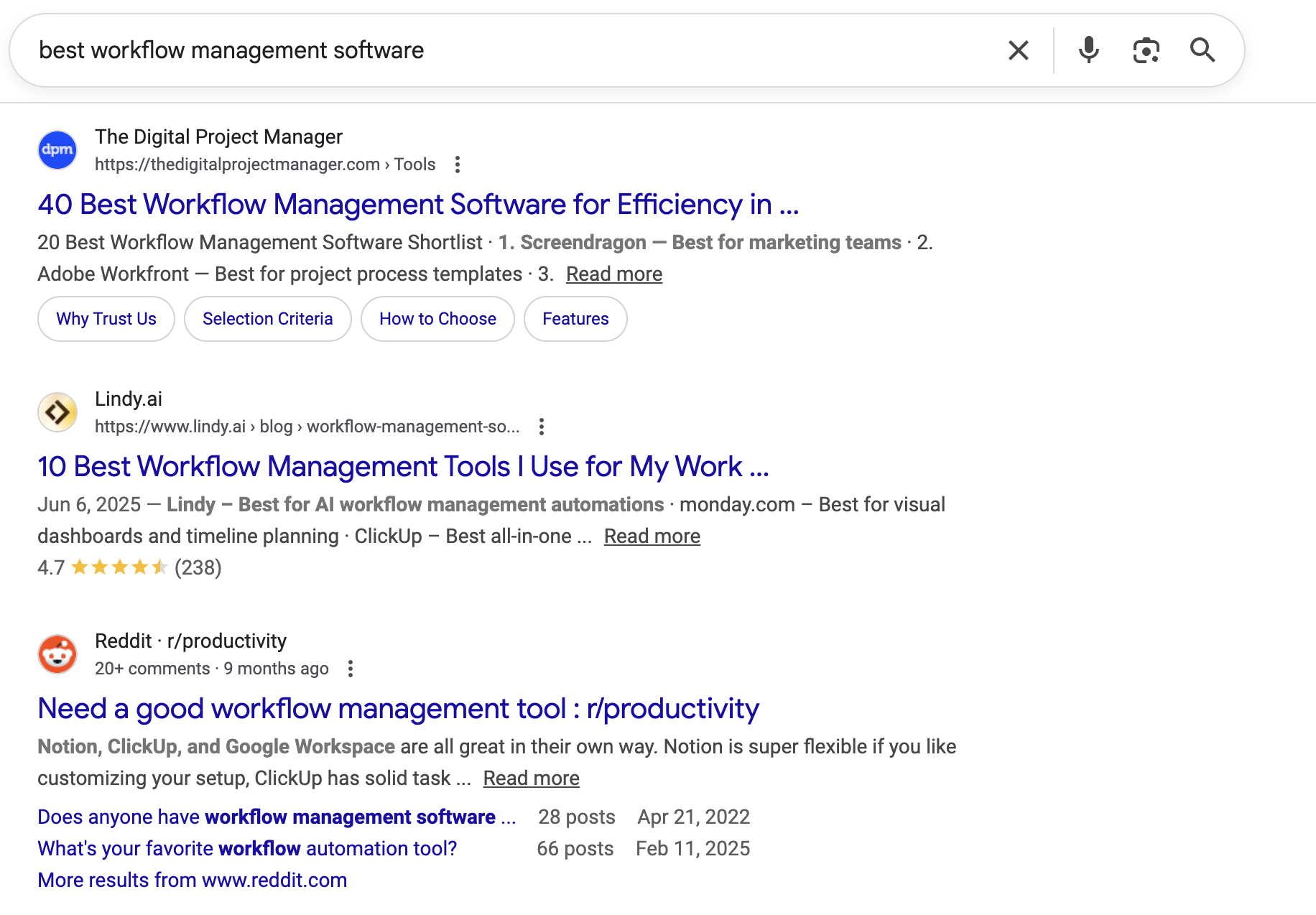
Meanwhile, with SEO, you can appear on Google whenever they search for the queries related to what you offer, and use the opportunity to showcase who you are. For example, if you’re a workflow management software provider, wouldn’t it be nice to be featured in one of these lists?
2. SEO is the lowest cost, highest ROI channel
That’s always been true for a really long time. Indeed, you have to invest into content marketing and link building, but those costs tend to be more predictable compared to paid ads, whose cost is determined by market demand, and it’s getting more and more expensive every day.
Here’s a simple table to demonstrate that:
| Month | Content Creation ($) | Link Building ($) | SEO Tools ($) | Total Monthly SEO Spend ($) | Cumulative SEO Spend ($) | Monthly SEO Conversions (First-Touch) |
|---|---|---|---|---|---|---|
| 1/1/2026 | 5,000 | 3,000 | 2,000 | 10,000 | 10,000 | 2 |
| 2/1/2026 | 5,000 | 2,500 | 2,000 | 9,500 | 19,500 | 6 |
| 3/1/2026 | 5,000 | 2,000 | 2,000 | 9,000 | 28,500 | 12 |
| 4/1/2026 | 5,000 | 1,800 | 2,000 | 8,800 | 37,300 | 20 |
| 5/1/2026 | 5,000 | 1,500 | 2,000 | 8,500 | 45,800 | 30 |
| 6/1/2026 | 5,000 | 1,200 | 2,000 | 8,200 | 54,000 | 42 |
| 7/1/2026 | 5,000 | 1,000 | 2,000 | 8,000 | 62,000 | 55 |
| 8/1/2026 | 5,000 | 1,000 | 2,000 | 8,000 | 70,000 | 62 |
| 9/1/2026 | 5,000 | 1,000 | 2,000 | 8,000 | 78,000 | 68 |
| 10/1/2026 | 5,000 | 1,000 | 2,000 | 8,000 | 86,000 | 72 |
| 11/1/2026 | 5,000 | 1,000 | 2,000 | 8,000 | 94,000 | 76 |
| 12/1/2026 | 5,000 | 1,000 | 2,000 | 8,000 | 102,000 | 80 |
You can see how SEO has:
- Heavy upfront investment with slow early conversions
- Monthly SEO spend stabilizes after the foundation phase
- Conversions compound over time without proportional spend increases
- CAC improves every month when viewed cumulatively
- SEO economics outperform paid channels over longer time horizons
3. SEO works when you invest into topical authority
Topical authority is one of the most controllable levers in SEO. Google doesn’t evaluate pages in isolation; it evaluates them in the context of your entire website and the broader web.
When multiple pages on your site consistently cover the same topic and are well interlinked, Google begins to build a site-level understanding of what your website represents. This helps Google confidently associate your site with a specific topical cluster.
As that topical authority strengthens, your site becomes more likely to appear whenever users search for related queries within that topic area.
HubSpot is a strong B2B example of this approach done well, having built massive visibility by deeply covering and interlinking content around core marketing topics.

They published such a large volume of authoritative content around inbound marketing that Google had little choice but to rank them at the top for almost any search related to that topic.
However, they later made a critical misstep by overextending into areas where they lacked true expertise, such as broad topics like “emojis” and “quotes.” This dilution of topical focus ultimately hurt their authority and contributed to a sharp decline in organic traffic, dropping from roughly 5–8 million monthly visits to around 2 million, with a clear inflection point visible in mid-2024.
So here are the steps you can take to boost topical authority for your B2B website if you want to invest into SEO:
- Pick one primary topic per site section and commit to owning it
- Map all subtopics users search within that topic
- Create one core page (pillar) that defines the topic
- Publish supporting pages that go deeper on each subtopic. They don’t have to be long-tail. It’s better for users when you serve them 1 short article that answers their question immediately than an essay that makes them scroll 100 times before they find the answer.
- Internally link from subpages to pillar page and between related subpages.
- Use descriptive, topic-rich anchor text
- Keep content tightly scope. Do not mix unrelated topics on the same URLs since that confuses Google.
- Update older pages to align terminology, entities, and intent. If you have old pages that aren’t related to your ultimate topical cluster, don’t be afraid to delete them
- Only expand to the next cluster when you have exhausted the subtopics in the current one.
4. SEO works when you invest into BOFU keywords
One big problem I noticed from SEO programs is that they target keywords that their target audience doesn’t care about.
I used to work with an agency (a pretty famous one) when I was still an SEO manager at my previous company which offers a B2B software platform. They target the keyword “What is API?” in their SEO content strategy, which is pretty odd, since the audience of our software are developers who build APIs on a daily basis. They will NEVER Google “What is API?”. That keyword only brings beginner-level visitors who don’t understand and can’t use our product.
If we do SEO like that, of course it doesn’t work.
What I’m trying to say is that SEO should always prioritize low-volume but high-intent keywords rather than the opposite. BOFU keywords are the search terms people use when they’re very close to making a purchase decision. They already understand their problem, they’ve done their research, and now they’re evaluating specific solutions. BOFU keywords help you meet them where they need you.
Those keywords usually look like this:
- [service provider] case studies in [industry]
- [vendor] alternatives
- [solution] vs [solution]
- best [category] platforms for [industry/role]
- [vendor] pricing
- [vendor] reviews
- top [industry] providers
- [solution] for [specific workflow or department]
- [solution] ROI
Most BOFU keyword has low volume, but it’s alright. People are actually competing for it intensely in the search ads. For example, this BOFU keyword “B2B SEO agencies” only has a volume of 390 in the US, but it has a cost per click of $28.76, which is pretty high. Imagine ranking on the top position for this keyword and bringing in around 200 clicks per month. That’s $5752 in ad spend you saved! If that’s not SEO working, I don’t know what is.

5. SEO takes time, but it compounds nicely once you get the traction
It’s common advice, but I think it needs repeating: SEO is a long-term game. It won’t drive a thousand signups overnight, but it will quietly compound behind the scenes, month over month.
Metaphorically, SEO is like Sisyphus on a curve.

When your site’s new and has little authority, it’s unrealistic to expect fast traction. Over months and years, you build traffic, expertise, reputation, a solid content library, and a rhythm that compounds into real momentum.
The challenge is that many teams expect a quick payoff, sometimes in just a couple of months. Sure, that’s possible if Google trusts your site. In that case, every new piece of content has a chance to perform well. But for smaller or newer players, there’s no shortcut. With little ranking power and no built-in audience, results take time. Most businesses give up before the flywheel starts spinning, just when it’s about to get good.
Conclusion
Yes, SEO absolutely works for B2B companies, but like all things else, you need to know how to do it.
Here’s my playbook to do B2B SEO if you’re interested:
Further reading: A guide to B2B SEO