

SEO for fintech companies requires a very different playbook.
It’s much less about flashy tactics and more about earning trust.
And it’s getting increasingly harder in a world where the buying process looks like this:
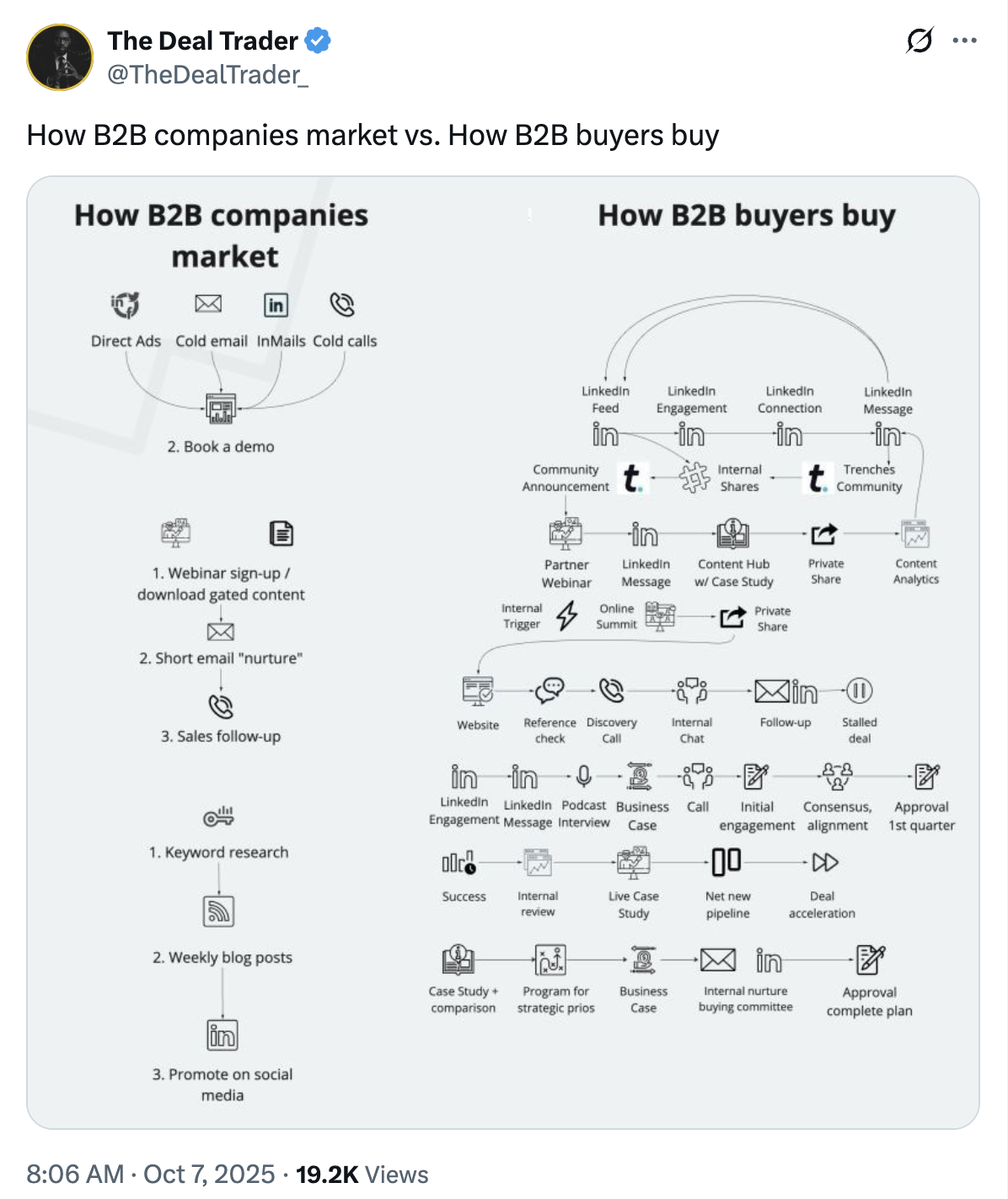
Fintech buying decisions rarely occur in isolation. Every purchase typically involves a buying committee that includes a CFO, a compliance officer, someone from procurement, and often a technology or product lead. You need to really cater for all parts of the buying journey.
That’s why SEO for fintech companies requires its own specialized approach, and it deserves to be treated as such. And I wrote this guide to break down exactly how to do fintech SEO.
Here’s what I’ll walk you through:
- What makes fintech SEO so uniquely challenging and interesting
- How the core principles stay the same, but the execution looks very different
- A full walkthrough of the SEO process tailored for fintech and financial services
- Smart keyword research frameworks that account for buyer journeys
- Best practices for content that resonates with fintech audiences
- And why real results in finance organic marketing require going beyond SEO alone
There’s a lot to unpack, so dig in, or skip to the sections you care about most. That said, I strongly recommend reading the whole thing.
Why SEO for fintech companies is different?
Finance people are some of the most analytical and detail-oriented professionals you’ll encounter. They operate in environments where precision matter, which means they spot marketing fluff a mile away.
- Shallow content doesn’t work in this space. To engage them, you need writing that’s clear, useful, and grounded in the technical realities of your product.
- Credibility is non-negotiable. Whether you’re selling embedded payments, fraud prevention, or API-first banking infrastructure, your SEO content may need to explain complex concepts. Good fintech SEO needs to come from someone who knows the industry.
- The user journey doesn’t end at sign-up. In fintech, activation often depends on integrating with live systems or migrating data from legacy vendors. Fintech SEO extends way beyond the acquisition stage and also contributes to onboarding, retention, and long-term value realization.
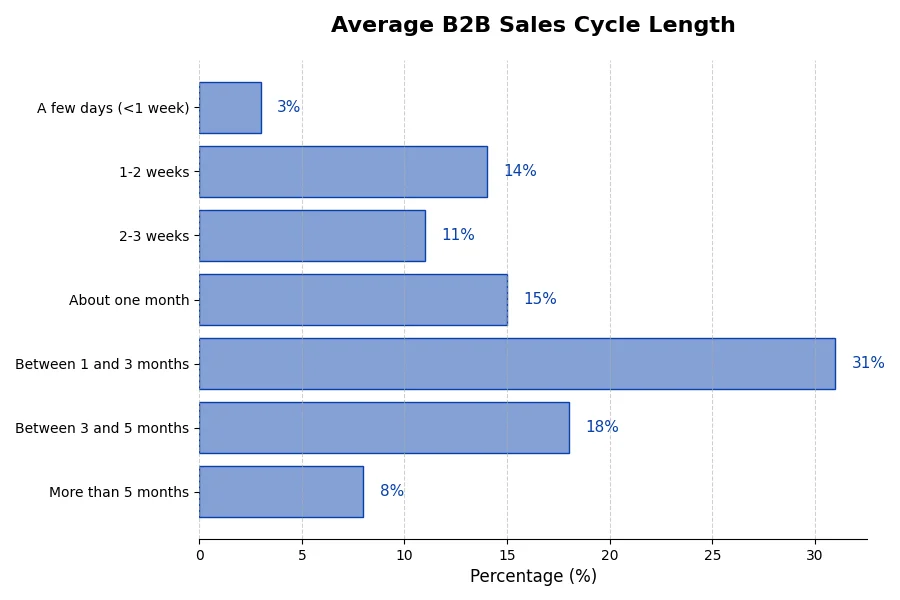
And then there’s the slow burn of the fintech sales cycle. A B2B payments platform can stretch to 6-18 months since there are just so many stakeholders and complex evaluation phases. Your content strategy needs to support that whole journey.
Is it worth investing in SEO for fintech companies?
Based on the survey we asked 532 fintech professionals, it is definitely worth investing in SEO if you’re a fintech company:
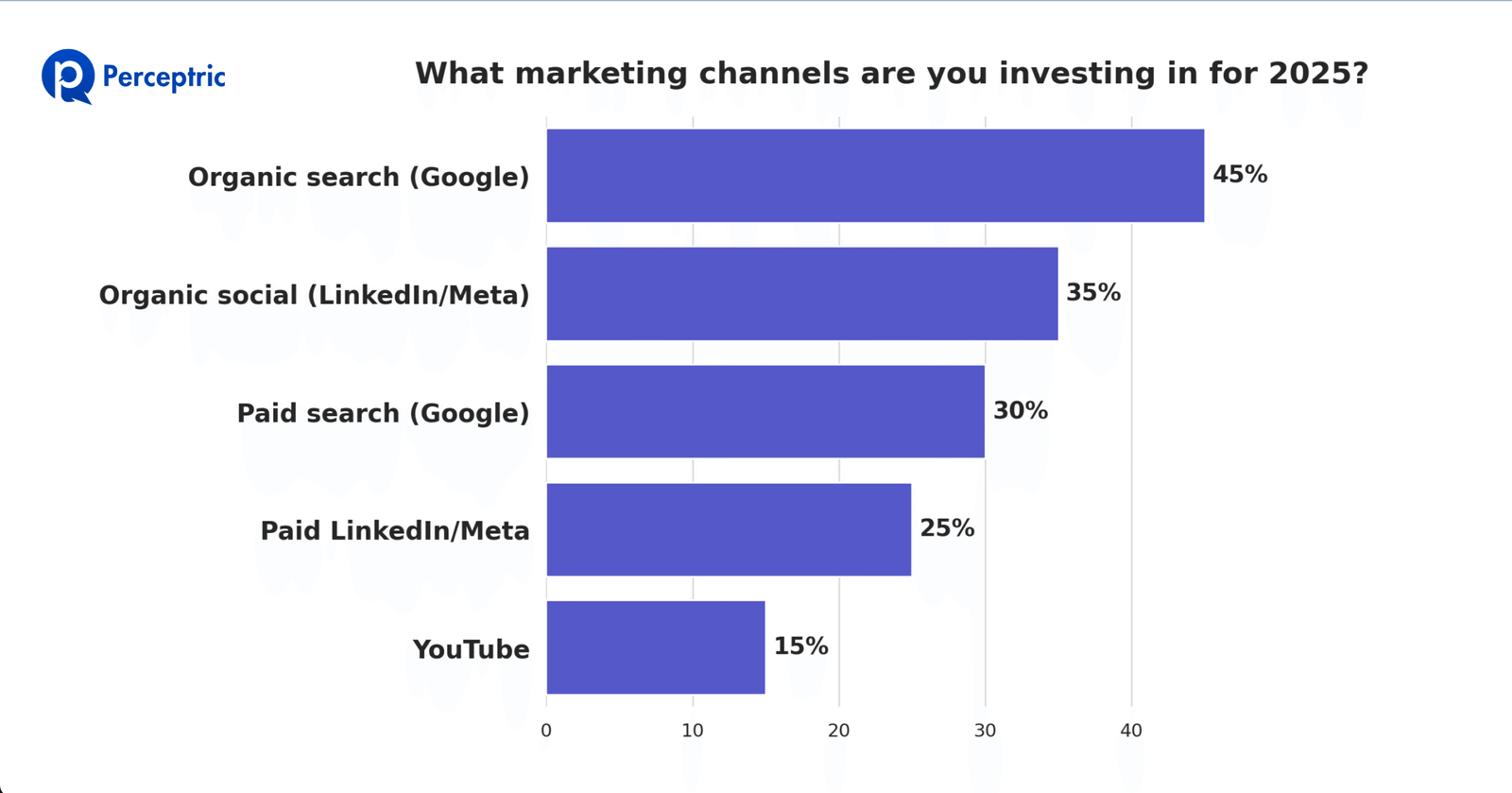
The benefits are pretty easy to see:
1. SEO goes hand-in-hand with content marketing
SEO helps you show up on Google, but that’s only half the battle.
What the user finds after they click through is also critical. That’s where content marketing steps in to educate your buyers on your financial product to build trust and eventually convert them.
Remember: if your blog posts help your users and customers make smarter decisions, they’ll come back and convert when the time is right.
Further reading: My approach to content marketing for Fintech companies
2. SEO for fintech is a long-term game
It’s common advice, but I think it needs repeating: SEO is a long-term game. It won’t drive a thousand signups overnight, but it will quietly compound behind the scenes, month over month.
This is the perfect chart to understand the nature of SEO:
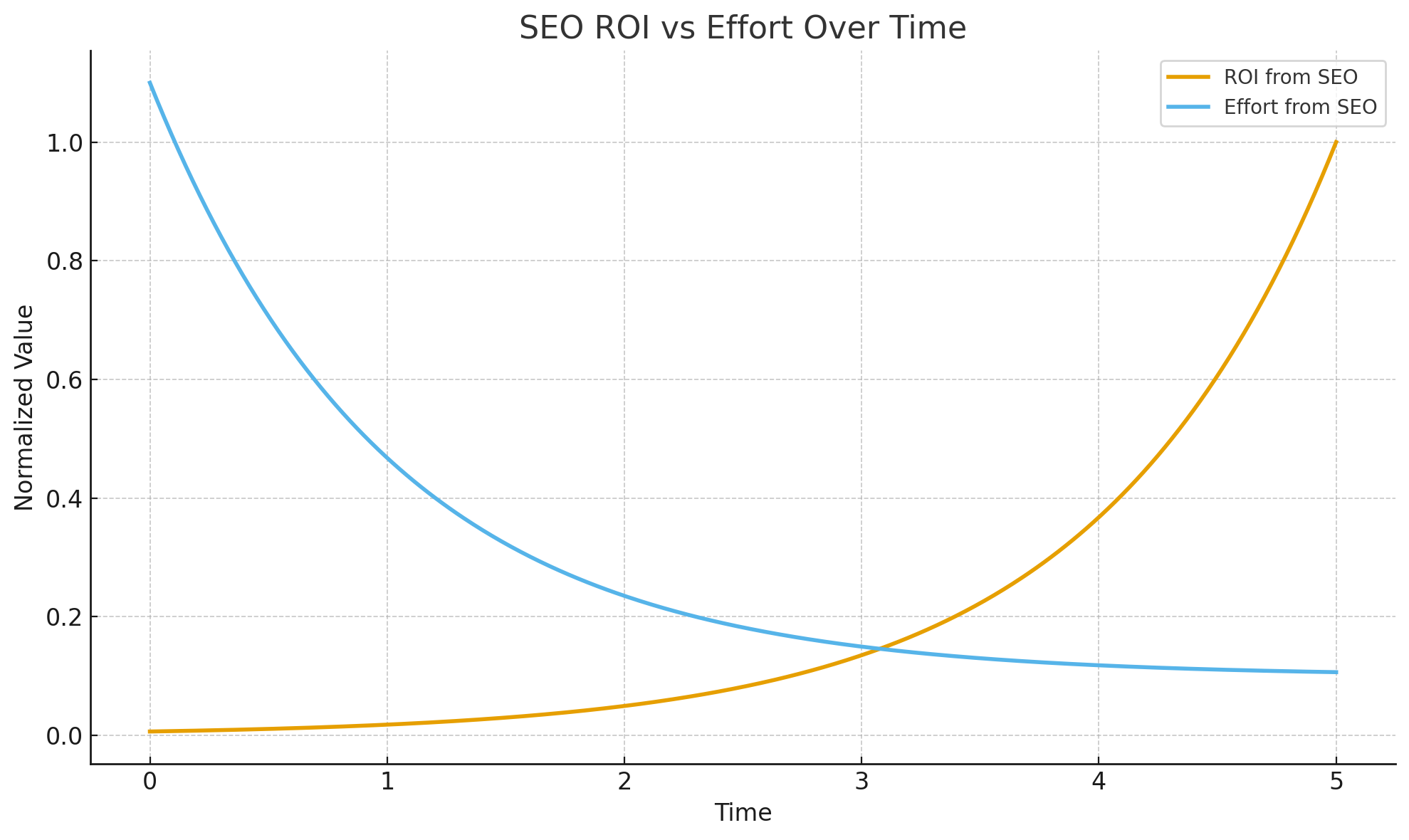
A new site won’t gain traction overnight. Building organic performance takes time through steady publication that resonates with your audience. Over months, you establish domain authority and create the kind of momentum that compounds.
The problem is many teams expect SEO to deliver fast results, often within a couple of months. That can totally happen if your domain already has strong trust signals. In that case, new content has a better chance of ranking, even fast.
Niche fintech players also have a very good chance to rank fast too, since there is relatively low competition. But for newer fintech players in a competitive niche, there’s no shortcut. With low domain authority and limited brand visibility, progress is slow at first. Most give up right before the momentum kicks in, just as the strategy is starting to work.
If you want to know where you fit in when you start with fintech SEO, check out this table:
| New Domain | Established Domain | |
|---|---|---|
| Niche Market |
Faster early wins Low competition Needs technical depth Build topical authority from scratch |
Strong SEO leverage High trust for specialized content Easy to scale long-tail keywords Ideal for thought leadership |
| Saturated Market |
Very slow ramp-up Hard to rank early Needs strong backlink & content strategy Relies heavily on differentiation |
Can compete on core terms Refreshes perform well Brand trust accelerates traction Requires constant optimization |
How to rank SEO content for fintech?
There’s no secret. Your goal should be to create the single best piece of fintech content available online for your topic, something that clearly outshines everything else currently ranking on the top page of Google.
If it reads like it could’ve been churned out by a language model, it’s not hitting the mark. It needs to feel human and brings a unique point of view.
Here’s what Google says about the kind of content that earns visibility:
Google’s automated ranking systems are designed to present helpful, reliable information that’s primarily created to benefit people, not to gain search engine rankings, in the top Search results. This page is designed to help creators evaluate if they’re producing such content. (Source)
At the end of the day, it’s all about creating good content that helps other fellow human beings. So, if you have decided to invest in SEO, you must also invest in quality writers. Good content and good SEO are two sides of the same coin.
Investing in good and exceptional content is always worth it, because good content means that:
- Readers stay on your page for longer
- Readers share your content to their coworkers and make discussions
- Readers remember your brand, and will return to consume more content from you
- Readers are interested enough to check your products and services
Want an agency to help? 12 Best Fintech SEO Agencies For Your Fintech Company in 2026
How to do SEO for fintech and finance companies (6 steps)
Here are the 6 steps I use to grow SEO of many financial services and fintech brands I’ve worked with:
Let’s dive in!
Step 1. Get your technical SEO right
A decent web designer with a decently modern techstack can ensure that your technical SEO is in place, so you don’t have to worry about it too much.
But if you want to gain a deeper understanding of technical SEO, it’s important to start with two key processes: crawling and indexing.
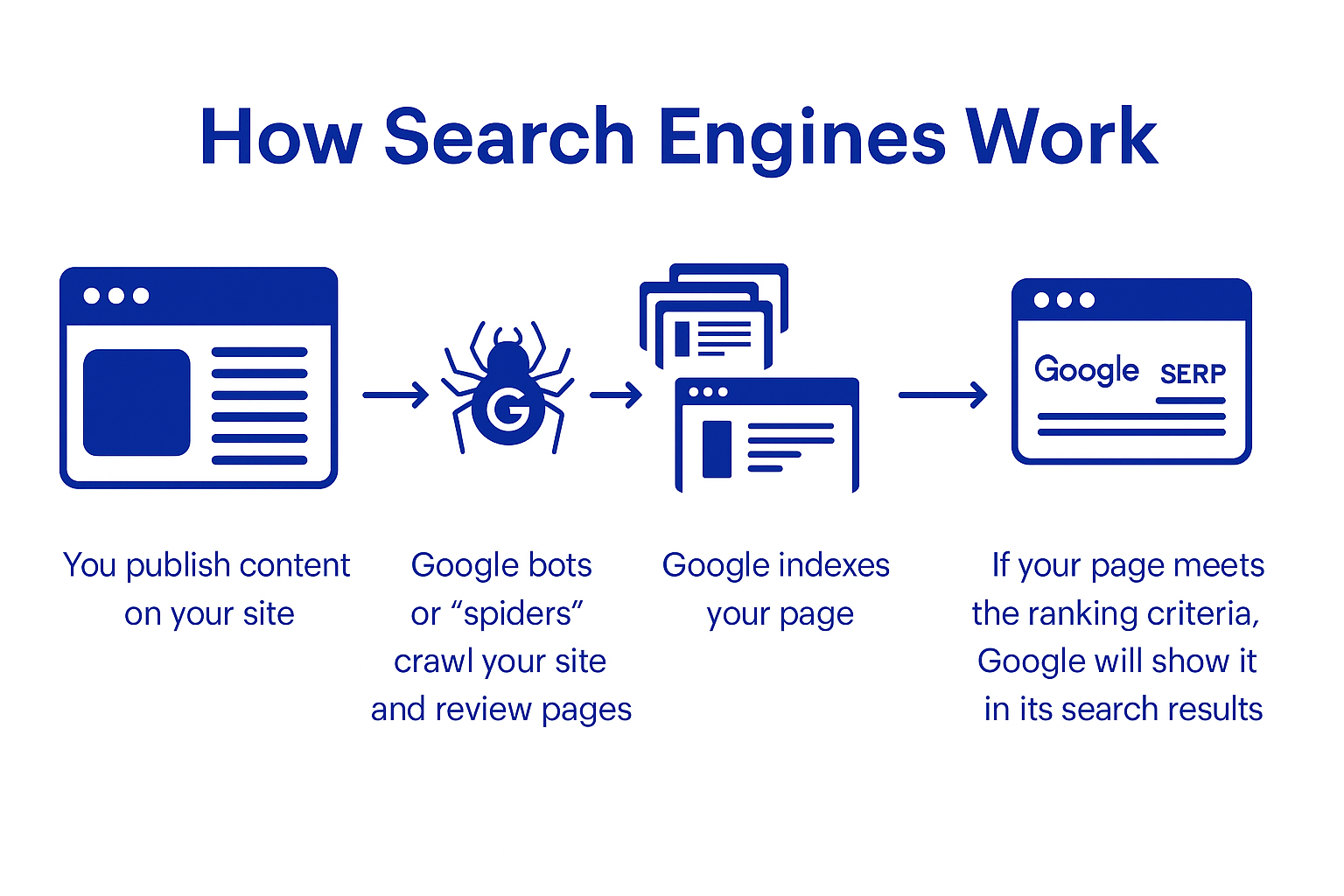
- Crawling is how search engines find content. They send out bots called spiders that travel across the web by following links from one page to the next. When these bots land on a page, they scan its structure, content, and links to detect anything new or updated.
- Indexing kicks in after crawling. At this stage, the search engine processes the information it gathered and stores it in a massive database known as the index. Think of this as a digital catalog that allows the engine to quickly pull up relevant pages whenever a user searches for something.
When someone types in a search query, the engine sifts through this massive pre-built index. The process takes milliseconds and involves several core steps:
- Query parsing – The engine breaks down the search terms to figure out what the user really wants, identifying intent, keywords, and context.
- Index lookup – It scans its database for the most relevant matches, similar to pulling records from a library catalog rather than combing the entire internet.
- Ranking – Next, it uses its ranking systems—powered by hundreds of factors like keyword matching, backlinks, page freshness, mobile optimization, and engagement signals—to sort the results.
- Results presentation – The chosen results are then displayed on the SERP, with the top positions going to pages that are both relevant and high-quality.
Technical SEO is all about making sure your site plays nicely with this entire process. Here are some best practices to help with that:
1. Create an SEO-friendly site architecture
A clean site architecture helps both users and search engines navigate your website easily. Every page should be just a few clicks away from the homepage, forming a logical hierarchy such as Homepage → Category Pages → Subpages.
This structure improves crawl efficiency and reduces orphan pages (pages that have no internal links pointing to them).
2. Submit your sitemap to Google
An XML sitemap gives search engines a clear map of the pages on your site and where they’re located. It’s particularly useful for large sites or those with complicated structures.
Most sites have their sitemap available at URLs like yoursite.com/sitemap.xml or yoursite.com/sitemap_index.xml. To submit it, head to Google Search Console, navigate to “Indexing” → “Sitemaps,” and drop in the link.
After submission, you’ll get a confirmation once it’s been processed. This helps ensure Google can access all your important pages, even the ones that aren’t well linked internally.

3. Understanding indexing
To check if your site is indexed, perform a “site:” search (for example, site:yourdomain.com).
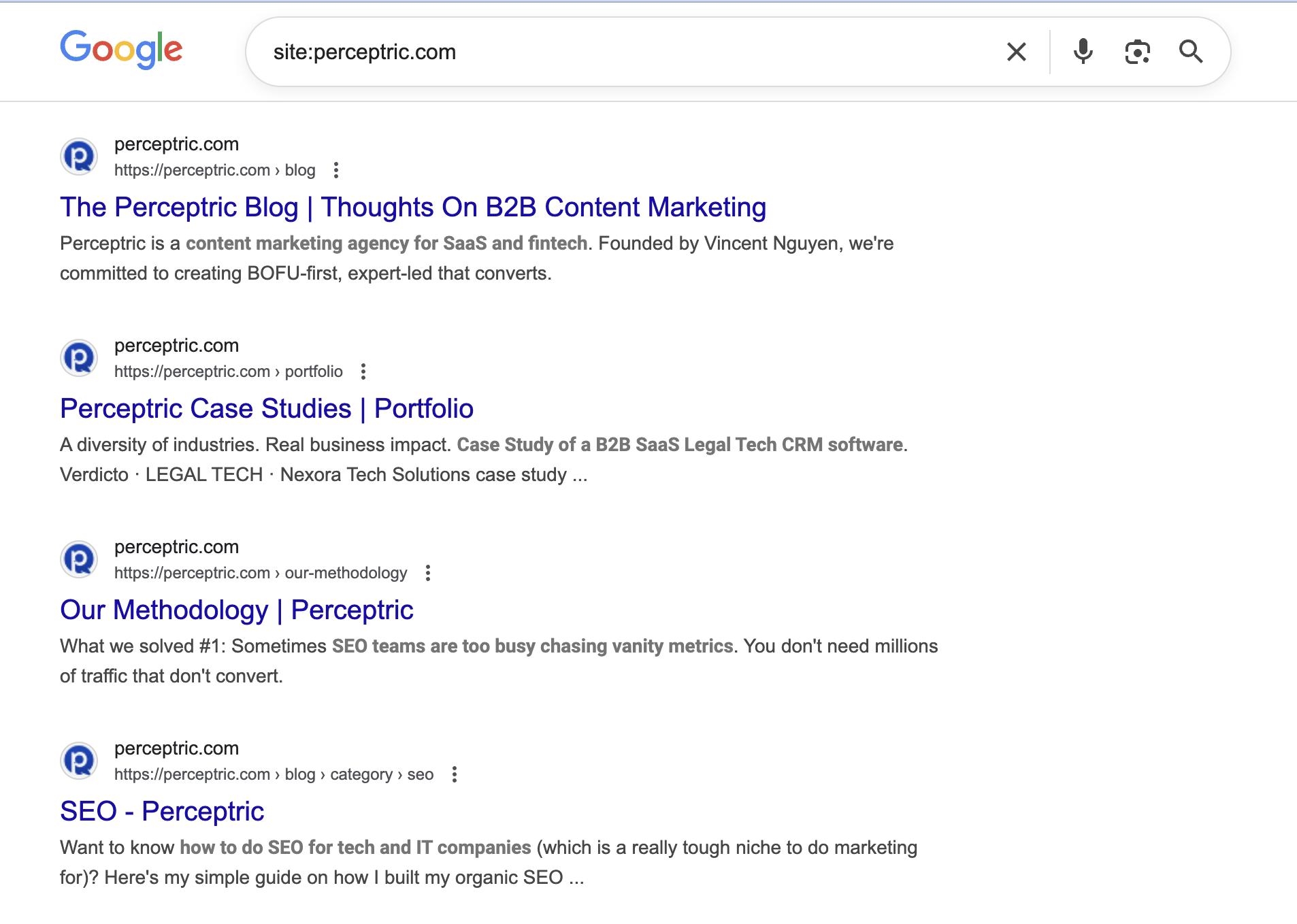
If key pages aren’t indexed, it’s often due to technical or tagging issues, so make sure you fix all of that before proceeding with any other SEO activities.
When you have similar or duplicate content, use canonical tags to tell search engines which version is the primary one. This avoids index confusion and consolidates ranking signals toward the correct page.
4. Make your site fast
Page speed is another core ranking factor. You can use Google’s PageSpeed Insights to test load time. GTMetrix is also a great tool to use.

Similarly, your site must be mobile-friendly since Google prioritizes mobile-first indexing. Always check your website’s responsiveness across the pages, and especially the product pages.
Step 2. Structure your Solution pages
Solution pages are specialized landing pages that position your product as the ideal answer to a specific use case. You can group Solution pages by:
- Industry (e.g., “Solutions for Digital Banks”)
- Role (e.g., “Solutions for Compliance Officers”)
- Problem (e.g., “Automate Multi-Bank Reconciliation”)
- Use Case (e.g., “Instant Payouts for Lending Platforms”)
Why are Solution pages important for SEO? From my experience ranking 20+ finance sites, I realize that Google knows your market positioning by looking at your product pages.
The way you structure your product pages tells Google a lot about what pain points you solve, and they’ll decide whether to rank you for the generic terms or the niche terms.
I’ll use Riviera Finance and DAT to demonstrate this point.
- Riviera Finance positions itself broadly in invoice‑factoring and receivables finance. Their pages speak to “cash flow & invoice factoring” for growing businesses across many industries. Because the content is general, Google sees the site as a broad financial‑services provider. That helps for generic queries like “invoice factoring company” or “accounts receivable financing” but means less signal around any tightly‑defined niche or vertical.
- DAT Freight & Analytics (formerly “DAT Solutions”) targets a specific industry: logistics, freight, trucking, carriers, brokers. Their “Solutions” pages are clearly built around logistics‑use‑cases: load boards, freight analytics, TMS, etc. Because the site speaks predominantly to the freight/logistics vertical, Google can interpret the market positioning as “fintech/financial services for logistics” (among other logistics‑software services) rather than a general service provider.
Here’s what I get when I search for “invoice factoring”, just a generic term, and since Riviera Finance is a full-service invoice factoring company, they show up in search results:
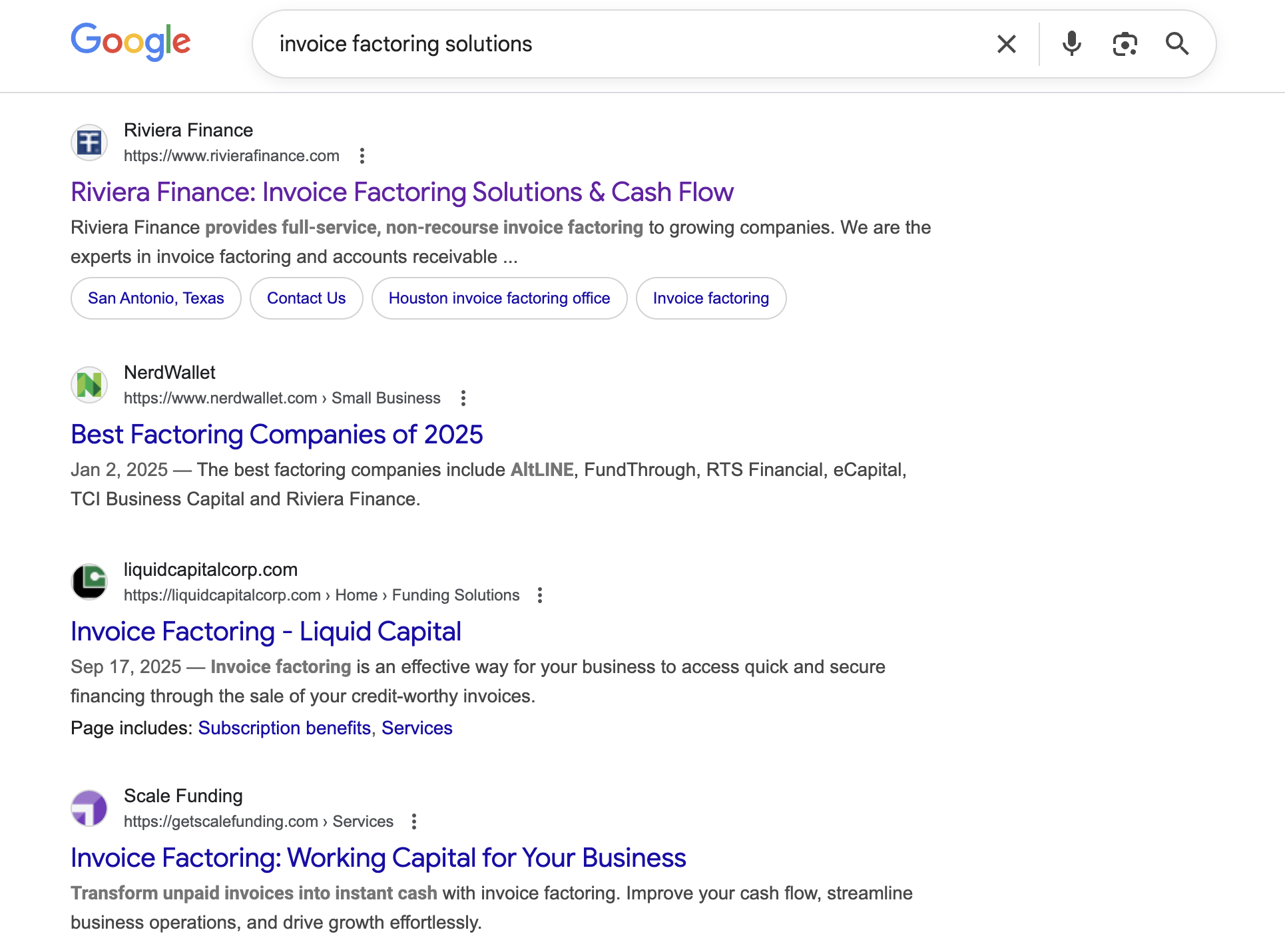
As you can clearly see, Google is ranking either listicles of the best invoice factoring companies, or the service providers that are fully dedicated to doing invoice factoring (which is Riviera Finance, ranking top in this case).
Meanwhile, DAT shows up pretty high for the keyword “invoice factoring companies for logistics companies”:
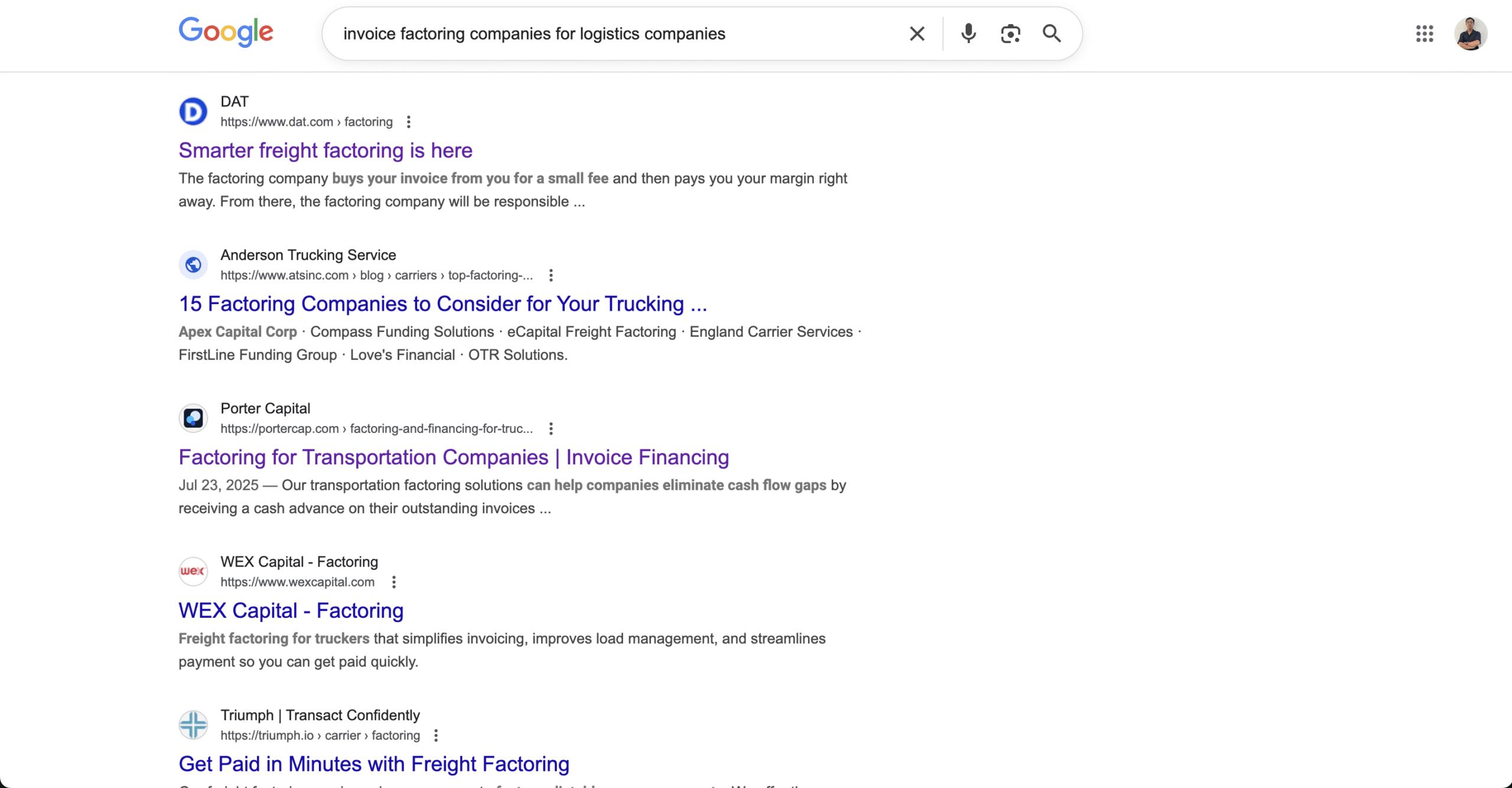
In short: Google uses the whole solution‑page architecture plus supporting content to triangulate what your business is about.
If your positioning is clear and narrow, you can out‑rank broader competitors in that niche because you speak directly to the user intent. If your positioning is broad, you may rank for many general queries but struggle to dominate the specific long‑tail ones.
Step 3. Do your keyword research
Keyword research should ideally be tied to the user journey, which looks slightly like this:
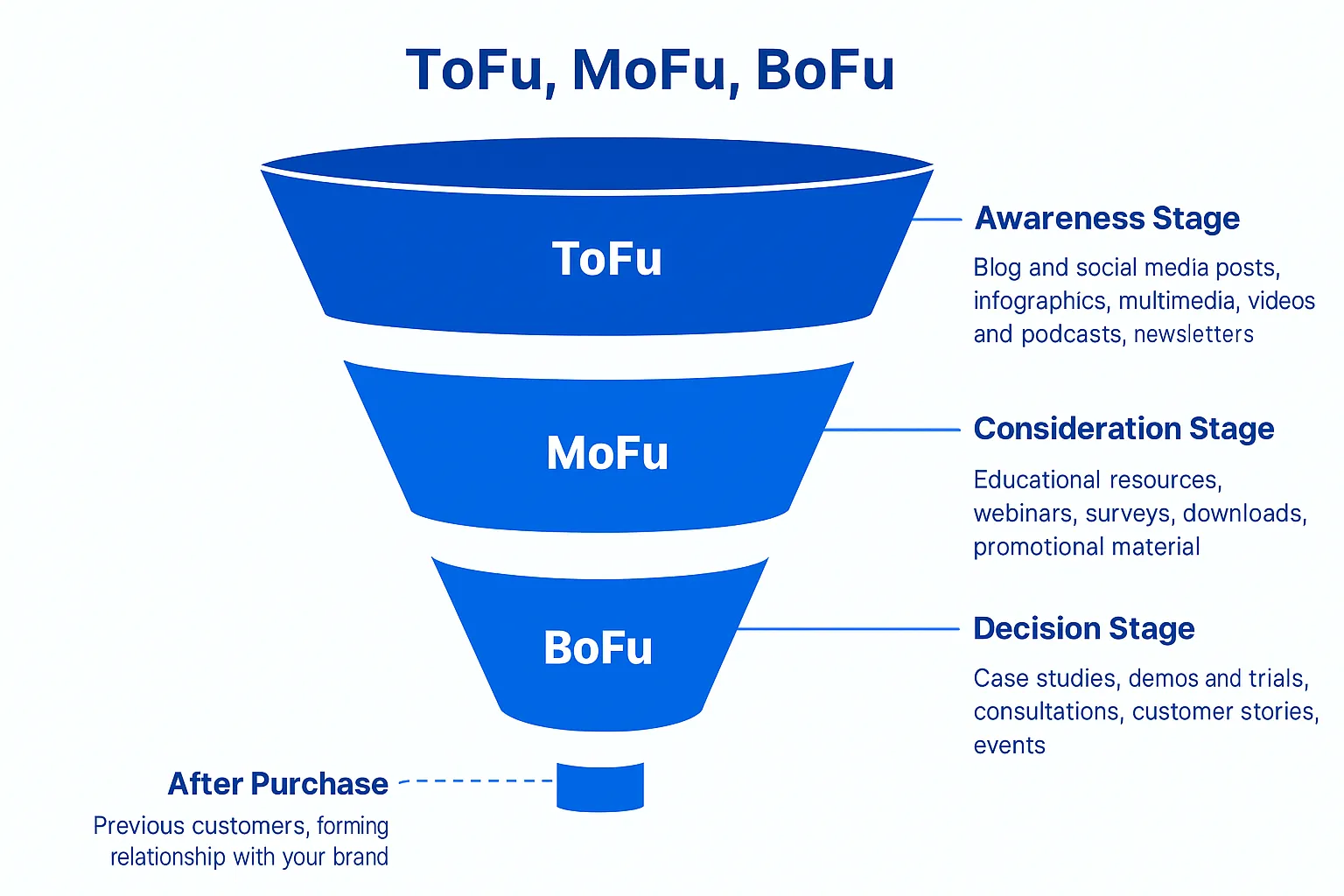
In reality, the user journey is much more complicated (like the screenshot I shared at the top of this article), but let’s just keep it simple.
Before keyword research
Before jumping into keyword research, I always start with Audience Research.
If you don’t have a solid grasp of how your audience thinks and behaves, how can you expect to create content that actually resonates?
Here are some of my go-to sources for uncovering those questions:
- Sales call transcripts – Sales know everything, literally. Connect with them, have a quick chat, and discuss what customers’ pain points they hear the most on a daily basis. If your team has a Gong subscription, simply dig into the Sales call transcripts and pick out the key problems that your product/services are trying to solve.
- Google’s “People Also Ask” – Enter terms relevant to your business to Google to get a tree of follow-up questions that reflect real user search behavior.
- Reddit and Quora – Threads like r/InsurancePros, r/FinTech, and r/Accounting are filled with questions about vendor selection, regulation pain points, or workflow hacks. These surfaces what practitioners care about that generic competitor blogs miss.
- Industry forums and fintech Slack groups – While you’re browsing through communities, observe how founders, PMs, CFOs, and compliance leads describe their pain. Use their language for your solution messaging.
I will categorize my keywords into four groups, by order of priority:
| Types of Keywords | What It Means | Why It Works | How to Find Them |
|---|---|---|---|
| Competitor Keywords | Target competitors directly to position your product as the better option. Common formulas are “X alternatives,” “X vs Y,” and “X vs [your tool].” |
People searching for alternatives of your competitors are already solution-aware and close to buying. | Simply list your competitors (that you can reasonably compete with) based on the formulas. Then use keyword tools to find comparison keywords with traffic potential. |
| Listicle Keywords | Keywords that compile multiple tools or solutions in your niche. Examples: Top 10 best tools for [your niche]. |
They capture mid-funnel users who are actively researching options and looking for the best fit. This is perfect for introducing your tool into their consideration set. | Brainstorm all of the ways your tool can be described. What use case does it have? What verticals can it serve? |
| Pain Point Keywords | These keywords address specific problems your audience faces. Examples: “how to do X,” “how to fix Y,” or “why X happens.” |
They attract users with high intent to solve a specific issue, giving you the chance to position your product as the direct solution. | Use forums like Reddit or niche communities to find pain-point questions. |
| Lead Magnet Keywords | Focus on actionable templates, guides, and strategy resources that help users create or improve something right away — like content calendars, social templates, or campaign frameworks. | These attract marketers searching for ready-to-use tools or step-by-step resources. They’re high-value, practical assets that position your brand as both useful and credible. | Look for keywords tied to templates, frameworks, and strategies for your niche. |
I’ll take a methodological approach and do keyword research for each category.
During keyword research
If you’re using a keyword research tool like Ahrefs or SEMrush, here’s a streamlined approach:
- Choose a competitor’s domain to analyze.
- Plug it into Ahrefs or SEMrush to uncover the keywords they currently rank for.
- Alternatively, enter a seed keyword to generate related search terms and variations.
- Identify low-hanging fruit, which are basically just keywords with good search volume and low competition.
- Repeat the process across multiple competitors or seed terms to expand your list.
Step 4. Create exceptional content
Now that you’ve built out a solid keyword list, it’s time to move into content production.
There’s one real differentiator in high-performing fintech content: defensibility. If your content doesn’t contain something that’s hard to replicate: proprietary data, firsthand insight, niche POVs, it’s not going to outperform.
There is one characteristic of good content: it has something that can’t be (easily) replicated by someone else.
I’ve written before about why AI has flattened the barrier to entry in content. However, although everyone can produce content, very few can actually differentiate. So the only lasting edge is uniqueness. A high-impact SEO piece (and the surrounding content strategy) should demonstrate the following:
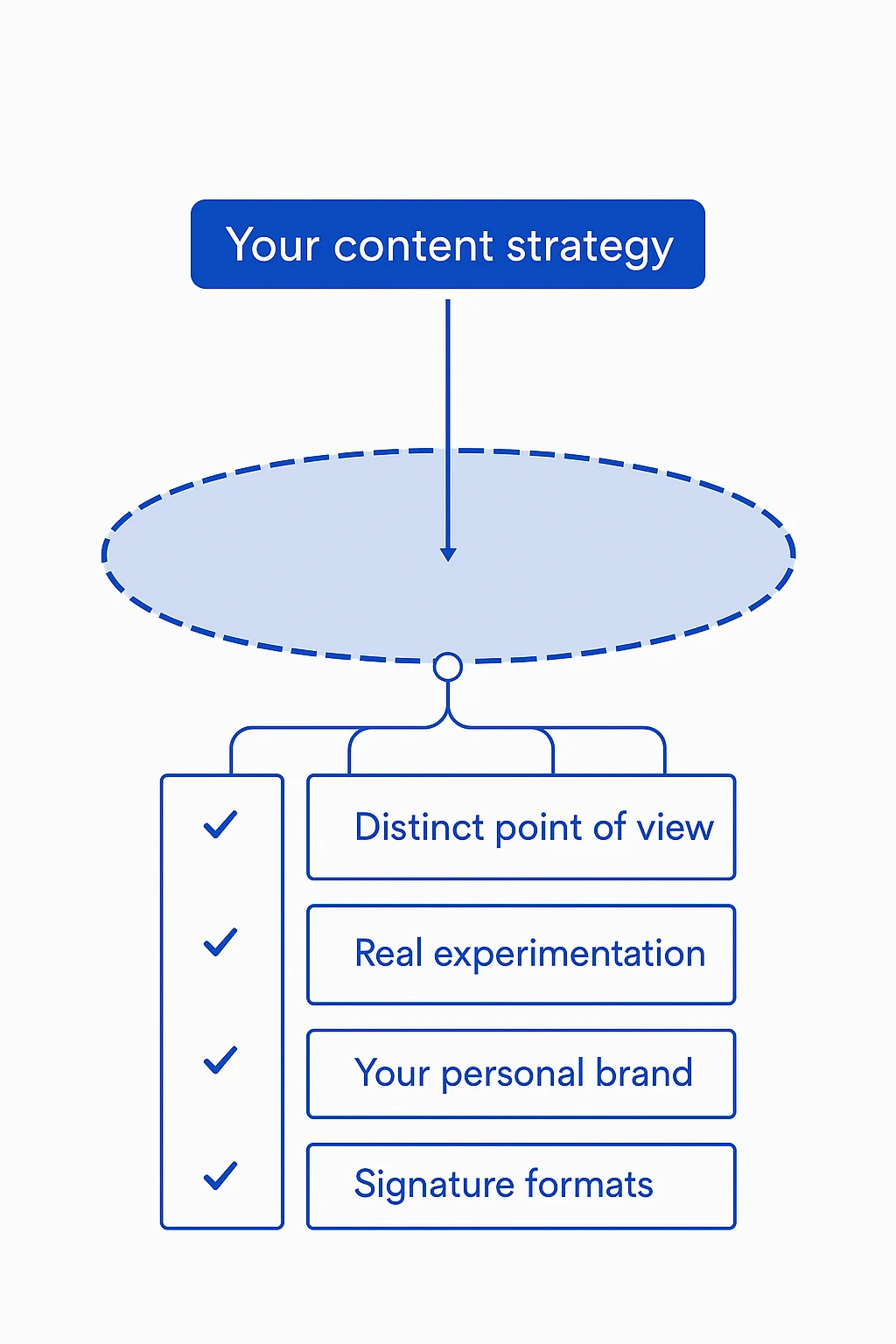
Here’s how I typically build an SEO-driven piece targeting a fintech SaaS term like “B2B SaaS marketing”:
- Localize SERP context by adjusting Google to show results for your target market: US, UK, APAC, etc.
- Search the keyword and analyze the top-ranking URLs to identify:
- What formats Google is prioritizing (case studies, guides, listicles)
- How deep the coverage goes and where the gaps are
- Any forum threads showing what real users care about
Once done, I start writing, like a real wordsmith, with all of the SEO content best practices:
- Align each piece with the exact information users expect to discover.
- Center the article around one core keyword, weaving in closely related terms where they add value.
- Craft sharp, benefit-focused titles and meta descriptions that drive clicks from the SERP.
- Structure the content using a clear heading hierarchy (H1, H2, H3) to enhance readability and visual flow.
- Keep the writing tight and digestible. Use short paragraphs, bullet lists, and plenty of visuals. Screenshots work especially well since they’re faster to create than custom graphics and far more actionable.
- Position keywords with intention, like opening paragraph, key subheads, and closing section. This method has powered SEO wins for years because it delivers.
- Build strong internal connections by linking to other relevant assets. Add external links to trusted sources within your industry. Strategic backlinking from older pages to new ones also strengthens performance.
- Write with real users in mind. Make it engaging, then fine-tune it for search visibility.
The core rule remains: write for people first, optimize for search second.
And to make the piece truly unique, I include in the article my own insight, or maybe a client anecdote if it fits. That editorial flavor is what gives content its staying power. And yes, you can absolutely blend in thought leadership in a piece of fintech content.
You don’t need a 5,000-word macroeconomic thesis to be seen as a leader. Sometimes, a one-paragraph insight in the right context does the job.
Here are some of my tips to make a blog post have more “thought leadership”:
- Built by real operators. Content should come from people with firsthand experience — those who’ve actually executed, tested, failed, and iterated. That’s the baseline we uphold at Perceptric and expect from every client asset. Insight from the field outperforms abstract theory every time.
- Takes a clear stance. Even in basic explainers, a strong perspective gives the piece structure and weight. Opinion creates hierarchy, which makes the content easier to follow and more likely to resonate.
- Primarily human-written. AI can assist, but it can’t replicate the perspective of a real writer. Content should feel alive, spontaneous, purposeful, and emotionally in tune with the reader.
- Grounded in data. Stats attract backlinks and break up the monotony of walls of text, so make sure to include strong data visualizations in your content.
Step 5. Link building
Link building is honestly the most boring and time-consuming part of SEO. You usually only have two tactics with link building. Either you reach out to another website in your niche to ask for link exchange or guest post, or you buy those links. But it’s all a very manual process.
Here are some link building tactics that I find more rewarding:
1. Write a data-rich article that you can share on social media. Journalists and bloggers love citing data sources especially if you visualize it well. This is a tactic promoted by Brian Dean from Backlinko, who has had tons of success with it.
2. You can build simple tools like a “ROI Calculator” or “Automation Cost Estimator” and you can actually attract backlinks from blogs recommending resources.
3. You can also do guest post, but instead of reaching out to “guest post sites”, who probably receive dozens of guest post request emails on a daily basis that they can’t handle, it’s better to reach out directly to founders and entrepreneurs in your niche, offering to contribute an article for them (free of charge).
This group is more than willing to have someone help them grow their visibility, and they are even happier if you can drive real business for them.
Step 6. Monitor analytics
Most content strategies fall short because they fixate on surface-level metrics like pageviews or time on page. Those figures say little about whether the content actually drives pipeline movement.
A smarter approach is syncing HubSpot with GA4 and Google Search Console:
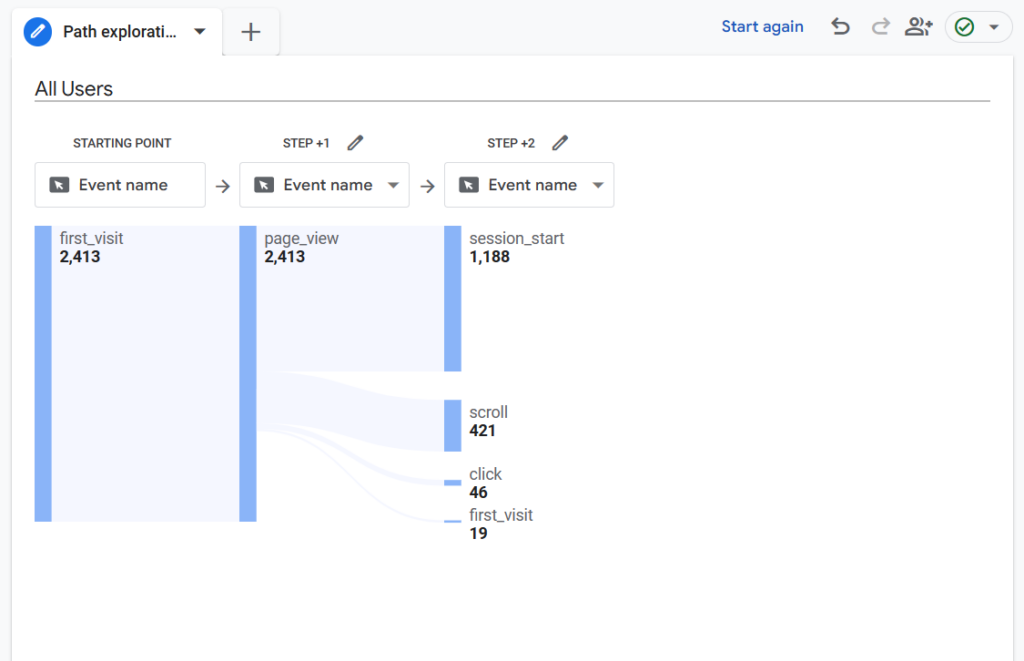
With GA4’s event-based tracking, you can map the entire user journey: landing on a blog post, clicking through to pricing, and eventually converting. Use exploration reports to track assisted conversions, such as users who engage with a blog, leave, and return later via branded search to convert. Just make sure your event tags are set up properly on all key CTAs to capture this behavior.
Content upkeep is equally critical. No article remains evergreen in a live search environment. Intent shifts, competitors leapfrog you, and stale recommendations erode trust. Refreshing high-authority content can rapidly unlock new traffic—Google rewards relevance, especially on URLs it already deems credible.
Conclusion
At its core, doing SEO in fintech (or any industry, really), is just about building trust. When you stick with proven, ethical strategies and consistently publish content that delivers value to both the user and the search engine’s expectations, your site tends to ride algorithm updates in the right direction. Over time, this approach shapes a recognizable, reliable brand. And in this space, content is the brand.
In the mean time, here are some even better reading resources for you: