

The B2B sales cycle is long. It almost never happen in isolation. Most deals run through a layered buying committee: operations, finance, technical leadership, procurement, and sometimes even legal. Each stakeholder brings their own lens, their own concerns, and their own definition of “value.”
That’s why B2B buying process looks like this:

Traditionally, the sales-led growth motion would involve a sales rep who would pitch and try and convince leaders that their brand would benefit from whichever product or service they were offering. However, a more tech-savvy buyer is now entering the arena, and they are bringing their consumer-based buying preferences along with them.
That’s when your content marketing activities come into play.
Does content influence buying decisions?
Yes, content is particularly effective at convincing buyers to make the final decision. Here are some stats about B2B buying for you:
- In a typical firm with 100–500 employees, 7 people are involved in most buying decisions.
- B2B buyers are 57–70% through their research before contacting sales. That’s why you need to invest into SEO to show up when they’re doing research.
- 90% of B2B buyers say online content has a moderate to major impact on purchasing decisions.
- 67% of the buyer’s journey now happens digitally.
- 84% of CEOs and VPs use social media to inform purchasing decisions.
- 62% of B2B buyers say a web search is one of the first 3 resources they use to learn about a solution.
- 80% of business decision-makers prefer learning about companies through articles rather than advertisements.
- 84% of B2B decision-makers begin their buying process with a referral.
Types of content that influence B2B buying decisions
1. BOFU content
Content marketing for B2B, and more specifically SEO for B2B, should always prioritize low-volume but high-intent keywords rather than the opposite. BOFU keywords are the search terms people use when they’re very close to making a purchase decision. They already understand their problem, they’ve done their research, and now they’re evaluating specific solutions. BOFU keywords help you meet them where they need you.
Those keywords usually look like this:
- [service provider] case studies in [industry]
- [vendor] alternatives
- [solution] vs [solution]
- best [category] platforms for [industry/role]
- [vendor] pricing
- [vendor] reviews
- top [industry] providers
- [solution] for [specific workflow or department]
- [solution] ROI
Most BOFU keyword has low volume, but it’s alright. People are actually competing for it intensely in the search ads. For example, this BOFU keyword “B2B SEO agencies” only has a volume of 390 in the US, but it has a cost per click of $28.76, which is pretty high. Imagine ranking on the top position for this keyword and bringing in around 200 clicks per month. That’s $5752 in ad spend you saved! If that’s not SEO working, I don’t know what is.

A good example of B2B content that has done so well with BOFU keywords is Wise, a well-known international money transfer and business banking platform. They create content focused on queries that people who want to open an international bank account might want to ask:

In those BOFU articles, your job is to:
- Address the exact problem the buyer is trying to solve
- Compare options honestly and transparently
- Explain how your solution fits specific use cases
- Provide proof through examples, data, or case studies
- Answer common objections before sales conversations
- Make next steps clear without being overly salesy
2. Case studies
Case studies influence B2B buying decisions more than almost any other content format because they reduce risk at the exact moment buyers are trying to justify a decision.
Remember: B2B buyers are putting their credibility on the line internally. Case studies provide concrete proof that a similar company faced the same problem, made a decision, and achieved a measurable outcome. That evidence makes the choice defensible.

Case studies are also uniquely persuasive because they mirror how buyers think. The structure naturally aligns with the buyer’s internal narrative: a clear problem, a credible solution, and tangible results. That structure helps buyers map their own situation onto the story and visualize success before committing.
But most importantly, case studies is a form of peer validation. B2B buyers trust other buyers more than they trust vendors, which make sense. It answers unspoken questions like “Has this worked before?” and “Who else is using this?” without sounding promotional.
Here are some recommendations for you when it comes to building case studies:
- Structure each case study around problem, solution, and results
- Focus on specific pain points
- Show exactly how the product was used in real workflows
- Quantify outcomes wherever possible (revenue, time saved, efficiency)
- Write in the customer’s voice, not marketing language
- Keep the story concise and easy to scan
If you’re just starting out, and don’t have case studies yet, here’s what I recommend:
- Start with internal/pilot use cases and document real outcomes
- Use anonymized case studies if customers can’t be named yet
- Pick a company in the niche you want to target then analyze the impact if they had used your products/services
3. Sales Enablement content
Sales and content teams rarely work in close alignment.
In most organizations, they operate in silos. Interaction tends to be reactive rather than strategic—sales asks for one-off assets, while content occasionally requests market feedback. There’s little ongoing collaboration, no shared planning cadence, and almost no joint KPIs tying the two functions together.
We asked our readers to rate the level of collaboration between their Content team and Sales team on a scale of 1 to 5, in which:
- 1 – Minimal (Rare contact, mostly ad-hoc requests)
- 2 – Low (Some shared information but mostly siloed work)
- 3 – Moderate (Occasional updates, limited joint planning)
- 4 – High (Frequent meetings, shared goals, joint campaigns)
- 5 – Excellent (Fully integrated workflows, co-owned KPIs)
And the survey result is quite fascinating:
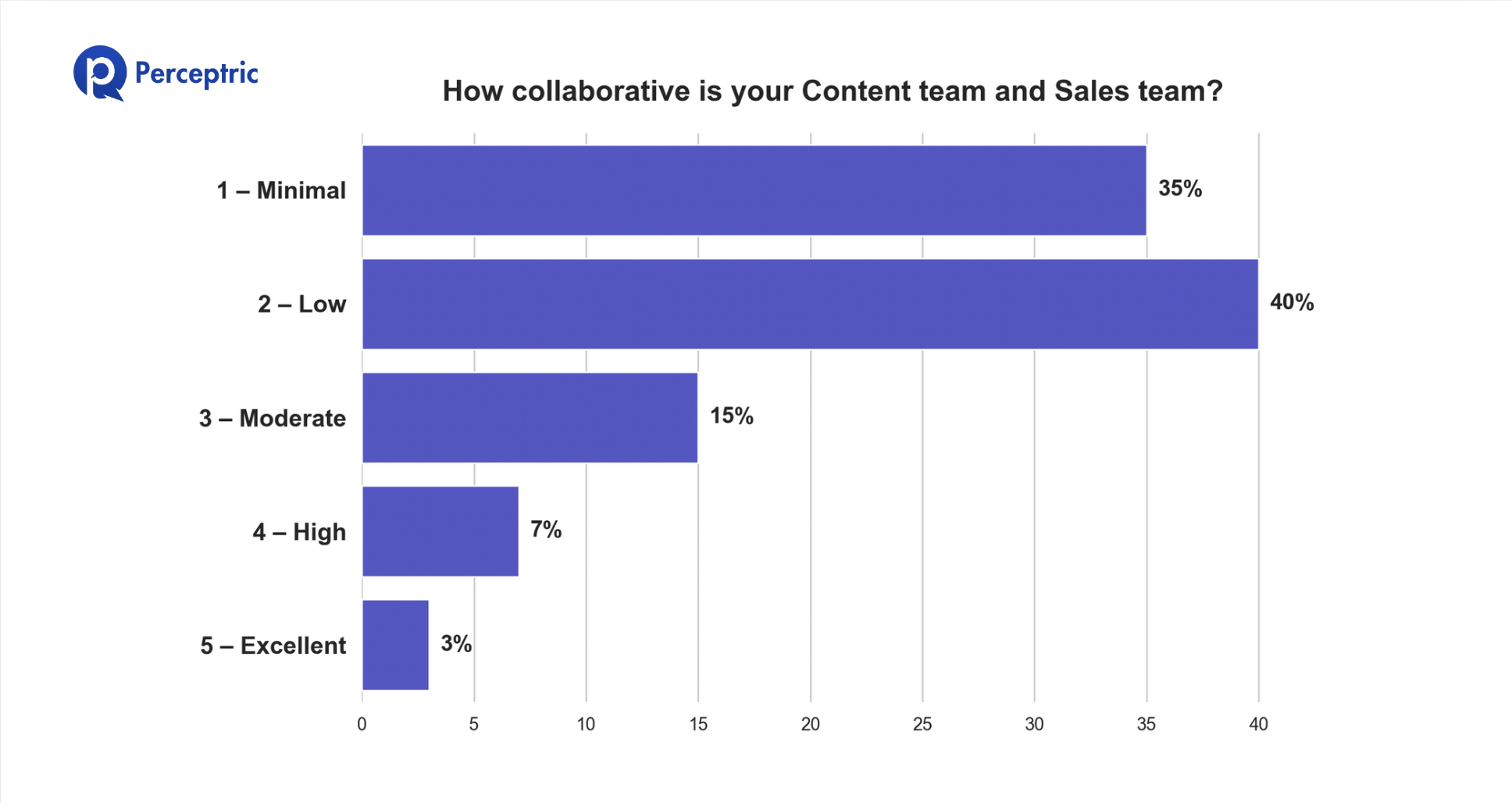
But little do they know that this partnership can potentially become a rewarding one in the long run. Content can affect sales, which affects content. It is a valuable feedback loop that strengthens both teams.
Here’s how Sales Enablement content looks like:
- This content is highly specific and situational. Instead of broad thought leadership, it focuses on concrete use cases, objections from customers, comparisons, and outcomes. Think battlecards, one-pagers, competitive comparisons, ROI breakdowns, security explainers, pricing frameworks, and short case studies tied to a specific industry.
- Good sales enablement content mirrors real sales conversations. It’s built around the questions prospects actually ask on calls: “How is this different from X?”, “Will this work for our setup?”, “What results have others seen?”, and “What does implementation really look like?” If it doesn’t help a rep answer those questions faster and more confidently, it’s not enablement.
To create Sales Enablement content, of course you need to work closely with Sales:
- teams are closest to real buyer objections, confusion, and decision blockers. The first step is to regularly listen by reviewing call recordings and scan CRM notes to understand what prospects actually struggle with at each stage of the deal.
- Next, create a simple, recurring feedback loop. This doesn’t need to be complex. A monthly or biweekly check-in where sales shares the top objections and competitor questions they face. Your goal is to spot patterns then build content around repeated problems.
Conclusion
In short, B2B buying decisions are most influenced by content that builds confidence in your products/services:
- BOFU content that helps buyers compare options, evaluate fit, and make a final decision
- Case studies that provide peer validation and prove real-world results
- Sales enablement content that answers late-stage objections and accelerates consensus
- SEO-driven content that shows up during active research, before sales is involved
- Practical, specific content that mirrors how buyers actually think and decide