
Engineering is a complex field, and doing SEO for engineering companies require a deep understanding of the terminologies.
In this guide, I will break down exactly how those dynamics work and what it means for your search strategy.
Here’s what I’ll walk you through:
- What makes SEO for engineering companies uniquely challenging (and more interesting)
- How the core principles of SEO stay familiar, but the execution changes
- A full walkthrough of the SEO process tailored for complex engineering sales cycles
- Best practices for content that resonates with engineers
- And why real results here require going well beyond SEO alone
What is SEO for Engineering companies?
SEO for engineering is all the activities you do to rank your technical engineering content and pages on Google when people search for your products/services.
Here’s an example of good SEO from ProtoLabs, a manufacturer that provides Custom Plastic Injection Molding. If you’re in the US, and you search for “Custom Plastic Injection Molding”, it’s likely that you will land on this page:
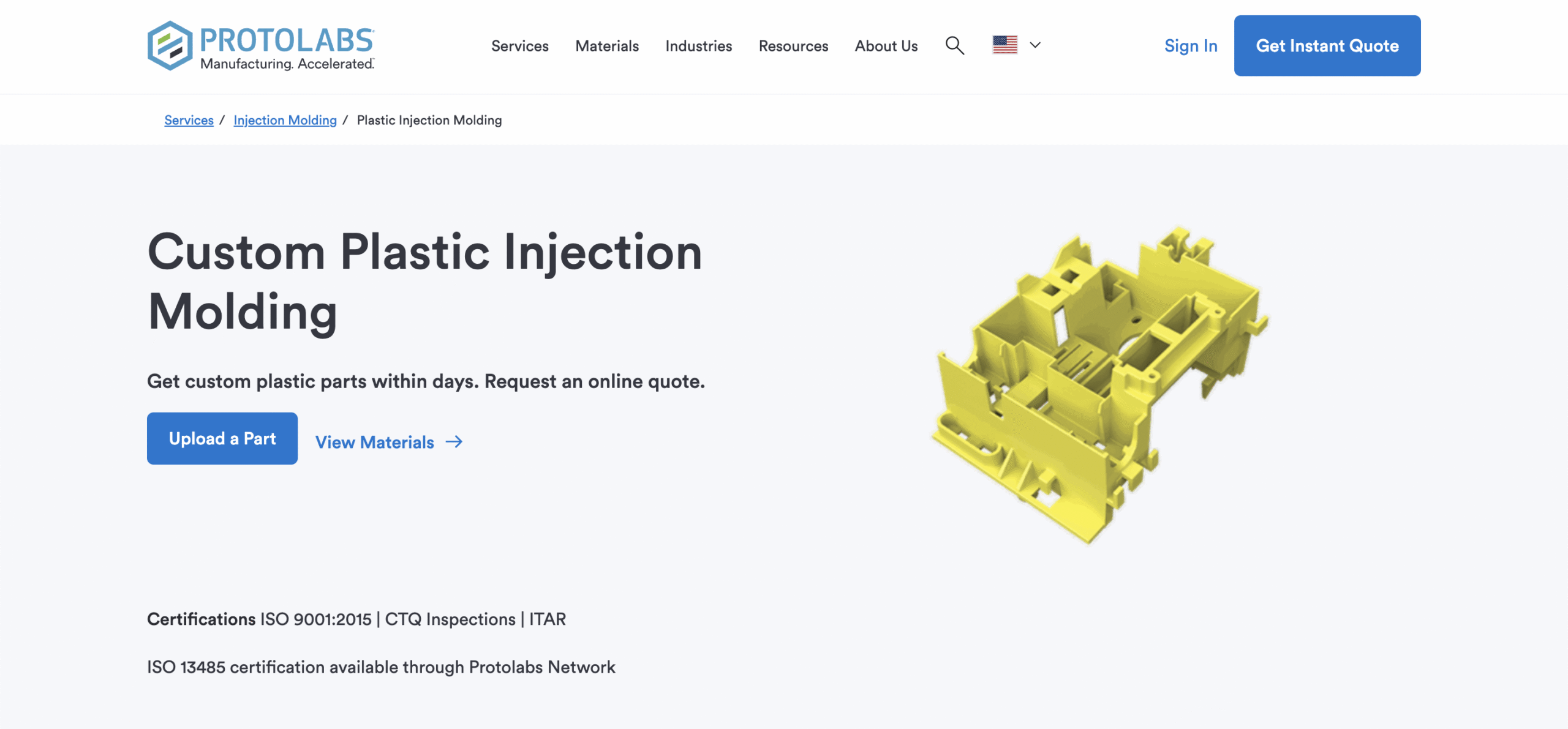
And you can order that custom plastic part online. ProtoLabs acquired 4K traffic/month from this website, and even if just 10% of that converts into a sale, they still made 400 sales, all just with 1 webpage that took probably 1 day to make.
Why Engineering companies need SEO?
- SEO brings Visibility: Ranking higher in search engines like Google can place your company in front of potential customers who are actively seeking engineering solutions. If you are a civil engineering firm, and you show up on Google when people search for “civil engineering firm”, that’s a competitive advantage.
- SEO can generate leads: When you optimize your content for specific keywords and phrases that are relevant to your business, you can draw in clients who are searching for the exact services you offer.
- More credibility: In engineering, you would want establish trust and credibility in your customers before you reach the final buying decisions. If Google trusts your website to show you up on the first page, it’s likely that you have built good authority in the niche.
Does SEO work for Engineering companies?
Yes, SEO absolutely works for engineering companies, but the rules are a little bit different.
Engineering is a complex, technical field, and SEO in this space is less about catchy copy and more about precision and trust.
SEO works here because search is often the first serious step in a long, technical buying process. If your company shows up at that moment, you are effectively inserting yourself into the shortlist before sales conversations even begin.
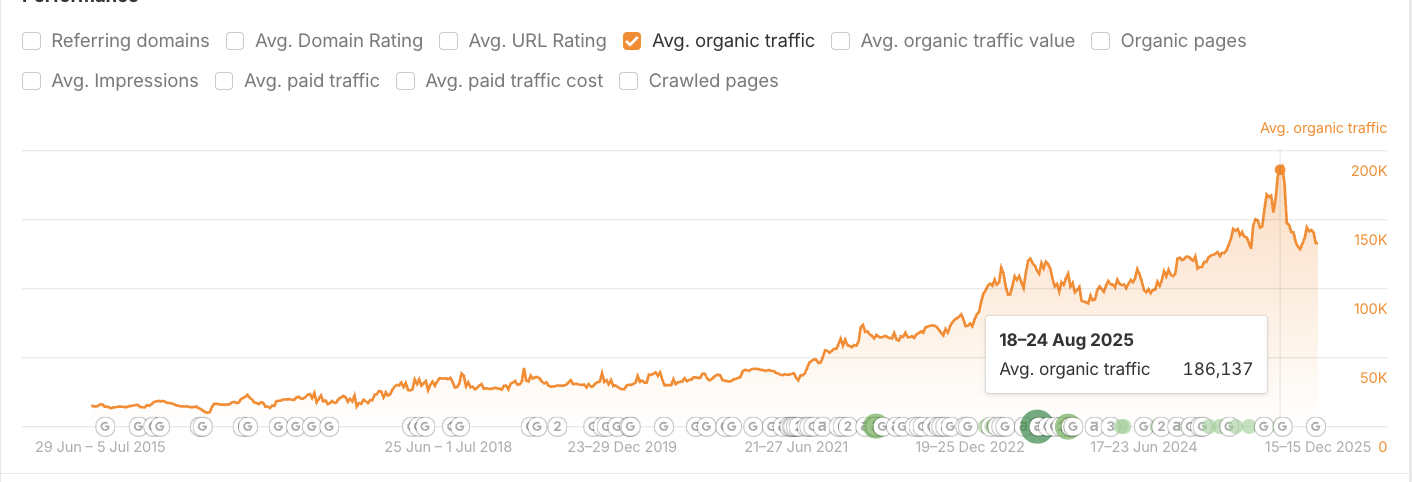
If you want to see numbers, here is what ProtoLabs achieved through doing good SEO for Engineering: 186K website visits per month. Imagine just 1% of that turning into sales per month. And they have been growing this number steadily since 2015.
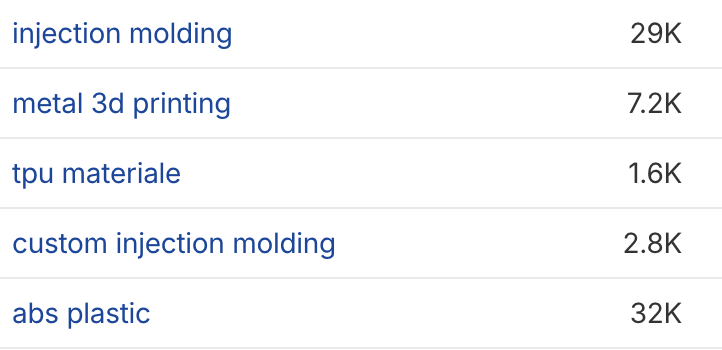
And they ranked for a lot of the important engineering keywords too. These are their highest ranking keywords (which means if you search those terms it’s likely that you’ll see them on the top). If you’re a manufacturer in injection molding, you’d love to be ranked on the top when people search that keyword too.
How much ROI can an Engineering company get from SEO?
The answer is A LOT of ROI, but only when you do SEO correctly.
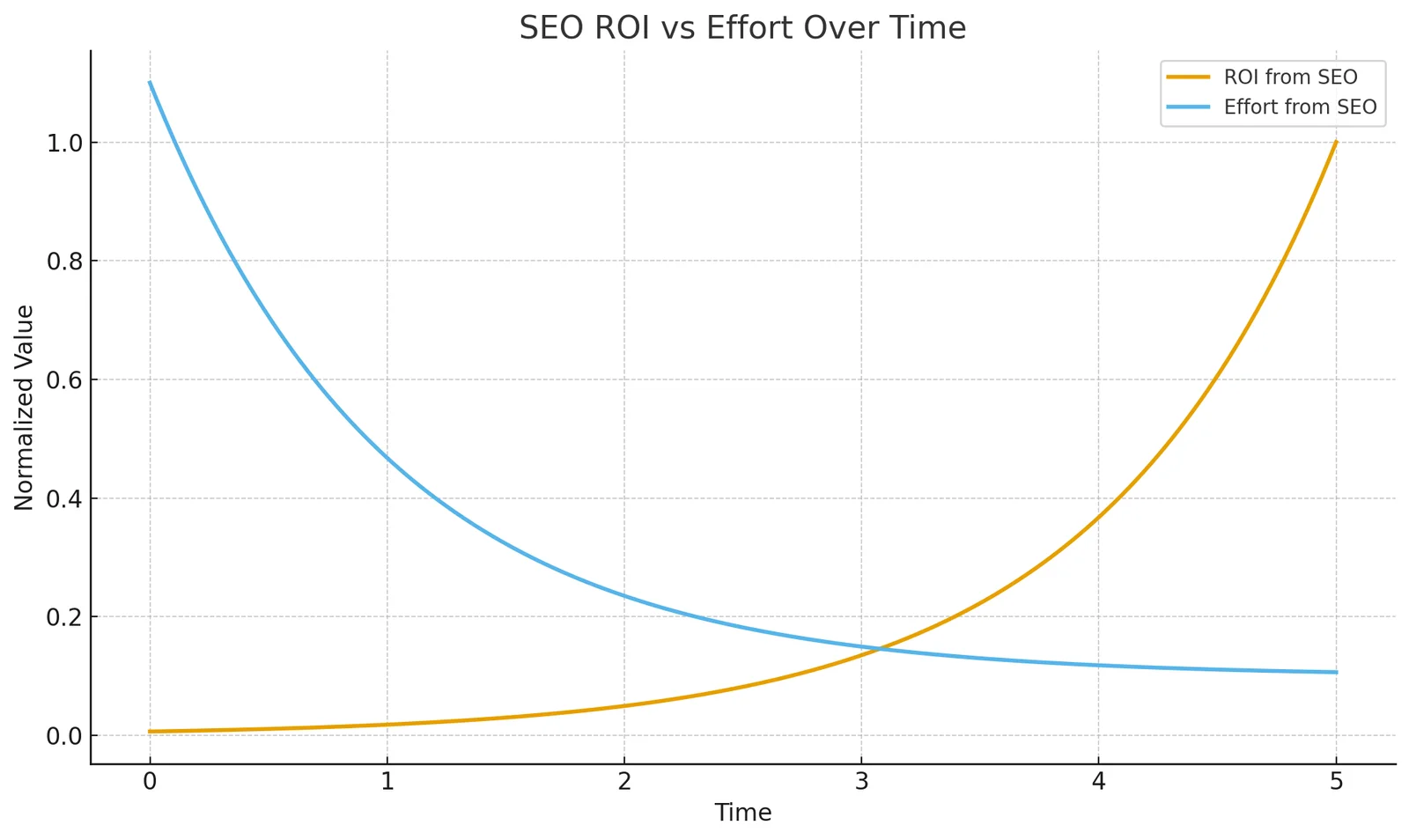
Remember: it takes a little bit of time to see result from SEO in Engineering. Here’s why it takes a little bit long to see ROI from doing SEO for engineering firms:
- Google has no reason to trust a new site yet: When a site is new, Google has almost no historical data about it. It doesn’t know whether your pages satisfy users, whether they lead to good outcomes, or whether they’ll disappear in six months. Because search is risk-averse, Google surfaces new sites cautiously and in low-impact queries first. This slows early ROI by design.
- Every new page has to be tested, not rewarded: Google doesn’t assume a page is good; it tests it. New pages are shown to a small number of users, often in lower positions or long-tail queries. Google watches what happens next. If users click, stay, and stop searching, the page earns more exposure. This testing loop takes time and repetition across many queries.
- Authority compounds, but only after enough evidence exists: just like investing, SEO needs time to compound results. Each page that performs acceptably adds a small amount of trust. Over time, Google becomes more willing to surface new pages from the same site. But this compounding only starts after enough pages have proven themselves. Before that threshold, everything feels linear and slow.
But once the SEO effect kicks in, you’ll see it was a smart decision to have invested into doing SEO for your Engineering firm.
How to do SEO for Engineering companies (6 steps)
Here are the 6 steps I use to grow SEO of many Engineering companies I’ve worked with:
Step 1. Decide your Topical Authority
Topical authority is a term used in the SEO community to describe how well a website is known as a subject matter expert in a given topic.
The ultimate goal of doing SEO is to make your website become the BEST in Google’s eye for a very specific topic.
Instead of asking “How do we do SEO?”, the more useful question is: What do we want our engineering company to be known for in search?
- A Civil Engineering Firm specializing in infrastructure?
- A Mechanical Engineering Company focused on manufacturing systems?
- An Electrical Engineering Firm known for power systems?
- A Manufacturing Engineering Company centered on automation?
- A Materials Engineering Company known for composites, metals, polymers?
- A Robotics or Automation Engineering Firm specializing in control systems?
- A Environmental Engineering Company focused on water treatment?
- A Software or Systems Engineering Company serving complex technical products and platforms?
Once Google sees your site consistently performing across the topic you chose, it starts treating you as a reliable node in that space. Whenever people search for something in that topic, Google shows you.
Step 2. Research Bottom-of-the-Funnel Keywords
Once you know what you want your engineering firm to be known as, it’s time to choose the keywords to target.
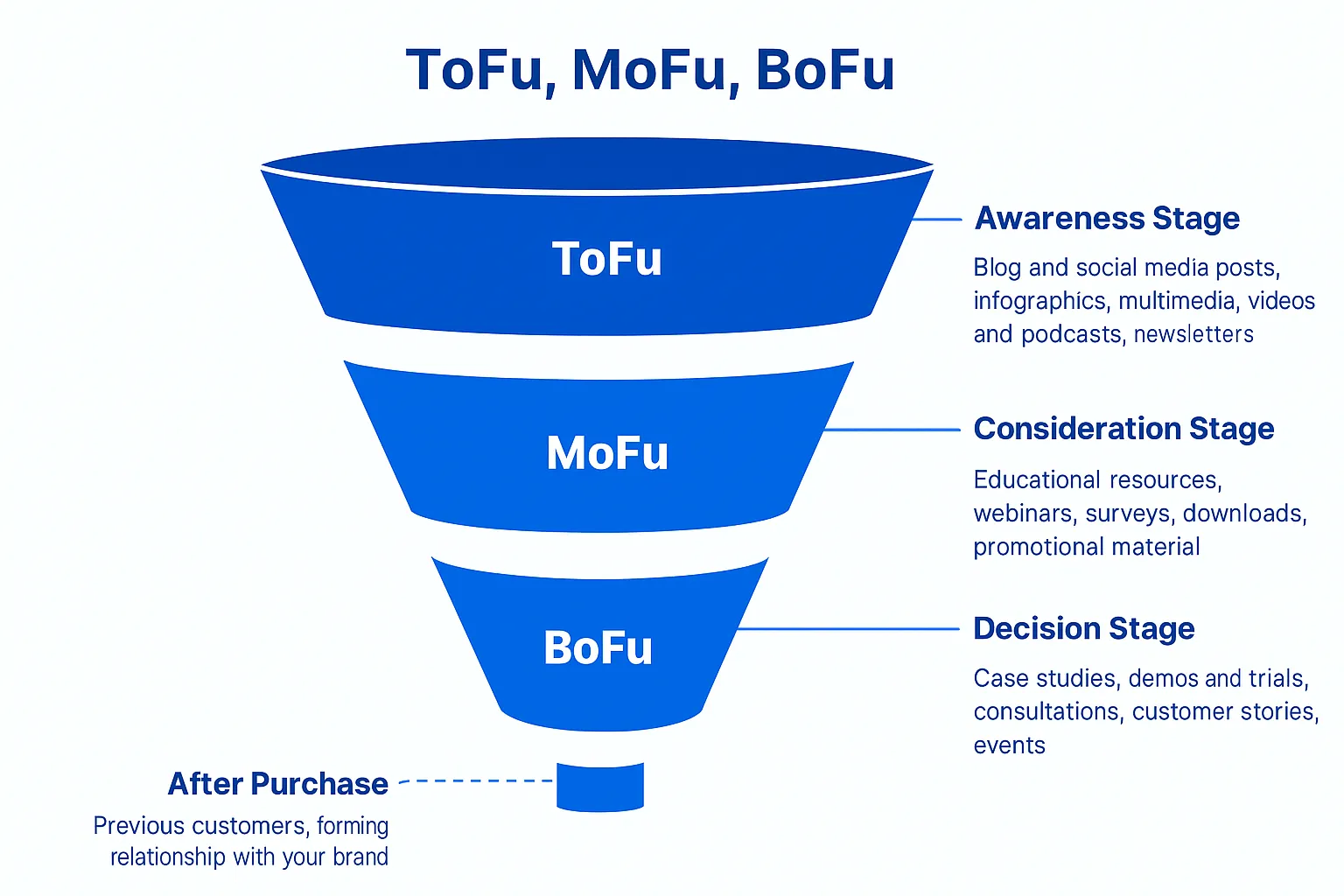
I always advocate for starting at BOFU stage. Bottom-of-the-Funnel.
BOFU keywords are the search terms people use when they’re very close to making a purchase decision. They already understand their problem, they’ve done their research, and now they’re evaluating specific solutions.
These keywords usually look like:
- [Vendor] alternatives for engineering applications
- [Engineering solution] vs [engineering solution] for technical use cases
- Best [engineering software / system / equipment category] for [industry, discipline, or engineering role]
- [Vendor] pricing for engineering services or systems
- [Vendor] reviews from engineering teams or technical buyers
- Top [engineering discipline] providers for [industry or application]
- [Engineering solution] for [specific engineering workflow, process, or department]
- [Engineering solution] ROI for [project type or operational context]
- [Engineering service provider] case studies in [industry, sector, or application]
For example, in Perceptric case, one of our BOFU keywords is “Top 7 SEO Agencies For Technology Companies“

We ranked for this keyword relatively easily, and since people who search for this phrase are in research mode for their SEO agency, they immediately put Perceptric on their contact list. The same can be true for your engineering company.
Step 3. Create content that people need
Once I know what topic I want to claim authority for, I start writing, like a real wordsmith, with all of the SEO content best practices:
- Match my content to what users actually want to find.
- Focus on only one main keyword and include related supporting keywords naturally.
- Write catchy, benefit-driven titles and meta descriptions to boost click-through rate.
- Use proper heading hierarchy (H1, H2, H3) for structure and scannability.
- I always keep my writing clear, concise, and engaging with short paragraphs, bullet points, and of course, tons of visuals. Screenshots are great because they are much easier to produce compared to graphics, and they deliver more practical information compared to visualized images.
- I place keywords naturally in key spots: intro, subheadings, and conclusion. This has always been done for decades, because it absolutely works!
- I then add internal links to related pages and external links to credible sources. I always link to reputable sites in my niche rather than generic informational sites like Wikipedia. Sometimes it helps that you go back to old pages to link back to your new pages too.
- Always write for humans first, then optimize for search engines.
At the same time, I also incorporate my personal anecdote throughout my entire article. An article should always drive home the idea that my brand (and my targeted topical authority) stands for. A little bit of personal anecdote doesn’t hurt SEO. Quite the opposite, it even boosts SEO up.
Step 4. Optimize for Local SEO
Since a lot of Engineering companies operate locally, it’s a good idea to optimize for local SEO.
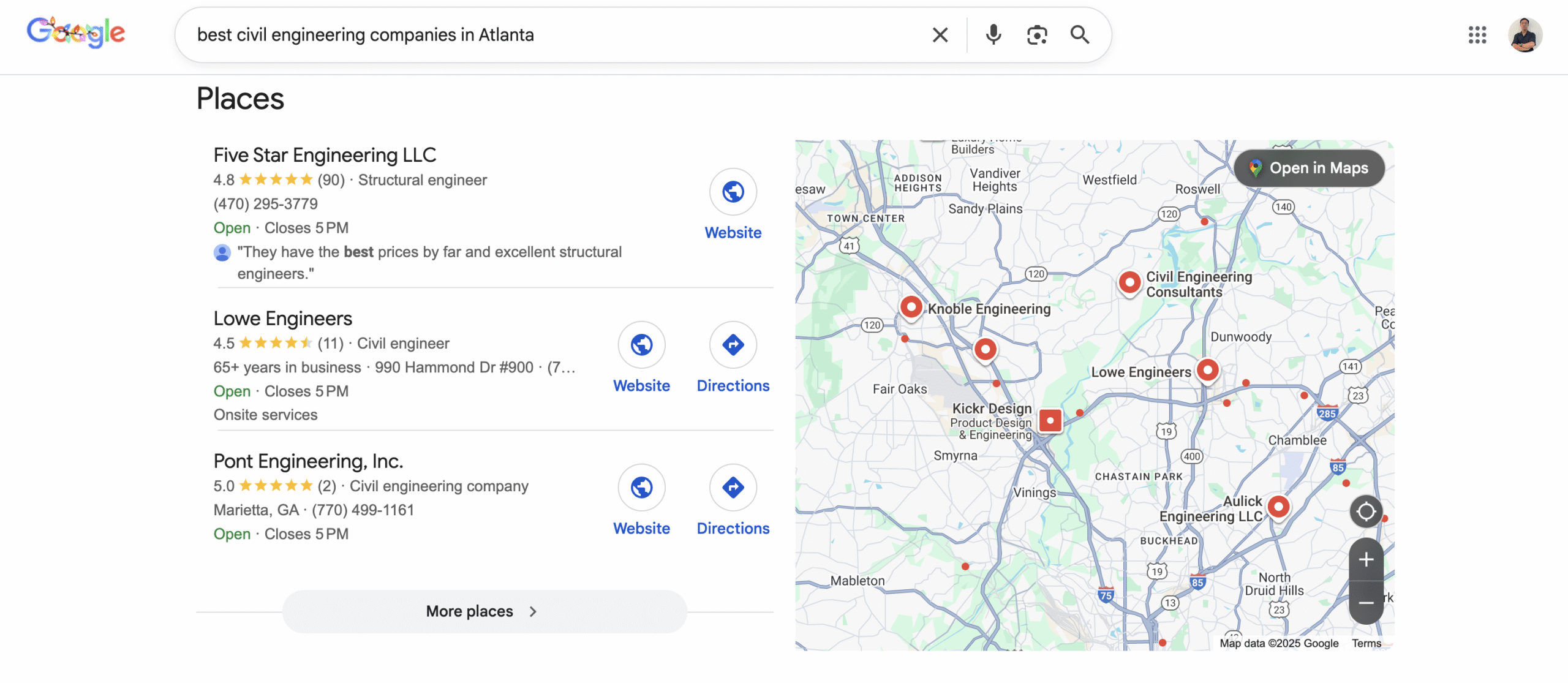
Local SEO helps engineering firms appear more prominently when potential clients search for services in a specific region. It signals to Google where you operate, what engineering services you provide, and how credible your firm is, which directly influences visibility in both map results and standard search listings.
For engineering companies, this is especially important because buyers often look for:
- Regionally licensed or code-compliant firms
- Providers with local project experience
- Teams that understand local regulations, utilities, and site conditions
When someone searches for engineering services (e.g., “structural engineering firm near me” or “MEP engineers in Austin”), Google evaluates:
- Relevance: How closely your firm’s services, specializations, and business profile align with the search (e.g., civil, structural, geotechnical, MEP).
- Distance: How close your office or service area is to the searcher’s location.
- Prominence: How established and trusted your firm appears based on reviews, citations, project mentions, and overall online visibility.
You also need to optimize your Google Business Profile (GBP). Your Google Business Profile is a free listing that can appear in Google results. Optimizing your profile increases the likelihood of ranking highly when potential customers search for relevant terms, making them more likely to contact or visit you.
In your GBP, provide details such as:
- Contact information
- Opening hours
- Photos and videos
- Business attributes (e.g., Wi-Fi availability, outdoor seating, etc.)
It should look like this:
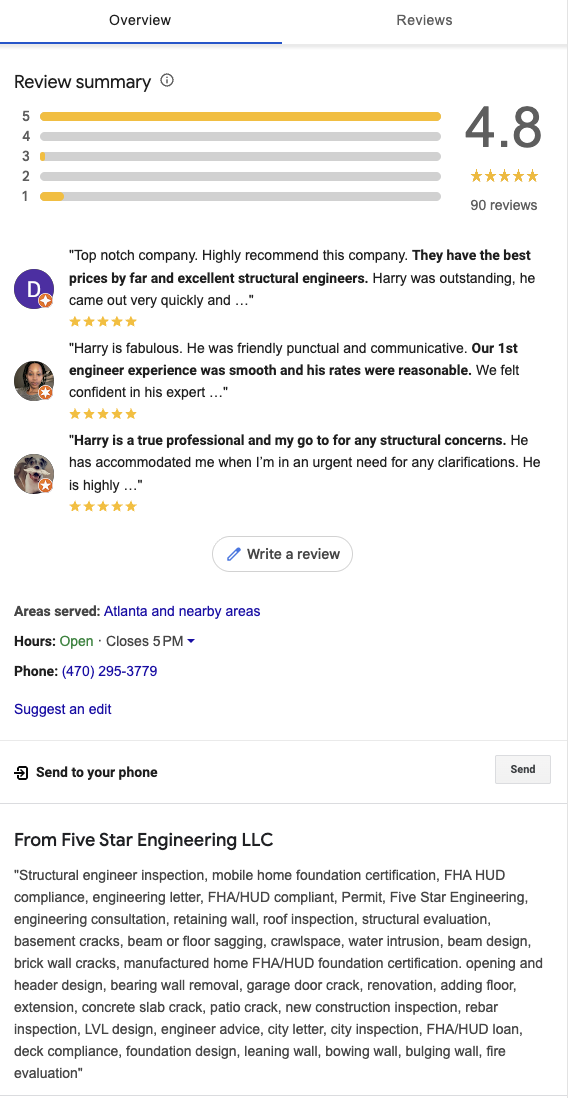
Here are some action items I highly recommend:
- Keep Your Business Profile Active: An active Business Profile shows Google and users that you’re an engaged business owner, which can improve rankings and attract more customers.
- Get and Monitor Local Citations: Citations are online mentions of your business’s name, address, and phone number (NAP) that typically appear in business directories and on social media profiles. NAP citations are important because Google may use them to verify that your business information is accurate and trustworthy.
- Encourage and Respond to Online Reviews: Aim to get reviews on Google, as they’re visible in search results and influence rankings.
How to do Technical SEO for Engineering Companies?
Technical SEO is the basis for any Engineering companies’ website. Without solid technical SEO, your website won’t even be considered in Search Engines, let alone ranking high. However, if you have a decent web developer, usually technical SEO is already properly done for you. You don’t have to worry too much about it.
Here are the action items for Technical SEO you should do:
- Fix crawl errors and broken links
- Ensure important pages are indexable (no
noindex, blocked resources, or robots.txt issues) - Remove or consolidate duplicate URLs and set correct canonicals
- Create and maintain clean XML sitemaps
- Improve site structure so key pages are within 2–3 clicks
- Add clear internal links between related services and pages
- Optimize page speed and Core Web Vitals
- Compress and properly size images, diagrams, and PDFs
- Remove or defer unnecessary JavaScript and third-party scripts
- Ensure full mobile usability across all templates
- Fix layout shifts and rendering issues
- Implement structured data (Organization, Service, LocalBusiness where relevant)
- Use descriptive, consistent URL structures
- Secure the site with HTTPS and correct security headers
- Monitor index coverage and performance in Google Search Console
How to do link building for Engineering companies?
Link building is honestly the most time-consuming part of SEO, but that’s what drives you SEO forward.
Remember, the core technology behind Google is PageRank, which works “by counting the number and quality of links to a page to determine a rough estimate of how important the website is”. The underlying assumption is that more important websites are likely to receive more links from other websites.
Here’s the graph explaining the mechanism of PageRank. If you want to get all nerdy and technical, check out the Wikipedia page about PageRank.
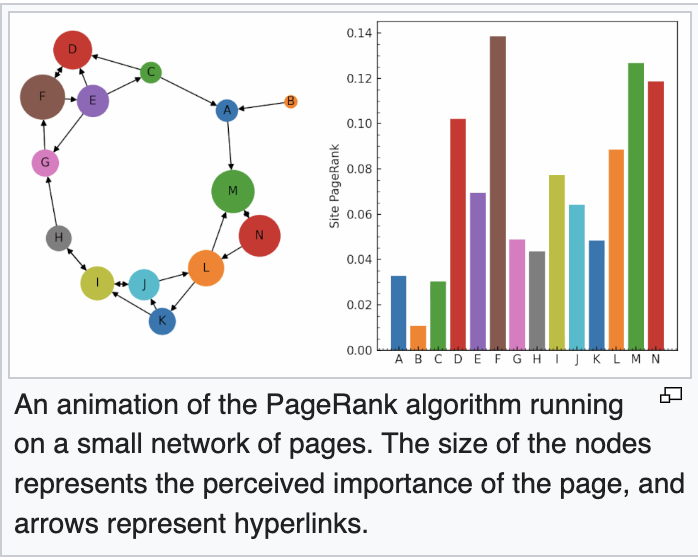
Google highly recommends that you let links build naturally. However, you can always invest in some link building tactics for the more competitive keywords.
Here are some link building tactics that I find rewarding:
- Get listed in professional engineering associations and licensing bodies
- Earn links from project partners, contractors, and architecture firms on completed project pages
- Publish technical case studies that suppliers and clients can reference and link to
- Contribute expert commentary to industry publications and trade journals
- Secure links from university research partnerships and academic collaborations
- Be cited in local government, infrastructure, or public works project pages
- Create authoritative technical resources that vendors and software providers reference
- Sponsor or speak at engineering conferences and earn links from event sites
- Obtain links from certification bodies, standards organizations, and compliance resources
- Get featured in regional business journals for major projects or expansions
- Collaborate with equipment manufacturers on application notes or implementation guides
- Reclaim unlinked brand and project mentions across the web
What you should not do when it comes to SEO for Engineering companies?
If you’re not careful, it’s easy to venture into bad SEO practices that can do more harm than good for you. I highly advise against:
- Chasing high-volume keywords that have no connection to real engineering buying intent
- Publishing generic blog content that lacks technical depth or real-world applicability
- Over-optimizing pages with repetitive keywords instead of clear, precise language
- Buying low-quality backlinks or participating in link schemes
- Creating thin location pages with no proof of local experience or projects
- Ignoring internal linking and leaving important pages buried or orphaned
- Failing to involve engineers or subject-matter experts in content creation
- Measuring success by traffic volume instead of qualified leads and project inquiries
Top SEO agencies for Engineering companies
When it comes to doing SEO for Engineering, it’s important to have a team who understands the complexity of this field. Most generic SEO agencies don’t really “get” Engineering. There are a lot of communication nuances that only people who work in the field can convey effectively.
Here are the top 3 SEO agencies with proven track record for Engineering companies that I highly recommend:
1. Perceptric (Best for all B2B SEO/content marketing needs across all technical niches)
Perceptric is a B2B SEO and B2B content marketing agency purpose-built to solve content needs of technical products and services. It combines the best practices of content marketing with the technical expertise of its internal team to bring you a content service that is both efficient and effective.
Think of pages like:
- Best [process] manufacturer for [industry]
- Top [process] suppliers in [region]
- [process] for [specific part]
- [material] manufacturing for [use case]
- Fix [manufacturing problem] supplier
This is the kind of keywords that drive leads and bring customers to you.
Not just that, our writers are all carefully selected. They come from real technical backgrounds, through training, experience, or both, so we can produce content that advanced users actually trust. With Perceptric, you get a team that can scale smoothly, adjust to changes on either side, and keep the work moving without interruptions.
2. Thomas (Best for manufacturing SEO backed by directory dominance)

Thomas is an SEO agency for manufacturers that offers industrial keyword targeting, directory optimization, product taxonomy SEO, and procurement-focused content. They help manufacturers appear where engineers and buyers search for suppliers.
3. Windmill Strategy (Best for industrial websites SEO for technical buyers.)

Windmill Strategy is a comprehensive marketing agency for manufacturers that offers technical site optimization, engineering-use-case keyword research, and UX-aligned content. They help industrial companies rank for complex specification-driven queries.
Conclusion
At the end of the day, I think that doing SEO for engineering companies (or for any industries) is basically building credibility. If you stick to white-hat practices and consistently create content that genuinely serves both your audience and Google’s intent, algorithm updates will usually work in your favor.