

I have been consistently writing content across a wide range of industries (from the most unimaginably boring to the unbelievably fun ones).
Let me tell you, B2B is where is real money is for content marketing. Both in terms of earning potential for the writer and revenue potential for the company.
And it’s not too difficult to see why.
If you’re a B2B company (bonus point if you’re in B2B SaaS), and you’re considering investing in content marketing, this article will show you its value.
Why content marketing is so important for B2B?
1. B2B is where (serious) content consumption takes place
Buyers in B2B are more serious than those in B2C.
In B2C, buying decision is based a lot on emotions, hype, FOMO. Of course, there are niches where buyers put more thought into their buying decisions, but ultimately the level of research needed for a B2C product is usually nowhere near that of a B2B product.
Think about it: you don’t want to research for months just to buy a piece of clothing, or a soda can. Content is generally shorter-form and more entertainment-driven in B2C.
It’s different in B2B, where the stakes and price points are higher, decisions are committee-based, and buyers self-educate for months.
There is a much heavier reliance on research-oriented content. And that’s where content marketing comes in.
But of course, content marketing is not ‘posting content and hoping that it brings in leads”. You need to think carefully about a content marketing strategy tailored for your B2B niche:
- Who is the audience? (CFOs care about cost savings, engineers care about integrations, operations care about efficiency.)
- What are their pain points? (This defines your topics.)
- Where do they consume content? (Industry forums, LinkedIn, specialized newsletters, analyst sites)
- What format matches each stage of the journey? (Blog posts for awareness, whitepapers and ROI calculators for consideration, case studies for decision-making.)
Your audience pain point is the starting point of your content marketing. That’s exactly what they are searching for, and they are ready to actually read your content if you know what you are talking about.
And that’s the real tricky part of content marketing. It’s not about writing SEO-compliant articles or the most punchy headlines, but writing guides that your audience genuinely and desperately needs to meet their targets.
Here’s a sample of the content marketing strategy I built based on audience pain points in Cybersecurity:
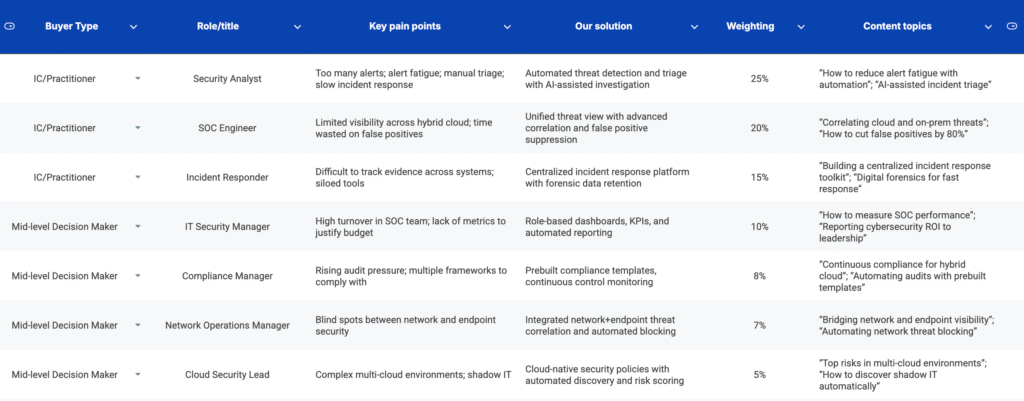
📚 Read more: The B2B content marketing strategy checklist you’d love
2. Good content marketing differentiates your brand
If you actually want to invest into content marketing for your B2B business, then treat it as a branding move.
Good content is powerful when it’s intertwined with brand building.
You cannot win at content marketing by talking about the same thing everyone is talking. Why? Because there’s an ocean of similarly-sized, similarly sophisticated B2B companies out there offering similar solutions.
Good copywriting sets you apart from the noise.
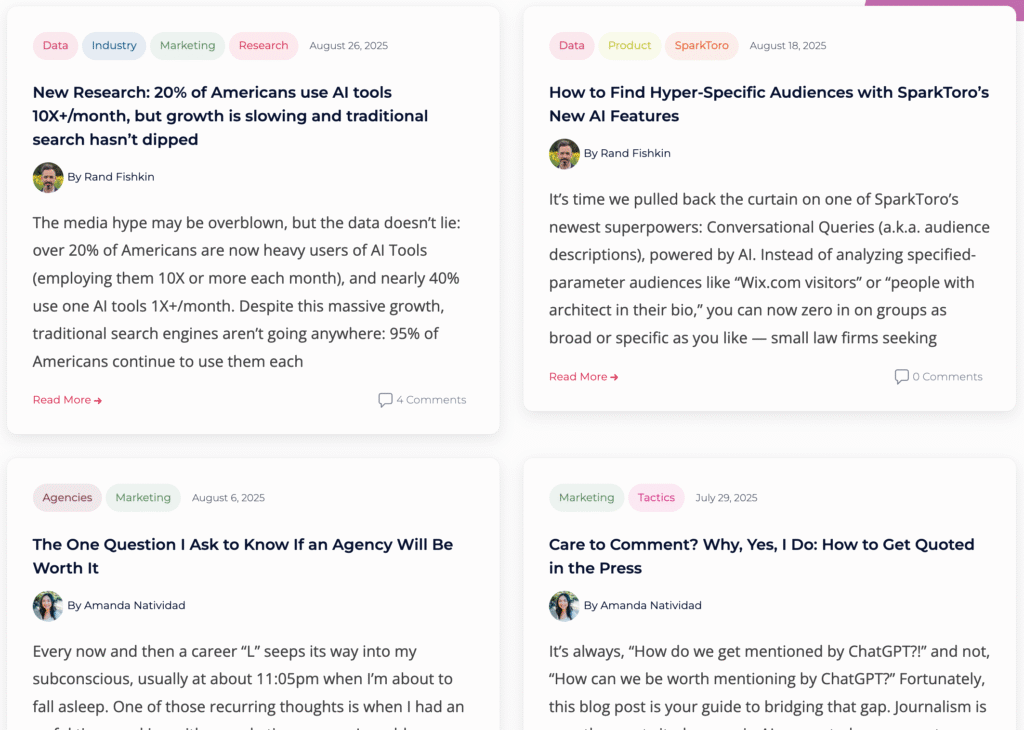
For example, SparkToro, an audience research tool, publish only short-form articles that contain golden nuggets of insights that readers don’t normally find anywhere else. This establishes themselves as a brand that “knows what they’re talking about”, and that along is more valuable than any SEO keywords.
📚 Read more: Why you must go beyond SEO in content marketing?
3. Content marketing allows you to grow SEO moat
Yes, once you publish enough SEO-driven content and rank for them, you should have a strong SEO moat that acts as an entry barrier to other competitors in the field.
However, I do believe that content marketing should not be entirely SEO-driven. In the long run, SEO-driven (only) content is really harmful for the business, because:
- You are chasing keywords and ended up writing watered-down tutorials written for algorithms rather than decision-makers
- When everything you publish is designed to rank on Google, you eventually drift toward sameness. You start producing what everyone else is already writing about because it’s low-risk, high-volume content.
- SEO changes. In the past, SEO has been touted as the channel of stability, but we know that Google updates its algorithm constantly. What ranked last month might vanish tomorrow. If your content strategy is 90% reliant on SEO traffic, you’re gambling future pipeline on forces outside your control.
But (and it’s an important but), SEO is extremely valuable when you chase the right keywords.
By order of importance, B2B content marketing should focus on:
- BOFU (Bottom-of-the-funnel) keywords: this is where prospects are ready to buy
- JTBD (Job-to-be-done) keywords: this is where Zapier is doing really well. They write really comprehensive articles showing how to accomplish certain automation-related tasks while positioning their product as the go-to solution
- Underserved information articles: these are really niche informational keywords that your competitors have not fully capitalized on and you know that you can create a better article to address them.
- General information keywords: these are the What-is articles that industry leaders don’t tend to search, and it’s usually a waste of time creating and optimizing for them.
Most importantly, SEO content marketing must be balanced out by non-SEO content. That’s when SEO can maximized its potential.
How content marketing should best be done in B2B?
Here are some of my principles for doing content marketing in B2B:
- Be unapologetically authentic and original: in the sea of AI sameness, standing out is a must. In fact, it’s even much easier to stand out than before as long as you define a clear writing voice. Readers connect with content that is authentic and showcases strong opinion/perspective, and if you nail that, you have successfully accomplish your brand awareness goal.
- Map your content goals with real customer pain points: sit down with Sales/Engineering/Product Support and have a chat. Pick their brains on the actual problems customers are facing, not what you assume that customers are facing. With insights from the trenches informing content, your content marketing strategy becomes more grounded and resonates better with the readers.
- Data, data, data: it’s hard to produce industry-level reports with data that people want to consume, but that’s exactly what makes it so valuable.
Conclusion
At the end of the day, good content marketing is content that solves a problem, fills a need, provides education, and have a clear call to action.
If your content checks all that boxes then you’re good. Done right, B2B content marketing compounds over time into authority, so invest in it early, and invest only in the good stuff.