
SEO for B2B tech companies requires a very different playbook.
It’s much less about flashy campaigns and more about earning trust.
And it’s getting increasingly harder in a world where B2B buying process looks like this:
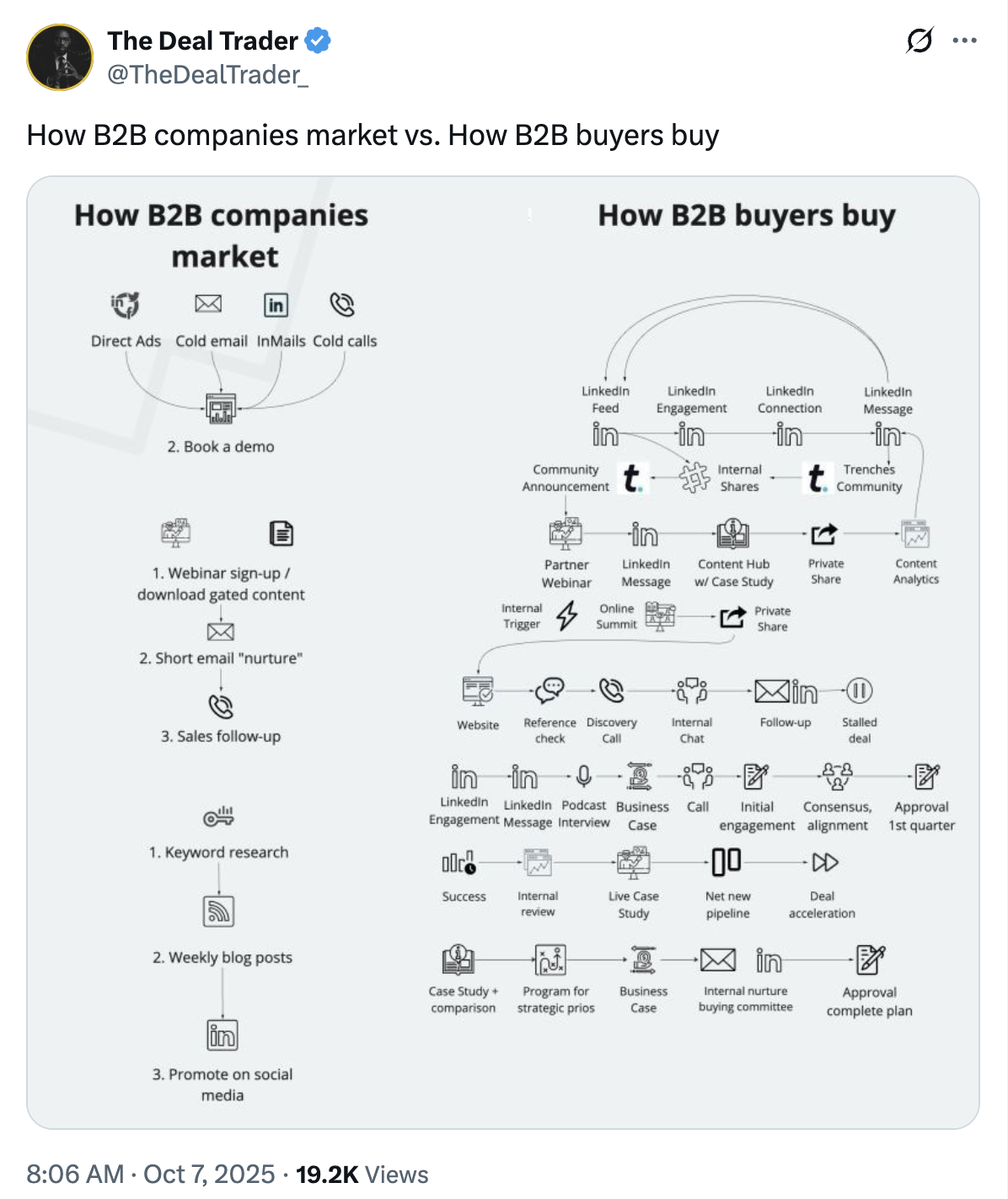
It’s a fact that B2B buyers rarely (if ever) make decisions in isolation. Most deals involve buying committees, maybe a CTO, a procurement lead, and a couple of technical stakeholders. Each of them brings different concerns to the table.
This is why doing SEO for B2B tech companies is its own category with its own rules. And that’s why I wrote this guide to show you those rules.
What I’m going to share:
- Why SEO for B2B tech companies comes with such unique challenges (and fun)
- Why the fundamentals don’t change but the nuances do
- The process to do SEO for B2B tech
- Keyword research best practices
- Content creation best practices for B2B tech industry
- Why you actually need to go beyond SEO in tech
That’s a lot of stuff to cover, so buckle up! Or you can just skip to the good parts you want to read. However, I really recommend that you read through everything, because the ideas I’m going to present will be a little bit different from the “traditional” way of doing SEO.
Why SEO for B2B tech companies is different?
People in tech are some of the most brilliant and idiosyncratic thinkers out there, and they have a low tolerance for fluff. They’ll sniff out buzzwords and low-value content fast.
Tech marketing operates on its own wavelength:
- Fluff won’t cut it. Your readers are engineers, dev leads, and product folks who solve complex problems every day. If your content is thin, clickbaity, or clearly written “for SEO,” they’re gone. To earn their time, your writing needs depth while still being discoverable through search.
- It has to be genuinely technical. Depending on the product, your SEO content might need to explain deep-tech concepts, which is never an easy task to do. Even when it doesn’t go that deep, you still need a solid understanding of the underlying tech to avoid sounding generic.
- The conversion isn’t the end. Especially in SaaS, the user journey continues well after the initial signup. Your SEO strategy should factor in not just what brings them in, but how the content supports onboarding, activation, and long-term retention.
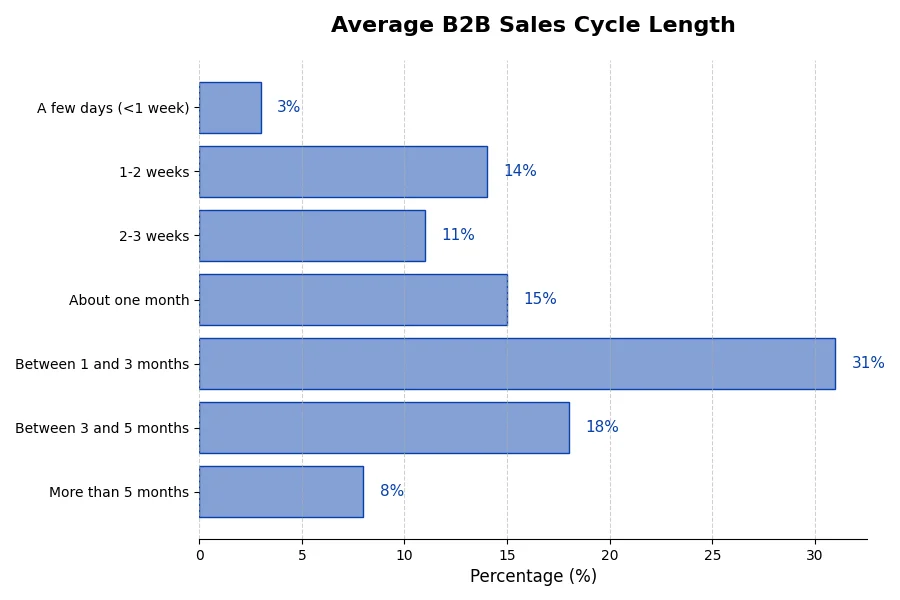
And if you take into account the fact that B2B deals tend to move very, very slowly, you get the full picture. An average B2B Sales Cycle length can last somewhere around 1-3 months, sometimes going beyond half a year for high-value deals.
Is it worth investing in SEO for B2B tech companies?
Based on the data, it is definitely worth investing in SEO if you’re a tech firm:
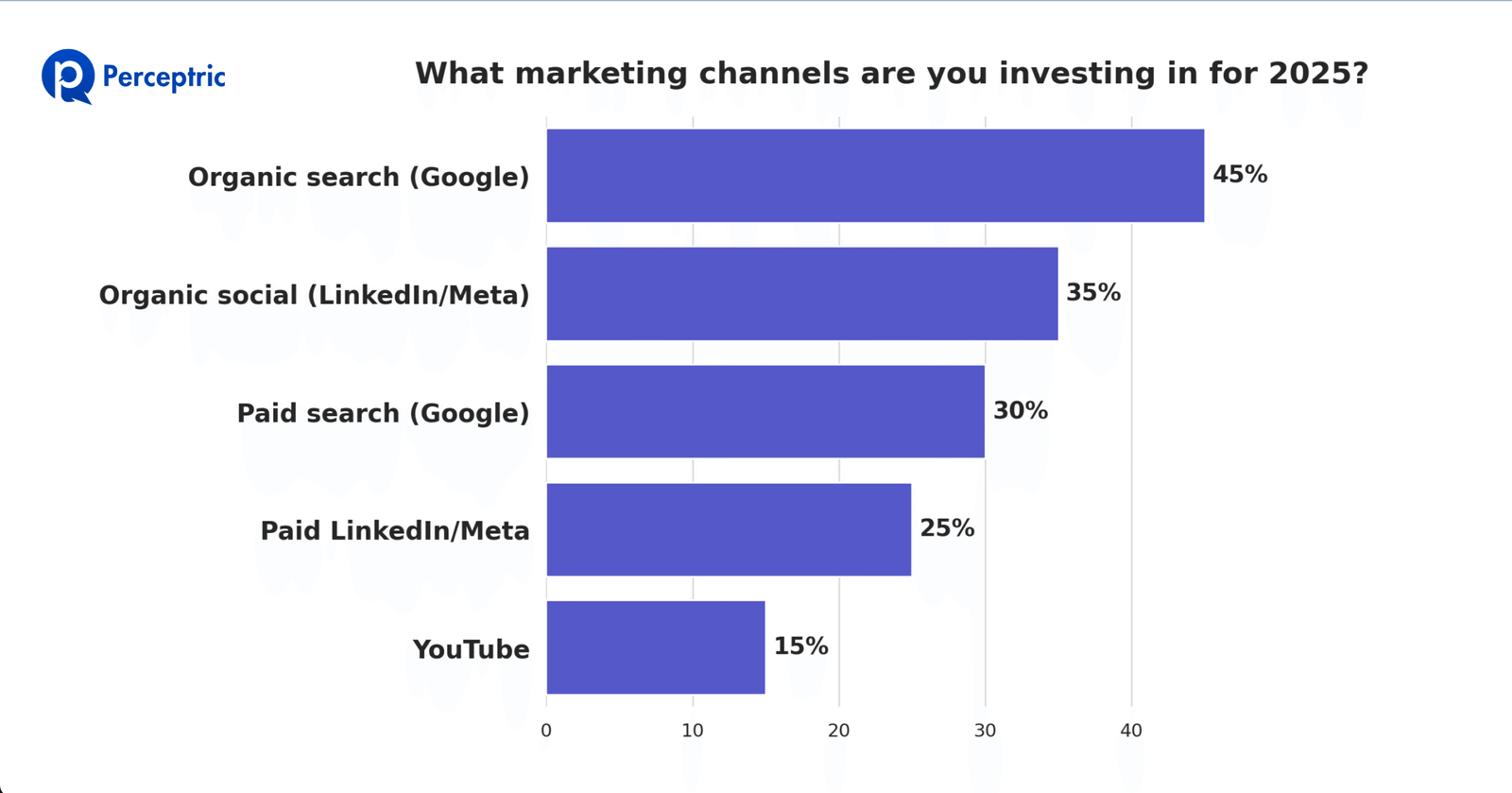
The benefits are pretty easy to see:
1. SEO goes hand-in-hand with content marketing
SEO helps you show up on Google, but that’s only half the battle.
What the user finds after they click through is also critical, and that’s where content marketing steps in to educate your buyers on your product, build trust, and answer their intent.
This is especially true in B2B tech, where buyers are skeptical and highly research-driven, and often highly technical. If your blog posts help them make smarter decisions, they’ll come back and convert when the time is right.
2. SEO is a long-term game
It’s common advice, but I think it needs repeating: SEO is a long-term game. It won’t drive a thousand signups overnight, but it will quietly compound behind the scenes, month over month.
The content you publish today can bring in leads for years. Unlike paid ads, which stop working the second your budget runs dry, SEO content continues to deliver value with little ongoing cost.
Metaphorically, SEO is like Sisyphus on a curve.
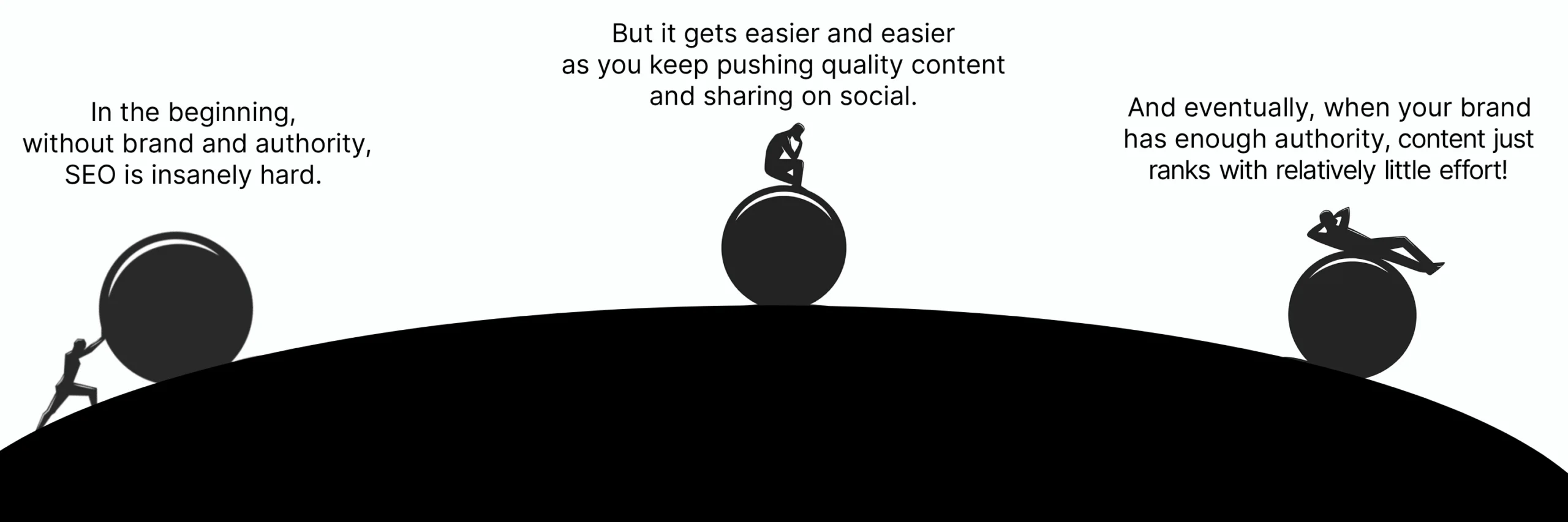
When your site’s new and has little authority, it’s unrealistic to expect fast traction. Over months and years, you build traffic, expertise, reputation, a solid content library, and a rhythm that compounds into real momentum.
My key principles to doing SEO for B2B tech firms
Let’s go back to the principles of what makes “good” SEO, not just for tech, but for virtually any industries.
1. Your SEO keyword strategy must be really focused
With the surge of AI-generated content, Google is forced to prioritize only the most relevant sources for any given search term.
When ranking for a keyword, Google cares about whether your entire website is relevant to that keyword.
Try searching for “Healthcare IT services” and you’ll notice a clear pattern: sites that specialize exclusively in Healthcare IT tend to outrank sites that offer generic IT services:
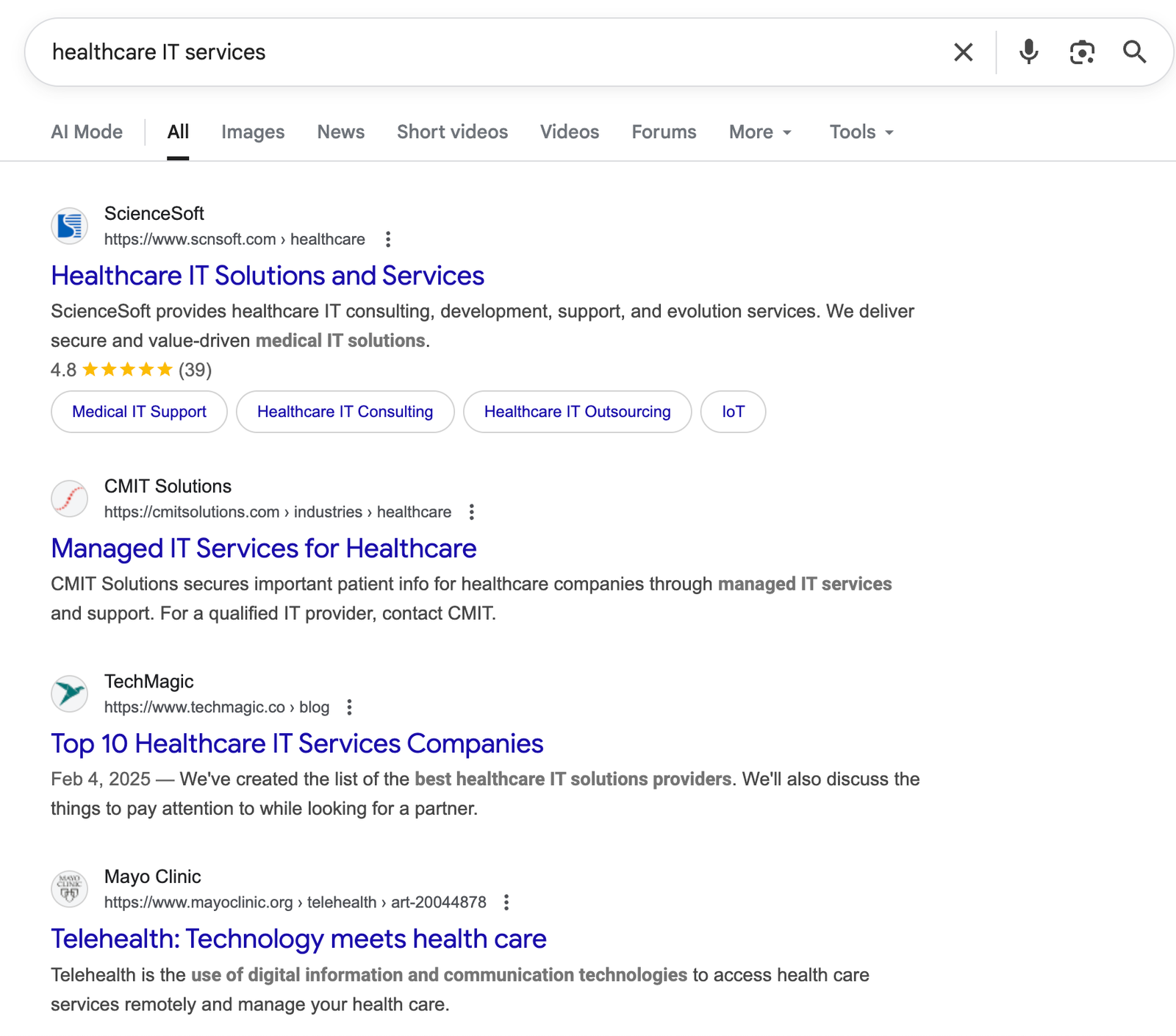
Google definitely has reasons behind this. Let’s say you are Google, and you are trying to rank a landing page about “web development services for HVAC providers”. Who would you rank higher:
- A cybersecurity company specializing in penetration testing, or…
- A web development company specializing in HVAC web development?
The answer is definitely the latter. The clients would prefer having their website developed by a company who knows what HVAC is, rather than a cybersecurity company.
SEO for B2B tech works best when you have enough topical authority. Create content specifically for that topic, go as deep as you possibly can about that topic, to the point of writing content that nobody is even searching for, as long as it broadens your authority on that topic.
That is the number one signal for Google to rank your articles high.
💡 Insight: Google rank your pages by looking at your entire website.
2. Your SEO content must be incredibly well-written
You need to aim to write the absolute best piece of content on the internet for your topic. Better than anything else out there.
If a language model could’ve written it, it’s not good enough. Make it human, make it sharp, and make it original.
This is what Google has to say about content that ranks:
Google's automated ranking systems are designed to present helpful, reliable information that's primarily created to benefit people, not to gain search engine rankings, in the top Search results. This page is designed to help creators evaluate if they're producing such content. (Source)

It's all about creating good content that helps other fellow human beings. So, if you have decided to invest in SEO, you must also invest in quality writers. Good content and good SEO are two sides of the same coin.
💡 Insight: People who write your content should know what they are writing about, ideally one who have walked the walk and can talk the talk.
Good content means that:
- Readers stay on your page for longer
- Readers share your content to their coworkers and make discussions
- Readers remember your brand, and will return to consume more content from you
- Readers are interested enough to check your products and services
That’s the end goal of SEO: generating “interest”.
How to do SEO for B2B tech companies (6 steps)
Here are the 6 steps I use to grow SEO of many B2B tech brands I’ve worked with:
Let’s dive in!
Step 1. Get your technical SEO right
Technical SEO can make or break your site’s performance.
If search engines can’t properly access your pages, your content won’t appear in search results, no matter how valuable it is.
To get a deeper understanding of technical SEO, it’s important to start with two key processes: crawling and indexing.
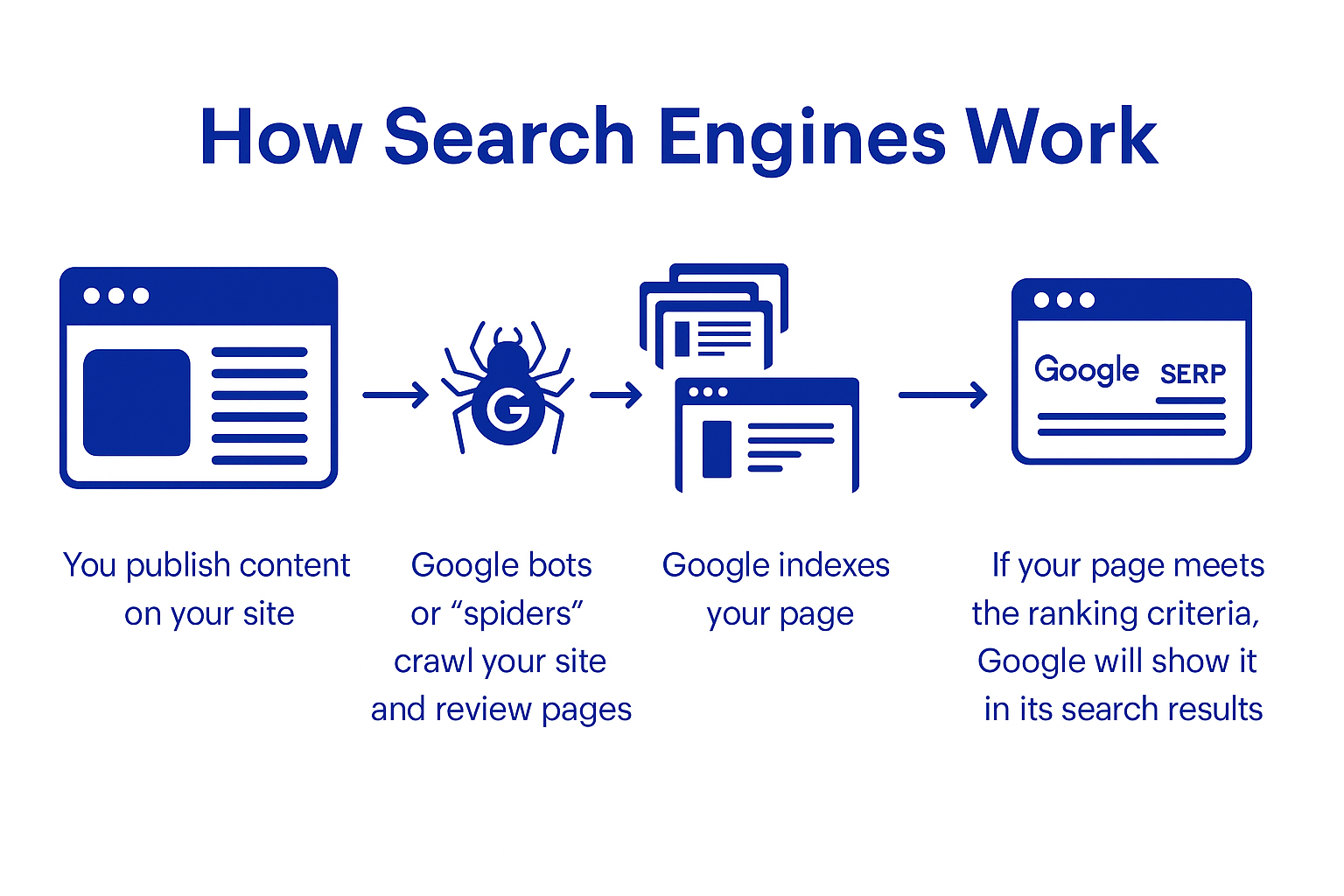
- Crawling is the discovery process. Search engines use automated programs called bots or spiders to navigate the web, following links from one page to another. Each time these bots visit a website, they scan its structure, content, and links to identify new or updated pages.
- Indexing is what happens after crawling. Once the bots collect information about your page, search engines analyze and store that data in a massive database known as the index. This index acts like a library catalog that helps search engines quickly retrieve and display relevant pages when someone performs a search.
When someone performs a search, the engine looks through this vast index of all the pages it has crawled and stored. The process unfolds in milliseconds and involves several key steps:
- Query parsing – The search engine analyzes the user’s query to understand intent, context, and key terms.
- Index lookup – It then searches its index for pages containing the most relevant content based on those interpreted terms, much like looking up entries in a digital library rather than scanning the entire internet.
- Ranking – The engine applies its ranking algorithms consisting hundreds of factors such as keyword relevance, backlinks, freshness, mobile usability, and user engagement metrics to determine which pages are most likely to satisfy the query.
- Results presentation – Finally, the search engine displays these results on the SERP (Search Engine Results Page), prioritizing the highest-quality, most relevant pages at the top.
Technical SEO basically ensures that this process of Google unfolds as smoothly as possible. Here are some of the best practices:
1. Create an SEO-friendly site architecture
A clean site architecture helps both users and search engines navigate your website easily. Every page should be just a few clicks away from the homepage, forming a logical hierarchy such as Homepage → Category Pages → Subpages.
This structure improves crawl efficiency and reduces orphan pages (pages that have no internal links pointing to them).
2. Submit your sitemap to Google
An XML sitemap tells search engines which pages exist on your site and where to find them. It’s especially helpful for large or complex sites.
You can usually access your sitemap at yoursite.com/sitemap.xml or yoursite.com/sitemap_index.xml. Submit it through Google Search Console by going to “Indexing” → “Sitemaps.”
Once processed, you’ll receive a confirmation message. This step ensures Google has visibility into all your key pages, even those not heavily linked internally.

3. Understanding indexing
To check if your site is indexed, perform a “site:” search (for example, site:yourdomain.com).
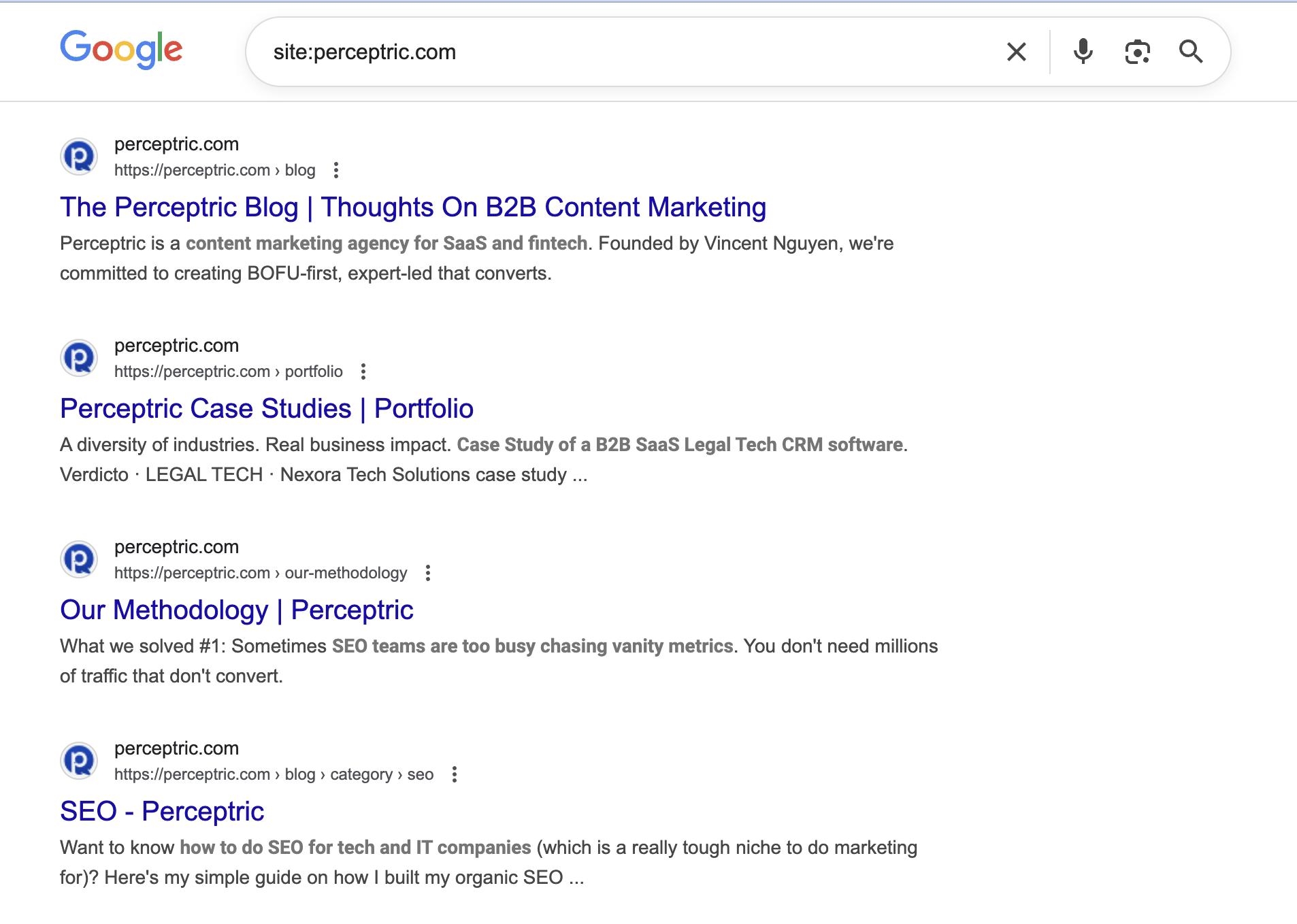
If key pages aren’t indexed, it’s often due to technical or tagging issues, so make sure you fix all of that before proceeding with any other SEO activities.
When you have similar or duplicate content, use canonical tags to tell search engines which version is the primary one. This avoids index confusion and consolidates ranking signals toward the correct page.
4. Make your site fast
Page speed is another core ranking factor. You can use Google’s PageSpeed Insights to test load time. GTMetrix is also a great tool to use.

Similarly, your site must be mobile-friendly since Google prioritizes mobile-first indexing. Always check your website’s responsiveness across the pages, and especially the product pages.
Step 2. Structure your service/product pages
One insight that I have is that Google doesn’t tend to rank service/product pages.
They’d rather rank an entire website selling only one niche product rather than a website selling one niche product among 100 other products.
For example, here’s what I get when I search for “API automation testing tools”:
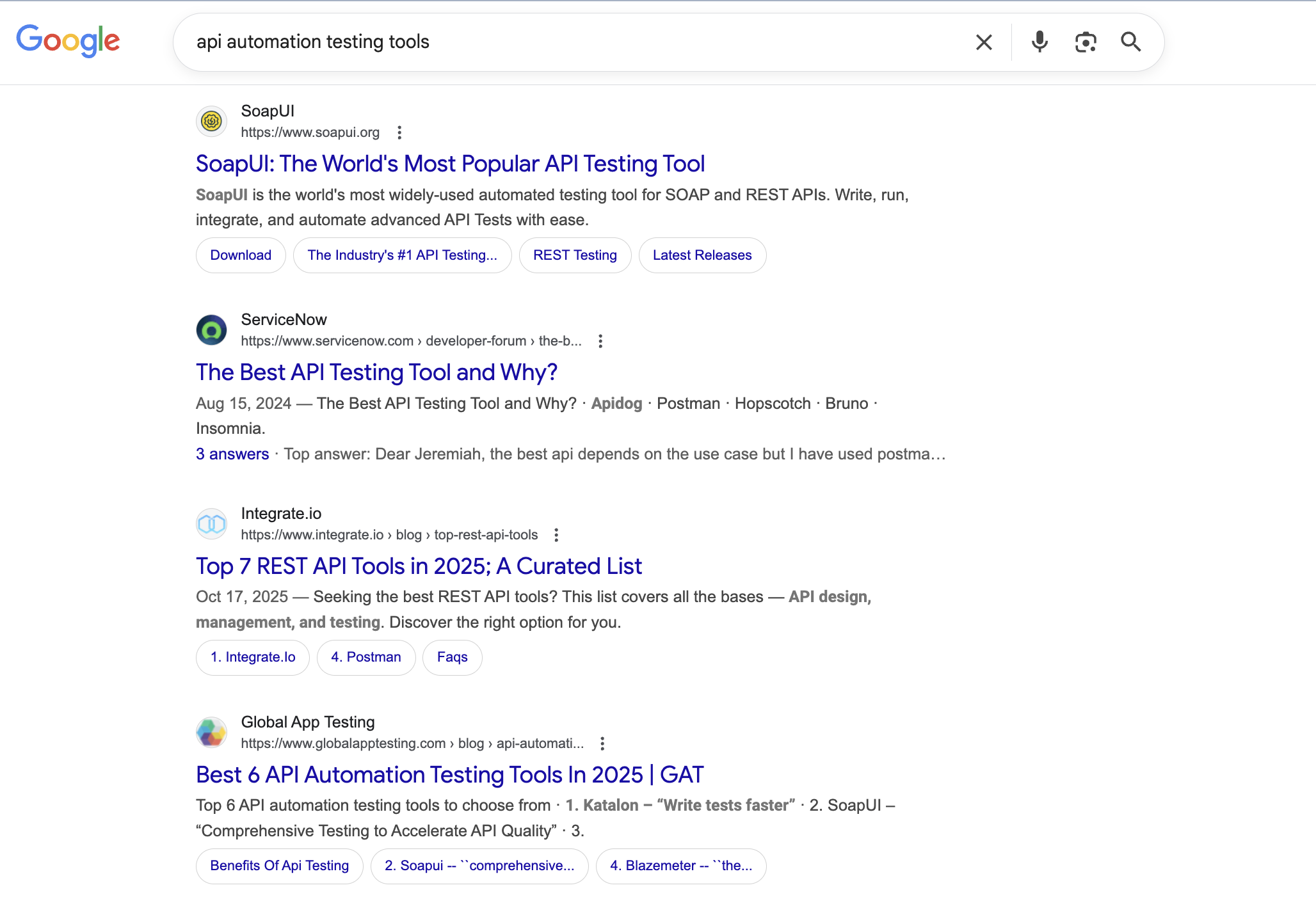
As you can clearly see, Google is ranking either listicles, or tools that are dedicated to doing API testing (which is SoapUI in this case).
There are a lot of tools doing API testing. They have product pages optimized for the keyword “API testing tool”, but they are known as just a “generic tool that also does API testing”. Meanwhile, SoapUI is the ultimate API testing tool, per Google’s opinion, and since they are known as the best in the niche, they deserve to be ranked for that keyword.
In short, for service/product keywords, Google ranks websites whose brand is the closest to the search query.
In case Google isn’t sure about who’s the best, they’ll rank listicles, so people can do their own research.
That doesn’t mean you don’t need to create content for product/service pages. You absolutely should build those Category pages, but the way you think about it should be like this: product pages tell Google what you do as a company.
- If you have many product pages covering a wide range of use cases, Google treats you as a general-purpose product, and rank you accordingly. Zapier is a good example.
- If you have product pages covering a very niche set of use cases, Google treats you as a niche tool, and therefore rank you high only for very specific terms. SoapUI is a good example.
The way you structure your product pages say a lot about your positioning in the market, and this is a conversation that goes beyond the scope of SEO. You need to involve product, brand, and other stakeholders to get alignment for this.
Step 3. Do your keyword research
Keyword research should ideally be tied to the user journey, which looks slightly like this:
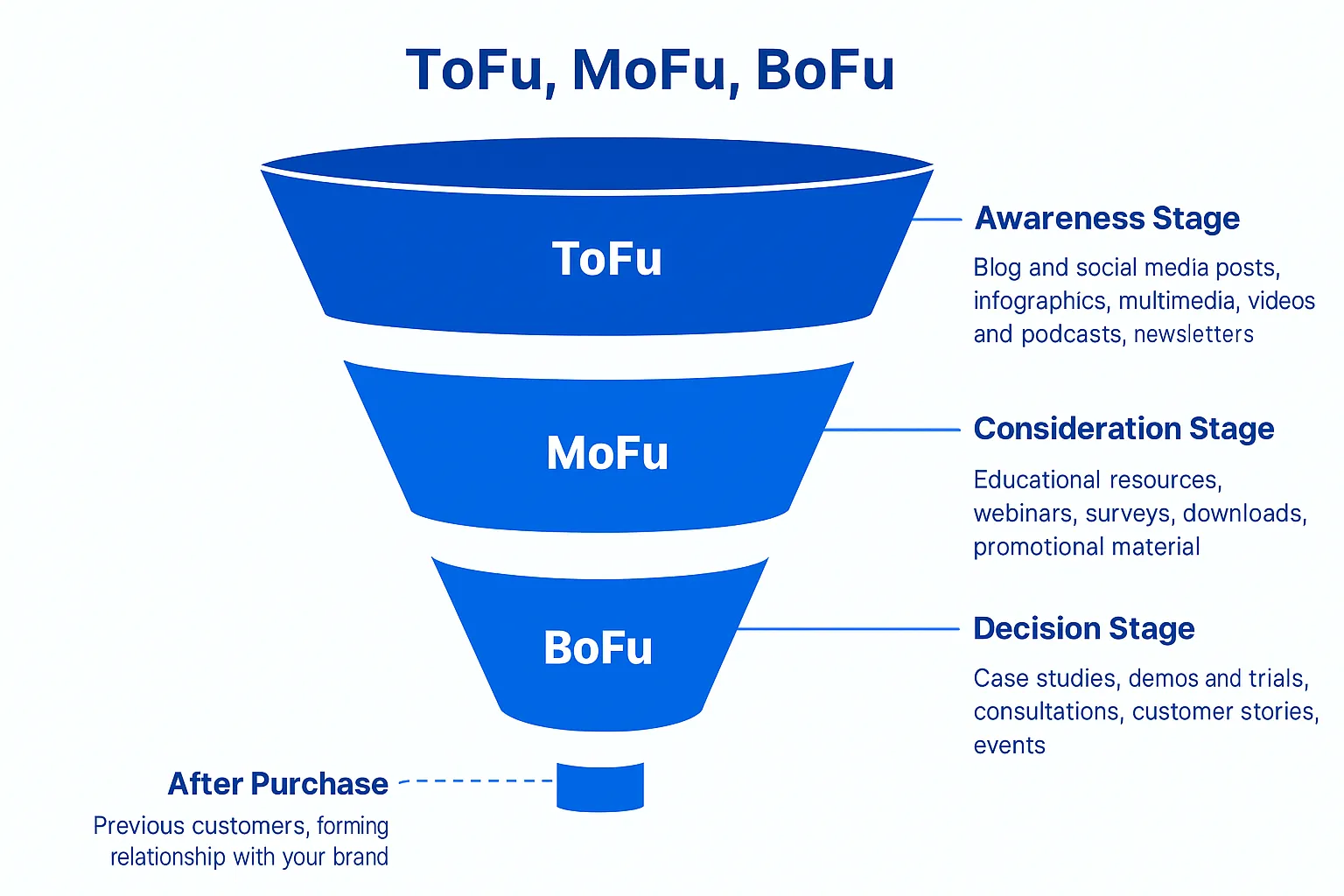
In reality, the user journey is much more complicated (like the screenshot I shared at the top of this article), but let’s just keep it simple.
Before keyword research
Before I start keyword research, I usually have a phase called Audience Research. If you don’t understand how your audience behave, how can you build content for them?
Ask, and you shall receive. You need to ask questions. Questions reveal what your audience wants to learn but hasn’t found satisfying answers to. Here are the places I will go to if I want to mine questions from the audience:
- Customer service logs – What do users repeatedly ask support?
- Sales call recordings – This is a goldmine. You can use tools like Gong or Chorus to search for phrases like “I’m wondering…” or “What’s the best way to…?”
- Google’s “People Also Ask” boxes – Drop your core topics into search and log every question Google surfaces.
- Reddit and Quora threads – You can scan niche subreddits or topic spaces for “dumb questions” your competitors are ignoring. Here’s my approach to using Reddit for content strategy.
- Community forums and Slack groups – How do your audience describe wins? What buzzwords do they actually use?
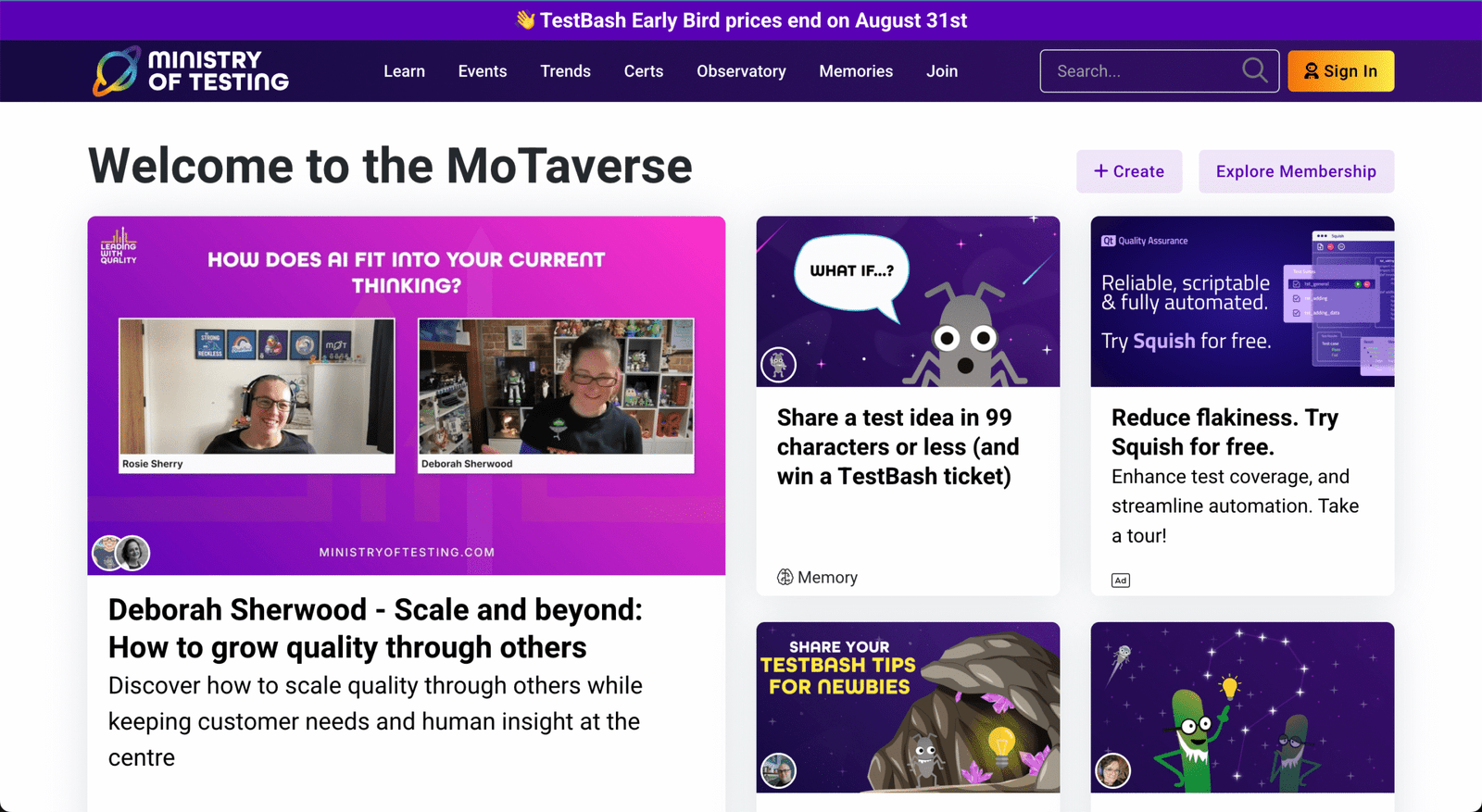
For instance, when I produced content in the software testing space for a B2B automation testing platform, I spent a lot of time in related communities like Ministry of Testing to collect insights and put myself in their position.
During keyword research
If you have a keyword research tool like Ahrefs or SEMRush, you can:
- Choose a competitor domain
- Plug it into Ahrefs and SEMRush to reverse-engineer what keywords they are ranking for. Or you can also pick a seed keyword and run the tool to generate phrases that match that seed.
- Pick out the most relevant low-hanging fruits to target (decent volume, low difficulty)
- Rinse and repeat
If you don’t have a keyword research tool, things can be a little bit more tricky. Here are some tactics:
- Use Google Autocomplete mode to reveal phrases that people are actively searching for
- Roam Reddit and niche communities to see what people are talking about and write content for those topics
- Open the “People Also Ask” box and keep expanding related questions, then copy those queries.
- Use Google parameters like intitle:, inurl:, and related: to find competitor content or similar domains to mine for topics.
I categorize my keywords into four groups, by order of priority:
| Types of Keywords | What It Means | Why It Works | How to Find Them |
|---|---|---|---|
| Competitor Keywords | Target competitors directly to position your product as the better option. Common formulas are “X alternatives,” “X vs Y,” and “X vs [your tool].” |
People searching for alternatives of your competitors are already solution-aware and close to buying. | Simply list your competitors (that you can reasonably compete with) based on the formulas. Then use keyword tools to find comparison keywords with traffic potential. |
| Listicle Keywords | Keywords that compile multiple tools or solutions in your niche. Examples: Top 10 best tools for [your niche]. |
They capture mid-funnel users who are actively researching options and looking for the best fit. This is perfect for introducing your tool into their consideration set. | Brainstorm all of the ways your tool can be described. What use case does it have? What verticals can it serve? |
| Pain Point Keywords | These keywords address specific problems your audience faces. Examples: “how to do X,” “how to fix Y,” or “why X happens.” |
They attract users with high intent to solve a specific issue, giving you the chance to position your product as the direct solution. | Use forums like Reddit or niche communities to find pain-point questions. |
| Lead Magnet Keywords | Focus on educational, in-depth guides that teach a process or framework. They attract leads looking for comprehensive resources. | These keywords capture early-stage prospects who are open to learning and can later be nurtured into customers. | Search for “complete guide,” “step-by-step,” or “tutorial” phrases in your niche. Analyze what topics competitors use for gated or downloadable content. |
Let’s use Zapier as an example. If I have to do SEO for Zapier when it was still an unknown tool, here are the keywords I’ll target:
- Competitor keywords: Make alternatives, n8n alternatives, Workato alternatives, Make vs n8n, Make vs Zapier, n8n vs Zapier
- Listicle keywords: top 10 workflow automation tools, no-code automation platforms, top marketing automation tools, top social media automation tools
- Pain point keywords: how to automate data extraction, how to automation Excel, how to automate IT operations
- Lead magnet keywords: Excel automation script, lead generation automation script
There’s another type of keywords called underserved keywords. It’s not easy to catch them, but they can be a goldmine. They have two characteristics:
- Low Content Supply but High Search Demand: these are topics or phrases where search volume is healthy, but there are few high-quality pieces of content covering them. Trust me, even in my field (B2B content marketing), which many believe that it is too oversaturated, there are still underserved keywords.
- Weak or Misaligned Competition: even if there’s content, it might not match the search intent. For example, you may find that the top results might be vendor pages when the intent is educational, or they’re targeting a different geography/industry than yours. This leaves room for you to craft the “right” page and outrank them.
Step 4. Create exceptional content
Okay now that you have tons of keywords, it’s time to write content. But not just any type of content. You have to write exceptional content, or else don’t bother.
There is one characteristic of good content: it has something that can’t be (easily) replicated by someone else.
In this article, I explained why content marketing is now having such a low entry barrier(due to AI), and now the only true competitive advantage of content is uniqueness. A piece of unique content (and even the overarching content strategy) should have the following:
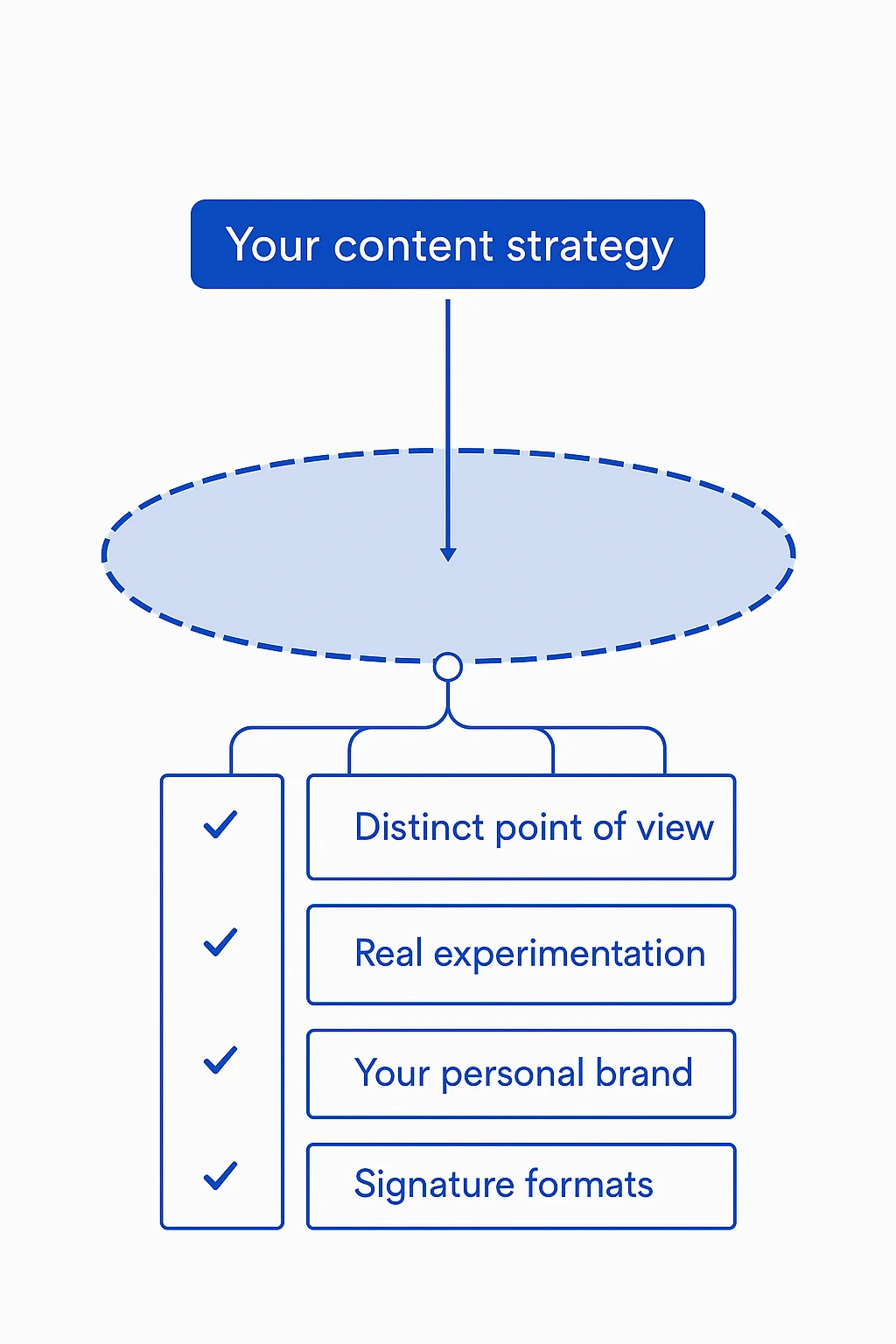
So, here’s my process of producing good SEO content. Let’s say I want to target the keyword “B2B SaaS marketing”:
First, I make sure that I adjust Google to show results for the region I want to target. I search the keyword to surface the top ranking results to see:
- The formats that Google favors
- The depth of top articles (and where I can beat them)
- Reddit threads (to see what people actually think about the topic)
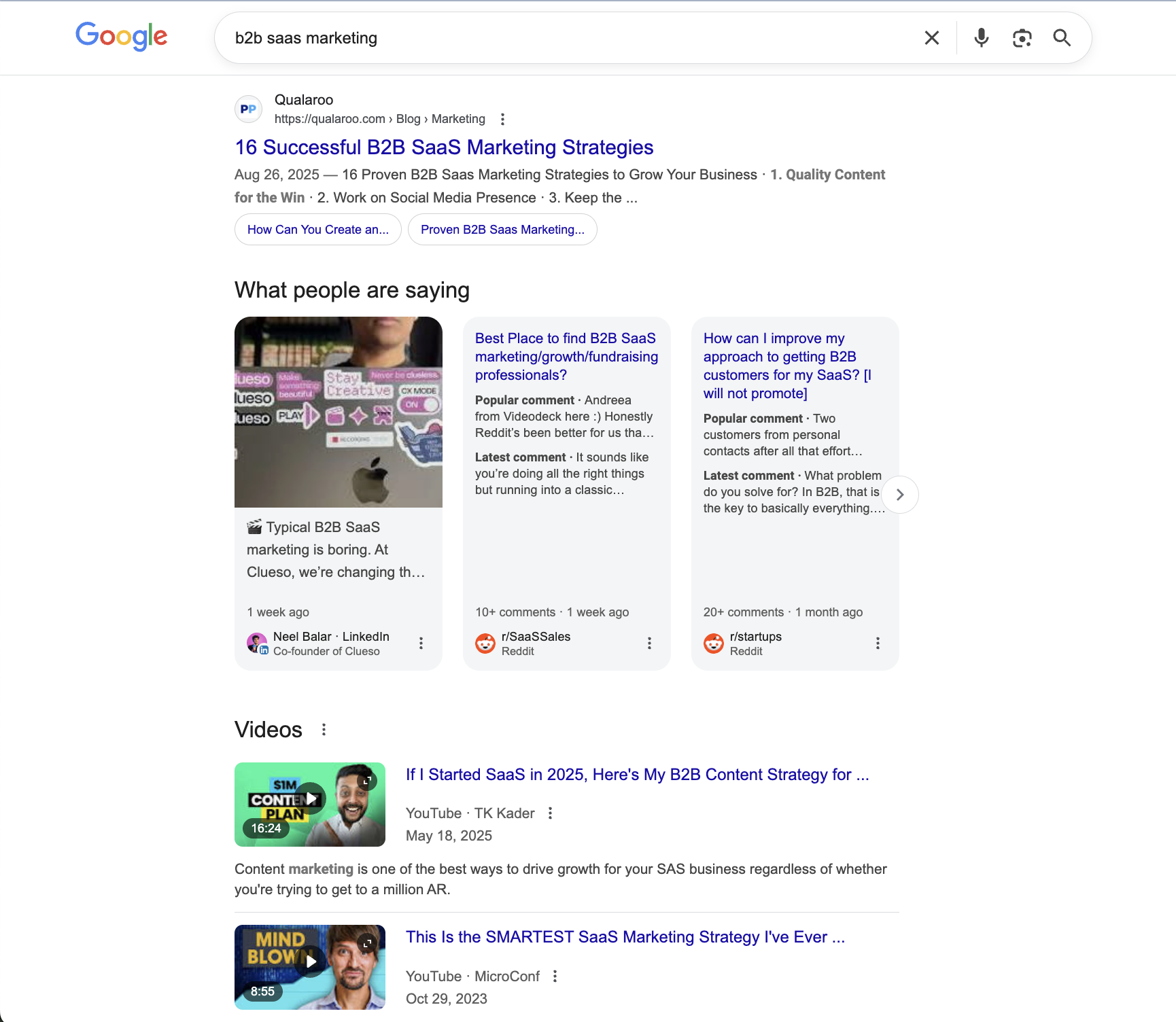
Once done, I start writing, like a real wordsmith, with all of the SEO content best practices:
- Match my content to what users actually want to find.
- Focus on only one main keyword and include related supporting keywords naturally.
- Write catchy, benefit-driven titles and meta descriptions to boost click-through rate.
- Use proper heading hierarchy (H1, H2, H3) for structure and scannability.
- I always keep my writing clear, concise, and engaging with short paragraphs, bullet points, and of course, tons of visuals. Screenshots are great because they are much easier to produce compared to graphics, and they deliver more practical information compared to visualized images.
- I place keywords naturally in key spots: intro, subheadings, and conclusion. This has always been done for decades, because it absolutely works!
- I then add internal links to related pages and external links to credible sources. I always link to reputable sites in my niche rather than generic informational sites like Wikipedia. Sometimes it helps that you go back to old pages to link back to your new pages too.
- Always write for humans first, then optimize for search engines.
In terms of making unique content, I simply add my own thoughts, opinions, insights into it. A little bit of personal anecdote doesn’t hurt SEO. Quite the opposite, it even boosts SEO.
You can even include some “thought leadership” when writing SEO content too. I believe that you don’t have to write a “thought leadership” article to demonstrate that you’re a “thought leader”.
To me, thought leadership starts from the small things.
For example, here’s an article from Rainforest QA about 5 essential QA testing best practices. If they write it in the traditional SEO way, they would have written the title as a boring “5 essential QA testing best practices”.
But they chose to write about it as “The Rainforest Method”:
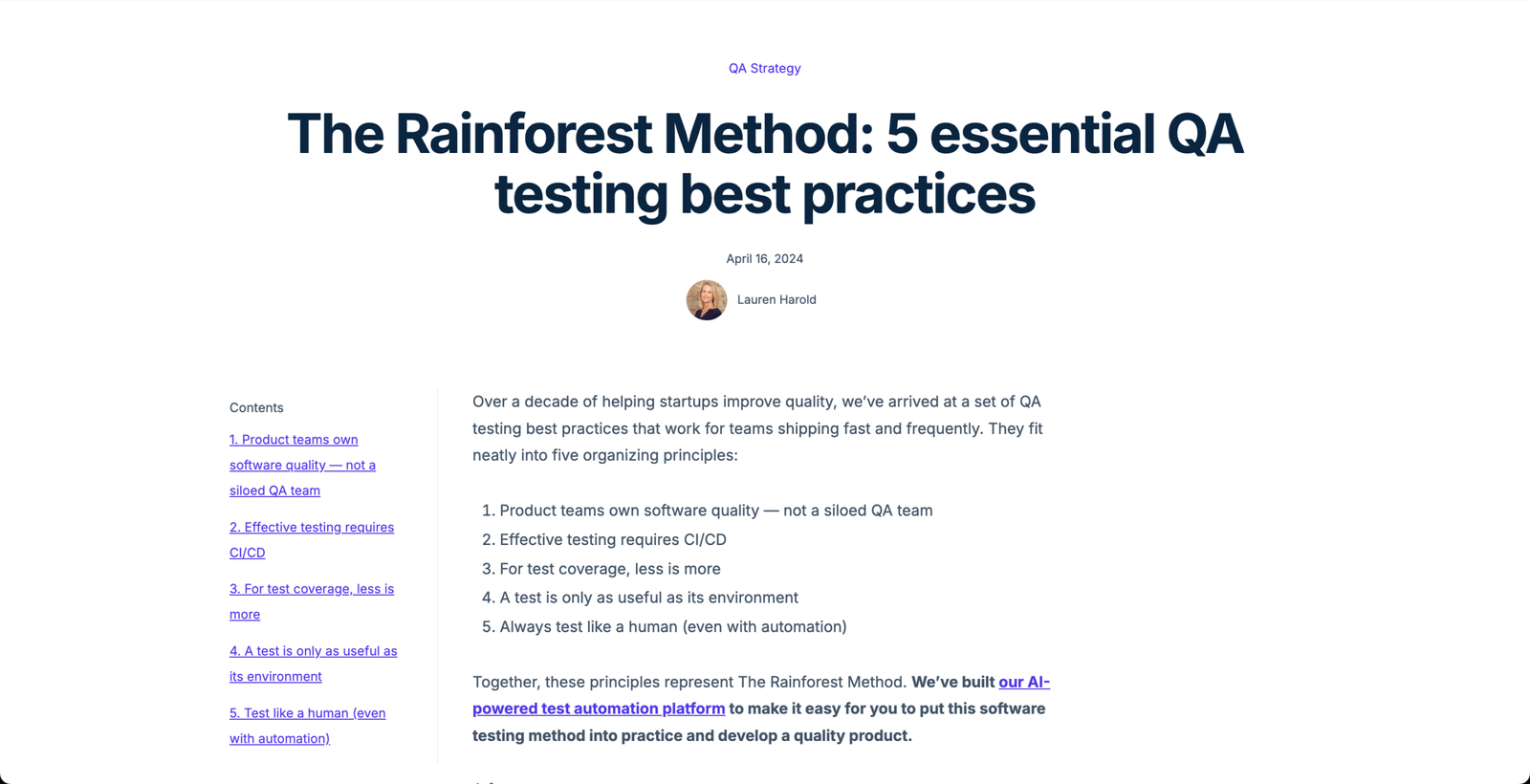
This accomplishes 3 goals:
- Traditional SEO (optimizing for a certain keyword)
- Authority building (showcasing the method that they are using for themselves, extracted from experience)
- Engagement (readers are more engaged with content that has originality)
Here are some of my tips to make a blog post have more “thought leadership”:
- It must come from people who actually have been in the trenches. I hold the content on Perceptric’s blog (and our clients) to the same standards. Expert-led content is the way to go.
- It should hold an opinion. Even if you’re just writing a “What-is” article that’s trying to explain a simple concept to your audience, you should still insert some opinions into it to establish a vantage point. Because neutral explanations don’t help readers decide or act, this vantage point allows your content to engage with readers. A stance supplies hierarchy (“this matters, that doesn’t”), and this lowers cognitive load to make the piece much more memorable.
- It should be written at least 80% by human. I have experimented with ChatGPT a lot, trying to tweak its writing to resemble a human as much as possible. However, at the end of the day, AI-generated content always lacks a sense of spontaneity that characterizes human writing. The audience doesn’t want that. Even if they click, they probably don’t want to read that kind of content that much.
- It should be data-driven. Stats make your article convincing, and from an SEO perspective, it encourages others to link back to you to attribute you as the original creator of the charts. From a reader’s perspective, charts also make the content more visually engaging to consume.
Step 5. Link building
Link building is honestly the most boring and time-consuming part of SEO. You usually only have two tactics with link building. Either you reach out to another website in your niche to ask for link exchange or guest post, or you buy those links. But it’s all a very manual process.
Here are some link building tactics that I find more rewarding:
- Write a data-rich article that you can share on social media. Journalists and bloggers love citing data sources especially if you visualize it well. This is a tactic promoted by Brian Dean from Backlinko, who has had tons of success with it.
- You can build simple tools like a “ROI Calculator” or “Automation Cost Estimator” and you can actually attract backlinks from blogs recommending resources.
- You can also do guest post, but instead of reaching out to “guest post sites”, who probably receive dozens of guestpost request emails on a daily basis that they can’t handle, it’s better to reach out directly to founders and entrepreneurs in your niche, offering to contribute an article for them (free of charge). This group is more than willing to have someone help them grow their visibility, and they are even happier if you can drive real business for them.
Step 6. Monitor analytics
Most content strategies fail because they stop at vanity metrics like pageviews or time on page. Those numbers don’t tell you whether the content moves prospects through your funnel.
One popular approach I see SEO teams in B2B tech do is integrating HubSpot with Google Analytics 4 and Google Search Console.
GA4’s event-based model lets you see the full path: from landing on an organic blog post → to viewing your pricing page → to converting. You can even create exploration reports to view how content contributes to assisted conversions (e.g., someone first visits your blog, then comes back via branded search and converts). Always make sure your GA4 tracking tags are firing correctly on key CTAs.
Also, you need to continuously update your content. No content stays evergreen forever. Search intent evolves, competitors outrank you, and outdated advice kills credibility. A well-updated article can double its organic traffic within days because Google already trusts the URL’s authority.
Conclusion
At the end of the day, I think that doing SEO for B2B tech (or for any industries) is basically building credibility. If you stick to white-hat practices and consistently create content that genuinely serves both your audience and Google’s intent, algorithm updates will usually work in your favor. Along the way, you’ll also build a brand that stands out. Remember, content is brand.
In the mean time, here are some even better reading resources for you: