
These days, content can be created at virtually zero cost. Just one free AI account, and you can generate as much as you want. In the very near future, information will explode exponentially, while trust in that information will decline just as fast.
That’s why, in the coming years, trust is going to be the ultimate competitive edge. We’re in a period of social transition, and with every shift like this comes both major risk and rare opportunity.
And thought leadership content is one of those opportunities. It is the most effective content type in terms of building trust and authority.
However, there are good thought leadership and there are bad thought leadership, and I believe that good thought leadership content must come from a genuine thought leader.
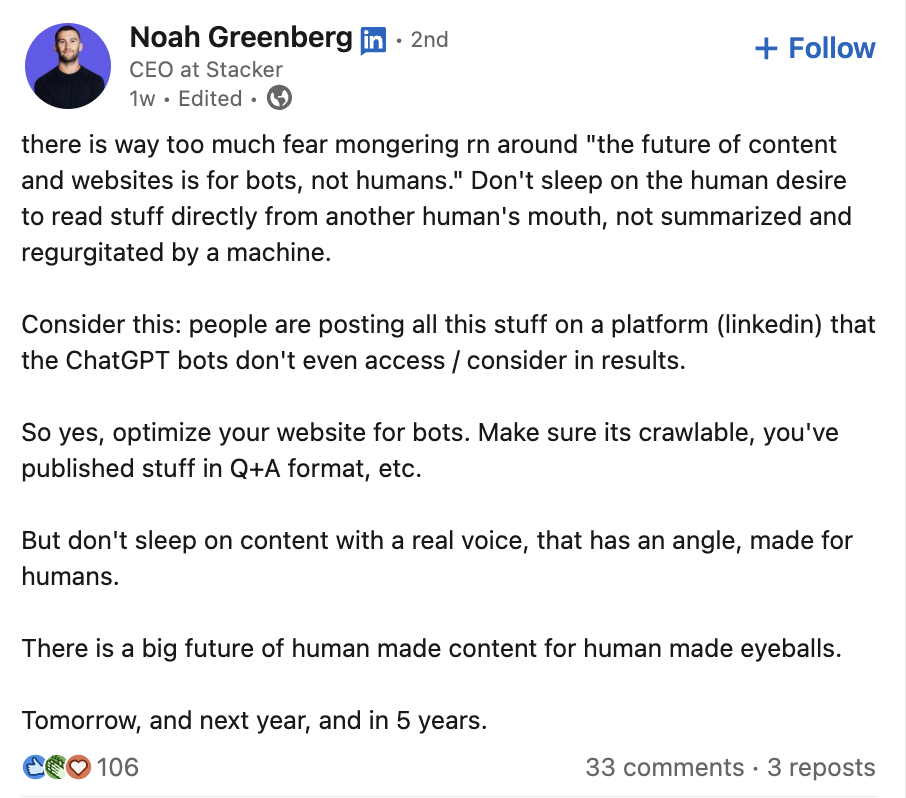
Thought leadership doesn’t even have to be polished. For example, this is a really good LinkedIn thought leadership post from Noah Greenberg (CEO at Stacker) on the topic of human-driven content marketing (written in a slightly casual style):
In this article, I’m going to share with you my process of doing thought leadership content that genuinely drives leads and builds the invisible trust that your company needs.
What is Thought Leadership?
Thought leadership is the skill of making your audience believe you’re a credible, trustworthy authority, whether as an individual, a company, or a brand.
Thought leadership is built through what you say and how you say it: via writing, speaking, presenting, or teaching. When done right, it sets you apart from the competition and makes people feel confident that the insight you’re sharing is worth listening to, and worth acting on.
The example of Noah Greenberg I shared above is a great example of thought leadership content.
But remember: thought leadership content doesn’t have to be groundbreaking. You don’t have to take a contrarian and controversial stance to be a thought leader. Sometimes just digging deep into a very specific topic to uncover “hidden gems” is more than enough to be a thought leader.
What does Thought Leadership really mean?
Where does “thought leadership” start and where does it end?
Aneesh Raman from LinkedIn defined thought leadership as “having authentic, relevant, insightful things to say about a few key issues and saying those things over a sustained period of time in order to provoke new thoughts and actions by others“.
Let’s break his words down:
- Authentic – You bring real credibility to the topic because it comes from your lived experience, deep interest, or proven expertise. People can tell it’s genuinely yours.
- Relevant – What you share connects directly to your industry, your audience, and the broader conversations already in motion. As Raman puts it, “You don’t want to be a philosopher-king with no one in your kingdom.”
- Insightful – You see its layers after layers of the topic you write for. You bring sharp observations, a hunger to keep learning, and a knack for connecting dots others miss.
- Focused – You stay close to the topics that matter most to you. Narrow, deep, and true to who you are.
- Consistent – People talk about quality over quantity, but without volume, no one knows you exist. You need both. Keep showing up, again and again, until the Internet can’t ignore you. Like Alex Hormonzi famously said: “Do so much volume that it would be unreasonable for you to fail”.
- Original – Your ideas bring something new to the table. They challenge assumptions, shift perspective, and make people think in ways they hadn’t before.
Why B2B marketing needs thought leadership?
No field needs thought leadership more than B2B, especially B2B SaaS, because:
- According to Wynter’s State of B2B SaaS Brand Marketing report, 92% of B2B buyers only purchase from the vendors already on their Day-1 shortlist. They buy because they know and trust you, way before they contact you. You need thought leadership to build that trust.
- In B2B, you are targeting a smart audience. They have been in the industry for decades, which gives them a unique understanding about it, so they can spot fluff content from miles away. You need content with a high standard.
- 75% of C-level and decision makers said that a piece of thought leadership is what led them to the final tipping point of making the purchase.
Sources of high-quality thought leadership content
1. Your own experience
Yes, you. Exactly you.
If you think about it, we are all incredibly unique individuals. Each and every single one of us all has our own collections of thoughts, opinions, ideas, beliefs, arguments, and perspectives that are so authentically ours, that nobody else fully overlaps with.
But the catch is that you must infuse that individuality into your content. If you successfully do that, your “shower thoughts” suddenly become thought leadership.
For example, I love reading content from @Megan Bouton, a freelance writer on LinkedIn. She has her own way of sharing her content: just honest, authentic takes on content marketing, with a little bit of visual assets that she designed herself.
In this post, she’s sharing that you should “put the time in if you want your content to stand out”. It’s good wisdom that we have all properly heard once, but have we actually implemented that under the pressure of KPIs of leads and MQLs?
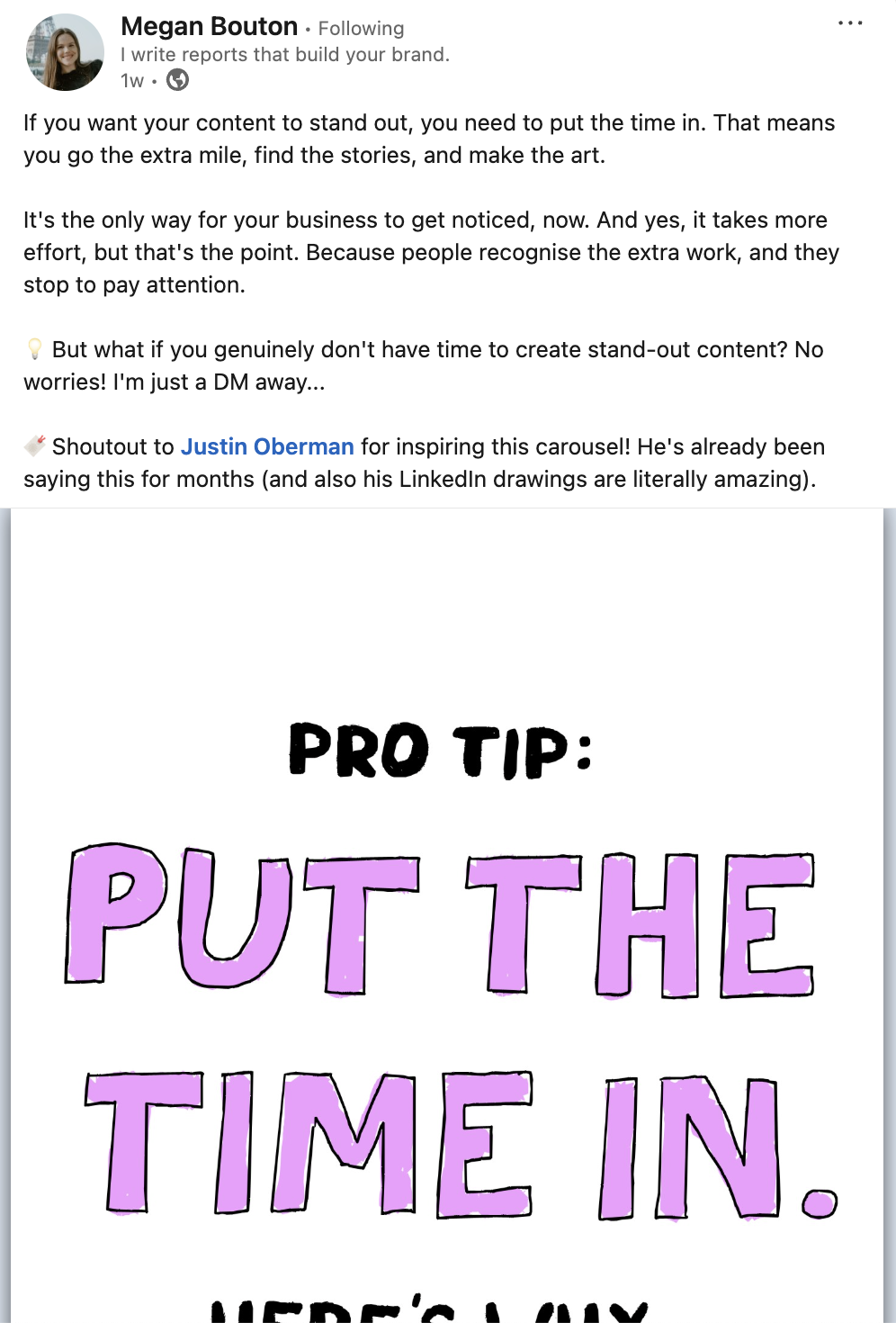
Sometimes thought leadership is simply sharing what you think, written in your own way, your own words, your own style.
2. Counter-narrative opinions
Of course, it helps that you sometimes go against the normal wisdom of your industry.
But, remember, only do it when you know what you are talking about. Do not go contrarian just for the sake of attracting attention, which obviously are going to damage your brand and reputation in the long term.
For example, in this post from SparkToro, Rand Fishkin has successfully expressed his counter-narrative opinion that “maybe performance marketing is just an analytics scam“. Could it be that all the PPC ads you’re running are getting the credit for all the sales that would have happened anyway?

It’s a great piece of thought leadership because it:
- Naturally requires you to conduct extensive research to back up your perspective
- Usually attracts more attention, and is incredibly effective if it resonates with what your audience actually thinks
- Contrarian content is generally more memorable to your audience compared to a generic content that regurgitates what everyone has known
3. Personal Narrative
People connect with stories. Sharing your own journey, from what you’ve learned, how you’ve grown, and what brought you to where you are, can be one of the most powerful ways to create thought leadership content, as long as the story feels real and meaningful.
If you’re doing B2B SaaS, this is similar to the Build-in-Public approach, where you basically share everything you’re doing with the product to the public to attract attention.
For example, here’s a LinkedIn post from Yunhao Jiao, CEO of TestSprite, one of the leading AI agent that tests software for you. He consistently shares his TestSprite journey on LinkedIn and what value it can deliver to testers:

4. Industry Analysis
Most of the best thought leadership discusses trends and other industry disruptors. If you are able to pay close attention to what is going on around you, you can more easily recognize what is working and what isn’t.
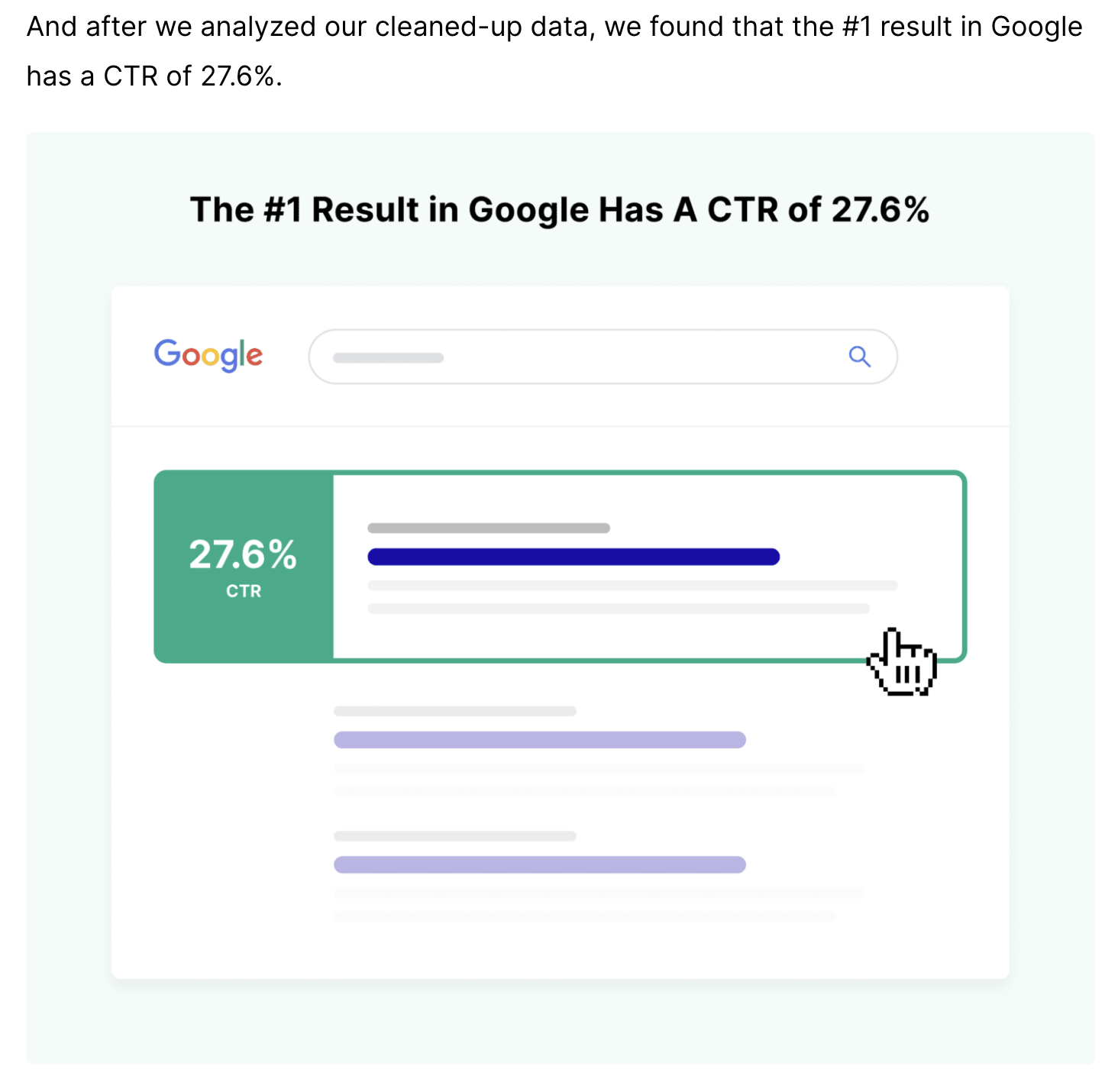
I think one of the most famous piece of industry analysis reports is the one from Backlinko: “We Analyzed 4 Million Google Search Results. Here’s What We Learned About Organic Click Through Rate“.
Incredibly digestible but so comprehensive, with a lot of good visuals and arguments to back up his claims, I consider this as the gold standard of industry analysis article.
How to write good thought leadership content?
Here’s my simple process of doing thought leadership:
1. Define your goals
Let’s face it, goal setting for B2B is difficult because attribution in B2B is incredibly difficult. The buyer journey is a giant maze:
- Multiple stakeholders
- Long sales cycles
- Dozens of touchpoints across channels (ads, social posts, email, webinars, cold outbound, referrals, blog posts, Slack DMs).
And half of those touchpoints happen anonymously or get lost in the noise.
Even if you’re relying on single-touch attribution, like “last click” or “first click”, you’re only seeing a fragment of the real picture. You might end up over-investing in what’s easy to measure (spoiler alert: PPC) and underestimating what’s actually driving demand.
Remember: thought leadership is innately hard to attribute success too, and it’s okay. At the end of the day, the goal of thought leadership is to just create killer content that entices genuine discussion from leaders.
For example, here is a thought leadership video from Alex Martins from Katalon on the topic of AI-powered testing, targeted at the QA leaders. The video attracted 100K impressions and 4K+ engagements and a lot of discussion from the QA leads.

If someone is already familiar and on the fence with your company, this is the kind of piece that can give them the final nudge they need.
2. Know what to say
There’s a really great quote from Ernest Hemingway that I love to apply to B2B content marketing, and it is this:

Remember: your target audience are usually well-informed experts. They have spent years in the industry, and they can spot fluff content from miles away. If you want to produce thought leadership content, you must first understand the field.
But the reality? A lot of so-called thought leadership content isn’t rooted in real expertise. It’s often outsourced to freelance writers with zero background in the subject. And the result is shallow, surface-level takes cobbled together from Google searches, then labeled as “thought leadership.” But content like that doesn’t build trust, and it definitely doesn’t convert.
That’s why you need to interview SMEs to produce content that resonates. They either are within your own company, or from other companies. Either way, you need content from real experts.
Connect with people from your company: Sales, Product, Support, Engineering, etc., and ask them questions that surface insights, like:
- Sales – “What’s the number-one objection you keep hearing?” “What’s the one thing that always closes a deal?”
- Product – “What’s coming in the roadmap that customers will care about most?” “What hard problem are we solving that no one else can?”
- Product Marketing – “Where are we winning and losing in competitive deals?” “What market narratives are we trying to own this quarter?”
- Product Support – “What’s the most common ‘quick fix’ or workaround customers need?” “What’s the feature everyone wishes they had?”
- Engineering – “What’s the most technically impressive thing we’ve built lately?” “What’s possible that marketing hasn’t talked about yet?
The tricky part is to ask the right questions with the right people. Once you manage to surface some good thought leadership topics, schedule a 30-min or 1-hour meeting to discuss with that person everything you want to know.
3. Identify content types
What is the most successful content types? Every one of them can be te successful content type.
- Short-form article
- Long-form article
- Video
- Data-driven report
- Testimonial
- Case studies
- LinkedIn posts
- X posts
As long as you have the interesting topics to say about, and post it consistently enough, your content should reach the right audience. It’s a game of inches.
Social media is a game of curation. The more you post about a certain topic, the more information the algorithm has about you, so it can better recommend you post to the right people that resonate.
For example, since I care a lot about LLMs and AI SEO, here’s the type of post I get when I first open my LinkedIn:

4. Post a mix of content types
Thought leadership content must be balanced with not-so-thought-leadership content.
Visionary pieces establish authority, but they often only speak to a narrow group of peers or forward-thinkers.
Not every buyer, user, or follower is ready for abstract frameworks. In fact, too much high-concept thought leadership can make you seem detached.
To truly resonate, your content strategy needs contrast. That means publishing material that answers real, immediate questions:
- Templates
- Playbooks
- Tool comparisons
- Hands-on workflows
- Behind-the-scenes decision breakdowns
- Day-to-day thoughts
This is the kind of content that builds trust with people in the trenches, and it also gives your audience something actionable to implement while your thought leadership earns long-term influence.
A practical example is HubSpot. One day they may be posting about the State of the Industry, the next they’re sharing Halloween memes
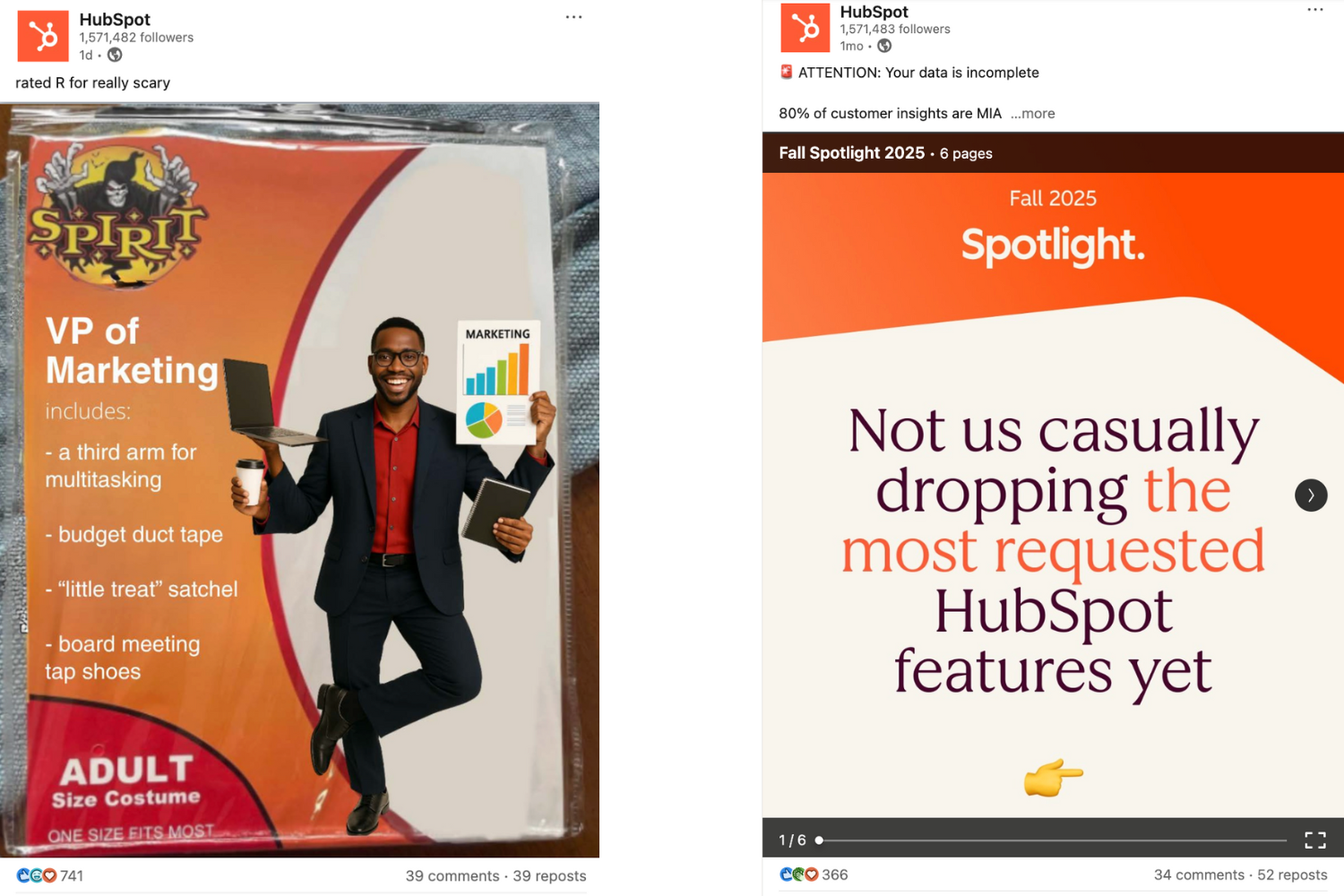
It doesn’t mean that you have to create memes. You just need to have a good balance between high-level, advanced content with daily, simple takes.
Conclusion
Here are my 4 simple principles when creating thought leadership content:
- Write about something you know intimately about
- Back it up with extensive research and data
- Balance your thought leadership content with daily, easier-to-digest pieces
- Be consistent. It’s a long-term game.
Nail that, and you are set up for success.
Partner with thought leaders at Perceptric
Welcome to Perceptric, where you’ll get the best-in-class:
- We understand your product (we’ll work with your internal team to make sure our content strategy strikes!)
- Revenue-driven SEO strategy tailored for the tech industries
- Expert-written content to build trust with your audience
- Conversion tracking configuration for your favorite CRM